Hey Tzoli, do you have any more information of the Super Tiger, and Rhadamanthus Designs?
Super Tiger is basically a BC version of Revenge class:
https://www.deviantart.com/tzoli/art/The-Super-Tiger-682427115
https://images-wixmp-ed30a86b8c4ca8...0.UV7oFv2pnb4HEGWTYFsOpxVmhxIQSwv2xtmy_xXmfzA
and
https://warshipprojects.com/2017/07/03/washington-cherrytrees-2/

The Rhadamanthus designs were evolved into the Courageous (later trough the Onslaught design) and Renown classes (Design 1 and 2) They Were Lord Fisher's initiated designs.
From my friend's:
Rhadamanthus is not going to be an imposition on me as I don’t have to do anything apart from pass on what little information is in the ships covers, Fisher Papers and d’Eyncourt Papers. That won’t take long. Rhadamanthus I is only a slightly shorter Renown with no B turret and 20 to 25 single 4-inch guns shoved in as best you can manage. Rhadamanthus II is Renown with 20 to 25 single 4-inch guns shoved in as best you can manage. And Renown is the previous but with the 4-inch guns in triple mounts.

Rhadamanthus Design 1:
Dimensions: 192,02m (pp) x 23,16m x 7,92m
Displacement: 19.000tons standard
Engine: 105.000shp Steam Turbines, 4 shafts
Maximum Speed: 59km/h (32knots)
Armour: 152mm Belt, 38mm Deck, 51mm Slopes
Armaments:
2x2 15"/42 Cannons
10x2 4"/45 Guns
2x1 21" Underwater Torpedo Tubes

Rhadamanthus Design 2:
Dimensions: 228,6m (pp)
Displacement: Unknown
Engine: 110.000shp Steam Turbines, 4 shafts
Maximum Speed: 59km/h (32knots)
Armour: 152mm Belt, 38mm Deck, 51mm Slopes
Armaments:
3x2 15"/42 Cannons
10x2 4"/45 Guns
2x1 21" Underwater Torpedo Tubes

Design 1914 was a refinement of the previous design and basically a prototype of what became the Renown class:
(I might have papers on it)
Or it was the actual Design of Rhadamanthus.

Dimensions: 219,46m (pp) x 26,22m x 8,23m
Displacement: 25.000tons standard
Engine: 110.000shp Steam Turbines, 4 shafts
Maximum Speed: 59km/h (32knots)
Armour: 152mm Belt, 38mm Deck, 51mm Slopes
Armaments:
2x2 15"/42 Cannons
10x2,5x1 4"/45 Guns
2x1 21" Underwater Torpedo Tubes

Onslaught is again Lord Fisher's design which later evolved into the Courageous and Furious classes:
Only info I have that it's armament would be 2x2 15" cannons and some tidbit info:
Note that both the later Incomparables, the Renowns, Onslaught and the large light cruisers were designed to carry large number of troops for an amphibious invasion of Northern Germany.

With HMS Onslaught Fisher was seeking a design for a new cruiser type that, with the sole exception of the Lion’s, could replace all the other cruisers types as well as providing a substantial high-speed amphibious assault capability (a capability the Royal Navy lacked). Fisher still needed to safely transfer an army from the UK, across the U-Boat patrolled North Sea to Jutland. A task that required a large vessel that combined high-speed with excellent sea keeping characteristics so that it could carry 10,000 troops on the open upper deck while traversing the often-rough waters of the North Sea. The requirement for a speed of 32 knots ensured speed superiority over any enemy vessel; an absolute necessity if 10,000 troops are crammed onto the upper deck.
Other design requirements were for a shallow draught of no more than 26 feet to allow passage into the Baltic via the Danish Sound, a characteristic that allowed use of waters too shallow for U-Boats to submerge and thereby providing strong protection against U-boat attack. This was also an unavoidable necessity that placed severe restrictions on displacement, limiting the weight of guns and armour Onslaught could carry. Had the large light cruisers carried the guns and armour that their critics deemed necessary, they could not perform their primary war missions.
Quite and informative read:
https://www.tapatalk.com/groups/all...s/a-second-drake-at-coronel-t8788.html#p21110

Design 1915 is the refined Onslaught design.
Dimensions: 228,6m (pp) x 22,55m x 6,71m
Displacement: 16.000tons standard
Engine: 85.000shp Steam Turbines, 4 shafts
Maximum Speed: 59km/h (32knots)
Armour: 76mm Belt, 89mm Deck
Armaments:
2x2 15"/42 Cannons
4x3 4"/45 Guns
2x1 21" Underwater Torpedo Tubes
 
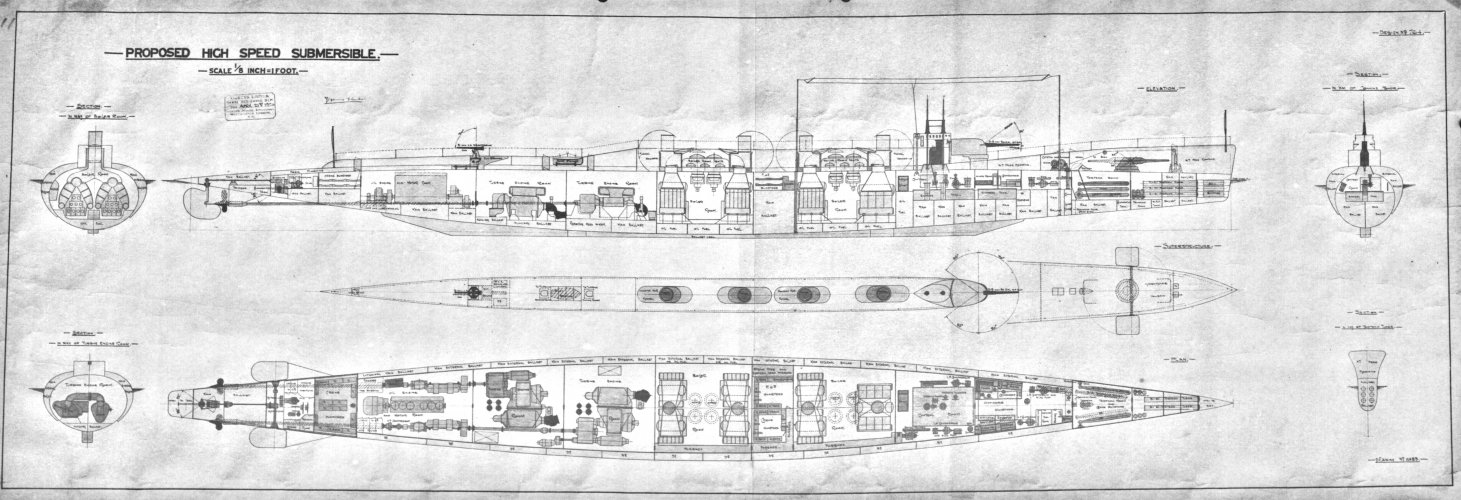
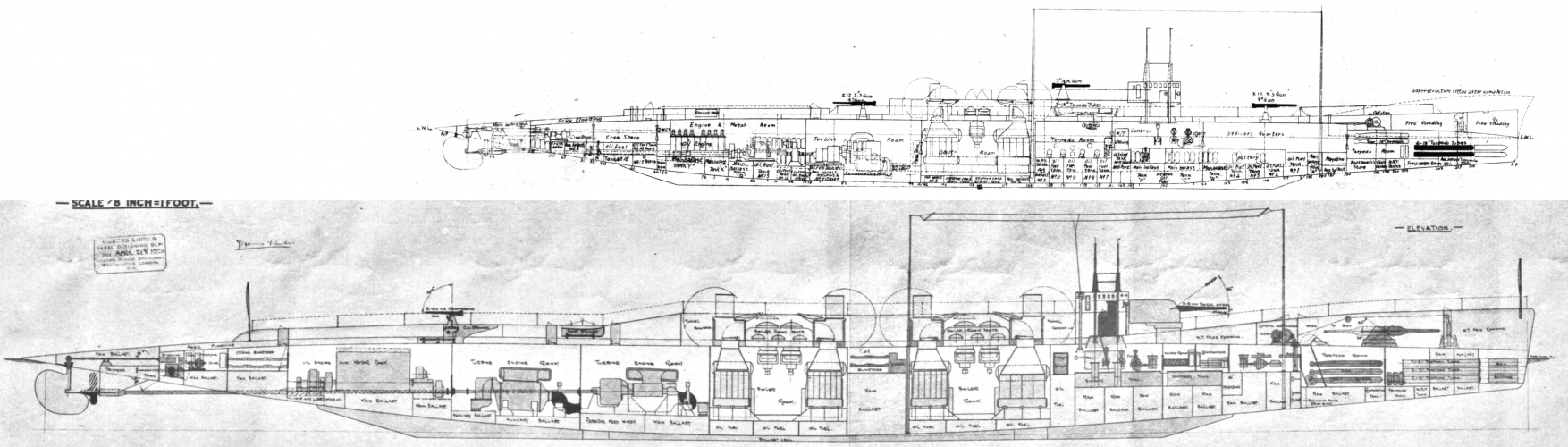
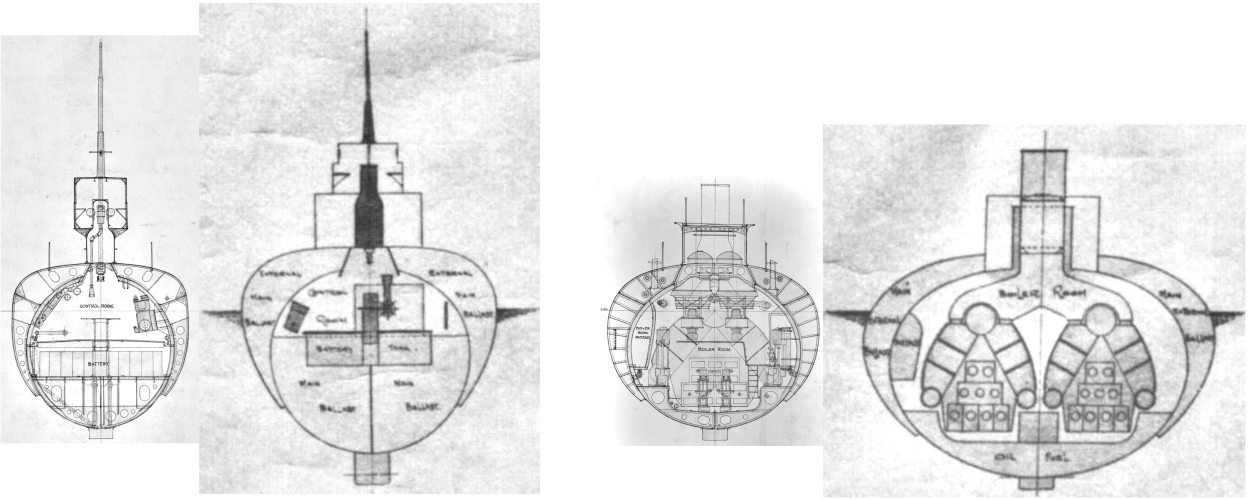
I wanted to share a rather fascinating design I came across in a Japanese document from the 1920s titled 列強新式潜水艦計重要領 (New Submarine Designs of the Great Powers). One of the designs shown is Vickers Design 764, a "Proposed High Speed Submersible," dated 21 April 1920. This is a remarkable design, essentially a K-class submarine enlarged to the dimensions of a light cruiser. If built, it would have been the largest submarine in the world (in terms of submerged displacement) until 1972, when the Soviet Project 667B (Delta I) SSBN entered service. I have never seen any reference to this design, although that is not particularly surprising; it was clearly far too large to be practical. And given the very poor reputation of the K class, the prospect of a "super K class" was likely becoming unattractive to the Royal Navy by 1920.

This table compares the characteristics listed on the first page of the document compared with the K class (taken from the same source to provide an apples-to-apples comparison; the K class figures are a little different than usual):

K classDesign 764
Length Overall338 ft.465 ft.
Beam26 ft., 6 in.44 ft.
Draft16 ft.23 ft.
Surface Displacement1,880 tons5,000 tons
Submerged Displacement2,650 tons8,070 tons
Surface PropulsionSteam Turbines (2 sets): 10,000 SHP
Diesel Generator (1): 800 HP
Steam Turbines (2 sets)
Diesel Generator (1, capable of 9.5 kn)
Submerged PropulsionElectric Motors (2): 1,400 SHPElectric Motors (2)
Surface Speed 24 kn29 kn
Submerged Speed 9 kn8 kn
Torpedo Tubes4 18-in. (bow)
4 18-in. (beam)
6 21-in. (bow)
Guns1 4-in.
1 3-in.
1 5.5-in.
1 3-in.

I have attached a slightly cleaned-up version of the drawing, as well as several comparisons with K class plans.

@Tzoli, I'd be interested in any information on the submarine designs you listed previously.
 

Attachments

  • design_764.jpg
    design_764.jpg
    2 MB · Views: 75
  • profile_comparison.png
    profile_comparison.png
    2.2 MB · Views: 62
  • superstructure_comparison.png
    superstructure_comparison.png
    1.2 MB · Views: 60
  • plan_comparison.png
    plan_comparison.png
    1.7 MB · Views: 58
  • section_comparison_2.png
    section_comparison_2.png
    3 MB · Views: 74
Last edited:
I wanted to share a rather fascinating design I came across in a Japanese document from the 1920s titled 列強新式潜水艦計重要領 (New Submarine Designs of the Great Powers). One of the designs shown is Vickers Design 764, a "Proposed High Speed Submersible," dated 21 April 1920. This is a remarkable design, essentially a K-class submarine enlarged to the dimensions of a light cruiser. If built, it would have been the largest submarine in the world (in terms of submerged displacement) until 1972, when the Soviet Project 667B (Delta I) SSBN entered service. I have never seen any reference to this design, although that is not particularly surprising; it was clearly far too large to be practical. And given the very poor reputation of the K class, the prospect of a "super K class" was likely becoming unattractive to the Royal Navy by 1920.

This table compares the characteristics listed on the first page of the document compared with the K class (taken from the same source to provide an apples-to-apples comparison; the K class figures are a little different than usual):

K classDesign 764
Length Overall338 ft.465 ft.
Beam26 ft., 6 in.44 ft.
Draft16 ft.23 ft.
Surface Displacement1,880 tons5,000 tons
Submerged Displacement2,650 tons8,070 tons
Surface PropulsionSteam Turbines (2 sets): 10,000 SHP
Diesel Generator (1): 800 HP
Steam Turbines (2 sets)
Diesel Generator (1, capable of 9.5 kn)
Submerged PropulsionElectric Motors (2): 1,400 SHPElectric Motors (2)
Surface Speed 24 kn29 kn
Submerged Speed 9 kn8 kn
Torpedo Tubes4 18-in. (bow)
4 18-in. (beam)
6 21-in. (bow)
Guns1 4-in.
1 3-in.
1 5.5-in.
1 3-in.

I have attached a slightly cleaned-up version of the drawing, as well as several comparisons with K class plans.

@Tzoli, I'd be interested in any information on the submarine designs you listed previouslyInteres:
Interesting discovery, the German naval engineer Oswald Flamm even designed a larger submarine cruiser in the 1920s: https://warshipsresearch.blogspot.com/2026/08/german-shipbuilding-engineer-oswald_03839785.html
 
@Tzoli, I'd be interested in any information on the submarine designs you listed previously.
Here:

Vickers Design for Latvia - Coastal Submarine - 1923
Dimensions: 50,17 (pp) x 52,22 (wl,oa) x 4,67m x 3,81m
Displacement: 445tons Standard, 505tons (Full Load)
Engine: ???shp Diesel-Electric (Vickers), 2 shafts
Maximum Speed: 27km/h
Range: 4.400km
Armaments:
1x4 18" Torpedo Tubes


DNC Design - Submarine - 1915
Dimensions: 103 (wl,oa) x 8,84m x 3,35m
Displacement: 1.700tons Standard
Engine: 10.000shp Steam-Diesel-Electric (Brown-Curtis & Vickers), 2 shafts
Maximum Speed: 44km/h
Range: 5.500km
Armaments:
1x1 4"/40
1x1 3"/30
2x4 18" Torpedo Tubes

Vickers Design - Submarine - 1915
Dimensions: 85,3 (wl,oa) x 8,53m x 7,01m (Entire hull height)
Displacement: 2.000tons Standard
Engine: 14.000shp Steam-Diesel-Electric (Brown-Curtis & Vickers), 2 shafts
Maximum Speed: 43km/h
Range: 5.500km
Armaments:
1x1 4"/40
1x1 3"/30
2x4 18" Torpedo Tubes

Vickers Export Design 783 for Argentina - Submarine - 1921
Dimensions: Unknown
Displacement: 600tons Standard, 850tons (Full Load)
Engine: Diesel-Electric (Vickers), 2 shafts
Maximum Speed: 43km/h
Range: 5.500km
Armaments:
1-2x1 4"/45
1x1 40mm/39
1x4 21" Torpedo Tubes

Vickers Export Design 788 for Greece - Submarine - 1921
No other info known except the designation

Vickers Export Design 831 for Argentina Submarine - 1921
Displacement: 645tons Standard
Engine: Diesel-Electric (Vickers), 2 shafts
No other info known

Vickers Export Design 833 for Argentina - Submarine - 1921
No other info known except the designation

Vickers Export Design 851 for Argentina - Submarine - 1921
Dimensions: 60,04 (pp) x 6,55m
Displacement: 640tons Standard, 777tons (Full Load)
Engine: 1.200shp Diesel-Electric (Vickers), 2 shafts
Maximum Speed: 26km/h
Range: 7.900km
Armaments:
1x1 4"/45
1x4,2x2 21" Torpedo Tubes

Vickers Export Design 855 for Argentina - Submarine - 1921
Dimensions: 62,03 (pp) x 6,55m
Displacement: 656tons Standard, 913tons (Full Load)
Engine: 1.600shp Diesel-Electric (Vickers), 2 shafts
Maximum Speed: 27km/h
Range: 16.300km
Armaments:
1x1 4"/45
2x1 40mm/39
1x4,1x1 21" Torpedo Tubes

Vickers Export Design 1011 for Brazil - Submarine - 1923
No other info known except the designation

Vickers Export Design 1012 for Brazil - Submarine - 1923
No other info known except the designation

Vickers Export Design 1077 for Greece Submarine - 1924
Dimensions: 62,80 (pp) x 63,4 (wl,oa) x 5,87 x 3,9m
Displacement: 600tons Standard, 850tons (Full Load)
Engine: 1.600shp Diesel-Electric (Vickers), 2 shafts
Maximum Speed: 25km/h
Range: 3.700km
Armaments:
1x1 3"/45
1x1 12,7mm/62
1x4 21" Torpedo Tubes
2x2 18" Torpedo Tubes

Vickers Export Design 1086 for Argentina - Submarine - 1924
Dimensions: 60,96 (pp) x 5,64m
Displacement: 610tons Standard, 745tons (Full Load)
Engine: ???shp Diesel-Electric (Vickers), 2 shafts
Maximum Speed: 26km/h
Range: 14.800km
Armaments:
1x1 4"/45
2x1 40mm/39
1x4,1x1 21" Torpedo Tubes

Vickers Export Design 1087 for Argentina - Submarine - 1924
Dimensions: 68,88 (pp) x 6,48m
Displacement: 910tons Standard, 1100tons (Full Load)
Engine: ???shp Diesel-Electric (Vickers), 2 shafts
Maximum Speed: 30km/h
Range: ???
Armaments:
1x1 4"/45
2x1 40mm/39
1x4,1x1 21" Torpedo Tubes

Vickers Export Design 1088 for Argentina - Submarine - 1924
No other info known except the designation

Vickers Export Design 1125 for Argentina - Submarine - 1925
No other info known except the designation

Vickers Export Design 1067 for China - Submarine - 1925?/1934?
Dimensions: 55,17 (oa) x 6,48 x 3,5m
Displacement: 580tons Standard, 725tons (Full Load)
Engine: 1.900shp Diesel-Electric (Vickers), 2 shafts
Maximum Speed: 27km/h
Range: ???
Armaments:
1x1 40mm/39
1x1 12,7mm/62
1x4 21" Torpedo Tubes

Vickers Export Design 1077 for Poland - Submarine - 1925?/1934?
Dimensions: 88,39m (wl,oa)
Displacement: 1.380tons Standard, 1.856tons (Full Load)
Engine: 5.000shp Diesel-Electric (Vickers), 2 shafts
Maximum Speed: 37km/h
Range: ???
Armaments:
1x6,3x2 21" Torpedo Tubes


Vickers Export Design 783 for Argentina - Minelaying Submarine - 1920
No other info known except the designation

Vickers Export Design 1084 for Argentina - Minelaying Submarine - 1924
No other info known except the designation

Vickers Export Design 1087 for Argentina - Minelaying Submarine - 1924
Dimensions: 79,25m (pp) x 7,31m
Displacement: 1.200tons Standard, 1.550tons (Full Load)
Engine: 5.000shp Diesel-Electric (Vickers), 2 shafts
Maximum Speed: 28km/h
Range: 18.500km
Armaments:
1x1 4"/45
2x1 40mm/39
1x4 21" Torpedo Tubes
40 Mines

Vickers Export Design 1068 for China - Minelaying Submarine - 1924?/1934?
Dimensions: 55,17 (oa) x 7,42 x 3,35m
Displacement: 600tons Standard, 770tons (Full Load)
Engine: 1.360shp Diesel-Electric (Vickers), 2 shafts
Maximum Speed: 22km/h
Range: ???
Armaments:
1x1 40mm/39
1x1 12,7mm/62
1x4 21" Torpedo Tubes
16 Mines


Modified K Class - Cruiser Submarine - 1916
Dimensions: 88,39 (pp) x 7,47 x 4,57m
Displacement: 1.500tons Standard, 1.980tons (Full Load)
Engine: 2.400shp Diesel-Electric (Vickers), 2 shafts
Maximum Speed: 30km/h
Range: 7.400km
Armaments:
1x1 12"/40
1x1 3"/45
1x4 18" Torpedo Tubes

Vickers Design 747 - Cruiser Submarine - 1915/36
Armaments:
1x1 12"/25
1x1 3"/45
1x4 21" Torpedo Tubes

Vickers Design 748 - Cruiser Submarine - 1915/36
Maximum Speed: 46km/h
Armaments:
2x2 12"/25
2x1 3"/45
1x4 21" Torpedo Tubes

Design 1916 - Cruiser Submarine - 1916
Dimensions: 69,95 (pp) x 71,44 (oa) 7,19 x 3,96m
Displacement: 927tons Standard, 1.122tons (Full Load)
Engine: 3.200shp Diesel-Electric (Vickers), 2 shafts
Maximum Speed: 34km/h
Range: ???
Armaments:
2x1 140mm/50
1x4 21" Torpedo Tubes

Design 1917 - Cruiser Submarine - 1917
Dimensions: 128,02 (pp) x 9,75 x 5,79m
Displacement: 3.000tons Standard
Engine: 40.000shp Diesel-Electric (Vickers), 4 shafts
Maximum Speed: 54km/h
Range: ???
Armaments:
2x1 6"/45
2x1 3"/45
1x6 21" Torpedo Tubes
1x4 18" Torpedo Tubes

Vickers Export Design 941 for Argentina - Cruiser Submarine - 1921
Armaments:
2x1 6"/45
1x4,1x2 21" Torpedo Tubes

 
@Tzoli thank you! I was also curious about this design:

From that book:

The launch of the Dreadnought at Barrow, Trafalgar Day (21 October) 1960. (D K
Brown collection)

A considerable number of propeller designs were tested at model scale at Haslar.
The interaction between the flow over the hull and into the propeller affected both
efficiency and noise. Power is lost due to friction of the water in the flow over the hull
and much of this loss can be recovered if the flow is channelled through the propeller.
In general the bigger the propeller the more efficient and quieter it would be, but the
bigger propellers needed to run at very low rpm – the biggest model propeller had a
full-scale diameter well over 30ft and ran at impossibly low speed. 24 To our surprise
we were past the optimum and a slightly smaller propeller would have been better.25 It
had long been realised that a single propeller was more efficient than two but the
redundancy of two shaft lines was initially preferred by operators in all navies. 26 The
success of uss Albacore made it clear that the advantages of the single shaft were
overwhelming. A small retractable propulsor was fitted. 27

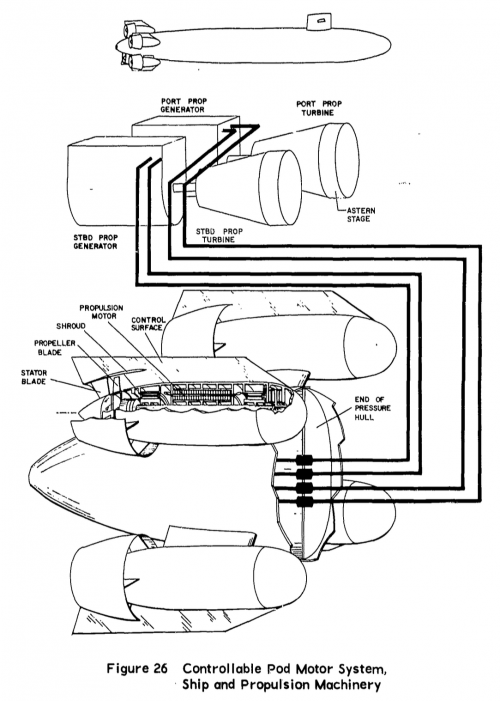
26 - There was even a four-shaft study with a propeller in each quadrant!
 
The concept sounded familiar, and I finally realized where I had seen it before. Electric Boat studied a similar arrangement as part of a 1963 study for the U.S. Navy (see p. 117 of the attached pdf).
 

Attachments

  • A Survey of Conventional and Unconventional Submarine Propulsion Systems.pdf
    8.4 MB · Views: 18
  • Screenshot 2026-08-23 at 6.40.48 PM.png
    Screenshot 2026-08-23 at 6.40.48 PM.png
    431.9 KB · Views: 30
What are the pros of such configuration? Redundancy and extra agility?
Yes, and potentially lower noise due to the propellers being in relatively uniform inflow conditions, their higher-frequency vibrations being easier to damp, and no cavitation below 90 feet. It would also allow the stern to have a sonar array or torpedo tube.
 

Similar threads

Back
Top Bottom