Thanks for those enlargements hesham. So, definitely a category description rather than a aero-club or institute.

1.png in reply #517 refers to American light aircraft developments. The Stearman-Hammond Y-1 and Waterman Whatsit (or Arrowplane?) safety planes are mentioned as is a auto engine-powered Nicholas-Beazley Airplane Co. product (Plymacoupe?) before moving on to autogiros. So, all American references with no obvious French content.

2.png in reply #517 does contain French references but all are about what we would now call general aviation.

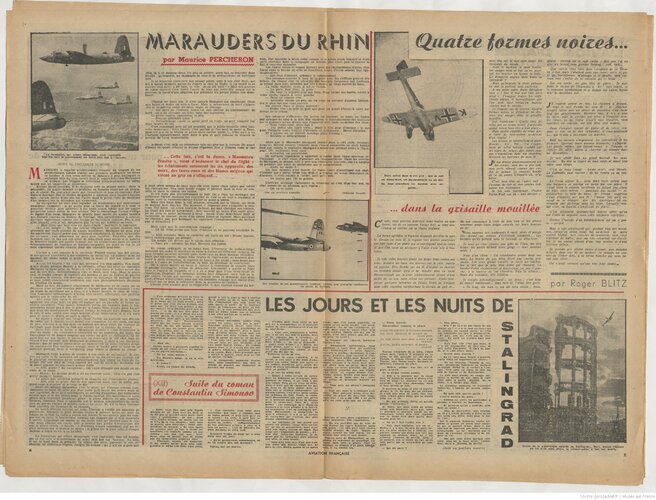
The clipping in reply #518 is another discussion of light aircraft in general. Mention is made of Klemm, Peyret-Nessler, Peyret-Mauboussin, Potez 58, and Caudron Phalène ... with photos of the Bassou Rubis and Brochet MB.30 (both parasols) and the Botali-du Rivau PAMA cabin monoplane.
 
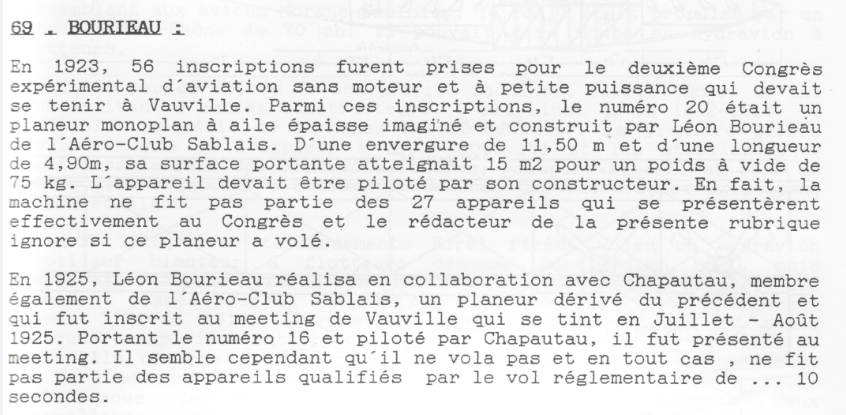
From TU 162,

- BOURIEKAU:

In 1923, 56 registrations were taken for the second Congress
low power, motorless aviation experiment which was to
stand in Vauville. Among these inscriptions, number 20 was a
monoplane glider with thick wing designed and built by Léon
Bourieau of the Aéro-Club Sablais. With a wingspan of 11.50 m
and a length of 4.90m, its bearing surface reached 15 m2 for an
empty weight of T5 kg. The aircraft had to be piloted by its
manufacturer. In fact, the machine was not one of the 27 devices
that presented themselves actually in Congress and the editor
of this column don't know if this glider flew.

In 1925, Léon Bourieau produced in collaboration with Chapautau,
member also from the Aéro-Club Sablais, a glider derived from the
previous one and which was registered for the meeting of Vauville
which was held in July - August 1925. Bearing number 16 and piloted
by Chapautau, it was presented to the meeting. It seems however
that he did not fly and in any case, did not part of the devices qualified
by the regulatory flight of ... 10 seconds.
 

Attachments

  • 11-1.png
    11-1.png
    277.5 KB · Views: 84

Attachments

  • 1.png
    1.png
    256 KB · Views: 159
  • Les_Ailes___journal_hebdomadaire_[...]_bpt6k96073593_1.jpeg
    Les_Ailes___journal_hebdomadaire_[...]_bpt6k96073593_1.jpeg
    2.1 MB · Views: 120
From TU 162,

here is a small Info about glider,designed by Mr. Henry Boursiac.
 

Attachments

  • 1.png
    1.png
    76.4 KB · Views: 107
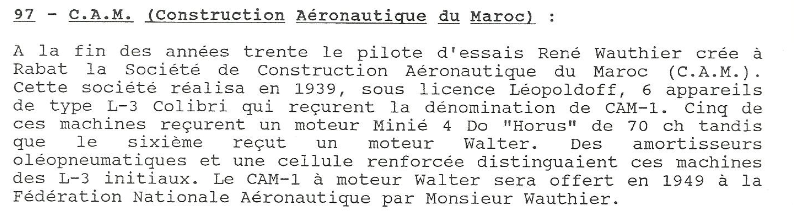
From TU 169,

C.A.M. (Construction Aéronautique du Maroc):

At the end of the thirties, the test pilot Reré Wauthier created in
Rabat the Société de Construction Aéronautique du Maroc (C.A.M.).
This company produced in 1939, under license Léopoldoff, 6 devices
type L-3 Colibri which received the name CAM-1. Five of
these machines received a Minié 4 Do "Horus" engine of 70 hp while
that the sixth received a Walter engine. Shock absorbers
oleopneumatic and a reinforced cell distinguished these machines
initial L-3s. The Walter-powered CAM-1 will be offered in 1949 to the
Fédération Nationale Aéronautique by Monsieur Wauthier.
 

Attachments

  • 1.png
    1.png
    116.1 KB · Views: 71

Attachments

  • 1.png
    1.png
    175 KB · Views: 62
  • 2.png
    2.png
    187.6 KB · Views: 59
  • 3.png
    3.png
    185.4 KB · Views: 63
  • 4.png
    4.png
    137 KB · Views: 65
  • 5.png
    5.png
    161 KB · Views: 62
  • 6.png
    6.png
    176.8 KB · Views: 87
  • 7.png
    7.png
    555.3 KB · Views: 94
  • Les_Ailes___journal_hebdomadaire_[...]_bpt6k65601917_8.jpeg
    Les_Ailes___journal_hebdomadaire_[...]_bpt6k65601917_8.jpeg
    1.8 MB · Views: 95
  • Les_Ailes___journal_hebdomadaire_[...]_bpt6k6555890h_13.jpeg
    Les_Ailes___journal_hebdomadaire_[...]_bpt6k6555890h_13.jpeg
    1.9 MB · Views: 83
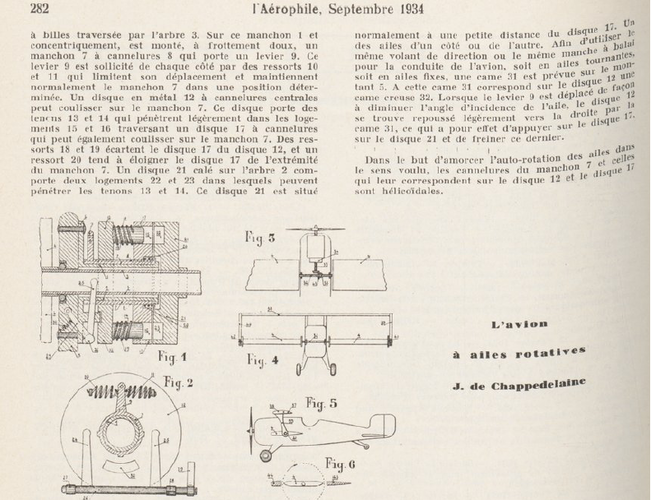
From Aerophile 1934.
 

Attachments

  • 1-9-1934.png
    1-9-1934.png
    451.5 KB · Views: 94
  • 2-9-1934.png
    2-9-1934.png
    585.2 KB · Views: 126
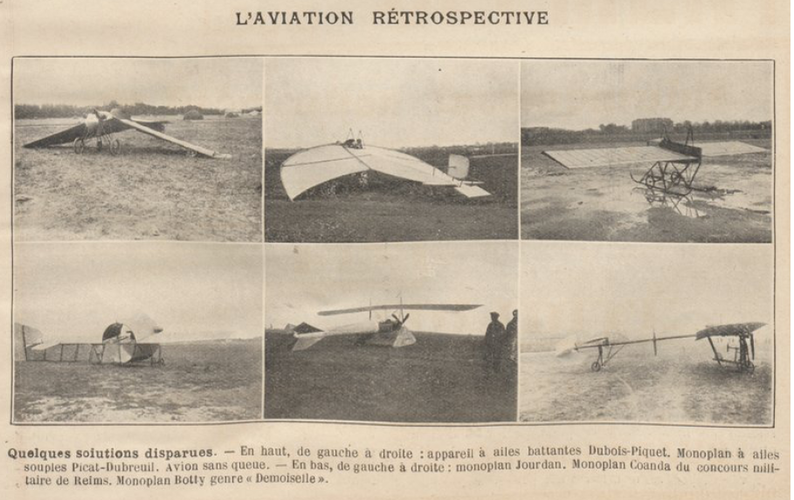
Mr. Botty designed an experimental airplane in 1920,no more details are known.

there was unknown airplane from 1920,designed by Dubois-Piquet,any idea ?.
From Aerophile 1920,

Some missing solutions. - Above, from left to right: Dubois-Piquet
swing wing plane. Winged monoplane flexible Picat-Dubretul.
Tailless plane - Bottom, from left to right: Jourdan monopian.
Coand monoplane of the Reims military competition. Monoplane
Botty kind (Lady).
 

Attachments

  • 1.png
    1.png
    732.9 KB · Views: 144
Last edited:
From TU 170,

BERNET (New Manufacturer):

In 1935, in Depienne in Tunisia Mr. Bernet made a small plane. which unfortunately the editor does not know.
 

Attachments

  • 1.png
    1.png
    47.9 KB · Views: 93
From TU 305 & Aerophile 1922,

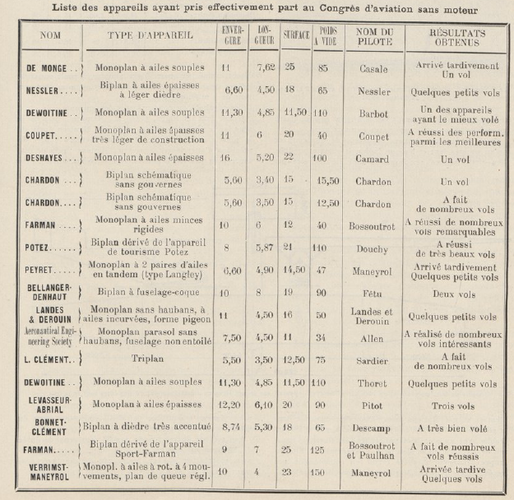
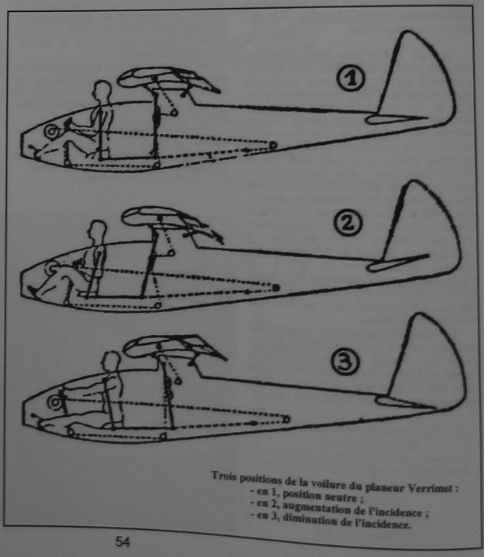
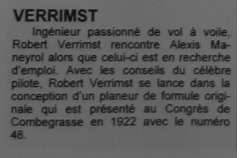
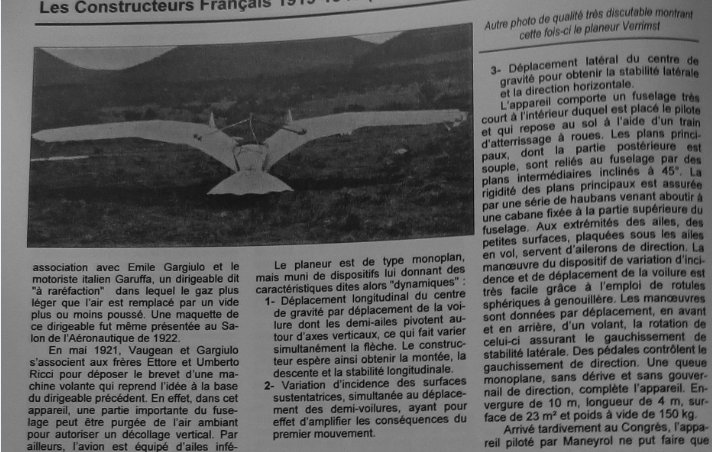
here is all story for Mr. Robert Verrimst and Mr. Alexis Maneyrol,
if someone can translate well ?.
 

Attachments

  • 4-1922.png
    4-1922.png
    559.5 KB · Views: 81
  • 1.png
    1.png
    216.8 KB · Views: 81
  • 2.png
    2.png
    33 KB · Views: 91
  • 3.png
    3.png
    318.9 KB · Views: 82
  • 4.png
    4.png
    162.1 KB · Views: 78
  • 5.png
    5.png
    153.9 KB · Views: 68
  • 6.png
    6.png
    163.8 KB · Views: 67
  • 7.png
    7.png
    163.1 KB · Views: 68
  • 8.png
    8.png
    129 KB · Views: 75
From TU 226,

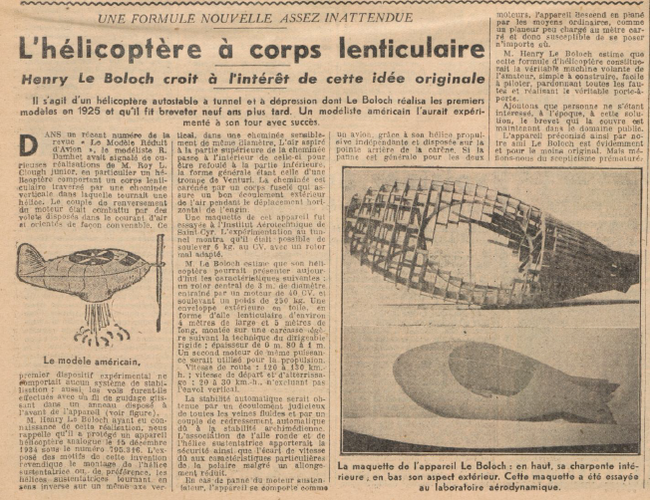
Mr. Henri Le Boloch designed a system for Brake Flaps in 1920,followed by Lift Machine with a propellers,and
a Helicopter in 1934/35,we spoke about him before here;

https://www.secretprojects.co.uk/th...e-ideas-from-ailes-journal.31298/#post-345752
The first is the subject of the patent 526,166 filed February 20, 1920 and which relates to lower shutters, in fact
brake flaps.

In 1934, he proposed a system lift based on an original principle. A small diameter propeller special shape, the
profile not including than an attack spout with no back surface,rotates horizontally at very high speed flush with
a flat surface. To the very high rotational speeds, the air streams, violently spread by the edge of the propeller
as by a projectile, cannot close immediately behind her. The result is the formation of an intense and remarkably extensive depression. Air nets,by folding back, draw in some so the profile of least resistance determined by the
leading edge.

Such a propeller, even in rotation very fast in the open air, would not lead to no practical results; but, and there it
is the crux of this invention, if this rotation takes place flush with a horizontal plane surface, this surface harvest all
the benefit of the area intense pressure, in the form of a vertical thrust. Of course, the contact must be intimate to compel all the air streams to pass through the upper surface.,it suffices to coat the surface plane with a simple film
of oil very viscous,this device therefore consists of get a pressure difference between the upper part of the plane on which turns the propeller which lifts the column of air at each pass, and the lower part on which is exerted without
constrains atmospheric pressure. The result must be a lifting force.

To roughly quantify, we can say that if the total vacuum existed on the surface swept by the propeller, we would
obtain a force of 10,000 kg per meter square. Like the depression area is only one fifth of the swept area and
admitting 50% of all orders, we arrive at 1000 kg per meter square of swept area.

Editor does not know if work were conducted on the basis of this idea, but in 1935, it was announced that Le Boloch
is studying a helicopter at Saint-Cyr in collaboration with Mr. Toussaint.
From, Special Types of Rotary Wing Aircraft - Volume 11,

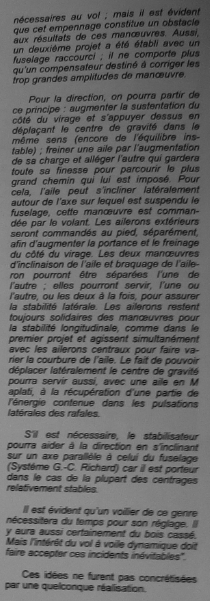
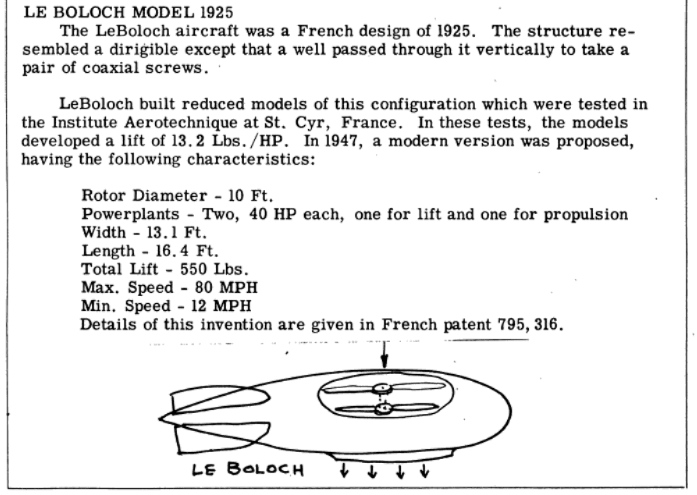
Mr. Henry LeBoloch or Le Boloch designed a dirigible-helicopter during
1920s,I spoke about him before,and also TU magazine,issue 226,he had
a real Projects.
 

Attachments

  • 77.png
    77.png
    120.5 KB · Views: 87
  • 1.png
    1.png
    718.4 KB · Views: 109
The Moineau biplane was designed and built by MM Bessard & Millevoye at Saint-Ouen in 1935. The drawing above can be found in Les Ailes of 15 August 1935 p.3
It seems there is a mistake in the length (longueur) in article. According to the scheme, the length should be not 5,1, but 5,4 meters.
 
From TU 193,

Mr. Jean Adolphe,who we talked about him before;

In the Vie Aérienne Illustrée N ° 176 of March 25, 1920, we can read that
a ultra-light airplane, a monoplane with tractive propeller, will be tested by
its inventor, Mr. Adolphe.
 

Attachments

  • 1.png
    1.png
    40.7 KB · Views: 87
From TU 194,

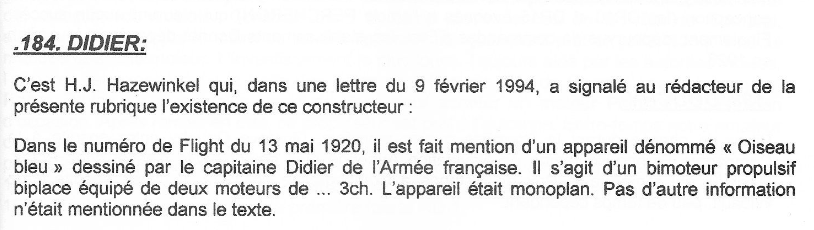
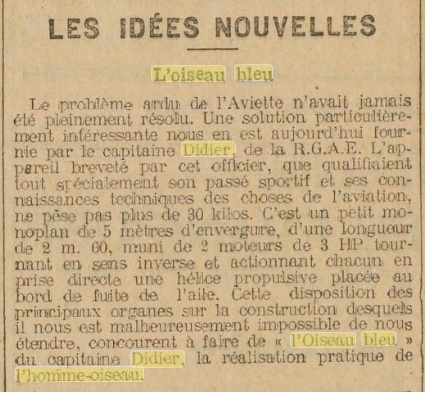
Didier:

It was H.J. Hazewinkel who, in a letter of February 9, 1994, informed the editor of the present section the existence of this constructor:

In the issue of Flight of May 13, 1920, mention is made of an aircraft called "Oiseau blue ”designed by Captain Didier of the French Army. It is a twin-
engine propellant two-seater equipped with two engines of… 3 hp. The
aircraft was a monoplane. No other information was not mentioned in the
text.

https://gallica.bnf.fr/ark:/12148/bpt6k4628374m/f2.item.r=didier oiseau bleu.zoom
 

Attachments

  • 2.png
    2.png
    111.2 KB · Views: 70
  • 3.png
    3.png
    339 KB · Views: 92
From TU 193,

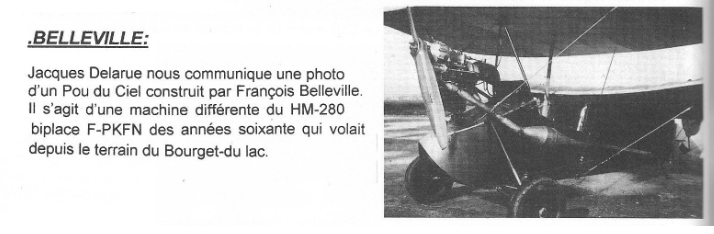
Belleville;

Jacques Delarue sends us a photo of a Pou du Ciel built by François
Belleville
. This is a different machine from the HM-280 two-seater
F-PKFN from the sixties that flew from the field of Bourget-du lac.
 

Attachments

  • 1.png
    1.png
    130.8 KB · Views: 109
Last edited:
Hi,

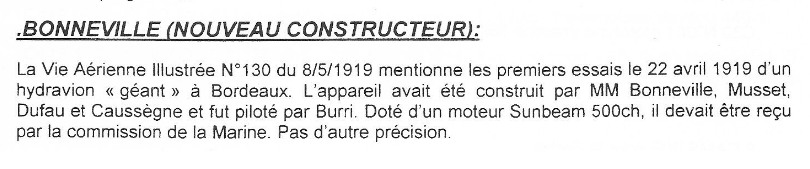
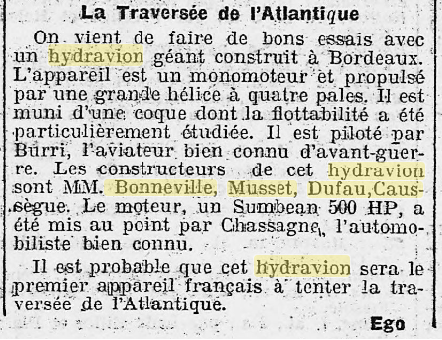
does anyone hear about Bonneville seaplane aircraft of 1919
From TU 193,

La Vie Aérienne lllustrée N ° 130 of 8/5/1919 mentions the first tests on
April 22, 1919 of a “giant” seaplane in Bordeaux. The seaplane had been
built by MM Bonneville, Musset,Dufau et Caussègne and was piloted by
Burri. Equipped with a Sunbeam 500hp engine, it had to be received
by the commission of the Navy. No further clarification.

Strange Info,I never heard it was built ?.

https://gallica.bnf.fr/ark:/12148/b...=BONNEVILLE hydravion musset,dufau?rk=42918;4
https://gallica.bnf.fr/ark:/12148/bpt6k5996431/f3.item.r=BONNEVILLE hydravion musset,dufau.zoom
 

Attachments

  • 1.png
    1.png
    75.3 KB · Views: 76
  • 2.png
    2.png
    173.1 KB · Views: 61

Attachments

  • 0.png
    0.png
    44.2 KB · Views: 59
  • a.png
    a.png
    156.5 KB · Views: 65
  • b.png
    b.png
    258.3 KB · Views: 64
From TU 194,

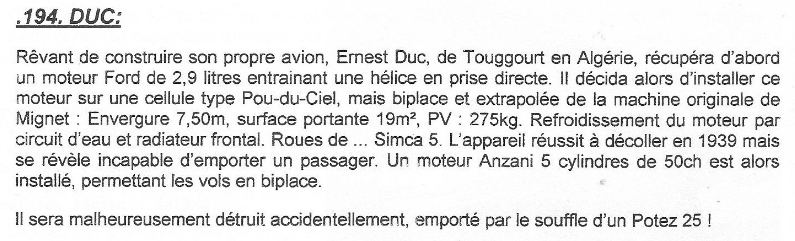
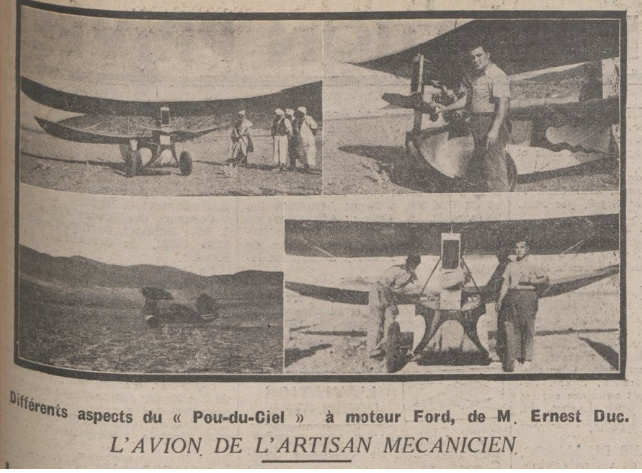
Dreaming of building his own airplane, Emest Duc, from Touggourt in
Algeria, first recovered a 2.9-liter Ford engine driving a direct-drive
propeller. He then decided to install this engine on a Pou-du-Ciel type
cell, but two-seater and extrapolated from the original machine of
Mignet: Wingspan 7.50m, bearing surface 19m2, HP: 275kg. Engine
cooling by water circuit and front radiator. Wheels of… Simca 5. The ]aircraft succeeded in taking off in 1939 but proves unable to carry a passenger.
A 50 hp 5-cylinder Anzani engine is then installed, allowing them to be
seen in tandem.

it will unfortunately be accidentally destroyed, carried away by the breath
of a Potez 25 !.
 

Attachments

  • 1.png
    1.png
    157.3 KB · Views: 82
  • 2.png
    2.png
    542.6 KB · Views: 83
  • Les_Ailes___journal_hebdomadaire_[...]_bpt6k65559132_13.jpeg
    Les_Ailes___journal_hebdomadaire_[...]_bpt6k65559132_13.jpeg
    1.7 MB · Views: 82
In TU magazine, they spoke about Mr. Ducceschi who designed an airplane in 1934, but when I search on it in Ailes, I can't understand what was it ?.

Nothing to do with aircraft. M. Ducceschi was proposing the use of large-diameter fans to drive 'asphyxiating gases' (smog, pollution, natural gas fumes?) away from Algiers. These large-bladed fans would be powered by aero-engines of 400-to-500 hp. That seems to be the only aviation connection. (The article ends voicing a concern that Ducceschi's concept may serve to displace the noxious gases without actually dissipating these pollutants.)

Obviously, any avion developed by Ducceschi in 1934 was utterly unrelated to his Algiers proposal (assuming this is the same Ducceschi). Alternatively, Trait d'Union was equally misled by Ducceschi's mention of aero-engines for his pollution project.
From TU 194,

Cycle merchant on Boulevard Baudin in Algiers, Ducceschi exhibited
in January 1934, in his store, a small plane of his design. Classic shaped parasol monoplane, built in welded steel tubes and fitted with a 16 hp Aubier-Dunne engine, it weighed 130 kg empty. His becoming is unknown
to the editor.
 

Attachments

  • 1.png
    1.png
    84.4 KB · Views: 76
Hi,


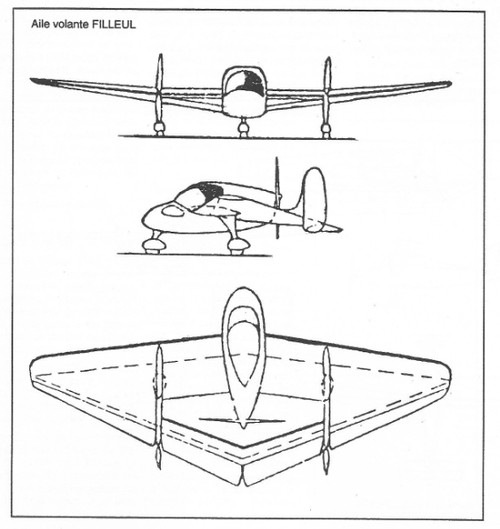
also the Filleul box-wing pusher light aircraft project;


http://gallica.bnf.fr/ark:/12148/bpt6k65605157/f9.i
More Info from TU 206,

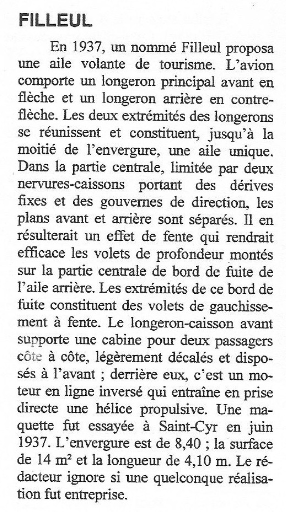
In 1937, a man named Filleul proposed a flying wing of tourism. The
plane has a front main spar in boom and a rear spar in counter-boom.
Both ends of the spars come together and constitute, until the half
the wingspan, a single wing.In the central part, limited by two box
ribs carrying fins fixed and directing governors.the front and rear
planes are separated. It would result in a slit effect which would make
effective elevator flaps fitted on the central part of the trailing edge of
the rear wing.

The ends of this edge of leakage form slotted warping flaps. The front box spar overwears a cabin for two passengers side by side, slightly staggered and arranged in front; behind them, it is an inverted in-line motor which drives in direct drive a propulsive propeller. A model was tested in Saint-
Cyr in June 1937. The wingspan is 8.40: the area of 14 m° and the length
of 4.10 m. The editor does not know if any implementation was
undertaken.
 

Attachments

  • 1.png
    1.png
    136.9 KB · Views: 97
  • 2.png
    2.png
    178.9 KB · Views: 137
Last edited:
An odd wing arrangement. But I'm not sure if "boom" and "counter-boom" make any sense in this context. Maybe 'beam' and 'counter-beam' are closer? (Can a native speaker confirm on flèche and contre-flèche?)

It often helps to edit machine translations. Eg: going way back to post #528, "Monoplane Botty kind (Lady)" tells an Anglophone even less that the original Monoplan Botty genre «Demoiselle».

Obviously, in that instance, 'Demoiselle' does not mean 'Lady'. [1] It refers to the 1907 Santos-Dumont Demoiselle design. So, Monoplan Botty genre «Demoiselle» translates as 'Botty's monoplane of the Demoiselle type - ie: a high-winged monoplane with underslung fuselage.

________

[1] AFAIK, Alberto Santos-Dumont named his aircraft after the similarly underslung damselfly ... nothing to do with ladies.
 
Last edited:
TU 271 talks about Nieuport aircraft with the designation NiD.320, Nie.130 and Loire-Nieuport LN.80 (LN.21). Do any of you have drawings or illustrations of these planes?
 
From TU 262,

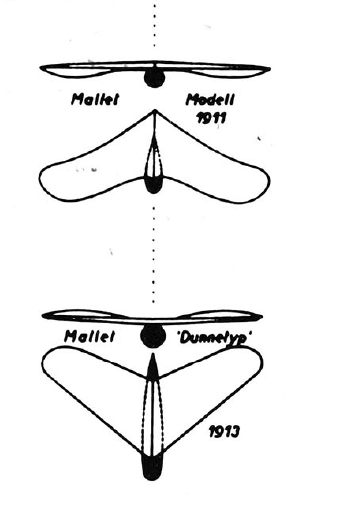
here is a Helicoplane,designed by Mr. Mallet.
I think those drawings were belonged to he same guy,Mr. Mallet ?.

- Winged Wonders
 

Attachments

  • 0.png
    0.png
    47.5 KB · Views: 114
From TU 262,

here is a Helicoplane,designed by Mr. Mallet.
I think those drawings were belonged to he same guy,Mr. Mallet ?.

- Winged Wonders
Not sure who was behind the Helicoplane but those tailless models were designed and tested by Robert Mallet between 1910 & 1914.
Span up to 4,5m.
Robert Mallet was helped by Gustave Eiffel.
 
My dear Retrofit,

I think he was the same person ?.
 
From TU 183,

Mr. Louis Clement built a single seat racer monoplane in 1919 and
a single seat ultra-light triplane in 1921,but he had also a design for
seaplane triplane of 1919.
From TU-193,

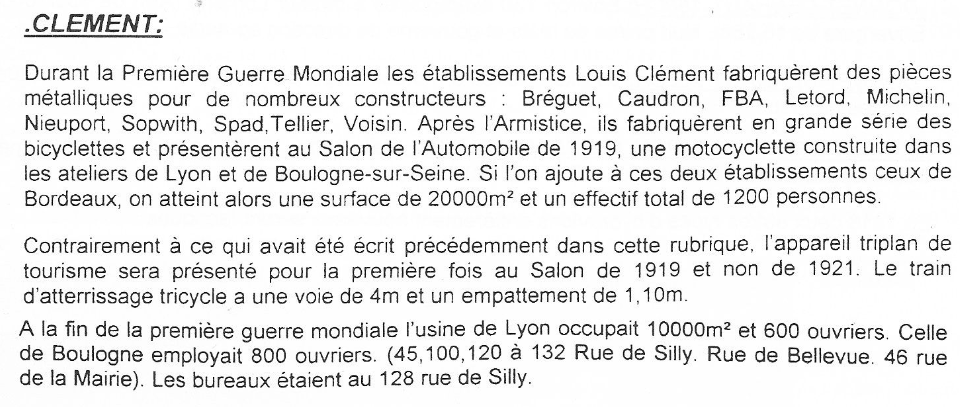
During the First World War, Louis Clément establishments manufactured parts
metal for many manufacturers: Bréguet, Caudron, FBA, Letord, Michelin,
Nieuport, Sopwith, Spad, Tellier, Voisin. After the Armistice, they produced large series of
bicycles and presented at the 1919 Motor Show, a motorcycle built in
the workshops in Lyon and Boulogne-sur-Seine. If we add to these two establishments those of
Bordeaux, do we reach a surface of 20,000m? and a total workforce of 1,200 people.
Contrary to what had been written previously in this section. the triplane of
tourism will be presented for the first time at the Salon of 1919 and not of 1921. The train
tricycle landing gear has a 4m lane and a 1.10m wheelbase.

At the end of the First World War, the Lyon factory occupied 10,000m? and 600 workers. That
de Boulogne employed 800 workers. (45,100,120 to 132 Rue de Silly. Rue de Bellevue. 46 rue
of town hall). The offices were at 128 rue de Silly.
 

Attachments

  • C.png
    C.png
    251.4 KB · Views: 68

Similar threads

Back
Top Bottom