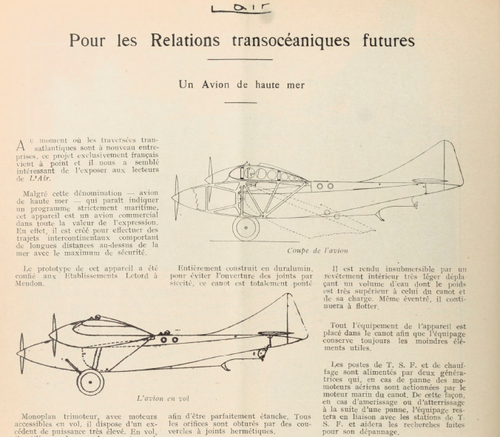
From L'Air Revue 1928,

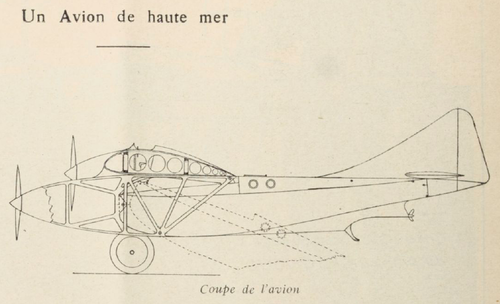
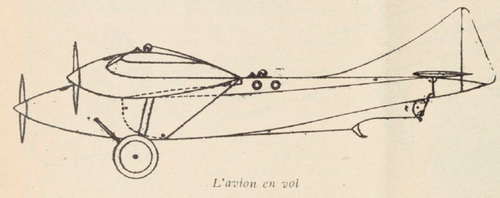
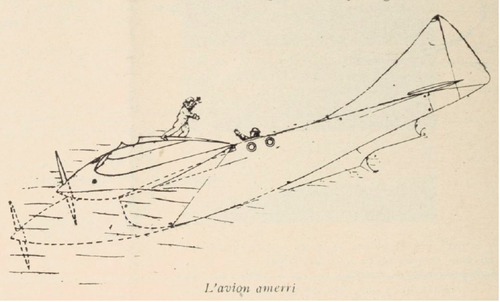
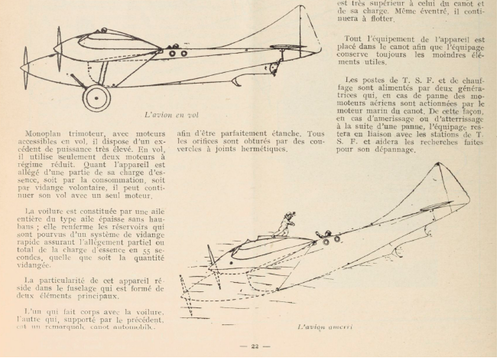
here is an unknown Project for Letord for transatlantic proposed,it was a high-wing three engined
monoplane and if the motors failed,it could converted into a boat,maybe it was the same which
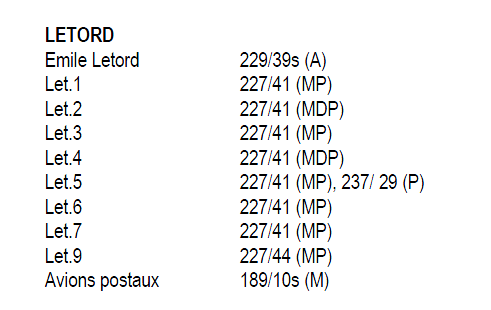
mentioned in TU magazine as a postal aircraft ?.
 

Attachments

  • 1.png
    1.png
    402.4 KB · Views: 111
  • 2.png
    2.png
    280.7 KB · Views: 118
  • 3.png
    3.png
    358.7 KB · Views: 109
  • 4.png
    4.png
    530.6 KB · Views: 102
  • 5.png
    5.png
    416.8 KB · Views: 105
  • 6.png
    6.png
    17 KB · Views: 112
From L'Aeronautique Paris 1923,

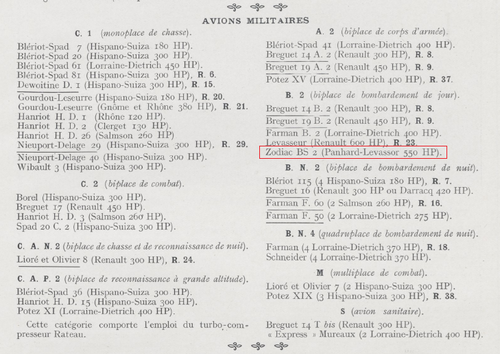
here is a small Info about mystery aircraft,called BS 2,designed by Zodiac company and intended
for two-seat light bomber and combat aircraft in B.2 category,we know this company very much,
but never heard about this before
 

Attachments

  • Zodiac.png
    Zodiac.png
    378.2 KB · Views: 108
Hi,

does anyone hear about Bonneville seaplane aircraft of 1919
 
Last edited:
From TU 175,

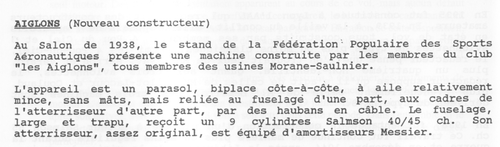
here is a Les Aiglons side-by-side two-seat parasol wing light monoplane of 1938,powered by one 40/45 hp Salmson engine.
 

Attachments

  • 1.png
    1.png
    176.3 KB · Views: 72
Last edited:
From TU 170,

Mr. Fernand Argoud designed a light monoplane aircraft in 1934,powered by one motorcycle Harley-
Daidson engine.
 

Attachments

  • 1.png
    1.png
    124.3 KB · Views: 103
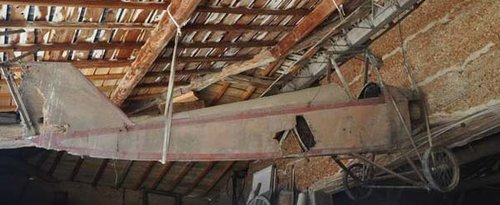
Designed and built in 1934. As stated, Fernand Argoud's monoplane was powered by a Harley-Davidson motorcycle engine but, it seems this was later replaced by an Anzani aircraft engine. Some reports say that Argoud had two more aircraft under construction (he wanted to start a flying school - at Marcilloles-Chambarran aka Penol-Les Burettes - but this scheme was thwarted by the outbreak of WW2). Argoud's single-seat, parasol monoplane survives and his grandson is looking for a restorer.

BTW: Fernand Lucien Argoud had some formal aviation background. From April 1917, he was a mechanic with 2ème Groupe d'aviation at Bron. From February 1918 Argoud worked on SPAD VIIs of SPA 152 (Groupe de chasse 22) until being demobilized in 1919.[/U]
 

Attachments

  • argoud-parasol-1934.jpg
    argoud-parasol-1934.jpg
    35.5 KB · Views: 114
From L'Air Revue 1942,

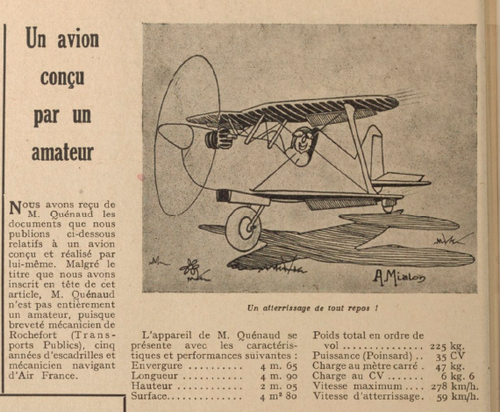
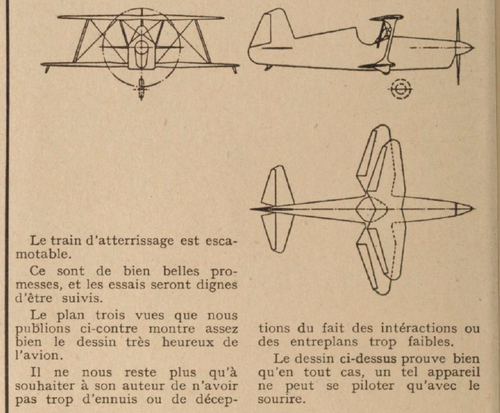
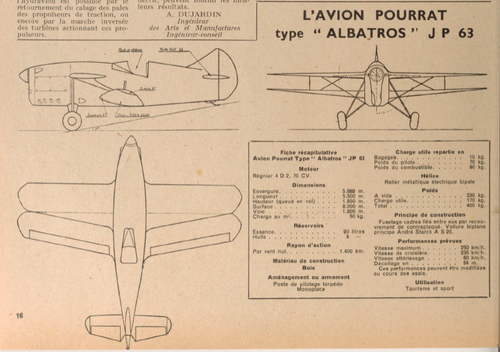
here is a light aircraft designed by Mr. Quenaud.
 

Attachments

  • 1.png
    1.png
    465.8 KB · Views: 113
  • 2.png
    2.png
    566.6 KB · Views: 124
From L'Air Revue 1942,

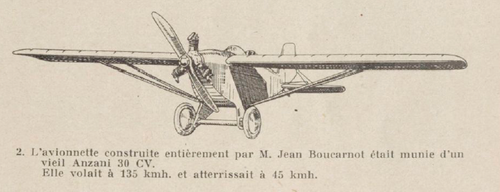
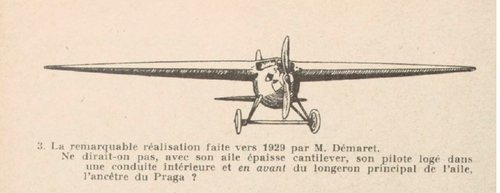
here is a two light airplane drawings,designed by Mr. Jean Boucarnot and Mr. Demaret.
 

Attachments

  • 1.png
    1.png
    214.7 KB · Views: 103
  • 2.png
    2.png
    215 KB · Views: 129
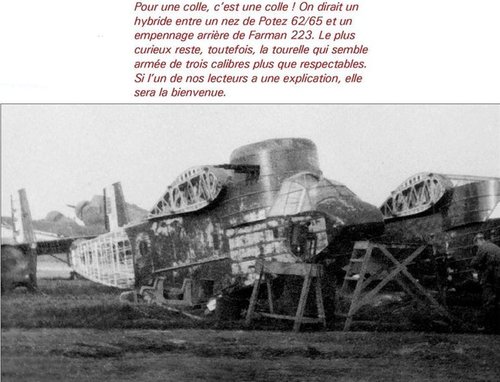
The French caption says: “This is a glue, a glue ...”
Which to my mind means a bunch of random airplane parts glued together Perhaps to decoy attackers, perhaps a mock-up, perhaps as a Joke!
Hah!
Hah!
It includes the nose of a Potez 62/65 and the empennage (tail) of a Farman 223.
The turret contains three calibres/guns of considerable power.
If any reader can explain thi .... they are welcome me.
To my eyes, it looks like a prankster piled a heap of old bomber parts after the German invasion in 1941. Some prankster players laid a random bunch of parts on top of each other.
 
"C’est une colle" indeed means literally "it’s a glue", but it’s also an expression meaning it’s a very difficult question, upsetting cause answer difficult to find, thus "sticky" to the mind until you get the answer. So every time I see this pict , it bothers me cause I don't know what it is ... C'est une colle.
Yes it looks like a mix of 30/40s french bomber parts glued together , with an armored car turret added…
 
Last edited:
Also from Onera Archive,we can find those Projects,according to their designers names;

Balzard was a tubular fuselage airplane Project of 1933
Bayon was a tailless airplane Project of 1927
Berthaume was airplane Project of 1934
Beniot was a tailless airplane Project of 1927
Cabasse was a tailless airplane Project of 1933
Capazza was a monoplane Project of 1928,maybe related to Louis Capazza ?
J.V.5 was a seaplane Project with folded floats,1929
Lemoigne was a 12 bi-motor airplane Project of 1938
Mainguet was airplane Project of 1938
Netzer was tailless airplane Project of 1934
Perrin 106 & Autogyro were airplane and autogyro of 1933 & 1935,
but was he the same guy of early helicopter in France,Edouard Alfred
Perrin ?
Pineau-Phalempin Ultra & Trimotor were a ultra-light and three engined Projects of 1923
Ploix was designed a two different airplanes in 1933
Proquitte was a three engined airplane Project of 1931
SFAM Type-2 was airplane Project of 1924
Schul was a tailless airplane of 1933,I don't know if he was a German
design or not ?
Shaffard was a two-seat airplane Project of 1928
Terme was a sesquiplane flying boat or seaplane Project of 1929
Tixier was airplane Project of 1932
Verger was airplane Project of 1935
Viratelle was a monoplane Project of 1929

https://docplayer.fr/62076991-Onera-archives-des-essais-en-soufflerie.html#
 
Last edited:
It's important to remember that dates listed in the ONERA: Essais en Soufflerie pdf correspond to wind tunnel tests. That gives a 'ballpark' for design/development but not a start date for a project.

One name in there is familiar ...

Rudolf Schul ... yes, he was German (and a member of the Modell- und Segelflug, Magdeburg). Schul patented the Schulsche Flügelform (Patent 509465), an inherently stable wing design. In November 1930, the Magdeberg club began work on a tailless parasol glider - the Schul-Marczinski Stadt Magdeburg.

With structural calculations by W. Marczinski, this glider was built to Schul's design (span 14.00 m, wing area 26.00 m2, NACA M 12 profile). Sometimes referred to by a generic name - Schwanzloses Segelflugzeug Rudolf Schul - this glider flew in February 1931. Performance was generally acceptable but the wingtip rudders were considered too small to be truly effective.

-- http://www.volaticum.com/luftfahrt-geschichte-1931.htm
-- http://aviadejavu.ru/Images6/FT/FT1937/12/3561-1.jpg
-- https://www.j2mcl-planeurs.net/dbj2mcl/planeurs-machines/planeur-fiche_0int.php?code=1981

It seems that Schul was mainly interested in proving his wing theories. Here's something in English from Development of Tailless and All-Wing Gliders and Airplanes, R. W. E. Lademann, NACA Technical Memorandum No. 666, National Advisory Committee For Aeronautics, Washington, DC, 1932, page 10

"Since 1929 Rudolf Schul has been investigating models with new inherently stable wings charactsrized by the fact that each outer portion of the wing forms a hollow halfcone with its open side down and its vertex coinciding with the end point of the leading edge of the central portion of the wing. The Göttingen and Munk profiles are used, including the N.A.C.A. profile M 12. According to the model tests, good lift-drag ratios are obtainable, even with a smaller. aspect ratio, which, according to Schul, is attributable to the favorable effect of the wing tips on the marginal vortices, Schul's models exhibited remarkable stability in straightening out from any attitude of flight."

A few more notes on names ...

Berthaume: Likely Maurice Berthaume an aeronautical engineer who, four years later, began teaching at the École polytechnique féminine.

Capazza: Possibly Louis Capazza but ... he was known almost exclusively for lighter-than-air ships.

Lemoigne: Probably Ing. Pierre-Marcel Lemoigne. Best known for sport parachute design, he was became a test pilot in the 1930s (gaining a World altitude record in a Gourdou-Leseurre LGL-32). Before the war, Lemoigne was acquainted with Michel Détroyat (winner of two Coupes Michelin and the Thompson Trophy) and test pilot Louis Rouland (later killed flying the SNCASE SE.100). Later on, Lemoigne was also involved with the development of the SNCAC NC.1080 shipboard fighter prototype.

I note that Lemoigne was also testing an "Aile avec dispositif hypersustentateur" or 'wing with high lift devices'.

Tixier: Possibly refer to Charles Léon Georges Tixier. If so, Georges Tixier would be killed on 04 December 1935 when his Caudron Simoun (F-ANRK) clipped the trees and crashed while trying to land at Tours.

Viratelle: Possibly relates to a project by the Lyon firm Société Anonyme des Motocyclettes et Automobiles Viratelle . Perhaps a monoplane avionette powered by one of Marcel Viratelle's motorcycle engines?

 
Many great thanks to you my dear apophenia,

and there is some mysteries or unknown companies ?,such as;

A.D.B. 60,A.L.E E.20,Bernard tailless,de Marsay (maybe de Marcay ?),Dujardin 1938 ?,Ecole Polytechnique
Féminine 1936,Jancel commercial 1928,Jannin 1 to 6 & Maillet-Régnier 1934.


Also for those designers,I will speak about them later;

Chamoy,claude,Minie,Richard,Richard-Penhoët,Touya & Vacher
 
and there is some mysteries or unknown companies ...

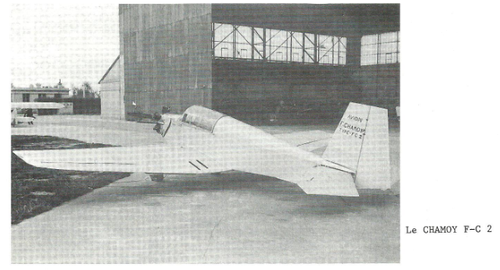
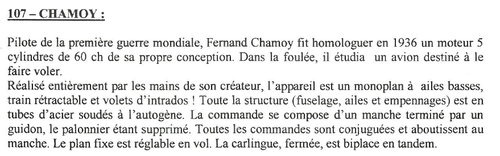
Chamoy: Probably refers to Fernand Pierre Chamoy of Paris, a WWI pilot who designed the Monoplan Chamoy 2-seat trainer prototype of 1938 (1 x 65 hp Chamoy 5-cylinder radial, span 9.00 m). "France-Aviation Chamoy" also pops up but I'm not sure what that refers to.

The École Polytechnique Féminine 1936 could well involve the EPF instructor Maurice Berthaume again.

For "de Marsay (maybe de Marcay ?)" you are looking for the Baron Edmond de Marçay ... as in the Société Anonyme d'Etudes et de Construction Aéronautique Edmond de Marçay.
-- https://www.secretprojects.co.uk/threads/de-marçay-aircraft.21456/

Maillet-Régnier 1934: Refers to the aircraft designs of André Maillet (who was killed in a flying accident that year) and the engines of the Société Anonyme des Etablissement Emile Régnier. As a generic term, 'Maillet-Régnier' was use to describe the SFCA Maillet 20.

Minié would be Établissements Minié of Colombes (sometimes given as Ets V. Minié) which became Paris-based Victor Minié Aéronautique after WW2 (sometimes given as Société Minié Aéronautiques). Minié built both aero-engines of original design and aircraft.

Richard-Penhoët, of course, refers to the work of Ing. Paul Aimé Richard for the Société des ateliers et chantiers de Saint-Nazaire-Penhoët (most notably the five-engined Richard-Penhoët 2 flying boat).

Edit: for Lemoigne, there was a Pierre Lemoigne who set a world landplane altitude record in the LGL.323 in 1929 before becoming chief test-pilot for Étienne Romano in 1931.
 
Last edited:
Thank you my dear Apophenia,

and here is all Info about Chamoy F-C 2.
 

Attachments

  • 0.png
    0.png
    385.5 KB · Views: 133
  • 3.png
    3.png
    148 KB · Views: 105
  • 4.png
    4.png
    48.9 KB · Views: 100
By the way,

In Onera archive,

ALE means, Aviation Légère Economique
ADB means, Société Aucouturier Dugoua et Cie

but what was J.V. and SFAM ?.
 
Old info from Internet,

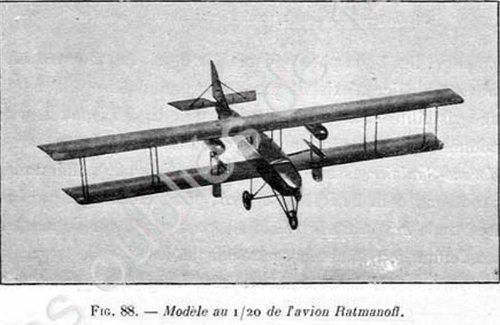
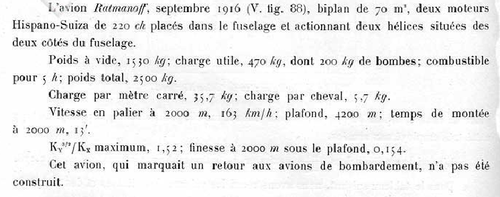
here is a strange biplane of 1916,designed by Mr. Ratmanoff,I don't know if he was French or not ?.
 

Attachments

  • 3-Ratmanoff.JPG
    3-Ratmanoff.JPG
    45.7 KB · Views: 137
  • 1.png
    1.png
    152.6 KB · Views: 139
Despite the name, Pierre de Ratmanoff (or maybe Pyotr Ratmanov?) was French entrepreneur and his company Ratmanoff & Cie in Suresnes manufactured the "Normale" propellers according to patents of Polish engineer Stefan Drzewiecki. It seems that in 1917 his company was the third largest manufcturer of propellers in France, and also that he like Levasseur tried to move into aircraft manufacturing (but without succes). He's mentioned in French Aicraft Before the Great War as manufacturer of at least two de Beer monoplanes and at least two two-seater monoplanes of his own design.
 
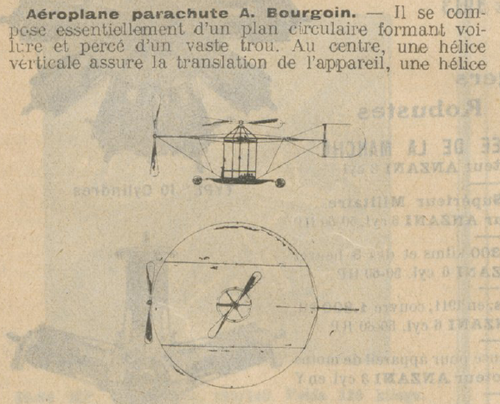
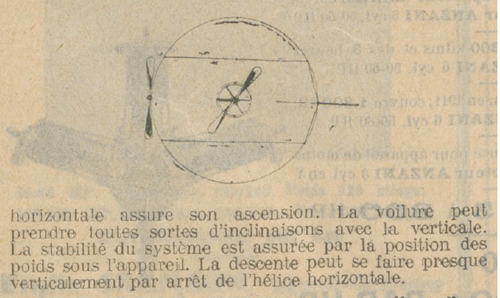
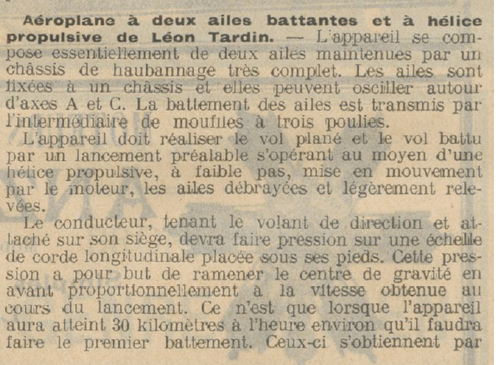
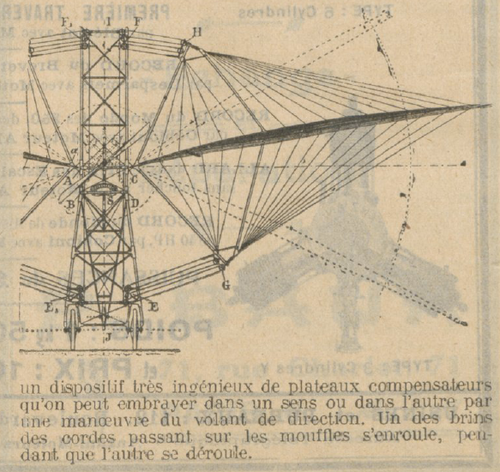
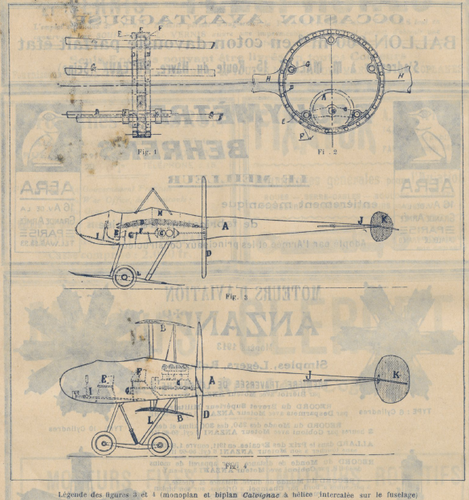
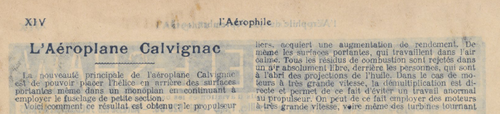
From Aerophile 1913,

here is a three strange concepts to A. Bourgoin,Léon Tardin and Calvignac.
 

Attachments

  • 1.png
    1.png
    468.3 KB · Views: 80
  • 2.png
    2.png
    349.8 KB · Views: 68
  • 3.png
    3.png
    488.7 KB · Views: 72
  • 4.png
    4.png
    620.3 KB · Views: 82
  • 5.png
    5.png
    727.2 KB · Views: 89
  • 6.png
    6.png
    252.6 KB · Views: 77
  • 7.png
    7.png
    351.6 KB · Views: 91
From Aerophile 1914,

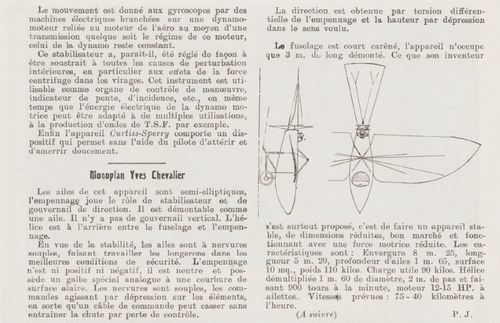
here is an airplane,designed by Mr, Yves Chevalier or Chevallier.
 

Attachments

  • 122.png
    122.png
    585.2 KB · Views: 103
Last edited:
Thank you my dear Apophenia,and from Aerophile 1914,

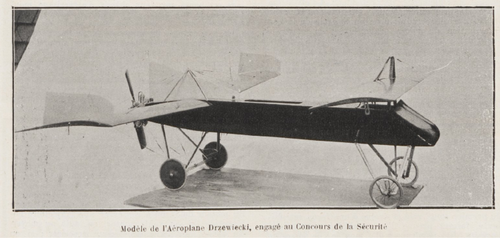
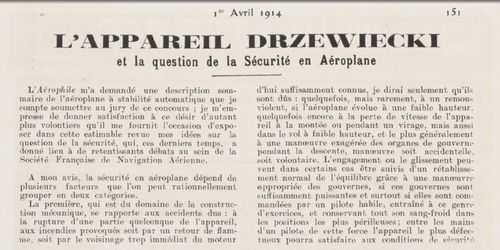
here is a tandem wing monoplane of Drzewiecki.
 

Attachments

  • 123.png
    123.png
    306.9 KB · Views: 118
  • 124.png
    124.png
    459.5 KB · Views: 108
  • 125.png
    125.png
    488.8 KB · Views: 96

Attachments

  • 1.jpg
    1.jpg
    30.2 KB · Views: 97
Initial design work on what became the Aiglon-Roulier was begun in 1914 before EV 1 Jean Roulier was even accepted for flight training. The following is from CAM de Venise - Les escadrilles françaises:

"Heureux dans l'action, Jean est aussi un esprit inventif. Dès 1914, il fait les plans d'un hydravion de chasse, jugé par la marine comme une avancée technologique importante. C'est à Venise qu'il pourra en parfaire les plans. En juin 1916, il raconte à son frère : 'Les Italiens nous ont fait des propositions écrites pour construire à Venise, probablement dans un chantier privé, mon appareil'."

Quoted by Bernard Roulier in his 2000 reminscences: http://albindenis.free.fr/Site_escadrille/CAM_Venise.htm

Translating something like: "Content in action, Jean was also an inventive spirit. In 1914, he made design for a fighter seaplane, judged by the navy as an important technological advance. He perfected his plans in Venice. In June 1916, he told his brother: 'The Italians made us written proposals to build my design in Venice, probably in a private shipyard'."

So, it sounds like the Italians were considering building Roulier's hydravion de chasse design before deciding upon Macchi-built Lohner copies instead.

OT: I've seen a reference to Jean Roulier as lieutenant de vaisseau. Most sources list him as an Enseigne de vaisseau de 1ère classe at the time of his death in August 1916. Does anyone know if Roulier was an EV 1 raised to LV 1 posthumously?
BTW, I've also seen online refs to his death in action as 17 Aug 1916 (along with his "Mécanicien Mitrailleur", Costerousse). Actually, Roulier's final attack on Trieste had occurred on 15 Aug 1916. Since the aircraft (FBA 150, n°308) was carrying bombs, QM (Quartier-Maître) Costerousse would have been acting as observateur not gunner. Roulier was shot down over Trieste harbour by a Lohner M (L 16) flown by Gottfried Freiherr von Banfield. The body of EV 1 Jean Jules Henri Roulie was recovered by an Italian torpedo boat soon after the crash. AFAIK, the body of QM Auguste Henri Costerousse was never recovered (or, at least, not identified).
 
Thank you my dear Apophenia,

and I hope to solve the SFAM mystery.

Mr. Léon Bare in 1933,from Marthureux-sur-Saône, built an airplane Mignet formula with a wingspan of 10 m,
depth 1.30 m. The weight of the glider is 87 kg. With the Indian 9 hp engine, the change speed and propeller,
you get to 186 kg. The first one was to take place in the summer of 1933.
 

Attachments

  • 1.png
    1.png
    62.8 KB · Views: 112
Last edited:
"Marthureux-sur-Saêne" should read Monthureux-sur-Saône. Also, I believe that "avec le changement de vitesse" refers to a change to gearing not "speed". Could a native French-speaker help out here?

Another question for francophones: Marthureux s/saône shows up in a handful of online search with dates in the 19th Century. Google keeps prompting 'Monthureux-sur-Saône'. Any actual relationship between Monthureux-sur-Saône and the similar-looking Marthureux-sur-Saône?
 
From TU 147,

Mr. Guillaume Bisson designed a motor-glider or ultra light airplane (moto-aviette) in 1923,no more
details are known.
 

Attachments

  • 1.png
    1.png
    179.2 KB · Views: 96
Last edited:
From TU 185;

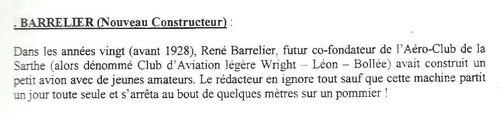
in the 1920s (before 1928),René Barrelier, future co-founder of the Aéro-Club de la Sarthe
(then called Light Aviation Club Wright - Léon - Bollée} had built a small plane with young
amateurs. The editor ignores everything except that this machine left one day alone and
stopped after a few meters on an apple tree.
 

Attachments

  • 1.png
    1.png
    108 KB · Views: 68
From TU 137,139 & 170,

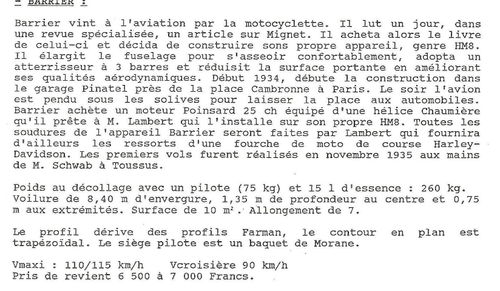
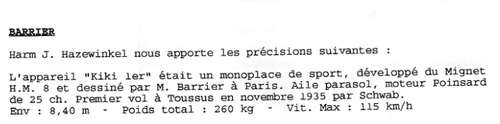
Mr. Barrier built a copy of Mignet HM.8,followed by a single seat looks like tourist parasol wing
monoplane,called Kiki,powered by one 28 hp Poinsard engine,1934/35.
 

Attachments

  • 6.png
    6.png
    280.8 KB · Views: 66
  • 7.png
    7.png
    71.1 KB · Views: 67
  • 8.png
    8.png
    61.3 KB · Views: 59
From TU 224,

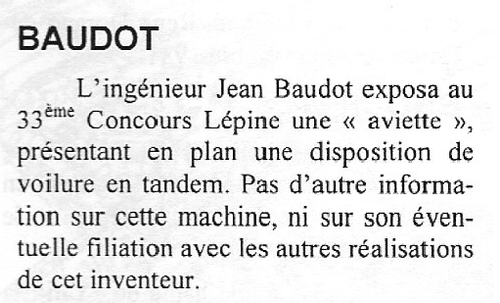
Mr. Jean Baudot designed a ultra-light airplane,had a tandem wing.
 

Attachments

  • 2.png
    2.png
    127.2 KB · Views: 63

Similar threads

Back
Top Bottom