Beaucarnot/Payen "Airëau" seaplane of 1929

hesham

ACCESS: USAP
Senior Member
Joined
26 May 2006
Messages
37,562
Reaction score
19,602
From TU 137,this designer was known;

Mr. Jean Beaucarnot built in 1928 a tourist plane called "Aireau". It was a single seat monoplane with a wing
located on the fuselage. Originally equipped with an old engine coming from a Nieuport plane from ... 1908.
This engine causing so much in trouble during the first flights, he was replaced by an Anzani 25 hp.
The plane was entered by Société Aireau for the Airplane Competition light. No further information.
 

Attachments

  • 1.png
    1.png
    159.5 KB · Views: 87
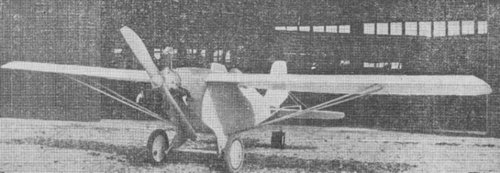
Attached is a poor-quality image of the Beaucarnot Airëau.

The sole Airëau was (or was to be) converted into a rocket-powered aircraft by Roland Payen. (The engineless airframe was given to Payen by either Jean Beaucarnot or pilot Marcel Aurouze, depending upon sources,) Stargazer identified this as Payen's 1929 project number K3B, saying it remained unbuilt.

From: Nicolas Roland Payen et l'aire delta: http://museedelta.free.fr/payen/payenbio.htm

"... Puis, en 1930, c'est l'aventure de l'avion léger offert à Payen par Jean Beaucarnot. Roland Payen, impressionné par les essais de l'avion-fusée piloté en Allemagne par Fritz von Opel, prévoit d'équiper le petit Beaucarnot de trois fusées à poudre. Lors d'essais effectués dans une remise, une explosion souffle le bâtiment. Payen, indemne par miracle, est guéri pour un temps de l'aviation à réaction."

So, in 1930, the Airëau was offered to Roland Payen who planned to fit three solid rockets to Beaucarnot's aircraft à la the Opel-Sander RAK.1 of 1928. During ground tests, those rockets exploded (while mounted on the aircraft?) and the project abandoned.

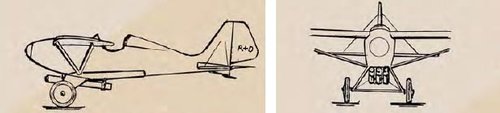
Attached is a 2-view drawing of how Payen's Airëau conversion was to look. As you can see, Payen redubbed this aircraft R+O (but I don't what that stands for ... Roquette + ?, perhaps): http://www.acfr.fr/files/Exposition...avions_a_aile_delta_-_par_Pierre_Gaillard.pdf

There is some confusion over the 1929 YA.11 seaplane amphibian. Did Jean Beaucarnot design the YA.11 for Payen? (As I suspect.) Or, did Payen design the YA.11 for the Société Airëau? I suspect that the confusion stems from Payen project numbers. For some reason, the YA.11 "hydravion léger" was given Payen project number K3 while the rocket-powered Airëau (R+O) was numbered K3B. What is the connection between the R+O and the YA-11? Probably nothing at all beyond the same project year of 1929 and a Jean Beaucarnot/Société Airëau origin.

Does anyone know the layout of the YA.11? That "hydravion léger" and Payen project number relationship has me wondering if the wing design (or other components) from the avionette might have been inherited by the YA.11?
 

Attachments

  • Beaucarnot-Airëau.jpg
    Beaucarnot-Airëau.jpg
    187 KB · Views: 107
  • Payen-Airëau-rocket-conversion.jpg
    Payen-Airëau-rocket-conversion.jpg
    20.1 KB · Views: 110
Thank you my dear Apophenia,

and fortunately I don't know what was "hydravion léger" Payen project number.but I will search.

From TU 137;

- BEAUJARD-VIRATELLE
Louis Beaujard was born on December 18, 1877 in Paris. A graduate of the School of Arts and Crafts, he studied
and produced in 1908 an engine to explosion which it machines in the mechanical workshops founded by him.
In 1910, he built a monoplane powered by a Ballot engine.Excellent pilot, he practices Blériot, Antoinette and
others Morane-Sailnier.He develops the device with automatic stability from the Swiss Fischer. In 1919, he
would fly Etampes the aircraft to Levavasseur variable surfaces.Fighter pilot during the Great War, he was
taken prisoner on March 31, 1916. After several escape attempts, he succeeded finally eight days before the
Armistice.When peace returned, Beaujard joined the Société des æéroplanes Bellanger where he worked
with Denhaut, Bill and Briès.In 1924, Louis Beaujard made a personal ultra-light with a 16 hp Sergant engine.
This work is carried out in collaboration with an excellent technician, M. Viratelle.This monoplane will be
entered in the Tour de France of the 1924 light planes but will not participate in this test, as it could not
be completed in time.

‘The editor does not know whether this device ultimately flew, as well as its characteristics and performance.
 

Attachments

  • 1.png
    1.png
    302.4 KB · Views: 84
Attached is a poor-quality image of the Beaucarnot Airëau.

The sole Airëau was (or was to be) converted into a rocket-powered aircraft by Roland Payen. (The engineless airframe was given to Payen by either Jean Beaucarnot or pilot Marcel Aurouze, depending upon sources,) Stargazer identified this as Payen's 1929 project number K3B, saying it remained unbuilt.

From: Nicolas Roland Payen et l'aire delta: http://museedelta.free.fr/payen/payenbio.htm

"... Puis, en 1930, c'est l'aventure de l'avion léger offert à Payen par Jean Beaucarnot. Roland Payen, impressionné par les essais de l'avion-fusée piloté en Allemagne par Fritz von Opel, prévoit d'équiper le petit Beaucarnot de trois fusées à poudre. Lors d'essais effectués dans une remise, une explosion souffle le bâtiment. Payen, indemne par miracle, est guéri pour un temps de l'aviation à réaction."

So, in 1930, the Airëau was offered to Roland Payen who planned to fit three solid rockets to Beaucarnot's aircraft à la the Opel-Sander RAK.1 of 1928. During ground tests, those rockets exploded (while mounted on the aircraft?) and the project abandoned.

Attached is a 2-view drawing of how Payen's Airëau conversion was to look. As you can see, Payen redubbed this aircraft R+O (but I don't what that stands for ... Roquette + ?, perhaps): http://www.acfr.fr/files/Exposition...avions_a_aile_delta_-_par_Pierre_Gaillard.pdf

There is some confusion over the 1929 YA.11 seaplane amphibian. Did Jean Beaucarnot design the YA.11 for Payen? (As I suspect.) Or, did Payen design the YA.11 for the Société Airëau? I suspect that the confusion stems from Payen project numbers. For some reason, the YA.11 "hydravion léger" was given Payen project number K3 while the rocket-powered Airëau (R+O) was numbered K3B. What is the connection between the R+O and the YA-11? Probably nothing at all beyond the same project year of 1929 and a Jean Beaucarnot/Société Airëau origin.

Does anyone know the layout of the YA.11? That "hydravion léger" and Payen project number relationship has me wondering if the wing design (or other components) from the avionette might have been inherited by the YA.11?


Hi,

welcome in the complicated world of Payen's planes… The biggest problem is when was wrote what was wrote… The oldest is to be considered as the best (if it's possible to know how old it is).

the link to the articles of Pilote privé n°83 of December 1980 and 84 of January 1981, where we can see three drawings of the YA.11 project (111 of page 52 is a mistake) and another photo of the Airëau.


Hesham showed the three Drawings of the YA.11 :


A rocket exploded, not while mounted on the aircraft, but during tests made in a barn :


Airëau/R+O is a play on words in French :

-Air = R
-ë = et/and = plus = +
-au = eau/water = O


Difficult to say if Payen worked on the YA-11 with or after Beaucarnot. Musée Delta says "with", Pilote privé says "after". Roland Payen was president of Musée delta, but member of the team of Pilote privé too...
I guess that Beaucarnot made the Airëau for himself (contest of light plane) and Payen worked on it after only . Payen is born in 1914 and I don't think that somebody could make a plane for a 14 years old boy. It's already difficult to think that it's possible to let a plane (even if it flew bad) to a 15 years old boy…
The article of Hesham and the article of Pilote privé 83 show that the Airëau did not fly good. I guess that the work of Payen began to improve/modify it.


The biggest list of Payen planes was made by Pierre Gaillard in Le trait d'union n°159 (01/02/1995). Gaillard explained that the list (names of the planes and K-list) was sometimes "adapted" because of "forgotten projects" of a first list. We can add that Payen made a lot of drawings about his past work and not always exactly like the real projects. Then the problem is to know when the drawing was made…


The article of Pilote privé and the list of Gaillard don't match... :
the list of Gaillard says : K3 YA.11 flew, but AFAIK the Beaucarnot flew without floats and Pilote privé shows us a YA.11 with floats...
I understand that the K3 YA.11 was the name for the plane with the Anzani 3C 35 hp engine (the article of Hesham says 25 hp…) with or without floats. It flew, yes, but only without floats.
Then K3B is the K3 YA.11 with rockets and no more with Anzani engine or floats.


Why YA.11 name ? : I don't know… Maybe A is for Anzani or Airëau… Maybe Y is a play on words for hYdravion/floatplane (as we don't pronounce h in french) ? Or maybe it's a play on words with (h)Y(dr)A(vion) ?


In the exposition (your link) Gaillard says Airëau Company built the plane in 1928...
In Pilote privé 83, Payen says that he was the one to give the name Airëau (Air + Water) to the plane when he wanted to modify, with floats, the Beaucarnot...


In Pilote privé 83, it is said that the wing of the Beaucarnot came from a SPAD XIII (visibly the upper wing). One of the drawing showed by Hesham from Pilote privé 83 gives some data on the plane with the floats and the Anzani engine.


I cannot make better… (if it can be considered as better…)

 
Last edited:
... I don't know what was "hydravion léger" Payen project number.but I will search...

No need ... as mentioned, the Payen project number was K3B ;)


...
Airëau/R+O is a play on words in French :

-Air = R
-ë = et/and = plus = +
-au = eau/water = O
...

Why YA.11 name ? : I don't know… Maybe A is for Anzani or Airëau… Maybe Y is a play on words for hYdravion/floatplane (as we don't pronounce h in french) ? Or maybe it's a play on words with (h)Y(dr)A(vion) ? ...

Deltafan: Great stuff! And the wordplays are hilarious :D

So, we have confirmation of a number of items there:
- We can be fairly certain that Jean Beaucarnot designed the Airëau light monoplane
- It was Marcel Aurouze (not Beaucarnot) who gave a 16 year-old Roland Payen the engineless Airëau.
- Those solid-fuel rockets blew up a shed, not the K3B airframe.

As always, questions remain. The 'Air + Water' part of the name Société Airëau suggests that a hydravion design was intended from the outset. That makes me wonder if there was any distinction at all between the seemingly nameless avionette on wheels and the YA.11. Might it be that they were one and the same?

If that were true, it may help explain Payen's project numbers (although I'm not clear on why Payen applied project numbers to airframes built by others in the first place). Pure speculation but perhaps since K3 was the monoplane on wheels and K3B was the planned rocket conversion, might an unknown 'K3A' project number have covered the float-fitted YA.11?

For English-speakers, it also becomes obvious that amphibie here refers to being capable of mounting on wheels or floats. This 'seaplane' was not an 'amphibian' in the wheeled floatplane sense.
 
The following file of Les Ailes in Gallica shows us that Beaucarnot was alone to build the plane, and that the first name of the plane was Airëau. This plane had, at the beginning, a 20 years old Nieuport engine that did not work good. This engine was replaced by an Anzani engine (25, 25/30, 35 hp, depending of the sources…). And this plane was foreseen (from the beginning or later) for a light aircraft contest.

article of November 1928 : https://gallica.bnf.fr/ark:/12148/bpt6k6554616z/f11.image.r=Beaucarnot?rk=21459;2

Then the explanation of Pilote privé for the name Airëau is not good : The name Airëau was not given by Roland Payen. But maybe Payen had the idea of R+O (=Airëau)

I Don't know at what stage the Airëau was named YA.11 too and why. But as the article of Les ailes says nothing about it and as YA.11 looks like the nomenclatures used later by Payen, I guess that Payen was at the origin of the YA.11 name. But it's just speculation.

As far as I understand all the articles, there was only one plane, that had to be modified two times by Payen (but each of the two changes has been canceled) : the first time at least with two floats, the second time at least with three rockets.

Then I guess that we could maybe have :

Jean Beaucarnot builds the Beaucarnot Airëau but does not keep it. When Roland Payen gets the plane he names it K3 YA.11 before or after the project of mounting floats (or he names it so some years later when he makes the list) and he names K3B the later project to replace the Anzani engine by three rockets (or he names it so some years later when he makes the list too).

A lot of "speculation", "guess", "could", "maybe" and "or"...
 

Similar threads

Back
Top Bottom