
You are using an out of date browser. It may not display this or other websites correctly.
You should upgrade or use an alternative browser.
You should upgrade or use an alternative browser.
North American Rockwell / Boeing B-1 Lancer
- Thread starter flateric
- Start date
-
- Tags
- air force global strike command boeing bomber cold war cold war ii early 21st century late 20th century north american aviation north american rockwell nuclear battlefield post-cold war rockwell international strategic air command strategic bomber supersonic united states air force united states navy variable geometry
The swing wing is more complex and hence will require more maintenance. That is easily determined using engineering failure mode analysis techniques. With the advent of Computational Fluid Dynamics software and other Finite Element design tools you can develop wings which encompass lift enhancement devices for take-offs and landings while retaining good cruise performance all without swinging the wing. The swing wing was an evolutionary step that has seen its day. Why go backwards to swing wings when you can get as good or better performance from other designs? None of the 6th gen fighter designs to date show a swing wing nor does the B-21 or a whole bunch of UCAV's.

Grey Havoc
ACCESS: USAP
- Joined
- 9 October 2009
- Messages
- 24,500
- Reaction score
- 18,175

FighterJock
ACCESS: Above Top Secret
- Joined
- 29 October 2007
- Messages
- 7,243
- Reaction score
- 8,557
Anyone know what B-1B it was that got sent to the Boneyard?

- Joined
- 16 April 2008
- Messages
- 10,595
- Reaction score
- 18,148
Anyone know what B-1B it was that got sent to the Boneyard?
The article talks at some length about the B-1B airframe that was taken from storage.
If you're asking about what airframes were placed in storage before, here is AMARC's inventory page for the B-1B:
https://www.amarcexperience.com/ui/index.php?option=com_content&view=article&id=205&Itemid=274#
FighterJock
ACCESS: Above Top Secret
- Joined
- 29 October 2007
- Messages
- 7,243
- Reaction score
- 8,557
Anyone know what B-1B it was that got sent to the Boneyard?
The article talks at some length about the B-1B airframe that was taken from storage.
If you're asking about what airframes were placed in storage before, here is AMARC's inventory page for the B-1B:
https://www.amarcexperience.com/ui/index.php?option=com_content&view=article&id=205&Itemid=274#
Thanks for the extra info TomS.

- Joined
- 19 July 2016
- Messages
- 4,814
- Reaction score
- 4,274
Anyone know what B-1B it was that got sent to the Boneyard?
Tail number 85-0092, it's in the article.

taildragger
You can count on me - I won a contest
- Joined
- 2 November 2008
- Messages
- 404
- Reaction score
- 521
,
It's hard to believe that scanning a physical object is the best way to build a digital model that will be used to understand the condition of the fleet. Each individual part differs from other examples within whatever tolerances were in effect when the part was produced. I'd think that it would be far better to work from the drawings, which include tolerencing representative of all examples and don't require disassembly.

- Joined
- 3 June 2011
- Messages
- 20,935
- Reaction score
- 19,156
,
It's hard to believe that scanning a physical object is the best way to build a digital model that will be used to understand the condition of the fleet. Each individual part differs from other examples within whatever tolerances were in effect when the part was produced. I'd think that it would be far better to work from the drawings, which include tolerencing representative of all examples and don't require disassembly.
Do they have the drawings? What condition are they in? What file format did they use? Is the CAD package still in existence? Do you know how long it takes to go from a drawing to a 3D printable model?
I would say that 3d scanning on the aircraft, won't help you much to predict fatigues and local strains without an extensive work that would require a full set of drawings. Then, the problem that you have starting with the drawing is that modelizing such complex assembly would cost you too much (time, workforce etc..) and will be met with quality escape and implemented design evolutions that might not be fully documented (those are complex projects).
A 3D scan will only allow you to match fit a part that had to be resourced or modified and check the validity of the new design in the assembly with local simulation. The name of the game is "Local".
Then eventually you can have a multi-pronged approach to rapidly rebuilt larger assemblies.
But the extend of the work will largely depend of the ressources you poor-in.
Here, the USAF IMOHO is more simply looking to document a serial representative airframe that contractors will be able to work with in their design, cutting cost of future modification or sustainement endeavors (part resourcing etc...).
A 3D scan will only allow you to match fit a part that had to be resourced or modified and check the validity of the new design in the assembly with local simulation. The name of the game is "Local".
Then eventually you can have a multi-pronged approach to rapidly rebuilt larger assemblies.
But the extend of the work will largely depend of the ressources you poor-in.
Here, the USAF IMOHO is more simply looking to document a serial representative airframe that contractors will be able to work with in their design, cutting cost of future modification or sustainement endeavors (part resourcing etc...).
,
It's hard to believe that scanning a physical object is the best way to build a digital model that will be used to understand the condition of the fleet. Each individual part differs from other examples within whatever tolerances were in effect when the part was produced. I'd think that it would be far better to work from the drawings, which include tolerencing representative of all examples and don't require disassembly.
Do they have the drawings? What condition are they in? What file format did they use? Is the CAD package still in existence? Do you know how long it takes to go from a drawing to a 3D printable model?
Scan output is a plot file that most software convert in a single surface file. You can easily 3D print that file directly if the model is suitable for the print process.
3d modeling from manufacturing drawings can be extensive with design evolution not always documented (various contractors manufacturing a single part through time for example).
Time needed greatly vary from a multi-parts per day to a week or more for a single part.
Often you'd need to re-invent the part trying to figure what exactly the process was and what are the compatible tolerances or quirks; that whithin a very short time. If you are serious, there can be a lot of documenting and FEA to match the part on hand.
It works well only if the project leader has a real knowledge of what this work involves. Sadly, too often, this work can be outsourced to contractors selected on the best offer per lots, leaving very few margins to do a proper work.
Agile billing is often needed but not quite well understood by the actors in presence.
Last edited:
- Joined
- 3 June 2011
- Messages
- 20,935
- Reaction score
- 19,156
,
It's hard to believe that scanning a physical object is the best way to build a digital model that will be used to understand the condition of the fleet. Each individual part differs from other examples within whatever tolerances were in effect when the part was produced. I'd think that it would be far better to work from the drawings, which include tolerencing representative of all examples and don't require disassembly.
Do they have the drawings? What condition are they in? What file format did they use? Is the CAD package still in existence? Do you know how long it takes to go from a drawing to a 3D printable model?
Scan output is a plot file that most software convert in a single surface file. You can easily 3D print that file directly if the model is suitable for the print process.
3d modeling from manufacturing drawings can be extensive with design evolution not always documented (various contractors manufacturing a single part through time for example).
Time needed greatly vary from a multi-parts per day to a week or more for a single part.
Often you'd need to re-invent the part trying to figure what exactly the process was and what are the compatible tolerances; that whithin a very short time. If you are serious, there can be a lot of documenting and FEA to match the part on hand.
It works well only if the project leaders has a real knowledge of what this work involves. Sadly, too often, this work can be outsourced to contractors selected on the best offer per lots, leaving very few margins to do a proper work.
Agile billing is often needed but not quite well understood by the actors in presence.
Yep. And this is why they're scanning the parts in. I wouldn't be surprised if there were software out there that could take a scan and auto-populate dimensions for tweaking. The kind of things scanning won't pick up are material properties. Was it machined from billet or a forging? What was the grain direction and material composition? Did it have heat treating or surface finishing? For geometry though scanning is light years away from trying to get the info from a drawing that may or may not exist.
But the scan output is a single file: there is no segegrated nuts, bolts, rivets, panels, ribs etc... All is blended into a single 3d model and you need to reconstruct what will be needed for you to use (interfaces, part that have an impact in your simulation, thickness of elements etc...).
Scanning is not a shortcut to design. It's a first step.
Scanning is not a shortcut to design. It's a first step.
- Joined
- 3 June 2011
- Messages
- 20,935
- Reaction score
- 19,156
But the scan output is a single file: there is no segegrated nuts, bolts, rivets, panels, ribs etc... All is blended into a single 3d model and you need to reconstruct what will be needed for you to use (interfaces, part that have an impact in your simulation, thickness of elements etc...).
Scanning is not a shortcut to design. It's a first step.
From the article, "Once the B-1B arrives at NIAR, researchers will 3D scan each part, "down to the nuts and bolts," to create a highly detailed virtual model that they can reassemble and disassemble at will on a computer."
They're going to tear it apart. Just waving a hand scanner over an assembled airplane would be useless. And nobody said it was a, "short cut to design". The design already exists. It IS however a much more efficient way than wading through a warehouse full of drawings and trying to update that mess to current CAD technology.
That part slipped through my mind in my attempt to put everything on the text. You are right... And, if that was not obvious in my reply, they do know absolutely what they are doing.But the scan output is a single file: there is no segegrated nuts, bolts, rivets, panels, ribs etc... All is blended into a single 3d model and you need to reconstruct what will be needed for you to use (interfaces, part that have an impact in your simulation, thickness of elements etc...).
Scanning is not a shortcut to design. It's a first step.
From the article, "Once the B-1B arrives at NIAR, researchers will 3D scan each part, "down to the nuts and bolts," to create a highly detailed virtual model that they can reassemble and disassemble at will on a computer."
They're going to tear it apart. Just waving a hand scanner over an assembled airplane would be useless. And nobody said it was a, "short cut to design". The design already exists. It IS however a much more efficient way than wading through a warehouse full of drawings and trying to update that mess to current CAD technology.
They might even use a library of modeled objects to cross reference the scan data and detect if a shape match the projection of a known part.
Last edited:
- Joined
- 3 June 2011
- Messages
- 20,935
- Reaction score
- 19,156
That part slipped through my mind in my attempt to put everything on the text. You are right... And, if that was not obvious in my reply, they do know absolutely what they are doing.But the scan output is a single file: there is no segegrated nuts, bolts, rivets, panels, ribs etc... All is blended into a single 3d model and you need to reconstruct what will be needed for you to use (interfaces, part that have an impact in your simulation, thickness of elements etc...).
Scanning is not a shortcut to design. It's a first step.
From the article, "Once the B-1B arrives at NIAR, researchers will 3D scan each part, "down to the nuts and bolts," to create a highly detailed virtual model that they can reassemble and disassemble at will on a computer."
They're going to tear it apart. Just waving a hand scanner over an assembled airplane would be useless. And nobody said it was a, "short cut to design". The design already exists. It IS however a much more efficient way than wading through a warehouse full of drawings and trying to update that mess to current CAD technology.
They might even use a library of modeled objects to cross reference the scan data and detect if a shape match the projection of a known part.
Hopefully somebody has a BOM and assembly tree structure somewhere.

aonestudio
I really should change my personal text
- Joined
- 11 March 2018
- Messages
- 3,378
- Reaction score
- 9,219

isayyo2
Lurker alert
- Joined
- 24 November 2011
- Messages
- 1,240
- Reaction score
- 2,836

marauder2048
"I should really just relax"
- Joined
- 19 November 2013
- Messages
- 3,158
- Reaction score
- 1,010
Video shows an air-breathing missile, so this is not a Skybolt descendant.
I'm just excited to see external pylon use for a large weapon.
- Joined
- 16 April 2008
- Messages
- 10,595
- Reaction score
- 18,148
Video shows an air-breathing missile, so this is not a Skybolt descendant.
I'm just excited to see external pylon use for a large weapon.
Trying to make out of that's one with a booster, or two weapons in tandem on the pylon. I can't tell.
marauder2048
"I should really just relax"
- Joined
- 19 November 2013
- Messages
- 3,158
- Reaction score
- 1,010
Video shows an air-breathing missile, so this is not a Skybolt descendant.
I'm just excited to see external pylon use for a large weapon.
Trying to make out of that's one with a booster, or two weapons in tandem on the pylon. I can't tell.
Looks like two weapons in tandem to me in the opening shot.
Years of pirating cable make me good at fuzzy video analysis

- Joined
- 1 April 2006
- Messages
- 12,279
- Reaction score
- 15,098
Trying to make out of that's one with a booster, or two weapons in tandem on the pylon. I can't tell.
Attachments
![Rhfv8q4sUCzAfjmo.mp4_snapshot_00.00_[2020.09.03_17.58.33].jpg](/data/attachments/176/176225-e8d6ff91d39765fc1eb16983fd7b0b5a.jpg)
![Rhfv8q4sUCzAfjmo.mp4_snapshot_00.07_[2020.09.03_17.58.54].jpg](/data/attachments/176/176226-f1a41cbb2ccc0cccbf44f20bdbfeddd0.jpg)
- Joined
- 16 April 2008
- Messages
- 10,595
- Reaction score
- 18,148
Looks like one weapon on each external hardpoint on the B-1B (total 6).
Off hand, those weapons hung on the B-1B look like ARRW. The air-breather later in the segment is a different weapon; the video doesn't show it coming off the B-1B, and it has a different color nosecone.
Off hand, those weapons hung on the B-1B look like ARRW. The air-breather later in the segment is a different weapon; the video doesn't show it coming off the B-1B, and it has a different color nosecone.
Attachments

- Joined
- 1 April 2006
- Messages
- 12,279
- Reaction score
- 15,098
Video shows it coming from the weapons bay at 0:13 actually.the video doesn't show it coming off the B-1B, and it has a different color nosecone.
- Joined
- 1 April 2006
- Messages
- 12,279
- Reaction score
- 15,098
I stand corrected as video actually clearly shows both ARRW and HAWC.Video shows an air-breathing missile, so this is not a Skybolt descendant.
- Joined
- 16 April 2008
- Messages
- 10,595
- Reaction score
- 18,148
Video shows it coming from the weapons bay at 0:13 actually.the video doesn't show it coming off the B-1B, and it has a different color nosecone.
You're right; I missed the aircraft at the top of the frame in my first slow pass through. So, confirmed two different weapons, one of them likely ARRW, the other apparently air-breathing (HAWC, presumably). I think that lines up with the comments in that article from a couple of months ago about using the B-1 to launch hypersonic weapons.
https://taskandpurpose.com/military-tech/air-force-b-1b-lancer-hypersonic-weapons
- Joined
- 3 June 2011
- Messages
- 20,935
- Reaction score
- 19,156
I stand corrected as video actually clearly shows both ARRW and HAWC.Video shows an air-breathing missile, so this is not a Skybolt descendant.
Just for scale, those external pylons were designed to carry 2 AGM-129s on EACH That's 2 x 3700lb+ and the weight of the dual pylon. Anybody know what the hardpoints are rated for?

Bhurki
ACCESS: Secret
- Joined
- 16 July 2020
- Messages
- 345
- Reaction score
- 389
FAS states a 58,800 lbs max payload externally.I stand corrected as video actually clearly shows both ARRW and HAWC.Video shows an air-breathing missile, so this is not a Skybolt descendant.
Just for scale, those external pylons were designed to carry 2 AGM-129s on EACH That's 2 x 3700lb+ and the weight of the dual pylon. Anybody know what the hardpoints are rated for?
Fwd-Int-Aft stations are rated in a ratio of 2-3-2,
so Forward and Aft station rating is 8,400 lbs and Intermediate station rating is 12,600 lbs
Last edited:
- Joined
- 16 April 2008
- Messages
- 10,595
- Reaction score
- 18,148
FAS states a 58,800 lbs max payload externally.I stand corrected as video actually clearly shows both ARRW and HAWC.Video shows an air-breathing missile, so this is not a Skybolt descendant.
Just for scale, those external pylons were designed to carry 2 AGM-129s on EACH That's 2 x 3700lb+ and the weight of the dual pylon. Anybody know what the hardpoints are rated for?
Fwd-Int-Aft stations are rated in a ratio of 2-3-2,
so Forward and Aft station rating is 8,400 lbs and Intermediate station rating is 12,600 lbs
Dennis Jenkins' B-1 Lancer says the design had structural provisions for six dual and two single pylons, but only the six dual pylons were actually wired and plumbed (they could apparently handle external fuel tanks, though none have been ever seen loaded). He describes these six stations as the "forward-most," suggesting the two non-wired stations are further aft, presumably along the tail section behind the aft bomb bay.
Bhurki
ACCESS: Secret
- Joined
- 16 July 2020
- Messages
- 345
- Reaction score
- 389
These two non wired stations are right abreast outboard the Intermediate main stations, not aft of all other main stations.two non-wired stations are further aft, presumably along the tail section behind the aft bomb bay.
(Technically they are still aft of forward stations, obvio)
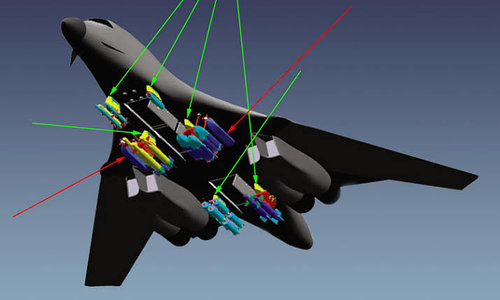
(Not official. For creative use)
Non-wired stations are shown in red arrows.
Loadout for Agm 86B on B-1b prior to Salt2 -
Fwd - 2x(2)
Int - 2x(2) main station + 2x(1) abreast station
Aft - 2x(2)
Salt2 brought it down to 12 and these 2 stations were not used.
- Joined
- 16 April 2008
- Messages
- 10,595
- Reaction score
- 18,148
Those pics are B-1R; are all the hardpoints necessarily in the same spots as the B-1B?
I only ask because Jenkins is very good otherwise, and it seems odd he'd be wrong on those two pylon locations. Unfortunately, the book has no drawing of all the pylon locations.
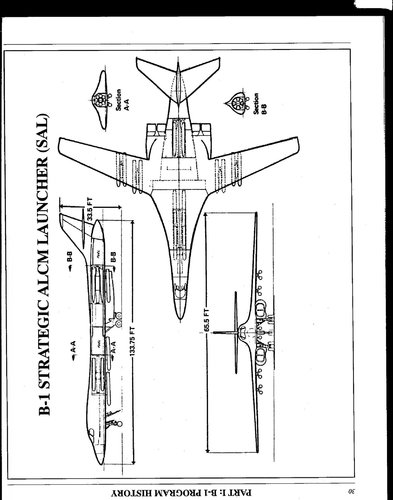
And now for something completely different --proposed Strategic ALCM Launcher configuration of the B-1A from 1979. Very different layout, with six single ALCMs under the fuselage and four twins under the wings. Plus 16 on two internal rotary launchers (total 30 ALCMs), with fuel tanks rearranged to make it all fit, I think. Obviously, this was not an as-built configuration, though.
I only ask because Jenkins is very good otherwise, and it seems odd he'd be wrong on those two pylon locations. Unfortunately, the book has no drawing of all the pylon locations.
And now for something completely different --proposed Strategic ALCM Launcher configuration of the B-1A from 1979. Very different layout, with six single ALCMs under the fuselage and four twins under the wings. Plus 16 on two internal rotary launchers (total 30 ALCMs), with fuel tanks rearranged to make it all fit, I think. Obviously, this was not an as-built configuration, though.
Attachments

- Joined
- 3 June 2011
- Messages
- 20,935
- Reaction score
- 19,156
Those pics are B-1R; are all the hardpoints necessarily in the same spots as the B-1B?
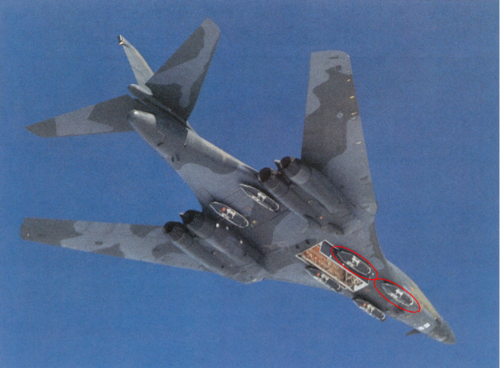
This box art from years ago suggests the same location:

The video looks like they've got one big missile on each of these positions:
apparition13
I really should change my personal text
- Joined
- 27 January 2017
- Messages
- 758
- Reaction score
- 1,397
I think that makes way more sense than destroying production lines. Keep the line, even if nothing is being produced (although ideally you should have some minimal production to keep the supply and spares lines intact), until a replacement is in production. That way if there is an emergency you can build something rather than having no options. Witness the C-17 and F-22 debacles, with lines destroyed and then - hey, we could use some more of those.We could see something similar on the other shore of Atlaintic ocean (Pacific as well) - Russia restore production of Tu-160 Blackjacs after decades of launching the last (Soviet-time) example. I'm sure that's not an easy task, though...
Difference is the line never went anywhere. It just collected dust. Big difference.
Those are the six two station pylons. The two single pylons aren't attached.Those pics are B-1R; are all the hardpoints necessarily in the same spots as the B-1B?
This box art from years ago suggests the same location:
View attachment 640619
The video looks like they've got one big missile on each of these positions:
View attachment 640620
Last edited:
Bhurki
ACCESS: Secret
- Joined
- 16 July 2020
- Messages
- 345
- Reaction score
- 389
The model art most likely represents Agm-86.
Loadout for Agm 86B on B-1b prior to Salt2 -
Fwd - 2x(2)
Int - 2x(2) main station + 2x(1) abreast station
Aft - 2x(2)
Similar threads
-

-
 AMSA Program & B-1 Bomber projects
- Started by overscan (PaulMM)
- Replies: 193
-

-

-