Given the rapidityof AESA development cutting back on a radar may well be a pause for future advances.

Miniature munitions are happening but longer range and the requirement for deeper ground/steel/concrete penetration munitions will assure replacing the B-1+2 ,will take a long time.
 
The precision and reduced size of weapons would seem to make a large bomber unneeded.
Ignoring nuclear weapons, there's still a need for heavy bunker busters and long range missiles. Both of which are big and bulky, and usually need to be carried en masse.

With long-range missiles, B-52s with LRSO or AGM-158 carry 20 while best-guess for B-21 is 8. So you'd need 2.5x as many B-52s to carry the same load.

And of course there's the fact that B-21s carry half the load of a B-2. (Maybe 3/4, but heavy bunker busters only half.)


The B-52 will be around for what, another 30 years of it does finally get new engines and electronics.
Which means that we need to start planning the replacement in less than a decade.
 
Part two of the Rockwell B-1 story has been uploaded onto YT:


The B-1 Lancer was a highly innovative design, capable of high-speed, low-altitude flight and potentially could have been a vital buttress to the United States Nuclear Triad. But as we discuss in this second part of the B-1 story, post the Vietnam War, military spending was very much at the forefront of turbulent economic times. New President Jimmy Carter had to make a crucial decision about the future of the B-1.​
Buy The Supersonic BONE: A Development and Operational History of the B-1 Bomber by Kenneth P. Katz at The Aviation Show Bookshop. 10% of each sale supports the show.
UK: https://uk.bookshop.org/a/16621/97813...https://www.youtube.com/redirect?ev...kshop.org/a/16621/9781399020299&v=PDsv29T6LjA
US: https://bookshop.org/a/111804/9781399...https://www.youtube.com/redirect?ev...shop.org/a/111804/9781399020299&v=PDsv29T6LjA

0:00 Introduction to the B-1 Bomber
0:37 Technical Features of the B-1
8:45 Initial Findings and Performance
12:08 Political Context and Controversy
14:55 The Rise of Cruise Missiles
16:04 The B-1's Uncertain Future
17:16 President Carter's Final Decision
 
No, I meant a new-production aircraft that was a supersonic cruise missile carrier, like the B-1A and Tu-160 were designed to be.

But yes, I do think that we're looking at retiring half the B-1s, then the B-2s, and then the rest of the B-1s.
So, some B-52s might actually become candidates for one hundred years of active service? And yes, this is an actual non-rhetorical question.
 
So, some B-52s might actually become candidates for one hundred years of active service? And yes, this is an actual non-rhetorical question.
Possibly, it'll be really close.

IIRC the life-limiting part is the upper wing skins, it isn't cost-effective to replace those huge panels. But they age out at 37,000 hours or so. There was a whole poster/image showing the life limits, IIRC it was posted in 2016. Average B-52 life at the time of the poster was ~21,000hrs. So, 16k hours life remaining. Average 350 hours a year means 45 years and a bit life remaining from 2016. Which brings us to 2061 or 62 for the last year of the Buff.
 
Here is part 3 of the B-1 Story:


A new president brings a new future to the B-1 Lancer program as the Reagan rearmament program sees development of the B-1 accelerated. The concurrent development and production brings its own headaches as the Lancer matures in time for a twenty year period of constant operations over Afghanistan and Iraq.​
-----------------------------------------------------
0:00 The B-1's Resurrection
4:10 Reagan's Military Buildup Begins
6:15 Key Changes in B-1 Development
8:47 The B-1's Entry into Service
11:35 Concurrency and Its Challenges
15:53 The Cold War Ends: A New Mission?
18:31 The B-1's Transformation in the 1990s
20:25 The B-1's Role in Modern Conflicts
22:19 Adapting to a New Warfare
 
I need some help...

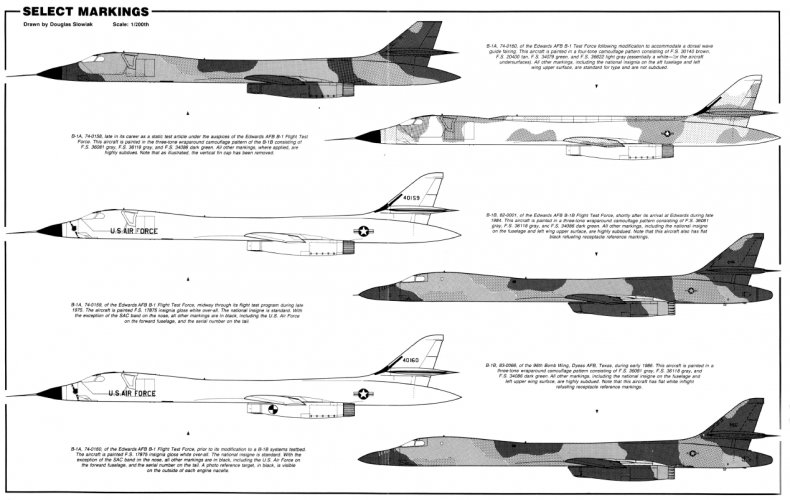
I'm willing to realize an artwork of mine about the first B-1A.
Did someone has high res image of the crew capsule area, especially the various markings?
I cannot a decent photo of such markings and I cannot find reference anywhere.

Thanks in advance.
Giuseppe
 
Here is part 4 of the B-1 story:


The B-1B Lancer has been in service for 40-years and her later life has been incredibly busy. With the Lancer's replacement, the B-21 Raider, taking to the skies, you would think the B-1B could look forward to a well earned rest. But, as Kenneth P. Katz brings up to date on the B-1's story, we see that the Lancer's story is far from done.​
0:00 The B-1's Evolving Role
1:45 Modernization and Technological Updates
3:41 Recent Incidents and Losses
7:18 Sustainability Challenges
8:59 Parts and Supply Chain Issues
11:28 Future of the B-1 Bomber
15:35 Recent Combat Operations
19:17 The B-1's Endurance and Future Prospects
22:52 The Legacy of the B-1 Bomber, so far
 
I do not see how the B-1s can manage another decade, even if you retired half the force to scavenge parts and retain the airframes in the best condition.

B-2 on the other hand has plenty of life in it, though it is incredibly expensive to maintain a small force of such a complicated aircraft. But the capability is still unique, and until there’s a hundred B-21s the B-2s contribution would still be huge.
 
The B-1 is currently the premiere anti shipping platform. I assume these upgrades are for more external racks to carry more munitions or outsized hypersonics. Budget hell for sure but it will be cool to see 4 strategic bombers operating together.
 
The B-1 is currently the premiere anti shipping platform. I assume these upgrades are for more external racks to carry more munitions or outsized hypersonics. Budget hell for sure but it will be cool to see 4 strategic bombers operating together.

I honestly do not see much utility in external stores given the weight and drag associated with it. The only advantage I see is that it might allow oversized weapons like HACM.

I kinda question whether retaining the B-1 that long is cost effective and if this is not just another Trump appointee making unrealistic choices that will be reversed in two years.

Retaining B-2 on the other hand seems sound until the USAF is flush with B-21s.
 
Is this not the third aircraft returned to service to meet the congressionally mandated level of 45? IIRC only one more airframe is retained in top restorable condition, with maybe two more marked as off limits for parts and potentially restorable.

I really doubt the timeline of keeping B-1s for another decade, and if that does happen, I would guess it still involves the retirement and canibalization of about 40% of the force. The base restructuring for B-21 seems to indicate the B-1s get consolidated at Dyess.
 
Last edited:
Can you give a quick summary of the future weapons that he thinks will be integrated?
 
I think the B-1 is about the most beautiful aircraft ever made.

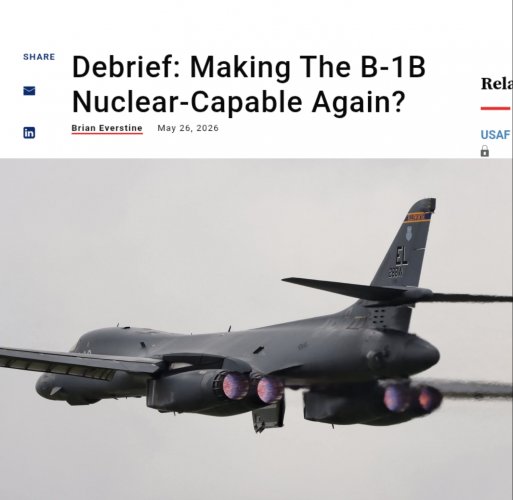
That said, making it nuclear capable is kinda like refilling a disposable butane lighter.
 
I admit I don't pay any attention to nuclear capabilities at all, but I remember the B-1 was designed as a nuker from the onset, so what gives?
 
I admit I don't pay any attention to nuclear capabilities at all, but I remember the B-1 was designed as a nuker from the onset, so what gives?
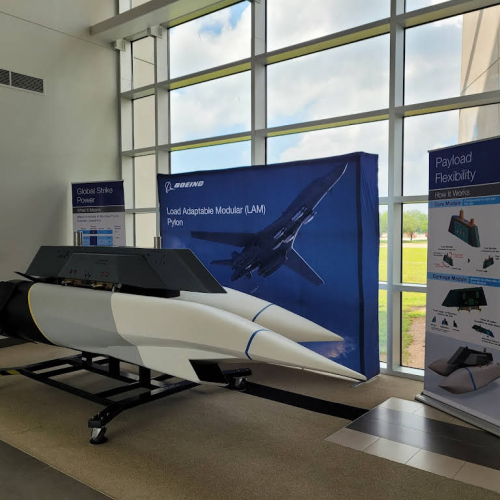
As part of one of the arms reduction treaties, the B-1s were de-nuked. All nuclear equipment removed, including the external pylons and the mounts/structure for them. Command and control gear, gone.

Still left them capable of carrying 24x 2000lb bombs, or likely 50% above what a B-52 can carry in smaller weapons.
 
Still left them capable of carrying 24x 2000lb bombs, or likely 50% above what a B-52 can carry in smaller weapons.

24 Mk-84s is 48,000lb and IIRC the B-52 can carry something like 60,000lb.
 
24 Mk-84s is 48,000lb and IIRC the B-52 can carry something like 60,000lb.
That's counting external pylons for the B-52.

While the rotary launcher or however the BUFF carried 2000lb weapons meant ~16,000 internal. 500lb bombs on the Big Belly Racks, the BUFF wins at 42,000lbs. 750s on Big Belly racks makes 31,000lbs internal load.

Of course, that's also not counting the new 6x5000lb HSABs or whatever they're called that the ARRWs hang from.
 
"hard points under the wings"
Emphasis mine.

Say what now?

When did B-1s have under-wing pylons?

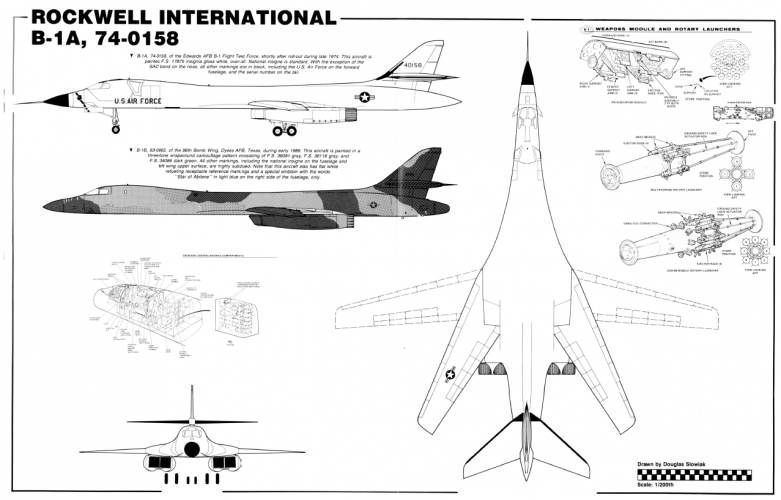
Now, fuselage pylons they had. 8 of them, 6 dual/~10,000lb load and 2 single/~5000lb load. The two forward-most dual pylons are basically reserved for targeting pods (I haven't seen a photo of a B-1 without a Sniper pod in a long time) and maybe EW pods, though the full press release says they re-designed all the dual pylons. So maybe the forward two are set up to hold a Sniper pod plus 3x weapons?
 
Hey everybody.
I heard the early version/concept of B1 had a tail gun. Does anyone have a picture of that?

Thank you.
 

Similar threads

Back
Top Bottom