
Oh, just for fun, can we try to identify the whole weapons spread in that photo?

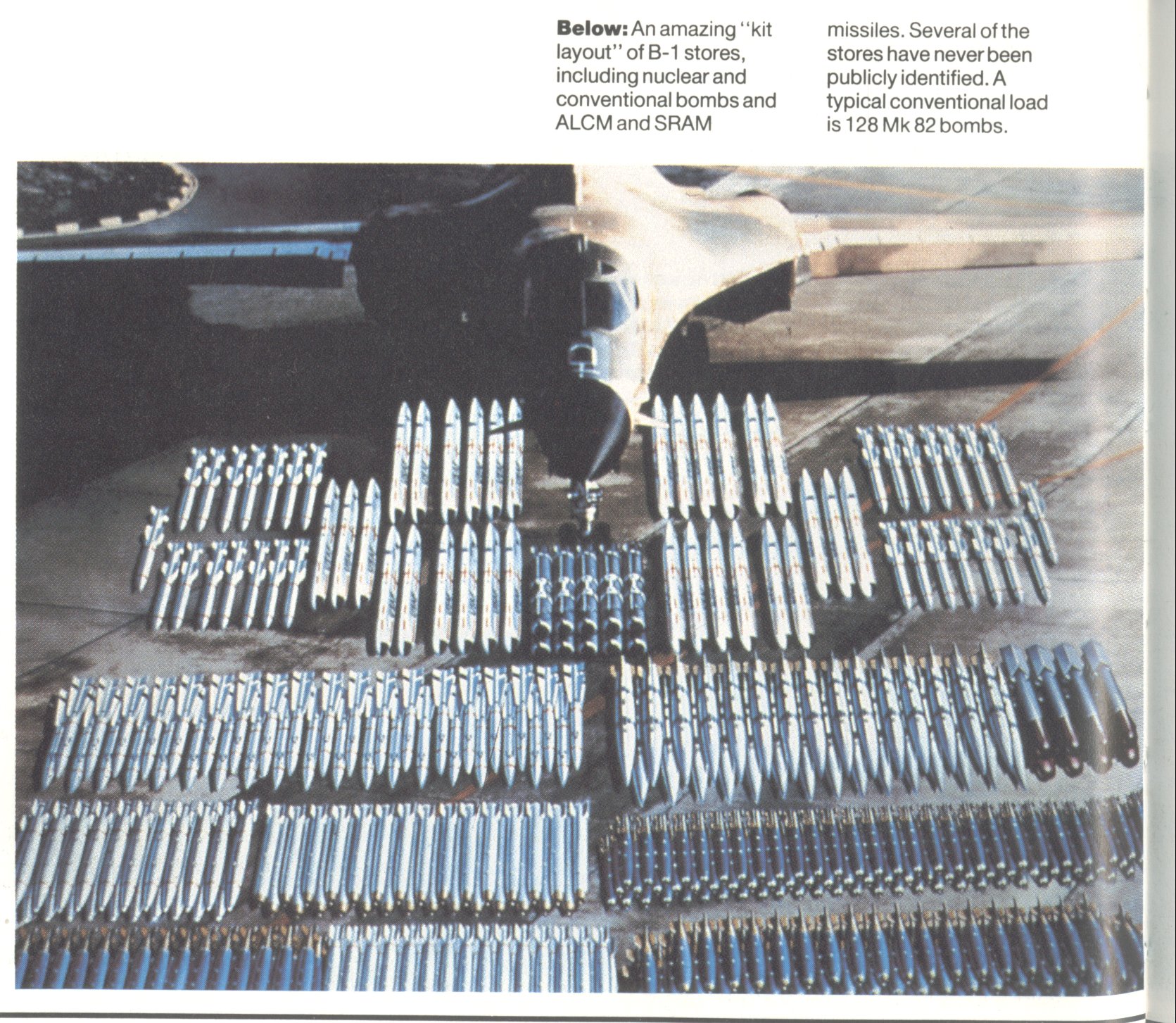
b1a-armament.jpg

Top row looks like: 15x Harpoons, 15x ALCMs, 10x B57s? 15x ALCMs, and 15x Harpoons
2nd row looks like: 38x Phoenix, 30x SRAM, 8x B28?
3rd row looks like: 22x B61?, 30x CBUs, 84x 500lb bombs
bottom row looks like: 2000lb bombs, maybe B83s, 1000lb bombs
To drag the picture over here.
ALCMs must have been the shorter AGM-86As.
Must be, but the contrast paint for drops makes it really hard to see the shapes.
 
如果有人很乐意拥有这些北美Rockwell PR图纸(NA-73-400,REV 9-83)的高分辨率版本,我将非常有义务与我分享它们。谢谢。
Hello, may I ask if this drawing is still available? I really want to get it.
 

B-1B To Finally Get New External Pylons Drastically Expanding Missile Carriage Potential​


Interesting, but what about the original external stores pylons designed and built for the B-1Bs in the 1980s? Do they still exist in storage or were they scrapped after the B-1B's external weapons carriage capability was eliminated when its' nuclear-bomber role was cancelled?
 
Interesting, but what about the original external stores pylons designed and built for the B-1Bs in the 1980s? Do they still exist in storage or were they scrapped after the B-1B's external weapons carriage capability was eliminated when its' nuclear-bomber role was cancelled?

They would have a hopelessly out of date wiring bus even if they still existed. Also the new pylons seem purpose built for external hypersonic weapon carriage. There’s little reason to carry AGM-158 externally; the internal load of 24 is apparently already a heavy load without additional weight and drag.
 
Defense Updates has put out a video concerning the new Large Adaptable Modular pylons for carrying external stores on the B-1B:


The B-1B Lancer is expected to be retired by the mid-2030s as the Northrop Grumman B-21 Raider comes online. However, to avoid a potential capability gap in the event of delays to the Raider program, the U.S. Air Force has continued to upgrade the B-1B fleet, particularly in terms of payload enhancements.​
In line with this effort, Boeing has been awarded a new contract to produce external pylons for the B-1B. These pylons, known as the Large Adaptable Modular (LAM) system, have been in development for several years and are designed to significantly expand the bomber’s versatility. Once integrated, they are expected to boost the B-1B’s payload capacity by up to 50 percent, allowing it to carry a wider array of heavier munitions.The deal is worth approximately $78.7 million. It stipulates an initial $10 million in funding for 2025, with the remaining balance to be allocated in 2026.​
In this video, Defense Updates analyzes how B-1B’s lethality would be greatly increased by Large Adaptable Modular pylons?
#defenseupdates #b1b #usmilitary
Chapters:
0:00 TITLE
00:11 INTRODUCTION
01:21 SPONSORSHIP - NordVPN
01:55 THE DEAL
03:16 B-1B with LAM pylon
06:25 ANALYSIS
 
They would have a hopelessly out of date wiring bus even if they still existed. Also the new pylons seem purpose built for external hypersonic weapon carriage. There’s little reason to carry AGM-158 externally; the internal load of 24 is apparently already a heavy load without additional weight and drag.
The range hit of carrying 12 AGM-158s externally would be good to know. If one bay carried a fuel tank, one B-1 could carry 28 AGM-158s. Range would be impacted, but I think the AF wants to maximize weapons load, especially if they are short on bombers. A three bomber cell could carry 84 JASSMs/LRASMs. Expand that out to 30 or 40 B-1 and that's a lot of firepower that the USAF can apply. A B-1 is much more survivable than a cargo aircraft with Rapid Dragon.

I'd try to keep the B-1 around until sufficient numbers of B-21s are purchased.
 
These hypotheticals often are predicated by limitless JASSM and LRASM stocks. CONOPS that rely on massed volleys of these weapons plus whatever you can put OTOT is questionable and not workable beyond a week in a high intensity peer level conflict, even if it could be MacGuyvered by the US.
 
These hypotheticals often are predicated by limitless JASSM and LRASM stocks. CONOPS that rely on massed volleys of these weapons plus whatever you can put OTOT is questionable and not workable beyond a week in a high intensity peer level conflict, even if it could be MacGuyvered by the US.
Agreed, the only way this could work is with the recent developments in low cost cruise missiles.
 
I just stumbled across this "Wings over the Rockies" video concerning the difference between the B-1A and B-1B:


This week, we take an in-depth look at the Wings Over the Rockies Museum's Rockwell B-1A Lancer. Joe Wilding helps us delve into the differences between the B-1A and the operational B-1B, highlighting the design changes made to the A-model to meet the evolving role that the B-model continues to fulfil today.
Chapters
0:01 Introduction
1:43 Exploring the B-1A Aircraft
3:46 Transitioning to the B-1B
5:45 Ejection Mechanisms Explained
8:39 The Importance of Wing Design
11:34 Overview of the Aircraft Structure
17:04 Discussion on Bomb Bays
27:32 Features and Capabilities of the B-1
29:35 Conclusion and Acknowledgments
 
For an aircraft with no replacement planned, the B-1Bs sure have gotten a lot of use lately. If budgets allowed, I'd like to see a new large heavy bomber developed.
 
The USAF has already decided on a two plane fleet of B-21s and B-52s. That’s it, do not pass go. More B-21s could be on the table, but that’s all.
 
For an aircraft with no replacement planned, the B-1Bs sure have gotten a lot of use lately. If budgets allowed, I'd like to see a new large heavy bomber developed.
In all honesty, the most likely heavy bomber development would be something closer to a B-1A or Tu-160. High altitude supersonic, cruise missile carrier.

But I suspect that the more likely answer would be either a tactical bomber (FB-111 or B-58 to Tu22M class) or just a whole lot more B-21s to replace all the Strike Eagles.
 
In all honesty, the most likely heavy bomber development would be something closer to a B-1A

Talking about the B-1A, Scott, what happened to that post-Cold War proposal about 25 years ago to modify some (If not all) of the B-1Bs air-intake assemblies to restore variable air-inlet geometry to give them the M2 dash capability (Lost when the B-1A was cancelled).​
 
Talking about the B-1A, Scott, what happened to that post-Cold War proposal about 25 years ago to modify some (If not all) of the B-1Bs air-intake assemblies to restore variable air-inlet geometry to give them the M2 dash capability (Lost when the B-1A was cancelled).​
Was that part of the B-1R proposal?

I suspect it got eaten by the GWOT spending. Plus, the radar blockers in the inlet would likely need to be changed.
 
So the future force structure of the USAF bomber force will only be two bombers until the B-52 replacement bomber turns up.
 
So the future force structure of the USAF bomber force will only be two bombers until the B-52 replacement bomber turns up.

Yes. B-1s will start retiring first, though it is unclear what the exact order will be. Based on the base upgrade schedule, it is possible about half the B-1s retire, then the B-2, then the rest of the B-1s. But the USAF has not announced any final decisions; I think they state that retirements will be ‘events driven’ or something like that. But they have explicitly stated the B-2 will be retired as well and they will become a two bomber force.
 
Very depressing if true.
The B-1s are pretty well worn to the bone (pardon the pun, too good to pass up) after Afghanistan. Too much time spent puttering around at relatively low airspeed really messed up the wings.

Then there's the B-2s, which cost an arm and a leg to maintain. Even if they aren't worn out.

Hopefully the USAF starts a "B-52 replacement" program sometime around the late 2030s.
 
A decade long timeline for retirement is effectively no time line. The "battlefield pez dispenser" as a senior test officer crew man once described it. Theatre cdrs demand maximiumized options, so It won't likely cease being upgraded as long as munition missile development takes precedence.
 
In all honesty, the most likely heavy bomber development would be something closer to a B-1A or Tu-160. High altitude supersonic, cruise missile carrier.

But I suspect that the more likely answer would be either a tactical bomber (FB-111 or B-58 to Tu22M class) or just a whole lot more B-21s to replace all the Strike Eagles.
A $1.5 trillion budget makes a more things possible... if they can pass it!
 
A $1.5 trillion budget makes a more things possible... if they can pass it!
Pure fantasy; they will not even fund the current conflict. The B-1s will be retired as quickly as legally possible, though it might be a two step process if the USAF deems B-2 even more burdensome to maintain.
 
Pure fantasy; they will not even fund the current conflict. The B-1s will be retired as quickly as legally possible, though it might be a two step process if the USAF deems B-2 even more burdensome to maintain.
No, I meant a new-production aircraft that was a supersonic cruise missile carrier, like the B-1A and Tu-160 were designed to be.

But yes, I do think that we're looking at retiring half the B-1s, then the B-2s, and then the rest of the B-1s.
 
I stumbled across this interesting B-1 video a couple of days ago:


The B-1 bomber is an aircraft that captivates all aviation buffs, a true creature of politics and engineering. The B-1's journey to 40 years on the front line of the US Air Force has not been straightforward. Join us as Kenneth P. Katz, author of The Supersonic BONE, describes the journey to the AMSA program that saw the creation of a series of bombers, like the wonderful madness of the XB-70 Valkyrie, that informed what would become the B-1.​
0:05 The B-1: A Creature of Politics
1:27 Technological Advances in Aviation
4:54 The B-70: Wonderful Madness
9:10 The Emergence of the Triad
11:50 Shaping the B-1A Specifications
17:30 Competing for the AMSA Contract
 
In all honesty, the most likely heavy bomber development would be something closer to a B-1A or Tu-160. High altitude supersonic, cruise missile carrier.

But I suspect that the more likely answer would be either a tactical bomber (FB-111 or B-58 to Tu22M class) or just a whole lot more B-21s to replace all the Strike Eagles.
The precision and reduced size of weapons would seem to make a large bomber unneeded. The B-52 will be around for what, another 30 years if it does finally get new engines and electronics. Already cutting back on the radar though which to me is the start of death by a thousand cuts...

Enjoy the Day! Mark
 
Last edited:

Similar threads

Back
Top Bottom