
You are using an out of date browser. It may not display this or other websites correctly.
You should upgrade or use an alternative browser.
You should upgrade or use an alternative browser.
Little-Known French Projects and Prototypes
- Thread starter hesham
- Start date

- Joined
- 26 May 2006
- Messages
- 37,573
- Reaction score
- 19,617
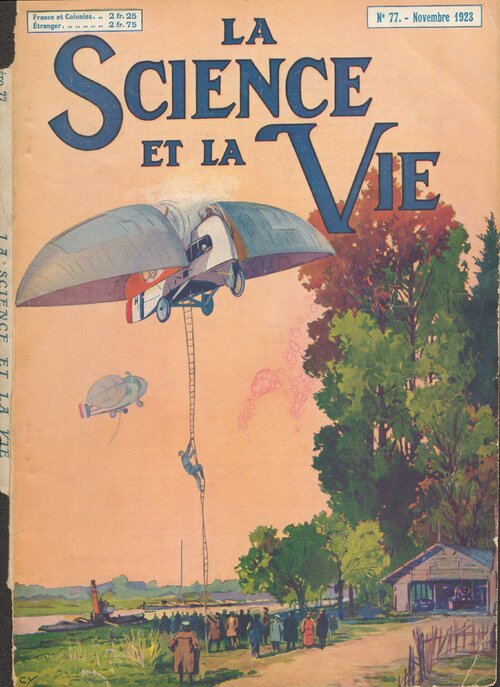
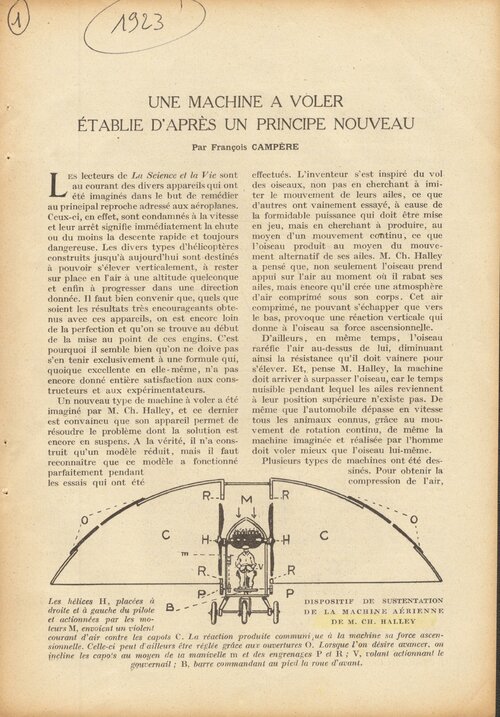
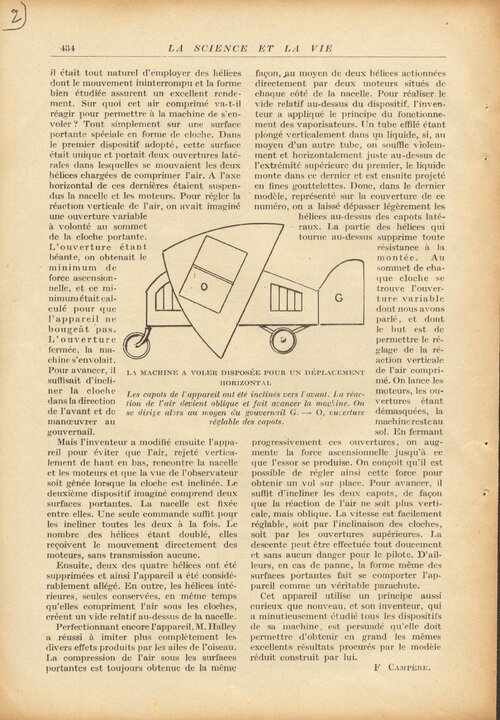
hey community, a little trouvaille from 1923, name : M. CH . HALLEY
Strange design,never heard about it,and no sign in TU magazine ?,thank you Boyington.
This concept make smore sense than the next dozen flying saucer proposals. Just use centrifugal compressor(s) to blow air outwards across (chord-wise) an air-foil shaped ring.From TU 170,
here is a helicopter,designed by Mr. Henry Bergier in 1937.
Bergier Annular lift-generating device 1930,
in 1930 Henri-Eugène-Philippe Bergier patented this machine announced as « self-lifting ». It was based on the « principle of the kite » where the kite cellulas, reduced to aircraft wings (A) were lifted by the air stream generated by contra-rotating turbines (E-F).
Modelstories: analyses de maquettes d'avions.
Modelstories, avions & maquettes. Modelstories, kits & planesmodelarchives.free.fr
That diamond-shaped fuselage reminds us of Lobet Ganagobie. Ganagobie went through several iterations - mostly to accommodate heavier engines. Chris Falconar even sold Ganagobie plans.The Gaston Sablé / Société Mayennaise d'Aviation Légère/S.M.A.L 1937 :
View attachment 674980
View attachment 674981
The S.M.A.L built 2 planes :
They both get through WW II , and monsieur Sablé tried to sell them after the war :
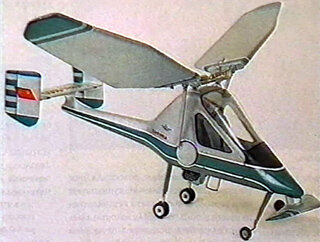
I think we have to look on the side of autogyre like La CiervaFrom Pegase 2007,
what was this ?.

fabulousfour
ACCESS: Confidential
- Joined
- 20 October 2009
- Messages
- 83
- Reaction score
- 159
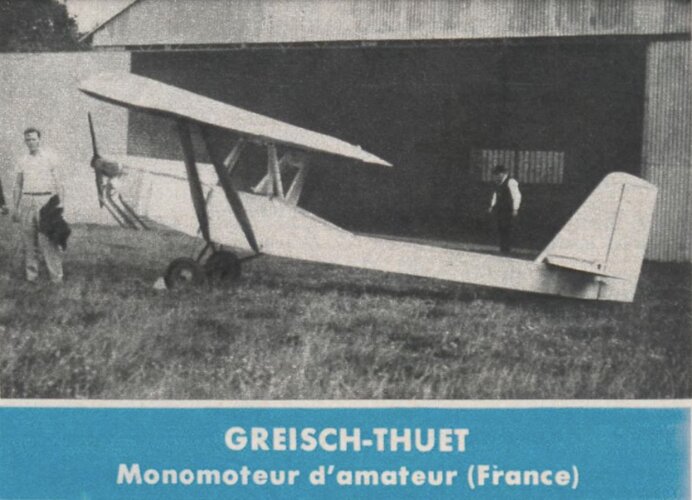
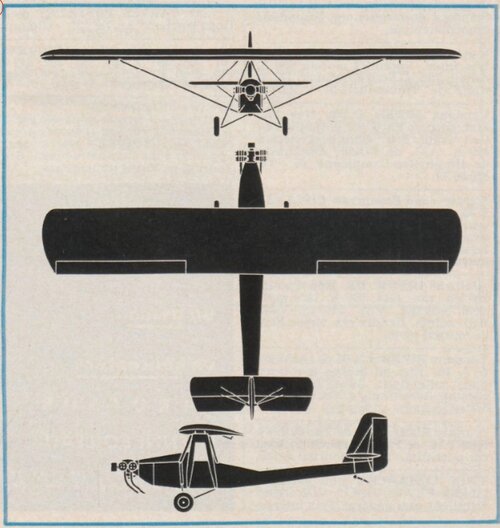
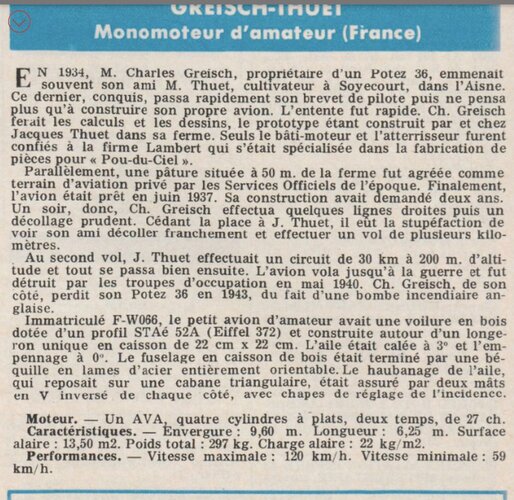
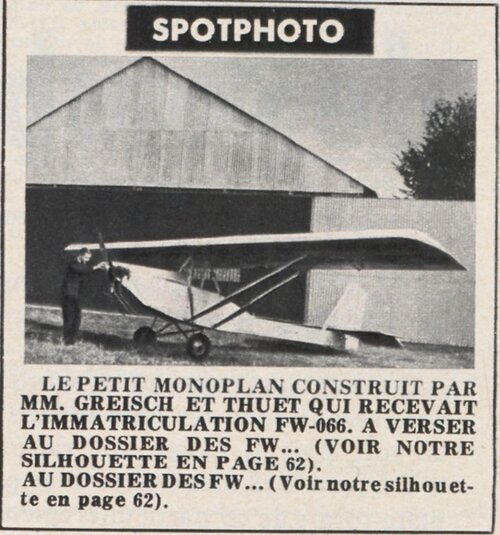
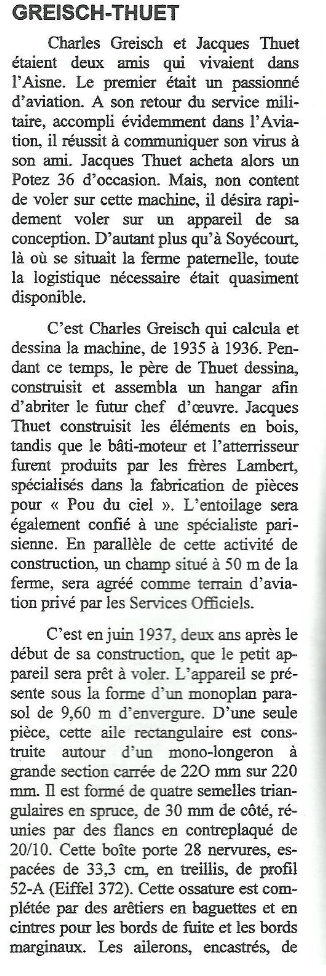
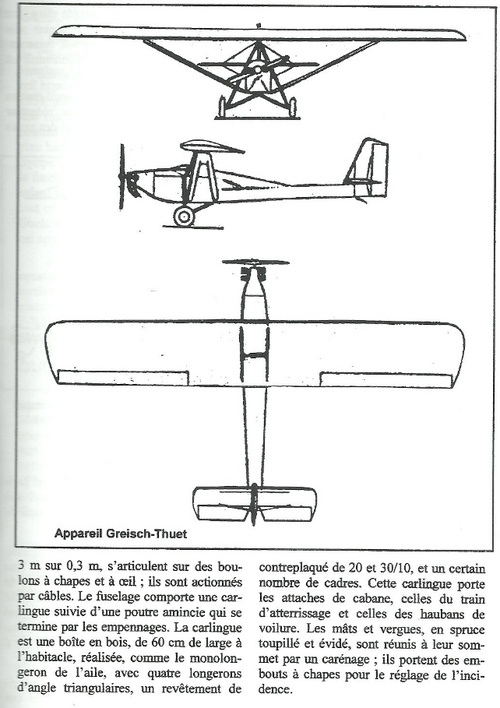
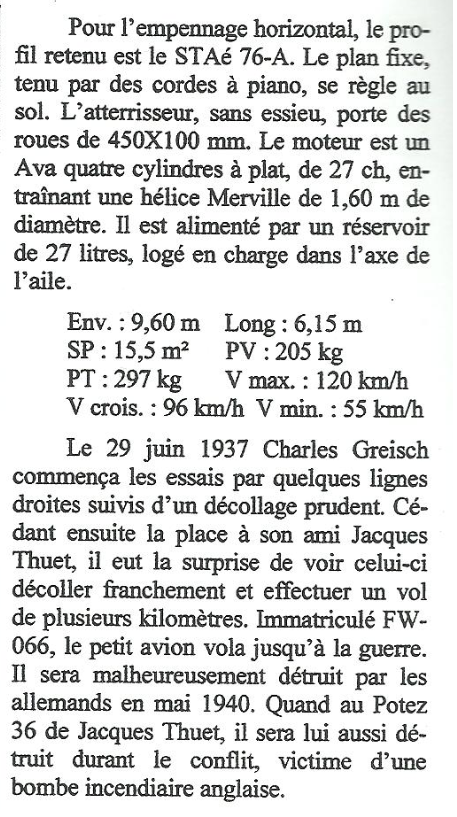
I think this one is new here, the amateur-built Greisch-Thuet monoplane (from Aviation Magazine International February 1967)
My French isn't very good, but it seems that the first flight took place in 1937 after 2 years of construction, the aircraft flew regularly until May 1940 when it was destroyed by occupation troops.
Powered by a 4-cylinder two-stroke AVA engine with 27 hp, registration was F-W066.


My French isn't very good, but it seems that the first flight took place in 1937 after 2 years of construction, the aircraft flew regularly until May 1940 when it was destroyed by occupation troops.
Powered by a 4-cylinder two-stroke AVA engine with 27 hp, registration was F-W066.
- Joined
- 26 May 2006
- Messages
- 37,573
- Reaction score
- 19,617
- Joined
- 26 May 2006
- Messages
- 37,573
- Reaction score
- 19,617
From TU 182,
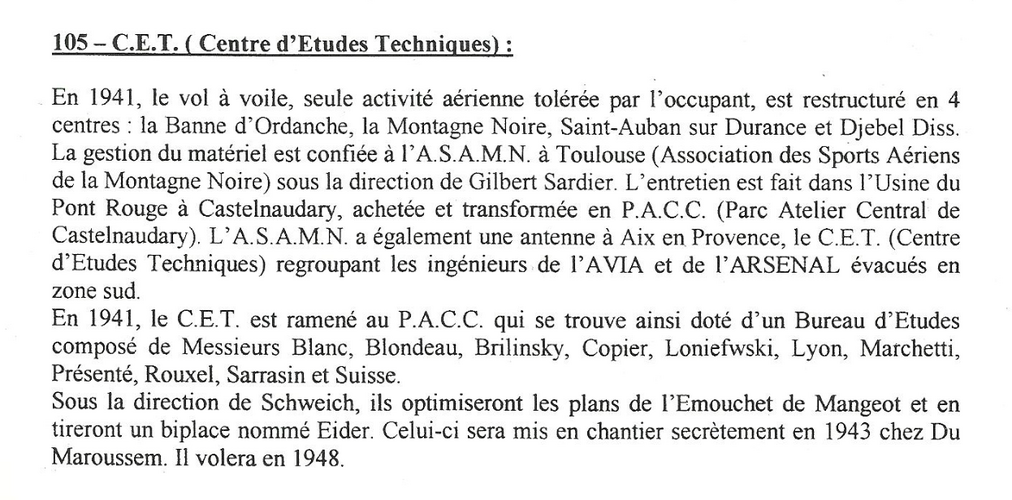
C.E.T.
(Technical Studies Center):
In 1941, gliding, the only aerial activity tolerated by the occupier, was restructured into 4 centers: Banne d’Ordanche, Montagne Noire, Saint-Auban sur Durance and Djebel Diss.
Material management is entrusted to A.S.A.M.N. in Toulouse (Air Sports Association
de la Montagne Noire) under the direction of Gilbert Sardier. Maintenance is carried out in the Factory Pont Rouge in Castelnaudary, purchased and transformed into a P.A.C.C. (Central Workshop Park Castelnaudary). A.S.A.M.N. also has a branch in Aix en Provence, the C.E.T. (Center of Technical Studies) bringing together engineers from AVIA and ARSENAL evacuated in southern zone.
In 1941, the CET. is brought back to the P.A.C.C. which is thus equipped with a Design Office composed of Messrs Blanc, Blondeau, Brilinsky, Copier, Loniefwski, Lyon, Marchetti, Presented, Rouxel, Sarrasin and Suisse.
Under the direction of Schweich, they will optimize the plans of Emouchet de Mangeot and in will pull a two-seater named Eider. This will be started secretly in 1943 at Du Maroussem. It will fly in 1948.
C.E.T.
(Technical Studies Center):
In 1941, gliding, the only aerial activity tolerated by the occupier, was restructured into 4 centers: Banne d’Ordanche, Montagne Noire, Saint-Auban sur Durance and Djebel Diss.
Material management is entrusted to A.S.A.M.N. in Toulouse (Air Sports Association
de la Montagne Noire) under the direction of Gilbert Sardier. Maintenance is carried out in the Factory Pont Rouge in Castelnaudary, purchased and transformed into a P.A.C.C. (Central Workshop Park Castelnaudary). A.S.A.M.N. also has a branch in Aix en Provence, the C.E.T. (Center of Technical Studies) bringing together engineers from AVIA and ARSENAL evacuated in southern zone.
In 1941, the CET. is brought back to the P.A.C.C. which is thus equipped with a Design Office composed of Messrs Blanc, Blondeau, Brilinsky, Copier, Loniefwski, Lyon, Marchetti, Presented, Rouxel, Sarrasin and Suisse.
Under the direction of Schweich, they will optimize the plans of Emouchet de Mangeot and in will pull a two-seater named Eider. This will be started secretly in 1943 at Du Maroussem. It will fly in 1948.
Attachments
Last edited:
- Joined
- 26 May 2006
- Messages
- 37,573
- Reaction score
- 19,617
From TU 183,
CLAUDEL:
President of a group called “L’aile tende”, Roland Claudel will study and create
gliders of early Zôgling type. A first machine, called RC-2, would have flown in
1933 followed by an RC-3.
A motor glider, known as RC-4, would also have been studied, it is unknown if it was built.
This group was at the origin, in 1936, of the Popular Air Sports Federation.
CLAUDEL:
President of a group called “L’aile tende”, Roland Claudel will study and create
gliders of early Zôgling type. A first machine, called RC-2, would have flown in
1933 followed by an RC-3.
A motor glider, known as RC-4, would also have been studied, it is unknown if it was built.
This group was at the origin, in 1936, of the Popular Air Sports Federation.
Attachments
Last edited:
- Joined
- 26 May 2006
- Messages
- 37,573
- Reaction score
- 19,617
From TU 183,
COLLET:
In 1923, a man named H. Collet entered a machine in the Grand Prix de la Moto-Aviette du Petit Parisien. It did not, however, appear for the test and the configuration of this hypothetical machine remains unknown to the editor.
COLLET:
In 1923, a man named H. Collet entered a machine in the Grand Prix de la Moto-Aviette du Petit Parisien. It did not, however, appear for the test and the configuration of this hypothetical machine remains unknown to the editor.
Attachments

Last edited:
- Joined
- 26 May 2006
- Messages
- 37,573
- Reaction score
- 19,617
From TU 183,
CONTE,
In his book “Light Aviation in Algeria (1909-1939)”, Pierre Jarrigue quotes a manufacturer amateur named Conte who is said to have built a machine in
Miliana. However, this construction can dating back to before the First World
War.
CONTE,
In his book “Light Aviation in Algeria (1909-1939)”, Pierre Jarrigue quotes a manufacturer amateur named Conte who is said to have built a machine in
Miliana. However, this construction can dating back to before the First World
War.
Attachments

Last edited:

- Joined
- 25 July 2007
- Messages
- 4,788
- Reaction score
- 5,291
... In his book “Light Aviation in Algeria (1909-1939)”, Pierre Jarrigue ...
It would probably be better not to translate book titles when quoting. Instead ...
In his book «L'Aviation Légère en Algérie (1909-1939)», Pierre Jarrigue cites an amateur builder named Conte who allegedly built a machine in Miliana. However, this construction may date back to before the First World War.
Title L'aviation légère en Algérie (1909-1939)
Author Pierre Jarrige
Publisher P. Jarrige, 1992
ISBN 2950662005, 9782950662002
Besides Conte, Pierre Jarrigue mentions other amateur builders in Algeria: Fournier (Marengo), Mouraret, Ducceschi, Bonnefont-Péduplan, Seigle and Roland Lassale (Alger), Louis Poire and Paul Grégoire (Oran), Jean Olivier (Blida), the Jamme brother (Mascara), Marcel Brau (Hussein-Dey), and René Hirsch (Batna).
-- https://bibliotheque-aviation.com/wp-content/uploads/2021/11/47-Construction-amateur2.pdf
- Joined
- 26 May 2006
- Messages
- 37,573
- Reaction score
- 19,617
Thnak you my dear Apophenia,and from TU 183,
COQUERY:
In 1934, at the Club Aéronautique de Corbeil, Louis Coquery built a small
monoplane derived from the HM.8 and equipped with a 25 hp Anzani engine.
With a wingspan of 8.85 m and a length of 5 m, its bearing surface was
14 m2.
COQUERY:
In 1934, at the Club Aéronautique de Corbeil, Louis Coquery built a small
monoplane derived from the HM.8 and equipped with a 25 hp Anzani engine.
With a wingspan of 8.85 m and a length of 5 m, its bearing surface was
14 m2.
Attachments

Last edited:
- Joined
- 26 May 2006
- Messages
- 37,573
- Reaction score
- 19,617
From TU 183,
COULAUD:
During the summer of 1938, the Amicale d’Aviation Légère (A.A.L.) of Lyon
flew a light aircraft built by a of its members, Mr. Coulaud, in collaboration
with the engineer Arnaud. It will be noted that Mr. Coulaud was not a pilot
at the time and this machine was used for his first training. The device is a
parasol monoplane with open cockpit and powered by a 35 hp Poinsard.
The profile of the sail is a “Jacob profile” type 23012. After a few straight
lines on the Bron terrain and a slight increase in the incidence of the sail,
MM Fellot and Lacour made it make its first flights.
The aircraft, which was basically a derivative of the HM.8, survived the conflict
and was reactivated in 1944 in the absence of its designer then still a prisoner in Germany.
In 1948, the aircraft was taken over and improved, becoming the Coulaud-Meo 01
(F-WEAU). First equipped with a Mercedes 22 hp gearbox engine, it will be equipped with a 40 hp engine.
COULAUD:
During the summer of 1938, the Amicale d’Aviation Légère (A.A.L.) of Lyon
flew a light aircraft built by a of its members, Mr. Coulaud, in collaboration
with the engineer Arnaud. It will be noted that Mr. Coulaud was not a pilot
at the time and this machine was used for his first training. The device is a
parasol monoplane with open cockpit and powered by a 35 hp Poinsard.
The profile of the sail is a “Jacob profile” type 23012. After a few straight
lines on the Bron terrain and a slight increase in the incidence of the sail,
MM Fellot and Lacour made it make its first flights.
The aircraft, which was basically a derivative of the HM.8, survived the conflict
and was reactivated in 1944 in the absence of its designer then still a prisoner in Germany.
In 1948, the aircraft was taken over and improved, becoming the Coulaud-Meo 01
(F-WEAU). First equipped with a Mercedes 22 hp gearbox engine, it will be equipped with a 40 hp engine.
Attachments
Last edited:
- Joined
- 26 May 2006
- Messages
- 37,573
- Reaction score
- 19,617
From TU 183,
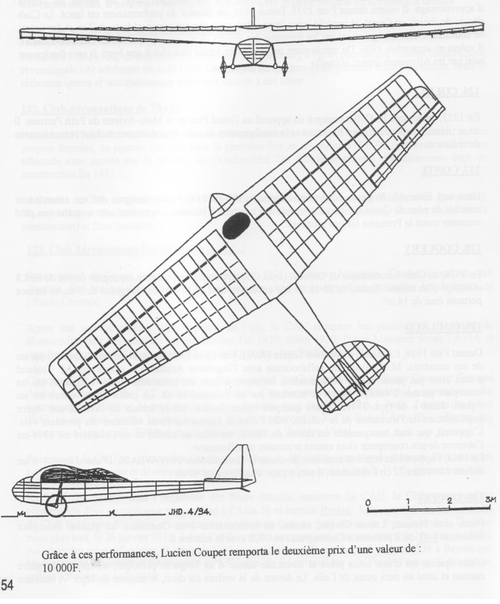
COUPET:
Pilot at Farman, Lucien Coupet, created, in collaboration with Guerchais, a monoplane glider called 1-01 which he presented to Combegrasse in 1922 with
the number 8.
The thick wing is in one piece and built around a main spar, spruce, of the type
box and located in the front third of the wing. The top of the sail is straight, the bottom in a slight V, achieving thus a thinning of the wing. The fins, long and narrow, are articulated on a false rear spar.
The one-piece fuselage also attaches under the wing using 4 bolts. Its section is
triangular; it is built around 3 cross-braced and cable-stayed spars. The position of
piloting is placed in front of the main spar. Only the head protrudes from the fuselage. The orders are classics: broomstick and rudder. The landing gear, initially composed of two skids elastic, will be replaced at the end of the first flight in August 1922 at Combegrasse, by a wheeled train, in steel tubes. Fully covered, the machine will then be lined with plywood on the rear half in order to improve its torsional strength.
Piloted by Coupet, it completed 19 flights selected by the jury between August 11 and 24. The longest will be 4 minutes and 50 seconds with an altitude gain of 53 m. On August 24, he covered 3.15 km in 4 minutes and 45 seconds, over a height difference of 600 m. |
When Coupet wanted to bring the device back to Toussus, he put it on a covered railway wagon.
of a tarpaulin. Unfortunately, a storm broke out, crushing the glider under the weight of the water accumulated on the tarpaulin. Only the main wing spar will be kept by Lucien Coupet as a souvenir.
COUPET:
Pilot at Farman, Lucien Coupet, created, in collaboration with Guerchais, a monoplane glider called 1-01 which he presented to Combegrasse in 1922 with
the number 8.
The thick wing is in one piece and built around a main spar, spruce, of the type
box and located in the front third of the wing. The top of the sail is straight, the bottom in a slight V, achieving thus a thinning of the wing. The fins, long and narrow, are articulated on a false rear spar.
The one-piece fuselage also attaches under the wing using 4 bolts. Its section is
triangular; it is built around 3 cross-braced and cable-stayed spars. The position of
piloting is placed in front of the main spar. Only the head protrudes from the fuselage. The orders are classics: broomstick and rudder. The landing gear, initially composed of two skids elastic, will be replaced at the end of the first flight in August 1922 at Combegrasse, by a wheeled train, in steel tubes. Fully covered, the machine will then be lined with plywood on the rear half in order to improve its torsional strength.
Piloted by Coupet, it completed 19 flights selected by the jury between August 11 and 24. The longest will be 4 minutes and 50 seconds with an altitude gain of 53 m. On August 24, he covered 3.15 km in 4 minutes and 45 seconds, over a height difference of 600 m. |
When Coupet wanted to bring the device back to Toussus, he put it on a covered railway wagon.
of a tarpaulin. Unfortunately, a storm broke out, crushing the glider under the weight of the water accumulated on the tarpaulin. Only the main wing spar will be kept by Lucien Coupet as a souvenir.
Attachments

Last edited:
- Joined
- 26 May 2006
- Messages
- 37,573
- Reaction score
- 19,617
From TU 183,
COURION:
Member of the Aero-Club des Landes, Charles Courion had, at the beginning
of 1934, under construction at the Ateliers Montois, a 15 hp Chaise motor
plane. The machine was to fly during the summer in the hands of its
construction engineer. The editor does not know any more.
COURION:
Member of the Aero-Club des Landes, Charles Courion had, at the beginning
of 1934, under construction at the Ateliers Montois, a 15 hp Chaise motor
plane. The machine was to fly during the summer in the hands of its
construction engineer. The editor does not know any more.
Attachments

- Joined
- 26 May 2006
- Messages
- 37,573
- Reaction score
- 19,617
From TU 193,
Belleville;
Jacques Delarue sends us a photo of a Pou du Ciel built by François
Belleville. This is a different machine from the HM-280 two-seater
F-PKFN from the sixties that flew from the field of Bourget-du lac.
I don't know if they were the same person or just similar names ?.
Attachments

- Joined
- 26 May 2006
- Messages
- 37,573
- Reaction score
- 19,617
From TU 186,
CAUX:
At the Combeprasse congress, Jules Caux had registered a helicopter. This
machine, equipped with skates, had a rotor of 5.50 m in diameter, a length
of 3.50 m and surface area of 20 m° and an empty weight of 32 kg. Finally
only the glider will be presented.
CAUX:
At the Combeprasse congress, Jules Caux had registered a helicopter. This
machine, equipped with skates, had a rotor of 5.50 m in diameter, a length
of 3.50 m and surface area of 20 m° and an empty weight of 32 kg. Finally
only the glider will be presented.
Attachments

- Joined
- 25 July 2007
- Messages
- 4,788
- Reaction score
- 5,291
At the Combeprasse congress, Jules Caux had registered a helicopter. This
machine, equipped with skates, had a rotor of 5.50 m in diameter, a length
of 3.50 m and surface area of 20 m° and an empty weight of 32 kg. Finally
only the glider will be presented.
That translation is quite garbled. And 'Combeprasse' is an obvious typo. Gliding activities took place on the slopes of the Puy de la Combegrasse near Clermont-Ferrand.
My take would be:
For the Combegrasse conference, Jules Caux initially registered a helicopter. This machine, equipped with skids, had a 5.50 m diameter rotor, disc area of 20 m2, overall length of 3.50 m, with an empty weight of 32 kg. In the end, only a glider would be presented.
By inference, this Caux "hélicoptère" would have been an unpowered gyroglider of some kind. That would also help explain its extremely low weight. [1] Still, it would have been one of the smallest-ever manned helicopters - with a slightly smaller rotor diameter than the Rotorcycle and even shorter than the Hiller.
Caux biplane glider: https://www.secretprojects.co.uk/th...ects-and-prototypes.15821/page-15#post-485712
__________________________________________________
[1] For comparison, the Hiller Rotorcycle weighed 140 kg (309 lbs) empty. But the Rotorcycle was powered by a Nelson H-63C engine - which, complete with cooling fan and shroud, weighed 34 kg (76 lb). Perhaps with the H-63C and its fuel systems completely removed, the empty weight could be brought down almost to the level of the Caux design?

avion ancien
The accidental peasant!
- Joined
- 6 March 2013
- Messages
- 386
- Reaction score
- 291
Whilst not averring that such has been used for the French/English translations on this thread (not knowing whether this is so), perhaps this demonstrates the 'down side' of using google translate, and similar mechanical translators, in isolation. Without, at least, a good working knowledge of the language being translated, it is difficult, perhaps impossible, to assess the appropriateness of a mechanical translation and, if necessary, to adjust that to reflect the perceived meaning of the original text. At the risk of sounding trite, google translate, and its like, is a good slave but a bad master.
- Joined
- 26 May 2006
- Messages
- 37,573
- Reaction score
- 19,617
- Joined
- 25 July 2007
- Messages
- 4,788
- Reaction score
- 5,291
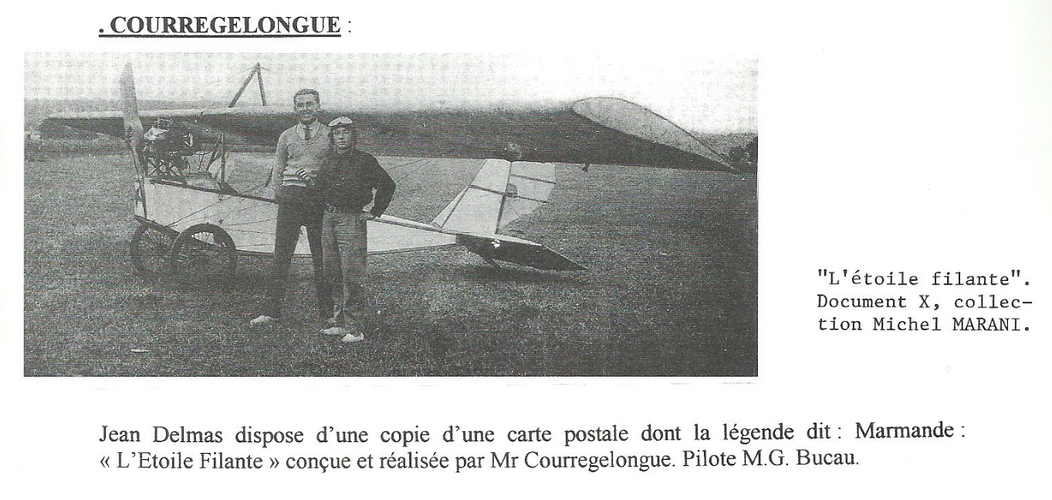
... Jean Delmas has a copy of a postcard whose caption reads: Marmande: “L’Etoile Filante” designed and produced by Mr Courregelongue...
Is there a date associated with this postcard? I am assuming that this Monsieur R. Courregelongue of Paris (who I believe was a lawyer).
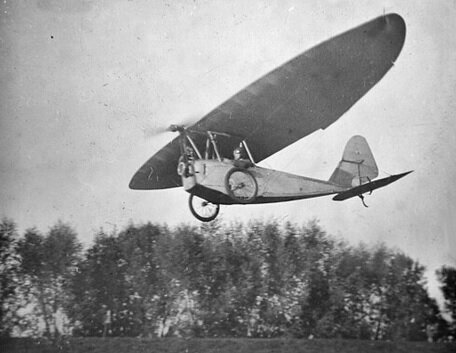
Aéroclub member Courregelongue designed and built at least one other aircraft - his 1931 single-seat avionette belt-driven by an air-cooled 500 cc Chaise OHC engine - as per Dollar Type LSS (Entretube) motorcycles. If this design is related to your L'étoile filante, it features a very different wing planform at least.
According to a flickr poster, this machine was built in the workshops of Jean Paul Charrie (who also took the attached photograph). This Courregelongue-designed aircraft type first flew on 27 August 1931.
-- View: https://www.flickr.com/photos/charriejeanpaul/4349046378/
Attachments
- Joined
- 26 May 2006
- Messages
- 37,573
- Reaction score
- 19,617
From TU 1987,
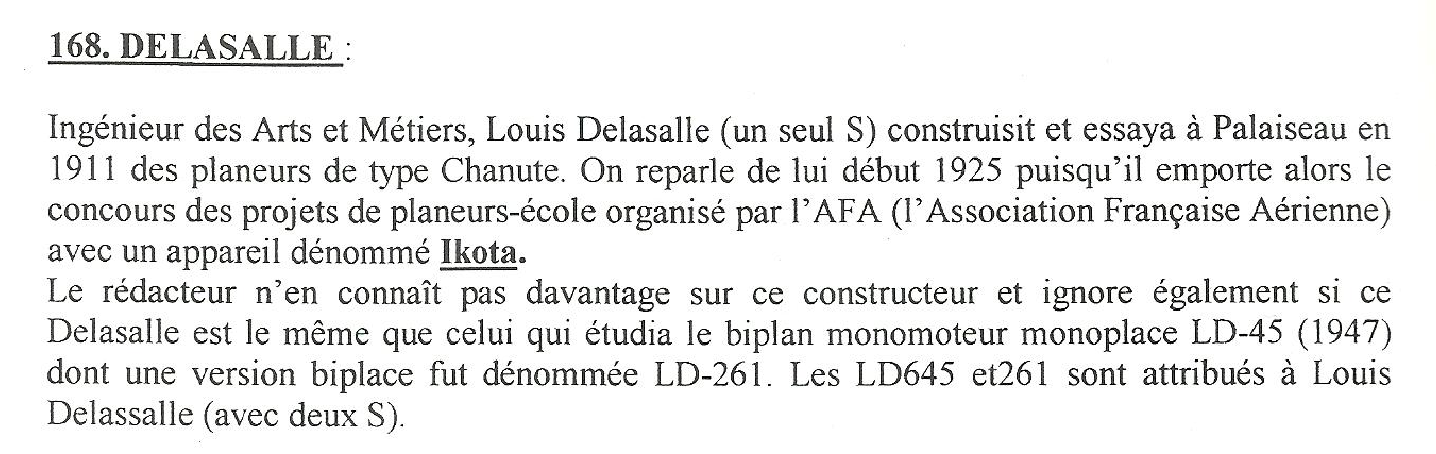
DELASALLE
Engineer of Arts et Métiers, Louis Delasalle (a single S) built and tested at Palaiseau in
1911 Chanute type gliders. We talk about him again at the beginning of 1925 since he then won the competition for glider training projects organized by the AFA (the French Aerial Association) with a device called Ikota.
The editor does not know more about this manufacturer and also does not know if this Delasalle is the same one who studied the single-engine, single-seat biplane LD-45 (1947) of which a two-seater version was named LD-261. LD645 and 261 are attributed to Louis Delassalle (with two S).
DELASALLE
Engineer of Arts et Métiers, Louis Delasalle (a single S) built and tested at Palaiseau in
1911 Chanute type gliders. We talk about him again at the beginning of 1925 since he then won the competition for glider training projects organized by the AFA (the French Aerial Association) with a device called Ikota.
The editor does not know more about this manufacturer and also does not know if this Delasalle is the same one who studied the single-engine, single-seat biplane LD-45 (1947) of which a two-seater version was named LD-261. LD645 and 261 are attributed to Louis Delassalle (with two S).
Attachments
avion ancien
The accidental peasant!
- Joined
- 6 March 2013
- Messages
- 386
- Reaction score
- 291
The Courregelongue avionettes look to be variants of or influenced by the Mignet HM-8.
- Joined
- 26 May 2006
- Messages
- 37,573
- Reaction score
- 19,617
From TU 187,
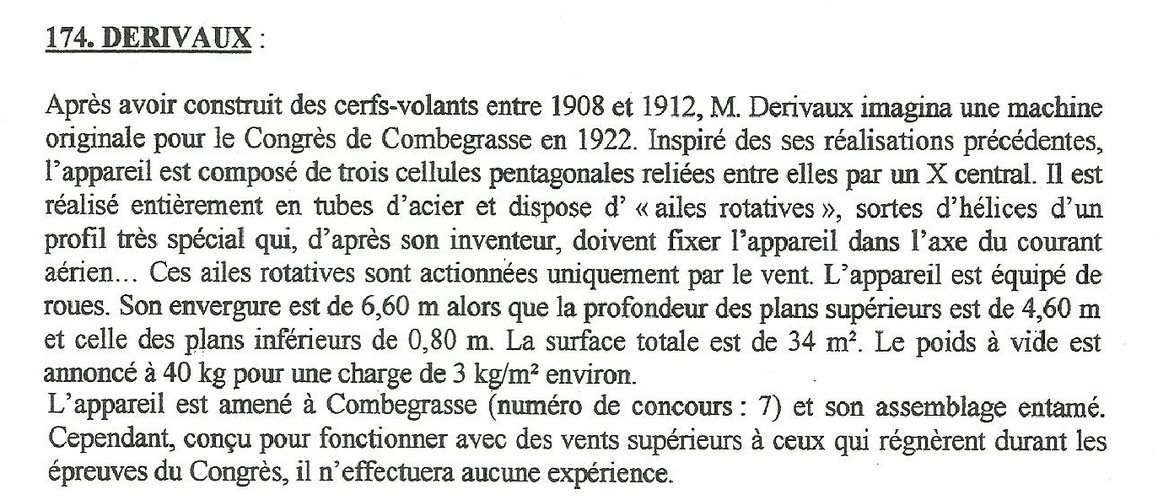
DERIVAUX:
After building kites between 1908 and 1912, Mr. Derivaux imagined a machine
original for the Combegrasse Congress in 1922. Inspired by his previous creations,
the device is composed of three pentagonal cells linked together by a central X.
He is made entirely of steel tubes and has “rotating wings”, a type of propeller of a
very special profile which, according to its inventor, must fix the device in the axis of the current air. These rotating wings are powered solely by wind. The device is equipped with wheels. Its wingspan is 6.60 m while the depth of the upper planes
is 4.60 m and that of the lower planes of 0.80 m. The total surface area is 34 m².
The curb weight is announced at 40 kg for a load of approximately 3 kg/m2. :
The device is brought to Combegrasse (competition number: 7) and its assembly started.However, designed to operate with winds higher than those which prevailed during the Congressional tests, he will not carry out any experiments. |
DERIVAUX:
After building kites between 1908 and 1912, Mr. Derivaux imagined a machine
original for the Combegrasse Congress in 1922. Inspired by his previous creations,
the device is composed of three pentagonal cells linked together by a central X.
He is made entirely of steel tubes and has “rotating wings”, a type of propeller of a
very special profile which, according to its inventor, must fix the device in the axis of the current air. These rotating wings are powered solely by wind. The device is equipped with wheels. Its wingspan is 6.60 m while the depth of the upper planes
is 4.60 m and that of the lower planes of 0.80 m. The total surface area is 34 m².
The curb weight is announced at 40 kg for a load of approximately 3 kg/m2. :
The device is brought to Combegrasse (competition number: 7) and its assembly started.However, designed to operate with winds higher than those which prevailed during the Congressional tests, he will not carry out any experiments. |
Attachments
Last edited:

- Joined
- 25 June 2009
- Messages
- 15,517
- Reaction score
- 9,300
The name is DERIVAUX. If Google tries to translate somebody's name, please resist it!From TU 187,
DERIVALS:
- Joined
- 26 May 2006
- Messages
- 37,573
- Reaction score
- 19,617

- Joined
- 25 July 2007
- Messages
- 4,788
- Reaction score
- 5,291
From TU 187,
DEROIN
Réalisation with Robert Landes of the plane Oiseau Bleu presenté to the combination sous la Denomimation Landes-Deroin and which portait the number 38 at Congrès de 1922. This machine You will be heard in the article “Landes”. |
Umm, that is completely garbled ... being neither English nor French!
To rephrase, the Oiseau Bleu [Blue Bird 1] glider designed by the Landes Frères (Robert and Théo) together with Robert Derouin was presented at the Combegrasse Congrès in 1922 as number 38.
In any case, we already have a page for the Landes-Derouin Oiseau Bleu:
-- https://www.secretprojects.co.uk/threads/oiseau-bleu-glider.13817/
- Joined
- 25 June 2009
- Messages
- 15,517
- Reaction score
- 9,300
I suspect that hesham uses the Google translator without getting rid of the carriage returns. In simpler words, when the original text has separations at the end of each line, you need to realign the entire text as one line to make the translation coherent.Umm, that is completely garbled ... being neither English nor French!
- Joined
- 26 May 2006
- Messages
- 37,573
- Reaction score
- 19,617
From TU 262,
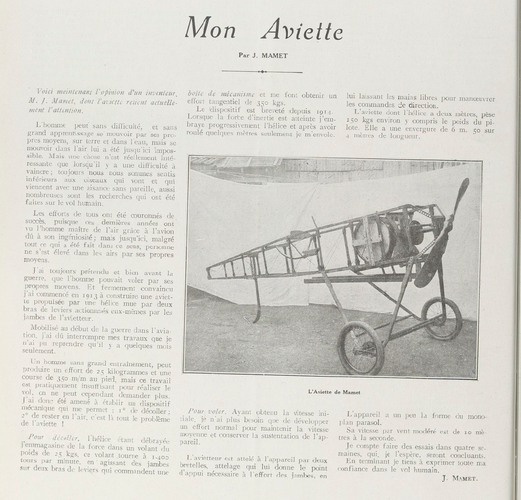
Mr. Julien Francois Mamet with Jules Vedrines designed a ultra-light airplane in 1919.
Also from L'Air 1919.
Attachments

richard B
ACCESS: Secret
- Joined
- 17 August 2006
- Messages
- 349
- Reaction score
- 537
- Joined
- 26 May 2006
- Messages
- 37,573
- Reaction score
- 19,617
Many Thanks to you my dear Riochard,and from TU 187,
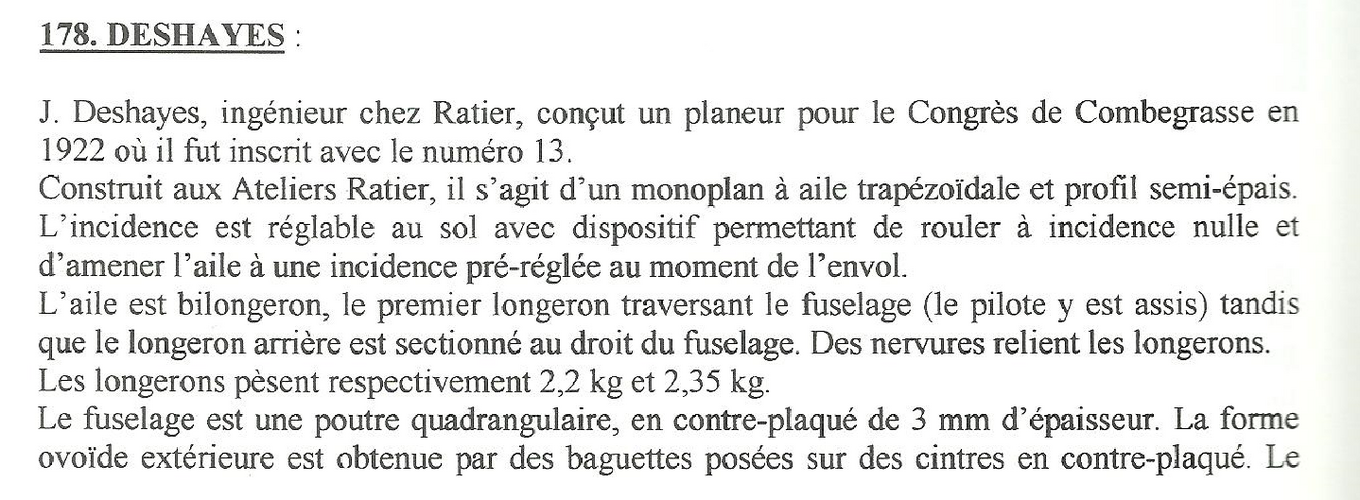
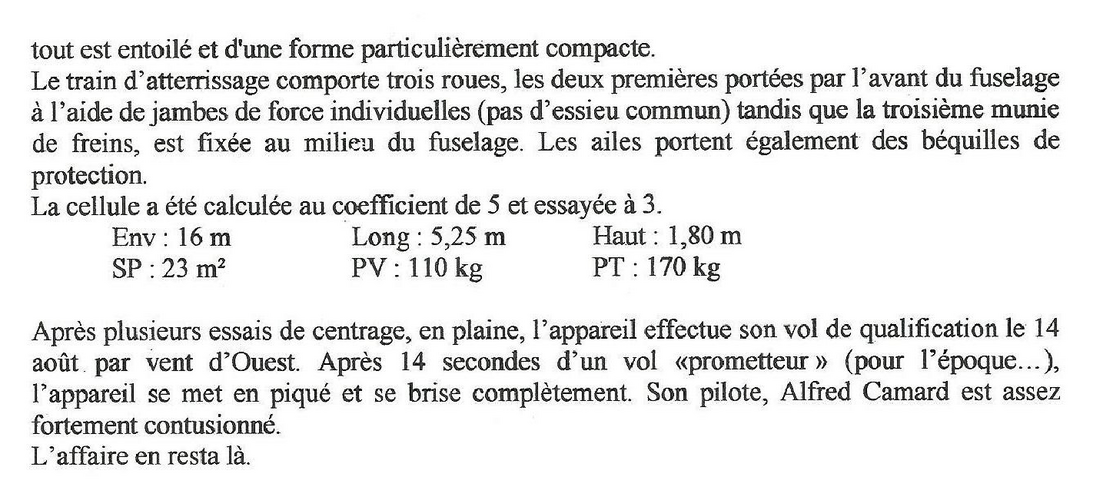
DESHAYES:
J. Deshayes, engineer at Ratier, designed a glider for the Combegrasse Congress in
1922 where 11 was registered with the number 13.
Built at Ateliers Ratier, it is a monoplane with a trapezoidal wing and semi-thick profile.The incidence is adjustable on the ground with a device allowing you to roll at zero incidence and to bring the wing to a pre-set angle of attack at the time of takeoff.
The wing is a bi-spar, the first spar crossing the fuselage (the pilot sits there) while
that the rear spar is cut to the right of the fuselage. Ribs connect the spars.
The spars weigh 2.2 kg and 2.35 kg respectively.
The fuselage is a quadrangular beam, made of 3 mm thick plywood. The form
External ovoid shape is obtained by sticks placed on plywood hangers. Everything is canvassed and has a particularly compact shape.
The landing gear has three wheels, the first two carried by the front of the fuselage
using individual struts (no common axle) while the third equipped
brakes, is fixed in the middle of the fuselage. The wings also carry crutches of
protection.
The cell was calculated at a coefficient of 5 and tested at 3.
Approx: 16m Long: 5.25m Height: 1.80m
SP: 23 m2 PV: 110 kg PT: 170 kg
After several centering tests, on the plain, the aircraft carried out its qualification flight on the 14th.
August by West wind. After 14 seconds of a “promising” flight (for the time...),
the aircraft goes into a nose dive and completely breaks up. Its pilot, Alfred Camard, is quite heavily bruised.
The matter remained there.
DESHAYES:
J. Deshayes, engineer at Ratier, designed a glider for the Combegrasse Congress in
1922 where 11 was registered with the number 13.
Built at Ateliers Ratier, it is a monoplane with a trapezoidal wing and semi-thick profile.The incidence is adjustable on the ground with a device allowing you to roll at zero incidence and to bring the wing to a pre-set angle of attack at the time of takeoff.
The wing is a bi-spar, the first spar crossing the fuselage (the pilot sits there) while
that the rear spar is cut to the right of the fuselage. Ribs connect the spars.
The spars weigh 2.2 kg and 2.35 kg respectively.
The fuselage is a quadrangular beam, made of 3 mm thick plywood. The form
External ovoid shape is obtained by sticks placed on plywood hangers. Everything is canvassed and has a particularly compact shape.
The landing gear has three wheels, the first two carried by the front of the fuselage
using individual struts (no common axle) while the third equipped
brakes, is fixed in the middle of the fuselage. The wings also carry crutches of
protection.
The cell was calculated at a coefficient of 5 and tested at 3.
Approx: 16m Long: 5.25m Height: 1.80m
SP: 23 m2 PV: 110 kg PT: 170 kg
After several centering tests, on the plain, the aircraft carried out its qualification flight on the 14th.
August by West wind. After 14 seconds of a “promising” flight (for the time...),
the aircraft goes into a nose dive and completely breaks up. Its pilot, Alfred Camard, is quite heavily bruised.
The matter remained there.
Attachments
- Joined
- 25 July 2007
- Messages
- 4,788
- Reaction score
- 5,291
... J. Deshayes, engineer at Ratier, designed a glider for the Combegrasse Congress in 1922 where 11 was registered with the number 13...
The glider in question was the one-off (and short-lived) Deshayes P-1. Jules Deshayes had come to Ratier from Breguet.
-- https://www.j2mcl-planeurs.net/dbj2mcl/planeurs-machines/planeur-fiche_0int.php?code=479
- Joined
- 26 May 2006
- Messages
- 37,573
- Reaction score
- 19,617
From TU 187,
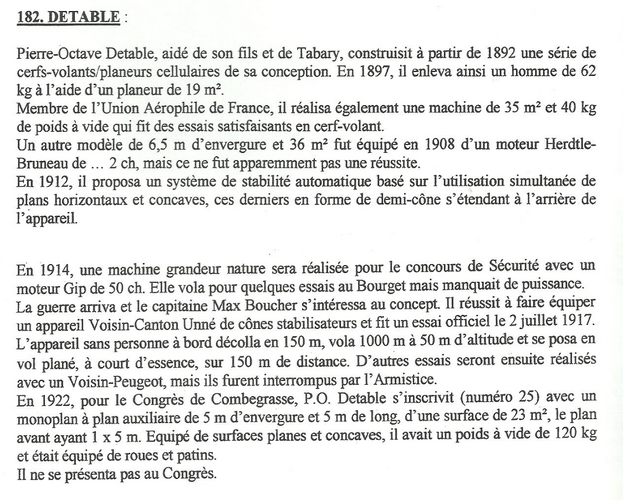
DETABLE :
Pierre-Octave Detable, helped by his son and Tabary, built from 1892 a series of cellular kites/gliders of his design. In 1897, he kidnapped a 62 kg man using a 19 m glider.
Member of the Union Aérophile de France, he also created a machine of 35 m° and 40 kg of empty weight which carried out satisfactory tests in kite flying.
Another model with a wingspan of 6.5 m and 36 m° was equipped in 1908 with a Herdtle-Bruneau engine of ...
2 ch, but it was apparently not a success.
In 1912, he proposed an automatic stability system based on the simultaneous use of horizontal and concave planes, the latter in the shape of a half-cone extending to the rear of the device.
In 1914, a full-size machine was built for the Safety competition with a 50 hp Gip engine. It flew for a few tests at Le Bourget but lacked power.
The war arrived and Captain Max Boucher became interested in the concept. He succeeded in having a Voisin-Canton Unné aircraft equipped with stabilizing cones and carried out an official test on July 2, 1917.
The aircraft without anyone on board took off in 150 m, flew 1000 m at an altitude of 50 m and landed in a glide, running out of fuel, over a distance of 150 m. Other tests were then carried out with a Voisin-Peugeot, but they were interrupted by the Armistice.
In 1922, for the Combegrasse Congress, P.O. Detable registered (number 25) with a monoplane with an auxiliary plane of 5 m wingspan and 5 m long, with a surface area of 23 m?, the front plane having 1 x 5m. Equipped with flat and concave surfaces, it had an empty weight of 120 kg and was equipped with wheels and skids.
He did not run for Congress.
DETABLE :
Pierre-Octave Detable, helped by his son and Tabary, built from 1892 a series of cellular kites/gliders of his design. In 1897, he kidnapped a 62 kg man using a 19 m glider.
Member of the Union Aérophile de France, he also created a machine of 35 m° and 40 kg of empty weight which carried out satisfactory tests in kite flying.
Another model with a wingspan of 6.5 m and 36 m° was equipped in 1908 with a Herdtle-Bruneau engine of ...
2 ch, but it was apparently not a success.
In 1912, he proposed an automatic stability system based on the simultaneous use of horizontal and concave planes, the latter in the shape of a half-cone extending to the rear of the device.
In 1914, a full-size machine was built for the Safety competition with a 50 hp Gip engine. It flew for a few tests at Le Bourget but lacked power.
The war arrived and Captain Max Boucher became interested in the concept. He succeeded in having a Voisin-Canton Unné aircraft equipped with stabilizing cones and carried out an official test on July 2, 1917.
The aircraft without anyone on board took off in 150 m, flew 1000 m at an altitude of 50 m and landed in a glide, running out of fuel, over a distance of 150 m. Other tests were then carried out with a Voisin-Peugeot, but they were interrupted by the Armistice.
In 1922, for the Combegrasse Congress, P.O. Detable registered (number 25) with a monoplane with an auxiliary plane of 5 m wingspan and 5 m long, with a surface area of 23 m?, the front plane having 1 x 5m. Equipped with flat and concave surfaces, it had an empty weight of 120 kg and was equipped with wheels and skids.
He did not run for Congress.
Attachments
- Joined
- 26 May 2006
- Messages
- 37,573
- Reaction score
- 19,617
From TU 194
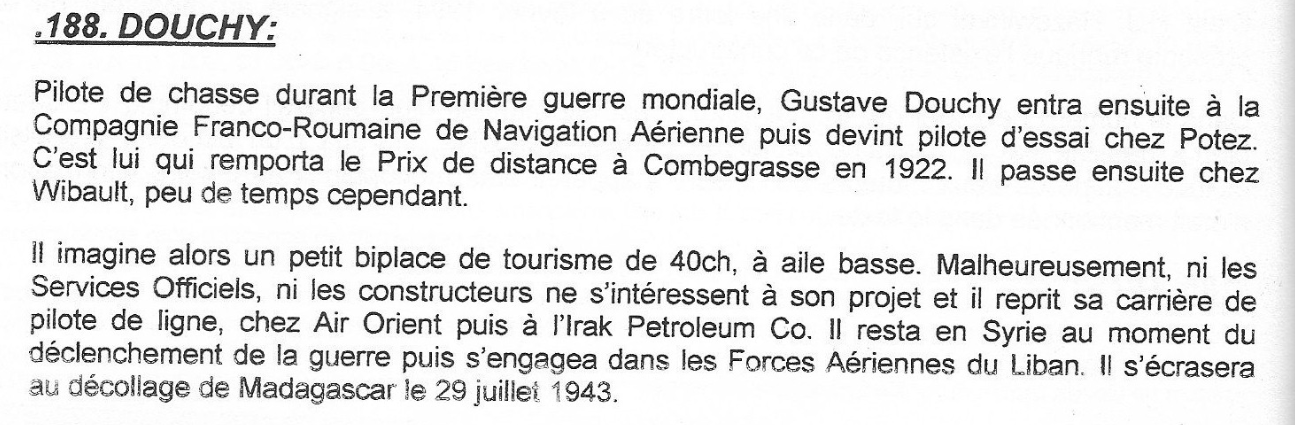
DOUCHY:
A fighter pilot during the First World War, Gustave Douchy then joined the Compagnie Franco-Roumaine de Navigation Aérien and then became a test pilot at Potez. It was he who won the Distance Prize at Combegrasse in 1922. He then moved to Wibault, not long though.
.
He then imagined a small 40hp touring two-seater, with a low wing. Unfortunately, neither the Official Services nor the manufacturers were interested in his project and he resumed his career as an airline pilot, at Air Orient then at Iraq Petroleum Co. He remained in Syria at the time of the outbreak of war then enlisted in the Lebanese Air Force. It crashed on takeoff from Madagascar on July 29, 1943.
DOUCHY:
A fighter pilot during the First World War, Gustave Douchy then joined the Compagnie Franco-Roumaine de Navigation Aérien and then became a test pilot at Potez. It was he who won the Distance Prize at Combegrasse in 1922. He then moved to Wibault, not long though.
.
He then imagined a small 40hp touring two-seater, with a low wing. Unfortunately, neither the Official Services nor the manufacturers were interested in his project and he resumed his career as an airline pilot, at Air Orient then at Iraq Petroleum Co. He remained in Syria at the time of the outbreak of war then enlisted in the Lebanese Air Force. It crashed on takeoff from Madagascar on July 29, 1943.
Attachments
Similar threads
-
 Georges R. Hamel / CLENA aircraft and projects
- Started by hesham
- Replies: 23
-
 Arsenal de l'aéronautique: built prototypes and unbuilt projects
- Started by Jemiba
- Replies: 101
-

-
Various SNCASO (Sud-Ouest) Projects and Prototypes
- Started by hesham
- Replies: 26
-