From TU 175,

I don't know if that was a new Monoplane for G. Bertout,or it was the same of Atalante aircraft,he
also worked on a Biplane ;

In March 1938 took off at the hands of Jacques Lamblin, a high wing monoplane, two-seater side-by-side and double control equipped with a 60 hp Régnier. This device, studied by Bertout, was built in Auxerre in the Nicolas workshops. Bertout takes off in 75 m and can pass acrobatics.Mr. Bertout had previously studied the Vollant offset wing biplane.

Is there any picture to it ?,

https://gallica.bnf.fr/ark:/12148/bpt6k6554857k/f44.image.r=BERTOUT monoplan avion?rk=42918;4
 
From TU 147 & 170;

Mr. Gratien Beyt, from Toulouse, did his pilot training towards the end of the first world conflict on the training
tracks around your city of Pau, using Nieuport devices.Subsequently, he built two airplanes: The first was equipped
with a Harley-Davidson engine. Drouillet, pilot of the squadron club at Francazal, will just try it on the ground.
The second was a parasol monoplane parasol, fitted with a 14-horsepower, 4-cylinder Ford engine. This automobile
engine had a major drawback, a mass of 75 kg. The landing gear was made up of motorcycle wheels. This machine
carried out its first tests in 1932 at Francazal.

Has anyone a pictures to them ?.
 
From TU 147,

Mr. Guillaume Bisson designed a motor-glider or ultra light airplane (moto-aviette) in 1923,no more
details are known.

Unfortunately,no trace in Gallica as I think ?.
 
Regarding the Bisson aviette, it looks as if Guillaume Busson, with a U, was scheduled to take part in the Grand Prix du "Petit Parisien" de la Moto-Aviette which took place on July 15th, 1923. Articles published after that event event do not seem to mention Busson or his aviette, however.

Incidentally, Guillaume Busson (1885-1958) was a French aviator and test pilot active both before and during the Great War. He developed a major interest in rotary wing flight around 1944, an interest he maintained until his death. Indeed, by 1951 at the latest, Busson was president of the Commission de Giraviation of the Aéro-Club de France.
 
Last edited:
Regarding the mention of Aviation Légère Économique, a snippet in a late December 1938 issue of the French daily Paris-Soir mentioned a Société L'Aviation Légère Économique which hoped to deliver the first examples of both versions of a so-called Boitel engine, a 50 to 75 hp 5-cylinder radial engine to be more precise, by April of 1939.

The engine in question, initially known as the Soleil engine, was developed by a Hungarian engineer, János Sklenár, and described in late 1937 issues of some French magazines. Development funding for that engine came from Achille Frédéric Boitel, a shady businessman who was killed in late July 1944 by members of the French Resistance because he was a collaborationist industrialist active on the black market (artworks?).

The Boitel engine was certified in very late 1938. The fall of France, in June 1940, brought to a close any idea of mass producing it, however. Only a small number of engines were produced, by the Société L'Aviation Légère Économique and / or some other entity.

That said, a 7-cylinder Boitel engine producing up to 95 hp might have been produced in small numbers after the end of the Second World War.
 
a so-called Boitel engine, a 50 to 75 hp 5-cylinder radial engine to be more precise, by April of 1939.

The engine in question, initially known as the Soleil engine, was developed by a Hungarian engineer, János Sklenár, and described in late 1937 issues of some French magazines. Development funding for that engine came from Achille Frédéric Boitel, a shady businessman who was killed in late July 1944 by members of the French Resistance because he was a collaborationist industrialist active on the black market (artworks?).

The Boitel engine was certified in very late 1938. The fall of France, in June 1940, brought to a close any idea of mass producing it, however. Only a small number of engines were produced, by the Société L'Aviation Légère Économique and / or some other entity.

The Léopoldoff L.31 Colibri was a modified L.3 powered by a 50 hp Boitel 5AO (5-cylinder engine).
That Boitel engine was also a possible alternative to the Régnier and Continental engines on the Bassou FB.4 (FB.40) [F-(P)EPM] but I don't know if it was ever actually tested.

That said, a 7-cylinder Boitel engine producing up to 95 hp might have been produced in small numbers after the end of the Second World War.

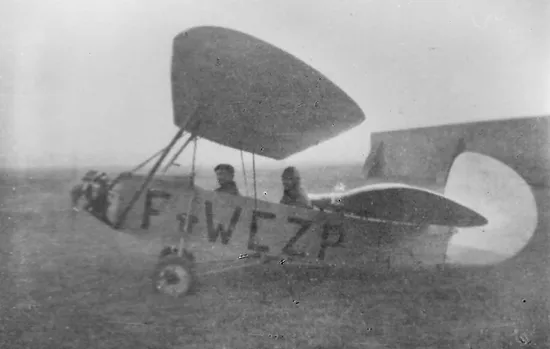
The 7-cylinder Boitel engine was used in 1948 on both the first Croses EC-1 Pouplume [F-WCZP/F-PCZP] and on the Allard D.40 (HMA.214) Pück, two Pou-du-Ciel derivative designs.

1754602019682.png
 
If someone can find a drawing or more Info to it in Gallica,may I searched by
wrong way ?.
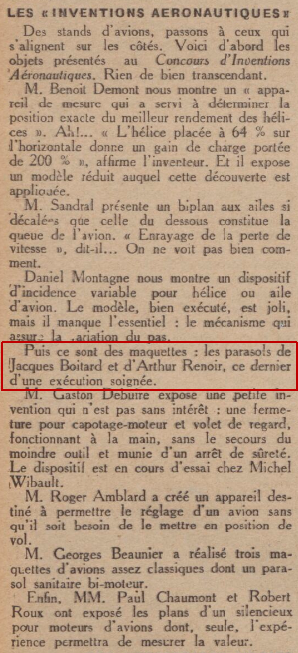
Only mention of Jacques Boitard and his parasol design on Gallica is here, in an article from the September 5, 1929 issue of Les Ailes, entitled "La section aéronautique du concours Lépine" (a very famous national competition open to inventors of all kinds). The text reads: "Then come the scale models: the parasol types of Jacques Boitard and Arthur Renoir, the latter being very neatly crafted."
https://gallica.bnf.fr/ark:/12148/bpt6k6554659q/f10.image
1755465971469.png
 
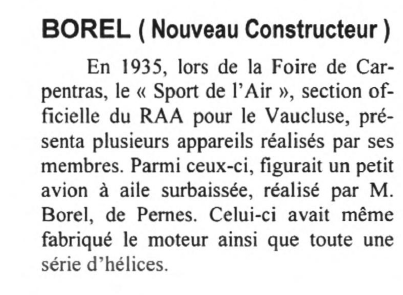
There is another Borel.
 

Attachments

  • 3.png
    3.png
    77.6 KB · Views: 66
Thank you my dears Apophenia and Grey,

from TU 224,here is an ultra-light airplane of 1930s,by Bouvier-Gaveau ;

M.Gaveau, gliding pilot,built in the thirties a single-seat airplane on the plans of Henri Bouvier. It was planned with a
20 hp Vaslin 4-cylinder engine. The editor doesn't know if construction was actually finished.

Is there any picture to it ?.
 
So weird,when you search in Gallica,there's no sign...

Its possible that is a result of Trait d'Union getting the wrong end of the stick on this project.

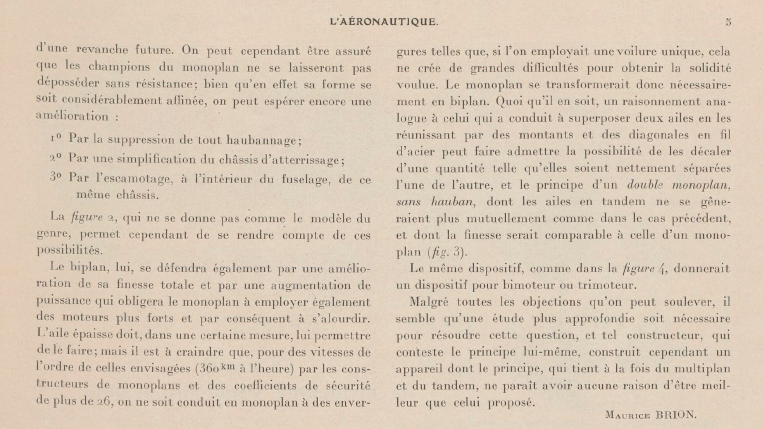
I know that your TU 186 clippings was sub-titled "Nouveau constructeur". However, two sentences give me pause. The first is "Bi ou trimoteur" (Twin- or trimotor type). The second: "Une construction entièrement métallique est recommandée" (All-metal construction is recommended).

So was this really an announcement that C.A.F. was about to enter the aircraft-building business? If so, why were they initially dithering over a 2- or 3-engined layout? And to whom were they directing their recommendation of an all-metal structure?

The above at least suggests the possibility that this 1931 Marseille-Saïgon postal aircraft description may actually have been a Compagnie aérienne française role requirement published to attract ROI and/or RFP submissions from established manufacturers.
 
So weird,when you search in Gallica,there's no sign.
I don't know about that particular search, but it is also possible that a lousy scan might result in defective OCR. The words are there in the text but they haven't been recognized and therefore do not appear in a search. That being said, I have found that Gallica's scans and OCR are generally very qualitative.
 
I've begun to slim down this topic a bit by creating separate ones every time there was enough material to justify it. More than once, people posted stuff that had already been shared or discussed elsewhere, so it made sense to regroup all the contents about a single subject. In some cases, I also merged the posts with isolated topics, and also used the "copy" function in a few cases to duplicate posts from certain discussions that seemed relevant in both places.

Here is a list of the new consolidated topics:
There will be more in the future, but that's a start!
 
From TU 224,

Mr. Casteix designed a ultra-light or Avionnette airplane;

M.Coucilles, delegate of the RAA at Boulogne-sur-Gesse (31), mentions in an issue of "Envol" in the middle
construction in its thirties region, from a light aircraft by Mr. Casteix.No further details.

There's no trace to it in Gallica
 
... M.Coucilles, delegate of the RAA at Boulogne-sur-Gesse (31), mentions in an issue of "Envol" in the middle construction in its thirties region, from a light aircraft by Mr. Casteix.No further details.

Couldn't resist ...

CASTEIX (Nouveau constructeur)

M. Coucilles, délégué du RAA à Boulogne-sur-Gesse (31), menionne dans un numero de "Envol" du milieu des années trente, la constrion dans sa région, d'une avionnette par M. Casteix. Pas d'autre précision.

CASTEIX (New Builder)

M. Coucilles, RAA delegate in Boulogne-sur-Gesse (31), mentions - in an issue of "Envol" from the mid-1930s - the construction in his region of a light aircraft by M. Casteix. No further details are provided.

For French speakers ... Would I be right in assuming that, in this case, RAA probably stood for Recueil des Actes Administratifs and that Monsieur Coucilles would have been the regional officer responsible for compiling the RAA for Boulogne-sur-Gesse? If so, his mention of M. Casteix may have been part of a report on a local aerodrome.
 
This here thread is now down to 13 pages, instead of 20. Only the truly rare or little documented subjects remain.
Everything that could become a separate topic or be added to existing topics was moved.

Last topic additions for today:
Existing topics renamed/expanded/modified:
 
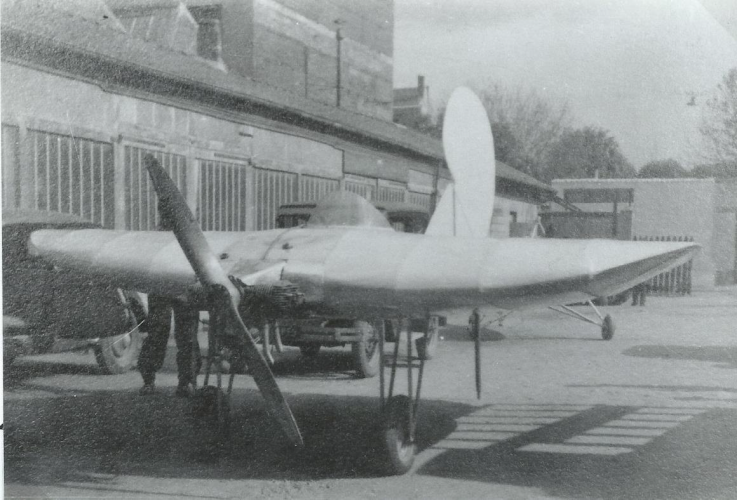
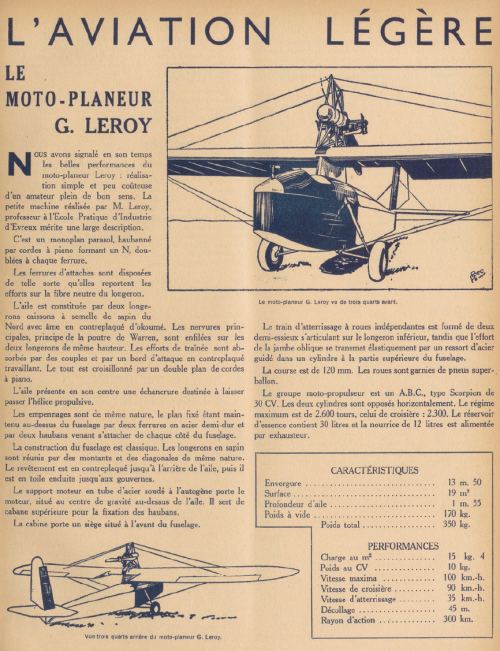
The Joubert J 3, which bears more than a passing resemblance to the Mignet HM.8 but, equally, differs in significant respects. Maybe its design was influenced by the HM.8. Maybe it was constructed using HM.8 components. Maybe it was converted from an HM.8. So far I've found next to no information about it. Does anyone have any?

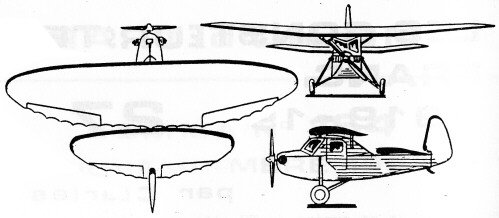
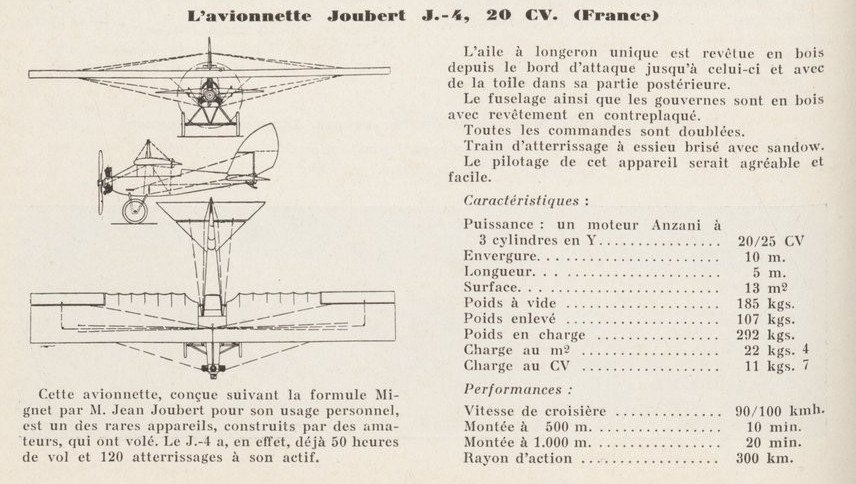
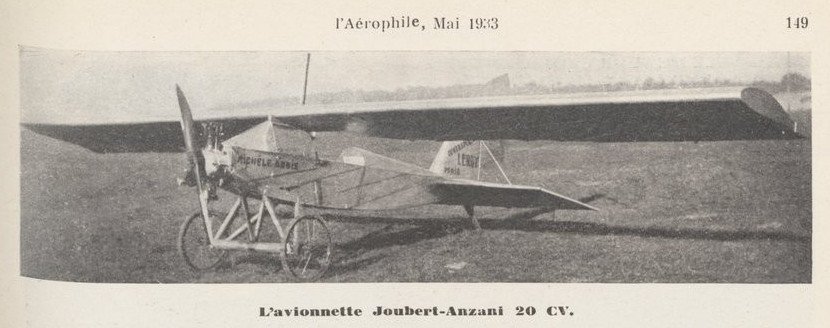
No, but I have the Joubert J.4, from L'Aérophile, May 1933:

Joubert J.4, L'Aérophile 1933-05.jpg Joubert J.4, L'Aérophile 1933-05 (photo).jpg
 
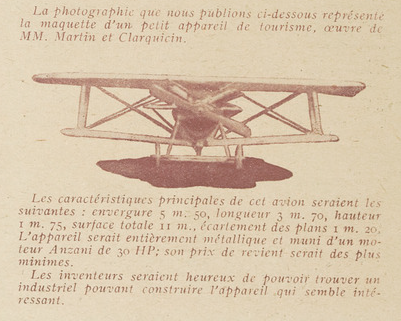
Two individuals by the names of Martin and Clarquicin came up with a small tourism biplane design in 1920 which they presented in the form of a model, hoping to catch the attention of an industrial willing to build it. Needless to say that never happened... (from L'Air, 20 Nov. 1920):

1761153964521.png
 
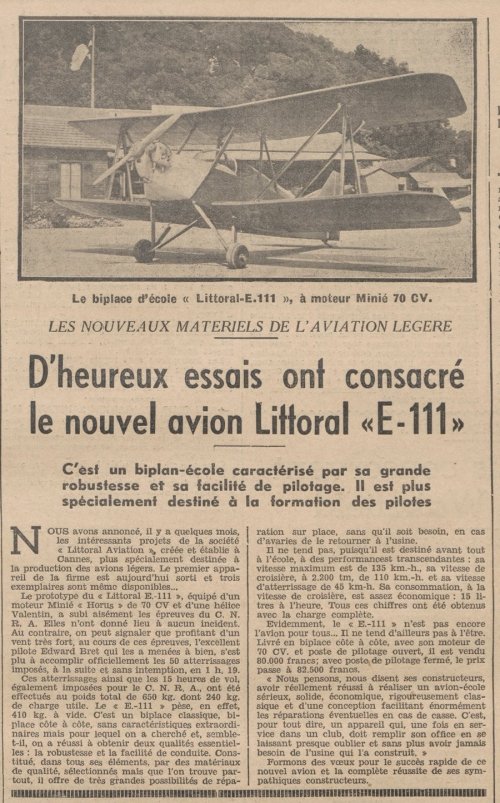
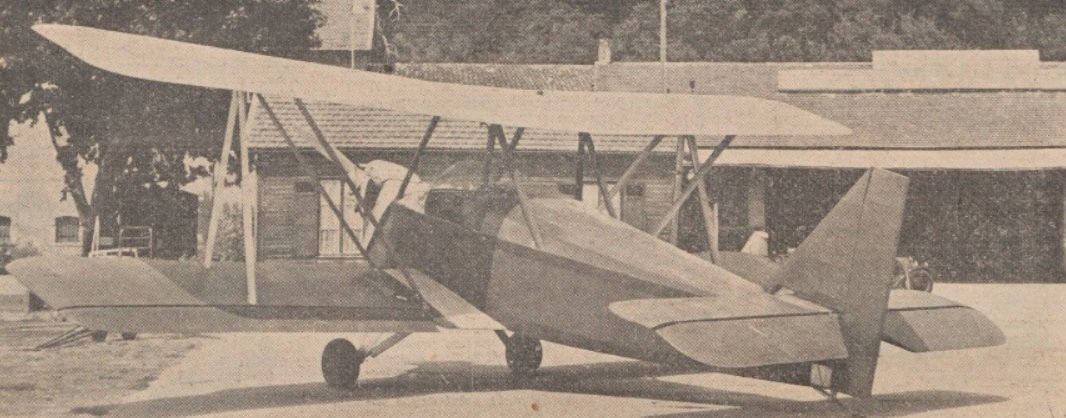
According to Edward Bret (1907-1996), pilote d’exception by Philippe Jung, the appearance of the sole E-111 was unknown until a photograph (attached) was found in the archives of Edward Bret ("Aucune photo de ce mystérieux avion n’était connue des historiens, jusqu’à ce qu’elle soit trouvée dans les archives d’Edward.")

That is a load of bull! Les Ailes did a feature on the Littoral E-111 in their August 31, 1939 issue!

Littoral E-111, Les Ailes 1939-08-31.jpg
 
For what it's worth, according to the April 25, 1940 issue of the weekly Les Ailes, the Littoral E-111 was designed by Jacques Abel Triou (1891-1995).

That engineer was the brother in law of Henri Mignet, the gentleman behind the Pou du Ciel family of aircraft. (Anne Marie Lucie Sophie Triou married Mignet in April 1926.)
 

Attachments

  • Les Ailes 25 avril 1940 page 6 ou 7.jpg
    Les Ailes 25 avril 1940 page 6 ou 7.jpg
    175.8 KB · Views: 34
For what it's worth, according to the April 25, 1940 issue of the weekly Les Ailes, the Littoral E-111 was designed by Jacques Abel Triou (1891-1995).

That engineer was the brother in law of Henri Mignet, the gentleman behind the Pou du Ciel family of aircraft. (Anne Marie Lucie Sophie Triou married Mignet in April 1926.)
Great complement of information, thanks!
 

Similar threads

Back
Top Bottom