
You are using an out of date browser. It may not display this or other websites correctly.
You should upgrade or use an alternative browser.
You should upgrade or use an alternative browser.
Little-Known French Projects and Prototypes
- Thread starter hesham
- Start date
JC Carbonel
ACCESS: Secret
- Joined
- 7 September 2006
- Messages
- 231
- Reaction score
- 197
for all those interested I can as well advertise my own work :
http://modelarchives.free.fr/Bestiaire/index.html this page covers many weird French designs around the two world wars and all the texts are bilingual French / English
example :

Dorand's VTOL mailplane (thirties)
Fauvel AV31 transport plane (1943)
Lecheres patent for a VTOL flying wing (1943-44)
Chappedelaine Gyroptère : a "spinner" type machine of the late twenties
JCC
http://modelarchives.free.fr/Bestiaire/index.html this page covers many weird French designs around the two world wars and all the texts are bilingual French / English
example :
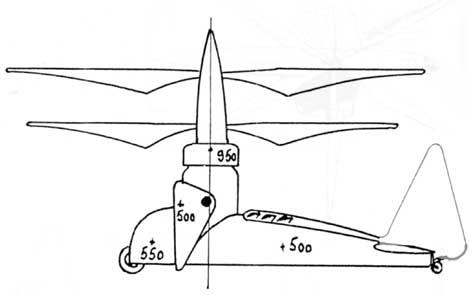
Dorand's VTOL mailplane (thirties)
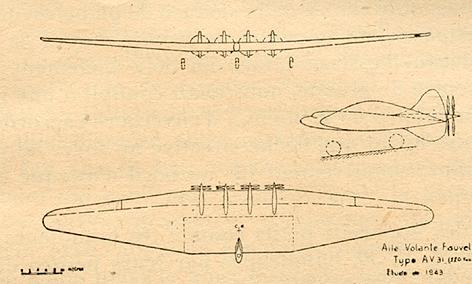
Fauvel AV31 transport plane (1943)
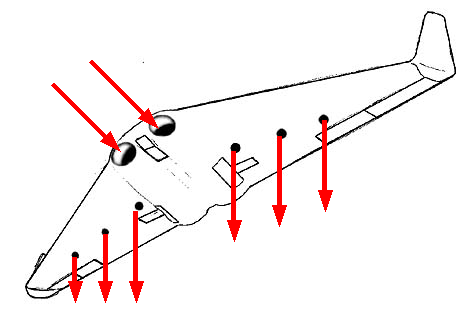
Lecheres patent for a VTOL flying wing (1943-44)
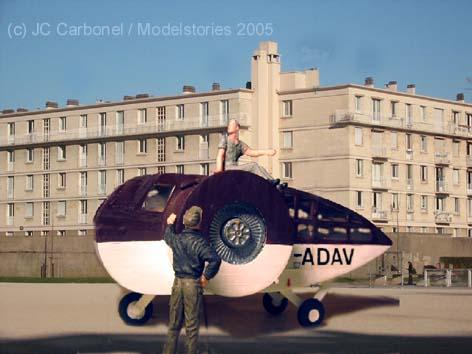
Chappedelaine Gyroptère : a "spinner" type machine of the late twenties
JCC

- Joined
- 26 May 2006
- Messages
- 38,347
- Reaction score
- 20,482
Hi,
Levy :triplane patrol flying boat of 1922.
Levy-Biche LB-4: single engined reconnaissance seaplane. [see here]
Levy :triplane patrol flying boat of 1922.
Levy-Biche LB-4: single engined reconnaissance seaplane. [see here]
- Joined
- 26 May 2006
- Messages
- 38,347
- Reaction score
- 20,482
Hallo dears,
some little known aircraft:
Bloch MB.170 single engined single seat racer aircraft (not related to MB.170 twin engined reconnaissance aircraft).
Mureaux ANF-150 racer aircraft.
Bechereau (SRAP) T-7: single engined sesquiplane as transport biplane.
some little known aircraft:
Bloch MB.170 single engined single seat racer aircraft (not related to MB.170 twin engined reconnaissance aircraft).
Mureaux ANF-150 racer aircraft.
Bechereau (SRAP) T-7: single engined sesquiplane as transport biplane.
- Joined
- 26 May 2006
- Messages
- 38,347
- Reaction score
- 20,482
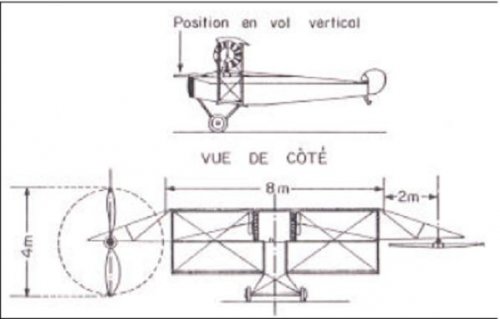
Tophe
ACCESS: Top Secret
Sorry, there is not a single word of text about it. And the data do not mention weapons nor use. Only mysterious word that may have a meaning: "Laboratory Type" but that may mean simply "experimental", otherwise the use may be transporting measure apparatus for something scientific.

- Joined
- 25 June 2009
- Messages
- 15,515
- Reaction score
- 9,453
Tophe said:Sorry, there is not a single word of text about it. And the data do not mention weapons nor use. Only mysterious word that may have a meaning: "Laboratory Type" but that may mean simply "experimental", otherwise the use may be transporting measure apparatus for something scientific.
Probably an old French equivalent to "test-bed"...

Tophe
ACCESS: Top Secret
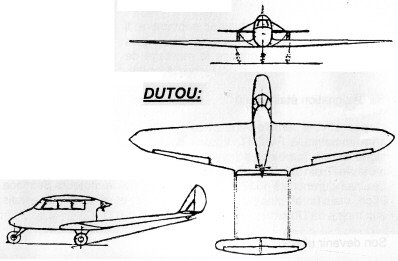
In the Trait d'Union #194 (Nov-Dec 2000): "in 1932, Paul Dutou designed a twin-boom pusher with Maurice Arnoux. Monoplane with low wing and a Salmson 9 cylinders 60hp. Not built."
EDIT: In the Trait d'Union #224 (Nov-Dec 2005) is this addition: "this twin-boomer was named D.T.G (unknown meaning), tested at wind-tunnel, removable wings. Length 7;5m Total weight 525kg empty 280kg speed range 75-185km/h"
EDIT: In the Trait d'Union #224 (Nov-Dec 2005) is this addition: "this twin-boomer was named D.T.G (unknown meaning), tested at wind-tunnel, removable wings. Length 7;5m Total weight 525kg empty 280kg speed range 75-185km/h"
Attachments
Tophe
ACCESS: Top Secret
Tophe
ACCESS: Top Secret
Tophe
ACCESS: Top Secret
As well:Tophe said:(The search does not find this)
(source: Trait d'Union #194 Nov-Dec 2000)
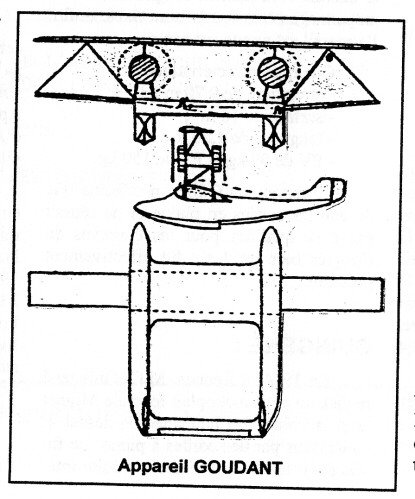
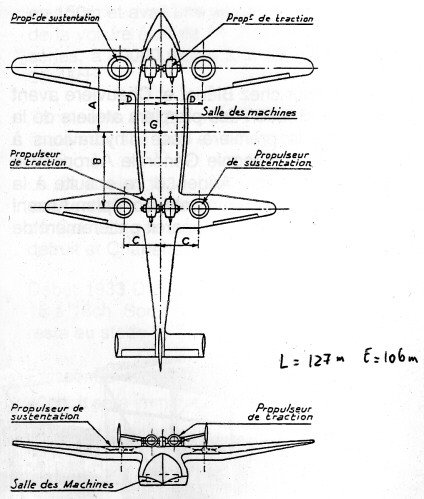
A. Dujardin designed during WW2 a giant flying boat of 250t with turbojets (4 for lift and 4 for speed). Length 127m Span 106m.
Attachments
Tophe
ACCESS: Top Secret
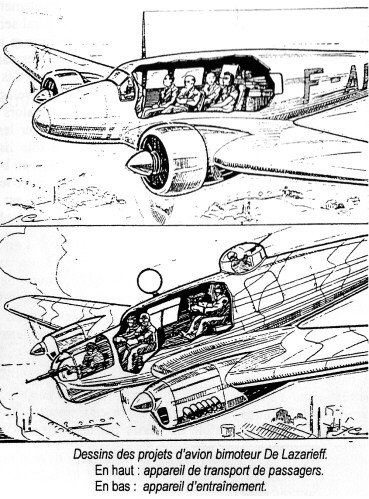
During WW2, the French engineer De Lazarieff designed a twin-engine aircraft to carry passengers or for training.
Span 13.25m Length 9.92m Height 3.95m Weight empty 1,625kg total 2,500kg Engines 2x 240hp Maximum speed 320km/h
Source: Trait d'Union #217 Sep-Oct 2004
Span 13.25m Length 9.92m Height 3.95m Weight empty 1,625kg total 2,500kg Engines 2x 240hp Maximum speed 320km/h
Source: Trait d'Union #217 Sep-Oct 2004
Attachments
Tophe
ACCESS: Top Secret
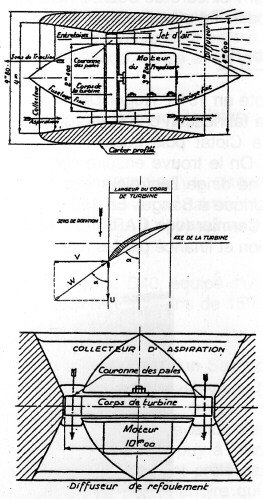
I add the engines drawings. And I gave one line summary from 19 lines detail. I could translate more, but it is very technical, and I lack English vocabulary. I try.Tophe said:As well:Tophe said:(The search does not find this)
(source: Trait d'Union #194 Nov-Dec 2000)
A. Dujardin designed during WW2 a giant flying boat of 250t with turbojets (4 for lift and 4 for speed). Length 127m Span 106m.
"For speed, blades had 4.5m diameter and hubs: 3m. Blades were driven by a turbo motor located in the hub and working like a steam turbine but with air at pressure 12kg and 500°C. This air is provided by an engine room located in the hull. These propellers are adjustable around the vertival axis.
In the wings depth, were lift propellers of 10m diameter for take off, so it was able to take off from land. All this mechanical engine parts were weighing 60t, with a power of 140,000hp! Range 10,000km in 24 hours.
A reduced size model had been tested in 1937, as a 2.66m span model that was an air tubine with wings and a boom holding a tail. These tests were performed at Issy les Moulineaux in the Etablissements d'Etudes Techniques du Ministère de l'Air. The full-size air-jet project was not built."
Attachments
- Joined
- 26 May 2006
- Messages
- 38,347
- Reaction score
- 20,482
Hi,
my dear Maveric spoke before about some French projects from WW1,and I
found an info for two of them,first,the Bassan-Gue BN.4,it was triplane
bomber project powered by three 450 hp Renault engines,and the second,
the Bille SACANA triplane bomber project,which was studied in three versions,
projects are provided with six (400 hp Lorraine or 400 hp Liberty) engines,and
the third one was a heavy bomber equipped by 700 hp SANA engines.
my dear Maveric spoke before about some French projects from WW1,and I
found an info for two of them,first,the Bassan-Gue BN.4,it was triplane
bomber project powered by three 450 hp Renault engines,and the second,
the Bille SACANA triplane bomber project,which was studied in three versions,
projects are provided with six (400 hp Lorraine or 400 hp Liberty) engines,and
the third one was a heavy bomber equipped by 700 hp SANA engines.
- Joined
- 26 May 2006
- Messages
- 38,347
- Reaction score
- 20,482
What was those projects from Couse Pratique d-Aviation?.
http://translate.google.com/translate?sl=fr&tl=en&js=n&prev=_t&hl=ar&ie=UTF-8&eotf=1&u=http%3A%2F%2Fpages14-18.mesdiscussions.net%2Fpages1418%2Faviation-1914-1918%2Fidentification-trimoteur-bifuselage-sujet_913_1.htm
http://translate.google.com/translate?sl=fr&tl=en&js=n&prev=_t&hl=ar&ie=UTF-8&eotf=1&u=http%3A%2F%2Fpages14-18.mesdiscussions.net%2Fpages1418%2Faviation-1914-1918%2Fidentification-trimoteur-bifuselage-sujet_913_1.htm
Attachments
hesham said:What was those projects from Couse Pratique d-Aviation?.
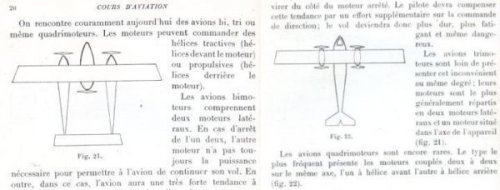
Most probably these are not actual projects, but sketches illustrating various engine placements on 3 and 4-engine aircraft.
The book title means "Practical Aviation Course". The text on 3 and 4-engine aircraft reads: "Three-engine aircraft do not have this defect to the same degree ; the engines are usually distributed as two engines mounted on the side and one mounted on the aircraft axis. Four-engine aircraft are still rare. The most frequent type has the engines mounted by pairs on the same axis, one with the propeller at the front and the other with the propeller at the rear."
- Joined
- 26 May 2006
- Messages
- 38,347
- Reaction score
- 20,482
Hi,
mysteries in that French George Messier's site,unknown projects;
http://www.acam.asso.fr/histo/premiers_equipements6.php
Morane-Saulnier MS-080
SNACSO E-3635
SNACSO SO.1060
Arsenal AEA 16800
LeO 40-C-30 (I know only C.41)
Wibault-Penhoet 700
Roussel 20
Schreck (FBA) 330
Levasseur PL-109
mysteries in that French George Messier's site,unknown projects;
http://www.acam.asso.fr/histo/premiers_equipements6.php
Morane-Saulnier MS-080
SNACSO E-3635
SNACSO SO.1060
Arsenal AEA 16800
LeO 40-C-30 (I know only C.41)
Wibault-Penhoet 700
Roussel 20
Schreck (FBA) 330
Levasseur PL-109
- Joined
- 26 May 2006
- Messages
- 38,347
- Reaction score
- 20,482
Hi,
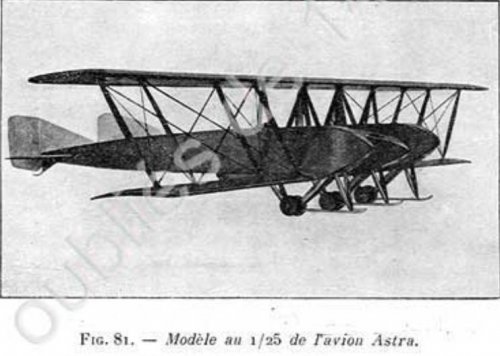
the Astra-Nieuport company designed a large twin boom biplane with a span
of 25.5m,propellers were mounted at the nose of each boom,driven either by
a single central engine or or one in each boom,unclear if that aircraft was
still a project or never completed,that was in 1915/1916,who know more ?.
the Astra-Nieuport company designed a large twin boom biplane with a span
of 25.5m,propellers were mounted at the nose of each boom,driven either by
a single central engine or or one in each boom,unclear if that aircraft was
still a project or never completed,that was in 1915/1916,who know more ?.
- Joined
- 26 May 2006
- Messages
- 38,347
- Reaction score
- 20,482
hesham said:Hi,
the Astra-Nieuport company designed a large twin boom biplane with a span
of 25.5m,propellers were mounted at the nose of each boom,driven either by
a single central engine or or one in each boom,unclear if that aircraft was
still a project or never completed,that was in 1915/1916,who know more ?.
A small mistake,
the company was Astra and not Astra-Nieuport.
- Joined
- 26 May 2006
- Messages
- 38,347
- Reaction score
- 20,482
hesham said:hesham said:Hi,
the Astra-Nieuport company designed a large twin boom biplane with a span
of 25.5m,propellers were mounted at the nose of each boom,driven either by
a single central engine or or one in each boom,unclear if that aircraft was
still a project or never completed,that was in 1915/1916,who know more ?.
A small mistake,
the company was Astra and not Astra-Nieuport.
And here is the Astra twin boom aircraft
Attachments

avion ancien
The accidental peasant!
- Joined
- 6 March 2013
- Messages
- 394
- Reaction score
- 307
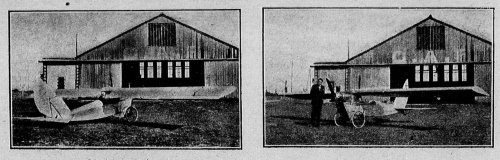
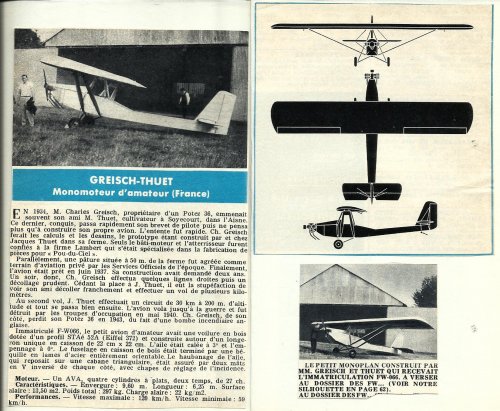
The Joubert J 3, which bears more than a passing resemblance to the Mignet HM.8 but, equally, differs in significant respects. Maybe its design was influenced by the HM.8. Maybe it was constructed using HM.8 components. Maybe it was converted from an HM.8. So far I've found next to no information about it. Does anyone have any?
Attachments
avion ancien
The accidental peasant!
- Joined
- 6 March 2013
- Messages
- 394
- Reaction score
- 307
![René Lemaire I n°01 [F-PPPN].jpg](/data/attachments/90/90817-68544cdf1354d8590ef14f290d8edffa.jpg)
avion ancien
The accidental peasant!
- Joined
- 6 March 2013
- Messages
- 394
- Reaction score
- 307
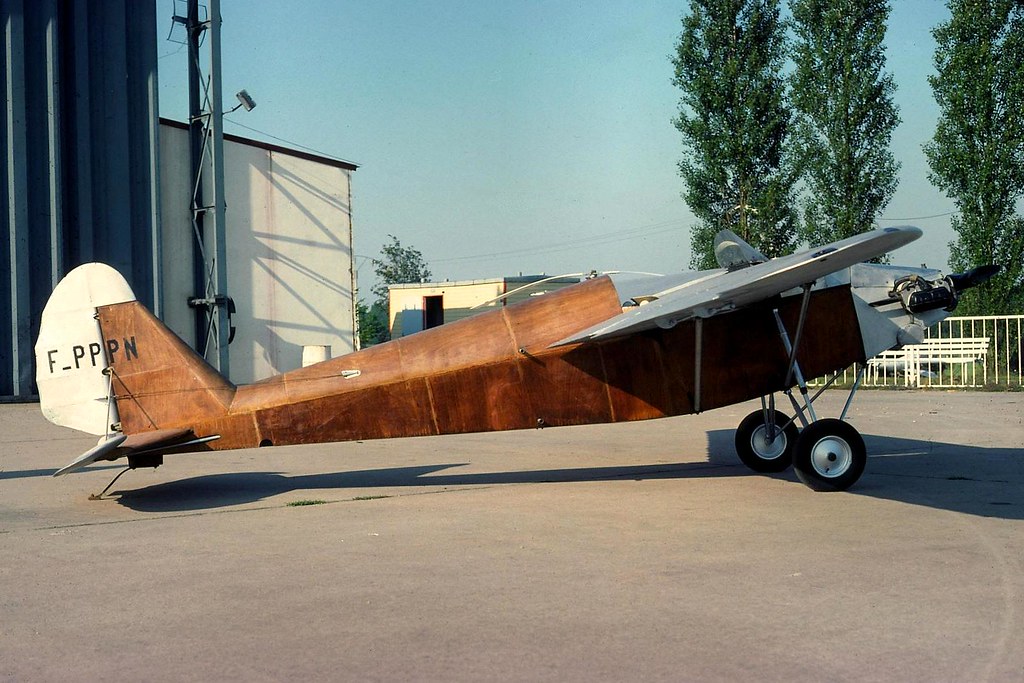
Apparently the Lemaire 01 (F-PPPN) is held in the reserve collection of Espace Air Passion at Angers-Marcé (see http://www.musee-aviation-angers.fr/collections/avions-et-voilures-tournantes/). I'll try to remember to enquire about it when next I'm there. In the meantime, here are some clearer pictures of it.


toura said:always old paper..."aviation magazine"
It's been a while since this post, I admit, but it's neat that this old design is exactly within the current French microlight limit of 300kg gross weight.
avion ancien said:Apparently the Lemaire 01 (F-PPPN) is held in the reserve collection of Espace Air Passion at Angers-Marcé (see http://www.musee-aviation-angers.fr/collections/avions-et-voilures-tournantes/). I'll try to remember to enquire about it when next I'm there. In the meantime, here are some clearer pictures of it.
Absolutely fantastic pics and that link is worth following. I have never seen a museum with such an interesting collection of unusual and homebuilt light planes. You could make a book of oddball configurations and prototypes just from that one collection. I've have to make a point to get over there next summer.
Thanks Toura!toura said:Hi C 460
From "aviation magazine
Do you have all those Avimags?
Adrien
For readers that don't speak French, the subtitle says it all.
Courte histoire d'un "veau-marin"
"Veau" literally means calf (from which we get the English word veal) but when applied to a vehicle it means something gutless and without power, so "veau-marin" means "sea calf" and may be a pun on "sous-marin" or submarine. It is also reminiscent of "vache de mer" or "sea cow" (manatee) also probably not the name you'd choose for a new flying boat.
Courte histoire d'un "veau-marin"
"Veau" literally means calf (from which we get the English word veal) but when applied to a vehicle it means something gutless and without power, so "veau-marin" means "sea calf" and may be a pun on "sous-marin" or submarine. It is also reminiscent of "vache de mer" or "sea cow" (manatee) also probably not the name you'd choose for a new flying boat.
Similar threads
-
 Georges R. Hamel / CLENA aircraft and projects
- Started by hesham
- Replies: 23
-
 Arsenal de l'aéronautique: built prototypes and unbuilt projects
- Started by Jemiba
- Replies: 106
-

-
Various SNCASO (Sud-Ouest) Projects and Prototypes
- Started by hesham
- Replies: 26
-