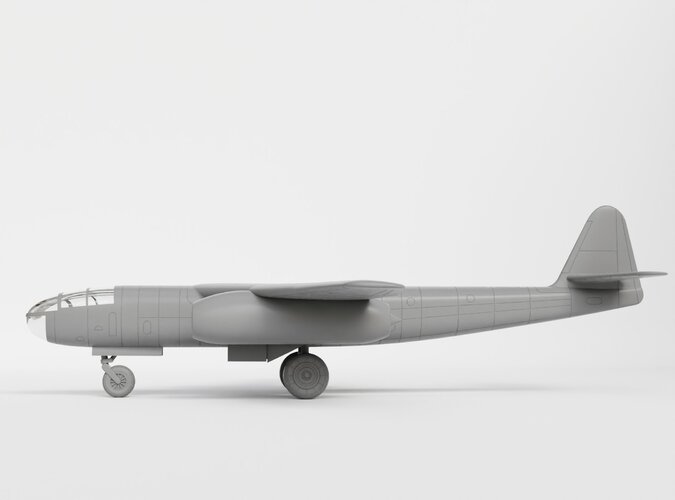
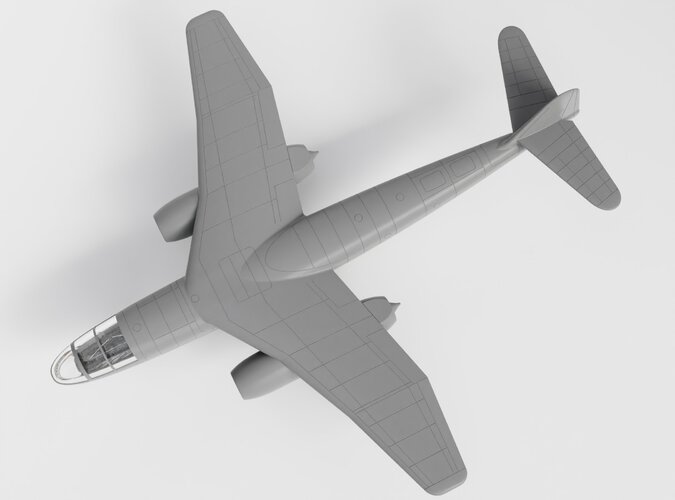
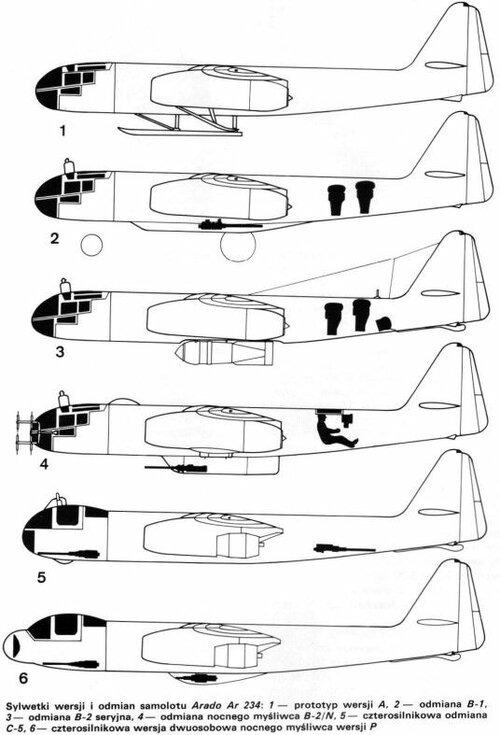
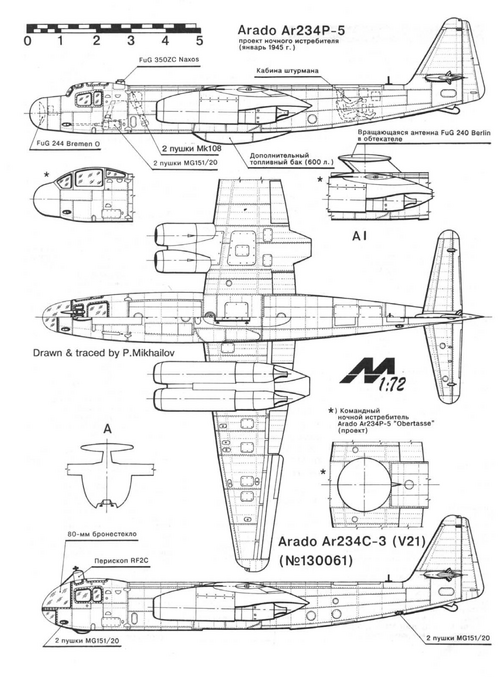
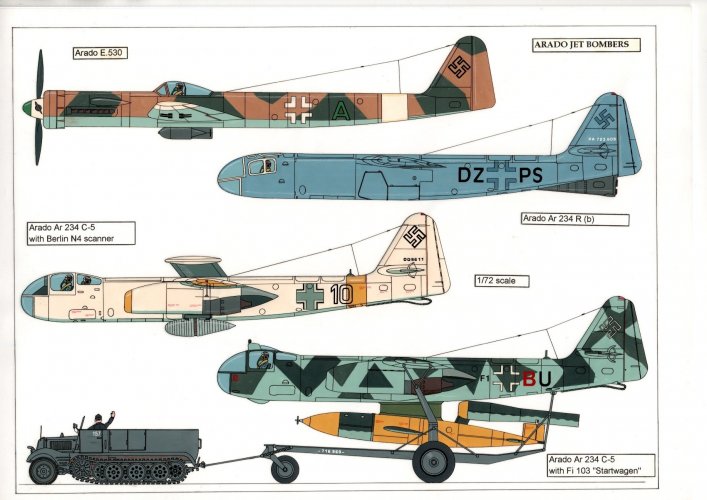
During the last year of the war in Europe, the Arado Company concentrated its efforts on the creation of several versatile multi-role aircraft.
These new designs depicted large aircraft capable of fighting American bombers by day, British bombers by night, flying in bad weather against D.H. Mosquitoes, attacking Soviet tanks at low altitude, or penetrating deep into heavily defended areas to bomb or photograph enemy installations.
On August 18, 1943, the Chief Designer Dr.-Ing. Walter Blume presented to representatives of the OKL the latest projects developed by the firm described in the internal document TEW 16/43. “T” means Technik und Konstruktion, “EW” signifying Entwurf (study) and “16“, the number of design series.
Arado TEW 16/43-19 was a preliminary study for the construction of a Stralhbomber (jet bomber) and a Nachtjäger (night fighter) powered by two turbojets.
Project 19 comprised three versions that differed in the type of turbojets used:
-Strahlbomber mit TL 1500 (Turbo-Lader) February 1943. It was powered by two Jumo 012 turbojets each rated at 2,780 kg static thrust. Wingspan: 16.2 m, length: 17.3 m, wing area: 46.6 sq. m, Max weight: 16,000 kg, range: 3,400 km.
-Strahlbomber mit TL 2000 (August 11, 1943) powered by two turbojets of unknown type. Wingspan: 19 m, length: 17.3 m, wing area: 64 sq. m, Max speed: 900 km/h with 2,000 kg of bombs.
-Strahlbomber mit TL 3000 (August 1943) powered by two turbojets of unknown type. Wingspan: 28 m, length: 17.3 m, wing area: 93 sq. m, Max speed: 940 km/h with 2,000 kg of bombs, range: 2,430 km.
The armament provided for all versions consisted of two forward firing MG 151/20 cannons; two rear firing MG 151/20 (fixed) and one MG 151/20 (flexible) mounted in a remotely controlled tail barbette FHL 151.
Arado TEW 16/43-22 was a preliminary study for the construction of a Zerstörer (heavy day fighter) armed with MK 213/20 and MK 103/30 cannons.
Arado TEW 16/43-24 was a preliminary study for the construction of a Kampfzerstörer (anti-tank) armed with MK 214/55 and BK 5/55 heavy cannons.
Arado TEW 16/43-26 was a preliminary study for the construction of a Schnellbomber (fast medium bomber) armed with two forward firing MG 151/20 cannons, two rear firing MG 151/20 (fixed) one MG 151/20 (flexible) mounted in a remotely controlled tail barbette FHL 151 and 2,000 kg bombs.
All these versions had a pressurized cabin that accommodated two crew members and were powered by two Jumo 012 turbojets.
In 1944 the four configurations were grouped together in the Arado E 560 project to simplify production by using as many common parts as possible.
E 560 was developed in at least eleven configurations with five specialized roles: Schnellbomber, Zerstörer, Nachtjäger, Schlechtwetterjäger and Zwangsaufklärer.
Only some information has been retained from six configurations:
E 560-2, Schnellbomber with two BMW 803 piston engine each rated at 4,000 hp, “T” tail, two crew members and 800 km/h.
E 560-4, Schnellbomber with swept back wings (25-degrees at ¼ chord), four BMW 003 E or Jumo 004C turbojets, two crew members housed in a pressurized cabin with 5-mm armor plates and 60-mm bullet proof glass, wingspan: 18.2 m, length: 17.6 m, height: 5 m, wing area: 48 sq. m, max weight: 17,000 kg, max speed: 900 km/h, range: 2,300 km, armament: two forward firing MG 151/20 cannons, two rear firing MG 151/20 (fixed) one MG 151/20 (flexible) mounted in a remotely controlled tail barbette FHL 151 and 2,000 kg bombs (external), electronics: FuG 10P, FuG 16, FuG 101, FuG 25a, K 12 autopilot and Kuto-nase (anti-balloons cable-cutter device).
E 560-7, Aufklärer (recce plane) with swept back wings (25-degrees at ¼ chord), powered by two turboprops BMW 028, Jumo 022 or Daimler-Benz DB 021.
E 560-8 (August 11, 1943), modified version of the TL 1500 project. Following the cancellation of the Jumo 012 turbojet and the awarding of all HeS 011 engine production to the Jägernotprogramm, it was proposed to use six BMW 003 A-1 turbojets, wingspan: 16.5 m, length: 18 m, height: 3.95 m, wing area: 46.6 sq. m, max weight: 16,000 kg, max speed: 920 km/h, range: 2,000 km, armament: two forward firing MG 151/20 cannons, two rear firing MG 151/20 (fixed) one MG 151/20 (flexible) mounted in a remotely controlled tail barbette FHL 151 and 3,000 kg bombs (housed in a bulged bomb bay), electronics: FuG 10P, FuG 16, FuG 101, FuG 25a, K 12 autopilot and Kuto-nase (anti-balloons cable-cutter device).
E 560-11 (December 1943), Schnellbomber with swept back wings (25-degrees at ¼ chord), designed to compete against the Blohm und Voss P. 188 and the Junkers Ju 286 jet bombers, powered by four BMW 018 turbojets each rated at 3,400 kg static thrust, wingspan: 24 m, length: 19.1 m, height: 5.1 m, max weight: 28,600 kg, armament: two forward firing MG 151/20 cannons, two rear firing MG 151/20 (fixed) one MG 151/20 (flexible) mounted in a remotely controlled tail barbette FHL 151 and 4,000 kg bombs (housed in a bomb bay), electronics: FuG 10P, FuG 16, FuG 101, FuG 25a, K 12 autopilot and Kuto-nase (anti-balloons cable-cutter device).
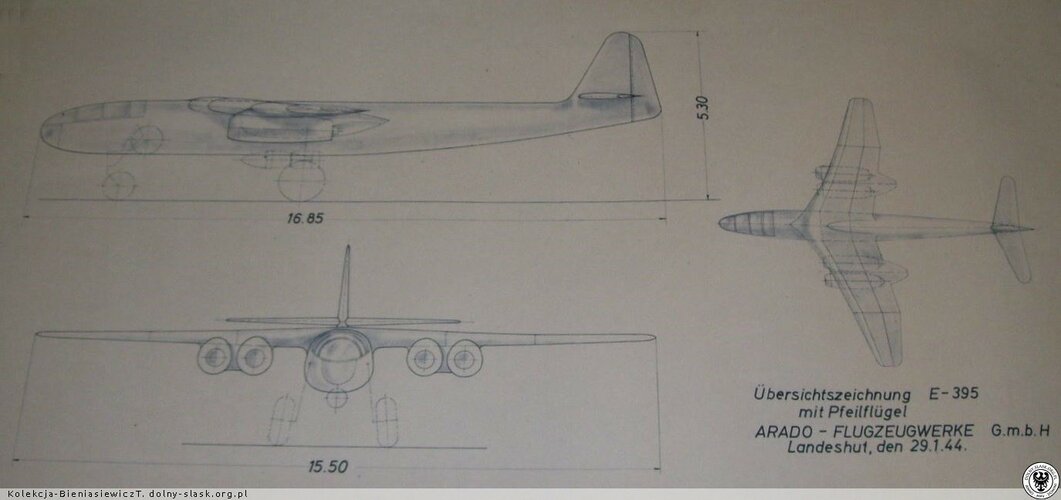
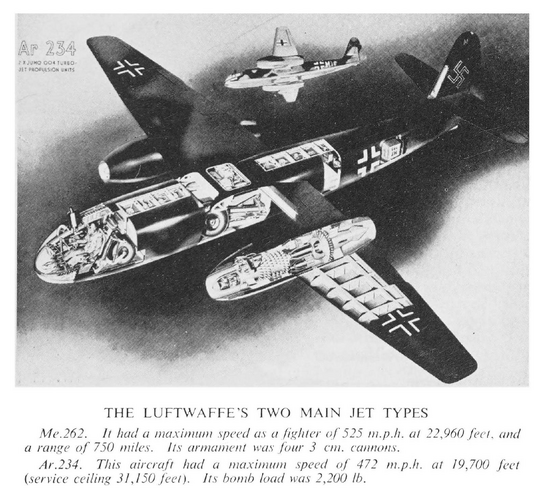
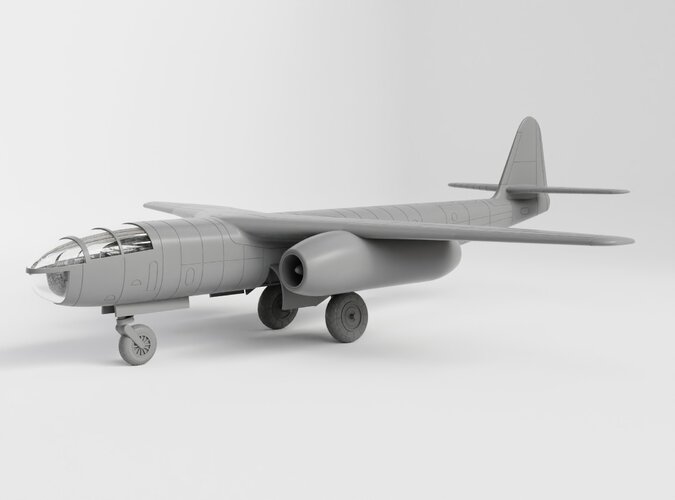
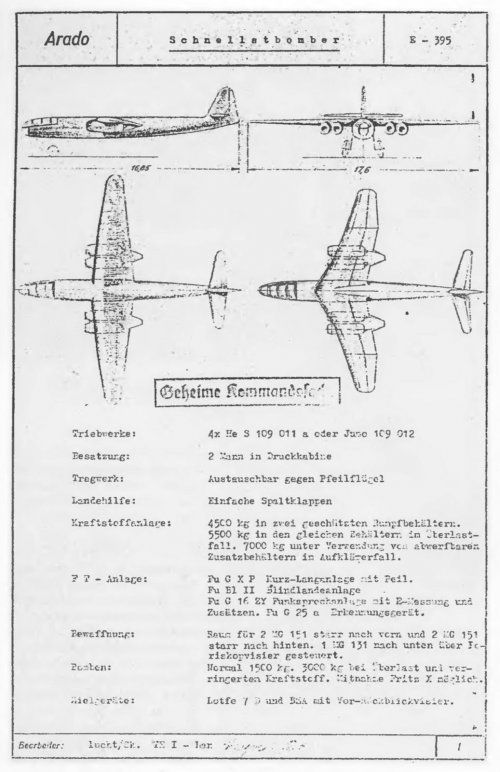
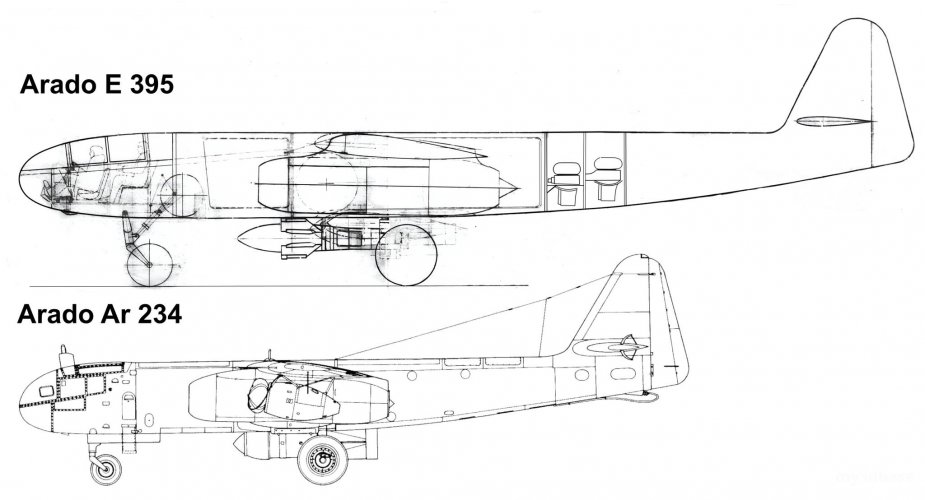
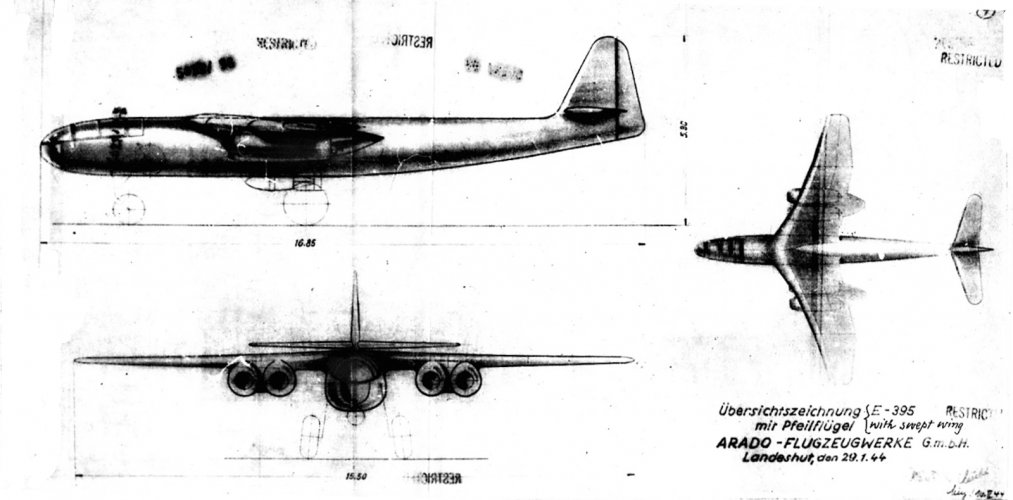
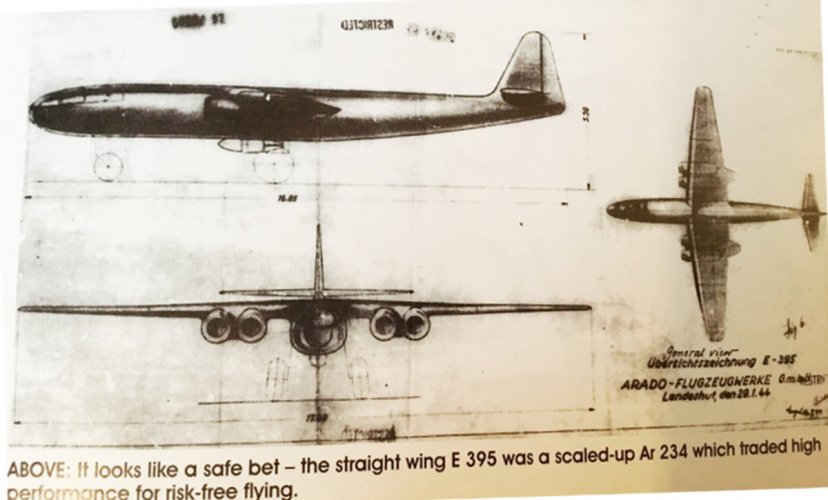
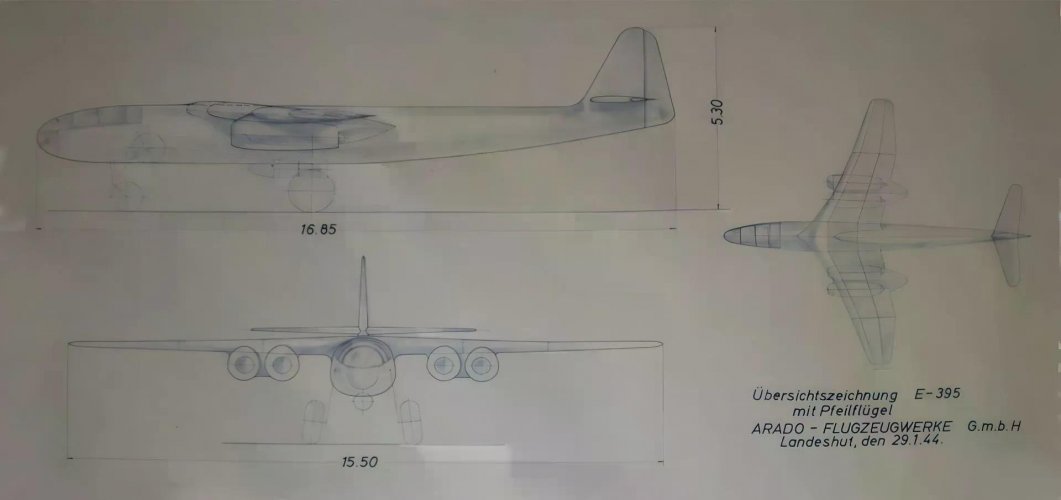
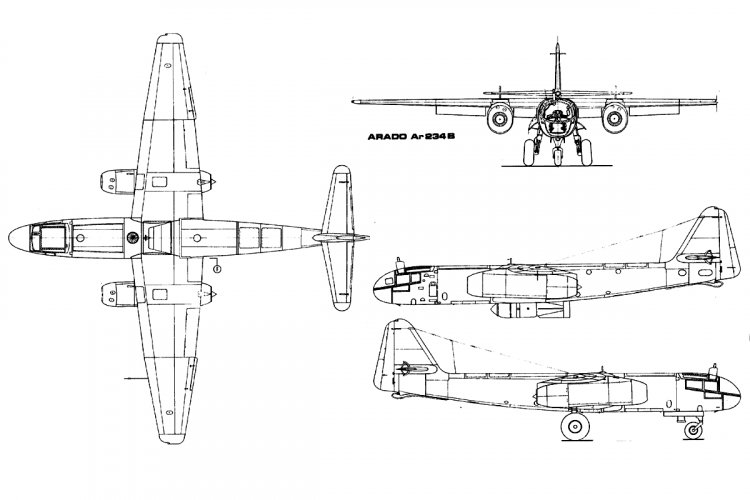
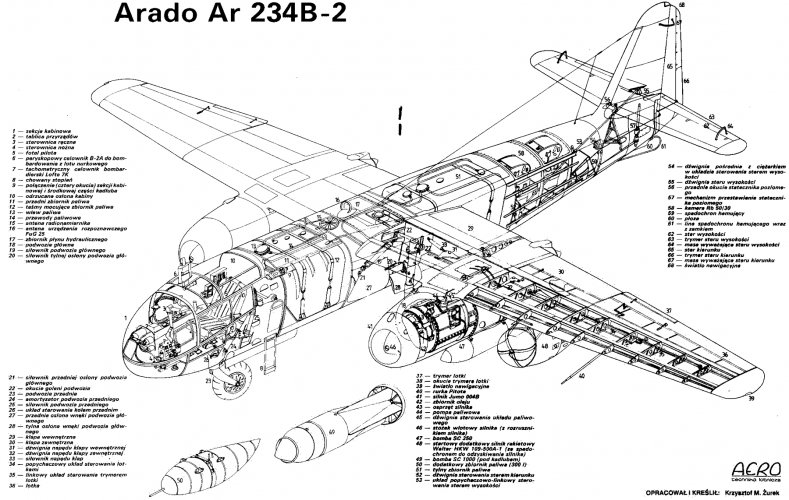
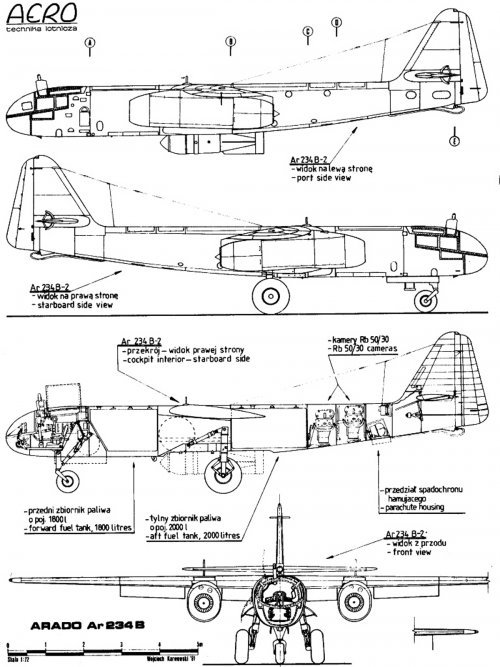
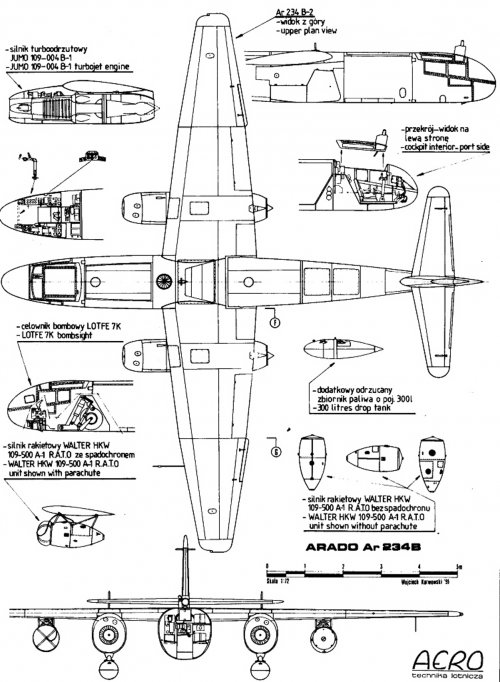
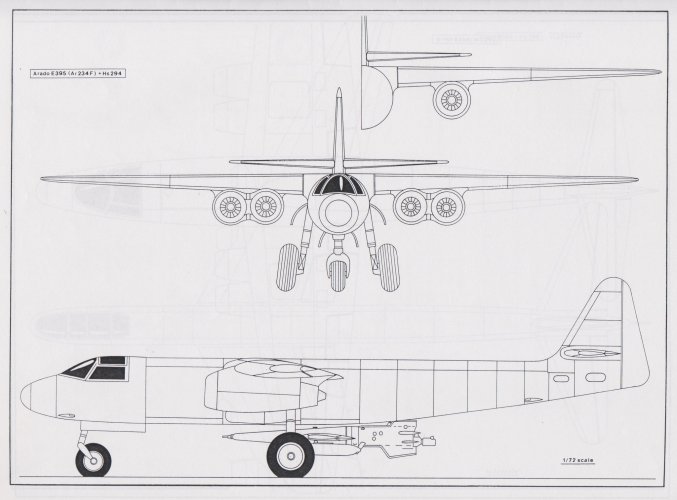
The E 395 project was a scaled-up version of the Ar 234 C, with two crew members housed in a pressure cabin, powered by four HeS 011 or Jumo 012 turbojets.
Two variants designed by Dipl.-Ing Lucht in competition with the Heinkel He 343 jet bomber, were proposed to the OKL:
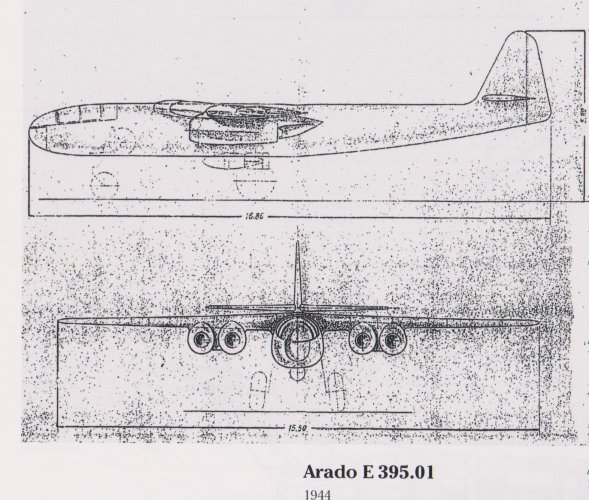
-E 395.01 (January 29, 1944) fitted with laminar-profile straight wing, wingspan: 17.6 m, length: 16.85 m, height: 5.3 m, wing area: 40 sq. m, max weight: 15,800 kg, max speed: 887 km/h at 6,000 m, service ceiling: 14,500 m, range: 1,500 km, armament: two forward firing MG 151/20 cannons, two rear firing MG 151/20 (fixed) one MG 151/20 (flexible) mounted in a remotely controlled tail barbette FHL 151 and 1,500 kg bombs (external) or one PC 1400 X missile, electronics: FuG 10P, Fu Bl 2, FuG 16 Zy, FuG 101, FuG 25a, K 12 autopilot, Lofte 7D, BZA and Kuto-nase (anti-balloons cable-cutter device).
-E 395.01 (May, 1944) fitted with compound crescent wing developed by Dipl-Ing Kosin, wingspan: 15.5 m, length: 16.85 m, height: 5.3 m, max weight: 16,800 kg, max speed: 960 km/h at 7,000 m, range: 2,000 km, armament: two forward firing MG 151/20 cannons, two rear firing MG 151/20 (fixed) one MG 151/20 (flexible) mounted in a remotely controlled tail barbette FHL 151 and 3,000 kg bombs (external) or one PC 1400 X missile, electronics: FuG 10P, Fu Bl 2, FuG 16 Zy, FuG 101, FuG 25a, K 12 autopilot, Lofte 7D, BZA and Kuto-nase (anti-balloons cable-cutter device).
A prototype was expected to make the first flight on 31 December 1944, but the project was cancelled along with the Jumo 012 turbojet.
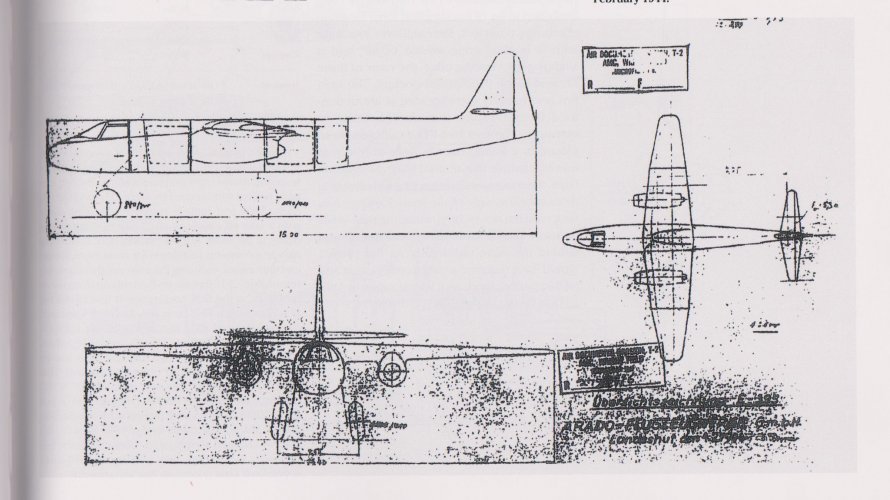
The E 395.02 (February 4, 1944) was a single-seat heavy day fighter with pressure cabin and stepped windshield, powered by two HeS 011 turbojets, wingspan: 14.4 m, length: 15 m, height: 5.1 m, max weight: 16,000 kg, max speed: 887 km/h at 7,000 m, range: 1,500 km, armament: two forward firing MG 151/20 cannons, two rear firing MG 151/20 (fixed) one MG 151/20 (flexible) mounted in a remotely controlled tail barbette FHL 151.
The project was cancelled following the OKL's decision to dedicate the entire production of the HeS 011 turbojet to the Jägernotprogramm.