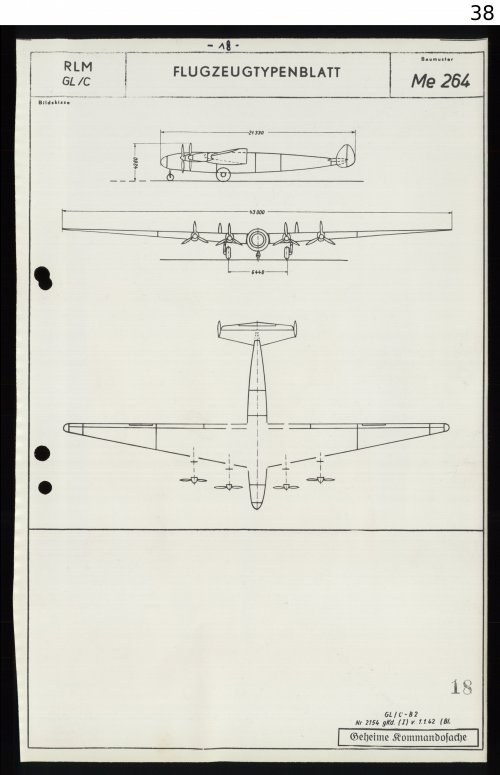
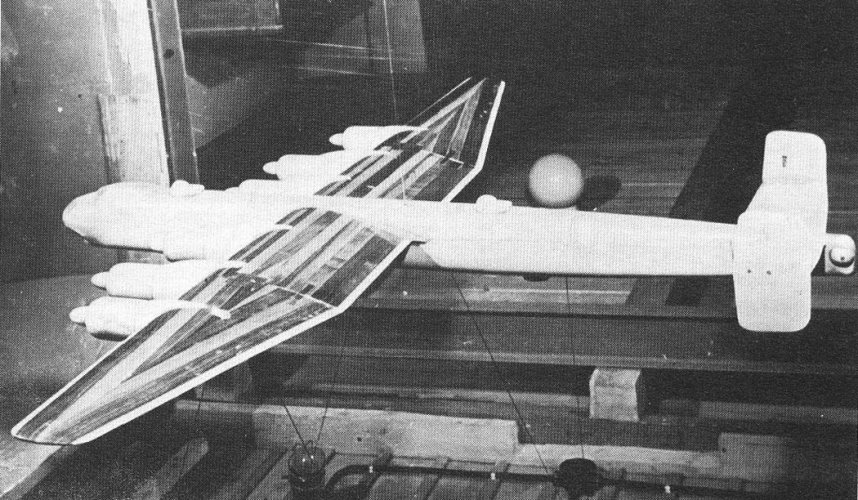
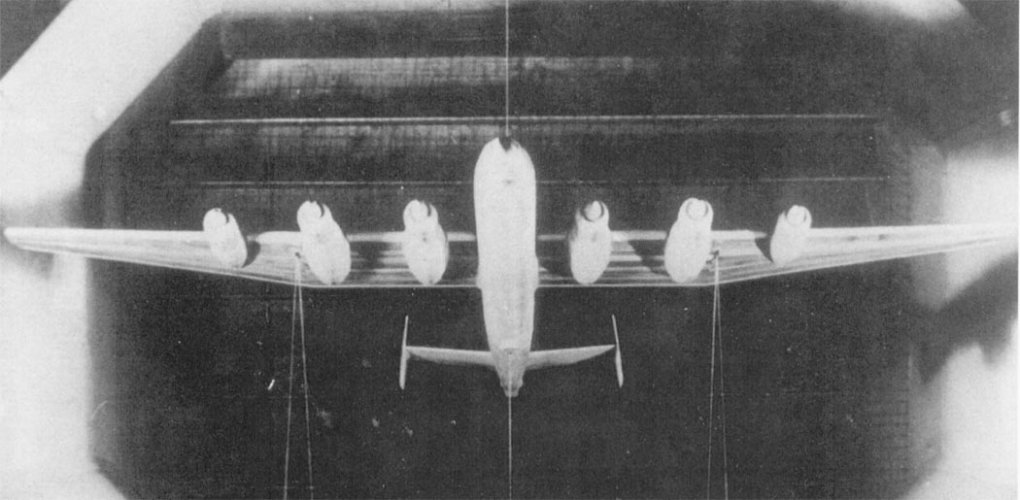
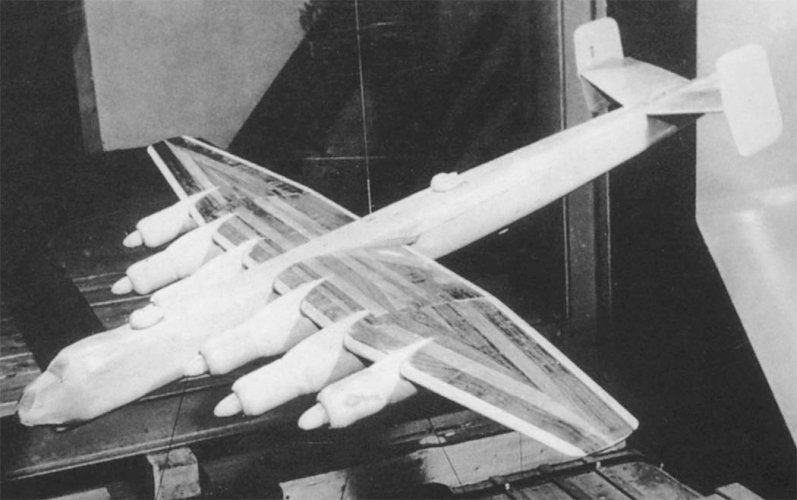
He177 pilot Peter Brill born 1924, d.2013 gave a public lecture in Spain in 2005 about the Amerika bomber conversion of an He177 with wings grafted from the abandoned Me. 264 project and DB613 engines producing 3,800hp. Referred to as having 11,100km (5,993nm) range.

The DB 613 was abandoned long before the Me 264 was. In fact, further development of the He 177 was abandoned before the Me 264 though not by a wide margin.
And 11,100km was regarded by the RLM as insufficient for the America mission.
According to deZeng and Stankey's Luftwaffe Officer Career Summaries https://www.ww2.dk/lwoffz.html, Brill's DOB was in June 1924 - which would make him barely 20 years old when the He 177 and Me 264 were cancelled. Also, he appears to have had no connection to the RLM nor any staff posting which might have given him access to what were, at the time, top secret documents. He ended the war as a leutnant and his only posting appears to have been to a fighter unit - JG 77 - rather then a bomber unit.
I would hazard a guess that he read this information somewhere in a postwar article.
 
On May 12, 1942, the Me 264 (when it was built) was said to have a range of 13,000km with a 2,000kg load. This was said to be insufficient for direct bombing raids on the US east coast, launched from bases near the French coast, since the Luftwaffe's planners thought a 15,000km range was essential.

Evidently, a flight from Brest Bretagne Airport to JFK in New York and back today would be a distance of 10,750km. Measured from city centre to city centre it would be more like 10,766km.

Even building in adequate safety margins, allowance for manoeuvring over the target, navigational errors etc. A 13,000km range (20% margin) seems like it would have been enough. Am I wrong? Would it have to be 15,000km (40% margin)?
 
Last edited:
Even building in adequate safety margins, allowance for manoeuvring over the target, navigational errors etc. A 13,000km range seems like it would have been enough. Am I wrong? Would it have to be 15,000km?

My dear Dan,the said in a book it,that its range would have been 14900 km.
 
My dear Dan,the said in a book it,that its range would have been 14900 km.

All sorts of different ranges were given for the Me 264 - it varies depending on bomb load, engine type, the date of the report, the author of the report (whether it was a Messerschmitt company figure, i.e. optimistic, or an RLM calculated figure, i.e. pessimistic) etc.

However, for the purposes of my question, the specific range is 13,000km with 2000kg of bombs, as stated in the GL meeting of May 12, 1942. That's the figure that critical decisions were based on.

Taking off from a base near Brest, would 13,000km have been enough for a direct bombing raid on the US east coast?

It rather seems as though the main reason why there was no in-service Amerikabomber was because the Germans had inaccurate data about the distance it would be required to fly - overestimating it by about 25% (they appear to have thought the basic distance, no margin, was 13,500km).
 
Last edited:
BUNDESARCHIV FILES

[CLICK "DIGITALISAT ANZEIGEN" TO VIEW THE FILES]

"Welche Forderungen sind an die Technik zu stellen für den Einsatz von Fernkampfflugzeugen mit einer Eindringtiefe von 2500 km"
by Hauptmann Jacobi - March 1944
Signatur: RL 2-IV/233
https://invenio.bundesarchiv.de/invenio/direktlink/87439c1d-1a5f-48b0-8469-d599d68189c7/Page: 20 - MAP*
Page: 36 - TA 400
(*Eindringtiefe 2500km = Flugstrecke 6400km, Bordeaux - Azoren, Kreta - Aden & Persischer Golf, Orscha - Ural)


Fertigungstechnischer Vergleich Ta 400/Me 264
Signatur: RL 3/1817
https://invenio.bundesarchiv.de/invenio/direktlink/bfa7810f-3a3d-461e-8fea-4ac213afc06a/[No Digitalisat available]
 
Last edited:
Taking off from a base near Brest, would 13,000km have been enough for a direct bombing raid on the US east coast?

It rather seems as though the main reason why there was no in-service Amerikabomber was because the Germans had inaccurate data about the distance it would be required to fly - overestimating it by about 25% (they appear to have thought the basic distance, no margin, was 13,500km).

Of course that also depends on how the Target Range was decided along with routing.

Was it a Point Target Like NYC mentioned here by the Great-circle navigation like Modern jets?

Or a closer to "Straight there" dash across the Atlantic over England rhumb line to make navigation slightly easier?

Maybe it was a general, We want to hit This Slice of the US East Coast, and not Just New York City which...

Well Didn't have that much production compare to Bethaham Steel up North, Philadelphia or Newport down south or even deep into the Country like Say Pittsburg 320 kilometers west? Or maybe they expected to SMACK the Convoys coming out of Canada as well? Causing hitting just New York City will not have done much to hinder the war effort, and Germany knew that.

We do not know the Specifics of WHERE German expected to bomb but we do have a decent idea of the general locations base on what we knew the Germans knew.

So I imagine that it was less a Point target like hitting NYC and more of a general We want to fuck up the factories of the east side of the CONTINENTAL United States of America. With NYC being used as the Big Mile Marker to design and plan around by adding extra range over it.

With having the with the 500 kilometer add to range over Brest to NYC will allow them to hit a massive chunk of the US. While maintaining a 5 percent if not more reserve for battle damage. That will allow them to hit all the way down south to the Carolina's border and as far west as the Indiania Ohio border.
 
We do not know the Specifics of WHERE German expected to bomb but we do have a decent idea of the general locations base on what we knew the Germans knew.

Sure we do:

0950.jpg

According to the accompanying report, dated April 27, 1942: “First priority targets are the US ferry system bases in Iceland (1,500km) and Greenland (cryolite mine 3,000km), starting from Bergen. Available for this purpose are: unarmed versions of the Fw 200 with two-ton bomb load (surprise effect), the in-flight refuelled He 177 with about five tons, and the BV 222 with 4-10 tons of bombs.
From the starting point Brest, US coastal plants for aluminium production (Massena, New York), aero engines (Wright at Paterson, New Jersey, and Pratt & Whitney at East Hartford, Connecticut), propellers (Hamilton Standard at East Hartford and Pawcatuck, Connecticut, plus Curtiss-Wright at Caldwell, New Jersey), weapons (Colt at Hartford), and instruments (Sperry Gyroscopes, Brooklyn, New York, and Bausch & Lomb optics, Rochester, New York) are only within reach of the Me 264 with DB 613 engines and 5.5 tons of bombs.
If the Azores could be used as an intermediate stop, it would be possible to attack these targets with: the He 177 (refuelled) with two tons of bombs, the BV 222 (refuelled) with 4.5 tons, the Ju 290 with five tons, and the Me 264 with Ju 88 engines with 6.5 tons. The Panama Canal cannot be attacked with the mentioned aircraft without at-sea refuelling (BV 222).”
 
Last edited:
Regarding range; +25% navigation reserve was a typical requirement at the time and one may still have to look at whether there are problematic winds or other conditions.

I suppose the "Amerikabomber" could have bombed Manhattan ONCE, ditched then near some Arctic Canadian island where the crews would reach land by inflatable boat to be picked up by submarine later. It would have been a propaganda and diversionary attack similar to the Doolittle Raid.

The real potential of the Me 264 was in North Atlantic convoy scouting and Fritz-X use against escort carriers. FM-2s would not have been effective interceptors against it. The Allies would have been forced to use throw-away interceptors (F6F) again, similar to the Hurricats. The CVEs would also have required a long range air search radar to stand a chance against a squadron of Me 264s.
Another potential would have been in striking the Iranian port where Lend-Lease goods arrived, striking Russian Urals industries and the Transsiberian Railway.
 
Regarding range; +25% navigation reserve was a typical requirement at the time and one may still have to look at whether there are problematic winds or other conditions.

I suppose the "Amerikabomber" could have bombed Manhattan ONCE, ditched then near some Arctic Canadian island where the crews would reach land by inflatable boat to be picked up by submarine later. It would have been a propaganda and diversionary attack similar to the Doolittle Raid.

The real potential of the Me 264 was in North Atlantic convoy scouting and Fritz-X use against escort carriers. FM-2s would not have been effective interceptors against it. The Allies would have been forced to use throw-away interceptors (F6F) again, similar to the Hurricats. The CVEs would also have required a long range air search radar to stand a chance against a squadron of Me 264s.
Another potential would have been in striking the Iranian port where Lend-Lease goods arrived, striking Russian Urals industries and the Transsiberian Railway.
Inflatable boat?

Submarine?

Why take a risk by being able to land in an uninhabited area and reach the Mexican border using motorcycles transported on the plane?

A stupid idea?

No, that was the Italian project.:rolleyes:
 
Regarding range; +25% navigation reserve was a typical requirement at the time and one may still have to look at whether there are problematic winds or other conditions.

I suppose the "Amerikabomber" could have bombed Manhattan ONCE, ditched then near some Arctic Canadian island where the crews would reach land by inflatable boat to be picked up by submarine later. It would have been a propaganda and diversionary attack similar to the Doolittle Raid.

The real potential of the Me 264 was in North Atlantic convoy scouting and Fritz-X use against escort carriers. FM-2s would not have been effective interceptors against it. The Allies would have been forced to use throw-away interceptors (F6F) again, similar to the Hurricats. The CVEs would also have required a long range air search radar to stand a chance against a squadron of Me 264s.
Another potential would have been in striking the Iranian port where Lend-Lease goods arrived, striking Russian Urals industries and the Transsiberian Railway.
Why would the FM-2 not be effective against a large, slow, bomber? The 264 has a cruise speed of about 215 mph (350 kph) and would be operating at about 15,000 to 20,000 feet (5 to 6,000 meters). The FM-2 would be intercepting at about 300 mph (500 kph) and has plenty of climb and ceiling to deal with a Me 264. So, why would the FM-2 be "ineffective?"

The 264 would be picked up on radar at anywhere up to 75 miles from the carrier / convoy and tracked in. Two FM-2 on CAP (the norm) could easily be vectored out to the bomber(s) for an intercept at beyond 40 NM and the fighters would either shoot down or seriously damage them in just a couple of passes. The 264 has to close to under 10 NM, and likely under 5 to launch a Fritz X or Hs 293 while holding a steady course towards the target so the bombardier can guide the weapon to the target. Of course, one would expect the carrier to have a set of jammers aboard to interfere with that and the carrier's screen would engage the bomber with AA fire. I'd also expect the carrier on contact with the bomber(s) on radar to launch an additional two FM-2 to supplement the CAP with more getting ready on deck to replace those in the air.

R.ac2585ed7fb1566ebe120c93f9372e6e


On that CVE, I see SG surface search radar (just above the SC set), SC 2-4 air search radar with IFF (large rectangle), SM-1 fighter control radar (forward and just below the SC antenna), YE homing beacon (mast top), SPR-1 ESM (little antennas on yardarms below YE), TDY ECM jammers (on the long very low yard arms). I'd say that's a pretty typical fit by late 1943 for a CVE.
 
The CVE's radar would be picked up at greater distance than its own range, so the Me 264 with a suitable FuMB (ESM) could safely triangulate the convoy from outside radar range. Which permits a feint from one direction followed by the real attack from another. In the morning, so all scout bomber crews would have decent astronavigation accuracy until recently. There you have your CAP and fighters ready to scramble neutralised or reduced to a 50/50 gamble.

An attack on a CVE would not be flown at cruise speed. It would be flown like He 1777 bombed London during Baby Blitz; starting high, expending altitude for extra speed in a shallow path of descent at maximum power. Me 264 could commence the attack at about 8000 m and descend to 4000 m for very high speed (over 600 kph). 4000 m was the lower boundary of effective Fritz-X use (this is mostly about guidance, not about penetration). The straight 10° climb afterwards would convert speed to altitude, but the bomber would still not be slow.

German bombers had self-sealing fuel tanks and some armour protection by 1943, so the 4 0.50cal A/N M2 of a FM-2 would not have done much. I strongly suppose you're overrating the lethality of a FM-2. German bombers weren't easily set on fire like Japanese ones. Furthermore, the A/N M2 jammed a lot when not fired in short bursts.

A single CVE would be worth the expenditure of 10 Me 264. A mere 1,000 Me 264 could have turned the tide in the Battle of the Atlantic this way (compare the size of the he 177 production run!).

The Germans never observed effective jamming of Fritz-X. The reports about effective jamming are originating from the Allies, who observed the technical failure of some Fritz-X and also that sometimes the bombardier lost track of the flare amid the light AAA tracers.

The weak heavy AAA firepower of an Atlantic convoy would not have made a difference, just as it made no discernible difference in real Fritz-X actions.

And then there's the thing about radars being in their infancy during WW2 and things often going wrong, including plain technical failure (just as a lot of Fritz-X were technical failures, but a squadron of 12 attack that drops 6 bombs on a CVE would likely score two hits with more than 21" magnetic fuse torpedo-like effect = CVE sunk).


Back to the Me 264; range was essential (and lacking in in-service designs) for
- Battle of Atlantic scouting
- Battle of Atlantic (guided) bombing
- bombing Soviet Urals industry
- bombing Soviet rear oil refineries
- disrupting Transsiberian railway
- disrupting Lend-Lease transports via Iran

To bomb New York would just have been a propaganda and diversion effort more than a substantial attack, so range with bombload to NY and back was not a justification for such a design effort.
 
Back to the Me 264; range was essential (and lacking in in-service designs) for
- Battle of Atlantic scouting
- Battle of Atlantic (guided) bombing
- bombing Soviet Urals industry
- bombing Soviet rear oil refineries
- disrupting Transsiberian railway
- disrupting Lend-Lease transports via Iran

To bomb New York would just have been a propaganda and diversion effort more than a substantial attack, so range with bombload to NY and back was not a justification for such a design effort.
I'm happy to see another person who gets it. The Amerikabomber obviously could not do sustained bombing campaigns due to the humongous effort put in by the US during WWII to improve warning time at the homefront, but for a propaganda raid or two it would've worked well. The true strenghts would've been against anything having to do with the USSR and the UK.
 
Also, with the topic of range at hand, does anyone know about the fuel efficiency of the BMW 801 VS the Jumo 211? That can help to answer some questions.
 
The CVE's radar would be picked up at greater distance than its own range, so the Me 264 with a suitable FuMB (ESM) could safely triangulate the convoy from outside radar range. Which permits a feint from one direction followed by the real attack from another. In the morning, so all scout bomber crews would have decent astronavigation accuracy until recently. There you have your CAP and fighters ready to scramble neutralised or reduced to a 50/50 gamble.

ESM is insufficient for guiding a Fritz X or Hs 293 to a target. You need visual contact with it as the guidance is MCLOS. Nothing less will do. So, while the plane would know the convoy's rough location, that doesn't equate into being able to attack it with anything available in 1942 to 1945. The closest thing that might work is the US Bat glide bomb as that has its own active radar for terminal homing. The alternative would be using TV guidance with MCLOS. The Germans were experimenting with that went the war ended. Only the US had actually tried using it as a guidance method.

A US CVE has a fighter direction center and radar for guiding the planes to an intercept. By the beginning of 1943, I'd say the intercept range on a bomber attack would be somewhere between 40 and 60 miles from the carrier. A feint does you no good either. Two planes are sent to the first target, two more launch and head to the next. Two more launch after that to be directed to the main strike. The planes are on the ship's radar, and the FDC has a plot of the action and talks them to an intercept. That was standard practice in both the RN and USN by 1943.
An attack on a CVE would not be flown at cruise speed. It would be flown like He 1777 bombed London during Baby Blitz; starting high, expending altitude for extra speed in a shallow path of descent at maximum power. Me 264 could commence the attack at about 8000 m and descend to 4000 m for very high speed (over 600 kph). 4000 m was the lower boundary of effective Fritz-X use (this is mostly about guidance, not about penetration). The straight 10° climb afterwards would convert speed to altitude, but the bomber would still not be slow.
It doesn't matter. An FM 2 still has a nearly 100 mph speed advantage over a He 177. Attacking ships is NOT like bombing a city. Ships move. Against ships the Me 264 would have to be at 3 to 4,000 meters on a steady course towards the target ship. This is necessary for the bomber to guide the weapon to the target and visual contact has to be maintained up to the weapon arriving at the target. This makes the plane(s) very vulnerable to intercept.

German bombers had self-sealing fuel tanks and some armour protection by 1943, so the 4 0.50cal A/N M2 of a FM-2 would not have done much. I strongly suppose you're overrating the lethality of a FM-2. German bombers weren't easily set on fire like Japanese ones. Furthermore, the A/N M2 jammed a lot when not fired in short bursts.

It wouldn't matter. An FM-2 performing a high side pass on a He 177 or Me 264 neither of which would be flying in some tight formation, something the Luftwaffe didn't practice with such planes, would mean a long burst of fire into the wing roots and engines of the plane. One engine out and that pretty much ends the bombing run. A fire ends the bombing run.
Prove the M2 jammed regularly.

A single CVE would be worth the expenditure of 10 Me 264. A mere 1,000 Me 264 could have turned the tide in the Battle of the Atlantic this way (compare the size of the he 177 production run!).

It would be more like the Germans expend the planes, don't sink anything, and have to wait several months before they have enough replacement planes and crews to try again.
The Germans couldn't build 1000 Me 264. The 264 is more complex than a He 177. I'd say the production rate if they really pushed it and dropped some other production to get it going as much as possible would result in about 1 Me 264 a day at most. That's about 300 or so a year.
The Germans never observed effective jamming of Fritz-X. The reports about effective jamming are originating from the Allies, who observed the technical failure of some Fritz-X and also that sometimes the bombardier lost track of the flare amid the light AAA tracers.

The Allies did. The Germans also observed that Fritz X often missed their targets. At Anzio, where Fritz X was used regularly, not one ship protected by USN jamming was hit (see: US History of Electronic Warfare vol 1, Alfred Price). I'd say, that the Fritz X and Hs 293 were no more effective or likely to hit a ship than a US Bat or Pelican glide bomb both of which had better guidance systems and weren't facing jamming.
The weak heavy AAA firepower of an Atlantic convoy would not have made a difference, just as it made no discernible difference in real Fritz-X actions.

Weak? The second more of an aerial threat appeared is the second ships and escorts get lots more AA guns. As it was, air attacks on convoys became increasingly rare as the war progressed so there was no need to provide much in the way of air defense.
And then there's the thing about radars being in their infancy during WW2 and things often going wrong, including plain technical failure (just as a lot of Fritz-X were technical failures, but a squadron of 12 attack that drops 6 bombs on a CVE would likely score two hits with more than 21" magnetic fuse torpedo-like effect = CVE sunk).

Given the Allies are about 10 years ahead of Germany in electronics by 1943 it's the Germans that have a problem. Trying to close to under 10,000 yards / meters and drop a torpedo using a medium or heavy bomber was suicide by 1943 against an Allied warship or formation of warships.
I doubt that 12 bombers would make it to visual range of the carrier, and they'd be lucky to get a hit. Aside from that, if it were really a threat, the Allies would bomb the snot out of the airfields the Germans were flying out of.


Back to the Me 264; range was essential (and lacking in in-service designs) for
- Battle of Atlantic scouting
- Battle of Atlantic (guided) bombing
- bombing Soviet Urals industry
- bombing Soviet rear oil refineries
- disrupting Transsiberian railway
- disrupting Lend-Lease transports via Iran

To bomb New York would just have been a propaganda and diversion effort more than a substantial attack, so range with bombload to NY and back was not a justification for such a design effort.
The Me 264 was a waste of resources for the Luftwaffe. They couldn't manufacture it in any sort of quantity where it could sustain operations. In terms of use of fuel, it was unaffordable. KG 1 with He 177 would save up fuel for weeks to launch one strike by late 1943 (See: The German Air War in Russia by Richard Muller for example). The Luftwaffe was incapable of producing a sustained bomber campaign in 1940 and that only got worse as the war progressed.
 
13,000km range / 6,500km radius would just be sufficient to reach New York from Brest on a perfect great-circle route with minimal diversions and little fuel wasted on weather or air combat*.

15,000km would seem to be the minimum practical range and would also bring Florida and the Mid West under threat.

Map by GPS Visualizer


* Nor does it give sufficient range to 'shuttle' through Argentina, that would need about 13,500km outbound in perfect conditions and 11,000km back to Brest.
 

Attachments

  • Brest_range_rings.png
    Brest_range_rings.png
    799.5 KB · Views: 117
Last edited:
Sure we do:

View attachment 783820

According to the accompanying report, dated April 27, 1942: “First priority targets are the US ferry system bases in Iceland (1,500km) and Greenland (cryolite mine 3,000km), starting from Bergen. Available for this purpose are: unarmed versions of the Fw 200 with two-ton bomb load (surprise effect), the in-flight refuelled He 177 with about five tons, and the BV 222 with 4-10 tons of bombs.
From the starting point Brest, US coastal plants for aluminium production (Massena, New York), aero engines (Wright at Paterson, New Jersey, and Pratt & Whitney at East Hartford, Connecticut), propellers (Hamilton Standard at East Hartford and Pawcatuck, Connecticut, plus Curtiss-Wright at Caldwell, New Jersey), weapons (Colt at Hartford), and instruments (Sperry Gyroscopes, Brooklyn, New York, and Bausch & Lomb optics, Rochester, New York) are only within reach of the Me 264 with DB 613 engines and 5.5 tons of bombs.
If the Azores could be used as an intermediate stop, it would be possible to attack these targets with: the He 177 (refuelled) with two tons of bombs, the BV 222 (refuelled) with 4.5 tons, the Ju 290 with five tons, and the Me 264 with Ju 88 engines with 6.5 tons. The Panama Canal cannot be attacked with the mentioned aircraft without at-sea refuelling (BV 222).”
These targets were already published on Manfred Griehl's "Luftwaffe Over America". I find it hard to believe Germans miscalculated distances.
 
These targets were already published on Manfred Griehl's "Luftwaffe Over America". I find it hard to believe Germans miscalculated distances.

They certainly were.

In terms of calculations, there were a lot of discussions at the time about what the correct figure was. Dietrich Schwencke had one figure, Friebel had another, Gablenz had another. The required reserve was also contested - whether it needed to be 1,500km, or up to double that.

The range achievable by the Me 264 was similarly a matter of debate, with different individuals and authorities coming up with different figures based on the same basic data. The picture was further complicated by the huge number of potential variations possible with the Me 264's design - whether it had armour, and if so how much, whether it had armament, and if so how many weapons, how much ammunition etc.

So I don't know if 'miscalculation' is quite right, but there was a definite lack of hard data.
 
Keep in mind the dismal track record of extreme long distance aircraft at the time.

The Japanese Ki-77, for example.

A 10,000 km flight would not have been routine at that time - it would have been something special like a record flight.

It was already astonishing that the Allies dared to have North Atlantic coverage with B-24 versions, half the range we're talking about here.
 
Gardner, I read your first sentence and concluded that you haven't understood what I wrote.
I am convinced my writing was clear enough to be understandable.

Put in more reading effort, then I may read what else you wrote.
Your ad hominem aside, I was clear that ESM alone isn't sufficient for carrying out an attack on a convoy. Outside of visual range, or good radar contact, all you know is you have some signal returns that belong to certain electronic equipment. For example, let's say your ESM system is one or another variant of Naxos. You are picking up several 10 cm SG or Type 271 radar signals. You don't know which since both are similar. You have no ESM to check and see if the contacts are using something like TBS which is an UHF FM radio system and line-of-sight. All you have are several returns and a rough bearing.

So, is the target a convoy with merchant ships that you want to attack? Or is it a hunter-killer group of warships that will just grind you up and spit you out? Either would have ships running those radar signals. At that point, you have no idea what you're getting into, just that it is the enemy and they're something like 20 NM away. At your current altitude, are you on an air search radar? Are there any long-range maritime patrol planes in the area?

So, ESM has located a potential target some distance away. You can't see it visually. Maybe there's cloud cover. That's extremely common in the Atlantic. You know that the Allies have radar coverage and will likely pick your approach up. Your own FuG 200 Hohentweil can pick out individual ships at ranges of about 15 to 25 km (9 to 15 miles), well inside the range of Allied air search radars. At ranges up to about 50 to 60 km (30 to 40 miles) you can get a generalized return on something like a group of ships or a convoy. Either way you're inside Allied air search range. As a patrol aircraft, you'd be alone. Do you radio in the coordinates and shadow (normally that'd be the case)? Do you go for a strike alone? How long between you making contact and the command ashore setting up and sending a strike will it be? Hours? Days?

Worse, you know if you turn on your radar to locate the Allied vessels, their own ESM is likely to pick up the signals and get a bearing on you. That means their radar is going to paint your plane and if they have defending fighters, they're on the way to shoot you down.

The Luftwaffe isn't going to send a strike package of bombers out randomly looking for a target. They will send out patrol planes singularly to locate Allied ships and convoys and report that information back to the OKL. From there, it will be shared with the OKM and sent out to U-boats. That takes the better part of a day to do.

Your version starts with the Germans magically knowing where the Allies are, their dispositions, and having a strike in the right place at the right time all in perfect order to attack. It doesn't work that way. It doesn't matter what exact plane(s) the Germans are using for this. The organization and planning of a strike doesn't change.

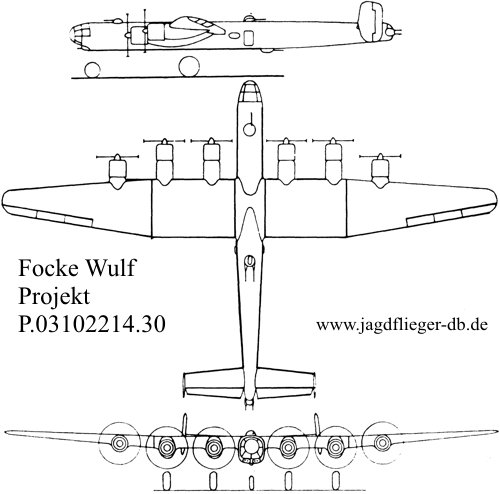
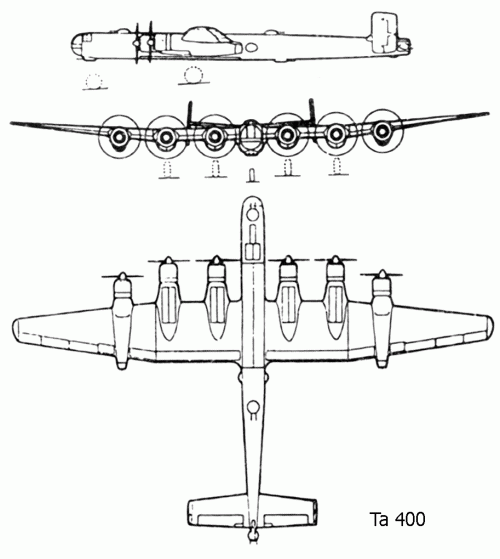
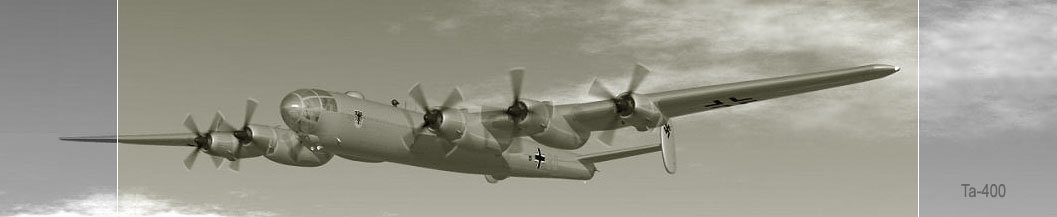
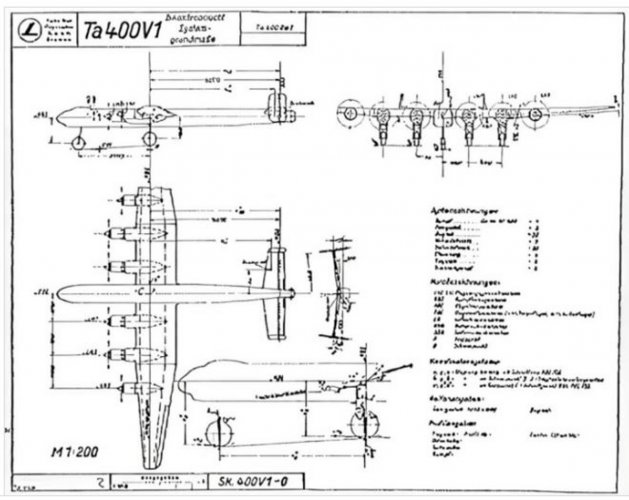
Your lone Me 264, Ta 400, whatever bomber on maritime patrol could just as easily run into a B-24, Sunderland, or whatever Allied maritime patrol plane and get into a fight. That happened more than once. Or your lone plane gets picked up on radar and intercepted by Allied naval fighters and shot down. That happened too, and more than a few times.

Also, the Allies have far better navigation aids for their ships and planes than the Germans do. By mid-43 they're using LORAN or DECCA with an accuracy of about 1 mile compared to dead reckoning the German aircrew would be using where they could be off tens of miles in position.
 
I'll counter this with the fact that the Type VII's GHG (hydrophone) array was able to detect a convoy at more than 100 km distance. The sound of escorts and the sounds of cargo ships were distinct to a GHG operator, so even a submarine could easily report the convoy targets.
The triangulation by scout-bombers would serve to determine the position more accurately, accurately enough for a synchronised (either both formations attacking or one just doing a feint).

There were about 50 jeep carriers. The Americans were not able to spare lots of heavy AAA-strong cruisers for ordinary Atlantic convoys and the British had few AAA cruisers and badly needed those in the Med.

Moreover, it's a simple fact that German guided weapons bombers successfully attacked Western Allies' convoys that were better-defended than any Atlantic convoy, including hitting the HMS Warspite off Salerno where plenty heavy AAA was concentrated. A little distraction was enough, just as Germans bombers over the Atlantic had a myriad ways to reduce the effectiveness of the weak fighter component of a petty CVE.

And frankly, at this point I got to say I find your position ridiculous. A CVE with a couple Atlantic escorts was far from a carrier task force in the Pacific. Its fighter component was small, some fighters would not be ready for use and the idea that maybe 4 FM-2 could do much against a squadron of Me 264 is ridiculous to me. The many Attacker class CVEs had but 20 aircraft, for example. Most of those were needed for ASW patrols. To have as many as 4 FM-2 make contact with a Me 264 before bombs impact would be very lucky.

"dead reckoning the German aircrew"

Well, I saw this quite late. It's another proof that you don't read properly, for I had countered that long ago already. So I'll just mute you.
 
I'll counter this with the fact that the Type VII's GHG (hydrophone) array was able to detect a convoy at more than 100 km distance. The sound of escorts and the sounds of cargo ships were distinct to a GHG operator, so even a submarine could easily report the convoy targets.
The triangulation by scout-bombers would serve to determine the position more accurately, accurately enough for a synchronised (either both formations attacking or one just doing a feint).

That's highly dependent on sea conditions. Most of the time, the GHG could pick up ships with reasonable accuracy at somewhere between 20 and 40 km. The sort fitted to the Type VII also required maneuvering the boat from side to side to get readings due to the way the hydrophones on it were laid out.

Since Luftwaffe maritime aircraft had no way to be in radio communication with U-boats--yes, they use different radio systems--and the boat captains would not transmit in any case, that means is out. What happened historically, was the plane would transmit to their home station or report on landing their findings. From there, the information would be passed up to the OKL where it would then be passed over to the OKM and then back down to the U-boats on the regularly scheduled transmission times using Enigma coding.
There were about 50 jeep carriers. The Americans were not able to spare lots of heavy AAA-strong cruisers for ordinary Atlantic convoys and the British had few AAA cruisers and badly needed those in the Med.

Neither the USN or RN need heavy AA cruisers for defense of convoys. A single CVE or merchant carrier with even a few fighters onboard would be more than sufficient against the small number of bombers the Germans could muster. Remember, the Ju 290 and FW 200 were being produced at rates of 1every week or two at most. So, you'll never have more than a handful operational at any time.
Moreover, it's a simple fact that German guided weapons bombers successfully attacked Western Allies' convoys that were better-defended than any Atlantic convoy, including hitting the HMS Warspite off Salerno where plenty heavy AAA was concentrated. A little distraction was enough, just as Germans bombers over the Atlantic had a myriad ways to reduce the effectiveness of the weak fighter component of a petty CVE.

Yes, they did. But the number of ships hit is still relatively small. In the case of Warspite and Savanah off Salerno, both were near stationary and engaged in fire support operations. There was a lack of air cover there as well as Salerno was at the edge of fighter range at the time so there wasn't continuous coverage. Thus, you have optimal conditions.

The same is true at Anzio but there the Allies had good jamming coverage and ships that got hit were almost entirely outside that coverage.

As for shipboard AA, the bomber(s) attacking with Fritz X or Hs 294 did so from the edge of heavy AA gun range for those ships, usually at 20,000 ft (6000 meters) + and a range of 5 NM (8 to 10 km) +. In fact, these weapons were the impetus for both the USN and RN to start developing SAM missiles around mid-1944.

 
Put in more reading effort, then I may read what else you wrote.
I see ad hominem here. Nothing serious, of course. But despite being a minor infraction, I prefer to remind the rules, in order to prevent the conversation going truly personal.
 
As a point of history... USS Bogue CVE 9 sank 11 U-boats, damaged or otherwise drove off many others from attacking, and never had a ship in a convoy the carrier was escorting sunk.

With up to 12 FM Wildcats aboard, along with 12 to 16 TBM Avengers equipped with radar mainly for ASW work, the ship's air wing is formidable. A handful of large bombers without escort are going to be easy targets for them.

As you can see in this photo, the Bogue's electronics suite consists of:

8ae34887f9233a0dfe64a67b27773ebb--battleship-aircraft-carrier.jpg

HF/DF on the forward mast near the bow.
YE homing beacon at mast top
SG surface search radar below the yard arms with SPR ESM system antennas on them.
SK air search radar. A much-improved SC-4 set that can go out to about 100 NM.
TDY jammer on the long yard arm.
The box above the bridge might be a Type 271 or something else British.

The typical escort group for the Bogue, most of the time, was 4 to 6 destroyers, mostly older "4-Pipers" reequipped with 4 x 3"/50 AA + 6 to 8 20mm and used for ASW work.
 
Curtiss XF14 C

​

To replace the F4F Wildcat, the U.S. Navy issued the 23 February 1941 Specification calling for a new carrier-borne interceptor designed for service aboard the 45,000-ton Midway-class carriers.

Grumman Aircraft Engineering Corp. proposed an extensively modified Wildcat powered by one Wright XR-2600-10 radial engine without turbo-supercharger.

It was a design suitable to the needs of the U.S. Navy that was built and used with great success under the designation F6F Hellcat.

The only way to compete with Grumman was to propose a fighter with superior performance. Curtiss decided to use a turbo-supercharged liquid-cooled in-line engine with the intention of surpassing Grumman's design in top speed and ceiling.

The U.S. Navy preferred to use air-cooled radial engines, but the F6F had been designed to defend the fleet against the attacks of low level torpedo-bombers and medium-altitude dive bombers and the existence of German bombers with 41,000 ft (12,500 m) ceiling could not be ignored.

On 30 June 1941 the U.S. Navy signed a development contract for a new high-altitude interceptor, under the designation XF14 C-1.

The airplane was powered by one 2,300 hp. Lycoming XH-2470-4, 24 cylinder ‘H’, liquid-cooled experimental engine, with turbo-supercharger, driving a six-bladed contra-rotating airscrew.

On 12 July 1940, during a series of aerial attacks by the Italians against the big and sluggish battleship HMS Warspite, not even one of the 300 bombs dropped between 8:50 and 11:50 hit their target.

The situation was repeated in December 1941 when Boeing B-17 bombers of the 19th B.G. based in the Philippines attempted to stop the Imperial Fleet Japanese by attacking from 25,000 ft (7,620 m). The reality of the war showed that the danger of high-altitude bombers had been overestimated.

The development of the Lycoming engine was unsatisfactory and the XF14 C-1 was cancelled in December of 1943.

The Germans created guided missiles which could be launched from planes at a great distance of the warships without being exposed to the efficient naval anti-aircraft artillery.

At first they consisted of already existing bombs and torpedoes that had been tested in combat, fitted with wings and tailfins made them capable of gliding until their impact against enemy ships.

They were guided by a cable, a radio-link or by means of passive sensors of radar or infrared radiation installed on board.

On July 1943 entered service the German radio-controlled bomb Fritz-X.

The new missile weighted 3,461 lbs (1,570 kg) and was used by the Dornier Do 217 K-2 of the III/KG 100 to sink the Italian battleship Roma and seriously damage the British battleship HMS Warspite and the Allied cruisers HMS Uganda and USS Savannah.

El Fritz-X could be launched by the Do 217 K-2 and Heinkel He 177 A-5/R2 bombers flying between 24,600 ft and 26,250 ft.

Early 1944 the U.S. Navy recommended the installation of one 2,300 hp Wright XR-3350-16 turbo-supercharged radial engine in the XF14 prototype (Bu no.03183) and continue its development under the designation XF14 C-2.

The airplane was flown in July 1944 reaching only 398 mph versus the guaranteed 424 mph. The propeller produced an undesirable vibration and the pressurised cockpit was not yet installed.

At that time the Allied already had electronic jammers capable of interfering with the Radio-link Kehl/Strassburg guidance system of the Fritz-X and the Germans began using the new Henschel Hs 293B missiles, with the wire guidance system Dortmund/Duisburg that would have been immune to the Allied jammers, but the Hs 293B should be released at just 4,500 ft (1,371 m) to prevent the control wires from breaking.

When Allied intelligence services discovered that the Japanese had serious difficulty building their own turbochargers, the tactical need for a naval high-altitude interceptor had failed to materialise and further development of the XF14 C-2 was cancelled.


Curtiss XF14 C-2 technical data

Power plant: one 2,300 hp Wright XR-3350-16 eighteen-cylinder turbo-supercharged radial engine driving a six-bladed contra-rotating airscrew, wingspan: 46 ft (14 m), length: 37.8 ft (11.5 m), height: 17 ft (5.18 m), wing area: 375 sq. ft (33.75 sq. m), max speed: 398 mph (640 kph), max weight: 14,582 lbs (6,606 kg), service ceiling: 39,500 ft (12,042 m), armament: four wing mounted 20 mm cannons with 166 rounds per gun.

 

Attachments

  • 035.jpg
    035.jpg
    573.5 KB · Views: 97
  • 036.jpg
    036.jpg
    537.1 KB · Views: 138
Bundesarchiv Files

Signatur: RL 3/2359
“Operational tasks for long-distance aircraft" April 27, 1942
https://invenio.bundesarchiv.de/invenio/direktlink/3c4adf97-641b-45c2-a955-c19e24e7c0b2/- Transport flights to Japan
- Raw materials from South America
- Reconnaissance and combat targets “Soviet Union, Central and Northeast African region and Persian Gulf, Western Atlantic coast and USA”
- World map with location of targets
- Long-distance aircraft 1942 - 1944
(He 111Z, He 177, Fw 200, Bv 222, Ju 290, Fw 300, Me 264, Bv 238S & L, Ju 390, Do 214)

Signatur: RL 3/3561
Flights to east asia.
(Fw 200, Bv 222) June 1942 - July 1943
https://invenio.bundesarchiv.de/invenio/direktlink/777e74cc-73b5-43e0-a7a4-2fbb5c26d175/
[CLICK "DIGITALISAT ANZEIGEN" TO VIEW THE FILES]
 
Bundesarchiv Files

Signatur: RL 3/2359
“Operational tasks for long-distance aircraft" April 27, 1942
https://invenio.bundesarchiv.de/invenio/direktlink/3c4adf97-641b-45c2-a955-c19e24e7c0b2/- Transport flights to Japan
- Raw materials from South America
- Reconnaissance and combat targets “Soviet Union, Central and Northeast African region and Persian Gulf, Western Atlantic coast and USA”
- World map with location of targets
- Long-distance aircraft 1942 - 1944
(He 111Z, He 177, Fw 200, Bv 222, Ju 290, Fw 300, Me 264, Bv 238S & L, Ju 390, Do 214)

Signatur: RL 3/3561
Flights to east asia.
(Fw 200, Bv 222) June 1942 - July 1943
https://invenio.bundesarchiv.de/invenio/direktlink/777e74cc-73b5-43e0-a7a4-2fbb5c26d175/
[CLICK "DIGITALISAT ANZEIGEN" TO VIEW THE FILES]

Nice find my dear Moin.
 

Attachments

  • RL_3_2359_0038.jpg
    RL_3_2359_0038.jpg
    1,011.6 KB · Views: 109

Attachments

  • ta400-1.jpg
    ta400-1.jpg
    240.9 KB · Views: 47
  • ta400-2.jpg
    ta400-2.jpg
    81.6 KB · Views: 31
  • ta400-3.jpg
    ta400-3.jpg
    90 KB · Views: 37
  • Ta400.jpg
    Ta400.jpg
    86.1 KB · Views: 40
  • ta400.gif
    ta400.gif
    40.4 KB · Views: 41
  • ta400_00.jpg
    ta400_00.jpg
    46 KB · Views: 41
  • Ta 400 v1.JPG
    Ta 400 v1.JPG
    298.3 KB · Views: 41
Last edited:

Similar threads

Back
Top Bottom