It would seem small carriers like this would be ideal platforms for UAV's & drones. They could have the additional equipment for control of various unmanned platforms. (Something like Turkey is doing with one of its amphibious ships)

You are using an out of date browser. It may not display this or other websites correctly.
You should upgrade or use an alternative browser.
You should upgrade or use an alternative browser.
Harrier Carriers
- Thread starter Mike Pryce
- Start date
-
- Tags
- bae british aerospace plc cold war fleet air arm great britain harrier carrier hawker siddeley aviation ltd helicopter carrier japan maritime self-defense force post-cold war royal navy sea harrier united states marine corps united states navy v/stol vosper thornycroft vsel vstol carriers vtol west germany

F.L.
ACCESS: Top Secret
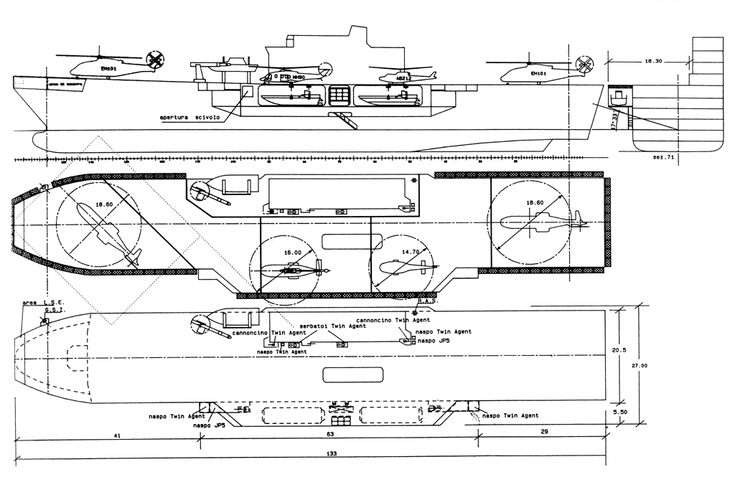
I was wondering, have there ever been considered operating Harriers or F-35Bs on the San Giorgio class LHD on emergency case ?
As an very light aircraft carrier.
In the style of Iwo Jima LHDs or project of Spruance Harrier carriers.

As an very light aircraft carrier.
In the style of Iwo Jima LHDs or project of Spruance Harrier carriers.
Scott Kenny
ACCESS: USAP
- Joined
- 15 May 2023
- Messages
- 19,511
- Reaction score
- 27,958
That doesn't seem to have an elevator big enough to get an F35 belowdecks (and maybe not enough vertical clearance in the hangar even if the elevator was 16.5x12m), but you could probably stow 6 on the deck and still have space at the bow and stern to operate helicopters.I was wondering, have there ever been considered operating Harriers or F-35Bs on the San Giorgio class LHD on emergency case ?
As an very light aircraft carrier.
In the style of Iwo Jima LHDs or project of Spruance Harrier carriers.
View attachment 725047

archipeppe
ACCESS: Top Secret
- Joined
- 18 October 2007
- Messages
- 2,556
- Reaction score
- 3,891
As Scott pointed out, even if they look like small carriers the Santi Class is not suited for fixed wing aircraft operations.That doesn't seem to have an elevator big enough to get an F35 belowdecks (and maybe not enough vertical clearance in the hangar even if the elevator was 16.5x12m), but you could probably stow 6 on the deck and still have space at the bow and stern to operate helicopters.
Probably they could be used only as emergency spot for Harriers or to transport them (like the Atlantic Conveyor during the Falklands War).
The only Italian LHD designed to be fully operational with both AV-8B+ and F-35B is the upcoming Trieste.
And the Cavour. That is not a LHD, but have a limited capability of transport of landing forces.As Scott pointed out, even if they look like small carriers the Santi Class is not suited for fixed wing aircraft operations.
Probably they could be used only as emergency spot for Harriers or to transport them (like the Atlantic Conveyor during the Falklands War).
The only Italian LHD designed to be fully operational with both AV-8B+ and F-35B is the upcoming Trieste.
Thera are no elevators for Helicopters in Santi Ships. The deck is only for the landing forces, and the helicopters could not be recovered, but stay always on the bridge.That doesn't seem to have an elevator big enough to get an F35 belowdecks (and maybe not enough vertical clearance in the hangar even if the elevator was 16.5x12m), but you could probably stow 6 on the deck and still have space at the bow and stern to operate helicopters.
Scott Kenny
ACCESS: USAP
- Joined
- 15 May 2023
- Messages
- 19,511
- Reaction score
- 27,958
I assumed that the narrow rectangle with rounded corners amidships on the flight deck and other deck image was some kind of elevator.Thera are no elevators for Helicopters in Santi Ships. The deck is only for the landing forces, and the helicopters could not be recovered, but stay always on the bridge.
It is… but too small for a fixed wing HarrierI assumed that the narrow rectangle with rounded corners amidships on the flight deck and other deck image was some kind of elevator.
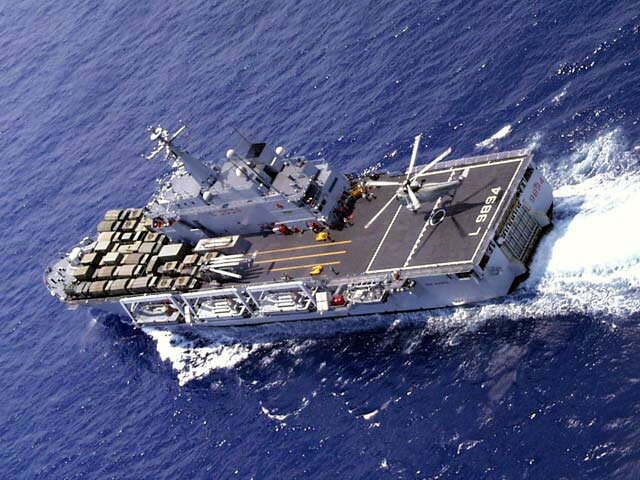
Yes, is an elevator, but only for terrain vehicles, that will be carried on the bridge.I assumed that the narrow rectangle with rounded corners amidships on the flight deck and other deck image was some kind of elevator.
Attachments
archipeppe
ACCESS: Top Secret
- Joined
- 18 October 2007
- Messages
- 2,556
- Reaction score
- 3,891
Of course.Yes, is an elevator, but only for terrain vehicles, that will be carried on the bridge.
When appeared for the first time in 1988 everyone in Italy was thinking about such ships as "small carriers" a smart way for Italian Navy to increase the number of harrier carriers after the Garibaldi (considering that Garibaldi was left alone without a sister ship).
The flat deck and the island look misleaded all about such point.
In reality, giving a close look to the project, the Santi Class were intended by since as pure helicopter assault ships.
The Santi Class hull was derived by the civilian Poeta Class shuttles (Boccaccio, Carducci, Pascoli, Leopardi, Petrarca, Manzoni, Deledda and Verga) launched in 1969-78 timeframe.
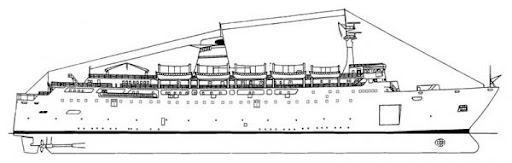
The Santi Class were Poeta modified with flight deck, island, and armament but they essentially remained modified shuttles so unsuitable to be real aircraft carriers, like the Garibaldi and the later Cavour, designed by since to be real aircraft carriers.
The Santi Class represented an high value asset for the Italian Navy giving, for the first time, an entire fleet of LHD with rapid deployment force of San Marco batallion and the possibility to operate as helicopter carriers.
Last but not least the look of small carriers like American counterpart helped to solve some thorny situations over the years.
But all the initial limitation given by their civilian ascendence remained in place.
That's why the new Trieste is so important: like the Garibaldi such ship represent the very first one conceived to operate as LHD (with large floodable basin inside) AND to operate as a real aircraft carrier with its complement of F-35B.
What is interesting is the Spanish have done the exact same (smart) move with their Juan Carlos. Instead of a miniature carrier, they went big, but amphibious: and multirole.
And say what you want about the F-35B, but that plane brings together into just one airframe
-supersonic flight
-AMRAAM missiles
-stealth
-VSTOL
Quite a powerful package for navies not wanting to go the full CATOBAR 100 000 tons way. Just ask USMC and their plan to provide additional decks to the USN carrier force, through their large amphibious. USMC really showed the way with AV-8B+ .
And say what you want about the F-35B, but that plane brings together into just one airframe
-supersonic flight
-AMRAAM missiles
-stealth
-VSTOL
Quite a powerful package for navies not wanting to go the full CATOBAR 100 000 tons way. Just ask USMC and their plan to provide additional decks to the USN carrier force, through their large amphibious. USMC really showed the way with AV-8B+ .
Scott Kenny
ACCESS: USAP
- Joined
- 15 May 2023
- Messages
- 19,511
- Reaction score
- 27,958
You could do pretty well with a 60,000 ton CATOBAR: USS Coral Sea, for example.What is interesting is the Spanish have done the exact same (smart) move with their Juan Carlos. Instead of a miniature carrier, they went big, but amphibious: and multirole.
And say what you want about the F-35B, but that plane brings together into just one airframe
-supersonic flight
-AMRAAM missiles
-stealth
-VSTOL
Quite a powerful package for navies not wanting to go the full CATOBAR 100 000 tons way. Just ask USMC and their plan to provide additional decks to the USN carrier force, through their large amphibious. USMC really showed the way with AV-8B+ .
Scott Kenny
ACCESS: USAP
- Joined
- 15 May 2023
- Messages
- 19,511
- Reaction score
- 27,958
Coral Sea herself, sure. That's old WW2 manning, though.Sure, but too expensive and manpower hungry for medium power navies.
Something roughly that size with gas turbine IEP and either a donkey boiler or EMALs wouldn't take anywhere near as much crew as something with steam turbines.
Using a submarine nuclear plant as my example, there are no joke at least 9 bodies on watch back aft 24/7, at least 32 nuclear-trained enlisted and usually closer to 40 between the noobs and the old timers, plus all the various junior officers (usually another 8). Turbines need 1 per watch and maybe 8 total in the Engineering Department.
Liz Herself has a crew of 680 plus air wing bodies, so I am pretty sure you could stay under 800 even with EMALS and AAG.
If your Navy cannot find ~2400 sailors for 3 carrier crews (not counting air wing), you have no business trying to have ONE carrier.
archipeppe
ACCESS: Top Secret
- Joined
- 18 October 2007
- Messages
- 2,556
- Reaction score
- 3,891
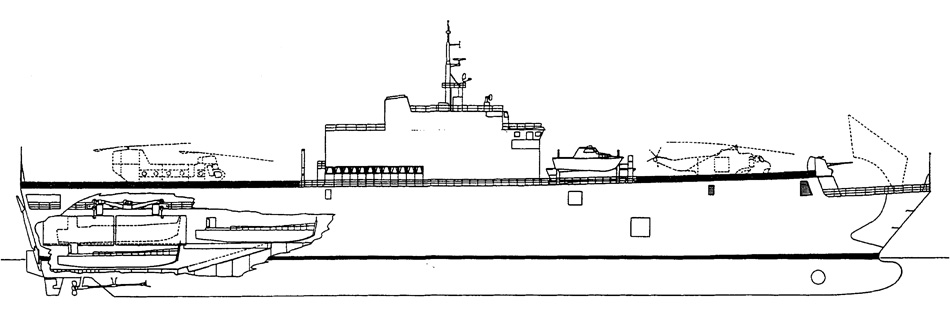
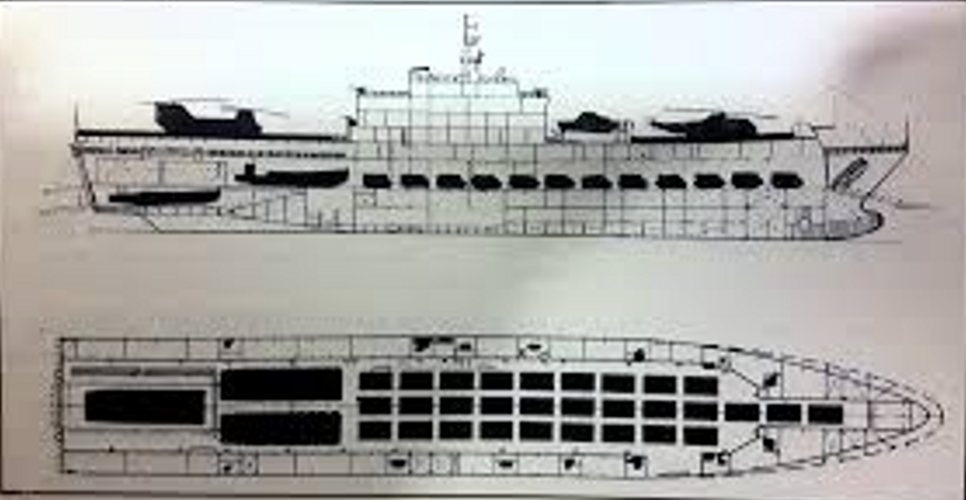
This is a typical Classe Santi cross section of the end of 80's (with its CH-47D and SH-3D), the Poeta Class shuttles ascendance is clearly visibile in its internal arrangement, apart of the floodable basin.

archipeppe
ACCESS: Top Secret
- Joined
- 18 October 2007
- Messages
- 2,556
- Reaction score
- 3,891
The Poeta Claass was conceived to connect both Sicily and Sardinia with mainland, all the ships had a back ramp and tiltable nose to imbark/disemark cars and trucks. Such feature appealed Navy officers and designers since was perfect to host all the military vehicles.
The main modifications were the rear basin for the 3 landing ships, and the flight deck with island instead of the shuttle's upper bridges.
The main modifications were the rear basin for the 3 landing ships, and the flight deck with island instead of the shuttle's upper bridges.
Last edited:
This is a typical Classe Santi cross section of the end of 80's (with its CH-47D and SH-3D), the Poeta Class shuttles ascendance is clearly visibile in its internal arrangement, apart of the floodable basin.
View attachment 725261
I'm modelling the San Giorgio post modification for Arma 3 and I would love to find deckplans....
Thanks for the image good reference picture
Hi, I have been putting some things together regarding LCS and was reminded of an old post in this thread with this image:

And to provide further context to what I am about to say, let me provide a post from another thread on this site:
Per the NPS Crossbow report, the USN would've fielded around 8 SEA ARCHERs alongside 20 SEA LANCE platforms. These Incat carriers would've presumably assumed the role of the SEA ARCHERs, while FSF-1 type vessels would've assumed the role of the SEA LANCEs.
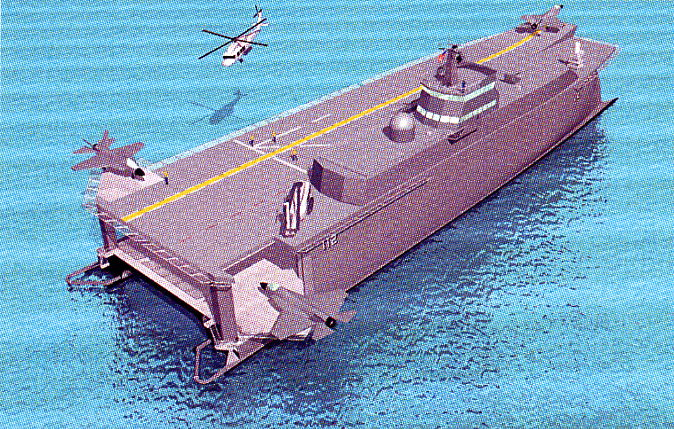
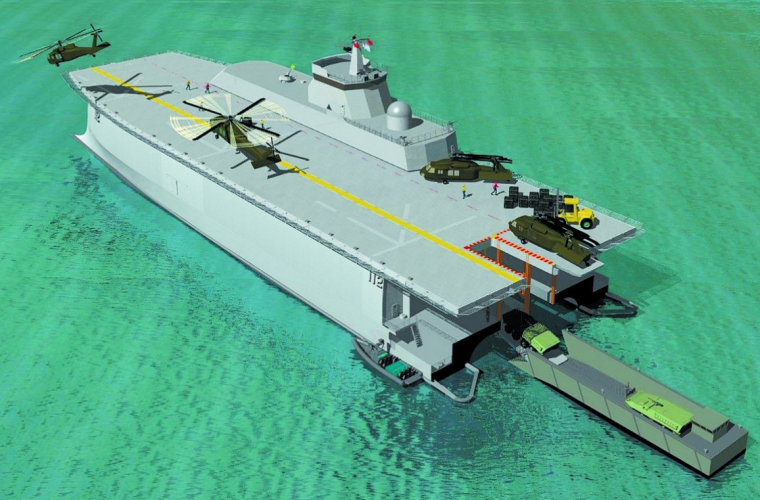
Last note: Incat, and apparently Austal also, didn't stop with just one design. There is reportedly a family of these things probably locked in a filing cabinet. The only other public concept I know of is the amphibious assault focused catamaran that featured in a magazine around the same time (image attached).
Maybe (hopefully) more to come
And to provide further context to what I am about to say, let me provide a post from another thread on this site:
I posit that Incat's "aircraft carrier" was not primarily aimed at the RAN as some have previously theorized, it was aimed squarely at the USN's Office of Force Transformation (OFT) led by Arthur K. Cebrowski until his death in 2005. According to one source, the OFT first expressed interest in Incat's design in 2003 (the same year they co-opted FSF-1 from the USMC for their LCS/Streetfighter experimentation).This was never a real USN project -- it was a constellation of concept studies by the "streetfighter mafia" led Admiral Arthur Cebrowski and Captain Wayne Hughes.
The Corsair concept was wargamed at the Naval Postgraduate School when Cebrowski led that organization. It assumed (but did not actually design) a force of small distributed carriers (c. 4000-6000 tons) with high speed and small aircraft complements.
Here are a couple of links to news stories from the time:
http://www.strategypage.com/htmw/htnavai/articles/20000926.aspx
http://findarticles.com/p/articles/mi_6712/is_61_207/ai_n28792153/
Later, these ships and some associated aircraft were actually designed (to a preliminary design stage) as part of a study project done by the Naval Postgraduate School called Project CROSSBOW. CROSSBOW covered all aspects to the concept: logistics, aircraft, ships, etc.
There's an overview here:
http://www.nps.edu/Research/Meyer/Content/SEA 2 (crossbow)/
and a page dedicated to the ship design here:
http://www.nps.edu/academics/gseas/tsse/subPages/2001Project.html
As developed, Corsair/Sea Archer turned out to be a surface effect ship design with extremely high speed and very limited air capacity, but much larger than Corsair had assumed.
SEA ARCHER Characteristics
- Displacement 13,500 mT
- Length 181 m
- Beam 59 m
- Draft – w/air cushion 2m
off air cushion 4m- Installed HP 327,000 HP
- Manning 128
The aircraft complement was very small:
- UCAV or JSF: 8
- Helicopter (SH-60): 2
- UAV: 10
Per the NPS Crossbow report, the USN would've fielded around 8 SEA ARCHERs alongside 20 SEA LANCE platforms. These Incat carriers would've presumably assumed the role of the SEA ARCHERs, while FSF-1 type vessels would've assumed the role of the SEA LANCEs.
Last note: Incat, and apparently Austal also, didn't stop with just one design. There is reportedly a family of these things probably locked in a filing cabinet. The only other public concept I know of is the amphibious assault focused catamaran that featured in a magazine around the same time (image attached).
Maybe (hopefully) more to come
Attachments
Scott Kenny
ACCESS: USAP
- Joined
- 15 May 2023
- Messages
- 19,511
- Reaction score
- 27,958
Good luck and good hunting!Have found more information, may warrant a thread in future. I'll see how much I get
Very sad to say my source with more documentation lost it all when his hard drive carked it and I don't have any contact with people at Austal or Incat who could provide them again.
I've attached the CROSSBOW papers I have found in addition to the executive summary I have posted above. I am very interested in finding volumes II and V if anyone can assist.
I've attached the CROSSBOW papers I have found in addition to the executive summary I have posted above. I am very interested in finding volumes II and V if anyone can assist.
Attachments

- Joined
- 16 April 2008
- Messages
- 10,588
- Reaction score
- 18,121
Similar threads
-
Was an opportunity missed with the Sea Harrier?
- Started by peterjayy
- Replies: 38
-

-
 Advanced Harrier Projects
- Started by overscan (PaulMM)
- Replies: 379
-
Harrier in place of Super Etendard: 1973
- Started by Archibald
- Replies: 16
-
