From TU 226,

here is the Le Grix,which I spoke about it before;

https://www.secretprojects.co.uk/th...licopter-projects-and-prototypes.16010/page-3
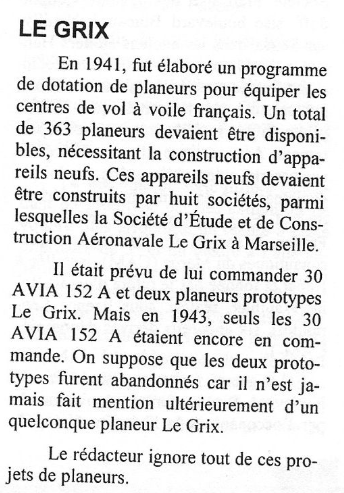
941 a program was drawn up of gliders to equip the French gliding centers. A total 363 gliders were to be available, requiring the construction of new aircraft. These new devices were to be built by eight companies, among which the Société d'Atude et de Construction Aéronavale Le Grix in Marseille.

He was scheduled to order 30 AVIA 152 A and two prototype gliders The Grix. But in 1943, only the 30 AVIA 152 À
were still on order. It is assumed that the two prototypes were abandoned because there was never any mention of
an any Le Grix glider.

The editor is unaware of any of these glider projects.
 

Attachments

  • 1.png
    1.png
    147.3 KB · Views: 97
what was this; Littoral Aviation E.111 ?.

In 1938, the Canne woodworking firm of Le Comptoir du Littoral created an aviation department named - rather unimaginatively - the Département Aviation. On 01 Jan. 1939, that department was redubbed Littoral Aviation. The E-111 was Littoral's 2-seat aerobatics trainer aimed at the French military use. The prototype flew on 08 April 1939 (piloted by Edward Bret) with an airworthiness certificate (CN) received on 06 July 1939. Alas, performance was deemed inadequate and work on the E-111 was abandoned.

According to Edward Bret (1907-1996), pilote d’exception by Philippe Jung, the appearance of the sole E-111 was unknown until a photograph (attached) was found in the archives of Edward Bret ("Aucune photo de ce mystérieux avion n’était connue des historiens, jusqu’à ce qu’elle soit trouvée dans les archives d’Edward.")

Update: See reply #516
 

Attachments

  • Littoral-E-111.jpg
    Littoral-E-111.jpg
    97.7 KB · Views: 108
Last edited:
From TU 248,

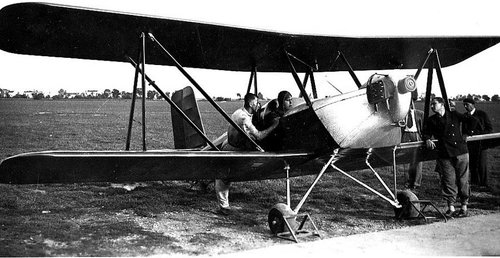
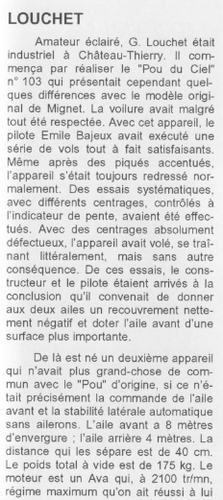
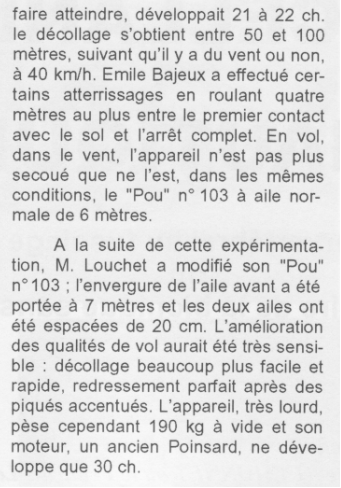
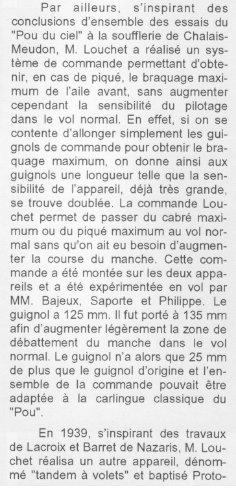
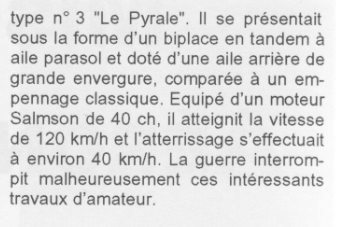
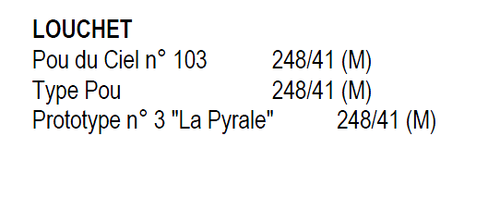
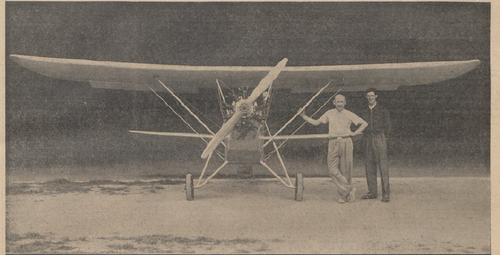
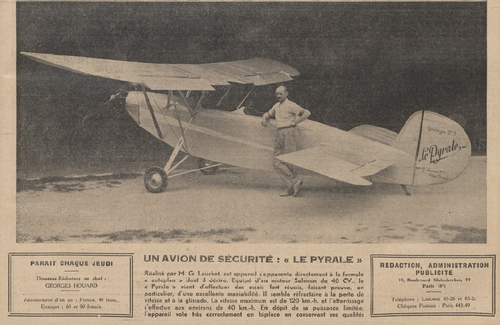
here is a three airplanes developed from Pou du Ciel,by the designer G. Louchet.
 

Attachments

  • 1.png
    1.png
    115.2 KB · Views: 86
  • 2.png
    2.png
    148.9 KB · Views: 66
  • 3.png
    3.png
    110.2 KB · Views: 72
  • 4.png
    4.png
    69.3 KB · Views: 74
  • 0.png
    0.png
    10.7 KB · Views: 76
  • 5.png
    5.png
    473.5 KB · Views: 95
  • 6.png
    6.png
    682.2 KB · Views: 99
From TU 262,

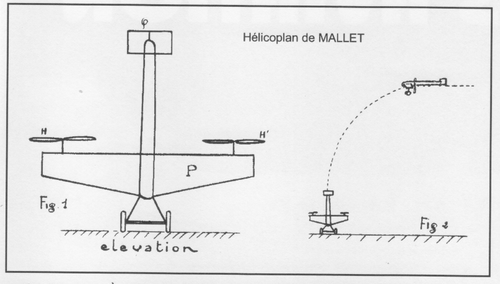
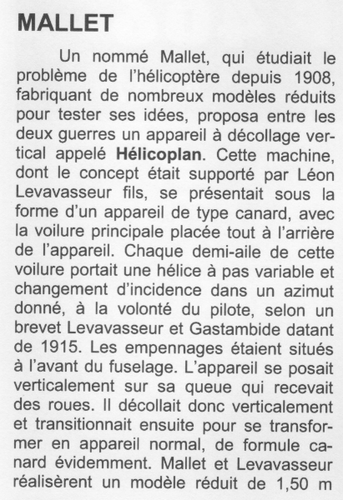
here is a Helicoplane,designed by Mr. Mallet.
 

Attachments

  • 0.png
    0.png
    271.3 KB · Views: 91
  • 1.png
    1.png
    234.5 KB · Views: 80
  • 2.png
    2.png
    81.2 KB · Views: 78
From TU 262,

here is a Helicoplane,designed by Mr. Mallet.
 

Attachments

  • 0.png
    0.png
    271.3 KB · Views: 15
  • 1.png
    1.png
    234.5 KB · Views: 13
  • 2.png
    2.png
    81.2 KB · Views: 12
here is a Helicoplane,designed by Mr. Mallet.

Something like ...

Someone named Mallet - who had been studying the problem of the helicopter since 1908 - manufacturing many scale models to test his ideas. Between the two wars, Mallet proposed a vertical takeoff aircraft called the Hélicoplan. This machine, the concept of which was supported by the son of Léon Levavasseur, was in the form of a canard aircraft. Each half of the rear wing carried a variable-pitch propeller, the pilot being able to change its incidence in azimuth in flight (according to a 1915 patent from Levavasseur and Gastambide). The empennage was located at the front of the fuselage.

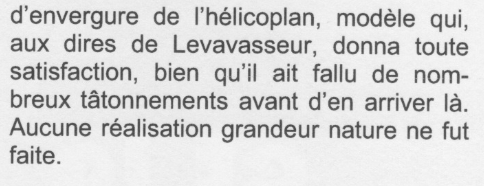
This aircraft was to land vertically on its tail wheels. It would take off vertically and then transitioned to forward flight as a conventional aircraft - albeit a canard. Mallet and Lavavasseur produced a scale model of 1.50 m wingspan of the helicoplane, a model which (according to Levavasseur) gave full satisfaction, although it took much trial-and-error before arriving there. No full-sized aircraft was realized.

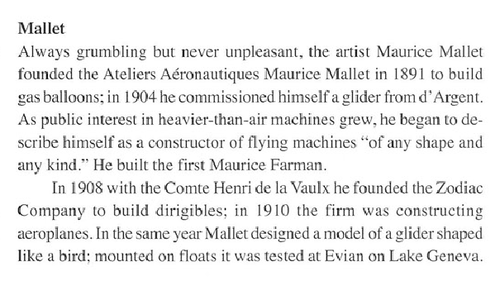
This M. Mallet could be anyone. Might that include the famous aeronaut, Maurice Mallet? That Mallet was a balloon- (Société Mallet, Mélandri et de Pitray) and aircraft-maker (Zodiac) as well as an Aéro-Club de France co-founder. Could it be the same person?

If I got the translation right, the Levavasseur in question was the son (fils) of Léon Levavasseur. But then there is mention of "un brevet Levavasseur et Gastambide datant de 1915." Now I'm confused. Jules Gastambide was the money backing ingénieur Léon Levavasseur. So, that 1915 patent would seem to have been made in the names of these two partners - not Léon's son o_O

Possibly more info here? L'Hélicoplane Mallet-Levavasseur, L'Air, Paris, Sept. 1, 1929, v.11, no.236, p.17, diagrs.
 
here is a Helicoplane,designed by Mr. Mallet.

Something like ...

Someone named Mallet - who had been studying the problem of the helicopter since 1908 - manufacturing many scale models to test his ideas. Between the two wars, Mallet proposed a vertical takeoff aircraft called the Hélicoplan. This machine, the concept of which was supported by the son of Léon Levavasseur, was in the form of a canard aircraft. Each half of the rear wing carried a variable-pitch propeller, the pilot being able to change its incidence in azimuth in flight (according to a 1915 patent from Levavasseur and Gastambide). The empennage was located at the front of the fuselage.

This aircraft was to land vertically on its tail wheels. It would take off vertically and then transitioned to forward flight as a conventional aircraft - albeit a canard. Mallet and Lavavasseur produced a scale model of 1.50 m wingspan of the helicoplane, a model which (according to Levavasseur) gave full satisfaction, although it took much trial-and-error before arriving there. No full-sized aircraft was realized.

This M. Mallet could be anyone. Might that include the famous aeronaut, Maurice Mallet? That Mallet was a balloon- (Société Mallet, Mélandri et de Pitray) and aircraft-maker (Zodiac) as well as an Aéro-Club de France co-founder. Could it be the same person?

If I got the translation right, the Levavasseur in question was the son (fils) of Léon Levavasseur. But then there is mention of "un brevet Levavasseur et Gastambide datant de 1915." Now I'm confused. Jules Gastambide was the money backing ingénieur Léon Levavasseur. So, that 1915 patent would seem to have been made in the names of these two partners - not Léon's son o_O

Possibly more info here? L'Hélicoplane Mallet-Levavasseur, L'Air, Paris, Sept. 1, 1929, v.11, no.236, p.17, diagrs.
 
Thank you my dear Apophenia,

and here is a more Info about him.
 

Attachments

  • 1.png
    1.png
    107.8 KB · Views: 13
From TU 262,

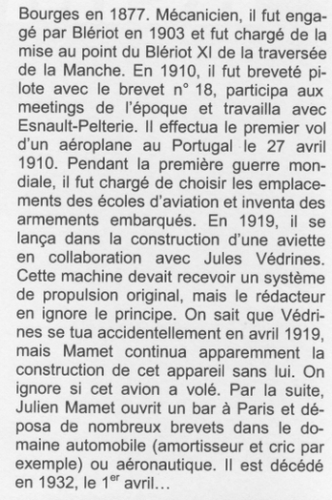
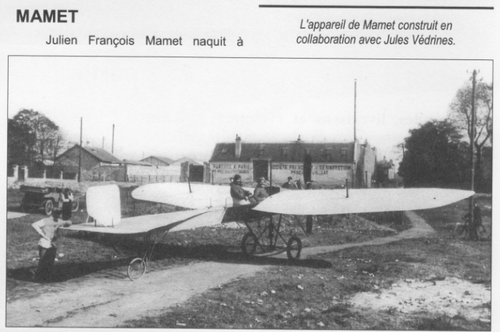
Mr. Julien Francois Mamet with Jules Vedrines designed a ultra-light airplane in 1919.
 

Attachments

  • 1.png
    1.png
    31.7 KB · Views: 67
  • 2.png
    2.png
    171.8 KB · Views: 80
  • 0.png
    0.png
    290.8 KB · Views: 102
From TU 263;

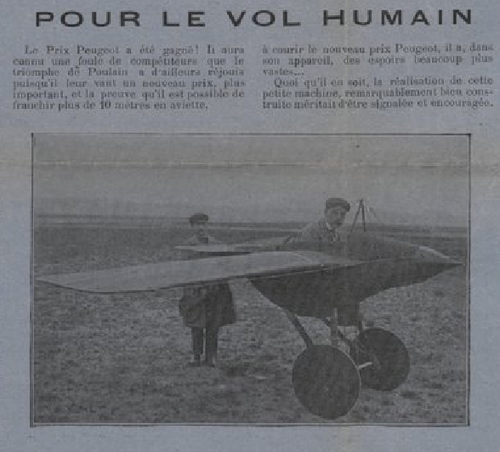
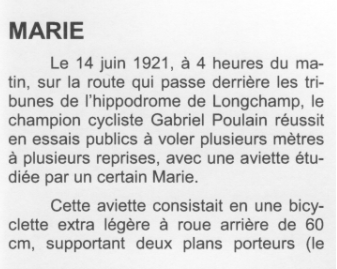
the Marie Aviette

On June 14, 1921, at 4 a.m., on the road that passes behind the stands of the Longchamp racecourse, the
cycling champion Gabriel Poulain succeeds
in public trials to fly several meters
on several occasions, with an aviette studied by a certain Marie.

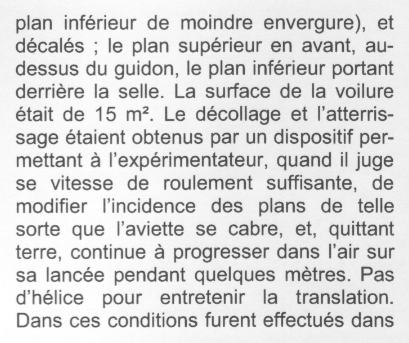
This aviette consisted of an extra light rear wheel bicycle of 60
cm, supporting two load-bearing planes (the
smaller lower plan), and
staggered; the upper plane forward, above the handlebars, the lower plane bearing
behind the saddle. The surface of the wing
was 15 m2. Take-off and landing were obtained by a device allowing the experimenter, when he judges
sufficient rolling speed,
change the impact of plans such
so that the plate rears up, and, leaving
earth, continues to progress in the air on
its launched for a few meters. Not
propeller to maintain the translation.
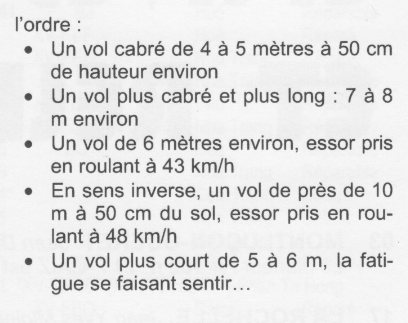
Under these conditions were carried out in
the order:

- A nose-up flight from 4 to 5 meters to 50 cm
about height

- A more nose-up and longer flight: 7 to 8
m approximately

- A flight of about 6 meters, boom taken
when traveling at 43 km / h

- An opposite direction, a flight of almost 10
m at 50 cm from the ground, boom taken at 48 km / h

- A shorter flight of 5 to 6 m, fatigue being felt.
 

Attachments

  • 1.png
    1.png
    76.5 KB · Views: 56
  • 2.png
    2.png
    132.7 KB · Views: 56
  • 3.png
    3.png
    107.1 KB · Views: 59
From TU 264,

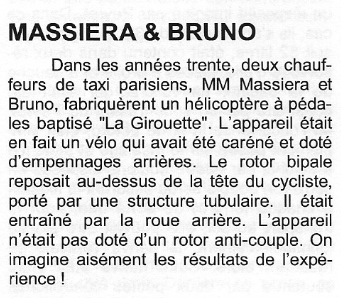
Massiera & Bruno;

In the 1930s, two Parisian taxi drivers, MM Massiera and
Bruno, manufactured a pedal Helicopter called "La Girouette". The device was
actually a bike that had been faired and endowed
rear tail. The two-bladed rotor
rested above the cyclist’s head,
carried by a tubular structure. it was
driven by the rear wheel. The device
did not have an anti-torque rotor. We
easily imagine the results of the experiment
 

Attachments

  • 1.png
    1.png
    102.8 KB · Views: 68
I'd imagine that la girouette described its performance perfectly - except, no doubt, it wouldn't have required the wind to rotate it as it would have achieved that by its own efforts!
 
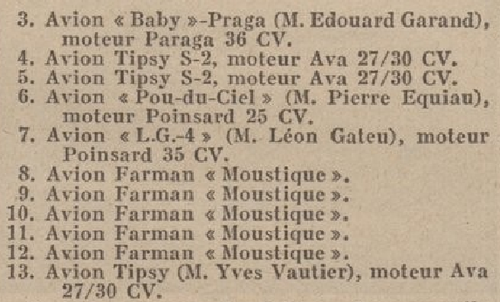
Mr. Leon Gateu designed a tourist Biplane in 1924,powered by one 25 hp Salmson engine,and also
created a two-seat Monoplane in 1930,powered by one 45 hp engine,the later maybe remained a
Project only ?.

From Ailes 1936,

I completely confuse,here is an airplane to him,called LG.4,maybe it's the later one which I spoke about it,but what was the early series from LG.1 to LG.3 ?.
 

Attachments

  • 1.png
    1.png
    200 KB · Views: 169
  • Les_Ailes___journal_hebdomadaire_[...]_bpt6k65552142_12.jpeg
    Les_Ailes___journal_hebdomadaire_[...]_bpt6k65552142_12.jpeg
    1.6 MB · Views: 146
Last edited:
From Ailes 1937,
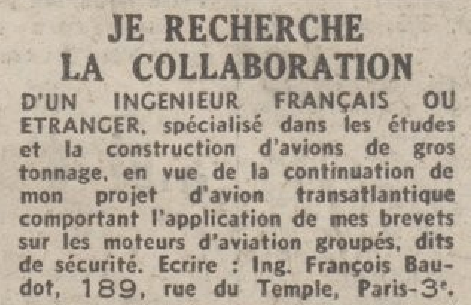
Mr. Francois Baudot who made a flying bicycle,he also designed a transatlantic Project ?.https://www.secretprojects.co.uk/th...or-would-be-aircraft.18657/page-2#post-374201

https://depatisnet.dpma.de/DepatisNet/depatisnet?action=pdf&docid=FR000000805991A&xxxfull=1
He patented between the wars coupled engines ,

https://depatisnet.dpma.de/DepatisNet/depatisnet?action=pdf&docid=US000001963432A&xxxfull=1https://depatisnet.dpma.de/DepatisNet/depatisnet?action=pdf&docid=GB000000392282A&xxxfull=1https://depatisnet.dpma.de/DepatisNet/depatisnet?action=pdf&docid=US000001963432A&xxxfull=1
and he was considering building a plane for transatlantic travel : The famous Paul Richard proposed a height Baudot engines aircraft in 1937 :

https://gallica.bnf.fr/ark:/12148/bpt6k6560497r/f7.image.r=Baudot
A little later (your advertisement) , Baudot proposes an appointment for an aircraft designer , without success : I can't find anything about a later real project .


Anyway , he built and flew in the thirties a "bicyclette aérienne".
 
From L'Auto 1942,

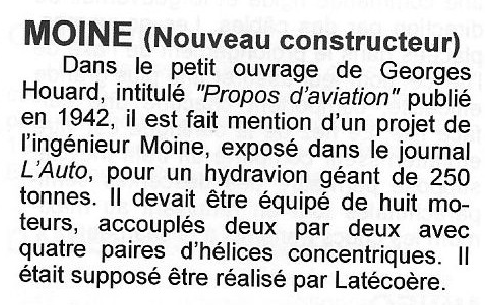
the engineering M. Moine,designed a 250 ton giant flying boat Project,powered by eight engines.
 
the engineering M. Moine,designed a 250 ton giant flying boat Project,powered by eight engines.

That would be l'Ingénieur Marcel Moine of Latécoère. Not sure about the weight, but the engine description sort of fits the Laté 150 - the four HS.24Zs being doubled HS.12Zs.
 
In Flightglobal 13/10/1921

they mentioned that a helicopter flight 200m only and got an accident,designed by M. Payer ?.
 
Last edited:
From TU 137,

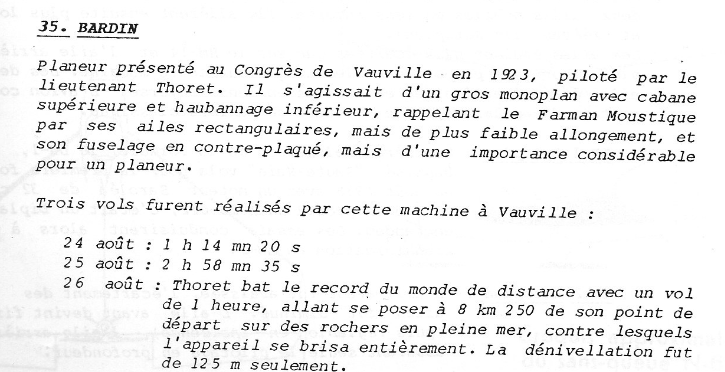
here is a monoplane designed by Mr. Bardin.
 

Attachments

  • 1.png
    1.png
    157.8 KB · Views: 56
  • 2.png
    2.png
    171.7 KB · Views: 62
From TU 137,

here is a monoplane designed by Mr. Bardin.

http://claudel.dopp.free.fr/Les_planeurs/Histoire/Vauville-1923/Vauville-1923_machines.htm
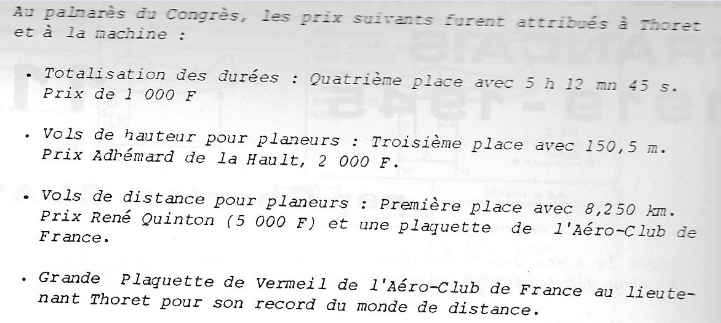
Bardin shoulder-winged monoplane. Seems to have been flown as a pure glider at Vauville. On 26 August, the pilot - Lieutenant Joseph Thoret - established a distance record but then had to ditch at sea. Thoret swam to shore but the aircraft could not be saved.

Wingspan: 11.60 m, Length: 7 m, Surface area: 21 m 2, Empty weight: 180 kg, Motor; Anzani 12 CV

Design: René Bardin (1925 founder of ETACA, École des Techniques Aéronautiques et des Constructions Automobiles)

A photograph of the Bardin monoplane glider can be seen in the link:

http://claudel.dopp.free.fr/Les_planeurs/Histoire/Vauville-1923/images/n34_Bardin.jpg
 
From TU 138,

A. C. Bergeron;

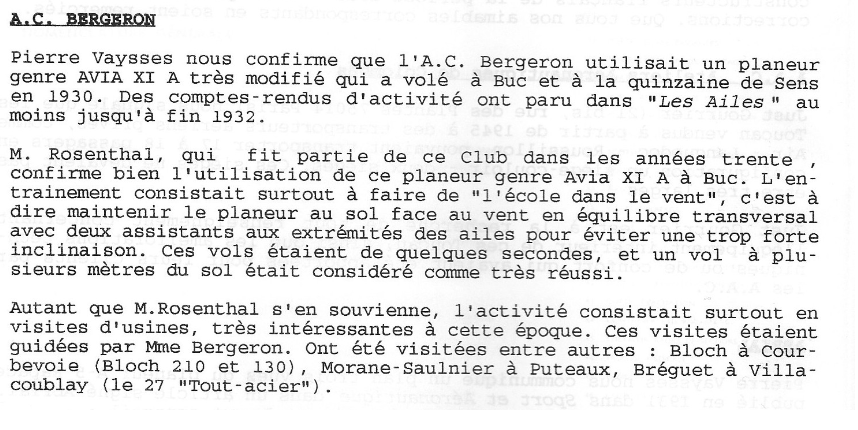
Pierre Vaysses confirms that the A.C. Bergeron was using a very modified AVIA XI À type glider which flew in Buc and the Sens fortnight in 1930. Activity reports appeared in "Les Ailes" at less until the end of 1932.

Mr. Rosenthal, who was part of this Club in the thirties,confirms the use of this Avia XI A type glider in Buc. The training mainly consisted in doing "school in the wind", it is at say keep the glider on the ground facing the wind in transverse balance with two assistants at the ends of the wings to avoid too strong tilt. These flights were seconds long, and a flight several meters from the 501 was considered very successful.

As far as Mr Rosenthal remembers, the activity consisted mainly of factory visits, very interesting at that time. These visits were guided by Ms. Bergeron. Were visited among others: Bloch in Courbevoie (Bloch 210 and 130), Morane-Saulnier in Puteaux, Bréguet in Villa-coublay (the 27 "All-steel"}).
 

Attachments

  • 1.png
    1.png
    276.9 KB · Views: 52
Thank you dear Apophenia,and from TU 139,

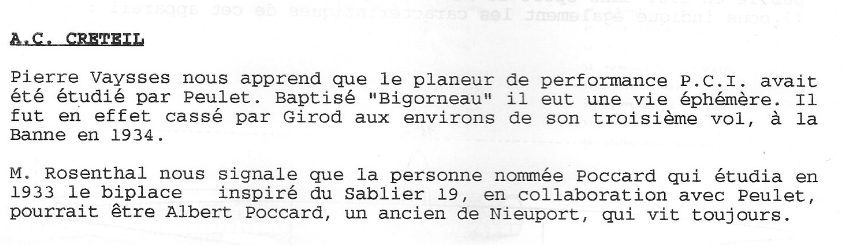
A. C. Creteil;

Pierre Vaysses tells us that the performance glider P.C.I. had been studied by Peulet. Baptized "Periwinkle" he had an ephemeral life. It was indeed broken by Girod around his third flight, at La Banne in 1934.

M. Rosenthal informs us that the person named Poccard who studied in
1933 the two-seater inspired by Sablier 19, in collaboration with Peulet,
could be Albert Poccard, a former Nieuport, who still lives.
 

Attachments

  • 1.png
    1.png
    131.9 KB · Views: 49
...Pierre Vaysses tells us that the performance glider P.C.I. had been studied by Peulet. Baptized "Periwinkle" he had an ephemeral life. It was indeed broken by Girod around his third flight, at La Banne in 1934...

The designer in question is Henri Peulet. And its not "P.C.I." but P.C.1 (these days, usually seen written as 'PC-1'). The 'Periwinkle' name may confuse. Logic would suggest the alliterative translation 'Pervenche' (after the flower) but the name given was actually Bigorneau (after the small whelk).

Henri Peulet was a member of the Aéro-club de Créteil (as was the pilot mentioned - Charles Girod). The 1934 construction of the P.C.1 was by club members supervised by Peulet and President Robert Dandois. (The geologist Dandois had helped establish the Aéro-club de Créteil in March 1931.)

https://www.j2mcl-planeurs.net/dbj2mcl/planeurs-machines/planeur-fiche_0int.php?code=1005
Also in 1934, Peulet worked with Poccard on a Georges Sablier Type 19 development - the Peulet Biplace Marcel Guittard . It too was flown by Charles Girod (note photo caption in link below).

https://www.j2mcl-planeurs.net/dbj2mcl/planeurs-machines/planeur-fiche_0int.php?code=1733
 
From TU 139,

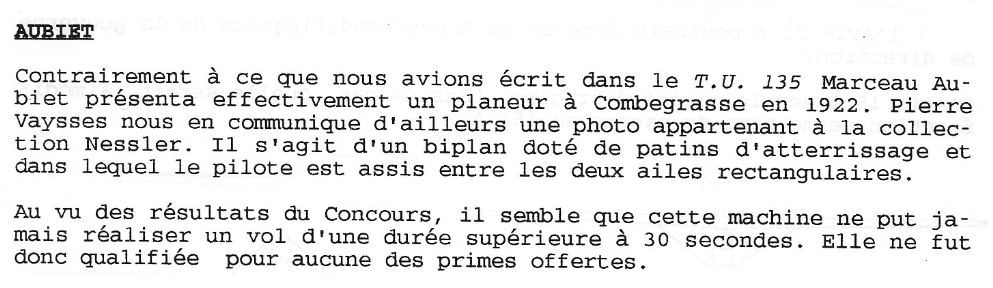
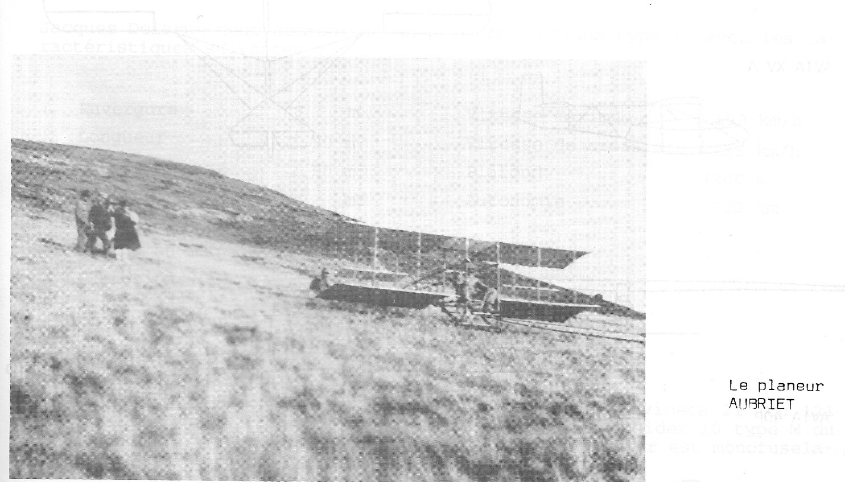
the Aubiet glider.
 

Attachments

  • 1.png
    1.png
    165.7 KB · Views: 79
  • 2.png
    2.png
    308.7 KB · Views: 90
From TU 147,

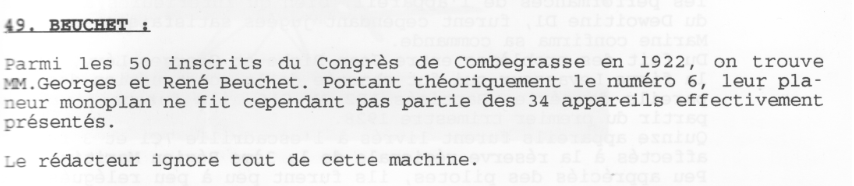
here is a Beuchet Glider.
 

Attachments

  • 1.png
    1.png
    106.6 KB · Views: 73
In TU magazine,

there was unknown airplane from 1920,designed by Dubois-Piquet,any idea ?.

I still can't find it in Gallica site ?,even from the book,French Aeroplanes
Before the Great War,I don't know if he was the same person or not,Mr.
Dubois ?!.
 

Attachments

  • 1.png
    1.png
    94.5 KB · Views: 71
Last edited:
Hard to say. Dubois (or DuBois) is the eighth most common surname in France.

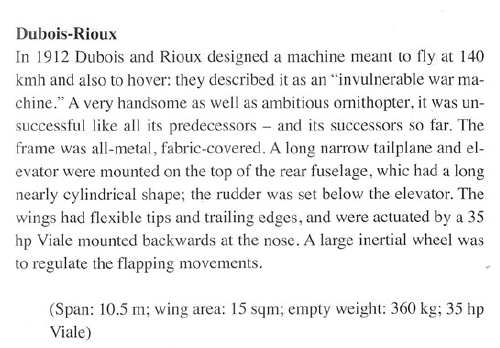
Interesting date in your clipping also - I have seen the Dubois-Riant ornithoptère dated to 1909. But its a tricky type to search for because of the names - Dubois being such a common family name and riant translating as 'laughing'.

Also, there was more than one 'Dubois' ornithopter. The first is that 1909 or 1912 System Dubois-Riant with its 35 hp Viale 5-cylinder. The second was a man-powered ornithopter displayed at the September 1935 Concours Lépine in Paris. Unfortunately, the chap at the Concours Lépine with the functioning ornithopter is never identified as anything more than "monsieur Dubois".

(I say 'functioning' because there's also a photo around of a man wearing a pair of fanciful mechanical dragonfly wings. Captions say that he is leaving the Métro station heading for the 1935 show. The Concours Lépine was meant to be a display of inventors' wares ... but this dragonfly ornithoptère has more the feel of a publicitiy prop.)

On the 1935 Dubois ornithopter, the man at the controls looks middle-aged. If Monsieur Dubois was a young man when he joined forces with M. Riant in 1909 (or 1912), he might be around 50 years-of-age in 1935. All speculation, of course, with zero evidence to connect our 1935 hopeful with the System Dubois-Riant or, indeed, your mysterious 1920 Dubois-Piquet project.
 
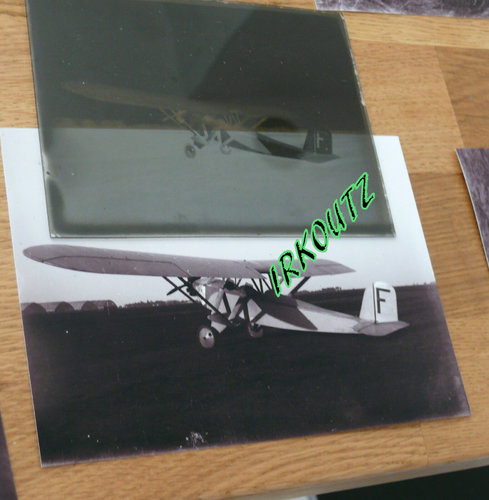
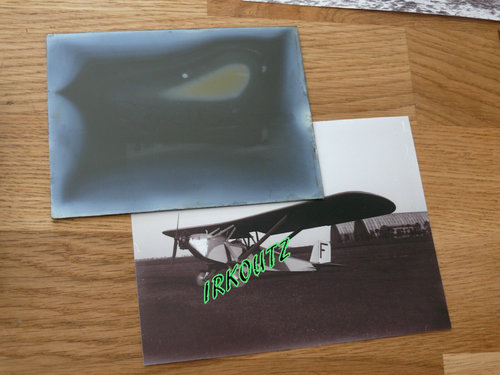
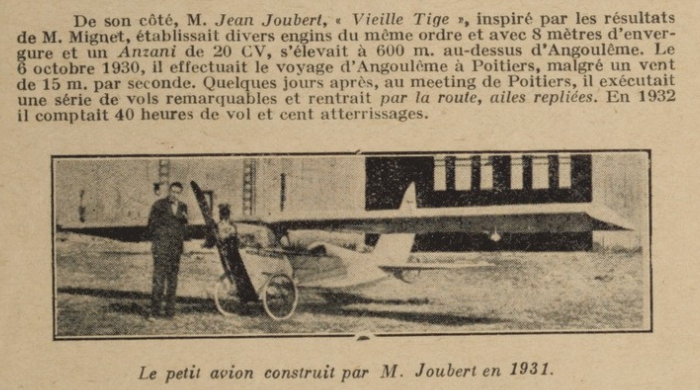
The Joubert J 3, which bears more than a passing resemblance to the Mignet HM.8 but, equally, differs in significant respects. Maybe its design was influenced by the HM.8. Maybe it was constructed using HM.8 components. Maybe it was converted from an HM.8. So far I've found next to no information about it. Does anyone have any?
From Toute L'Aviation.
 

Attachments

  • 1.png
    1.png
    543.8 KB · Views: 98
  • Toute_l'aviation_Ouvrage_honoré_de_[...]Blanc_Edmond_bpt6k9807582h_273.jpeg
    Toute_l'aviation_Ouvrage_honoré_de_[...]Blanc_Edmond_bpt6k9807582h_273.jpeg
    387.2 KB · Views: 111
From TU 183,

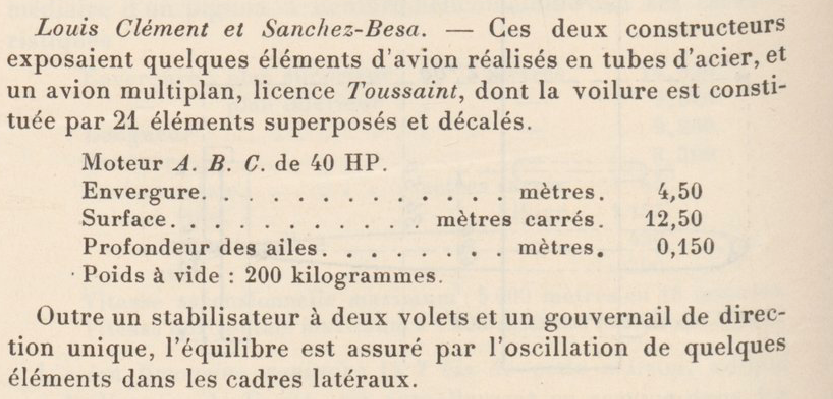
Mr. Louis Clement built a single seat racer monoplane in 1919 and
a single seat ultra-light triplane in 1921,but he had also a design for
seaplane triplane of 1919.
A more Info;

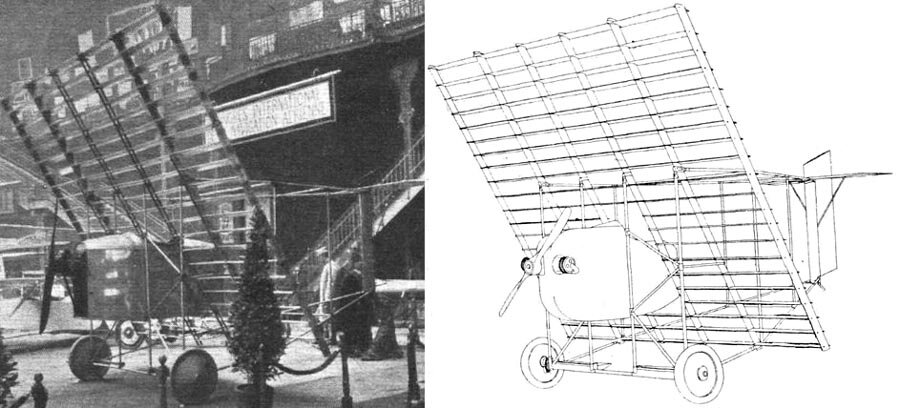
Louis Clément and Sanchez-Besa. - These two manufacturers exhibited several aircraft components made of steel tubes, and a multi-plane aircraft, Toussaint license, whose wing consists of 21 superimposed and staggered elements.

Motor 4. B. C. of 40 HP.

Span. . . . . . . . . . . . . meters. 4.50
Area. . . . . . . . . . . square meters. 12.50
Wing depth. . ,. . . . . meters, 0.150
: Empty weight: 200 kilograms.

In addition to a two-flap stabilizer and a single rudder, balance is provided by the oscillation of a few elements in the side frames.

Le_Génie_civil___revue_[...]_bpt6k6504208n
 

Attachments

  • 1.png
    1.png
    417.5 KB · Views: 89
the engineering M. Moine,designed a 250 ton giant flying boat Project,powered by eight engines.

That would be l'Ingénieur Marcel Moine of Latécoère. Not sure about the weight, but the engine description sort of fits the Laté 150 - the four HS.24Zs being doubled HS.12Zs.
After I discovered it,the TU magazine spoke about it.
 

Attachments

  • 1.png
    1.png
    137.2 KB · Views: 73

Attachments

  • La_Dépêche_de_Madagascar__bpt6k5410717x_8.jpeg
    La_Dépêche_de_Madagascar__bpt6k5410717x_8.jpeg
    596.5 KB · Views: 54
  • L'Auto-vélo___automobilisme_cyclisme_athlétisme_[...]_bpt6k4629446z_2.jpeg
    L'Auto-vélo___automobilisme_cyclisme_athlétisme_[...]_bpt6k4629446z_2.jpeg
    2.5 MB · Views: 60
  • Le_Petit_Parisien___journal_[...]_bpt6k607016r_1.jpeg
    Le_Petit_Parisien___journal_[...]_bpt6k607016r_1.jpeg
    2.9 MB · Views: 58
  • Paris-soir__bpt6k76407345_4.jpeg
    Paris-soir__bpt6k76407345_4.jpeg
    528.1 KB · Views: 65
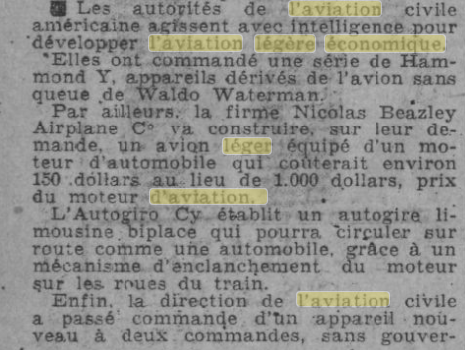
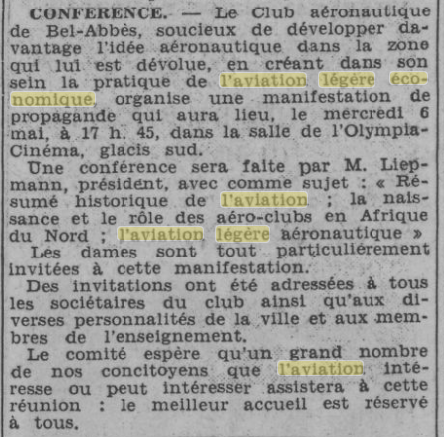
ALE means, Aviation Légère Economique

I don't know if that was this a club or institute or what ?.

In the page 2 article from l'Auto at least, "aviation légère, économique et sûre" is simply a category description. It refers to a light aircraft display attended by Air Minister Marcel Déat which was organized by the Fédération Aeronautique de France.

I wasn't able to spot the aviation légère économique references in your other clippings.
 

Similar threads

Back
Top Bottom