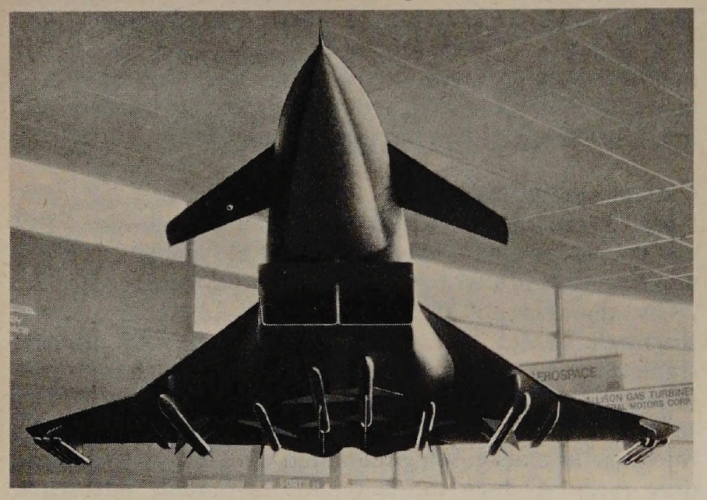
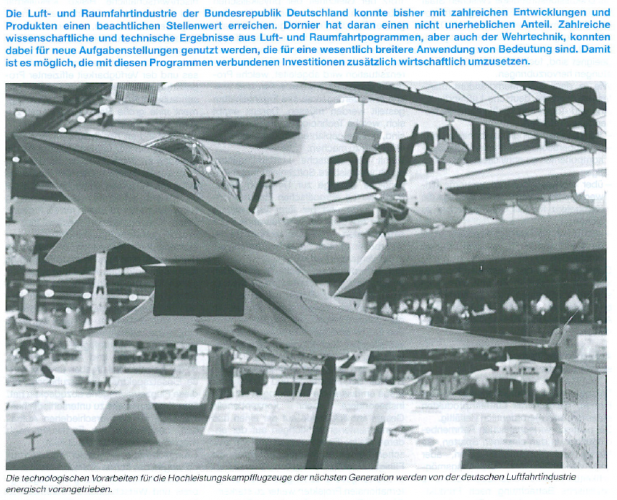
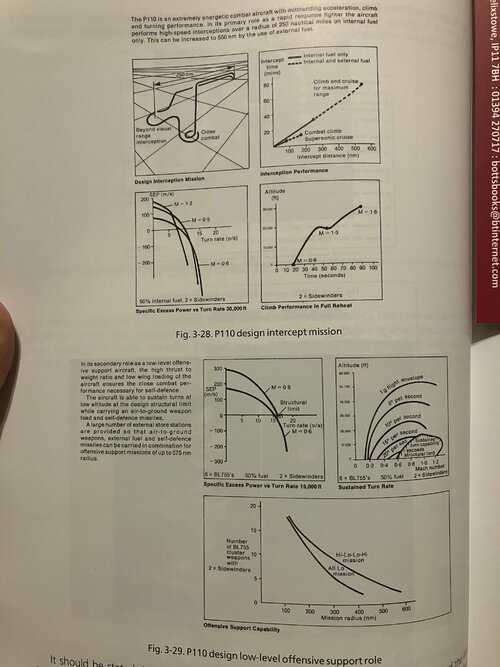
There are many changes when you look at it, many of them directly addressing the points raised in the RAE memo; e.g. move to long coupled canard to reduce drag in supersonic flight and removing post stall manoeuvre. The ventral intake on both TKF-90 and EAP/Typhoon masks a lot of the other aerodynamic differences.
There are many changes when you look at it, many of them directly addressing the points raised in the RAE memo; e.g. move to long coupled canard to reduce drag in supersonic flight and removing post stall manoeuvre. The ventral intake on both TKF-90 and EAP/Typhoon masks a lot of the other aerodynamic differences.
The RAE are arguing for Rafale and P.110-style short-coupled canards in the memo and objecting to the forward TKF-90 position that ACA, EAP and Typhoon share.
The RAE are arguing for Rafale and P.110-style short-coupled canards in the memo and objecting to the forward TKF-90 position that ACA, EAP and Typhoon share.
They are at that point which is interesting; all about trying to maximise that high subsonic sustained turn performance
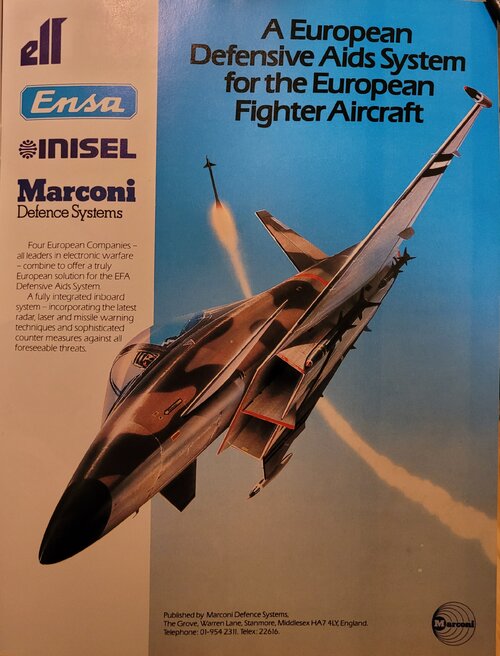
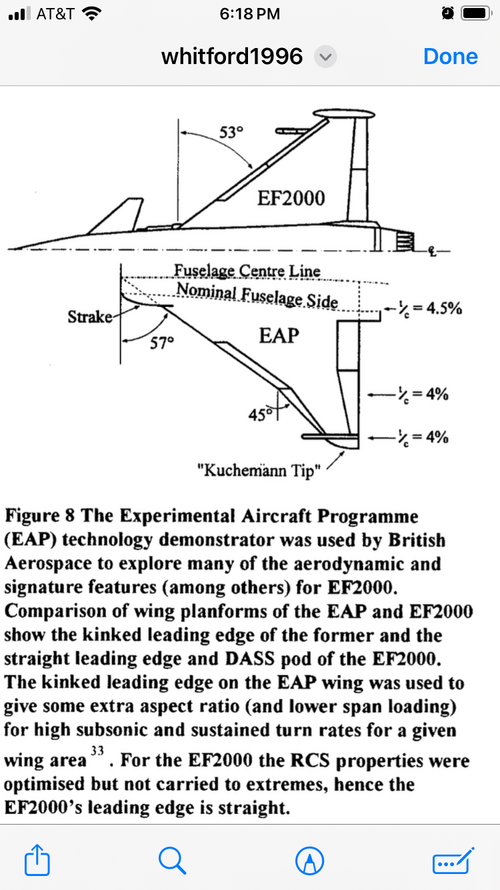
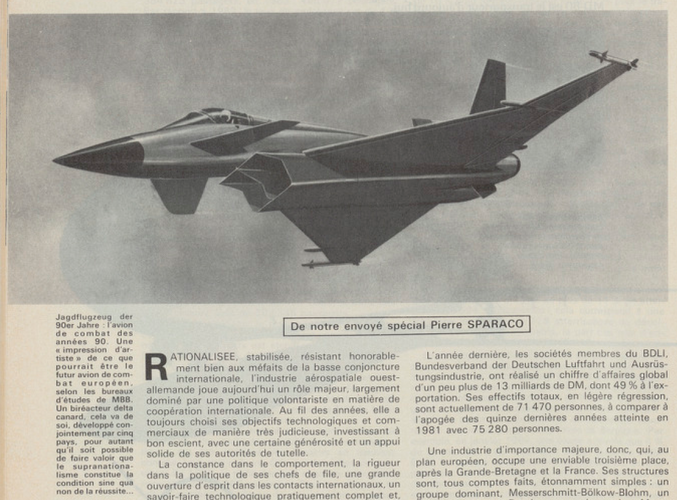
There quite some differences (size, position) between the TKF-90 canard and that for EAP and Typhoon (and other forebody vortex generating strakes), which reflect on the difference usage intended - i.e. high AoA pitch recovery post stall for TKF-90
Whats then missing is info on cg location / level of pitch instability, which has a major impact on the aerodynamic characteristics
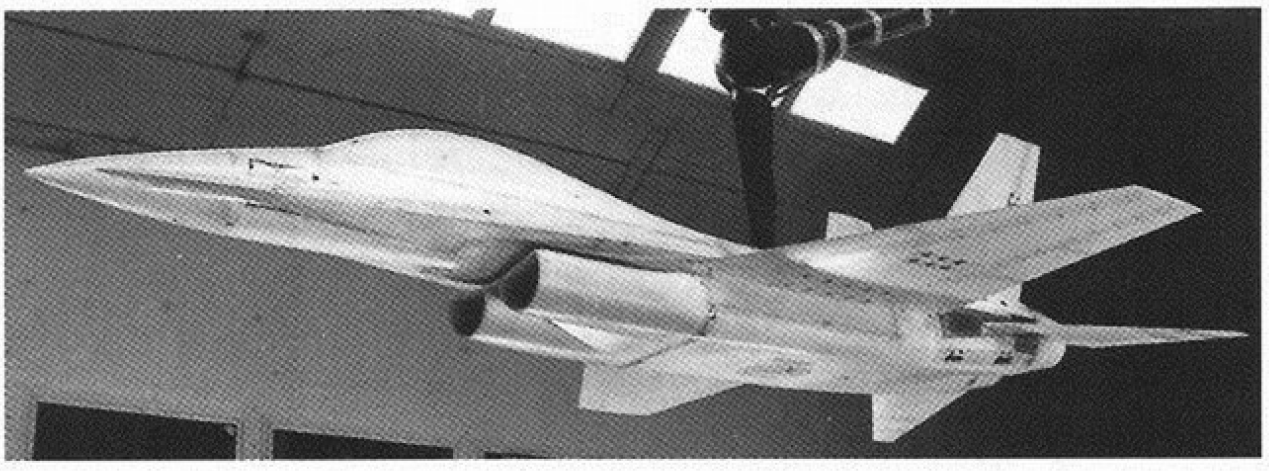
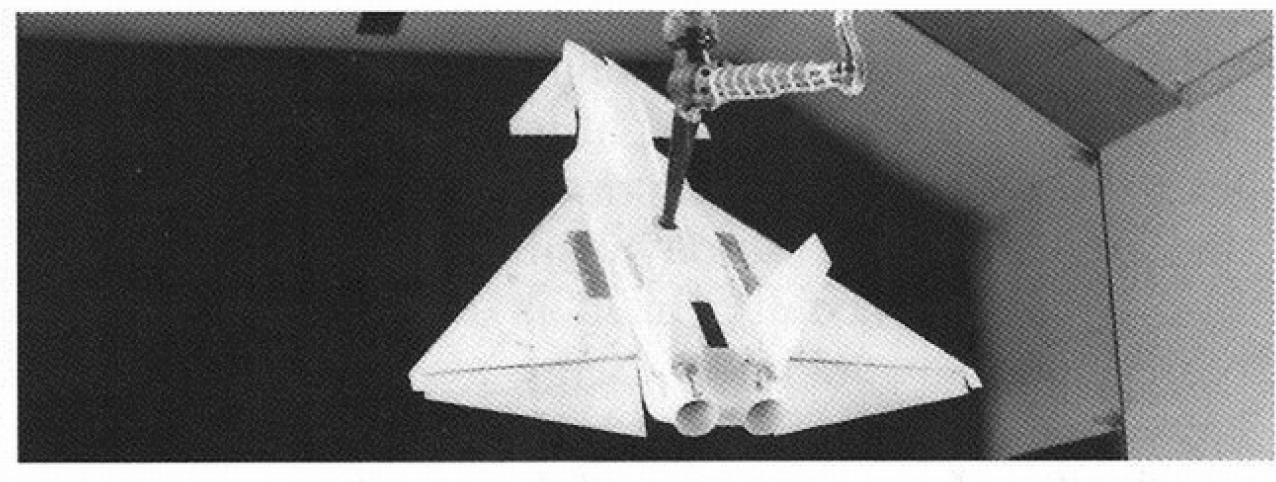
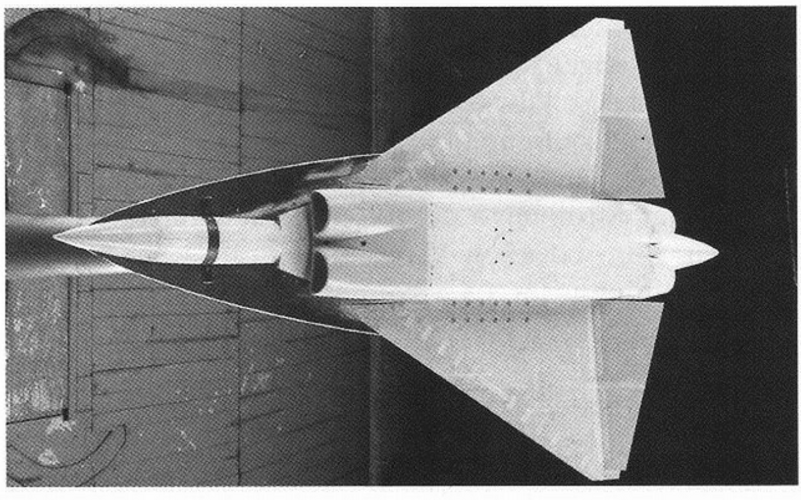
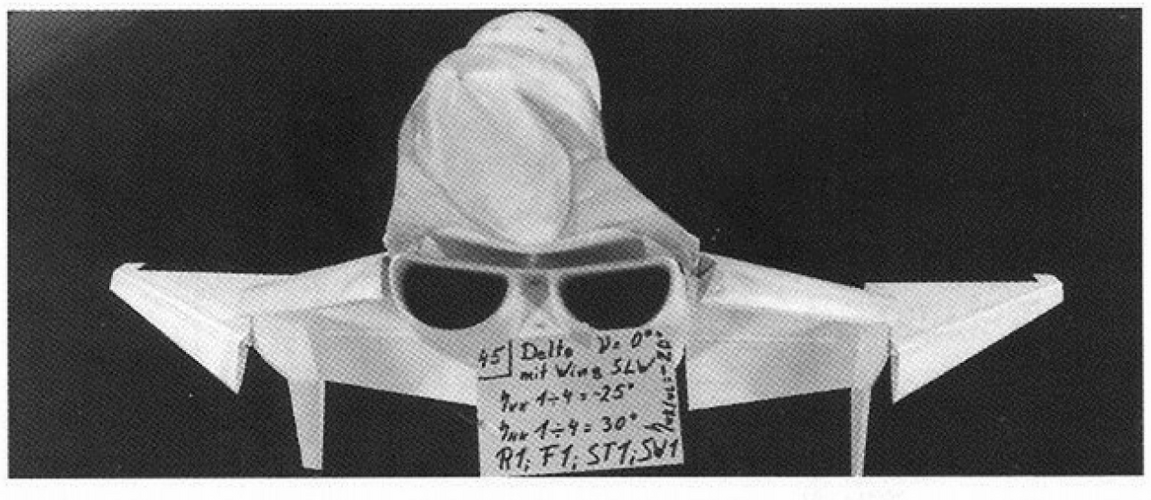
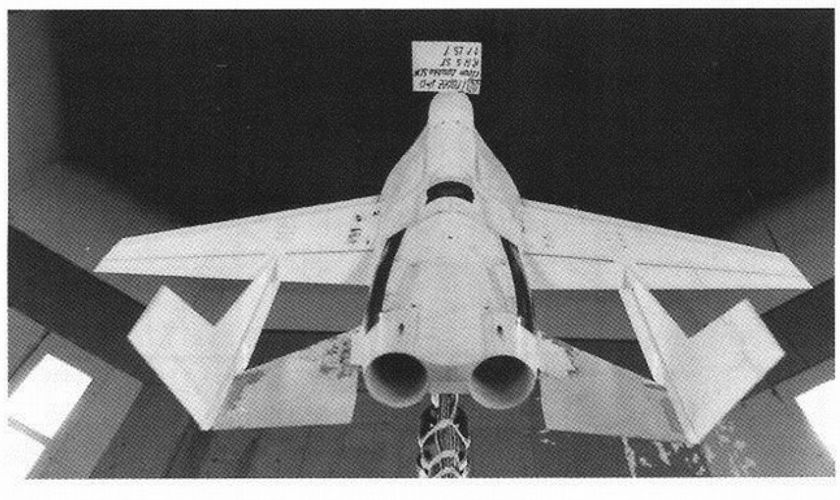
From an MBB report on a 1977 wind tunnel model test of high AOA / post stall capability.
1) delta wing
2) delta wing with wingerons and fins below the wing
3) trapezoidal wing with tail
4) delta wing with canard
5) trapezoidal wing with tail and vented fins
Conclusion was in favour of delta wing with canard (unsurprisingly).
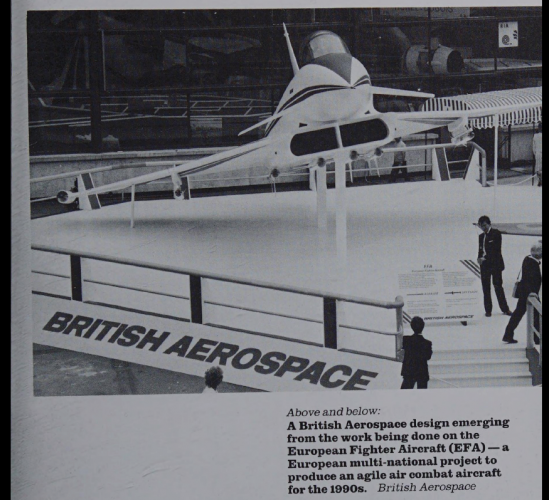
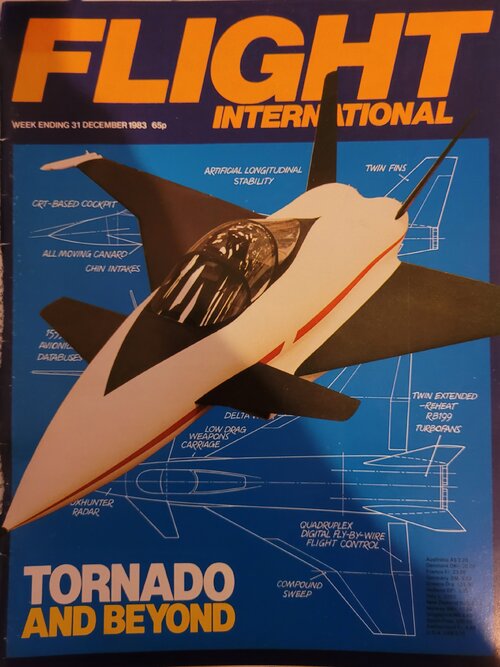
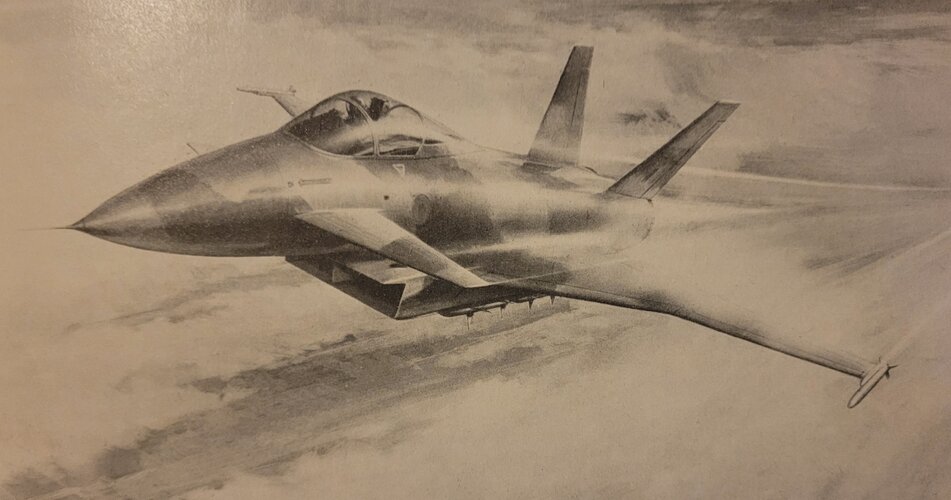
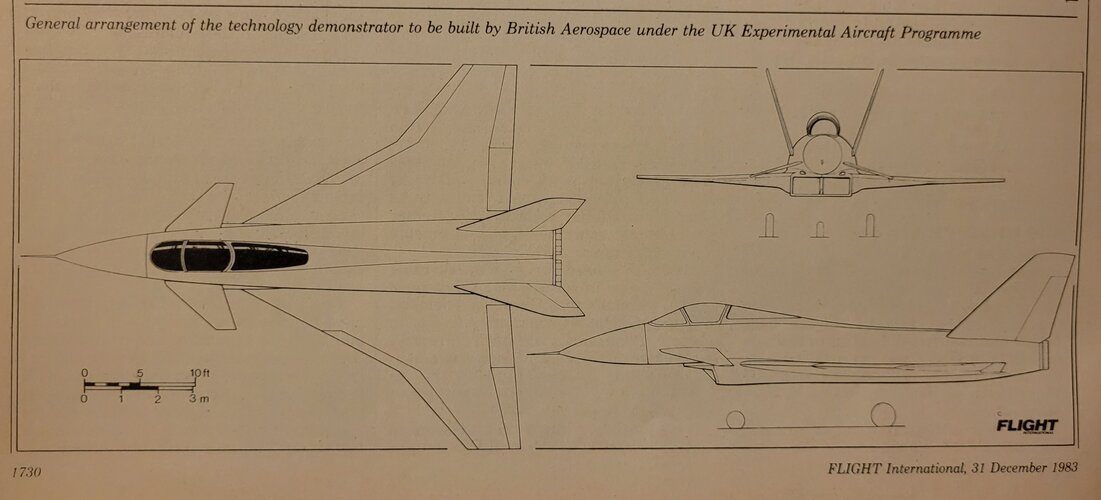
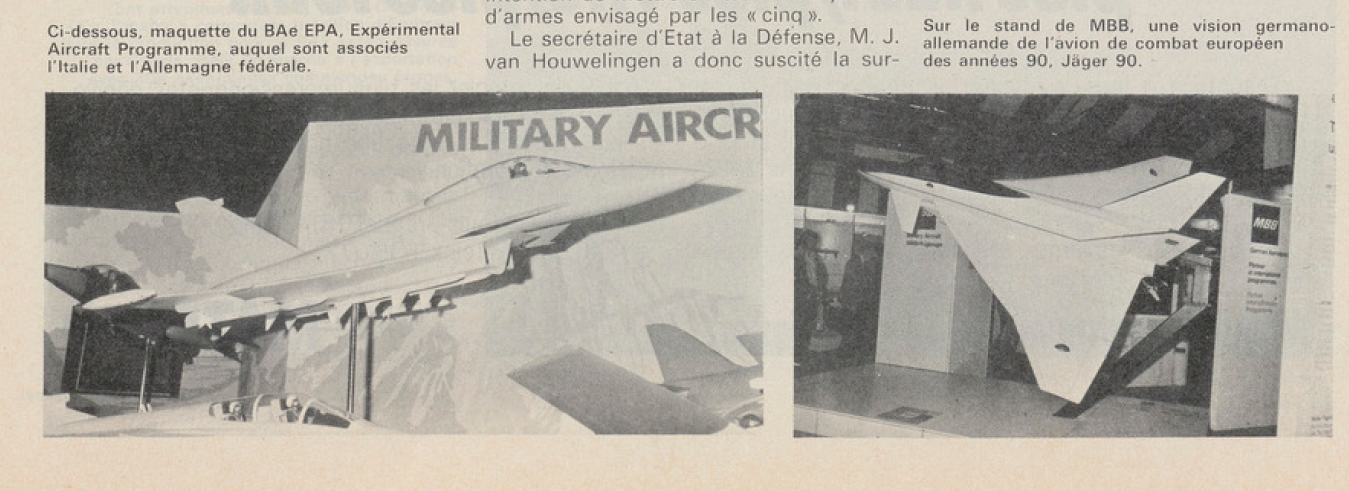
According to Henry Matthews (Prelude to Eurofighter) this is BAe's P.120 fighter derived from EAP. I've seen it described as Eurofighter EFA too though.
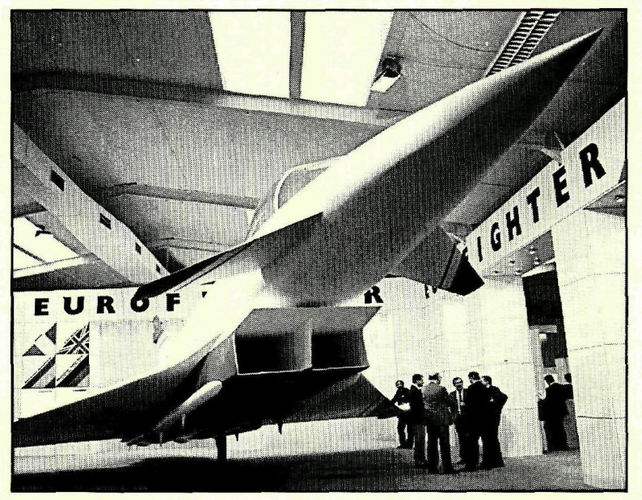
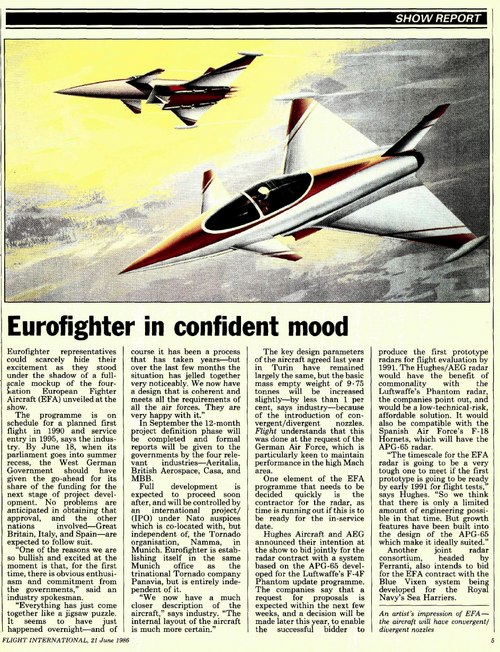
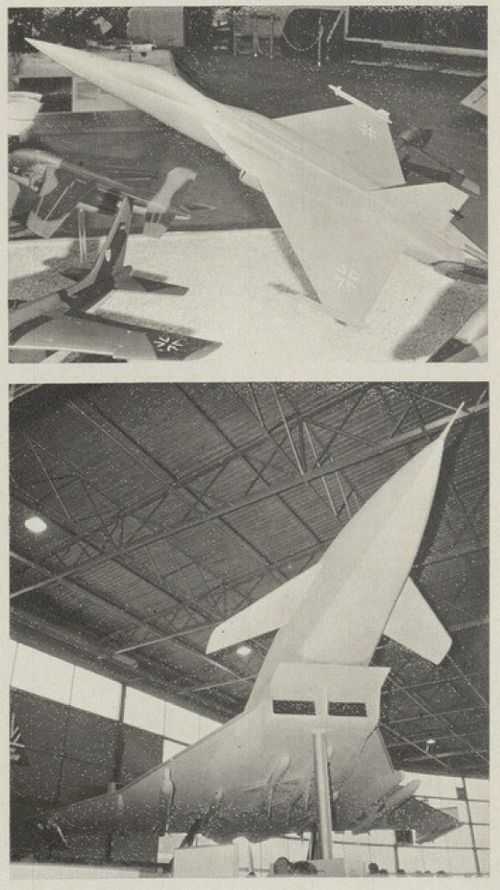
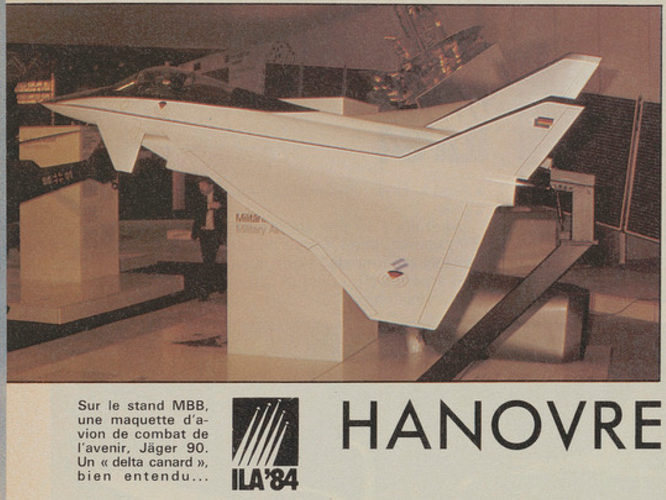
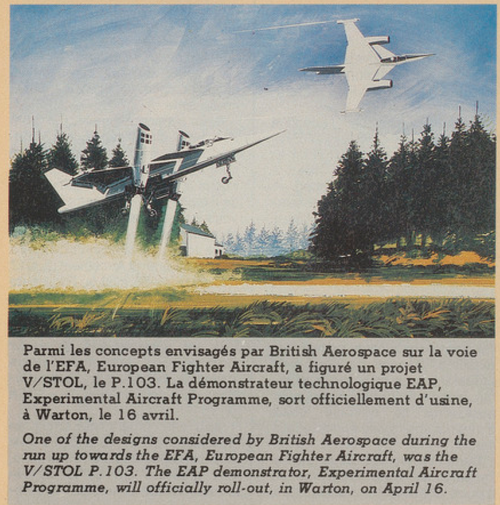
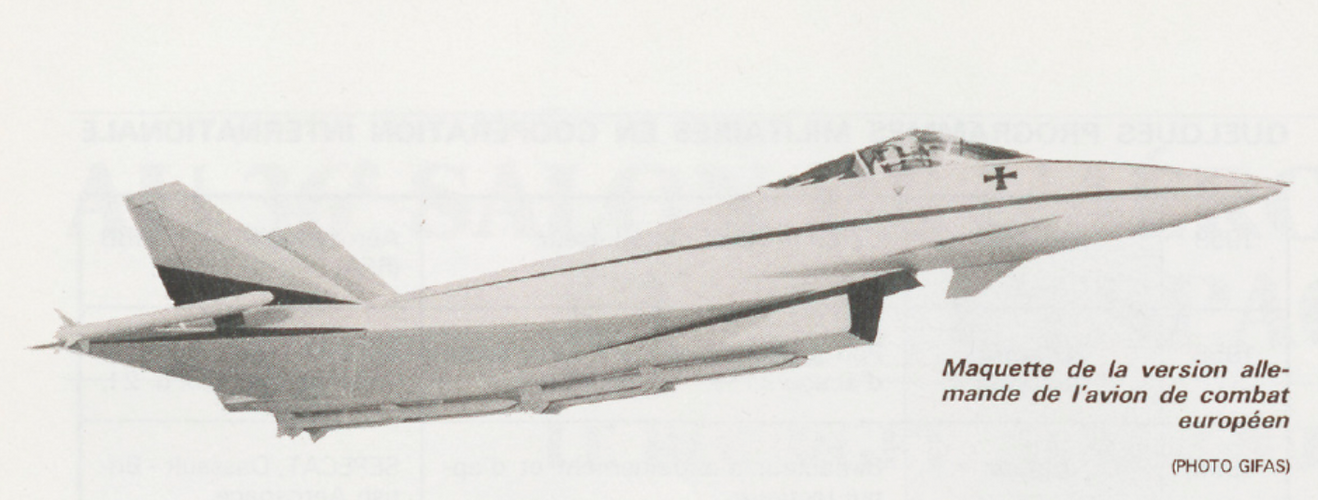
I don't see the point of this post. Small grainy pics of a well-known mockup we have better pics of. Was there anything interesting in the text? We can't tell, because you don't say which issue.
I don't see the point of this post. Small grainy pics of a well-known mockup we have better pics of. Was there anything interesting in the text? We can't tell, because you don't say which issue.
Effect of Engine Technology on Advanced Fighter Design and Cost
Otfrid Herrmann* and Werner Biehlf
Messerschmitt-Boelkow-Blohm GmbH, Munich, Federal Republic of Germany
ABSTRACT
The longer the development of a new European fighter aircraft is delayed, a central question becomes evermore critical: Is an existing engine still adequate or is it necessary and more cost-effective to develop a new engine? To help answer this question, a detailed study of the configuration, performance requirements, and costs has been conducted. Based on typical aircraft design and performance, the effect of the expected performance and cost of a newly developed engine on either higher aircraft performance or lower aircraft weight and cost was investigated. A completely new engine was found to be not only technically superior, but also less expensive, if 1) the new technology were used to reduce the size of the engine and aircraft and 2) the aircraft performance were held constant. With this "small aircraft approach," the development cost for a new engine can be recovered at the end of the acquisition phase, provided at least 450 aircraft are sold. Considering the total life cycle cost, the break-even point is less than 300 aircraft. For a multinational concept, these results clearly indicate that the development of a new engine is cost effective.
Munich—West Germany is in the final design and configuration phase of a proposed future tactical fighter aircraft which, if endorsed by other European coproduction partners, will be the major multibillion-dollar follow-on production aircraft to the Panavia Tornado multirole combat aircraft (MRCA) in the mid 1980s.
The Luftwaffe and West German aerospace companies are near completion of broad-based concept definition and general requirements of the new combat aircraft, which is to be operational by 1991. Plans will be presented for final approval to multinational partners by mid-year.
Designated the TCA, or TKF-90, the project has reached a point where West German military and civilian aircraft planners believe a decision to go ahead
with the future tactical fighter will be made within six months after the design concept is proposed to potential coproduction partners, including Great Britain and France. Talks to identify individual concepts and future tactical fighter requirements are taking place and a meeting of defense ministers involved in the program is scheduled for this spring (AW&ST Dec.2, 1978, p. 17).
West German planners believe a go-ahead decision must be made quickly for a1991 operational deadline. Although the West German concept differs from the proposed requirements of the British tactical fighter program, officials here said the discrepancies should be resolved to permit an initial go-ahead in 1979.
An early decision on the proposed aircraft is also necessary to permit design, research and development and prototype work before production begins in the late 1980s.
Aerospace engineers at Messerschmitt- Boelkow-Blohm (MBB) responsible for the development project said the TKF-90 would be a “fourth generation” aircraft, but would not be “revolutionary” in concept or design.
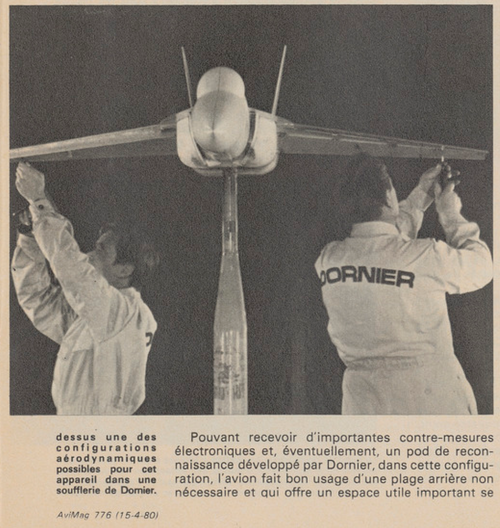
In reaching the final concept phase, the West German Defense Ministry funded about 90 tactical combat fighter studies aimed at defining the technology and possible configurations for the aircraft. The work, carried out at MBB and Dornier, was in collaboration with McDonnell Douglas and Northrop in the U. S. MBB worked with McDonnell Douglas and Dornier with Northrop in separate studies of possible fighter configurations. Wind tunnel testing of models has been done and the work has led to a clear definition of the proposed aircraft.
In evolving the characteristics and configuration of the aircraft, West German engineers and designers worked closely with Luftwaffe officials. The Luftwaffe air staff has now reached a stage where it is ready to meet with French and English planners to work out the final tactical fighter parameters.
Lt. Gen. Fredrich Oblcser, chief of staffof the West German air force, recently said that development and deployment of the trinational Tornado will meet West German needs for a tactical aircraft. During the Tornado development program, the air-to-air combat role was neglected deliberately, he said.
Successful completion of the role of a ground and deep interdiction aircraft has now led West German air force planners to concentrate on an aircraft to replace the McDonnell Douglas F-4 tactical fighter, he said.
Warsaw Pact introduction of a “third generation” combat aircraft with major improvements in combat effectiveness— MiG-23/27—has raised the question of whether the F-4 would be able to cover the air-to-air combat role in the future, Gen. Oblcser said. Luftwaffe planners also envision an increasing threat to areas behind the front line, he added.
The future tactical fighter for West Germany must be a “flying weapons system,” he said, which would have maximum efiectiveness against aerial targets. The aircraft must have multiple tracking and target acquisition capabilities and multiple weapons systems. In addition, the aircraft should also have an air-to-ground attack capability, he said, though this is a lesser priority than the air combat role.
Only after final definition of the TKF-90 is completed will the West German government conclude discussions with potential,partners, he said. While production quantities of the future fighter have not been discussed, West German planners said the German inventory includes 175 F-4Fs and 88 RF-
4Es.
MBB engineers said they do not want a vertical takeoff and landing (VTOL) “Harrier type” aircraft, which has been proposed by the British. They insist that attempts to develop a VTOL aircraft in the 1960s by West German aerospace companies showed that the problems are greater than the final product warranted.
While saying that short takeoff and landing (STOL) could be acceptable, the engineers said a possible solution would be for two airplanes to be built, which would satisfy the requirements for the British and the TKF-90 requirement for West Germany.
MBB officials said the proposed TKF-90 aircraft would emphasize dual-role functions, and in performance, cost and technology would be a step beyond the current McDonnell Douglas/Northrop F-18. The future aircraft program is aimed at keeping life cycle costs low while maintaining high performance. The aircraft would cost less than the Panavia Tornado, which has a price tag of about $15 million, they said. The aircraft would be small and light like the F-18, they said.
MBB officials said the TKF-90 will be powered by an advanced version of the Turbo Union RB.199, which is used in the Tornado. An RB.199 adapted to an air-to-air combat role would be acceptable, they said.
“We are not talking about a new engine,” an official said. A new engine would be justified only if the aircraft’s operational requirement would be pushed beyond the 1990 time period and extended to the year 2000 to allow additional time for a cost-effective engine development program, he said.
Plans call for a TKF-90 prototype to be built in 3 - 3 1/2 years after a go-ahead decision is made. Several prototypes would be built to cover technical risks in the development program, the officials said.
The TKF-90 concept aircraft proposed by the Germans would be a highly maneuverable, medium-altitude aircraft. it would have standoff capability. Top speed of the new fighter will be in the Mach 2 range.
The proposed highly maneuverable aircraft would be able to sustain a high angle of attack and would make extensive use of composites in construction, including a lightweight carbon wing.
MBB officials said that while three nations are being approached as partners in the project, the participating number in the TKF-90 program could be expanded or reduced, depending on the final agreement. MBB officials said they had conducted a “very fruitful” collaboration with McDonnell Douglas, but McDonnell-Douglas is not participating in the TKF-90 project. In addition, no contact between the West German and U. S. governments has been made. The U. S. is not seeking a future air-to-air combat aircraft, but has given priority to a ground attack aircraft, they added.
French interest in the project is continuing, primarily because the proposed aircraft would be a prime weapons platform the French air force needs in an
air-to-air combat role, they said.
ltaly, which is also interested in the tactical fighter project, is now concentrating on development of the AMX light ground attack aircraft to replace the Aeritalia G.91. Nevertheless, Italy is expected to join the TKF-90 program to meet its air-to-air combat requirements in the 1990s. Sweden, which is in the process of defining future aircraft needs and has canceled several proposed aircraft projects due to high development costs, could be a potential partner. MBB officials said Saab/Scania has shown interest in the TKF-90.
If the project is approved by the three partners of the current MRCA program, Italy, West Germany and Great Britain, Panavia would be a likely development and production organization to carry out the program. Panavia executives have said that management of the Tornado and the air defense version produced for the British air force has given the company experience in a $12-billion aircraft program. However, French participation in the tactical fighter program could lead to a special management and organizational structure being created to accommodate the larger membership, West German officials said.
Model of proposed advanced tactical fighter designated TKF-90 is tested in a wind tunnel by Messerschmitt-Boelkow-Blohm aeronauticalengineers to determine final configuration. Future fighter, to be a follow-on production aircraft to the Panavia Tornado, would be a small, highly maneuverable, medium-altitude non-variable-geometry wing aircraft able to sustain high angles of attack.
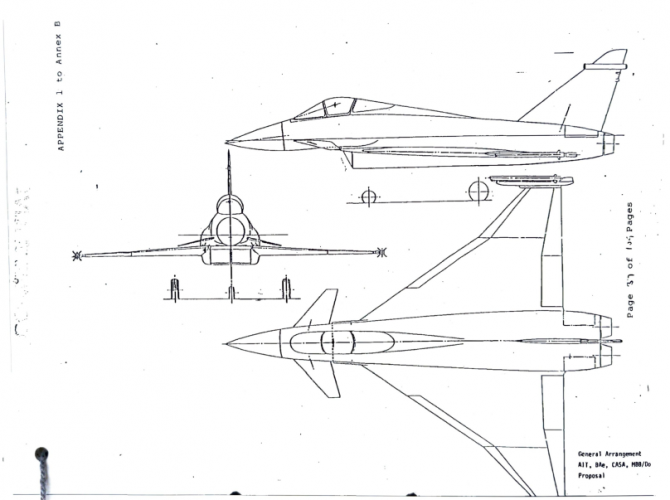
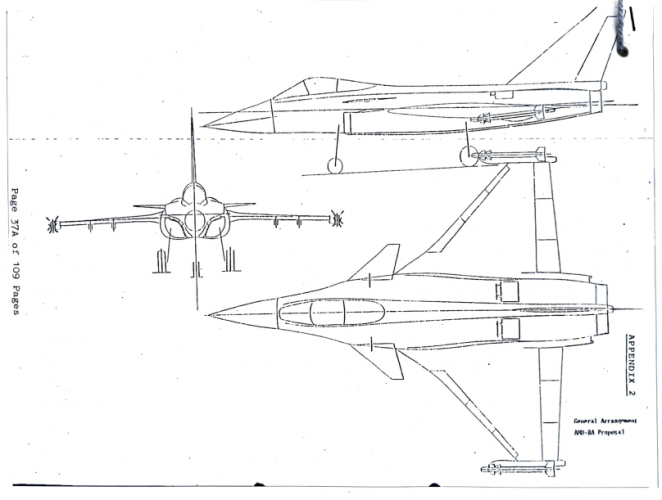
A little find from the National Archives: at the end of the EFA feasibility study (early 1985) there were two designs proposed. One was jointly proposed by AIT, BAe, CASA and MBB (representing Italy, Britain, Spain and Germany respectively); and the other was proposed solely by AMD-BA (representing France).
Perhaps unsurprisingly the the French design looks very similar to how the Rafale ended up looking, while the other four nations chose a design looking quite similar to EAP / Eurofighter (albeit with wingtip mounted missiles).
There's always multiple trade offs; I was trying to describe what I believe were the key reasons from what I know and what people involved have described.
There's also a difference between what was predicted to be better at the time, and how it turned out in practice. I'm pretty sure some different decisions would have been made with hindsight based on what was found in trials / operations.
Should have had leading edge vortex flaps instead of the slats
Could you please explain a little more about the slots on the leading edge of the Eurofighter? Why did the slots seem like a good idea at the time? And what would have changed if a different solution had been chosen?
This site uses cookies to help personalise content, tailor your experience and to keep you logged in if you register.
By continuing to use this site, you are consenting to our use of cookies.







 (who proposed nearly identical forward swept canards for the Me 163) ...