
You are using an out of date browser. It may not display this or other websites correctly.
You should upgrade or use an alternative browser.
You should upgrade or use an alternative browser.
Bugatti 100 Racer and 110 Fighter Projects

Pelzig
ACCESS: Secret
- Joined
- 23 October 2008
- Messages
- 448
- Reaction score
- 97
Bugatti submitted and was approved for five patents in association with the Model 100. I've found three of them which are:
UK patent GB526460 (for the engine/drivetrain)
U.S. patent 2,268,183 (for the cooling method)
U.S. patent 2,279,615 (for the trailing edge flap system)
I am aware he received a patent for the V-tail arrangement but was unable to come up with it checking the European patent search engine (or the U.S. one). It was granted by France in April 1939. I don't know what the fifth patent was for. Bugatti sure put in a ton of patents!
Any ideas? Thanks!
UK patent GB526460 (for the engine/drivetrain)
U.S. patent 2,268,183 (for the cooling method)
U.S. patent 2,279,615 (for the trailing edge flap system)
I am aware he received a patent for the V-tail arrangement but was unable to come up with it checking the European patent search engine (or the U.S. one). It was granted by France in April 1939. I don't know what the fifth patent was for. Bugatti sure put in a ton of patents!
Any ideas? Thanks!

Razorfish
ACCESS: Restricted
- Joined
- 14 September 2010
- Messages
- 1
- Reaction score
- 0
Hi all. I'm a little late to the thread but I hope you don't mind a little story. Please set me straight if this Yank is out of line.
I build/fly RC planes and have a stack of papers a couple inches deep of ideas and sketches of mostly unusual aircraft. I just can't do "normal" planes. I came up with the plane below about a year ago. After building somebody said it looks like a Bugatti. I never heard of it and was thinking, what is this Bugatti he speaks of. I suspect I saw a picture and only my subconscious remembered. I'm definitely not the type to steal credit for something I didn't come up with. Next stage in my evil plan is to build a more scale Bugatti and not just similar.
Picture 1 & 2 are two different planes. 2nd flew really well. 5 out of 5 on straight tracking. Let's just say the 1st flew.
Picture 3 is not mine.
Last video is a scratch built sloper I found online.
http://www.youtube.com/watch?v=5_IA9SsYXlk
I build/fly RC planes and have a stack of papers a couple inches deep of ideas and sketches of mostly unusual aircraft. I just can't do "normal" planes. I came up with the plane below about a year ago. After building somebody said it looks like a Bugatti. I never heard of it and was thinking, what is this Bugatti he speaks of. I suspect I saw a picture and only my subconscious remembered. I'm definitely not the type to steal credit for something I didn't come up with. Next stage in my evil plan is to build a more scale Bugatti and not just similar.
Picture 1 & 2 are two different planes. 2nd flew really well. 5 out of 5 on straight tracking. Let's just say the 1st flew.
Picture 3 is not mine.
Last video is a scratch built sloper I found online.


http://www.youtube.com/watch?v=5_IA9SsYXlk

Grey Havoc
ACCESS: USAP
- Joined
- 9 October 2009
- Messages
- 24,500
- Reaction score
- 18,170
Grey Havoc
ACCESS: USAP
- Joined
- 9 October 2009
- Messages
- 24,500
- Reaction score
- 18,170
Kim Margosein said:With all the modification to make the Bugatti fit for military use, I am reminded of the Bf-209 (the speed record aircraft) that went down the same road. By the time you make the aircraft and engine robust enough to be useful, you're left with an aircraft with little or no advantage over off the shelf contemporary fighters.
Kim Margosein
On the other hand, since the intent was to create a pursuit and/or a 'chasseur reconnaissense' fighter, the design team might have ended up going with an approach similar to the Japanese Zero, i.e. sacrificing armor and firepower in return for speed, maneuverability and range/endurance. Although they probably would have given the 110P self-sealing tanks as long as the weight penalty wasn't too severe.

2IDSGT
Ah tale yew wut!
- Joined
- 27 November 2012
- Messages
- 365
- Reaction score
- 14
Interesting story.
http://www.jalopyjournal.com/?p=1914
http://en.wikipedia.org/wiki/Bugatti_Model_100
http://iflyblog.com/2012/10/04/the-bugatti-100p-reviving-a-ghost/
Fortunately, someone is building a full-scale replica to fly. I'll be curious to know if the design can really make it to 550 mph with fix-pitch props. Lots of pictures on the project's Facebook page. https://www.facebook.com/TheBugatti100pProject
http://www.jalopyjournal.com/?p=1914
http://en.wikipedia.org/wiki/Bugatti_Model_100
http://iflyblog.com/2012/10/04/the-bugatti-100p-reviving-a-ghost/
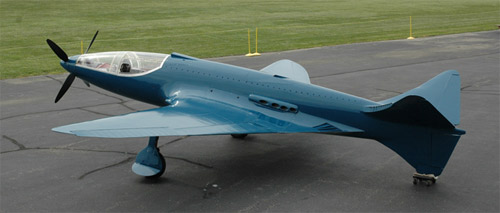
Fortunately, someone is building a full-scale replica to fly. I'll be curious to know if the design can really make it to 550 mph with fix-pitch props. Lots of pictures on the project's Facebook page. https://www.facebook.com/TheBugatti100pProject


There's a new book in the making about the Bugatti 100P.
'The Bugatti 100P Record Plane'
Created by Etore Bugatti and Louis de Monge.
written by Jaap Horst-240pp
Due for publishing Jan. 2013 by Lanasta in the Netherlands.
Perhaps the definitive history about this beauty..
'The Bugatti 100P Record Plane'
Created by Etore Bugatti and Louis de Monge.
written by Jaap Horst-240pp
Due for publishing Jan. 2013 by Lanasta in the Netherlands.
Perhaps the definitive history about this beauty..

- Joined
- 11 March 2006
- Messages
- 8,537
- Reaction score
- 4,998
... and it will have english text, as it seems:
http://www.lanasta.com/Shop/product/142/the-bugatti-100p-record-plane.html
http://www.lanasta.com/Shop/product/142/the-bugatti-100p-record-plane.html


Charlesferdinand
amateur theologian
- Joined
- 24 October 2013
- Messages
- 184
- Reaction score
- 311
Apparently, there has been a roll out of the plane recently. I only saw a photo and a short notice in a French aviation magazine, does anyone know more?
- Joined
- 11 March 2006
- Messages
- 8,537
- Reaction score
- 4,998
It's probably the one built by this team : http://bugatti100p.com/
About the roll-out, you can find out here, too : http://www.visitoshkosh.com/event/eaa-wright-brothers-memorial-banquet-2/
(".. and the airplane made its initial roll-out on October 25")
About the roll-out, you can find out here, too : http://www.visitoshkosh.com/event/eaa-wright-brothers-memorial-banquet-2/
(".. and the airplane made its initial roll-out on October 25")

- Joined
- 25 June 2009
- Messages
- 15,515
- Reaction score
- 9,426
As part of the revived interest in the Bugatti projects, a whole new comic book entitled Firehawks, featuring Bugatti fighters, has made its debut in the online Aces Weekly magazine, created by David Lloyd, of V for Vendetta fame. Firehawks is written and illustrated by no less than veteran Marvel Comics artist Herb Trimpe, who made a name for himself by illustrating over 100 issues of The Incredible Hulk and created graphically such famous characters as Wolverine and Captain Britain (he also did the G.I. Joe, Godzilla, Transformers and Shogun Warriors comics for Marvel, among many others).
Firehawks seems to be fun. However, the coloring job seems to be awful! Anyway, you can more info on the Aces Weekly website.
Original black and white version of the story (much better I think) can be purchased from Jaap Horst in the Netherlands.
Firehawks seems to be fun. However, the coloring job seems to be awful! Anyway, you can more info on the Aces Weekly website.
Original black and white version of the story (much better I think) can be purchased from Jaap Horst in the Netherlands.
Attachments








MaxLegroom
Why not?
- Joined
- 28 December 2013
- Messages
- 167
- Reaction score
- 59
This brought back some memories for me. One of my setups for Flight Simulator 2004 included the Bugatti 100 racer, and scenery to go with it. It was incredible. Seems I've found it again" http://www.sim-outhouse.com/sohforums/showthread.php?67800-Bugatti-Adventures

SlickDriver
ACCESS: Confidential
- Joined
- 20 June 2006
- Messages
- 161
- Reaction score
- 39
Bugatti 100P to fly
Am not sure where this belongs. A 1939 Bugatti 100P is getting ready for it's maiden flight.
http://www.theverge.com/2015/8/8/9118119/bugatti-100p-reve-blue-kickstarter-first-flight
Am not sure where this belongs. A 1939 Bugatti 100P is getting ready for it's maiden flight.
http://www.theverge.com/2015/8/8/9118119/bugatti-100p-reve-blue-kickstarter-first-flight
First Flight!
https://www.facebook.com/TheBugatti100pProject/photos/a.265365623540584.60202.261574317253048/843354212408386/?type=1
https://www.facebook.com/TheBugatti100pProject/photos/a.265365623540584.60202.261574317253048/843354212408386/?type=1
In keeping with our Full-Disclosure policy, here is my summation of our first flight experience:
We intended this flight to be limited to a short hop down the runway to check power required/power available and to check control responsiveness in all three axes. Preflight preparation and before-takeoff checks were normal. Takeoff was normal and at a predetermined reduced power (80%) setting; takeoff roll was 3000 feet and I became airborne at 90 knots. I climbed to 100 AGL to check power and control responsiveness. The plane responded as expected to all power changes and control inputs. Maximum airspeed was 110 knots.
I reduced power for landing but the airplane floated much more than we anticipated. I landed further down the runway than planned but with sufficient distance to stop the plane. Unfortunately, I lost the right brake and the airplane departed the left side of the runway at slow speed. Due to heavy rains the night before, the ground was soft and the airplane tipped upward on its nose, damaging the spinner and both props.
Such is the nature of flight testing a new design. The relevant news is we successfully flew the Bugatti 100P for the first time. The plane flew beautifully.
We’ll share more photos, video, and data with you in the coming days.
Attachments


blackkite
Don't laugh, don't cry, don't even curse, but.....
- Joined
- 31 May 2007
- Messages
- 9,515
- Reaction score
- 9,652
Hi! I can see two radiator shape.
https://sobchak.wordpress.com/2009/11/27/cutaway-bugatti-model-100-racer/
Robin-san's contribution.
https://oldmachinepress.com/2012/11/01/bugatti-model-100p-racer/
http://www.bugattirevue.com/revue3/rev3-2.htm
http://www.bugattirevue.com/revue4/plane.htm
"Figure 1 shows the flaps in the normal cruise position, triggered by moderate airspeed and manifold pressure. When the sensors picked up low airspeed and high manifold pressure, the flaps would be set in the takeoff/climb position, figure 2, increasing the lift of the wing. At max. power and high airspeed, the drag would be decreased to a minimum, figure 3. Less lift would be available, but not needed at this high speed. Fig. 4 shows the dive brake position, triggered by high air speed and low power. For landing the flaps operated to increase lift and drag, figure 5, while the top flap would rise while applyng the brakes, after landing (Fig.6). "
https://forum.warthunder.com/index.php?/topic/348404-bugatti-model-110p-french-superprop/
https://sobchak.wordpress.com/2009/11/27/cutaway-bugatti-model-100-racer/
Robin-san's contribution.
https://oldmachinepress.com/2012/11/01/bugatti-model-100p-racer/
http://www.bugattirevue.com/revue3/rev3-2.htm
http://www.bugattirevue.com/revue4/plane.htm
"Figure 1 shows the flaps in the normal cruise position, triggered by moderate airspeed and manifold pressure. When the sensors picked up low airspeed and high manifold pressure, the flaps would be set in the takeoff/climb position, figure 2, increasing the lift of the wing. At max. power and high airspeed, the drag would be decreased to a minimum, figure 3. Less lift would be available, but not needed at this high speed. Fig. 4 shows the dive brake position, triggered by high air speed and low power. For landing the flaps operated to increase lift and drag, figure 5, while the top flap would rise while applyng the brakes, after landing (Fig.6). "
https://forum.warthunder.com/index.php?/topic/348404-bugatti-model-110p-french-superprop/
Attachments

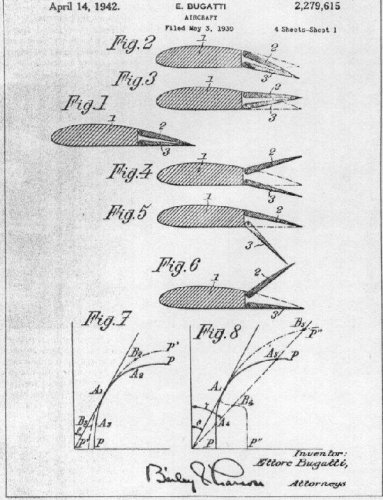
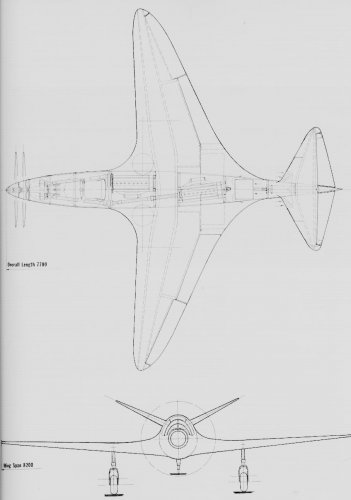
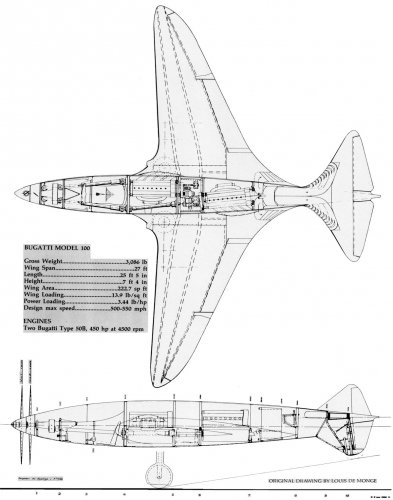


- Joined
- 19 July 2016
- Messages
- 4,814
- Reaction score
- 4,273
https://www.flyingmag.com/pilot-killed-in-crash-bugatti-100p-replica
Yes I've heard of that crash. It is heartbreaking. As a Frenchman I feel twice concerned.
First, because in the 80's, one of the last four existing Dewoitine D-520 was restored to flying status. On a sad day of July 1986, it crashed, killing pilot Christian Bove, who had been the driving force behind the project.
Second, because there is another Dewoitine to fly soon: a D-551 is being build from zero in Toulouse. Hopefully it won't crash like this...
http://replicair.fr/avions/dewoitine-d551/
First, because in the 80's, one of the last four existing Dewoitine D-520 was restored to flying status. On a sad day of July 1986, it crashed, killing pilot Christian Bove, who had been the driving force behind the project.
Second, because there is another Dewoitine to fly soon: a D-551 is being build from zero in Toulouse. Hopefully it won't crash like this...
http://replicair.fr/avions/dewoitine-d551/
- Joined
- 19 July 2016
- Messages
- 4,814
- Reaction score
- 4,273
A real shame those accidents. In the case of the Bugatti, perhaps it was too complex an aircraft for such a small team to recreate. All those propshafts with universal joints for a start and the coolant system, a real monster.

- Joined
- 19 October 2012
- Messages
- 2,070
- Reaction score
- 2,201
1920s and 1930s racing and record aircraft placed high demands on the pilots and a great many were on the very edge of flyable. Recreating them is not something to be taken lightly and unfortunately there have been too many fatal crashes. Supermarine S5r, Hughes H-1, Bugatti 100 and no doubt others.
Grey Havoc
ACCESS: USAP
- Joined
- 9 October 2009
- Messages
- 24,500
- Reaction score
- 18,170

August 15, 2020
Original Bugatti 100P Record plane moved in Oshkosh EAA museum
John Mellberg, who is often in the EAA museum in Oshkosh, sent the info that the original Bugatti airplane has been moved.
For those who have seen it in reality, or even the photographs only, know that the old spot was rather dark, difficult to take good photographs there for example. It just didn't do justice to such a unique airplane.
Now recently, that has been corrected at last.
Thanks John, for the photographs!
http://www.bugattiaircraft.com/news.htm
Grey Havoc
ACCESS: USAP
- Joined
- 9 October 2009
- Messages
- 24,500
- Reaction score
- 18,170
Regarding the tragic 2016 crash of the replica:
https://www.secretprojects.co.uk/th...arching-crowdfunding-to-fly.19041/post-701795
https://www.secretprojects.co.uk/th...arching-crowdfunding-to-fly.19041/post-701795
Grey Havoc
ACCESS: USAP
- Joined
- 9 October 2009
- Messages
- 24,500
- Reaction score
- 18,170
The September 2024 edition of Airfix Model World has a review of Aerotech Models' (part of Marsh Models) 1/32 scale mixed-media model kit of the Bugatti 100P. It is a limited edition kit unfortunately, with a planned production run of 150 examples, each retailing at £188.99. No word on whether there will be any aftermarket add-ons to allow you to complete the model as the Bugatti 110P light pursuit fighter aircraft instead.
EDIT: According to the Marsh Models website, the kit code is AT32025, while the stock code according to the aforementioned Airfix Model World review is just 32025.
EDIT: According to the Marsh Models website, the kit code is AT32025, while the stock code according to the aforementioned Airfix Model World review is just 32025.
Last edited:


Bugatti 110 C.1
On September 1937, Louis de Monge designed the Bugatti Model 100, a Monoplace de Course (Single-seat racer) to beat the Germans on their own soil in the Deutsch Cup Race of 1938. Underpowered with one 450 hp Bugatti T50 B engine, it was necessary to use one ultra-sleek highly streamlined airframe with forward swept wings, variable geometry automatic flaps, 120-degree V-tail and retractable landing gear.
To save weight the engine crankcases were made of magnesium and the airframe mostly of wood with sandwiched layers of balsa and tulipwood. Looking to restore national pride after the exhibition made by the Messerschmitt Bf 109 V13 in November 1937, the Ministère de l’Air offered to finance the construction of two special planes to break the world speed records of 634 kph over 100 km and 709 kph over 3 km.
The first, called Bugatti Model 100P (Poussée-boosted) with two 525 hp Bugatti 50P eight-cylinder straight liquid-cooled engines, two drive shafts, one gearbox reduction, two counter-rotating Ratier S.O.B. airscrews, 8.23 m wingspan and 650 kph estimated maximum speed. The second, Model 110P, with two 50P engines boosted to 550 hp, clipped wings with 6.7m wingspan and 750 kph estimated maximum speed. The contract, signed in August 1938 by 6.900.000 F, included two Type 50P spare engines and a bonus of 1.800.000 F if the two records should be broken.
In 1939, the German accepted the 'Propaganda War' making fly the Heinkel He 100 V8 at 746.606 kph on 30 March and the Messerschmitt Me 209 V1 at 755.138 kph on 29 April. The French prototype Dewoitine D.551 tried to overcome that mark on 22 November but could only reach 701.5 kph powered by one H.S.12 Y boosted to 1,300 hp.
At the end of 1939 the French preferred to concentrate its efforts on the production of 'panic fighters'. Anticipating the possibility of a long attrition war, the Ministére de l’Air promoted the construction from wood/plywood of the Arsenal VG 33 and commissioned the design of the Bugatti 110 C.1 (a third-generation fighter of the M.S.460 and D.520T class) with increased wingspan and propelled by one 1,600 hp H.S.12 Z or one 1,500 hp Bugatti T67 sixteen-cylinder ‘Vee’ liquid cooled engine. Production should be made at the new Bugatti factory in Bordeaux.
The construction of the Model 100P suffered delays caused by the complexity of the transmission, cooling and automatic flaps control systems. On 10 May 1940 the prototype was just nearing completion and was hidden to prevent access to their secrets by the Germans.
Author notes
A service aircraft would have needed larger air intakes for the radiators and less complex cooling and flaps systems. The magnesium engine crankcases would have been very vulnerable to the incendiary ammunition and the tulipwood, with a breaking strength of 70 MPa, too fragile to stand the tensile strength during a dogfight.
In my opinion, the Bugatti 110 C.1 should have been armed with six 7.5 mm, MAC 34 M39 machine guns in the wings (similar to the D.520T installation) and one H.S.404 cannon.
I believe that the fighter version would have a unique power shaft in starboard position and a flat windscreen to avoid the optical distortion when using the GH 38 gunsight.
Given the decentralization policy of aeronautical production, started by the French government in the last years of the decade of the thirties, it seems reasonable to assume that the Bugatti military version would have been propelled by an engine of the same firm, and I have been working on the scale drawings of the T67 V16 engine as published at
http: //www.bugattiaircraft.com.
As per my estimations, the installation of the T67 in the Model 100P airframe requires the following modifications: The undercarriage wide track should have been increased to 3.3 m, wingspan to 8.68 m, tailplane to 1.46 m, overall length to 8.33 m, height to 2.16 m and propeller disc diameter to 1.89 m. Based on all these assumptions I will try to draw the look that the mythical airplane might have had.
Attachments


Scott Kenny
ACCESS: USAP
- Joined
- 15 May 2023
- Messages
- 19,515
- Reaction score
- 27,963
Pardon me, binged the thread.
The Bugatti 100P is one of my favorite racers. And I say that having a Gee Bee on the airfield where I got my A&P. Not to mention the pair of P-51s. Helps that Bugatti Blue is gorgeous!
If true, that would help keep the propeller gearing small(ish) and light. What scares me is that the pilot is between a pair of high-rpm driveshafts with the gear reduction happening at the props. With each engine powering a separate prop, the arrangement of the two engines makes more sense. If you notice, the exhaust ports are on opposite sides of the airframe, so I suspect that the drive for one engine was being taken off the opposite end of the other engine. No extra gearing to make one prop turn the opposite direction, maximum simplicity.
It might be kinda fun to make a version of this with a pair of maximum-displacement Honda K-series inline-fours. Those will make 500hp with boost levels less than "block-breaking", and can make 1000hp off of about 2.5 liters.
==============================
As to the proposed armament for the 110P fighter, I'm leaning towards a pair of 7.5mm MGs and a cannon in the prop hub. That's it, nothing more. Compare with early Bf109s or A6M "zeros" in terms of armament. 2x MGs and 1-2 cannons.
The Oerlikon FF would fit in the nose.
The Bugatti 100P is one of my favorite racers. And I say that having a Gee Bee on the airfield where I got my A&P. Not to mention the pair of P-51s. Helps that Bugatti Blue is gorgeous!
Combined question, though not about the cooling system.This may help visualize the cooling system.
The images attached seem to show two completely separate props on a common axis. Each engine driving one prop. Not two engines combining and then each engine equally splitting the load on each prop, which is what I thought was going on. And confusing the hell out of me in the process.According to this drawing from the patent, the intakes in the leading edges seem
to have had no function for the basic cooling sytem, maybe acting as oil coolers ?
If true, that would help keep the propeller gearing small(ish) and light. What scares me is that the pilot is between a pair of high-rpm driveshafts with the gear reduction happening at the props. With each engine powering a separate prop, the arrangement of the two engines makes more sense. If you notice, the exhaust ports are on opposite sides of the airframe, so I suspect that the drive for one engine was being taken off the opposite end of the other engine. No extra gearing to make one prop turn the opposite direction, maximum simplicity.
It might be kinda fun to make a version of this with a pair of maximum-displacement Honda K-series inline-fours. Those will make 500hp with boost levels less than "block-breaking", and can make 1000hp off of about 2.5 liters.
==============================
As to the proposed armament for the 110P fighter, I'm leaning towards a pair of 7.5mm MGs and a cannon in the prop hub. That's it, nothing more. Compare with early Bf109s or A6M "zeros" in terms of armament. 2x MGs and 1-2 cannons.
The Oerlikon FF would fit in the nose.
Similar threads
-
-
-

-
Edgar Brandt & Company 1940 80mm HEAT projector-grenade
- Started by JWilly
- Replies: 5