From TU 215,

Mr. Hildebrandt and his design;

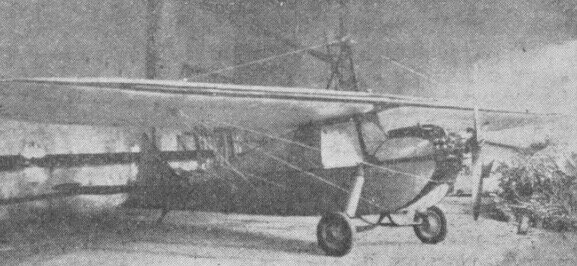
Single-seater torpedo also planned as a two-seater, low-wing monoplane built in 1934 by Mr. Hildebrandt. In
April of this year, this amateur aircraft totaled 5 flight hours per 15 to 30 minute outings. He had been tried
by Paul Vaux, from "Aïles de Touraine",in Villacoublay on the Morane-Saulnier aerodrome, then in Saint-Cyr.
What is the meaning of "torpedo" here,a shape of it,or it was a military aircraft ?.
 
From TU 215,

Mr. Hildebrandt and his design;

Single-seater torpedo also planned as a two-seater, low-wing monoplane built in 1934 by Mr. Hildebrandt. In
April of this year, this amateur aircraft totaled 5 flight hours per 15 to 30 minute outings. He had been tried
by Paul Vaux, from "Aïles de Touraine",in Villacoublay on the Morane-Saulnier aerodrome, then in Saint-Cyr.
What is the meaning of "torpedo" here,a shape of it,or it was a military aircraft ?.

The word torpédo originally referred to an open touring car. So, in this context, torpédo suggests a 'sporty' tourer. (Perhaps a native French speaker could confirm this?)

Unfortunately, Google intentionally ignores accents. So, put torpille into Google Translate, you get 'torpedo'. Put in torpédo instead, you still get 'torpedo' ;P
 
From TU 175,

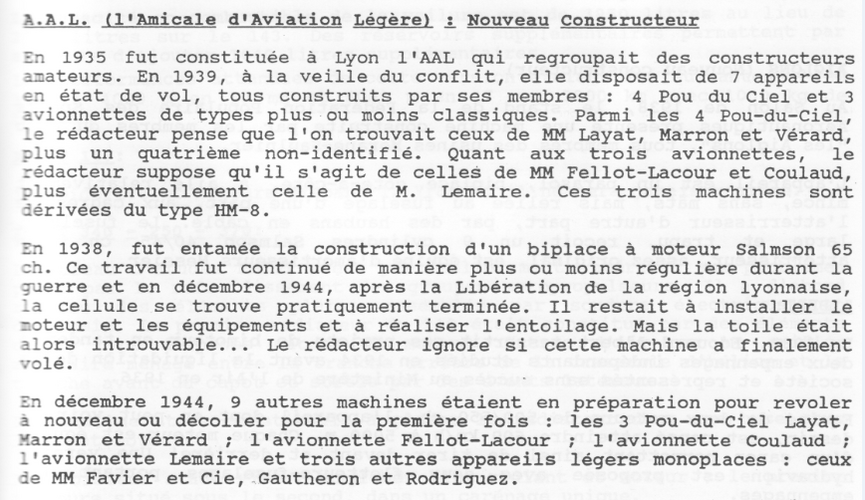
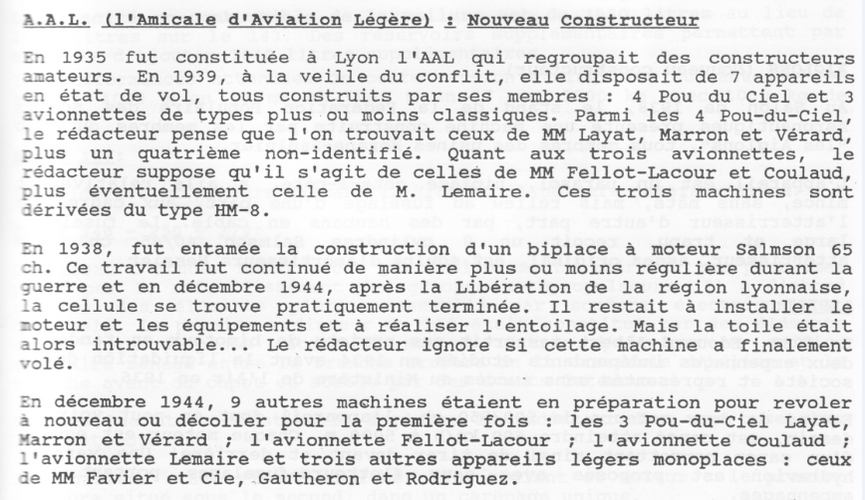
A.A.L. (Amicale d'Aviation Légère): New Manufacturer

In 1935, the AAL was incorporated in Lyon, which brought together manufacturers
2zators. In 1939, on the eve of the conflict, it had 7 devices
in flight condition, all built by its members: 4 Sky Pou and 3
more or less conventional types of aircraft. Among the 4 Pou-du-Ciel, the editor thinks that one found those of Messrs. Layat, Marron and Vérard, plus a fourth unidentified. As for the three airplanes, the
editor supposes that it is about those of MM Fellot-Lacour and Coulaud, more possibly that of Mr. Lemaire. These three machines are derived from the HM-8 type.

In 1938, construction began on a two-seater with a 65 hp Salmson engine. This work was continued more or less regularly during the war and in December 1944, after the Liberation of the Lyon region, the cell was practically finished. All that remained was to install the engine and the equipment and to make the canvas. But the web was then nowhere to be found ... The editor does not know if this machine finally flew.

In December 1944, 9 other machines were in preparation for re-flight
again or take off for the first time: the 3 Pou-du-Ciel Layat,
Marron and Vérard; the Fellot-Lacour aircraft; the Coulaud plane:
The Lemaire aircraft and three other light single-seater aircraft: those of MM Favier et Cie, Gautheron and Rodriguez.
 

Attachments

  • 1.png
    1.png
    363.1 KB · Views: 51
  • 1.png
    1.png
    363.1 KB · Views: 57
From TU 175,

A.A.L. (Amicale d'Aviation Légère): New Manufacturer

In 1935, the AAL was incorporated in Lyon, which brought together manufacturers
2zators.
Hum, not really "AAL new manufacturer": "Amicale d'Aviation Légère" can be translated as "Sport Aviation Friendly Group" and it was created in 1935 for and by Lyon area aircraft homebuilders.
 
Welcome back your return my dear Retrofit.

From TU 175;

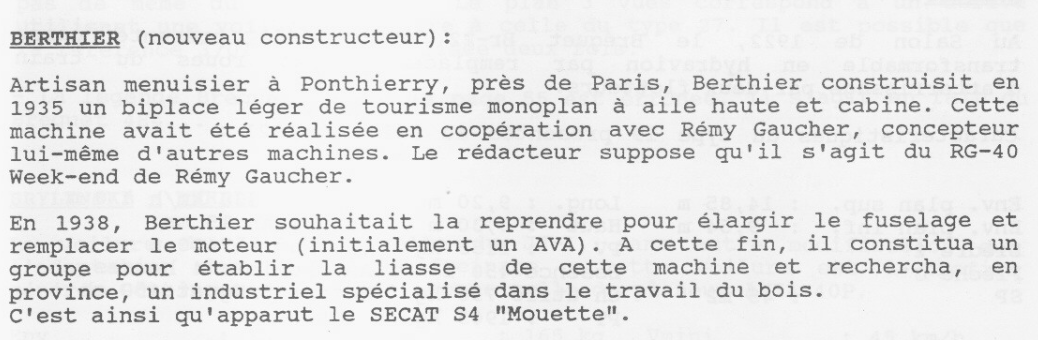
BERTHIER (new manufacturer):

Craftsman carpenter in Ponthierry, near Paris, Berthier built in
1935 a light two-seater touring monoplane with high wing and cabin. This
machine was produced in cooperation with Rémy Gaucher, designer
itself from other machines. Writer assumes RG-40
Rémy Gaucher weekend.

In 1938, Berthier wanted to take it over to widen the fuselage and
replace the motor (initially an AVA). To this end, he established a
group to establish the bundle of this machine and searched, in
province, an industrialist specializing in woodworking.

This is how the SECAT S4 "Seagull" appeared.
 

Attachments

  • 1.png
    1.png
    269.4 KB · Views: 69
The writer assumed rightly - Berthier built the Rémy Gaucher RG 40 Weekend at his workshops in Ponthierry. Unfortunately the better-known Ateliers Berthier belonging to the Odéon-Théâtre de l'Europe makes it almost impossible to search online for further information about the atelier Berthier in Ponthierry!

Is the implication here that the mysterious carpenter, Berthier, actually formed the Société d'Etudes et de Construction d'Avions de Tourisme? If so, that is odd since SECAT's factory at Boulogne-sur-Mer is over 300 km north of Saint-Fargeau-Ponthierry :confused:

On the engines, the first prototype RG 40 had a 26 hp AVA 4A-00, the second prototype had the planned-for 35 hp AVA 4A-02. The third prototype had a 60 hp Train - anticipating the SECAT IV/S 4 La Mouette. The postwar SECAT S 5 and larger RG 75 were both powered by Régnier 4D.2 4-cylinder inlines.
 
From TU 175,

who can ID those ?;

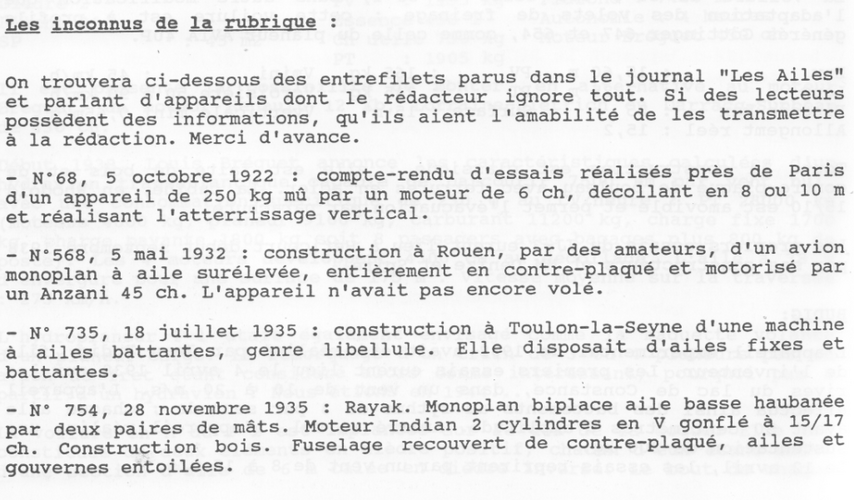
The unknowns of the section:

one will find below some snippets published in the newspaper "Les Ailes" and speaking of apparatuses of which the editor does not know anything. If readers have information, please pass it on to the editor. Thanks in advance.

- N ° 68, October 5, 1922: test report carried out near Paris of a 250 kg aircraft powered by a 6 hp engine, taking off in 8 or 10 m and performing a vertical landing.

- N ° 568, May 5, 1932: construction in Rouen, by amateurs, of a monoplane plane with raised wing, entirely in plywood and powered by an Anzani 45 hp. The device had not yet flown.

- N ° 735, July 18, 1935: construction in Toulon-la-Seyne of a machine with flapping wings, dragonfly type. It had fixed and flapping wings.

- N ° 754, November 28, 1935: Rayak. Two-seater low-wing monoplane guyed by two pairs of masts. Indian 2-cylinder V-shaped engine inflated to 15/17 hp. Timber construction. Fuselage covered with plywood, wings and control surfaces covered with canvas.
 

Attachments

  • 50.png
    50.png
    452.2 KB · Views: 53
From TU 170,

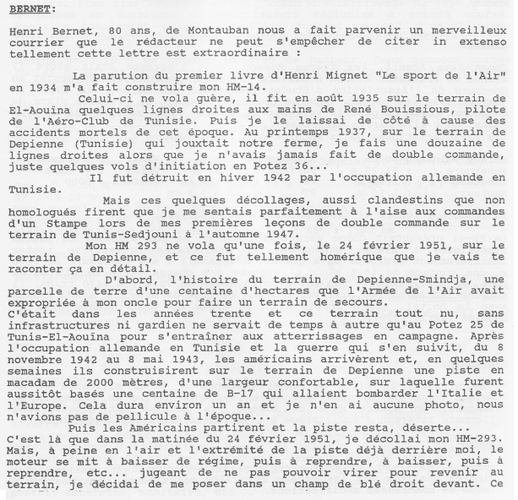
BERNET (New Manufacturer):

In 1935, in Depienne in Tunisia Mr. Bernet made a small plane. which unfortunately the editor does not know.

All Info from TU 175.
 

Attachments

  • 1.png
    1.png
    331.1 KB · Views: 51
  • 2.png
    2.png
    386 KB · Views: 44
From TU 182;

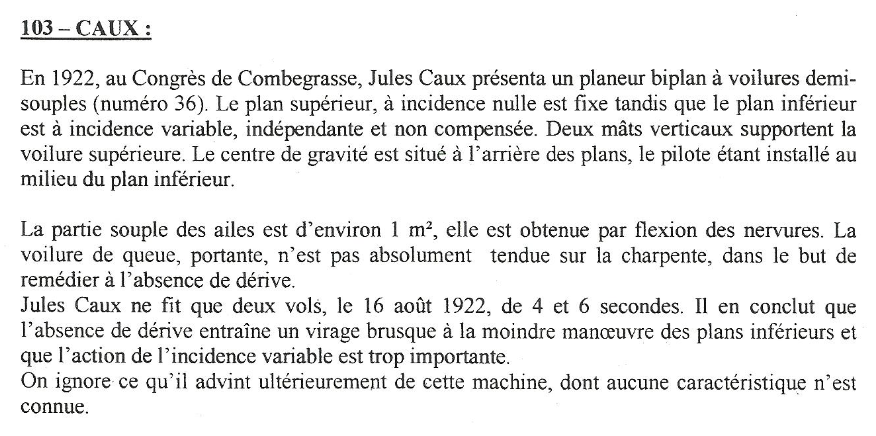
CAUX:

In 1922, at the Combegrasse Congress, Jules Caux presented a biplane glider with half-couple wings (number 36).
The upper plane, at zero incidence is fixed while the lower plane has a variable, independent and uncompensated
incidence. Two vertical masts support the upper canopy. The center of gravity is located behind the shots, with the
pilot seated in the middle of the lower plane.

The flexible part of the wings is about 1 m °, it is obtained by bending the ribs. The tail wing, load-bearing, is not
absolutely stretched over the frame, in order to remedy the lack of drift.

Jules Caux made only two flights, on August 16, 1922, of 4 and 6 seconds. He concludes that the absence of drift
causes a sharp turn at the slightest maneuver of the lower planes and that the action of the variable angle of
attack is too great.

It is not known what subsequently happened to this machine, of which no characteristics are known.
 

Attachments

  • 1.png
    1.png
    199.6 KB · Views: 48
From TU 186;

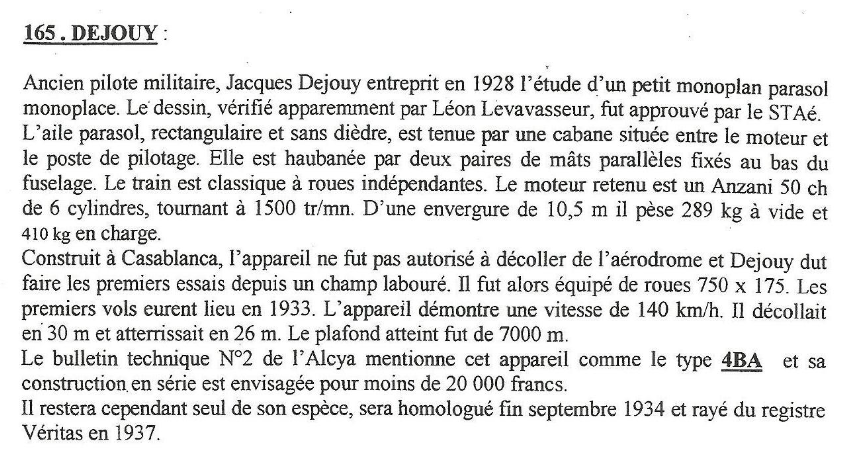
DEJOUY:

A former military pilot, Jacques Dejouy began in 1928 to study a small single-seater parasol monoplane. The drawing, apparently verified by Léon Levavasseur, was approved by the STAé.

The parasol wing, rectangular and without dihedral, is held by a cabin located between the engine and the cockpit. It is guyed by two pairs of parallel masts attached to the bottom of the fuselage. The train is classic with independent wheels. The engine selected is a 50 hp 6-cylinder Anzani, running at 1,500 rpm. With a wingspan of 10.5 m, it weighs 289 kg empty and 410 kg loaded.

Built in Casablanca, the aircraft was not allowed to take off from the airfield and Dejouy had to make the first tests from a plowed field. It was then fitted with 750 x 175 wheels.
The first flights took place in 1933. The aircraft shows a speed of 140 km / h. It took off in 30 m and landed in 26 m. The ceiling reached was 7000 m.

Alcya's technical bulletin N ° 2 mentions this device as type 4BA and its construction. in series is envisaged for less than 20,000 francs.

However, it will remain the only one of its kind, will be approved at the end of September 1934 and deleted from the Véritas register in 1937.
 

Attachments

  • 1.png
    1.png
    288.1 KB · Views: 53
... From TU 236,

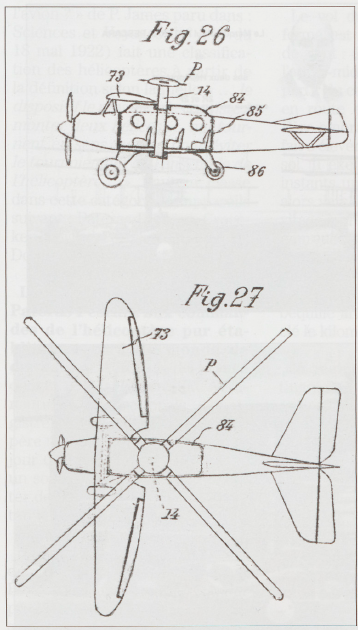
From Mr. Huttmann,who designed a helicopter in 1927;

Bernard Bombeau points out that 1927, a certain Huttmann proposed a helicopter with tandem rotors characterized by a rear rotor more lighter than the front rotor. This characteristic would result in that,when the angle of attack increases, the two rotors rotate at different speeds. generating, according to the inventor, longitudinal stability automatic.

Apparently, not Huttmann but Hüttmann.

There is a description of the Hüttmann-Drehflügel Modell (Rotary-Wing Model) 1927, with an image, here:
-- https://www.pennula.de/luftfahrt-geschichte-1927-heft-20.htm

In Flugsport XVIII, 1926, page 292, a "Hüttmann Drehflügel Versuchsmodell" is mentioned. (There is also a "Studienmodell" or 'study model' on page 80.) The 1926 Hüttmann Drehflügel Versuchsmodell differed from the 1927 model in having a two-bladed rotor.
 
Thank you dear Apophenia,

but maybe his work was in France,because he was mentioned in TU
magazine,right ?.
 
OK my dear Richard,but certainly it was two Huttmann ?.

And from TU 182;

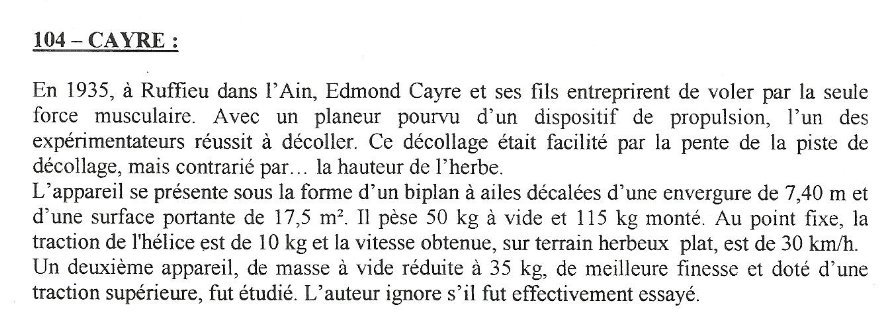
CAYRE:

In 1935, in Ruffieu in Ain, Edmond Cayre and his sons set out to fly by the only Muscular force. With a glider equipped with a propulsion device, one of the experimenters managed to take off. This take-off was facilitated by the slope of the runway take off, but upset by. the height of the grass.

The aircraft is in the form of a biplane with staggered wings with a wingspan of 7.40 m and with a bearing surface of 17.5 m °. It weighs 50 kg empty and 115 kg mounted. At the fixed point, the propeller traction is 10 kg and the speed obtained, on flat grassy terrain, is 30 km / h.
A second device, with an empty mass reduced to 35 kg, of better fineness and equipped with a upper traction, was studied. The author does not know if it was actually tried.
 

Attachments

  • 1.png
    1.png
    163 KB · Views: 53
From TU 170,

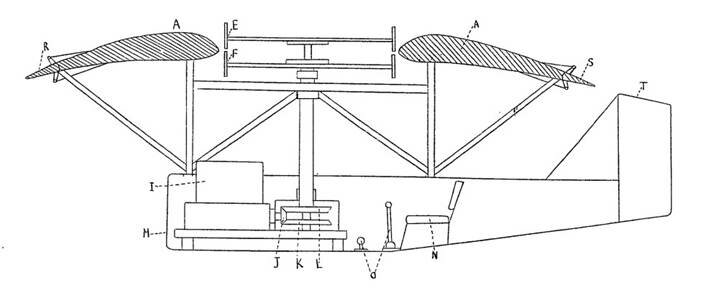
here is a helicopter,designed by Mr. Henry Bergier in 1937.

Bergier Annular lift-generating device 1930,

in 1930 Henri-Eugène-Philippe Bergier patented this machine announced as « self-lifting ». It was based on the « principle of the kite » where the kite cellulas, reduced to aircraft wings (A) were lifted by the air stream generated by contra-rotating turbines (E-F).

http://modelarchives.free.fr/Bestiaire/B_BERGIER_P/index.html
 

Attachments

  • 1.jpg
    1.jpg
    22.4 KB · Views: 188
OK my dear Richard,but certainly it was two Huttmann ?.
Yes , the French Huttmann and the German Hüttmann

Okay, I'm confused.

In this thread (on 27 April 2020), hesham clipped TU 236, which stated that in "1927, a certain Huttmann proposed a helicopter with tandem rotors ...".
-- https://www.secretprojects.co.uk/th...ects-and-prototypes.15821/page-12#post-389744

An assumption was made that, since this project was described in Trait d'Union is must be a French project. That assumpton was reasserted in reply #597.

But, in 1927, Flugsport described that exact same project as the Hüttmann-Drehflügel Modell. So, it seems that this - and Hüttmann's 1926 modell - were actually German projects.

Then we have "certainly it was two Huttmann". How so?

Although we have no first name, we do have a vague idea of what Herr Hüttmann was getting up to. But who was this Monsieur Huttmann? Do we have any actual record of this French Huttmann or his projects?

Barring fresh evidence,I would suggest that TU refers to a "Hélicoptère" in their index because its writers are French - not because Herr Hüttmann was French.
 
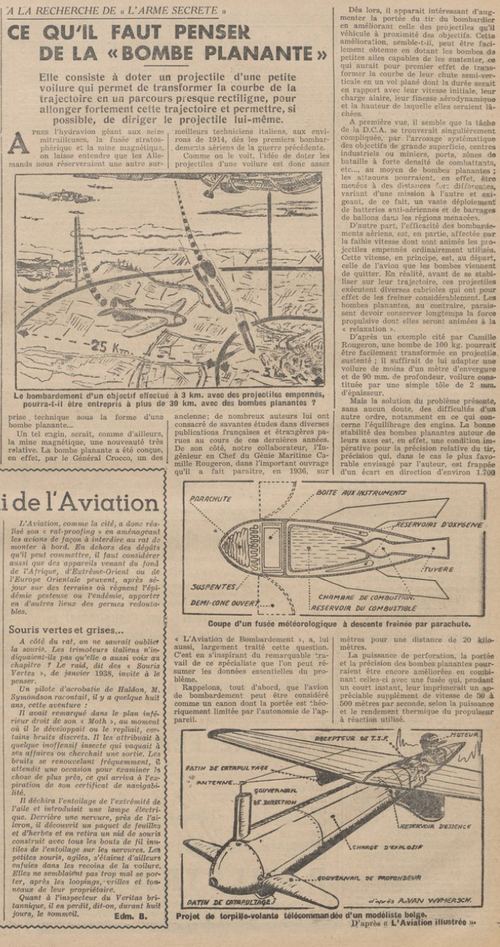
From Ailes 11 January 1940,

what was this ?.
 

Attachments

  • 1.png
    1.png
    1.7 MB · Views: 169
From Ailes 11 January 1940,

what was this ?.

Judging the first part of that article, nothing from France.

"AFTER the giant seaplane with sixteen machine guns, the stratospheric rocket and the magnetic mine,
it is suggested that the Germans have another technical surprise in the form of a gliding bomb."


What comes then, seems to be the introduction of such weapons from other contries.

Of course, it would be interesting to know, which giant (German) seaplane/flying boat was meant at the very beginning
of the year 1940. Magnetic mines were well known then, but the (German) stratospheric rocket ? The A5 ("Aggregat 5"),
tested from 1938 onwards ?
 
From Ailes 11 January 1940,

what was this ?.

Judging the first part of that article, nothing from France.

"AFTER the giant seaplane with sixteen machine guns, the stratospheric rocket and the magnetic mine,
it is suggested that the Germans have another technical surprise in the form of a gliding bomb."


What comes then, seems to be the introduction of such weapons from other contries.

Of course, it would be interesting to know, which giant (German) seaplane/flying boat was meant at the very beginning
of the year 1940. Magnetic mines were well known then, but the (German) stratospheric rocket ? The A5 ("Aggregat 5"),
tested from 1938 onwards ?
Many thanks my dear Jemiba,

and please we can transfer it to anther topic,and thanks.
 
From TU 207,

Mr. Leon Gateu designed a tourist Biplane in 1924,powered by one 25 hp Salmson engine,and also
created a two-seat Monoplane in 1930,powered by one 45 hp engine,the later maybe remained a
Project only ?.
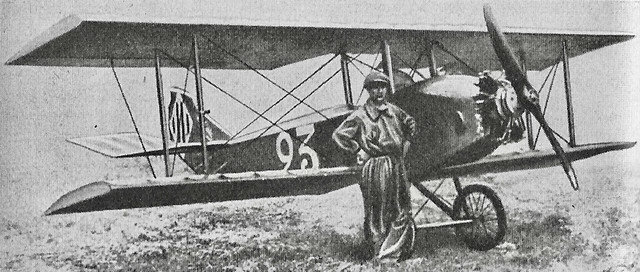
https://gallica.bnf.fr/ark:/12148/bpt6k9607206m/f1.image.r=Gateu?rk=85837;2

http://claudel.dopp.free.fr/Les_planeurs/Histoire/Vauville-1925/Vauville-1925.htm

http://claudel.dopp.free.fr/Les_planeurs/Histoire/Vauville-1925/Vauville-1925_machines.htm

and from "Taschenbuch der Luftflotten 1927 " , with the number 23 at Vauville :

Num-riser-1.jpg
 

Attachments

  • L'Aérophile__bpt6k6554816n_204.jpeg
    L'Aérophile__bpt6k6554816n_204.jpeg
    1.3 MB · Views: 130
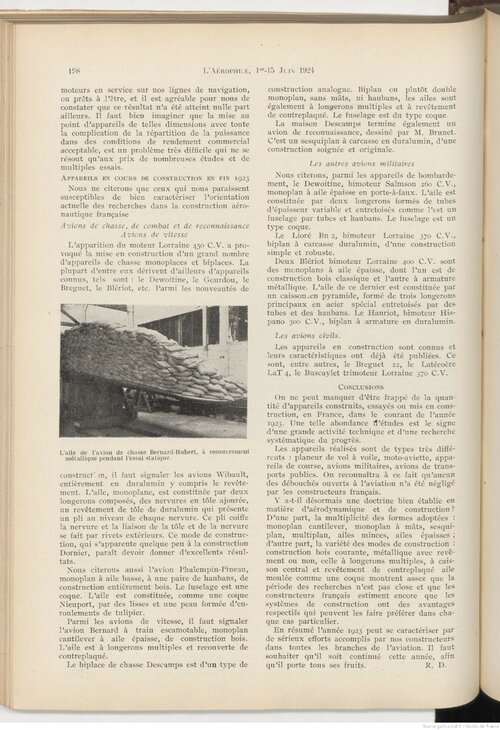
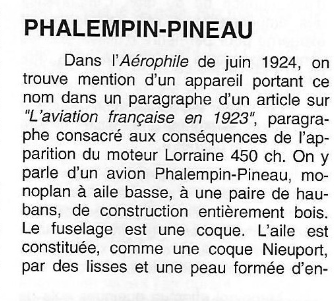
Pineau-Phalempin Ultra & Trimotor were a ultra-light and three engined Projects of 1923

Here is anther airplane for them powered by 300 hp engine,was it a Fighter or military aircraft ?.

https://gallica.bnf.fr/ark:/12148/bpt6k6554816n/f204.image.r=Phalempin pineau?rk=21459;2

Good question. The text doesn't seem to specify a role (being grouped under the title 'Avions de chasse, de combat et de reconnaissance Avions de vitesse')

A rough translation: "We will also cite the Phalempin-Pineau aircraft, a low-wing monoplane with paired bracing wires. Of entirely wooden construction, the fuselage is a semi-monocoque structure. The wing - like a Nieuport monocoque's - is formed by stringers skinned with winding laminations of tulipwood veneers."

I note that your earlier ONERA reference from the same year lists Pineau-Phalempin while, here, Phalempin-Pineau is used.

I'm also curious as to where you got the '300 hp' info from. The L'Aérophile article lists this airframe together with a range of 450 hp Lorraine-powered aircraft. Is there other information to the contrary?
 
Many thanks dear Apophenia,

but maybe I am wrong with 300 hp,it was 450 hp,and of course it was
not ultra light aircraft,so I think it definitely a military aircraft,right ?.

From TU magazine !?
 

Attachments

  • 1.png
    1.png
    95.8 KB · Views: 77
  • 2.png
    2.png
    10.6 KB · Views: 88
May be, someone just posted it.

In Les Ailes # 659 1934 p. 5 there was an article "Les resultats des concours d'avions et de moteurs" and three interesting projects-winners were described
 

Attachments

  • Ailes_65901.pdf
    395.9 KB · Views: 35
Last edited:
May be, someone just posted it.

In Les Ailes # 659 1934 p. 5 there was an article "Les resultats des concours d'avions et de moteurs" and three interest projects-winners were described
My dear Burunduk, I post them in reply # 91.
 
From Pegase 2007,

what was this ?.
 

Attachments

  • 1.png
    1.png
    262.8 KB · Views: 84
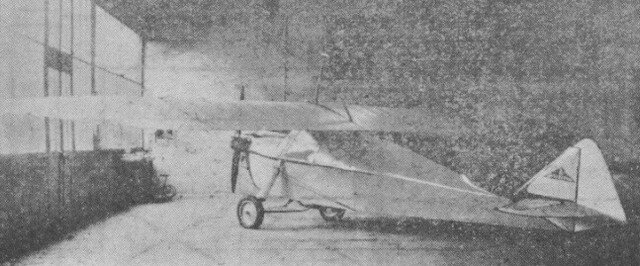
Is anything known about the second, low wing S.M.A.L. monoplane (mentioned in the 1946 advertisement), beyond it being a single seater and powered by a 35hp motor?

It would not surprise me if Mr Sablé failed to find buyers for his two monoplanes post-war. The photographs of the high wing monoplane suggest that the design was antiquated even in 1938. And with Piper Cubs, left behind by the Americans, being widely and inexpensively available in 1946, I rather doubt that there would have been much of a market for the two small, low powered, single seat S.M.A.L. monoplanes.
 
Last edited:
Is anything known about the second, low wing S.M.A.L. monoplane (mentioned in the 1946 advertisement), beyond it being a single seater and powered by a 35hp motor?

From TU 288,

need translate.
 

Attachments

  • 1.png
    1.png
    176.6 KB · Views: 66
  • 2.png
    2.png
    27.4 KB · Views: 61

From TU 288,

need translate.
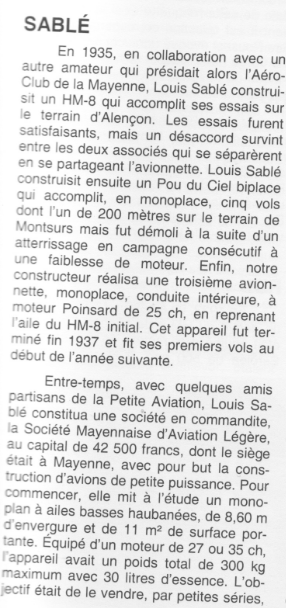
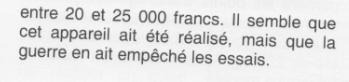
I've re-arranged some of the run-on sentences ... but something like this:

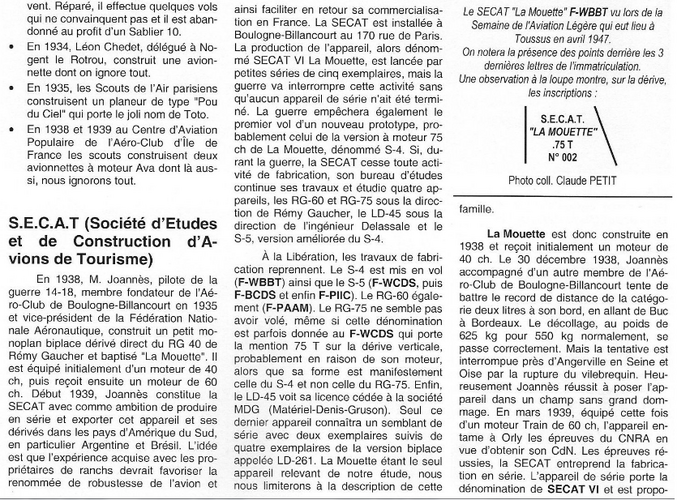
"Sablé

In 1935, in collaboration with another amateur who then chaired the Aéro-Club de la Mayenne, Louis Sablé built an HM-8 which carried out its tests satisfactorily. However, a disagreement arose between the two associates who then divided the aircraft. Louis Sablé then built a two-seater Pou du Ciel. This aircraft flew 200 metres from the airfield at Montsurs but was demolished on landing due to its weak engine. Finally, our manufacturer produced a third airplane - a single-seat sedan with a 25 cv Poinsard engine - which re-used the wings from the HM-8. This third airplane was completed at the end of 1937 and made its first flight at the beginning of the following year.

In the meantime, Louis Sablé set up a limited partnership with some friends who were supporters of the Petite Aviation. Established with the aim of building low-powered aircraft, the Société Mayennaise d'Aviation Légère had capital of 42,500 francs and was based at Mayenne. Initially, a low, braced-wing monoplane was studied. This design had wings with a 8.60 m span and 11 m2 area. Equipped with a 27 or 35 cv engine, the aircraft had a total weight of 300 kg maximum with 30 liters of gasoline. The objective was to sell it, in small series."

The snippet reads: "...between 20 and 25,000 francs. It seems that this machine was built, but the war prevented its testing."
 

Similar threads

Back
Top Bottom