This is the information I have about Wasserfall, I hope it can help.
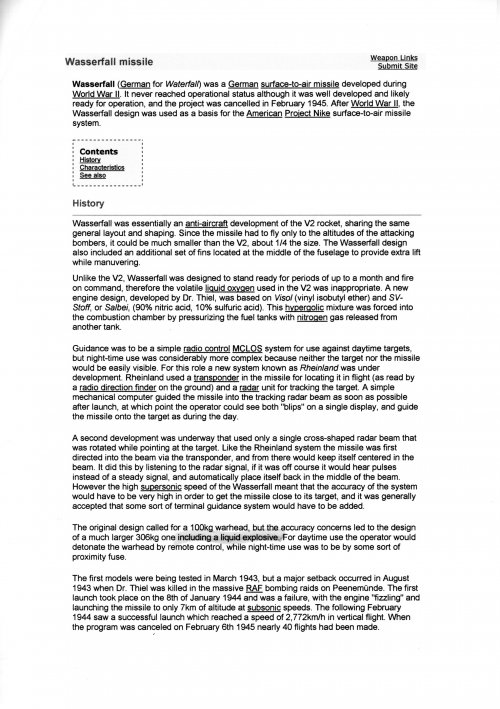
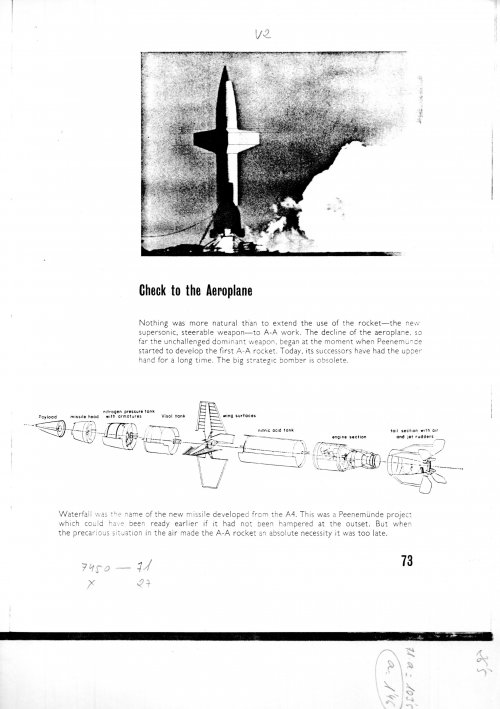
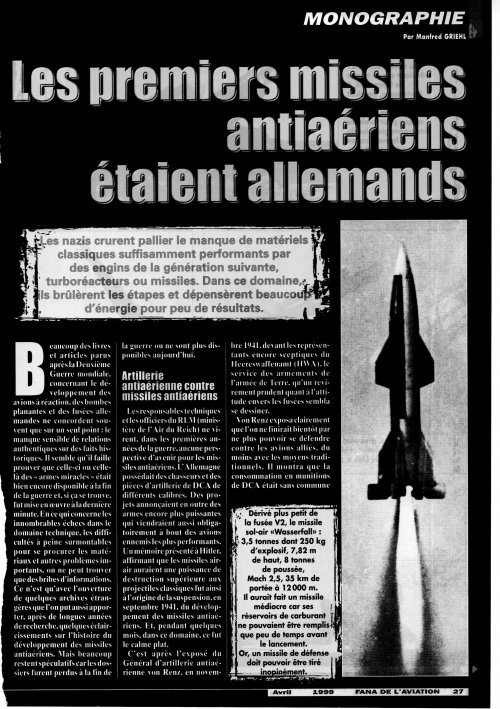
EMW Wasserfall
In September 1942,
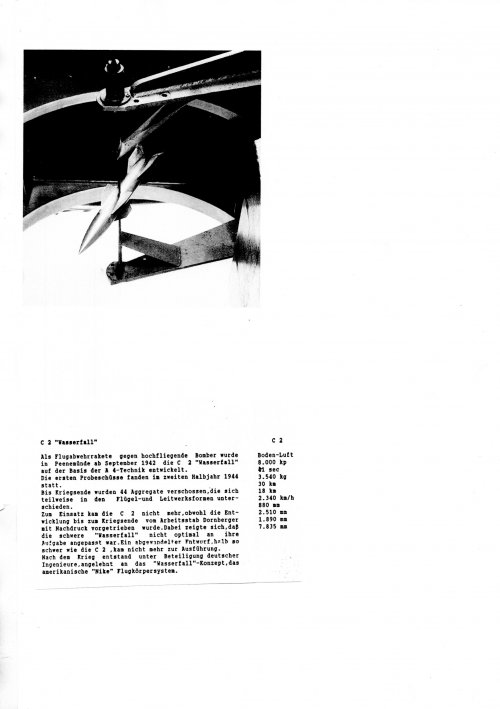
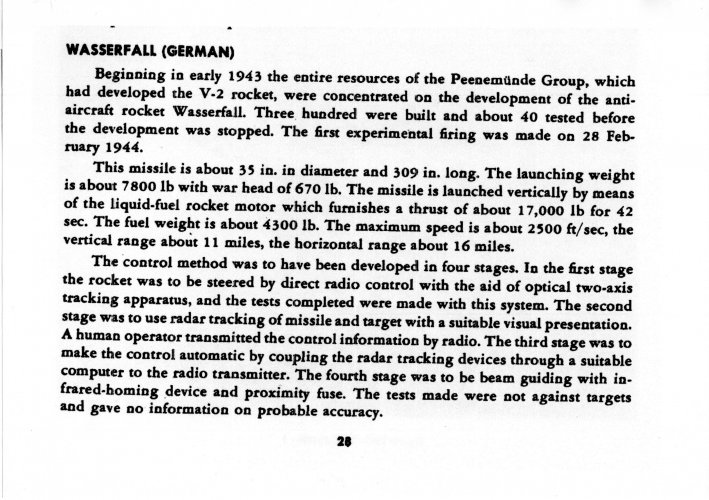
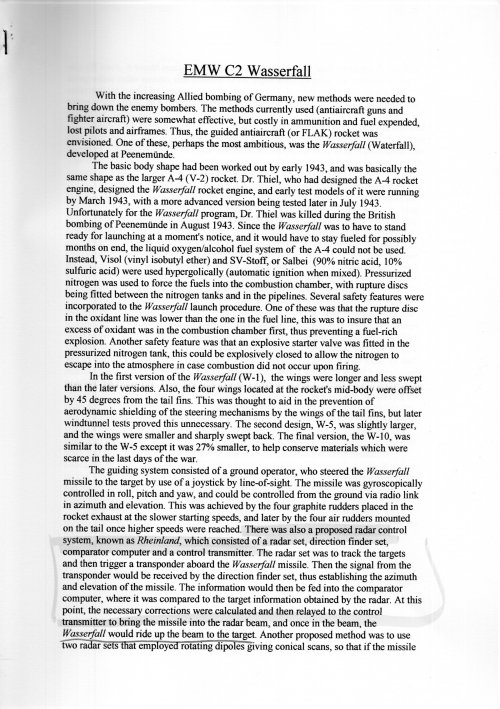
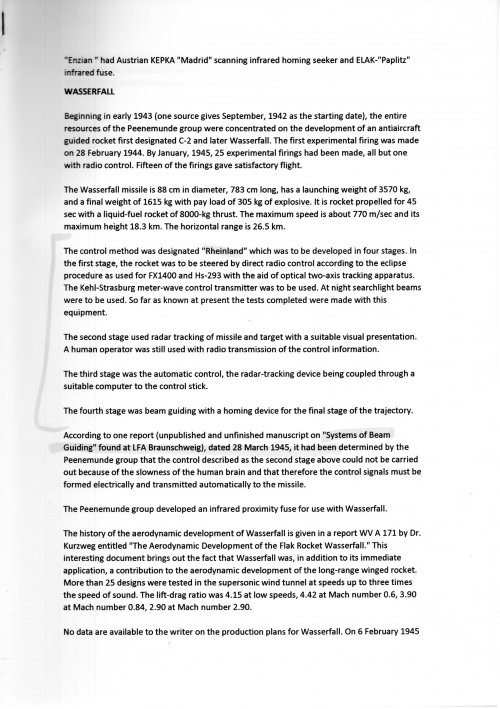
Elektromechanische Werke-Peenemünde (EMW) started the development of a high-altitude, anti-aircraft, supersonic missile (based in the V-2) under the codename EMW C-2 8/45.
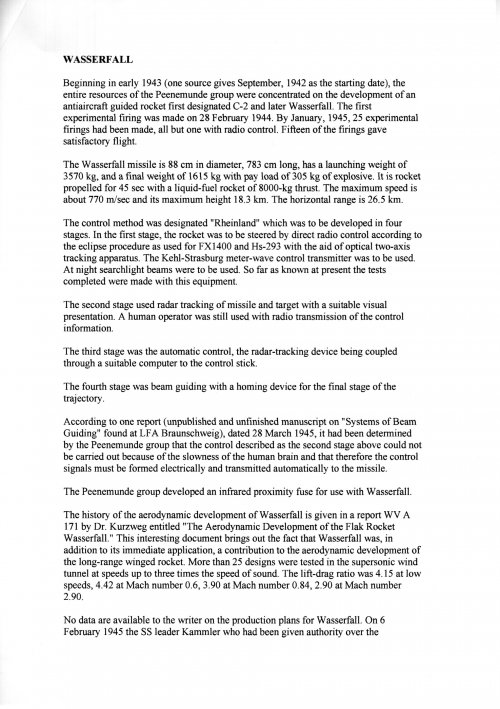
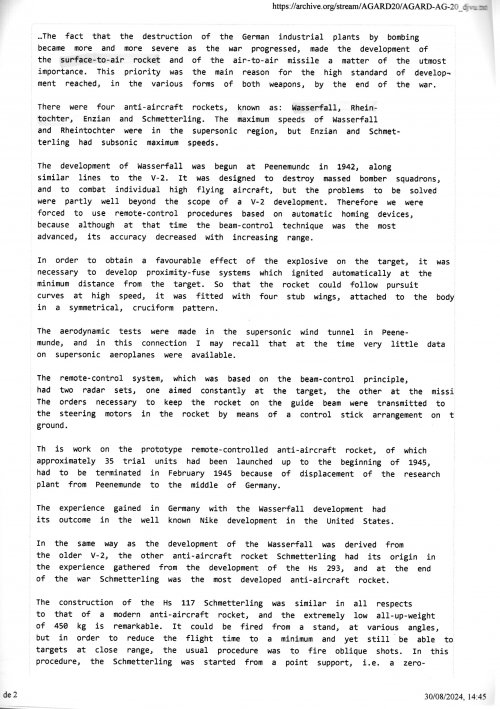
About twenty-five wind tunnel models, with six different aerodynamic configurations, were tested at speeds up to Mach 3.0.
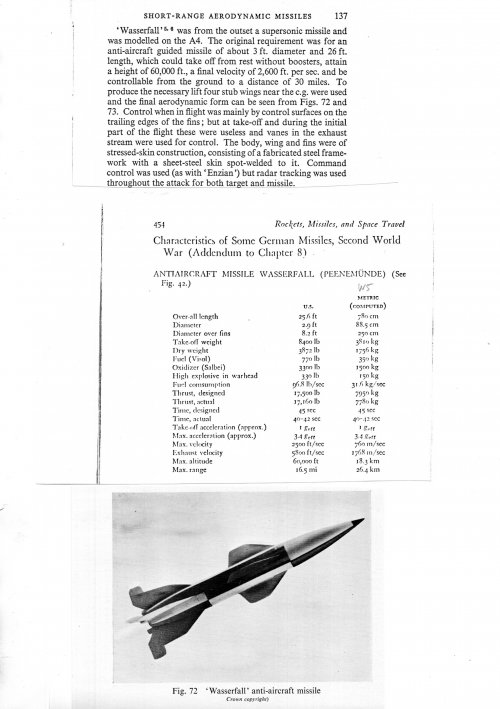
The original requirement was for an anti-aircraft guided rocket of about 900-mm of diameter and 8,000-mm length, which could take-off without boosters, attain 18,000 m of altitude and 800 m/sec speed.
In February 1943 the project was accepted by the OKL under the codename
Wasserfall.
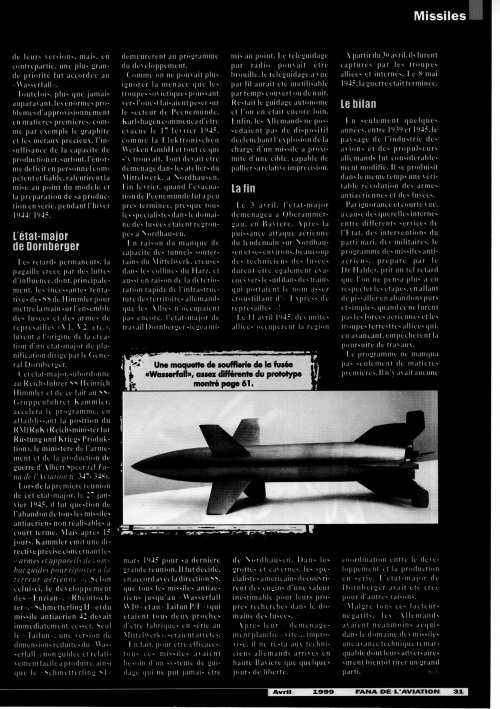
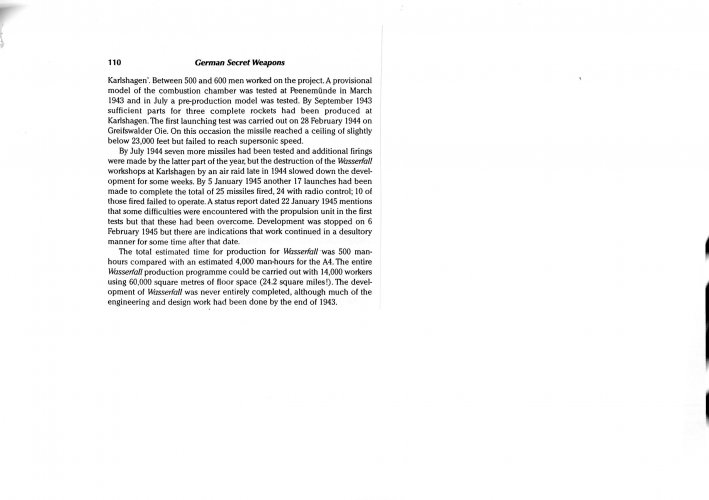
Two prototypes of the W-1 Series were built at the Peenemünde facilities early in 1944.
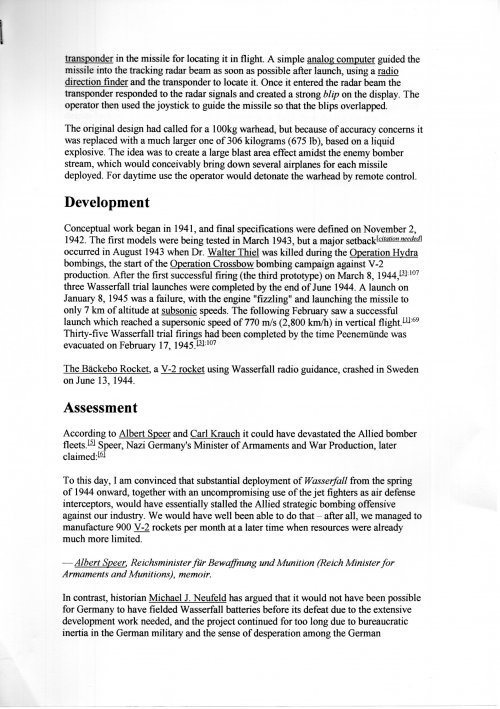
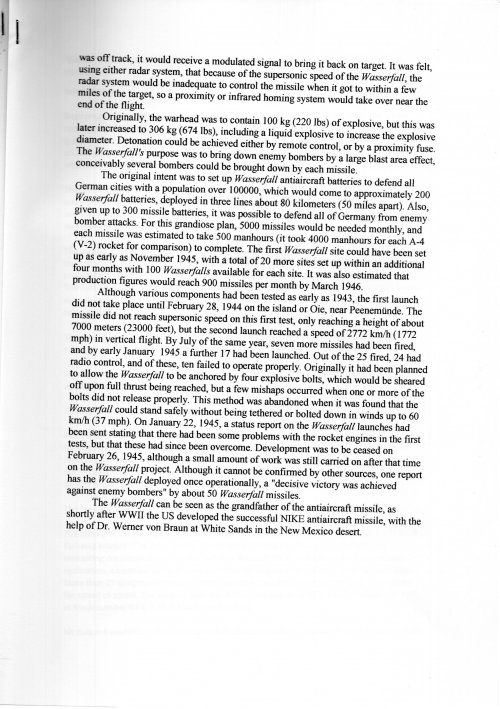
The first launch test was performed on February 28,1944 at Greifswalder Oie. The prototype was flown at subsonic speed reaching only 7,000 meters altitude, but the second missile reached 2,272 km/h on March 8,1944.
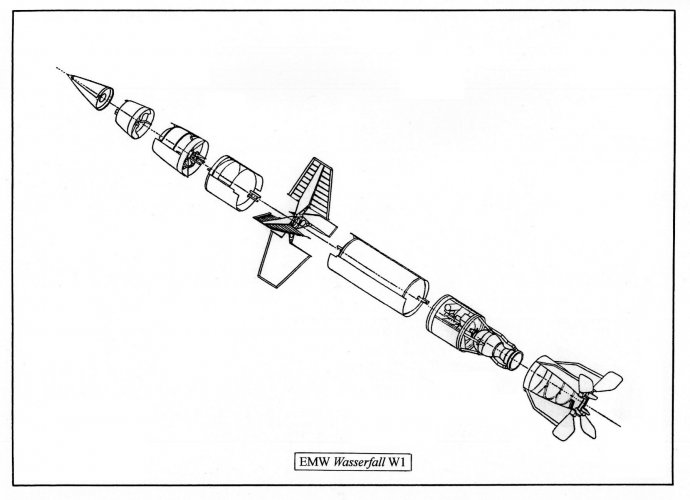
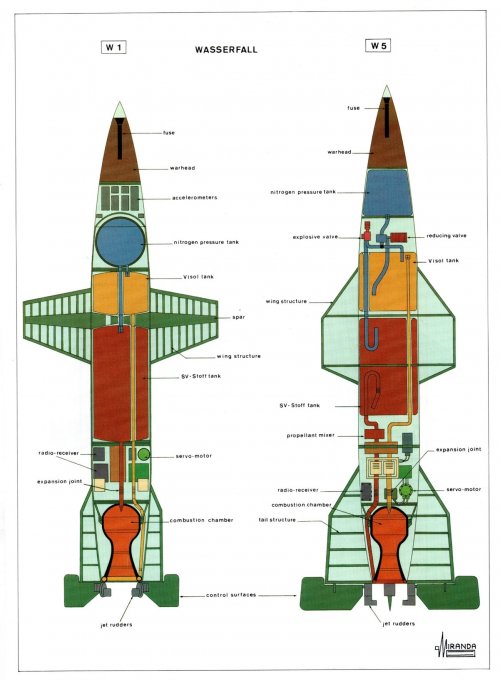
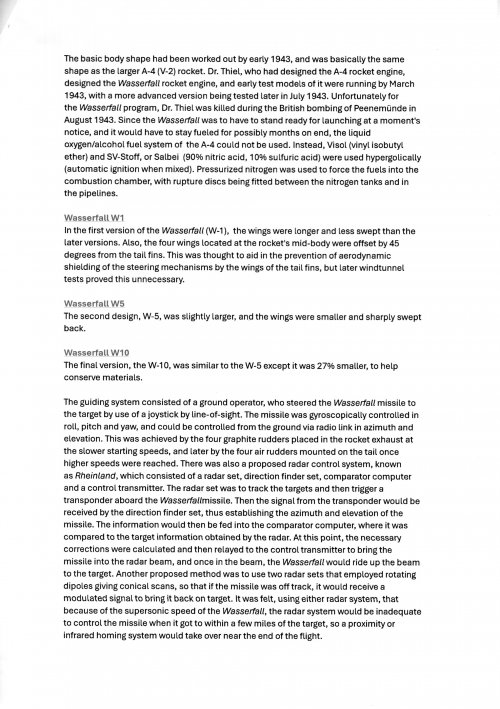
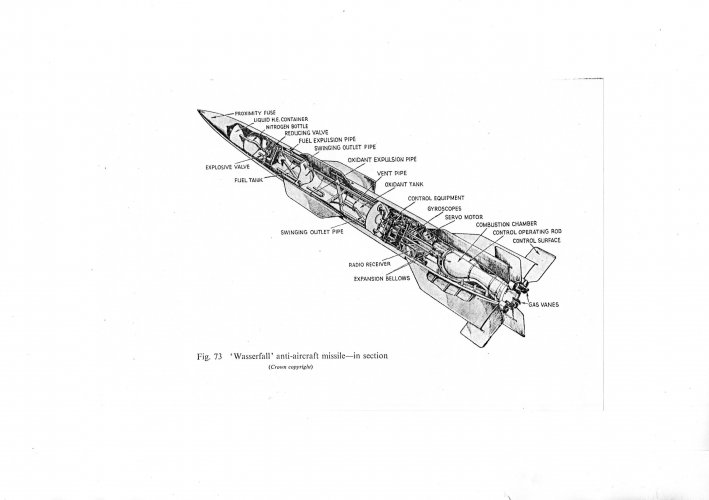
W-1 was built from mild steel, the body, wings and fins were of stressed skin construction consisting of a steel framework with a sheet-steel skin spot welded to it.
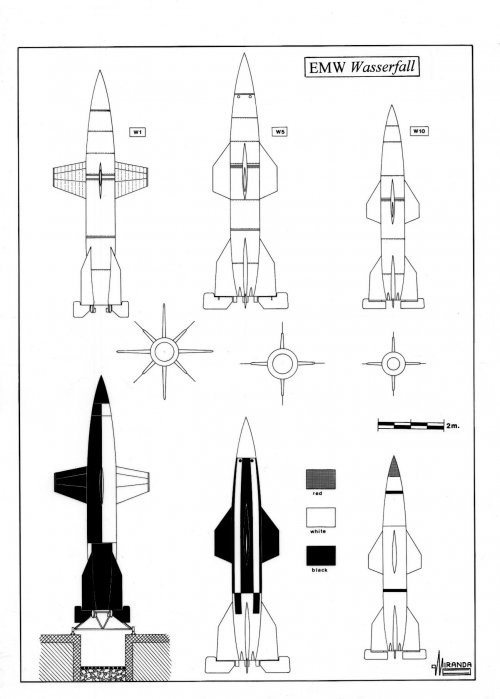
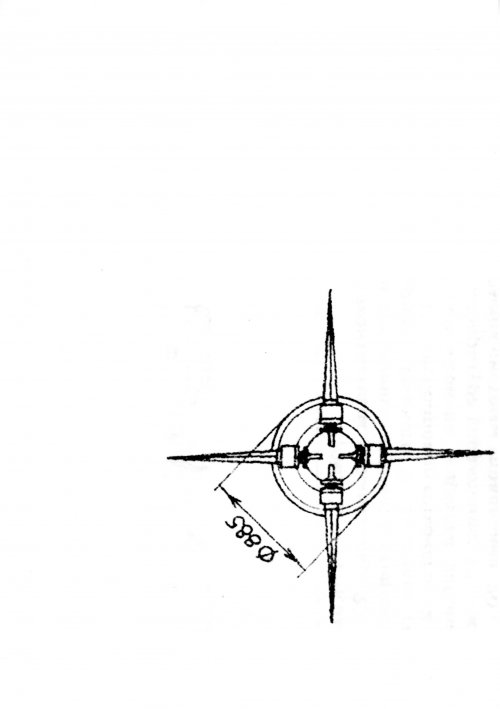
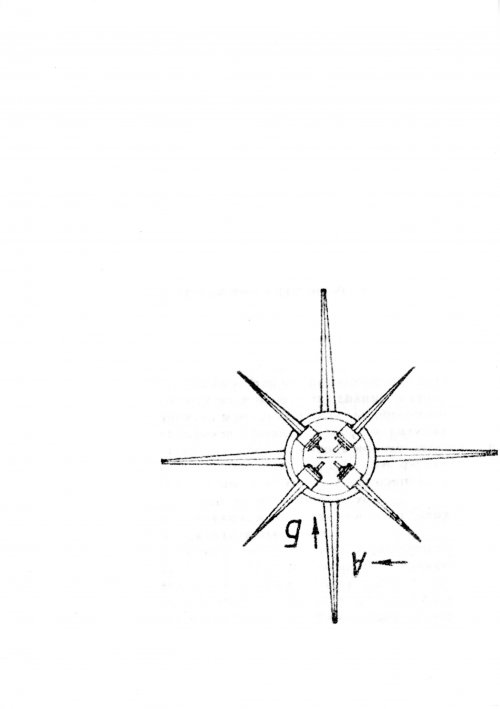
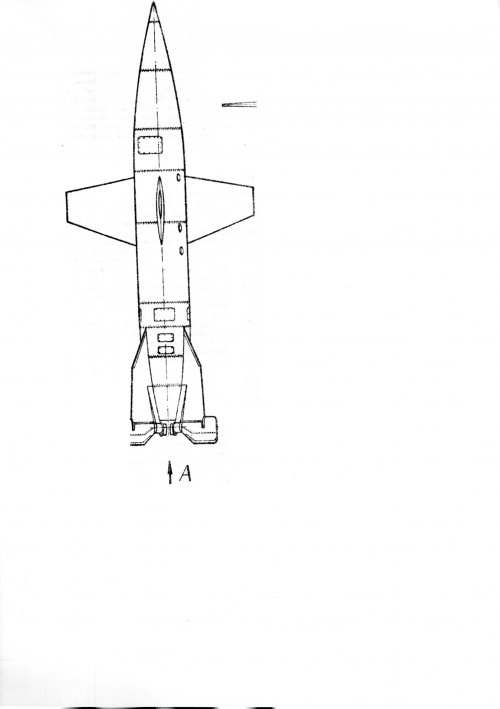
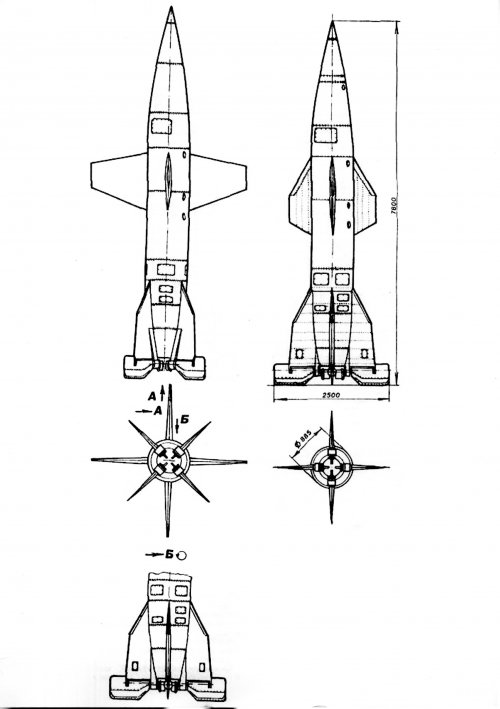
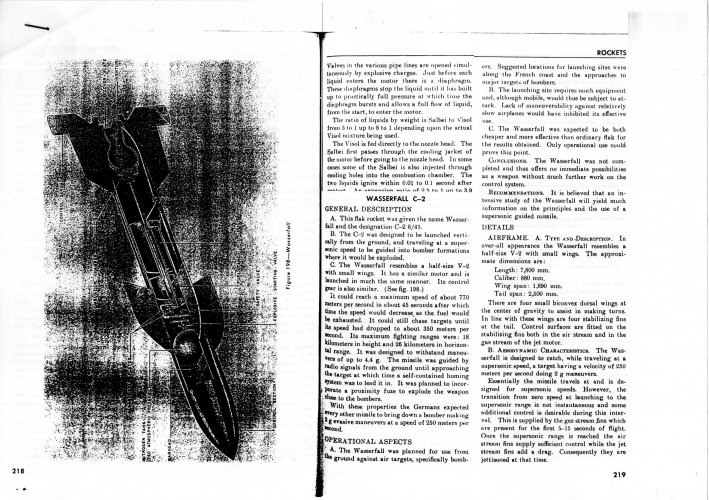
It was fitted with four biconvex wings to assist in making high-altitude pursuit curves at high speed and 4.4 g.
The W-1 was designed to intercept lone
Spitfire and
Mosquito reconnaissance aircraft that proved very difficult to shoot down by conventional
Luftwaffe fighters. To increase maneuverability at high altitude the wings were mounted offset by 45-degrees from the tail fins.
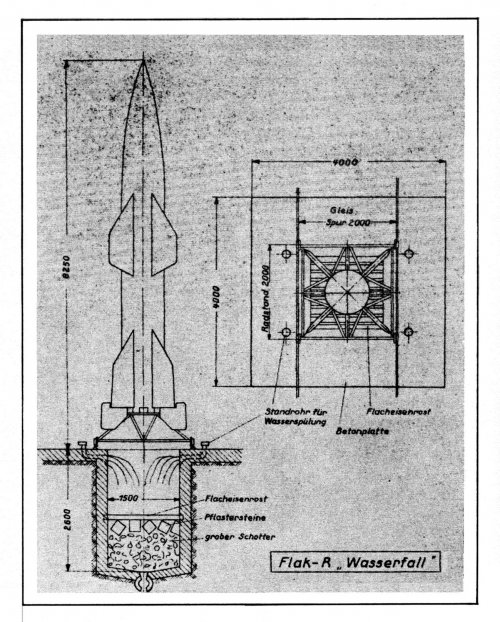
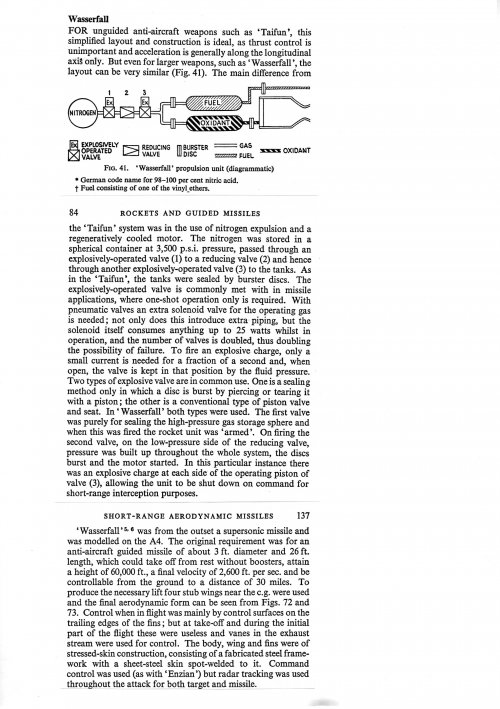
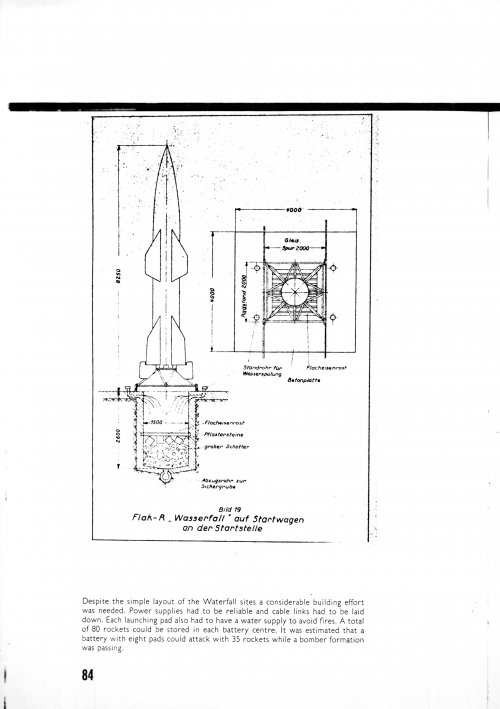
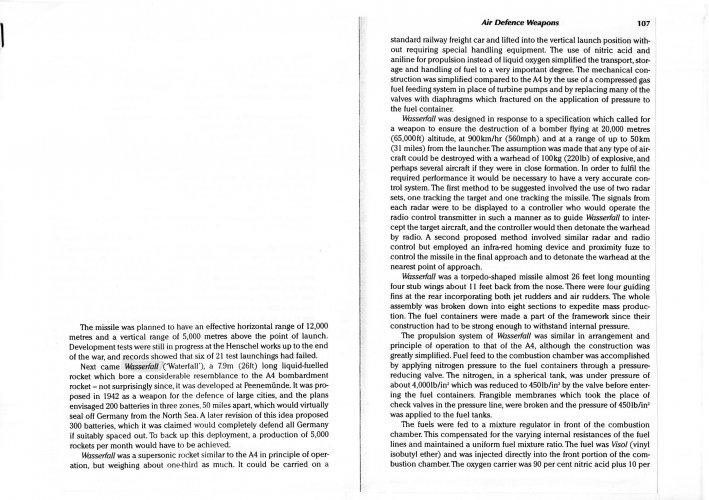
Wasserfall was launched at 22 m/sec in vertical position, like a V-2.
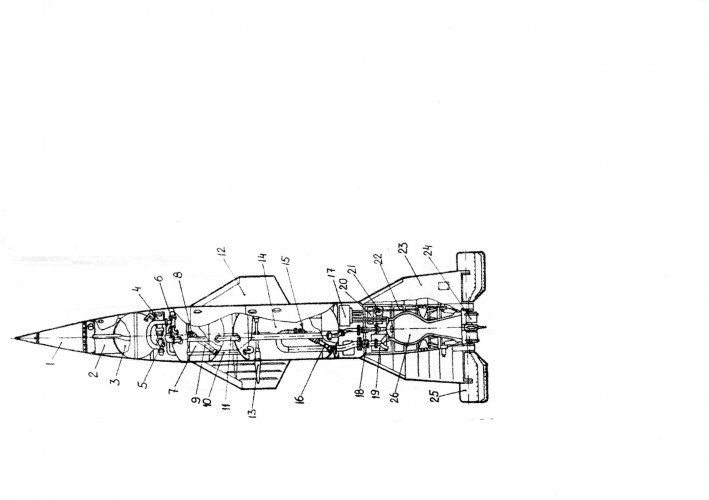
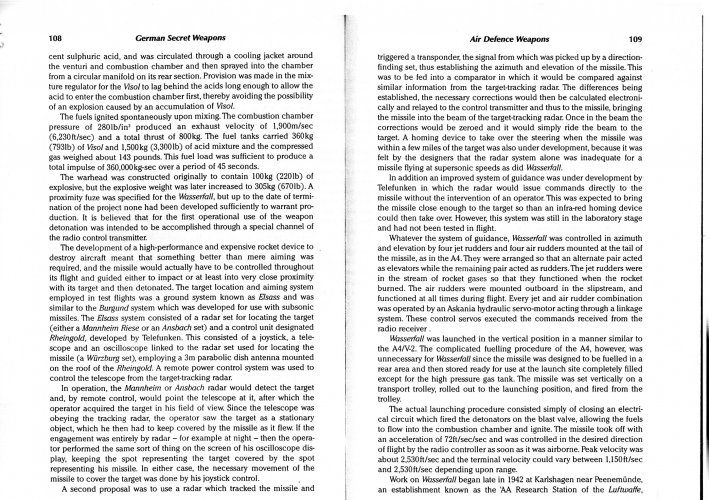
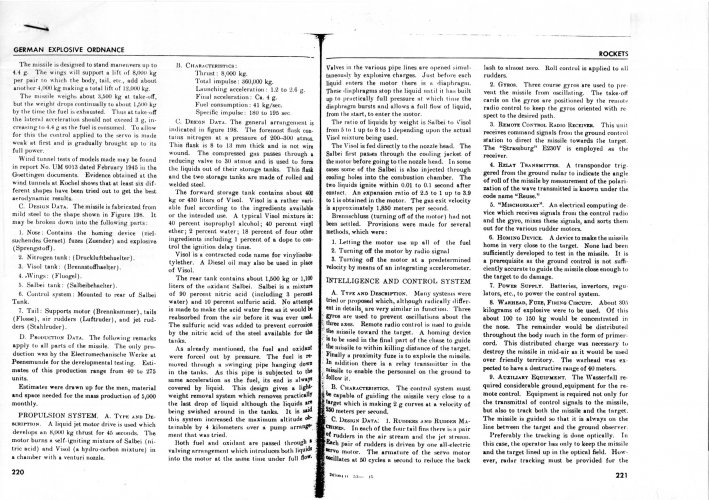
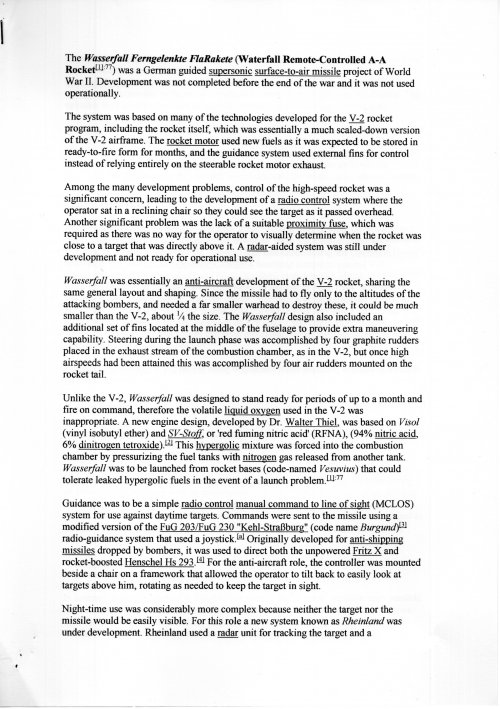
During take-off the missile was controlled by a three-axes gyro auto-pilot driving four detachable jet rudders mounted into the rocket nozzle. During the flight, control was achieved by means of four air rudders mounted in the tailfins. All the control rudders were operated by four Askania hydraulic servo motors.
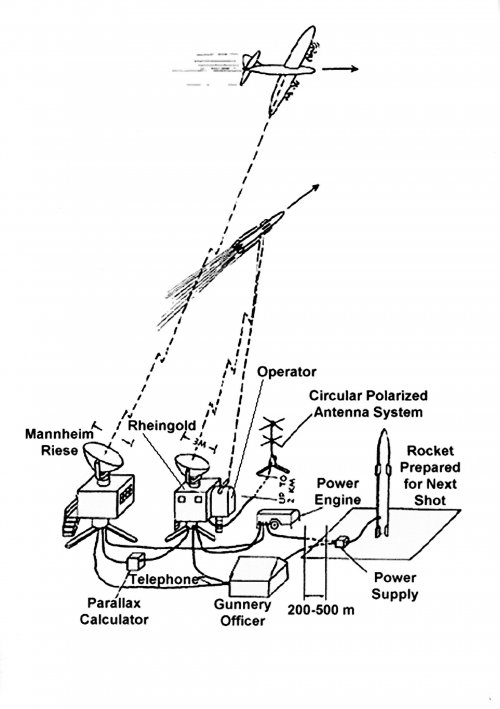
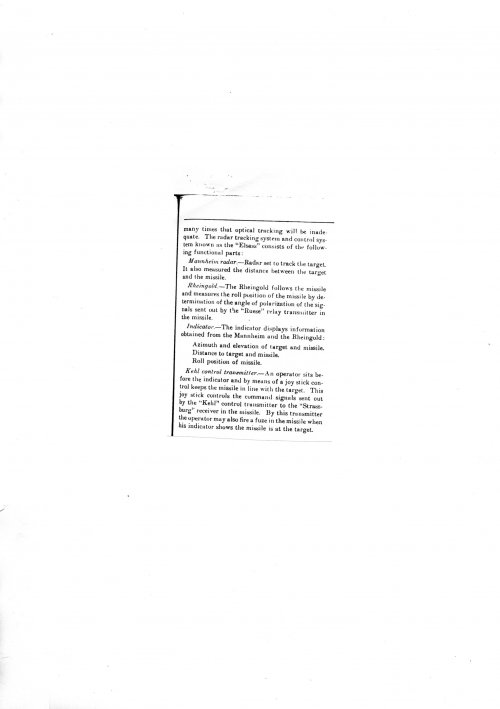
Radio-control commands were sent to the missile by means of the
Burgund MCLOS system, a modified version of the
Kehl/Strassburg control.
EMW
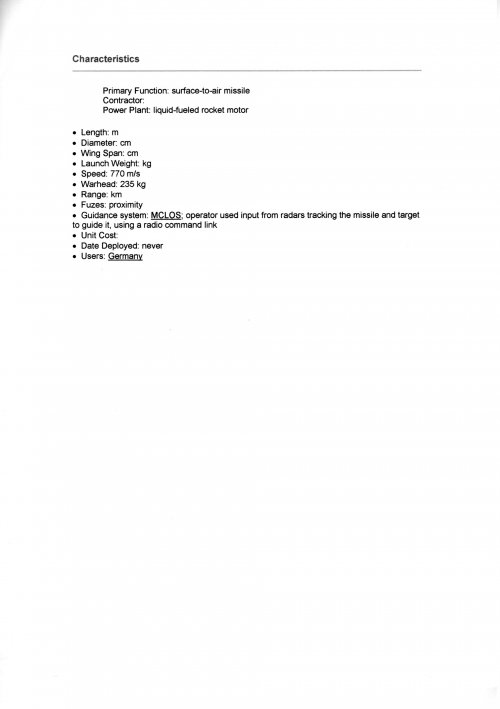
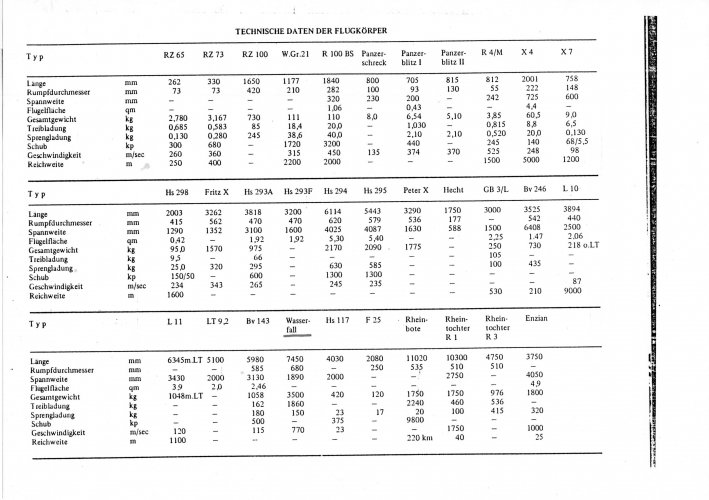
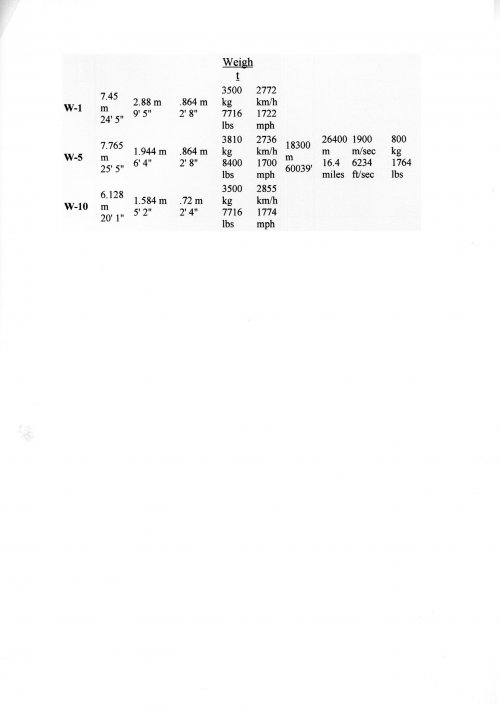
Wasserfall W-1 technical data
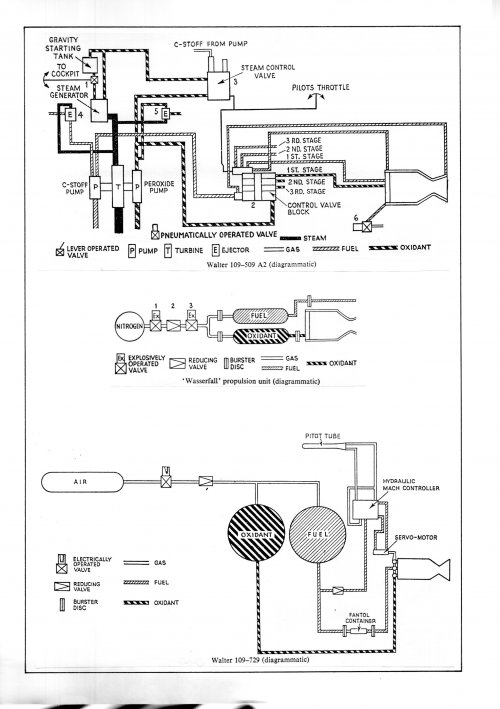
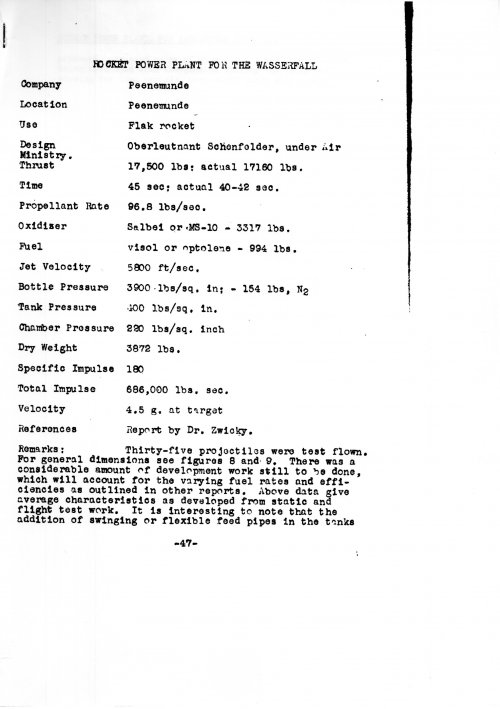
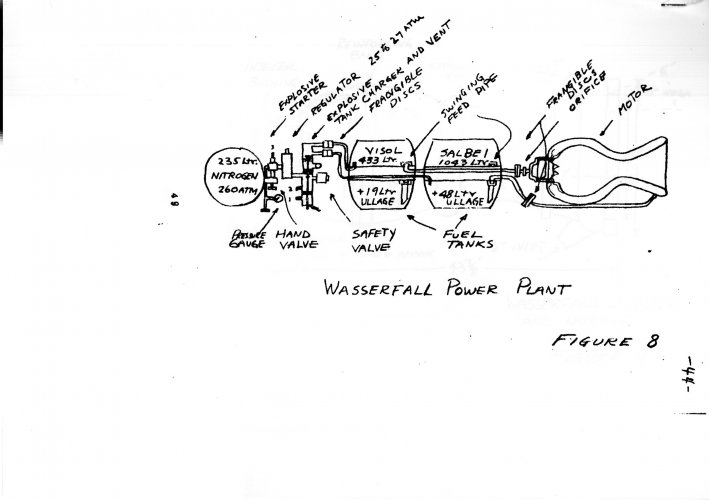
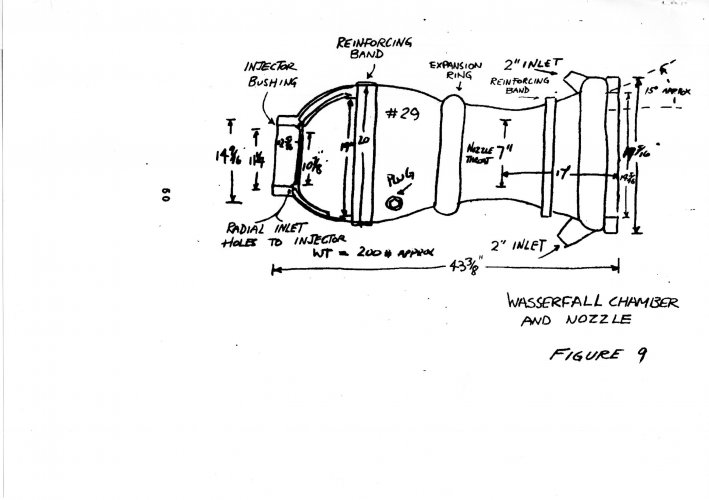
Wingspan: 2,880-mm, length: 7,450-mm, diameter: 864-mm, weight: 3,570 kg, speed: 2,772 km/h, service ceiling: 7,000 m, range: 12 to 18 km, warhead: 150 kg with 40 m lethal radius, power plant: one by-propellant rocket engine EMW, developed by Dr. Thiel and
Oberleutnant Schönfelder, with 7,780 kg peak thrust and 45 seconds life, propellants: SV-
Stoff +
Visol + compressed nitrogen.
A second development was underway in April 1944.
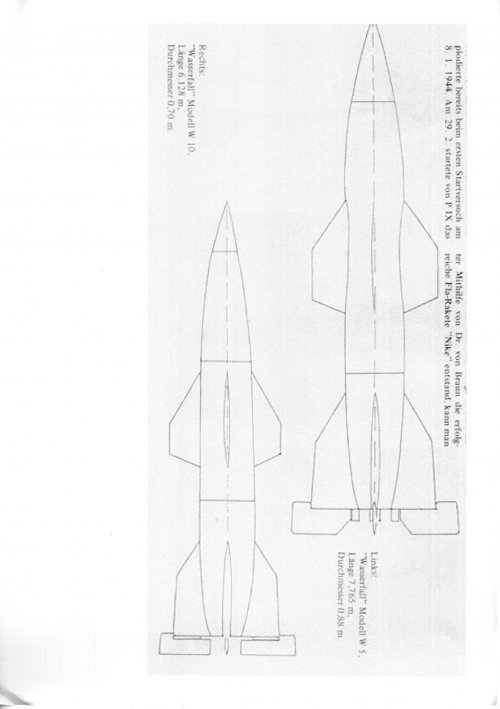
The W-5 was designed as
Pulkzerstörer weapon against U.S. bomber formations, it was slightly larger than the W-1 and its wings were smaller and sharply back.
The beam-control accuracy of
Burgund decreased with extended range, in the production version it was expected to be able to use the most advanced
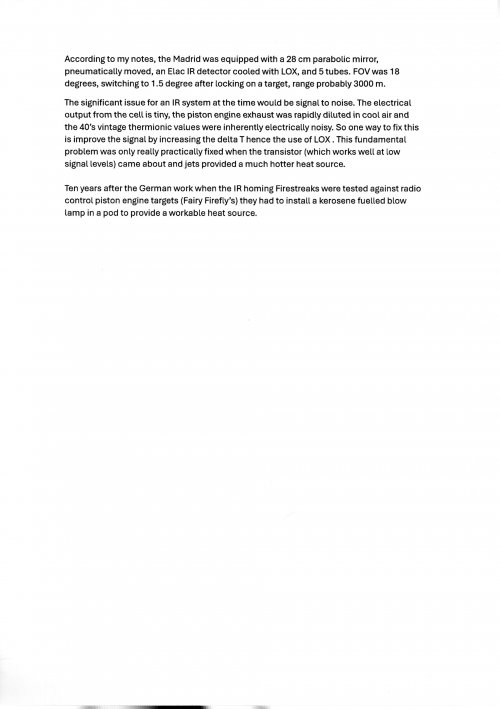
Rheinland automatic control system and the IR terminal seeker
Madrid.
Using
Rheinland the missile would ride up the beam to the target. The new system did not require visual tracking and could also be used at night against British bombers.
In early 1945 the
Luftwaffe planned to deploy the
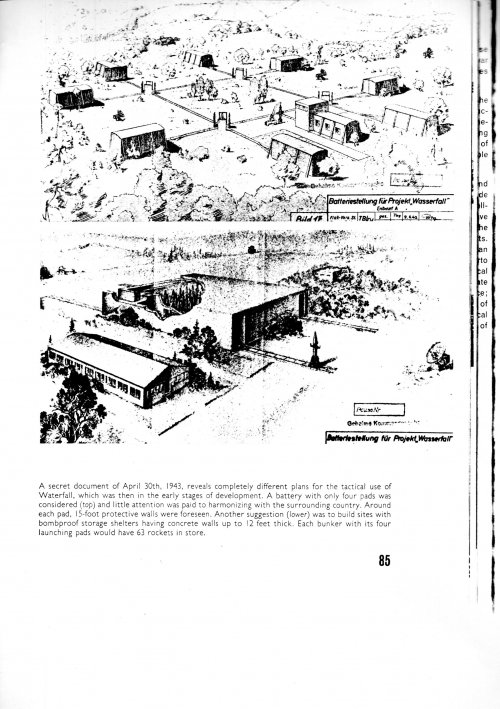
Wasserfall at 2,000
Vesubius Flakbatteries with 35 launch pads each.
The production rate expected from November 1945 was 5,000 missiles per month, but only 35 prototypes were built and flight tested.
EMW
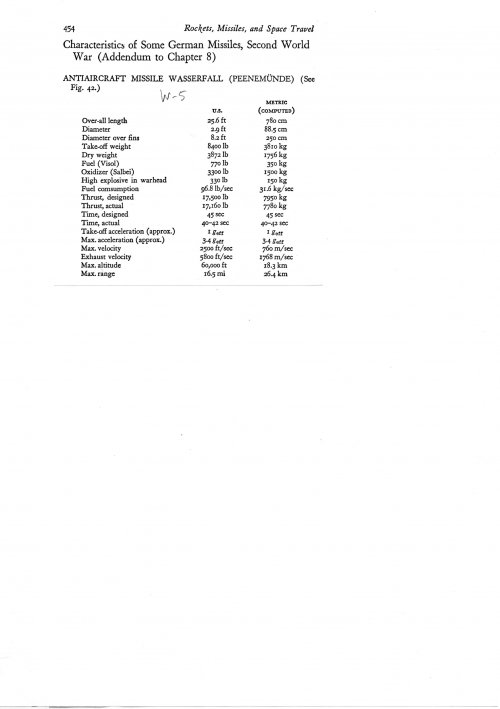
Wasserfall W-5 technical data
Wingspan: 1,980-mm, length: 7,765-mm, diameter: 885-mm, weight: 3,810 kg, speed: 2,736 km/h, service ceiling: 18,300 m, range: 26.4 km, warhead: 235 kg, power plant: one by-propellant rocket engine EMW, with 7,950 kg peak thrust and 45 seconds life, propellants: 770 kg of SV-
Stoff + 1,500 kg of
Visol + compressed nitrogen.
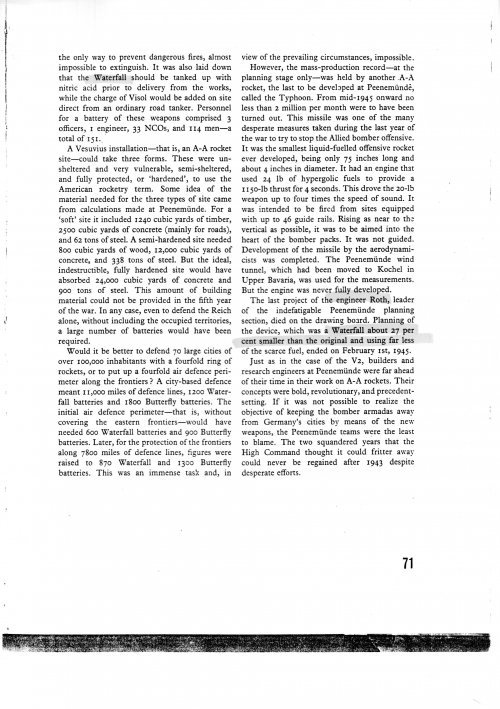
The W-10 was designed in January 1945 by Dipl. Ing. Roth as cheap 27 per cent scaled down W-5, using far less fuel. Roth estimated that it was not necessary to use much fuel to reach 18 km altitude when most enemy bombers routinely flew at altitudes of 7,000 to 8,000 meters. W-10 was also designed as
Pulkzerstörer with one powerful warhead.
EMW
Wasserfall W-10 technical data
Wingspan: 1,584-mm, length: 6,128-mm, diameter: 720-mm, weight: 3,500 kg, speed: 2,855 km/h, service ceiling: 8,000 m, range: 18 km, warhead: 305 kg of liquid explosive, power plant: one by-propellant rocket engine EMW, with 7,950 kg peak thrust and 45 seconds life, propellants: SV-
Stoff +
Tonka Optolin + compressed nitrogen.
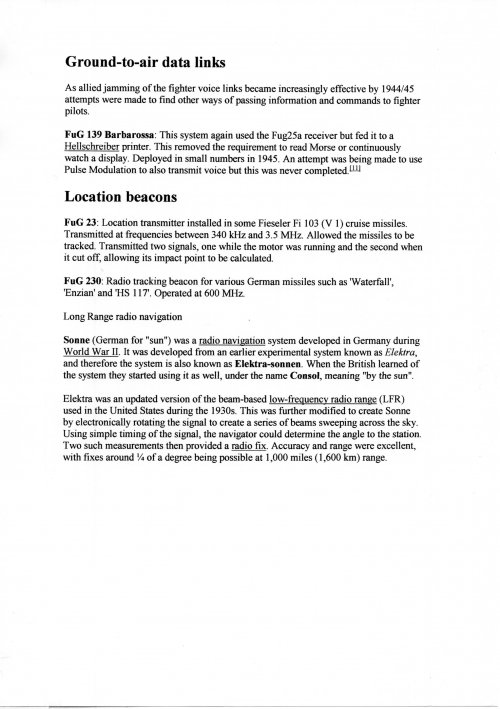
Project cancelled on February 26, 1945.




 .
.

