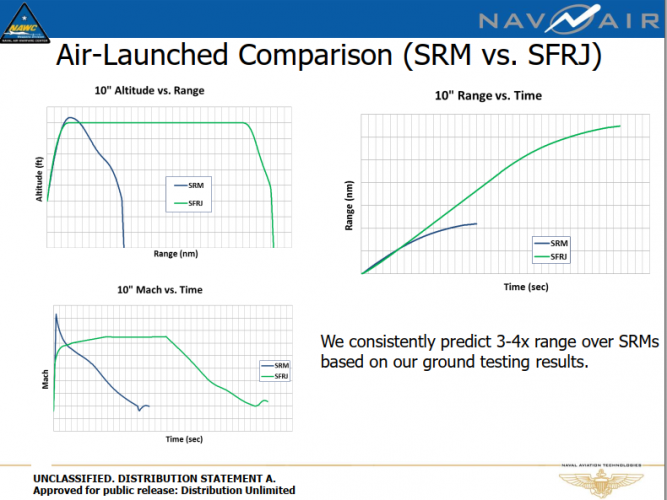
The PL-15, for example, has a higher top speed than the Meteor and also a longer maximum range. Apparently, Ramjets also bleed energy much faster once they burn out. The Meteor barely outranges the latest AMRAAMs despite being considerably bigger.
The existence of VLO aircraft means time-to-target and agility at shorter distances are more important.
Dunno where you've found that the meteor would have a limited speed compared to the last AMRAAM versions.Modern AAMs fly very parabolic BM-like trajectories. A high-speed low-drag rocket is going to achieve a longer range than a ramjet-powered missile in such a trajectory. Ramjet missiles have a lot of energy but they are too limited in speed. They give too much time to the opposing fighter to realise it is getting attacked, fire back and then u-turn. This is especially critical between stealth aircraft because the engagements are expected to happen within a few dozen kilometres.
The Meteor would be a beast if air combat stayed in the 1990s, but China and the U.S. progressed way beyond that.
They both are listed as "Mach 4" in all sources I check, with the Meteor having a slight edge in sustained speed during cruise due to its ramjet (throttleable) propulsion.
As the PL-15, while specific maximum speed data is not explicitly stated in available sources, the PL-15 is often described as having performance comparable or slightly superior to the Meteor in terms of range and maneuverability (I suppose from Chineses sources...). However, no reliable data confirms a speed exceeding Mach 4 for the PL-15.
The Meteor and AIM-120D AMRAAM have very similar maximum speeds (Mach 4 to Mach 4+). The PL-15, while highly capable in range and technology, is not documented as exceeding Mach 4. Overall, the three missiles are broadly comparable in maximum speed.
Unless you have precise inside sources, no one can say here which missile type is faster than the other, cause these infos are simply not open sources, they are all "Mach 4+...".
Last edited: