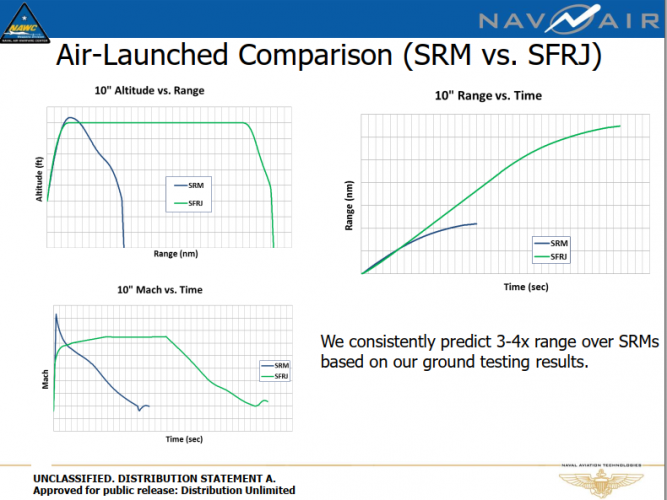
The PL-15, for example, has a higher top speed than the Meteor and also a longer maximum range. Apparently, Ramjets also bleed energy much faster once they burn out. The Meteor barely outranges the latest AMRAAMs despite being considerably bigger.

The existence of VLO aircraft means time-to-target and agility at shorter distances are more important.
Modern AAMs fly very parabolic BM-like trajectories. A high-speed low-drag rocket is going to achieve a longer range than a ramjet-powered missile in such a trajectory. Ramjet missiles have a lot of energy but they are too limited in speed. They give too much time to the opposing fighter to realise it is getting attacked, fire back and then u-turn. This is especially critical between stealth aircraft because the engagements are expected to happen within a few dozen kilometres.

The Meteor would be a beast if air combat stayed in the 1990s, but China and the U.S. progressed way beyond that.
Dunno where you've found that the meteor would have a limited speed compared to the last AMRAAM versions.
They both are listed as "Mach 4" in all sources I check, with the Meteor having a slight edge in sustained speed during cruise due to its ramjet (throttleable) propulsion.
As the PL-15, while specific maximum speed data is not explicitly stated in available sources, the PL-15 is often described as having performance comparable or slightly superior to the Meteor in terms of range and maneuverability (I suppose from Chineses sources...). However, no reliable data confirms a speed exceeding Mach 4 for the PL-15.
The Meteor and AIM-120D AMRAAM have very similar maximum speeds (Mach 4 to Mach 4+). The PL-15, while highly capable in range and technology, is not documented as exceeding Mach 4. Overall, the three missiles are broadly comparable in maximum speed.
Unless you have precise inside sources, no one can say here which missile type is faster than the other, cause these infos are simply not open sources, they are all "Mach 4+...".
 
Last edited:
Then the Americans can throw in the AIM-260 to sweeten the deal.
Yeah. In around 10 years from now on...

"The government has confirmed that integration of the MBDA Meteor air-to-air missile with the F-35B remains on an early 2030s timeline, with Minister Luke Pollard telling parliament on 20 April that “integration testing continues and the estimated timeline for in-service capability remains the early 2030s”, adding that the work is driven by the US-led Lightning II Joint Programme Office."

"The structural reason for that is the F-35’s Block 4 software upgrade, which is a prerequisite for integrating any new weapons including both Meteor and SPEAR 3 and which has itself run significantly late and over budget, having risen from an original cost estimate of $10.6 billion to around $16.5 billion with completion now anticipated around 2029, and because any weapon integration on the F-35 requires approval and coordination through the US-led Joint Programme Office"

https://sofrep.com/news/secret-aim-260-air-to-air-missile-breaks-cover/

"Newly released documents show the AIM-260 program jumping from $894 million in FY2026 to $2.9 billion in FY2027, a sharp escalation that signals fast-tracking production of this extra-special, air-to-air weapon. The missile itself costs at least $5.8 million, possibly as much as $7 million per copy, so it’s an expensive, “kick-the-door-down” weapon to be used sparingly against high-value targets.

So far, the only export customer is the Royal Australian Air Force, which is due to receive 450 AIM-260s beginning in 2033. In U.S. service, the AIM-260A JATM is expected to arm Air Force and Navy jet fighters primarily in the Indo-Pacific theater of operations and Alaska, keeping a close eye on communist China. Meanwhile, the AIM-120D-3 Slammer will continue to equip fighters in other theaters, and the $1-million AIM-120C-7/C-8 will be produced at lower cost for export customers."

Either way, 10 years. For a capability that the Gripen has right now.
 
Last edited:
Dunno where you've found that the meteor would have a limited speed compared to the last AMRAAM versions.
They both are listed as "Mach 4" in all sources I check, with the Meteor having a slight edge in sustained speed during cruise due to its ramjet (throttleable) propulsion.
As the PL-15, while specific maximum speed data is not explicitly stated in available sources, the PL-15 is often described as having performance comparable or slightly superior to the Meteor in terms of range and maneuverability (I suppose from Chineses sources...). However, no reliable data confirms a speed exceeding Mach 4 for the PL-15.
The Meteor and AIM-120D AMRAAM have very similar maximum speeds (Mach 4 to Mach 4+). The PL-15, while highly capable in range and technology, is not documented as exceeding Mach 4. Overall, the three missiles are broadly comparable in maximum speed.
Unless you have precise inside sources, no one can say here which missile type is faster than the other, cause these infos are simply not open sources, they are all "Mach 4+...".
The PL-15, beeing a Dual-pulsed solid-propellant rocket, accelerates faster, then goes with the cruise speed on the second stage of the rocket engine, and then coasts ballistically on the last part of the trajectory towards the target bleeding speed and energy. A ramjet missile accelerates slower than a rocket missile but then it goes on cruise speed all the way to the target, keeping the energy and capacity to maneuver. So the PL-15 might be faster as maximal speed, but the Meteor will be faster when it arrives on the target.
 
Last edited:
The PL-15, for example, has a higher top speed than the Meteor and also a longer maximum range. Apparently, Ramjets also bleed energy much faster once they burn out. The Meteor barely outranges the latest AMRAAMs despite being considerably bigger.

The existence of VLO aircraft means time-to-target and agility at shorter distances are more important.
↓↓↓↓↓↓↓↓↓↓↓↓↓↓↓↓↓↓↓↓↓↓↓↓↓↓↓↓↓↓↓↓↓↓↓↓↓↓↓↓↓↓↓↓↓↓↓↓↓↓↓↓↓↓↓↓↓↓↓↓↓↓↓
https://www.secretprojects.co.uk/threads/aargm-vfdr-missiles.3411/post-450763
1782200903649.png
 
The F-35 is planned to have the capability to operate Meteor and qualification has begun:
Oh its finally begun? How many years then?
Then the Americans can throw in the AIM-260 to sweeten the deal.
It looks like the Americans would be charging a very sweet price for AIM-260, more likely to be offering deals on AIM-120 while AIM-260 is prioritised for very few customers until production starts on an upgraded version.
 
Another video from Wes O'Donnell concerning the Meteor and its impending deployment to Ukraine:


The METEOR Missile is about to change Ukraine’s air war.
Russia dropped 7,987 glide munitions on Ukraine in March 2026, the highest monthly total of the entire war. The reason it can do that is geometry: Su-34s release from 70 to 100 kilometers behind the front, well outside Ukrainian air defense range, and let JDAM-style kits glide the rest of the way.​
Sweden is about to donate 16 Gripen fighters armed with the Meteor missile, and Zelenskyy stood at the podium and said directly that this combination would push Russian jets out of position so they can't run the tactic anymore.​
In this video: why Meteor's ramjet motor creates a "no-escape zone" that AMRAAM can't match and why threatening the aircraft beats intercepting the munition.​
 
They both are listed as "Mach 4" in all sources I check, with the Meteor having a slight edge in sustained speed during cruise due to its ramjet (throttleable) propulsion.
Most MRAAMs(and AAMs) are ~"mach 4", this number more or less meaning highest point they're meant to reach around engine burnout in optimal conditions.

Going higher, especially for prolonged periods of time, requires very different materials and solutions from thermal perspective. Or missile will just cook itself, which is suboptimal.

Only a couple normal air to air missiles really went well over M=4, both from 1980s, when it was tactically advantageous during SARH era. That being R-27(especially E series) and matra 530D.
The PL-15, beeing a Dual-pulsed solid-propellant rocket, accelerates faster, then goes with the cruise speed on the second sttage of the rocket engine, and then coasts ballisticaly on the last part of the trajectory towards the target bleeding speed and energy. A ramjet missile accelerates slower than a rocket missile but than it goes on cruise speed all the way to the target, keepeing the energy and capacity to maneuver. So the PL-15 might be faster as maximal speed, but the Meteor will be faster when it arrives on the target.
Ugh, corrections police.

Dual pulse is not the same as boost-sustain(which you've described; boost sustain is AMRAAM, as well as most historical long range AAMs).
It's broadly the fastest type for significant part of the trajectory.

Dual pulse is two equal powerful/short boosts with controlled ignition of the second pulse. Which means, until the end of effect of second pulse, dual pulse missile will generally be faster and can expect higher endgame speed than meteor, unless target is being highly annoying and uncooperative.

On the other hand, meteor first stage is the very same SRF, placed within ramjet duct. As such, meteor accelerates just as fast.
 
Last edited:
Execution!
giphy_s.gif


Jokes aside, Meteor is part of EU fighters suit, rn it just isn't integrated anywhere else (and it isn't integrated into Rafale all that well in any case).
Bolting it to F-16 is sort of commercial suicide for Eu nations. Maybe Rafale will survive, but for Gripen and Eurofighter it will be a deathblow.
What is the problem with Rafale?
A config with 4 Meteor is in the pipe.
The dual sens data link already integrated.
so ?
 
The latest Block 3 JF-17 has a Chinese developed AESA radar which is capable of guiding the PL-15 BVR missile so it is equal to the Rafale but do not know about the Su-30.
JF-17 radar is air cooled, so not as powerfull as expected.

And what about the T/R modules quality ?
I remember the RBE2 AESA prototyp (called RBE2-AA) developped in 2004+
it was made of US T/R modules... and shown only 25% increase in range over PESA. It was deceiptfull, but with no european alternative so far. It was so deceiptull that when UAE ask for an AESA radar Rafale in 2008-2010 a new cooling system was studied so as to boost the antenna from 9,6 to 13kw so as to be on par with F16-60 of UAE. It was an mess.
Reality was that USA gave us low quality modules (sweet dear ally...). Once a european solution was on the market, the 9,6Kw AESA antenna was able to increase the range by 100% over PESA.

So what about the chinese T/R modules quality ?
 
J-10ce one is substantially bigger than Rafale rbe; no hard data to compare tech.

Bars is surely bigger, but judging by unhappy noises from Russia, India didn't even do software/backend upgrades.
BARS is PESA, so by construction less potent for the same antenna size.
 
Probably just replace the seeker. The Meteor was originally a compromise project that joined a revolutionary motor with an existing, not that amazing seeker. It's about time to put a new on in it's place.
Seems it's not only a seeker question, but something else. what? I don't know.
 
Errr...you want to check that claim? The F-35 is planned to have the capability to operate Meteor and qualification has begun:
it has begun. as F136 engine work had began with a dead end.
most interesting is when it will end.
It already has been pushed back.
And now AIM260 is arriving....
 
PL15 is a size class above Meteor, it isn't nicknamed the telegraph pole for nothing.

Meteor
Mass 190kg
Range 120-200km
Diameter 17.8cm
Length 3.65m
volume ~111.8 sqm

PL15
Mass 250kg (210kg export)
Range 180-300km* (145km export)
Diameter 20.3cm
Length 3.996m
Volume ~129.3 sqm

*claimed, export version which can be independently evaluated is same dimensions but notably lighter and shorter ranged.
 
Last edited:
Most MRAAMs(and AAMs) are ~"mach 4", this number more or less meaning highest point they're meant to reach around engine burnout in optimal conditions.

Going higher, especially for prolonged periods of time, requires very different materials and solutions from thermal perspective. Or missile will just cook itself, which is suboptimal.

Only a couple normal air to air missiles really went well over M=4, both from 1980s, when it was tactically advantageous during SARH era. That being R-27(especially E series) and matra 530D.

Ugh, corrections police.

Dual pulse is not the same as boost-sustain(which you've described; boost sustain is AMRAAM, as well as most historical long range AAMs).
It's broadly the fastest type for significant part of the trajectory.

Dual pulse is two equal powerful/short boosts with controlled ignition of the second pulse. Which means, until the end of effect of second pulse, dual pulse missile will generally be faster and can expect higher endgame speed than meteor, unless target is being highly annoying and uncooperative.

On the other hand, meteor first stage is the very same SRF, placed within ramjet duct. As such, meteor accelerates just as fast.
My bad. But it still means that between the initial and the final phase the PL-15 missile coasts ballistically on it`s own inertia.
https://cat-uxo.com/explosive-hazards/missiles/pl-15-missile
 
My bad. But it still means that between the initial and the final phase the PL-15 missile coasts ballistically on it`s own inertia.
https://cat-uxo.com/explosive-hazards/missiles/pl-15-missile
Yes, it does. But broadly, unless missile is forced to maneuver violently enough, or flies through dense air, energy bleed is relatively spow.
Though yes, off 3 types, dual boost is perhaps the slowest TOT missile in the broad sense.

Meteor, thanks to ducts, has a lot of drag, but it also have lots of specific impulse (aka it can produce given thrust off given volume of fuel for very long, and that's without accounting for oxidizer).

Overall, it (should, per my understanding; note that until war thunder introduces meteor we won't see true curves) result in a powered cruise, which is finding balance between optimal thrust and drag. Usually for other ramjet weapons it's something like M=2.5...2.7; Likely here it is as well.

As such, it'll mean meteor isn't especially fast (probably slower than boost-sustain for large part of the trajectory), nor it's incredibly long ranged. But it isn't overly impaired at close range, and it can relatively freely react to any attempts by target to bleed off it's energy, being able to afford more aggressive intercept trajectories. = very high "NEZ" in the actual meaning of this term.
 
I have no sources of my own about this, but this reports a "senior officer" saying that METEOR Mid Life Upgrade is getting cut as well. We'll need to clarify what that exactly implies.

The recent French military planning law revealed work on the so called "COMET" to produce not an MLU but a "replacement" already by 2030.

Is the UK going that way too? And how should we read that? It doesn't exactly sound like a vote of confidence in METEOR, which is still young.

View: https://x.com/Gabriel64869839/status/2072605360133722480
 
Ok so is this a move to accelerate next generation long-range AAM, rather than upgrade Meteor?

A positive interpretation is to fully exploit new technologies, a new design is needed.

The negative is to cut today for 'jam' tomorrow that can be put off further into the future.
 
I would rather have a brand new missile other than upgrading the Meteor as it would cost just as much again to upgrade the Meteor.
 
I would rather have a brand new missile other than upgrading the Meteor as it would cost just as much again to upgrade the Meteor.
Exactly and if next generation has to be much longer ranged to meet American and Chinese developments. Meteor's design would balloon in size to achieve it.
 
Couldn't one make both a common european project?
Make 2 Funds and let everyone who's interrested pay for the intended missile? With this we probaly easily get funding for both across the board
 
Quite Zen bettter with a 450Km long ranged missile than something like the Meteor or we will just be left behind in the long range stakes, also having a single long ranged european missile program would be better still as it would work better than having multiple missiles kqcke for you much like what happened with the Meteor which originally started as an RAF Air Staff Target back in the 1990s.
 
450km means an aircraft flying over Stockholm can hit a aircraft flying over Helsinki.
Or London to Paris.
 
450km means an aircraft flying over Stockholm can hit a aircraft flying over Helsinki.
Or London to Paris.
I doubt they mean navigational range.
Usually these numbers are for suicidal cooperative targets.
Which isn't necessary impractical, as we saw in Sindoor; it just is not a map range, and making it so will take an aim-174/pl-17.
 
I was thinking about it being an Anti-AWACS missile, so something like the R-37 which has a range of 400Km.
 
I was thinking about it being an Anti-AWACS missile, so something like the R-37 which has a range of 400Km.
R-37m has its>400km against cooperative target*, when launched by mig-31 from H=21 and M=2.8. With such launch, it turns into a mad M7 comet.
For example, Su-35s can't launch nowhere as far even against an incoming civilian jet, other than in a stunt.

*400km at the moment of launch, and target happily flies to the best of it's ability to meet it's demise.

Navigational range will be significantly more modest, even more so if launcher isn't mig-31, but a loitering flanker instead. For example, recent mig-29 hit(if it indeed was a r-37m) at 190km true(navigational!) range is already highly unusual.
Hard to tell what happened exactly, but maybe Ukrainian pilot was already sure he's in safety, and bad luck intervened.

Similarly, in recent Sindoor clash, Pakistani J-10s apparently launched from 190km against heavily laden Rafales with SCALPs(RCS!), which just weren't expecting to be under fire.
As a result, as they went to their launch line, they were exactly dream "cooperative targets".
But PL-15s didn't have to fly 190km. Target helped, significantly.
 
Last edited:
A Stratus RS for the air to air role?
Yep, it's meant to be used against high value aerial targets (like AWACS), much like the American's idea for a 1000 NM air-to-air "ballistic" missile. I find it very interesting to see what MBDA settles on with Aquila; they're both testing ramjet propulsion for hypersonic defense and traditional rocket propulsion too - if MBDA settles on ramjets for Aquila then I also expect future MBDA general purpose AAMs to go this way instead of what other competitors (AIM-260, PL-17 over PL-21 etc), since hypersonic defense is a much harder air-to-air envelope than traditional air-to-air combat. It'll really signal how confident MBDA is in their ramjets. If the Meteor MLU is getting gutted, then it could signal that some new AAMs are on the horizon very soon.
 
PL15 is a size class above Meteor, it isn't nicknamed the telegraph pole for nothing.

Meteor
Mass 190kg
Range 120-200km
Diameter 17.8cm
Length 3.65m
volume ~111.8 sqm

PL15
Mass 250kg (210kg export)
Range 180-300km* (145km export)
Diameter 20.3cm
Length 3.996m
Volume ~129.3 sqm

*claimed, export version which can be independently evaluated is same dimensions but notably lighter and shorter ranged.
Meteor only carries its fuel. Oxidizer is free as taken in the air.
So it can be more potent than a classical missile, heavier, with powder engine.
 
Some info from a french journalist which seems to confirm that FASE ≠ Comète ≠ Meteor MLU :

The UK reportedly cannot afford to fund both the Meteor MLU and the Franco-british FASE successor.
As a result, the British have reportedly made the "courageous" decision to prioritize funding the new programs, notably those being developed in cooperation with France. (also Stratus)

On the French side, the UK decision not to pursue a Meteor MLU suits France which also prefers to focus on FASE
Now rather than carrying out a Meteor MLU (which would have been long and difficult to manage across six partner nations) and while waiting for FASE (the Meteor successor) the proposed stopgap for France is Comète.
What Comète actually is remains unknown… but he speculates it could be a deeply derived version of MICA, possibly incorporating technologies from Aster or other missiles.

The overall picture is urgency and tight budgets.
Multinational missile programs are cumbersome, so the preference is to develop systems nationally or with at most 1 partner.
He also notes that France and the UK appear to be working together particularly well on missiles.


I'll believe it when I see it.
Too good to be real this entry date.
Same, but this was stated again in the latest updated Military Planning Law from june 2026
L’effort portera sur la connectivité et les capacités offensives : un nouveau missile air‑air à très longue portée COMETE sera développé avec pour objectif d’armer le standard F4 dès 2030, le standard F5 s’appuiera sur le missile STRATUS RS de suppression des défenses aériennes adverses et de lutte antinavire pour contrer les stratégies de déni d’accès.​
​
The focus will be on connectivity and offensive capabilities: a new COMETE very-long-range air-to-air missile will be developed with the goal of equipping the F4 standard as early as 2030. The F5 standard will rely on the STRATUS RS missile for the suppression of enemy air defenses (SEAD) and anti-ship warfare, enabling it to counter anti-access (A2/AD) strategies.​
Comète is for Rafale F4, not even F5… they are in a hurry.
 
Last edited:
We should be doing the same thing Forest Green and buy two air-air missiles instead of just one, but at least we are buying a new long range air-air missile to replace Meteor.
 

Similar threads

Back
Top Bottom