
Titus K
ACCESS: Top Secret
- Joined
- 6 September 2025
- Messages
- 840
- Reaction score
- 2,853

On the Meteor successor. The meteor is the reference air to air missile today.
But the Russians and the Chinese have developped missiles of this class and that is why in 2030, France will equip itself with a "comète" missile that will surpass the performance of it's russian and chines counterparts.
I repeat for 2030 : the air to air missile "comète"

French Chief of the Defence Staff today in a hearing … much faster than expected.
Name : Comète or Comet
Probably the new AESA seeker of the MICA-NG (the current meteor also has the MICA seaker i believe)For such a short timeline that can only mean a development of the existing Meteor, or another existing missile...perhaps ideas for the MLU are far advanced....AESA Meteor? That seems nailed on regardless....Dual Mode? 2 stage Meteor with booster/s?
I think first idea kills the entire point. Second one will hit the wall with typhoon and f-35 integration?I was also thinking about a boosted Meteor with a jettisonable first stage similar to an Aster missile ... or maybe simply a lengthened ramjet section ?
Maybe 2 missiles :I think first idea kills the entire point. Second one will hit the wall with typhoon and f-35 integration?
I think first idea kills the entire point. Second one will hit the wall with typhoon and f-35 integration?
Probably just replace the seeker. The Meteor was originally a compromise project that joined a revolutionary motor with an existing, not that amazing seeker. It's about time to put a new on in it's place.For such a short timeline that can only mean a development of the existing Meteor, or another existing missile...perhaps ideas for the MLU are far advanced....AESA Meteor? That seems nailed on regardless....Dual Mode? 2 stage Meteor with booster/s?

Not aware that the specifications of the Meteor seeker (a development of the MBDA T2/AD4A radar seeker family, older variants of it can be found on the "Matra" Mica and original Aster 15/30 missiles) were/are public.Probably just replace the seeker. The Meteor was originally a compromise project that joined a revolutionary motor with an existing, not that amazing seeker. It's about time to put a new on in it's place.
Maybe 2 missiles :
- Meteor MLU with the new seaker but keeping the same size for the Typhoon center stations / F-35 weapons bay / KF-21
- Comet with the new seaker and either a lengthened ramjet or a booster stage, for underwing stations (Typhoon/Rafale)
If we're fitting a new sensor in the Comet, we might aswell retrofit them into existing Meteor as an MLU.I don't think so. I doubt there is the appetite for the huge costs to develop an entirely new AAM when Meteor has only been in service for less than 10 years to date, and its due an MLU in due course. The sensible move would be to update the seeker and if possible enhance the propulsion further, either via lengthening or by use of a booster/s (which coincidentally would also make a SAM version possible...).
Meteor already has booster (and can be used as SAM as a matter of principle; why not?). I just see booster as absolutely ineffective option,it won't be adding much of anything to an air breather, but it'll add size and dead zone.I don't think so. I doubt there is the appetite for the huge costs to develop an entirely new AAM when Meteor has only been in service for less than 10 years to date, and its due an MLU in due course. The sensible move would be to update the seeker and if possible enhance the propulsion further, either via lengthening or by use of a booster/s (which coincidentally would also make a SAM version possible...).
Bright cruising to 500 km at <3 mach, or getting low altitude range equal to full range of modern MRAAM?Perhaps also double the range of the Comet? That would combat the new threats that have materialised since Meteor entered service.
Meteor already has booster (and can be used as SAM as a matter of principle; why not?).
Thus, the renewal of fighter aviation will intensify with the launch of the Rafale F5 standard and preparations for the post-Rafale era. The effort will focus on connectivity and offensive capabilities: a new very long-range air-to-air missile, successor to the METEOR missile, will be developed with the aim of equipping the F4 standard as early as 2030; the F5 standard will rely on a SEAD and anti-ship missile to counter anti-access strategies; and efforts will be made to integrate accompanying drones with the Rafale, with initial experiments expected around 2028.
Why two boosters? Internal SRFE is already plenty enough for that; second one won't significantly affect range performance on top.A SAM version of the Meteor would do well with an added jettison able booster to get it up to at least high subsonic speed if not low supersonic speed before its' own integral rocket-booster.
The blessing and the curse of Meteor is that it is the least affected by either H0 or V0 a2a missile in the world.Keep in mind that when a Meteor AAM is launched the launch aircraft is flying at least at high subsonic speeds, a ground launched Meteor would start off with zero speed and likely have a reduced range compared to the AAM variant.
Why two boosters? Internal SRFE is already plenty enough for that; second one won't significantly affect range performance on top.
Reasonably sized booster won't give you enough thrust/speed to delay ignition of internal booster
If you want more range and terminal performance, you extend ramjet duration/fuel.
I think, without running the numbers, that a long-burning ramjet-powered missile would lose less range compared to a short-burning rocket-powered missile from a surface launch. Probably much less (I'm mentally expecting at least half to 2/3rds of the base range for a ramjet missile).The Meteor was designed to be air-launched at high-altitude and at least high subsonic speeds, its' internal launch-booster is designed around those parameters. But if it is ground-launched (Zero height and zero initial launch-speed) does that internal booster have enough energy under those conditions to get the missile to a high enough speed where it can successfully start its' ramjet sustainer? Maybe it can but it will be using a lot of energy just to get into its' design envelope for medium and long range targets, as @Scott Kenny has pointed out a few times in other threads a ground launched AAM typically has an aerodynamic range ~one-third of when it's air-launched.
Sure, but how fast does the Meteor AAM get going from a surface/zero speed launch?There is that. But having a ground-launch booster that would get it up to, say, M2 at burnout and separation would certainly have an effect on long-range performance.

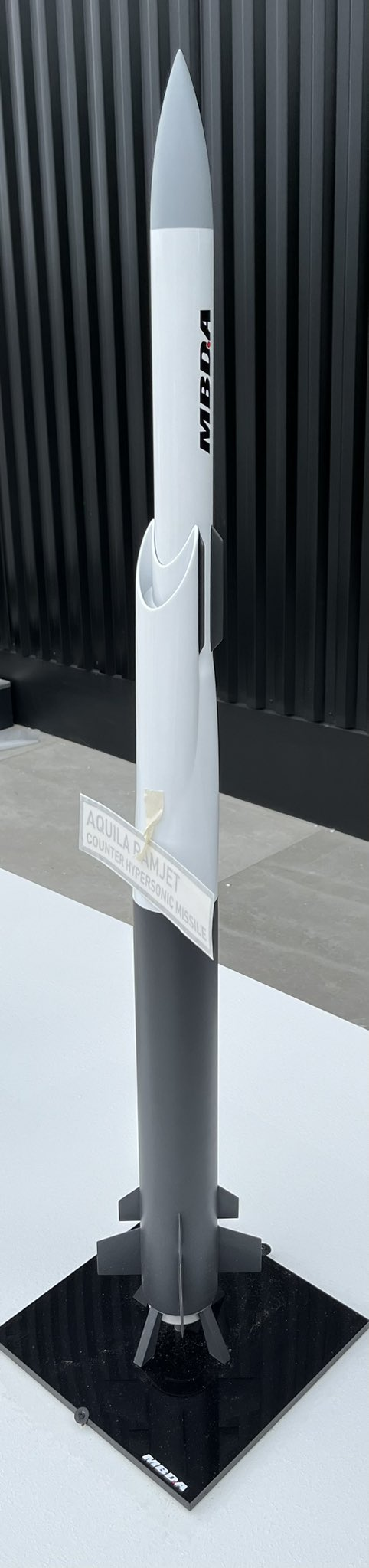
A ramjet missile needs a booster that will punt it to 10,000ft/3000m and Mach 1 ish.But if that's the case, the AASM booster solution might be where to start from. Not from a SAM.
Why? It's exactly "large enough to achieve start-up speed", it's more or less equal to a similar stage of SRF a2a missiles.As @timmymagic posted, the integrated Meteor booster is not optimal for surface launch.
Can it get the missile up to Mach 1 from the ground launch?Why? It's exactly "large enough to achieve start-up speed", it's more or less equal to a similar stage of SRF a2a missiles.
I'd expect > double that. Its responsibilities are exact same as in any other MRAAM, otherwise it won't be able to fulfil short-range/low altitude responsibilities. Plus take into account that it's actually quite large(compared to double pulse ones), as it takes most of the duct, and it has to counteract very significant additional drag of Meteor.Can it get the missile up to Mach 1 from the ground launch?
I think the conclusion from discussions previously was that the Meteor ramjet needed to get to m2.5 for efficient start up. With the previously proposed booster (which isn't from the Aster series) getting it to m1.6 before seperation of the booster stage, transition to internal booster and presumably straight into ramjet mode at m2.5. The proposal, we believed, was German and was initially supposed to go on MEADS. Seems reasonable to assume the booster was also German and of new design.A ramjet missile needs a booster that will punt it to 10,000ft/3000m and Mach 1 ish.
As @timmymagic posted, the integrated Meteor booster is not optimal for surface launch. But if you're going to go so far as to redesign the missile to remove the hanging lugs, you could also change the integrated booster if it is big enough to get you to ramjet startup speed. Else you would need an external booster plus the integrated booster.
Yeah, I was proposing a new internal booster to get the surface-launched Meteor ("Bolide"?) up to speed.I think the conclusion from discussions previously was that the Meteor ramjet needed to get to m2.5 for efficient start up. With the previously proposed booster (which isn't from the Aster series) getting it to m1.6 before seperation of the booster stage, transition to internal booster and presumably straight into ramjet mode at m2.5. The proposal, we believed, was German and was initially supposed to go on MEADS. Seems reasonable to assume the booster was also German and of new design.
Yeah, I was proposing a new internal booster to get the surface-launched Meteor ("Bolide"?) up to speed.


Errr...you want to check that claim? The F-35 is planned to have the capability to operate Meteor and qualification has begun:What the non-european competitors of Gripen are missing from their arsenal...
View: https://www.youtube.com/watch?v=IJHT5gZLMsA


And another competitor, the J-10CE is equipped with the PL-15E, a comparable or perhaps even superior missile (Meteor lacks the combat record to contest)Errr...you want to check that claim? The F-35 is planned to have the capability to operate Meteor and qualification has begun:
Irrelevant to introduce a totally different missile here.And another competitor, the J-10CE is equipped with the PL-15E, a comparable or perhaps even superior missile (Meteor lacks the combat record to contest)

What the non-european competitors of Gripen are missing from their arsenal...
View: https://www.youtube.com/watch?v=IJHT5gZLMsA
The PL-15, for example, has a higher top speed than the Meteor and also a longer maximum range. Apparently, Ramjets also bleed energy much faster once they burn out. The Meteor barely outranges the latest AMRAAMs despite being considerably bigger.
The existence of VLO aircraft means time-to-target and agility at shorter distances are more important.
Modern AAMs fly very parabolic BM-like trajectories. A high-speed low-drag rocket is going to achieve a longer range than a ramjet-powered missile in such a trajectory. Ramjet missiles have a lot of energy but they are too limited in speed. They give too much time to the opposing fighter to realise it is getting attacked, fire back and then u-turn. This is especially critical between stealth aircraft because the engagements are expected to happen within a few dozen kilometres.
The Meteor would be a beast if air combat stayed in the 1990s, but China and the U.S. progressed way beyond that.
Does the F-35 has this capability now? Can you load the Meteors on your F-35 already in service and send them tommorow to hunt Sukhois?Errr...you want to check that claim? The F-35 is planned to have the capability to operate Meteor and qualification has begun:

https://www.mbda-systems.com/meteor-missile-and-f-35a-one-step-closer-operational-capability
https://www.f35.com/f35/news-and-features/Meteors-First-Flight-on-an-F35B.html
Then the Americans can throw in the AIM-260 to sweeten the deal.And what happens if the europeans decide not to supply the missile to you?


