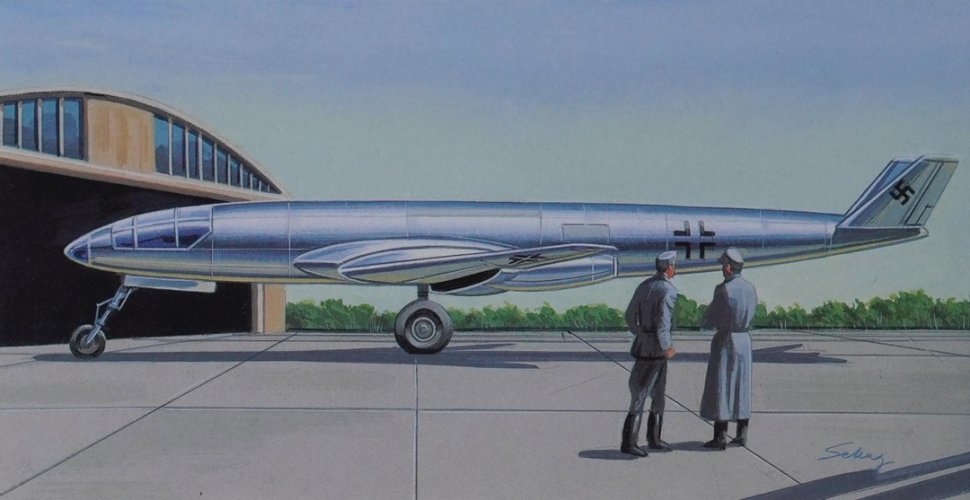
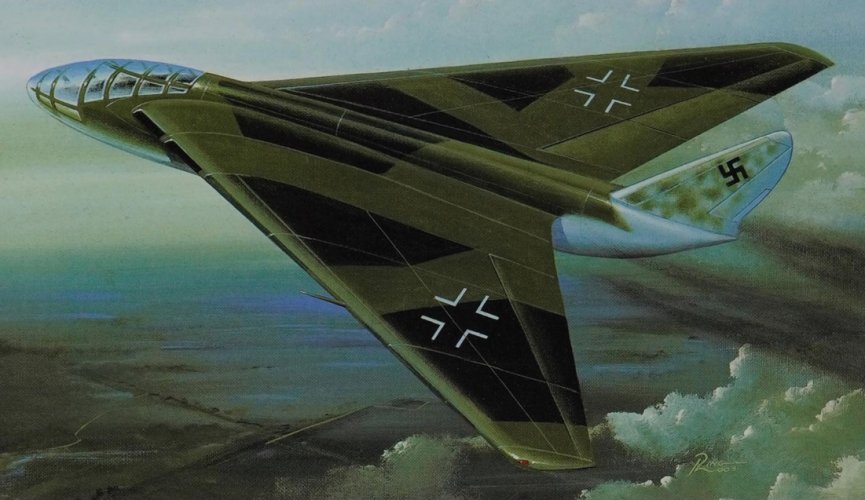
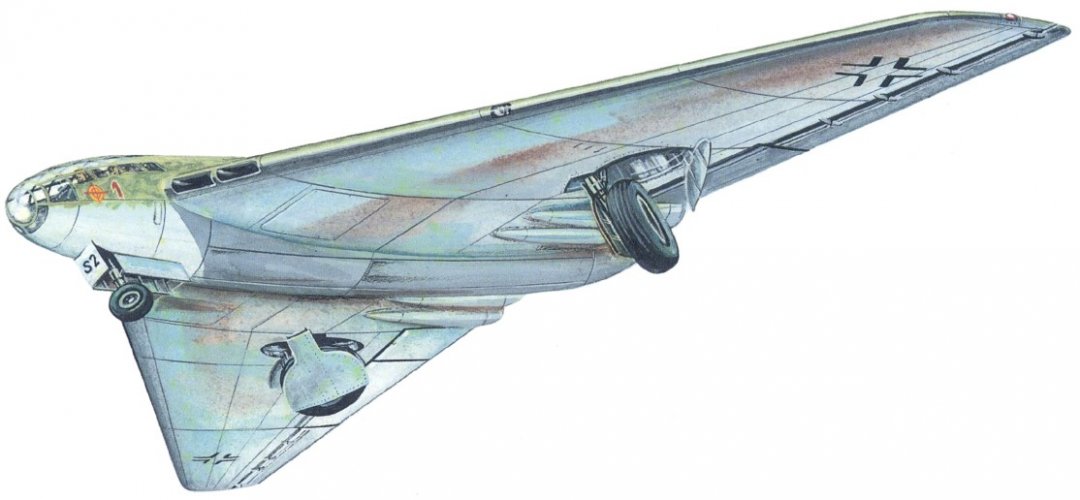
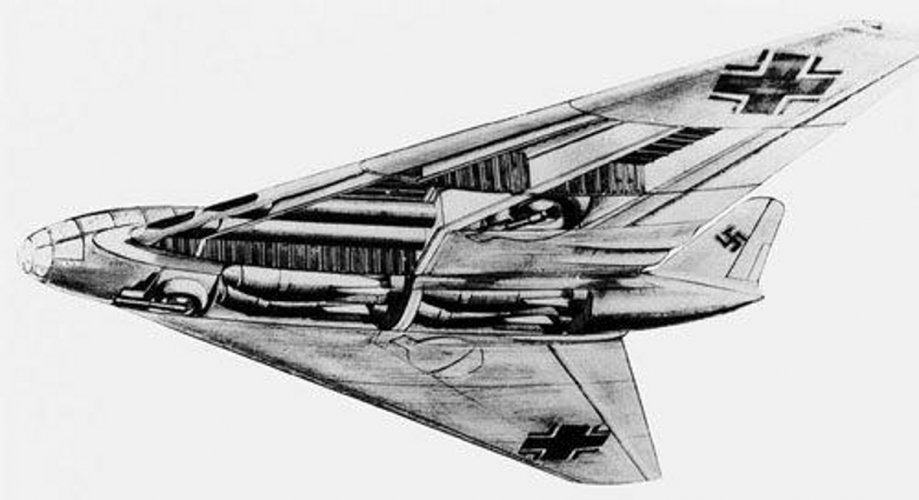
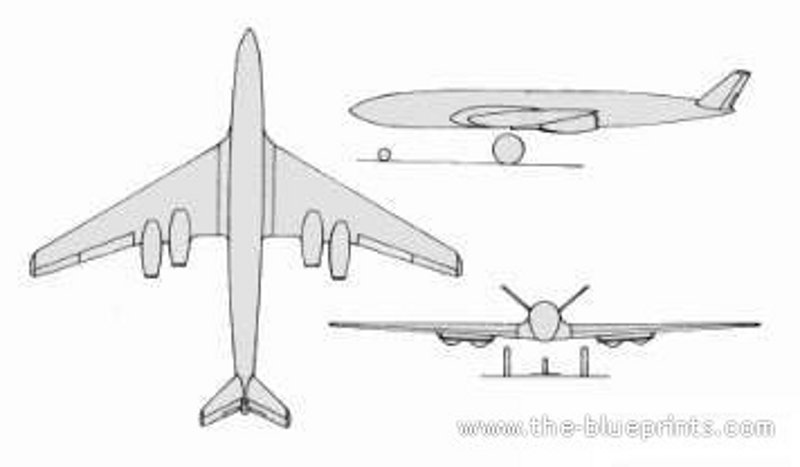
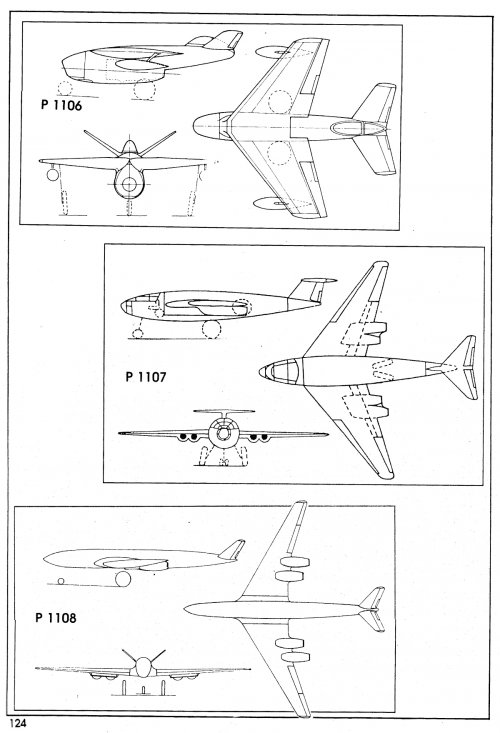
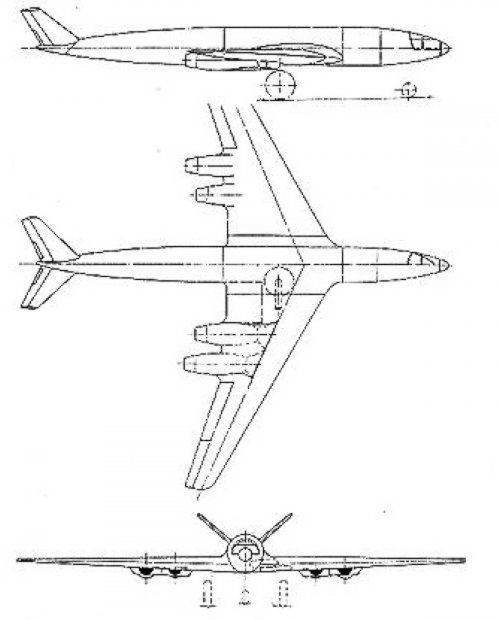
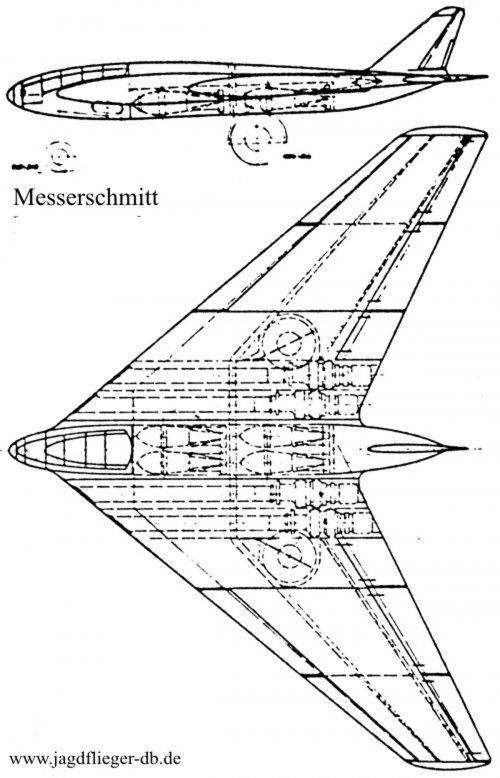
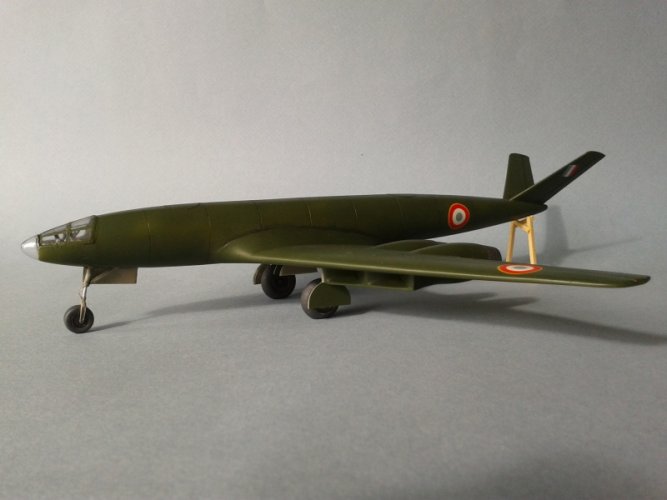
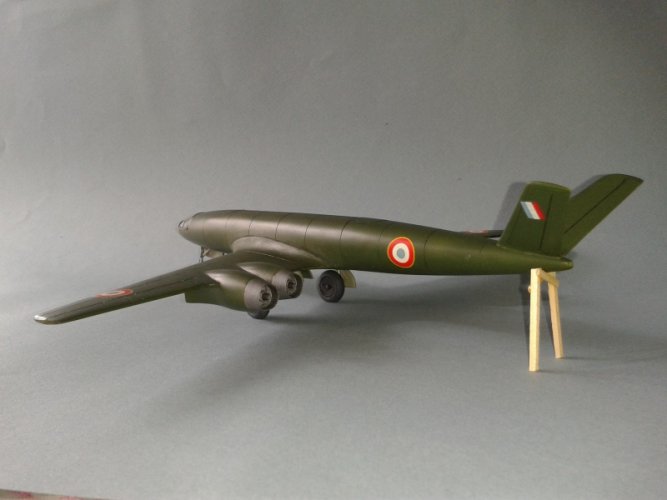
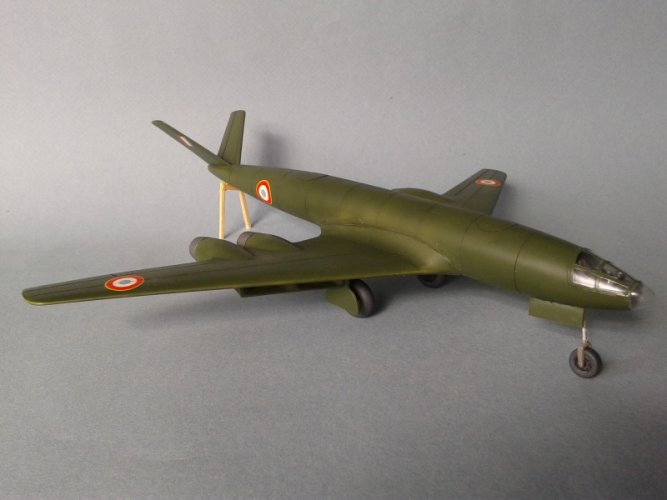
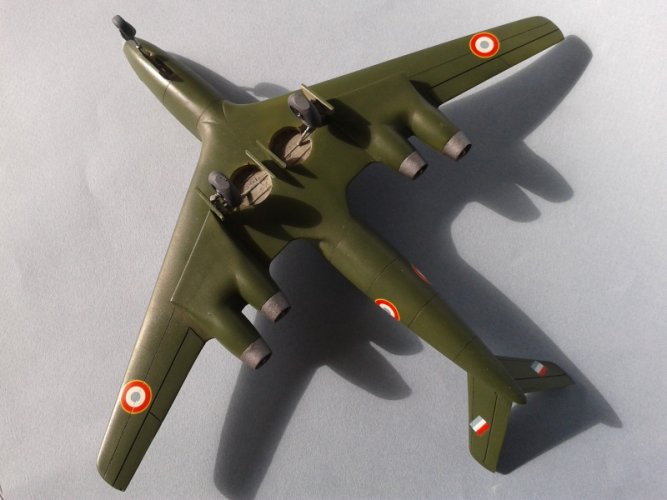
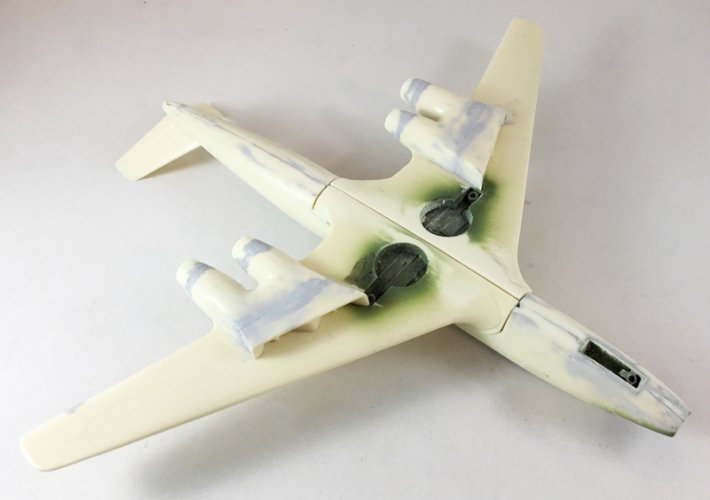
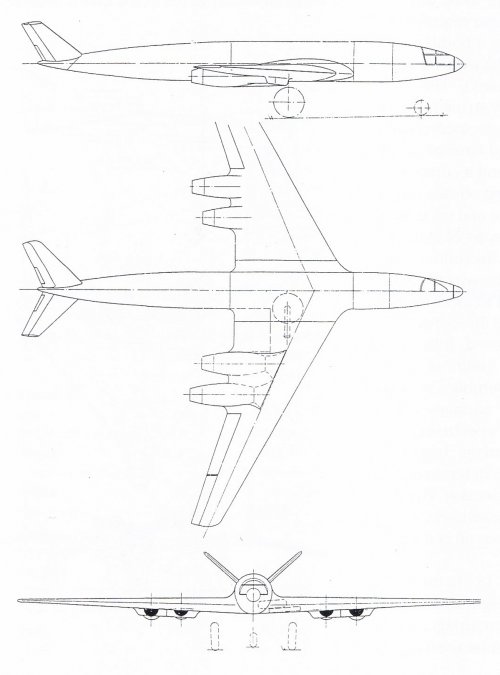
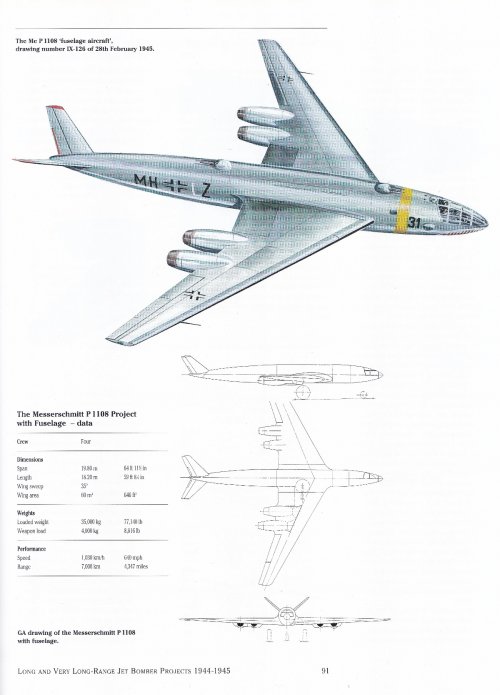
Messerschmitt P 1107 and P 1108 long range jet bombers

Kahla - where the construction of the H.XVIII was supposedly starting.
Sorry, but Kahla was REIMAHG and It's production line was for jet fighter Me262 only.

So far know were Horten connected with Gothaer Waggonfabrik in town of Gotha
and Gotha lies on west side of Thuringia while Kahla lies east on other side.
it would make more sense that H.XVIII would be build by Gothaer Waggonfabrik under supervision of the Horten,
but they had hand full to make Ho229 operational to get more data to build H.XVIII.
 
Motocar - I think it would be helpful if you explained where this drawing was originally published and clarified whether or not it was a German original, which is unlikely given the English notation.
The problem with improving our historical knowledge, is that over the years many drawings and information have simply been invented, often to fill the gap where original material no longer exists (or never existed).
Sometimes original drawings are very faded and redrawn to make them clearer but if thats what happened, then again we need to know the source material.
 
Michael, yes I am very familiar with REIMAHG, which as you correctly say was producing the Me262 of which (from memory) around 20 were completed and flown from the mountain top to a nearby airfield.
The Gauleiter of Thuringia covered both Gotha Waggonfabrik and Kahla and I can document proposals for Horten types to be built at Kahla. However that did not happen.
Gotha never had any involvement in the H.XVIII, even though, as you say, it would makes more sense if it was constructed there.
On the other hand, the Gotha factory was vulnerable and had been badly damaged by bombing in 1944. Kahla was of course a combination of bunkers and tunnels.

It is not correct to say that the Hortens had their hands full making the Ho229 operational. Their original drawings had been restressed by Gotha and then an enirely new centre section was designed by Gotha, both aerodynamically and structurally, for what might have become a production variant. As Horten had no experience of series building a combat aircraft, their input in 1945 would have been minimal.

In the closing months of the war, they produced range/performance data for 6-10 versions of the H.XVIII and in more detail for 3 of them.
Three entirely different fighters were developed in that period. Protoype construction of the H.X delta was well underway, along with the four engined H.VIII, plus series production of the H.IIId, H.IVb and H.VII. They were workaholics !

The interesting question is IF an instruction was issued to build the H.XVIII, as the meetings at which the Hortens calim it was authorised, did no such thing. In the obscene insanity of the final weeks of the war nothing would surprise me but in the chaos, much paperwork has been lost. Any snippets would be most appreciated.
Paul
 
Motocar - thanks for that info but the problem is that the image isn't given a source, so in reality we have no idea if its pre 1945 and original.
Its a minefield. My best advice is always to ask yourself - Is it original and can I prove it ?
 
Motocar, I shall (partially) eat my words - the original, undoctored drawing appeared on p.117 of Luftwaffe Secret Bomber of the Third Reich by Dan Sharp - a member of this forum and renown for using original material. Its a softback, modestly priced and highly recommended - invest !
Paul
 
On the other hand, the Gotha factory was vulnerable and had been badly damaged by bombing in 1944. Kahla was of course a combination of bunkers and tunnels.
here map of Bunker tunnels and underground factory
mittelwerk_vorwerk_siii-jpg.112290

Source
https://www.secretprojects.co.uk/th...rk-vorwerk-mitte-and-s-iii.10740/#post-123043
 
It doesn't belong in this topic if its been modified with AI. You could post it in User Artwork and Models section, so long as the use of AI is flagged.
 
Michel, your map illustrates the amazing amount of effort put into the many bunkers.
As far as I know, the only documented bunker that the Hortens were involved with was at Kahla, unless you have found some new information. As you know, original documents became scattered after the collapse.
 
Hesham, may I ask if that is that an original drawing or from a magazine ? Is there a known date ?
 
Hesham, may I ask if that is that an original drawing or from a magazine ? Is there a known date ?
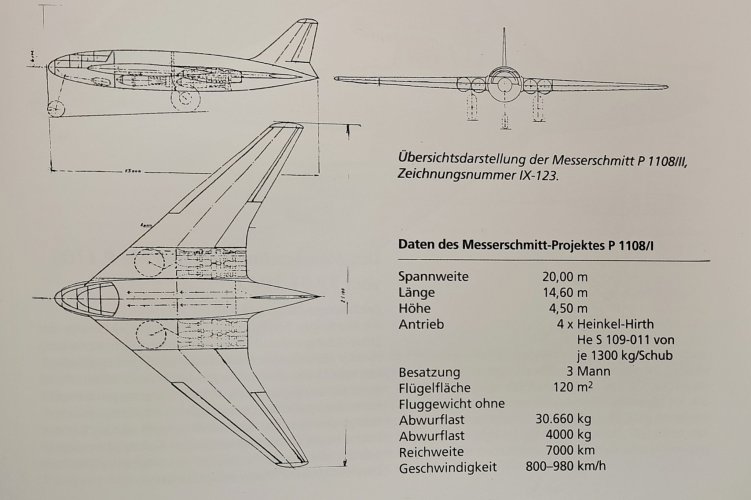
Geheimprojekte der Luftwaffe - Band II: Strategische Bomber 1935-1945 by Dieter Herwig and Heinz Rode, Motorbuch Verlag 1998.
Page 121.
 
Justo - as I am driven purely by the evidence and - exactly like you - have spent 50 years asking the questions that no one has ever bothered to ask, I am rather puzzled by your antipathy.

I completely agree that lack of evidence doesn't mean something is a myth.
However, the Hortens words MUST be regarded as myth, when documentary evidence shows events happened differently or at different times.
Kahla - where the construction of the H.XVIII was supposedly starting.
Instead of going via Google and secondary sources, the archives of the "Deutsches Museum" might be able to help with questions and primary sources for Horten, Junkers, Arado, Messerschmitt et al..
https://digital.deutsches-museum.de/en/collections/archive/
As I spent a week in the archiv, I got some first-hand insights. You could look at e.g.
https://www.deutsches-museum.de/for...e-des-archivs/luft-und-raumfahrtdokumentationwith more than 13,000 folders in Luft und Raumfahrtdokumentation (LRD) with means "Air and Space documentation."

Note that the collection descriptions "DE: Findbücher" are not all online. However, if you ask them a question about e.g. Ho-XVIII, Me-264, Ju-287 here at
[email protected]
then you might get pointers to the primary sources. As one example, folder LR 11015 seems to have info on Ho-XVIII plus an interview with Walter Horten regarding that plane. They are very helpful and I would encourage serious researchers to ask questions. (I count at least 5 relevant folders)

The library at "Deutsches Museum" has useful things as well like

MESSERSCHMITT Me 264 AMERIKA BOMBER
"The Luftwaffe's Lost Transatlantic Bomber"
Robert FORSYTH, and Eddie J. Creek, 2006
ISBN (13) 978 1 903223 65 9
https://opac.deutsches-museum.de/TouchPoint/perma.do?q=+1035="BV044655455"+IN+[2]&v=dmm&l=de
Horten Ho 229 der legendäre Nurflügel
https://opac.deutsches-museum.de/TouchPoint/perma.do?q=+1035="BV046442109"+IN+[2]&v=dmm&l=de
https://opac.deutsches-museum.de/TouchPoint/start.do?View=dmm&Language=de
 

Attachments

  • Me P.1107.jpg
    Me P.1107.jpg
    711.6 KB · Views: 98
  • P.1107 (IX-122).jpg
    P.1107 (IX-122).jpg
    38.2 KB · Views: 54
  • 491932322_122121191210785579_5361306855585471347_n.jpg
    491932322_122121191210785579_5361306855585471347_n.jpg
    430.4 KB · Views: 62
Last edited:
https://grokipedia.com/page/messerschmitt_p1108
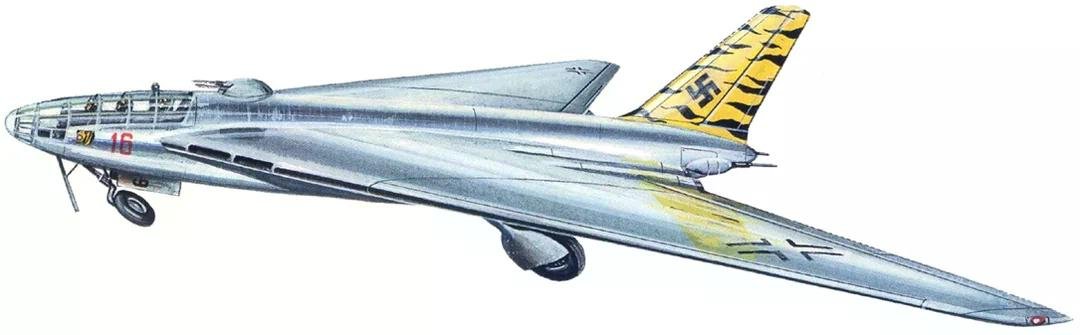
The Messerschmitt P.1108 was a late-World War II design project for a jet-powered long-range strategic bomber developed by the German aircraft manufacturer Messerschmitt for the Luftwaffe.[1] Conceived in response to Reichsmarschall Hermann Göring's autumn 1944 directive for high-speed bombers capable of striking distant targets in the United States and Soviet Union with a 4-ton payload, it adopted an innovative all-wing (flying wing) configuration to minimize drag and enhance speed, range, and fuel efficiency compared to conventional designs.

P.1108/I​

The P.1108/I represented the primary, baseline variant of the Messerschmitt P.1108 long-range jet bomber project, employing a conventional fuselage to integrate key operational elements. This design featured a traditional cylindrical fuselage that accommodated the internal bomb bay and crew stations for a crew of three in tandem seating, prioritizing simplicity and efficiency for strategic missions. Powered by four embedded turbojet engines, it was conceived as a high-speed platform for penetrating enemy airspace with heavy ordnance.Key structural dimensions included a wingspan of 20.12 m and a length of 18.2 m, which supported aerodynamic optimization for a cruise speed of 900 km/h. These proportions facilitated agile handling at high altitudes while maintaining the structural integrity needed for long-range flights. The wings incorporated a 35-degree sweep to enhance transonic performance, reducing drag and improving stability near the speed of sound during bombing runs.The variant was designed to carry a payload of 4,000 kg of bombs housed in the fuselage bay, underscoring its role in strategic bombing against remote industrial or military targets. Defensive considerations focused on speed rather than extensive armament, with the core propulsion provided by four Heinkel-Hirth He S 011 turbojets. Overall, the P.1108/I embodied Messerschmitt's late-war push for advanced jet technology amid resource constraints.

P.1108/II​

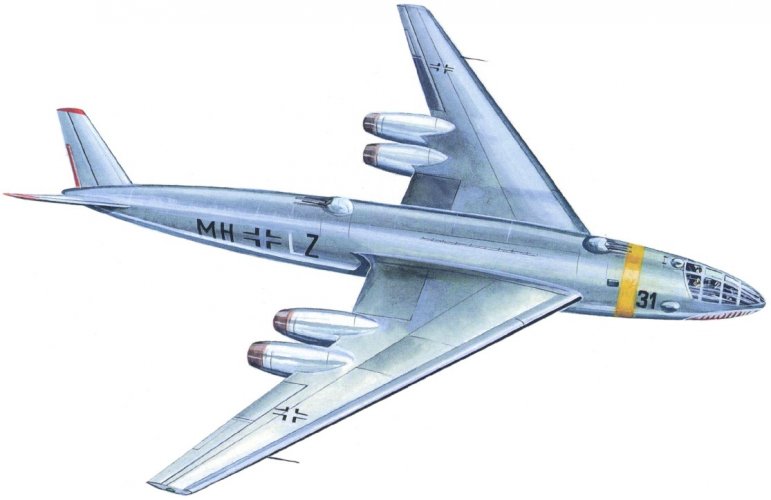
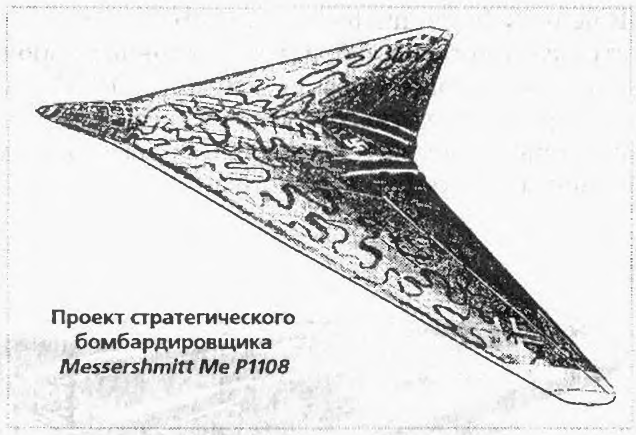
The Messerschmitt P.1108/II represented an advanced iteration of the P.1108 bomber project, adopting a radical blended-wing body configuration to achieve superior aerodynamic efficiency. This delta flying wing design with a single vertical fin and rudder, influenced by Alexander Lippisch's earlier concepts, integrated the fuselage seamlessly into the wing structure, eliminating distinct boundaries to minimize drag and enhance overall performance. Unlike the more conventional swept-wing layout of the baseline P.1108/I, the /II variant buried its four Heinkel-Hirth HeS 011 turbojet engines within the wing roots near the trailing edge, allowing for shared air intakes and reduced external protrusions.[5]With slightly larger dimensions than the P.1108/I—including a wingspan of 21.7 meters—the /II variant was engineered for improved lift generation without sacrificing compactness, resulting in a projected maximum speed of up to 910 km/h at high altitude. This configuration promised enhanced fuel efficiency due to the low-drag profile, enabling an extended operational range suitable for transatlantic strike missions, with estimates reaching approximately 7,800 kilometers while carrying a 4-ton bomb load. The design's emphasis on aerodynamic integration positioned it as a forward-thinking response to the Luftwaffe's need for long-range strategic bombers capable of evading Allied defenses.However, the P.1108/II's innovative structure introduced significant trade-offs, particularly in manufacturing complexity and operational practicality. Fabricating the blended-wing body required advanced techniques beyond the capabilities of wartime German industry, which was already strained by resource shortages and Allied bombing. Additionally, the all-encompassing wing design compromised crew visibility from the pressurized cockpit, potentially complicating navigation and bombing accuracy in low-level operations. These challenges, combined with stability concerns inherent to early flying-wing concepts, contributed to the variant's rejection in favor of simpler proposals by March 1945.

 
Last edited:
The conventional P.1108 in post 57, also appears in post #17 from a 1986 magazine but I don't recall seeing a wartime drawing ?
 
Thanks good point.
https://modelplanes.de/luftwaffe/bo...ernbomber-with-fuselage-antares-models-resin/
" In January/February 1945, only four months before the German “Third Reich” surrendered, Messerschmitt proposed two designs of a “Fernbomber” (Long-distant range/long-range bomber), the Me P.1108/I and –II. Although no post-war information provided by Messerschmitt's employees could be independently verified, since all data had already been removed by the French it seems that both projects were designed by Dr. Wurster from Messerschmitt to a concept by Dr. Alexander Lippisch.
While the Messerschmitt Me P.1108/I, (design drawing No. IX-126 from 28 th February, 1945) was a more conventional design with a fuselage, 35 degree back-swept wings and a butterfly-type tailplane, the Me P.1108/II (design drawing No. 117 from January 12 th , 1945) was a flying wing concept with 40 degrees sweep of the leading edge without any tailplane. Common to both projects were the installation of four Heinkel/Hirth HeS 011 turbojet engines, the air intakes were under the wings or in the wings leading edge. Calculated fully loaded weight was to be 30 tons, a range of 4,300 mi at a speed of 500-530 mph and a height of 30,000-39,000 ft. was estimated.
The Messerschmitt Me P.1108/I design had an aerodynamic clear fuselage with circular cross section and low positioned swept back wing with four He S 011 turbojet engines in paired nacelles half-embedded in the wing trailing edge. These were fed by a common intake on each lower wing surface. A two man crew sat in tandem position in a pressurized cockpit in the extreme nose of the aircraft. A tricycle landing gear arrangement was designed, with the main wheels retracting into the fuselage. It was planned that the armament of the production aircraft should consist of three twin 20mm cannon turrets, two located on the back of the fuselage and aft of the cockpit and one under the fuselage. All were remotely controlled from the cockpit.
Understandably, at the end of March 1945, only a few weeks before the total collapse of the “Third Reich” Messerschmitt was ordered by the RLM to cease all development on long range bomber designs ( Ref.: 15, 20 )."
 
Last edited:
There is a conventional P.1108 three side view drawing in the book "SECRET GERMAN AIRCRAFT PROJECTS OF 1945 Based on British Air Intelligence Reports", TOROS PUBLICATIONS, page 124.
 

Attachments

  • 51VwJviwwiL._SY445_SX342_FMwebp_ (1).jpg
    51VwJviwwiL._SY445_SX342_FMwebp_ (1).jpg
    36.1 KB · Views: 78
  • 1108.jpg
    1108.jpg
    525.4 KB · Views: 89
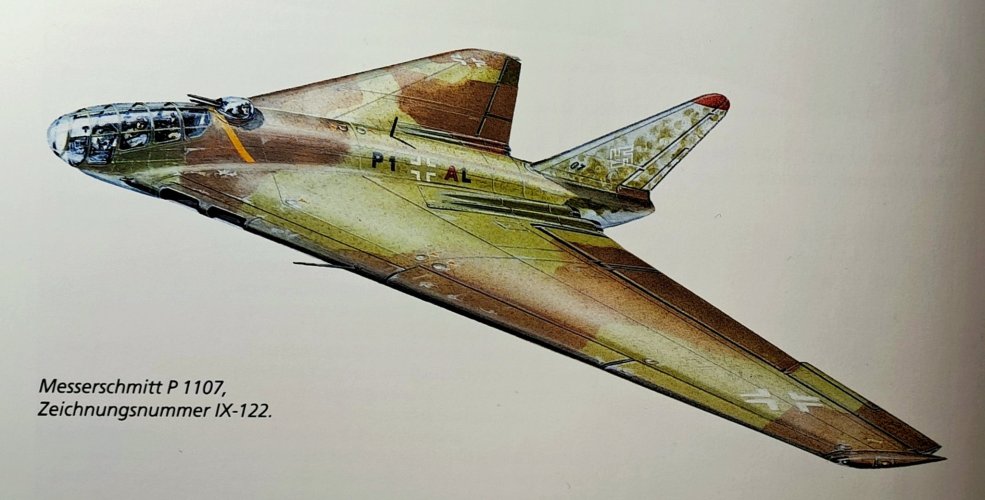
Hi! Messerschmitt P 1107, drawing number Ⅸ-122.
 

Attachments

  • Messerschmitt P 1107, drawing number Ⅸ-122.jpg
    Messerschmitt P 1107, drawing number Ⅸ-122.jpg
    435.7 KB · Views: 64
Messerschmitt Letters - Entwicklungshauptkommission

October 9, 1944 [1]
Letter from Messerschmitt to Lucht.
Messerschmitt discusses the discontinuation of the Messerschmitt 264, the development of the Dornier 335 Zwilling, and Daimler-Benz Director Nallinger's proposal for a composite bomber. Messerschmitt proposes developing a TL aircraft based on the Messerschmitt 262 with a reconnaissance range of 5,000–6,000 km and a bomber range of approximately half that, carrying a bomb load of 3–4 tons and capable of a speed of approximately 800 km/h.

January 31, 1945 [2]
Letter from Messerschmitt to Saur.
Messerschmitt submits the documents regarding the P.1107 long-range bomber/reconnaissance aircraft. It is proposed that the P.1107 be used against ships, enemy airfields, and as a fighter or destroyer.


Source:
Bundesarchiv
Signatur: R 3/1749
[1] Page: 209–210
[2] Page: 123-124
 
Thank you Moin and Blackkite, its frustrating that the timeline of these designs remainss so vague and that it is often not apparent which design or design variant they are talking about !
 

Attachments

  • 339367P11082.jpg
    339367P11082.jpg
    107.3 KB · Views: 55
  • 354866P11083.jpg
    354866P11083.jpg
    106 KB · Views: 62
  • 630316P11086.jpg
    630316P11086.jpg
    118.5 KB · Views: 55
  • 897705P110810.jpg
    897705P110810.jpg
    150.9 KB · Views: 52
  • 19051704295223563516241976.jpg
    19051704295223563516241976.jpg
    106.7 KB · Views: 66
Last edited:
Hi!
Source : LUFTWAFFE SECRET PROJECTS STRATEGIC BOMBERS 1935-1945, Dieter Herwig and Heinz Rode, 1998, MIDLAND
 

Attachments

  • Me P.1108 three side view drawing.jpg
    Me P.1108 three side view drawing.jpg
    552.9 KB · Views: 56
  • Me P.1108.jpg
    Me P.1108.jpg
    980.2 KB · Views: 62
From this book.
 

Attachments

  • 2.png
    2.png
    234.4 KB · Views: 39
  • 3.png
    3.png
    476.4 KB · Views: 37

Similar threads

Back
Top Bottom