overscan (PaulMM)

Administrator
Staff member
Joined
27 December 2005
Messages
19,230
Reaction score
35,694
MBB BBH

Rotor


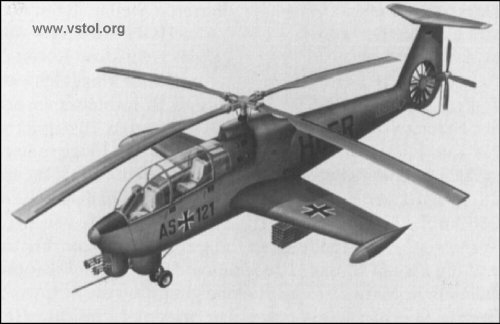
The design was started in 1968 after a request for proposals for an armed escort helicopter (Bewaffneter Begleithubschrauber, or BBH) was issued by the BMVg (deadline for submission was July 1969).

* requirements:
* Speed: 375 km/h (200 kt)
* Maximum rate of climb: 20 m/s (65.6 ft/s)
* Maximum hover altitude: of 2,500 m (8,200 ft) out of ground effect.
* Capacity: two seats
* Take-off weight: < 6 t (13,230 lb)
* All-weather capable
* Armored around the crew and the most important components

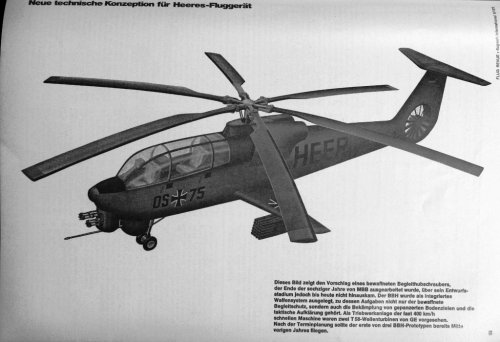
MBB studied two designs, designated BBH 1 and BBH 2.

* BBH 1 with small wing
* Speed: 375 km/h (200 kt)
* Rotor: a six-bladed rotor
* Take-off weight: 5.7 t (12,600 lb)

* BBH 2 with large wing, a fan-in-fin tail rotor, and a pusher propeller on the tail.
* Power: two Daimler-Benz DB 720, GE T58, or Lycoming T53 engines
* Cruise Speed: 385 km/h (208 kt)
* Rotor: four-bladed hingelessrotor
* Take-off weight: 5.9 t (13,000 lb)

The helicopter was designed to escort transport helicopters and attack enemy tanks. Both designs could carry various types of armament: one or two machine gun(s) in a revolving turret, a movable cannon, Home-on-Target (HOT) missiles, and rockets.

Although the original plan expected the prototypes to fly in mid-1972 and series production to begin in 1975, the projects were never funded for development. After additional design studies, a Memorandum of Agreement between Germany and France in 1979 - ten years later - began the development of the PAH 2 (Panzer abwehr Hubschrauber = anti tank helicopter), now known as the Eurocopter Tiger, roll out of the first serial production machine on March 22 2002.

http://www.aiaa.org/tc/vstol/unbuilt/mbb/index_r.html

BBH-2 Pic:
 

Attachments

  • bbh2.jpg
    bbh2.jpg
    59.5 KB · Views: 1,824
MBB BBH-1 (small wing) armed escort helicopter, from Flug-Revue 8/1973
 

Attachments

  • MBB BBH-1.jpg
    MBB BBH-1.jpg
    215.6 KB · Views: 1,455
richard said:
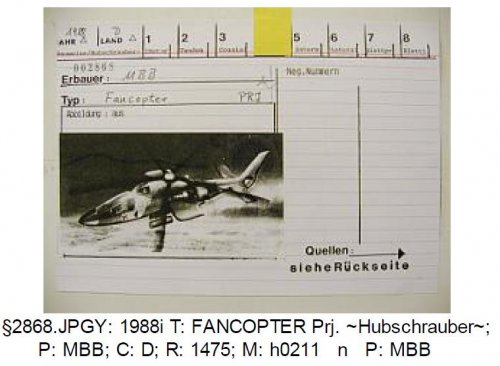
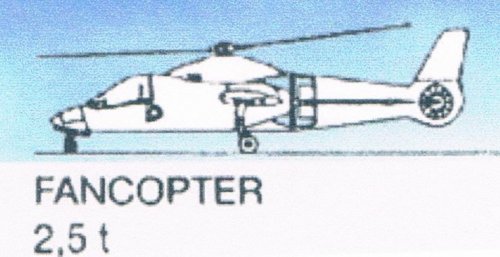
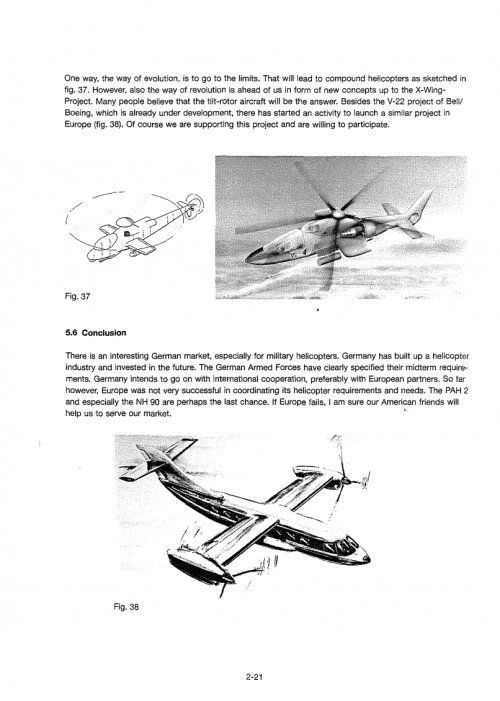
Source unknown : the Fancopter was a GYROcopter development of the Rhein Flugzeugbau Fantrainer

Why would a gyrocopter need a Fenestron?

Martin
 
Good question. Perhaps for low-speed maneuvering
 
Looking at the type card, which attributes the concept to MBB rather than RFB, and the overall design, I think it's really a compound helicopter comparable to the AH-56.

Martin
 
That sounds more likely. But the suggestion regarding control authority makes some sense. Conceivably you could have the rotors and fenestron on clutch, used only for take off and landing, but I doubt that's what is going on here.
 
Many thanks for that . . .
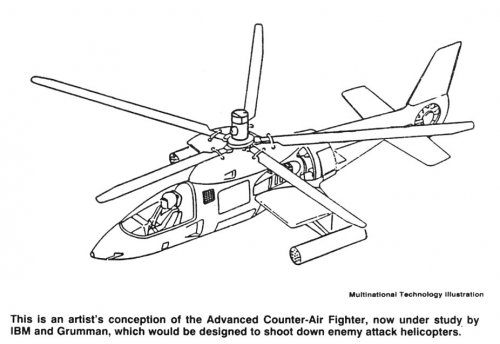
I've taken the liberty of converting your file to an image, cleaning it up a little, then cropping out the illustration, and attaching them both here.

cheers,
Robin.
 

Attachments

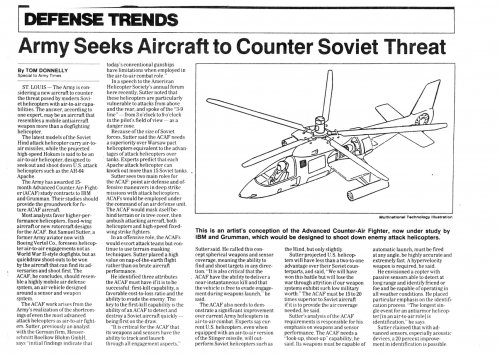
  • Advanced Counter-Air Fighter - Cropped.jpg
    Advanced Counter-Air Fighter - Cropped.jpg
    75.1 KB · Views: 541
  • Advanced Counter-Air Fighte.jpg
    Advanced Counter-Air Fighte.jpg
    883 KB · Views: 594
Very interesting design. What year is that article and drawing from? Thanks.

500 Fan.
 
"200kt armed escort helicopter" is definitely the same design brief that led to the AH56. Something fast enough to keep up with a lChinook.

The midships pusher fan and fenestron is interesting. Notably safer than the open props/rotors of the AH56.
 
While I think 200 knots (straight and level) might have been a bit over optimistic, it would have certainly been interesting to see the fruition of a platform of this sort.

During the period of the study the U.S. Army was very much looking at low altitude air combat, almost exclusively within a NATO/WARPAC environment. This would lead to the writing of a manual for Air Combat and at least two studies, one of which would support the development of the ARES aircraft by Rutan. A massive study by the Aviation Technical community took place in Virginia with AH-64, AH-1, UH-60, S-76 and SA365M to get first hand look at Air Combat. I imagine that while the studies likely demonstrated utility, competing funding priorities, and manpower requirements likely precluded it going beyond concepts, at least for the U.S. Army.
 
spring cleaning at the office. found this and thought it might be of interest.

Does anyone know the date of this proposal? I'm wondering if it might have influenced Western interpretation of the Ka-50 (or been inspired by such interpretations)?
 
Does anyone know the date of this proposal? I'm wondering if it might have influenced Western interpretation of the Ka-50 (or been inspired by such interpretations)?
It would not surprise me if the rationale for either effort was impacted by the other.
 
While I think 200 knots (straight and level) might have been a bit over optimistic, it would have certainly been interesting to see the fruition of a platform of this sort.

During the period of the study the U.S. Army was very much looking at low altitude air combat, almost exclusively within a NATO/WARPAC environment. This would lead to the writing of a manual for Air Combat and at least two studies, one of which would support the development of the ARES aircraft by Rutan. A massive study by the Aviation Technical community took place in Virginia with AH-64, AH-1, UH-60, S-76 and SA365M to get first hand look at Air Combat. I imagine that while the studies likely demonstrated utility, competing funding priorities, and manpower requirements likely precluded it going beyond concepts, at least for the U.S. Army.
I've got a pdf of one of those studies. It had some very surprised observations about how helicopter dogfighting was backwards compared to fixed wing. Fixed wings start high and get lower and lower as they descend to regain energy, while helos start down in the weeds and climb to get their guns to shoot into the rotor systems.
 
spring cleaning at the office. found this and thought it might be of interest.
Thank you for posting. The proposed ability to track & engage targets during high dynamic maneuver would be the preferred means to engage drones. Such a smaller lighter craft would indeed be able to accomplish lower nap-of-earth as alluded.

Lightweight hypervelocity guided rockets would have development possibilities against all sort of targets including guided bombs.

Advances in passive IRST's extreme range is evolving fast and an ability to track & possibly engage targets via mast mounted LF DEW revolutionary. LF DEW slung on the pylon is not optimum & the Apaches new role as counter air may be too expensive, while its lack of maneuverability render it vulnerable. 64s are slow missile trucks. Air defense is mentioned as a role. Defending & scouting for 64s would be new role. ACAF had a limited mission at the time & the wall fell. countering drones w/ high dynamic maneuver & lightweight should be considered.

The author's emphasis on 3-9 SA also could near guarantee an almost spherical Active Protection System (APS) against surprise drone threats.
 

Similar threads

Back
Top Bottom