
You are using an out of date browser. It may not display this or other websites correctly.
You should upgrade or use an alternative browser.
You should upgrade or use an alternative browser.
Little-Known French Projects and Prototypes
- Thread starter hesham
- Start date
According to the 9 September 1950 issue of Les Ailes, in the late summer of 1950, in Gaillac, a town located 30 or so miles from downtown Toulouse, to the northeast, a Mr. Guilhabert completed a Mignet Pou-du-ciel-type glider which seemingly flew quite well. Stability and maneuverability were said to be very good.
This glider was said to fly at very low speed, i.e. 9 or so mph, but could also reach more than 55 mph. At a speed of 25 or so mph, its rate of descent was a measly 185 feet per minute. In a parachute descent, that rate of descent did not exceed 400 feet per minute.
The wings of the Guilhabert glider being foldable, it could be towed on a road behind a motor scooter, which was quite convenient.
I wonder if the designer of this glider was the Jean-Jacques Guilhabert who was born in Gaillac on July 25, 1914 and deceased in Toulouse on June 8, 1973.
Incidentally, the Guilhabert glider was not the only Pou-du-ciel based glider... http://claudel.dopp.free.fr/Les_pla...Cosandey Pou Planeur/Cosandey_Pou-Planeur.htm
This glider was said to fly at very low speed, i.e. 9 or so mph, but could also reach more than 55 mph. At a speed of 25 or so mph, its rate of descent was a measly 185 feet per minute. In a parachute descent, that rate of descent did not exceed 400 feet per minute.
The wings of the Guilhabert glider being foldable, it could be towed on a road behind a motor scooter, which was quite convenient.
I wonder if the designer of this glider was the Jean-Jacques Guilhabert who was born in Gaillac on July 25, 1914 and deceased in Toulouse on June 8, 1973.
Incidentally, the Guilhabert glider was not the only Pou-du-ciel based glider... http://claudel.dopp.free.fr/Les_pla...Cosandey Pou Planeur/Cosandey_Pou-Planeur.htm

- Joined
- 25 July 2007
- Messages
- 4,916
- Reaction score
- 5,537
... in 1923, Mr. P. Hees designed a glider,no more details are known ?.
The person you are looking for is Pierre Hees - a surprisingly common name.
According to Flight 07 June 1923, the number '21' had been assigned to Pierre Hees for the 06-27 August Vauville meet.
Trait d'Union 215/31 (M) - HEES. Planeur.

- Joined
- 26 May 2006
- Messages
- 38,284
- Reaction score
- 20,422
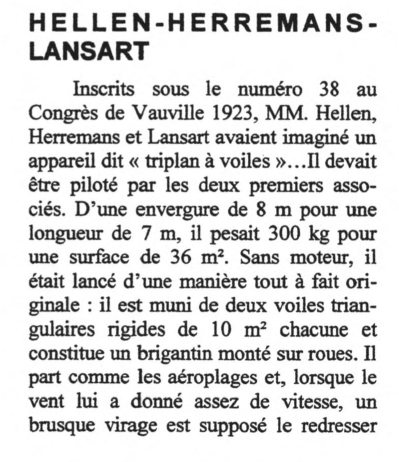
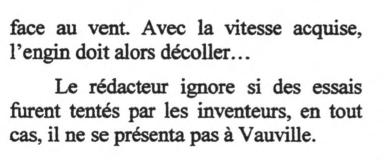
In case it was not clear, please note that Helen, not Hellen, Herremans and Lamart, not Lansart, were in fact three individuals.
Their aircraft seemingly included three wings from Spad fighter planes with small vertical sails atop the uppermost wing. That one off machine did not prove successful.
Their aircraft seemingly included three wings from Spad fighter planes with small vertical sails atop the uppermost wing. That one off machine did not prove successful.
- Joined
- 25 July 2007
- Messages
- 4,916
- Reaction score
- 5,537
According to Lot Polski (No.2, Rok 1 1923), the Hélen, Herremans, and Lamart glider had "an original sailplane control system" (apparently devised by Herremans). A pity that no images of that system appear to exist.
The TU statement above is also a bit suspect. Lot Polski states that it was not clear whether Hélen or Herremans would pilot the glider. There is no reason it couldn't have been both ... it is just that this was not confirmed at the time (as was implied by TU).
Claudel notes that the final name can be seen as 'Lamart', 'Lamarre', or 'Lansart'. Indeed, on j2mcl--planeurs.net, 'Lamarre' and 'Lamart' are seen on the same page.
Il devait etre pilote par les deux premiers associes.
The TU statement above is also a bit suspect. Lot Polski states that it was not clear whether Hélen or Herremans would pilot the glider. There is no reason it couldn't have been both ... it is just that this was not confirmed at the time (as was implied by TU).
Claudel notes that the final name can be seen as 'Lamart', 'Lamarre', or 'Lansart'. Indeed, on j2mcl--planeurs.net, 'Lamarre' and 'Lamart' are seen on the same page.
- Joined
- 26 May 2006
- Messages
- 38,284
- Reaction score
- 20,422
It would probably be better not to translate book titles when quoting. Instead ...
Title L'aviation légère en Algérie (1909-1939)
Author Pierre Jarrige
Publisher P. Jarrige, 1992
ISBN 2950662005, 9782950662002
Besides Conte, Pierre Jarrigue mentions other amateur builders in Algeria: Fournier (Marengo), Mouraret, Ducceschi, Bonnefont-Péduplan, Seigle and Roland Lassale (Alger), Louis Poire and Paul Grégoire (Oran), Jean Olivier (Blida), the Jamme brother (Mascara), Marcel Brau (Hussein-Dey), and René Hirsch (Batna).
-- https://bibliotheque-aviation.com/wp-content/uploads/2021/11/47-Construction-amateur2.pdf
About René Hirsch,
René Hirsch, a Water and Forests Inspector, built an aircraft of his own
design in Batna, Algeria, in 1932. Powered by an Anzani engine, the
aircraft was destroyed on its maiden flight after nosing over during
the landing.

- Joined
- 3 September 2006
- Messages
- 1,548
- Reaction score
- 1,698
AFAIK René Hirsch did not "buid an aircraft of his own design" in Batna, but restored and improved an old aircraft.About René Hirsch,
René Hirsch, a Water and Forests Inspector, built an aircraft of his own
design in Batna, Algeria, in 1932. Powered by an Anzani engine, the
aircraft was destroyed on its maiden flight after nosing over during
the landing.
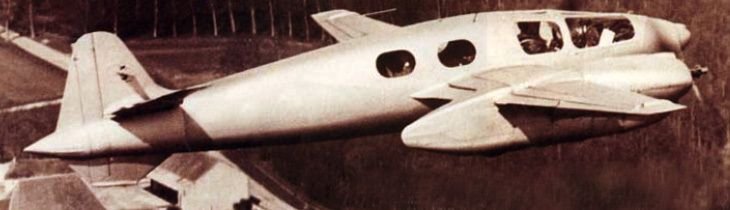
His real design is the Hirsch H-100 in 1955, a twin with a custom-design "gusts-dampening system".
See site http://aeroplanes.fr/www/html/Hirsch100.php
Attachments
- Joined
- 26 May 2006
- Messages
- 38,284
- Reaction score
- 20,422
AFAIK René Hirsch did not "buid an aircraft of his own design" in Batna, but restored and improved an old aircraft.
His real design is the Hirsch H-100 in 1955, a twin with a custom-design "gusts-dampening system".
See site http://aeroplanes.fr/www/html/Hirsch100.php
Thank you my dear Dan,of course I know this designer and his products, H.100 & H.300.
For what it's worth, according to https://web.archive.org/web/2023071.../uploads/2021/11/47-Construction-amateur2.pdf, René Hirsch (1908-1995), a water and forests engineer in Batna who later became an aerodynamics engineer, was an aviation enthusiast. A pilot with the Aéro-club de Batna, he built an aircraft of his own design there in 1932, equipped with an Anzani engine, which ended up nose in the ground and tail in the air on its maiden flight. During the war, he built a wind tunnel at the AIA (Atelier industriel de l'air) of Algiers. After the war, he participated in numerous aircraft programs in mainland France, then devoted himself to developing his own anti-gust system, which he applied to several prototypes, including the twin-engine RCH 100. This aircraft, powered by two 90 hp Regnier engines, made its first flight on June 15, 1954, and logged 130 flight hours until 1970 (Jean-Claude Royan).
Incidentally, the Hirsch H-100 or Hirsch MAé RCH-100 is seemingly on display in France, at the Musée de l'Air et de l'Espace --- https://www.museeairespace.fr/aller-plus-haut/collections/hirsch-h-100/
Incidentally, the Hirsch H-100 or Hirsch MAé RCH-100 is seemingly on display in France, at the Musée de l'Air et de l'Espace --- https://www.museeairespace.fr/aller-plus-haut/collections/hirsch-h-100/
Last edited:
I'm surprised that no company saw a marked for smooth flying small airplanes. The system seams to have worked very well, but unfortunately no company adapted it for production. I personally heard from private pilots which a struggling to convince their wife's (and children to use their planes more often for holiday trips etc. because they feel very uncomfortable during turbulences. My impression is, that aircraft companies often focused to much on the pilots and not on the relatives of the pilots.AFAIK René Hirsch did not "buid an aircraft of his own design" in Batna, but restored and improved an old aircraft.
His real design is the Hirsch H-100 in 1955, a twin with a custom-design "gusts-dampening system".
See site http://aeroplanes.fr/www/html/Hirsch100.php
- Joined
- 3 September 2006
- Messages
- 1,548
- Reaction score
- 1,698
Yes, the two sites differ in their wording. One says "restored and improved a written-off plane", the other says "own design."A pilot with the Aéro-club de Batna, he built an aircraft of his own design there in 1932, equipped with an Anzani engine, which ended up nose in the ground and tail in the air on its maiden flight.
IMO it could just be that they refer both to the same event, one more braggart and the other more unassuming.
But I don't know more, to tell who's right.
Similar threads
-
 Georges R. Hamel / CLENA aircraft and projects
- Started by hesham
- Replies: 23
-
 Arsenal de l'aéronautique: built prototypes and unbuilt projects
- Started by Jemiba
- Replies: 106
-

-
Various SNCASO (Sud-Ouest) Projects and Prototypes
- Started by hesham
- Replies: 26
-