
You are using an out of date browser. It may not display this or other websites correctly.
You should upgrade or use an alternative browser.
You should upgrade or use an alternative browser.
Grumman Model 623 VSTOL/CTOL Navy Fighter (VFAX)
- Thread starter hesham
- Start date

- Joined
- 26 May 2006
- Messages
- 38,251
- Reaction score
- 20,387
hesham said:Hi,
it was Grumman Model-623.
A very strange,the Grumman G-623 mention here,but with canard !.
http://ntrs.nasa.gov/archive/nasa/casi.ntrs.nasa.gov/19890000646_1989000646.pdf
Attachments


- Joined
- 27 December 2005
- Messages
- 19,225
- Reaction score
- 35,635
- Joined
- 27 December 2005
- Messages
- 19,225
- Reaction score
- 35,635
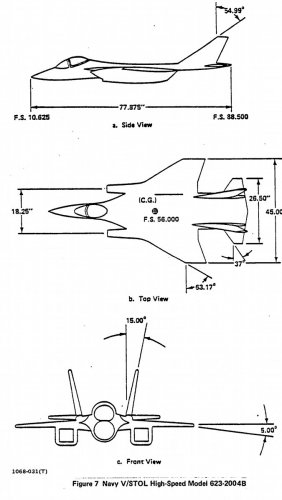
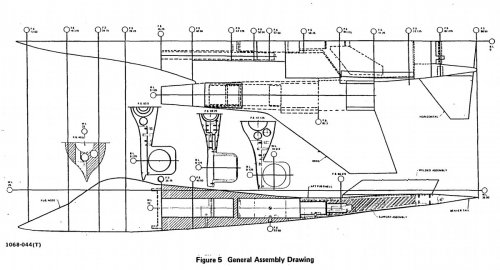
From a 1979 NASA Contractor report - CR-166365
Different variant with highly swept wings. According to Tony Buttler G-623V V/STOL version was distinguished by highly swept wings, so I suspect this is G-623V.
Different variant with highly swept wings. According to Tony Buttler G-623V V/STOL version was distinguished by highly swept wings, so I suspect this is G-623V.
Attachments
- Joined
- 27 December 2005
- Messages
- 19,225
- Reaction score
- 35,635
STUDY OF AERODYNAMIC TECHNOLOGY FOR VSTOL FIGHTER/ATTACK AIRCRAFT - PHASE I FINAL REPORT
Walter R. Burhans, Jr, Vincent J. Crafa, Jr, Nicholas F. Dannenhoffer, Frank A. Dellarnura, Robert E. Krepski, GRUMMAN AEROSPACE CORPORATION
http://ntrs.nasa.gov/archive/nasa/casi.ntrs.nasa.gov/19790001856_1979001856.pdf
Walter R. Burhans, Jr, Vincent J. Crafa, Jr, Nicholas F. Dannenhoffer, Frank A. Dellarnura, Robert E. Krepski, GRUMMAN AEROSPACE CORPORATION
http://ntrs.nasa.gov/archive/nasa/casi.ntrs.nasa.gov/19790001856_1979001856.pdf
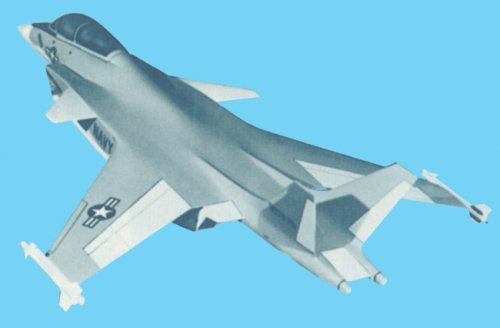
In 1973, Grumman and General Electric participated in a Navy exhaust nozzle development program. The resulting Grumman Design 623 using the General Electric ADEN nozzle has since been extensively tested in wind tunnels both here and abroad. This testing has ranged from VTOL hot gas tests to transonic and supersonic powered and flow-through model tests. This background data provided a starting point for this study.
Since its initial conception five years ago, advances in the state-of-the-art in propulsion, aerodynamics and materials, as well as a better understanding of the VTOL requirements has allowed Grumman to update Design 623 into a more potent fighter/attack aircraft.
- Joined
- 27 December 2005
- Messages
- 19,225
- Reaction score
- 35,635
- Joined
- 26 May 2006
- Messages
- 38,251
- Reaction score
- 20,387
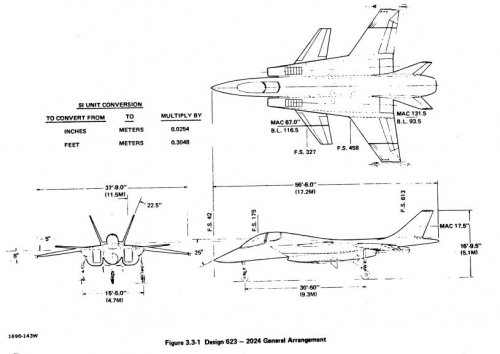
A report about Grumman Model 623-2024;
http://ntrs.nasa.gov/archive/nasa/casi.ntrs.nasa.gov/19790001856_1979001856.pdf
http://ntrs.nasa.gov/archive/nasa/casi.ntrs.nasa.gov/19790001856_1979001856.pdf
Attachments
- Joined
- 26 May 2006
- Messages
- 38,251
- Reaction score
- 20,387
PaulMM said:From a 1979 NASA Contractor report - CR-166365
Different variant with highly swept wings. According to Tony Buttler G-623V V/STOL version was distinguished by highly swept wings, so I suspect this is G-623V.
That design was called Grumman Model 623-2004B;
http://ntrs.nasa.gov/archive/nasa/casi.ntrs.nasa.gov/19820023425_1982023425.pdf
http://ntrs.nasa.gov/archive/nasa/casi.ntrs.nasa.gov/19820023426_1982023426.pdf
Attachments
- Joined
- 26 May 2006
- Messages
- 38,251
- Reaction score
- 20,387
- Joined
- 27 December 2005
- Messages
- 19,225
- Reaction score
- 35,635
- Joined
- 27 December 2005
- Messages
- 19,225
- Reaction score
- 35,635
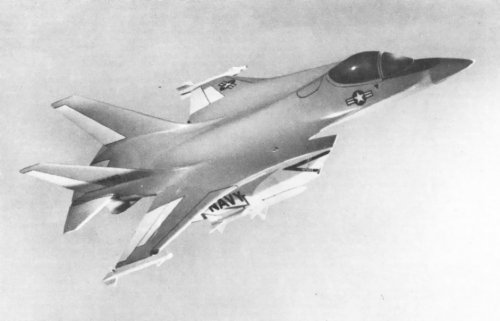
These pics are listed a Grumman model 723 on the NASA CRGIS website, but appear to be Model 623 to me.
Attachments
-
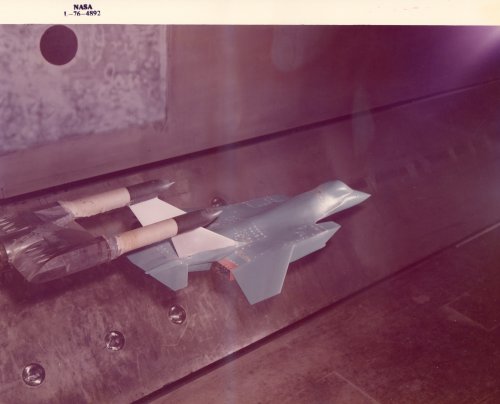 L-76-4892_Grumman-GE_ADEN_model_Test_316_1976.jpg851.4 KB · Views: 562
 -
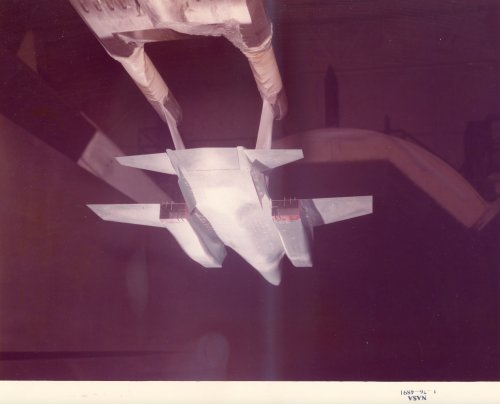 L-76-4891_Grumman-GE_ADEN_model_Test_316_1976.jpg811.2 KB · Views: 497
 -
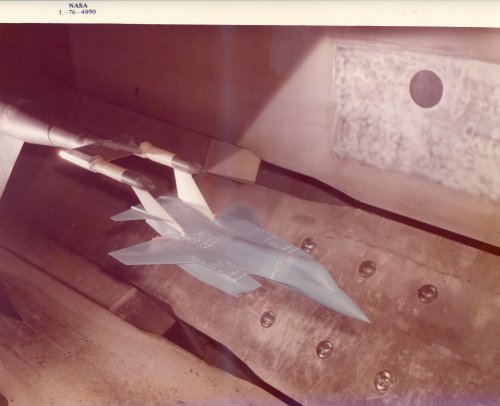 L-76-4890_Grumman-GE_ADEN_model_Test_316_1976.jpg796.2 KB · Views: 466
 -
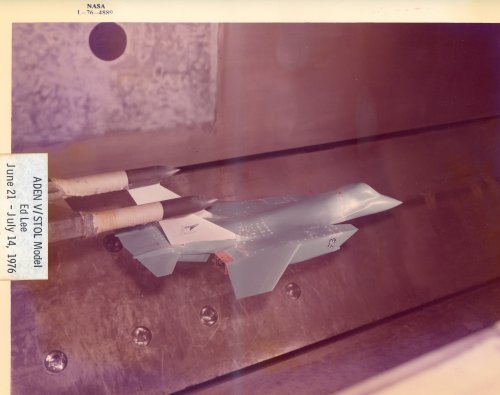 L-76-4889_Grumman-GE_ADEN_model_Test_316_1976.jpg807.1 KB · Views: 450
 -
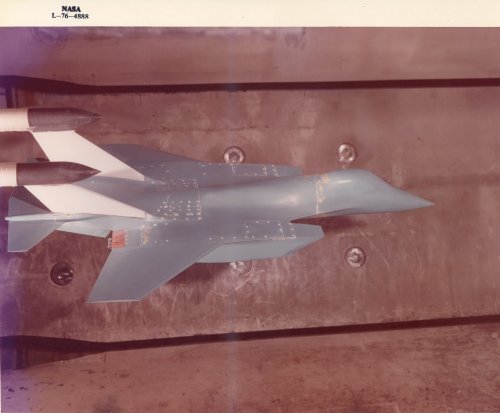 L-76-4888_Grumman_723_Airplane_Model_Test_316_1976.jpg738.6 KB · Views: 459
 -
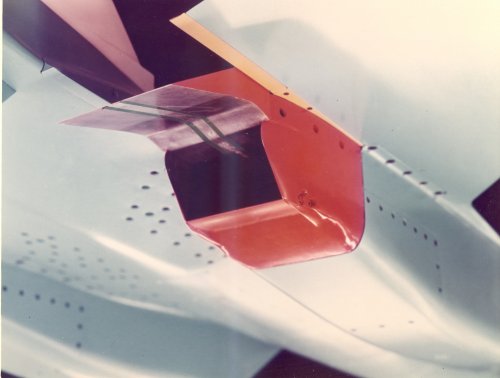 Grumman-GE_vectored_ADEN_nozzle_Test_316_1976.jpg723 KB · Views: 463
 -
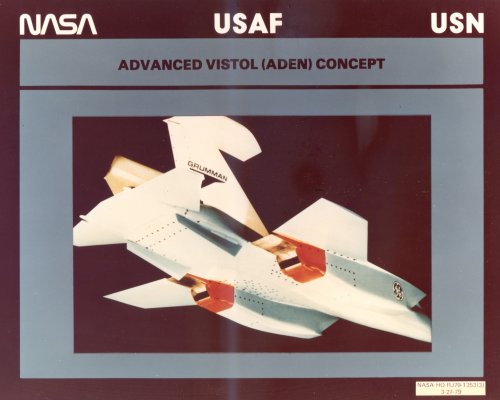 Grumman-GE_ADEN_model_2_Test_316_1976.jpg862.1 KB · Views: 467
 -
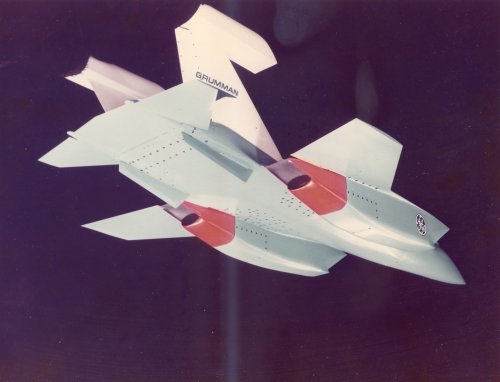 Grumman-GE_ADEN_model_Test_316_1976.jpg817.7 KB · Views: 524
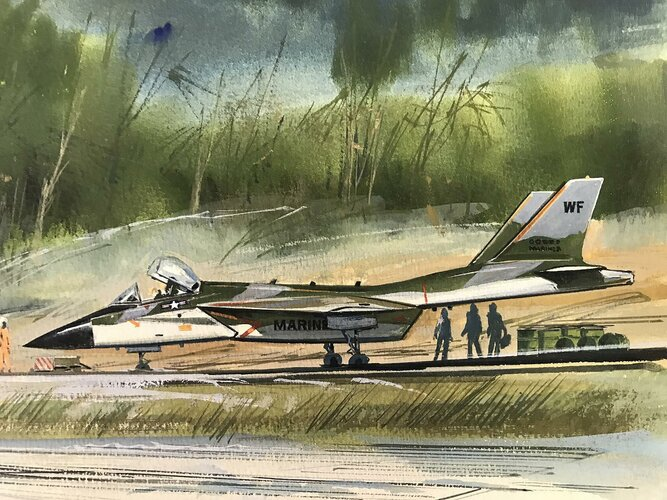
- Joined
- 27 December 2005
- Messages
- 19,225
- Reaction score
- 35,635
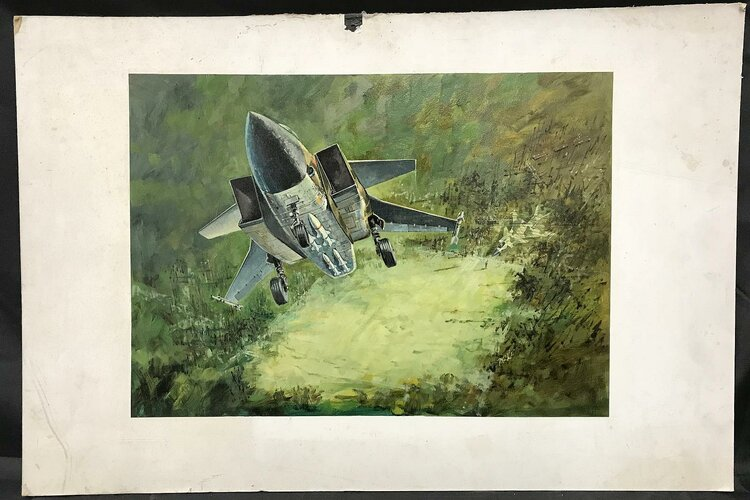
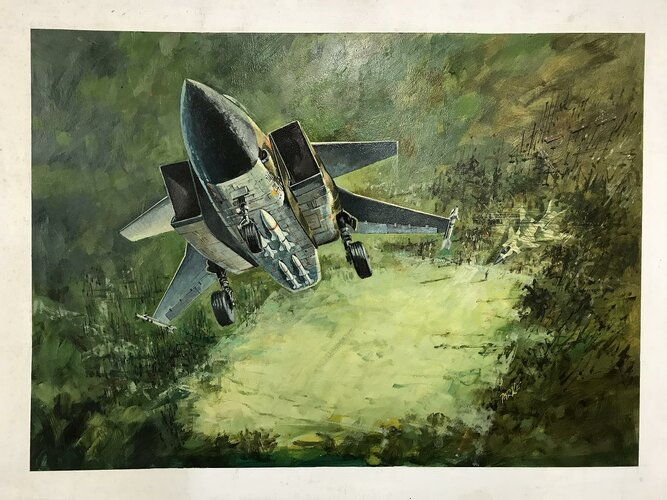
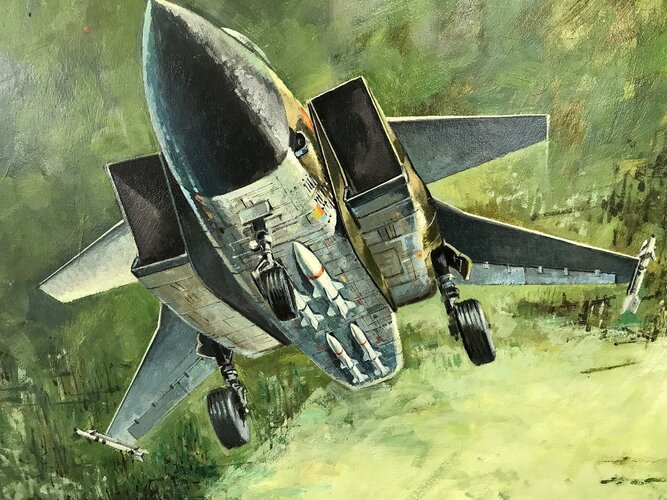
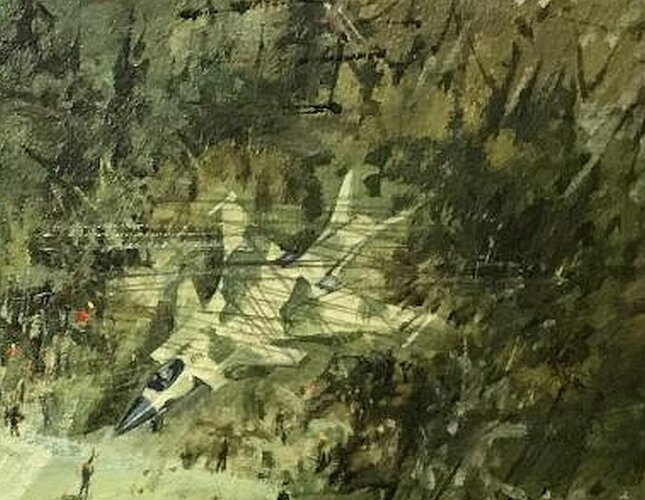
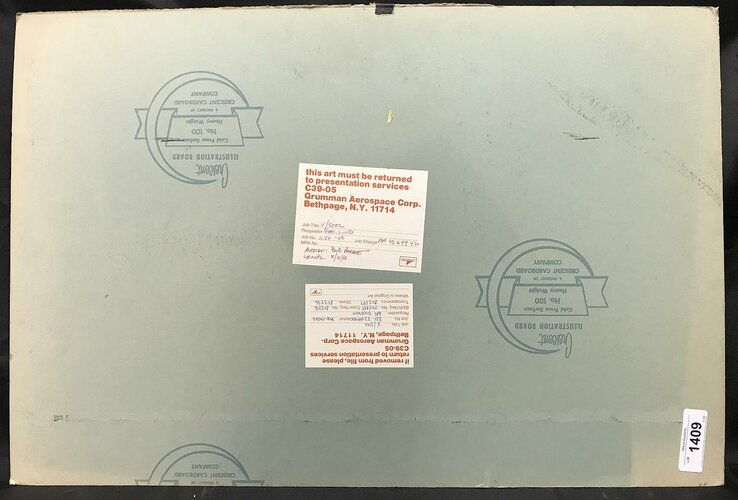
Another beautiful piece of art. Thanks for sharing.

Tomcat vibes from the front.
Tomcat vibes from the front.
Last edited:
- Joined
- 27 December 2005
- Messages
- 19,225
- Reaction score
- 35,635
Similar, but not identical.
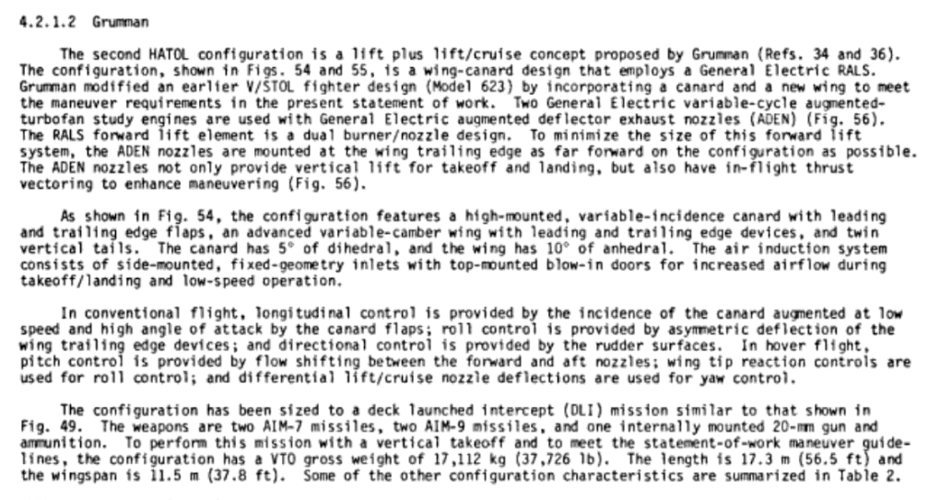
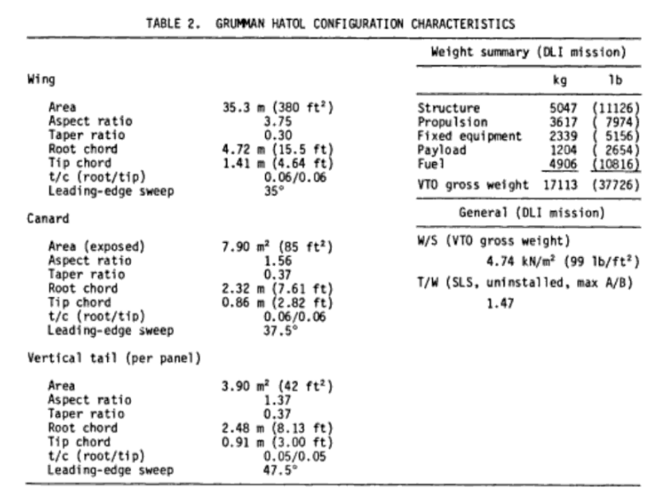
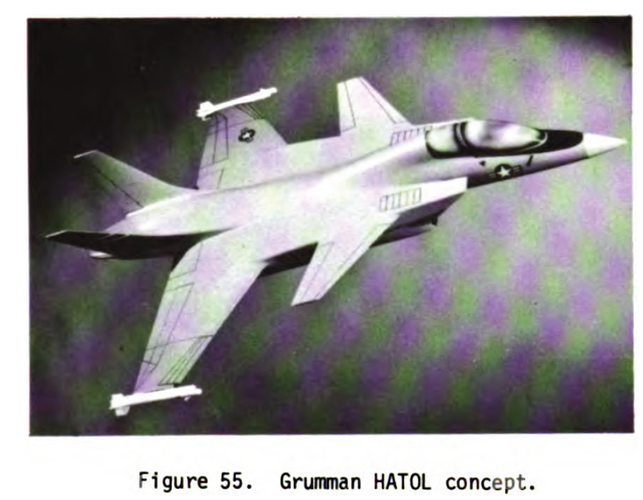
The second HATOL configuration is a lift plus lift/cruise concept proposed by Grumman (Refs.34 and 36). The configuration, shown in Figs.54 and 55, is a wing-canard design that employs a General Electric RALS. Grumman modified an earlier V/STOL fighter design (Model 623) by incorporating a canard and a new wing to meet the maneuver requirements in the present statement of work. Two General Electric variable-cycle augmented-turbofan study engines are used with General Electric augmented deflector exhaust nozzles(ADEN (Fig.56). The RALS forward lift element is a dual burner/nozzle design. To minimize the size of this forward lift system, the ADEN nozzles are mounted at the wing trailing edge as far forward on the configuration as possible. The ADEN nozzles not only provide vertical lift for takeoff and landing, but also have in-flight thrust vectoring to enhance maneuvering(Fig.56).
https://ntrs.nasa.gov/api/citations/19840014464/downloads/19840014464.pdf
The second HATOL configuration is a lift plus lift/cruise concept proposed by Grumman (Refs.34 and 36). The configuration, shown in Figs.54 and 55, is a wing-canard design that employs a General Electric RALS. Grumman modified an earlier V/STOL fighter design (Model 623) by incorporating a canard and a new wing to meet the maneuver requirements in the present statement of work. Two General Electric variable-cycle augmented-turbofan study engines are used with General Electric augmented deflector exhaust nozzles(ADEN (Fig.56). The RALS forward lift element is a dual burner/nozzle design. To minimize the size of this forward lift system, the ADEN nozzles are mounted at the wing trailing edge as far forward on the configuration as possible. The ADEN nozzles not only provide vertical lift for takeoff and landing, but also have in-flight thrust vectoring to enhance maneuvering(Fig.56).
https://ntrs.nasa.gov/api/citations/19840014464/downloads/19840014464.pdf
Last edited:
A very strange,the Grumman G-623 mention here,but with canard !.
(Slightly) improved version from ieee paper "The All-Electric Fighter Airplane Flight Control Issues, Capabilities, and Projections" :

- Joined
- 22 April 2012
- Messages
- 2,274
- Reaction score
- 2,847
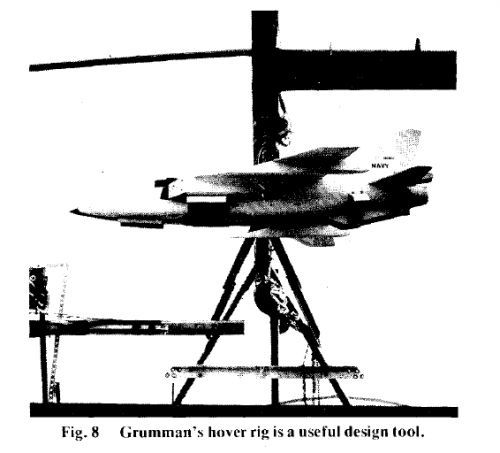
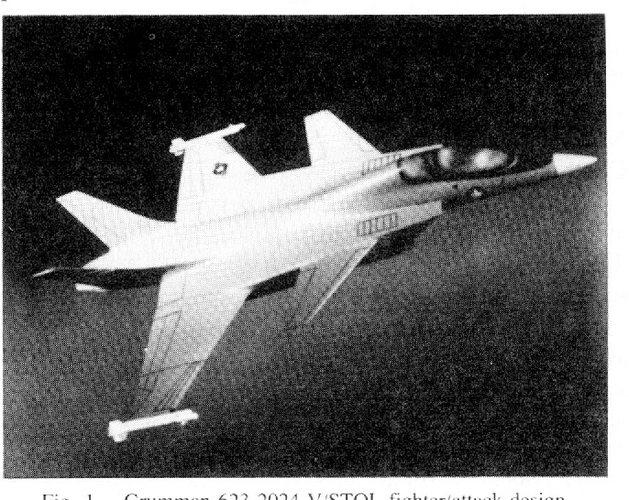
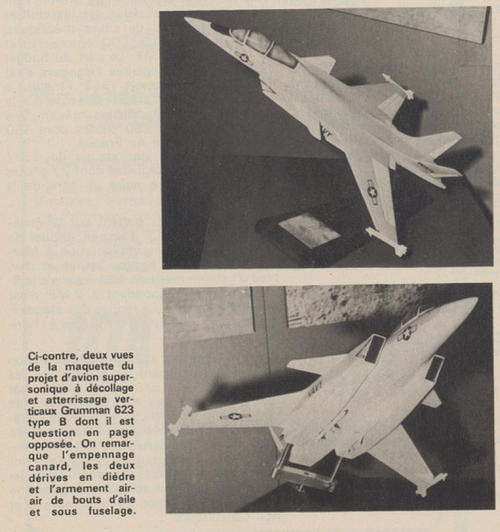
A few bits and pieces on the Grumman Model 623.
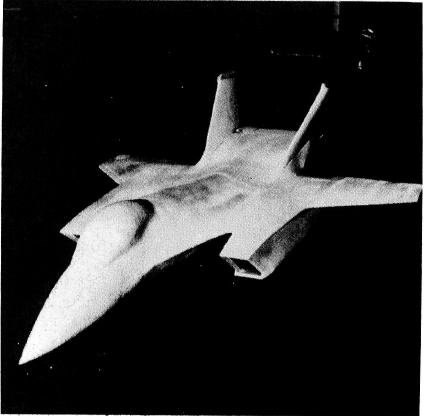
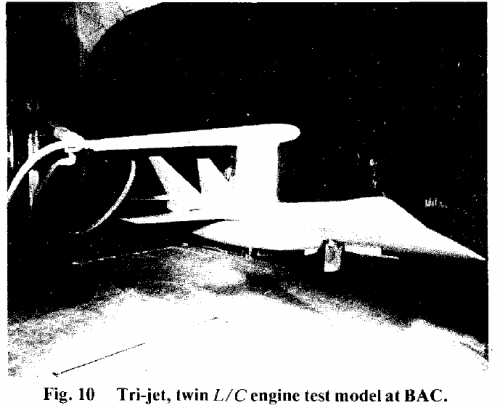
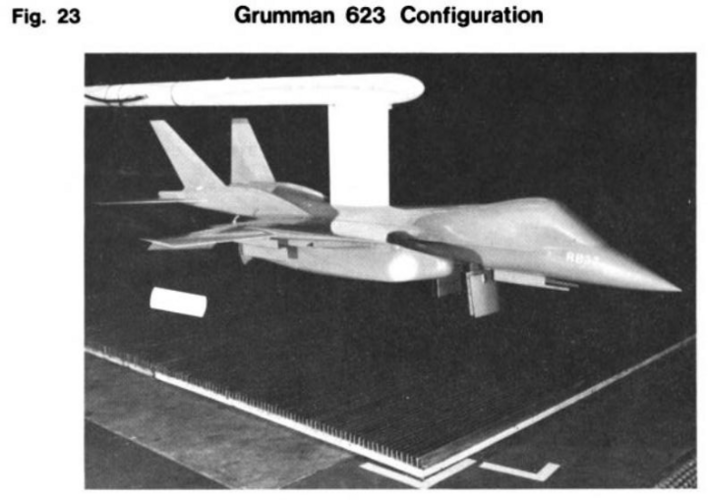
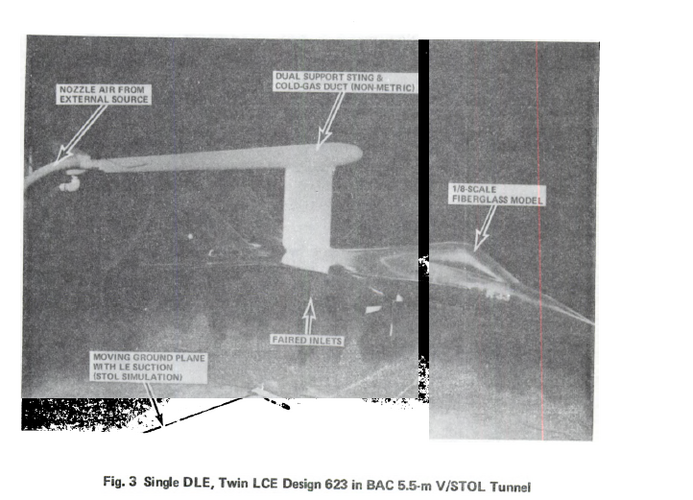
The first image is of a wind tunnel model from a report entitled "A Review of Some Fundamentals of Lifting Jet Interference with Particular Reference to US Navy Type A and B Concepts". The Paper is by P. G. Knott of the BAe Warton Division, which had performed wind tunnel testing for Grumman.
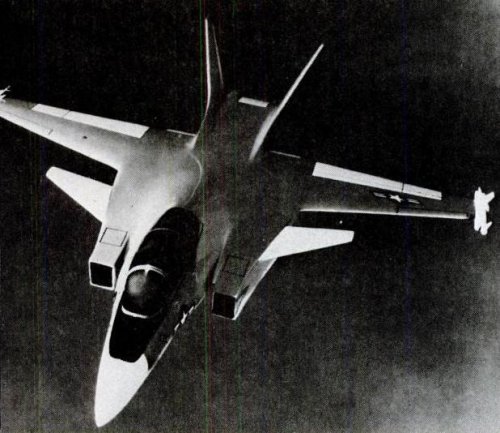
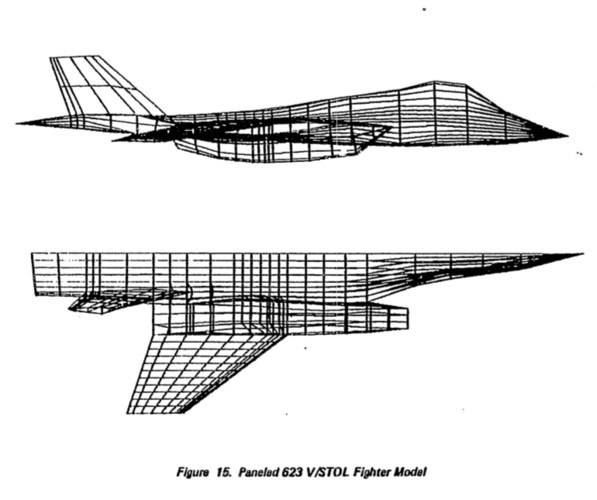
The second image is a paneled model from NASA Contractor Report 166466, by Boeing and covering flow analysis of nozzle installations with strong airplane flow interactions, and gives a good impression of the aircraft's shape.
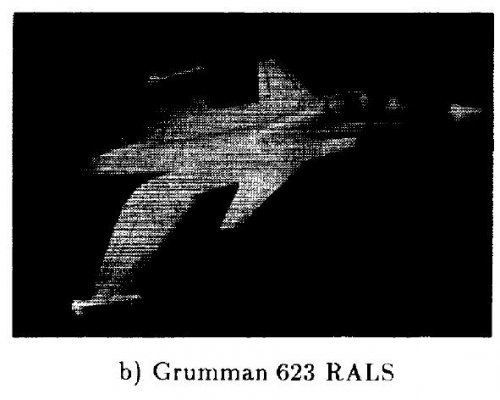
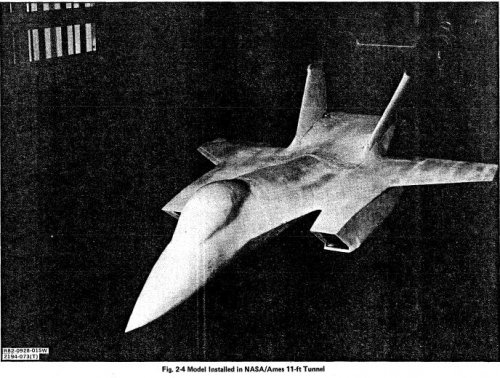
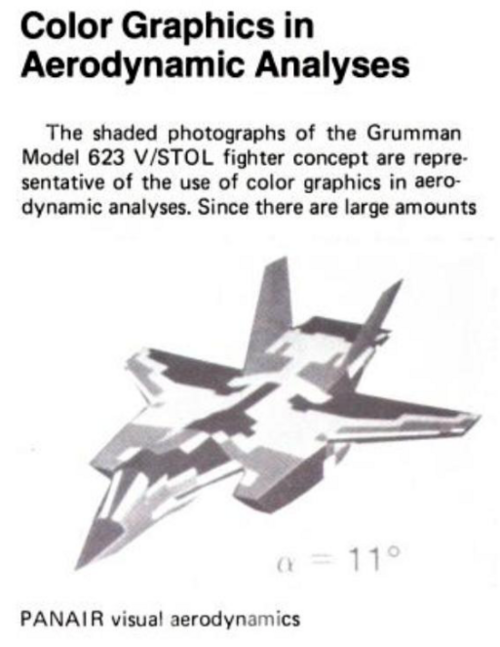
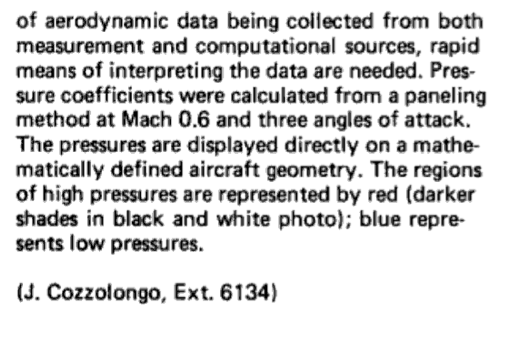
Images 3 and 4 relate to the use of the colour graphics in aerodynamic analysis using the Model 623 as an example. they are from the NASA Ames Research Center Research and Technology Annual Report, 1982.
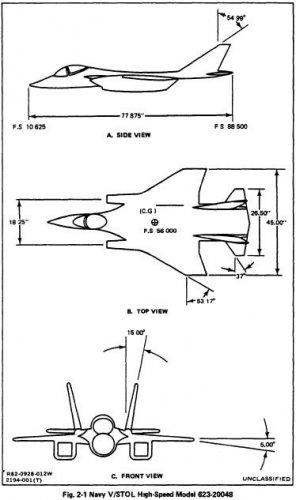
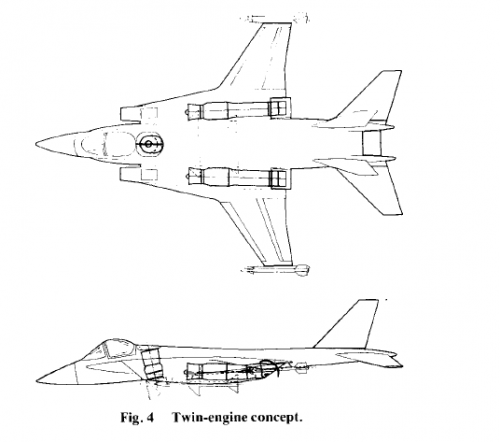
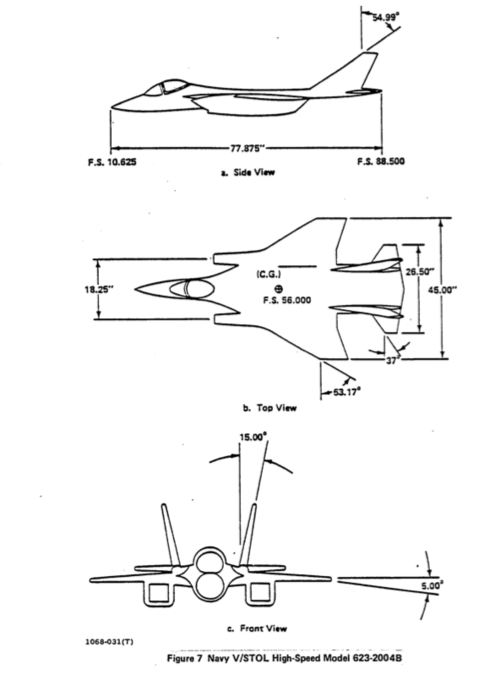
Also attached is a higher quality capture of the wind tunnel model dimensions plan Hesham posted previously. This is used in a three-part series of NASA reports produced by Grumman (Contractor Reports 166146, 166365 and 166147) that compared axisymmetric and non-axisymmetric (e.g. the Augmented Deflector Exhaust Nozzle - ADEN that the Model 623 was designed around and the derivative CTOL Asymmetric Load Balanced Exhaust Nozzle - ALBEN), Scaling up, the model was 1/8 scale, gives the following dimensions for the full size aircraft:
Length: 51ft 11"
Span: 30ft
Tailplane Span: 17ft 8"
Span between engine axis: 12ft 2"
All these images cover the Model 623-2004B, not the later 623-2024. The two had different baseline potential IOC dates, the 2004 being 1985 and the 2024 being 1995.
The first image is of a wind tunnel model from a report entitled "A Review of Some Fundamentals of Lifting Jet Interference with Particular Reference to US Navy Type A and B Concepts". The Paper is by P. G. Knott of the BAe Warton Division, which had performed wind tunnel testing for Grumman.
The second image is a paneled model from NASA Contractor Report 166466, by Boeing and covering flow analysis of nozzle installations with strong airplane flow interactions, and gives a good impression of the aircraft's shape.
Images 3 and 4 relate to the use of the colour graphics in aerodynamic analysis using the Model 623 as an example. they are from the NASA Ames Research Center Research and Technology Annual Report, 1982.
Also attached is a higher quality capture of the wind tunnel model dimensions plan Hesham posted previously. This is used in a three-part series of NASA reports produced by Grumman (Contractor Reports 166146, 166365 and 166147) that compared axisymmetric and non-axisymmetric (e.g. the Augmented Deflector Exhaust Nozzle - ADEN that the Model 623 was designed around and the derivative CTOL Asymmetric Load Balanced Exhaust Nozzle - ALBEN), Scaling up, the model was 1/8 scale, gives the following dimensions for the full size aircraft:
Length: 51ft 11"
Span: 30ft
Tailplane Span: 17ft 8"
Span between engine axis: 12ft 2"
All these images cover the Model 623-2004B, not the later 623-2024. The two had different baseline potential IOC dates, the 2004 being 1985 and the 2024 being 1995.
Attachments
Last edited:
- Joined
- 22 April 2012
- Messages
- 2,274
- Reaction score
- 2,847
Cross post from the G-607 thread, and thanks to @hesham .
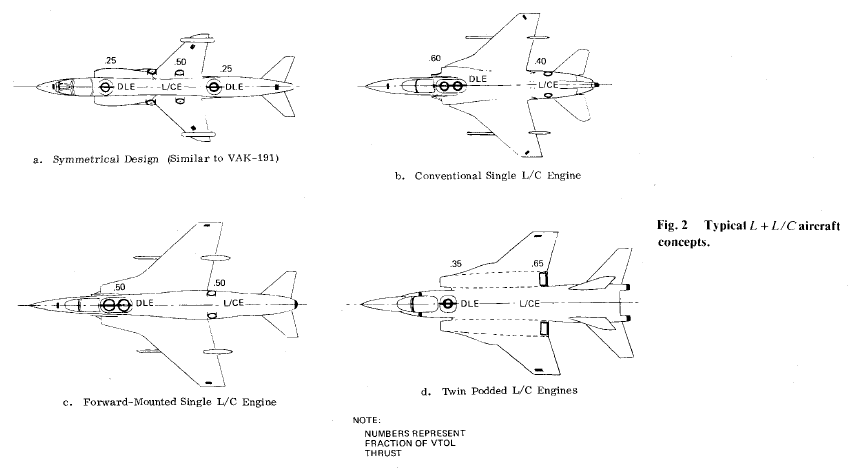
Concept D in the attached is the basic, original, Grumman 623 configuration. It is notable that the 623 configuration only uses a single Direct Lift Engine (DLE). This is depicted on the various models and artists impressions in the posts above as either a single jet efflux or single squarish intake cover behind the cockpit. The later VFA-V/STOL concepts that utilised a single F401 (Convair Model 200 and Vought V-521) proposed the use of two DLEs, 13,000lb each in the Model 200. Based on the ratios used here, and assuming a similar weight, the single DLE in the Model 623 would have probably required a higher thrust, perhaps 15,000lbs. For the era, this three post V/STOL configuration consisting of 2D nozzles on the lift/cruise engines (presumably YJ101s with ADEN) and a single DLE appears quite elegant, in principle, as it minimises the space and weight required for the DLE portion of the lift system.
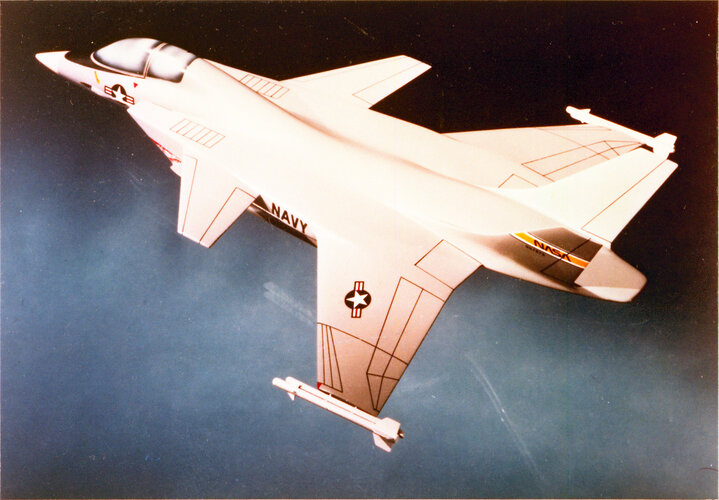
For completeness, also attached is some additional info on the later Model 623-2024 canard design from the NASA publication V/STOL Concepts in the United States - Past Present and Future by W. P. Nelms and S. B. Anderson, April 1984.
Concept D in the attached is the basic, original, Grumman 623 configuration. It is notable that the 623 configuration only uses a single Direct Lift Engine (DLE). This is depicted on the various models and artists impressions in the posts above as either a single jet efflux or single squarish intake cover behind the cockpit. The later VFA-V/STOL concepts that utilised a single F401 (Convair Model 200 and Vought V-521) proposed the use of two DLEs, 13,000lb each in the Model 200. Based on the ratios used here, and assuming a similar weight, the single DLE in the Model 623 would have probably required a higher thrust, perhaps 15,000lbs. For the era, this three post V/STOL configuration consisting of 2D nozzles on the lift/cruise engines (presumably YJ101s with ADEN) and a single DLE appears quite elegant, in principle, as it minimises the space and weight required for the DLE portion of the lift system.
For completeness, also attached is some additional info on the later Model 623-2024 canard design from the NASA publication V/STOL Concepts in the United States - Past Present and Future by W. P. Nelms and S. B. Anderson, April 1984.
Attachments
Last edited:

- Joined
- 26 May 2006
- Messages
- 38,251
- Reaction score
- 20,387
(Slightly) improved version from ieee paper "The All-Electric Fighter Airplane Flight Control Issues, Capabilities, and Projections" :
View attachment 669734
From this report
Attachments
Darthtabby
ACCESS: Restricted
- Joined
- 9 September 2021
- Messages
- 34
- Reaction score
- 71
Similar, but not identical.
The second HATOL configuration is a lift plus lift/cruise concept proposed by Grumman (Refs.34 and 36). The configuration, shown in Figs.54 and 55, is a wing-canard design that employs a General Electric RALS. Grumman modified an earlier V/STOL fighter design (Model 623) by incorporating a canard and a new wing to meet the maneuver requirements in the present statement of work. Two General Electric variable-cycle augmented-turbofan study engines are used with General Electric augmented deflector exhaust nozzles(ADEN (Fig.56). The RALS forward lift element is a dual burner/nozzle design. To minimize the size of this forward lift system, the ADEN nozzles are mounted at the wing trailing edge as far forward on the configuration as possible. The ADEN nozzles not only provide vertical lift for takeoff and landing, but also have in-flight thrust vectoring to enhance maneuvering(Fig.56).
https://ntrs.nasa.gov/api/citations/19840014464/downloads/19840014464.pdf
Some of the diagrams in the NASA document seem to be for the General Dynamics design rather then the Grumman one, but would I be correct in interpreting the RALS system as a combination of thrust vectoring the engine exhaust plus drawing air from the compressor stage and running it through ducting? Though the description of the forward lift element using a "burner/nozzle design" suggests the ducted airflow drawn from the compressor would be run through a combustion stage to increase thrust?
- Joined
- 27 December 2005
- Messages
- 19,225
- Reaction score
- 35,635
Yes the ducted air passes into a burner to increase thrust. Otherwise it would be just vectored thrust like the Harrier.Some of the diagrams in the NASA document seem to be for the General Dynamics design rather then the Grumman one, but would I be correct in interpreting the RALS system as a combination of thrust vectoring the engine exhaust plus drawing air from the compressor stage and running it through ducting? Though the description of the forward lift element using a "burner/nozzle design" suggests the ducted airflow drawn from the compressor would be run through a combustion stage to increase thrust?
Darthtabby
ACCESS: Restricted
- Joined
- 9 September 2021
- Messages
- 34
- Reaction score
- 71
That being the case it seems like it could still suffer from issues with surface heating and hot gas reingestion.
American Secret Projects indicates the VFAX proposal used two J-101s (though the data at the end of the chapter says YJ-101s) and does describe the lift engine for the non-VFAX 623V V/STOL variant as an enlarged and uprated XJ99.
Something that I wonder with such a triangular configuration of engines is whether the aircraft could land vertically if it lost even one of the three engines. I especially question if it could land if it lost the forward lift engine. It seems to me that the Model 200 and G607 might at least be able to land vertically if they lost one of the lift engines, though I'm not sure if the ability to get home on the pair of lift engine if the lift/cruise engine failed would extend to doing a vertical landing.
Cross post from the G-607 thread, and thanks to @hesham .
Concept D in the attached is the basic, original, Grumman 623 configuration. It is notable that the 623 configuration only uses a single Direct Lift Engine (DLE). This is depicted on the various models and artists impressions in the posts above as either a single jet efflux or single squarish intake cover behind the cockpit. The later VFA-V/STOL concepts that utilised a single F401 (Convair Model 200 and Vought V-521) proposed the use of two DLEs, 13,000lb each in the Model 200. Based on the ratios used here, and assuming a similar weight, the single DLE in the Model 623 would have probably required a higher thrust, perhaps 15,000lbs. For the era, this three post V/STOL configuration consisting of 2D nozzles on the lift/cruise engines (presumably YJ101s with ADEN) and a single DLE appears quite elegant, in principle, as it minimises the space and weight required for the DLE portion of the lift system.
For completeness, also attached is some additional info on the later Model 623-2024 canard design from the NASA publication V/STOL Concepts in the United States - Past Present and Future by W. P. Nelms and S. B. Anderson, April 1984.
American Secret Projects indicates the VFAX proposal used two J-101s (though the data at the end of the chapter says YJ-101s) and does describe the lift engine for the non-VFAX 623V V/STOL variant as an enlarged and uprated XJ99.
Something that I wonder with such a triangular configuration of engines is whether the aircraft could land vertically if it lost even one of the three engines. I especially question if it could land if it lost the forward lift engine. It seems to me that the Model 200 and G607 might at least be able to land vertically if they lost one of the lift engines, though I'm not sure if the ability to get home on the pair of lift engine if the lift/cruise engine failed would extend to doing a vertical landing.

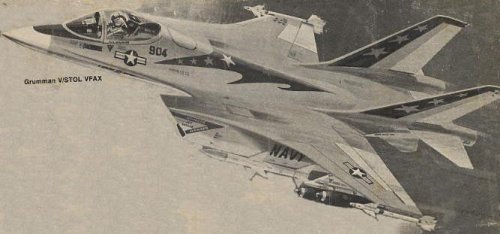
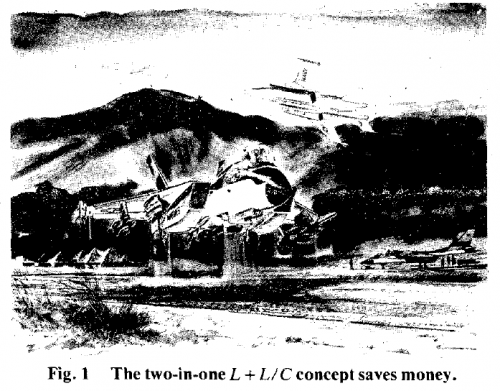
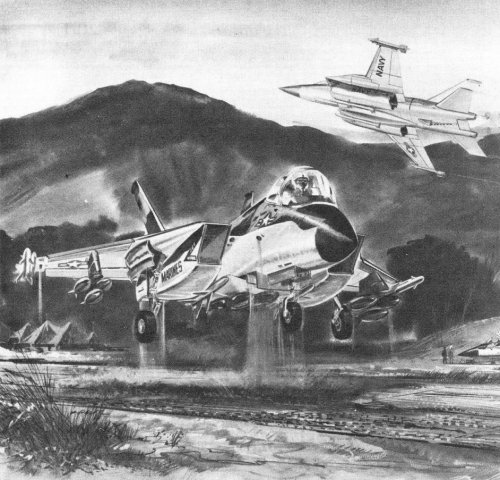
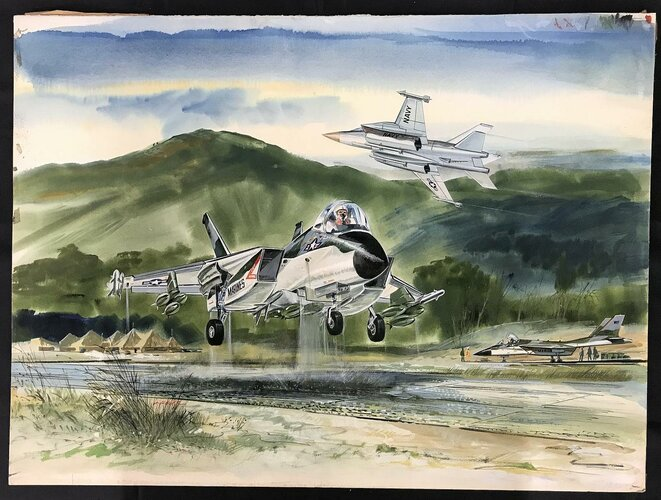
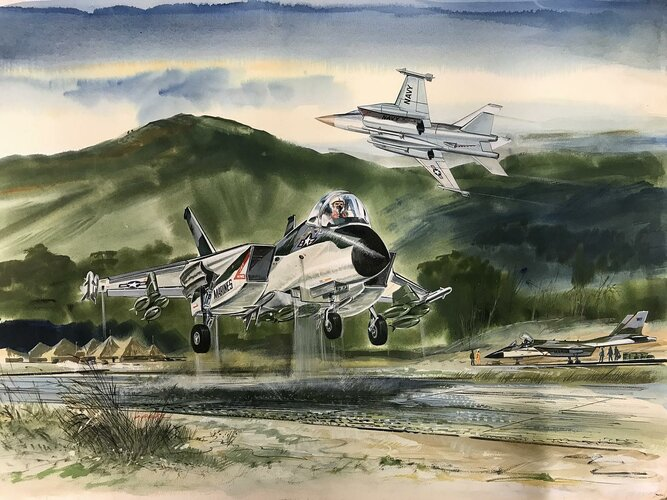
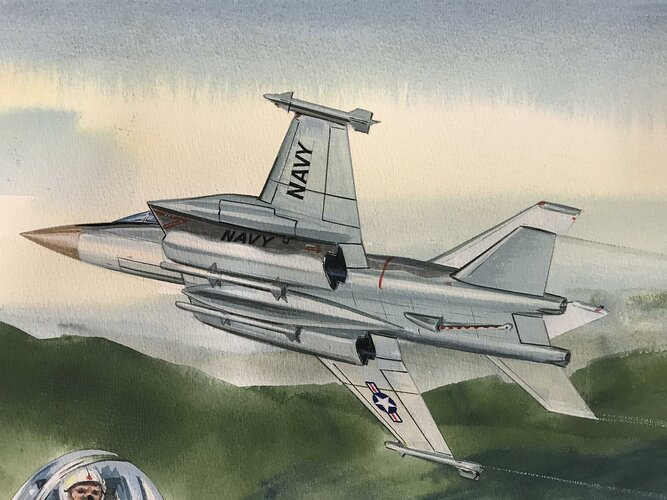
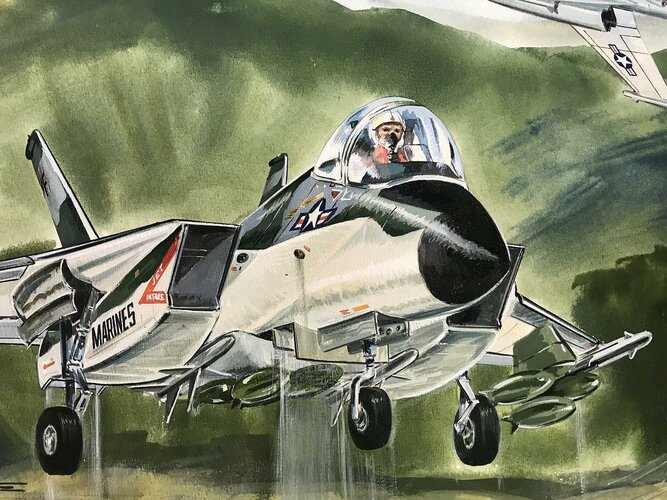
I recently noticed that this illustration included both the V/STOL and CTOL variants

Note the tailhook on the one flying by:

Note the tailhook on the one flying by:

Scott Kenny
ACCESS: USAP
- Joined
- 15 May 2023
- Messages
- 19,511
- Reaction score
- 27,956
That is such an interesting aircraft shape.
Darthtabby
ACCESS: Restricted
- Joined
- 9 September 2021
- Messages
- 34
- Reaction score
- 71
Does anyone know any good sources to find out more about the early versions of the G-623 and G-623V (the VFAX version and the VSTOL variant with the direct lift engine)? American Secret Projects has some info in the Chapter on Lightweight Fighters but its rather limited.
Do have the complete picture of the wheelIt (fig. 55) looks very close (I can't see obvious differences) to the top view of the hiding-in-the-woods article
This also from Flight Journal, June 2003 (which is Fig. 11 above ?)
View attachment 669721
Similar threads
-
 VFAX (1974) / NACF Projects (Pre F/A-18 concepts)
- Started by overscan (PaulMM)
- Replies: 56
-
REQUIREMENT: US Navy VFA - V/STOL Fighters for Sea Control Ships
- Started by overscan (PaulMM)
- Replies: 5
-

-

-
 Teledyne Ryan VTOL/VSTOL/STOL projects (NOT liftfan/Fan-In-Wing)
- Started by EEP1A
- Replies: 22