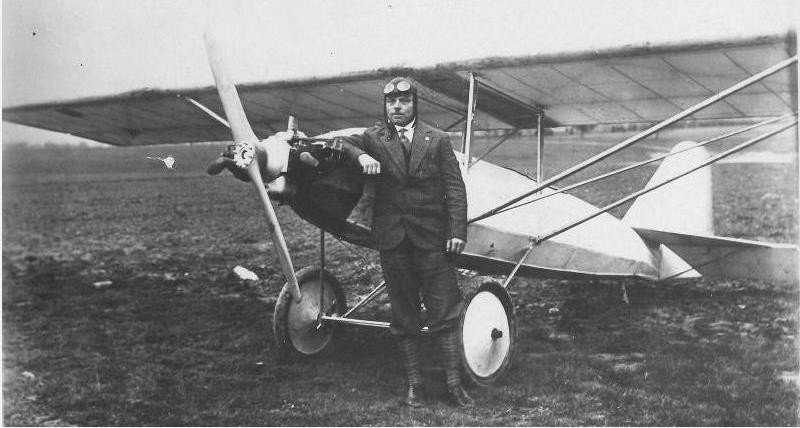
For Müller brothers,why there were no GMG.III or GMG.IV ?.
 
For Müller brothers,why there were no GMG.III or GMG.IV ?.

That question was covered by ADL (Arbeitsgemeinschaft Deutsche Luftfahrthistorik) member Dr. Ernst Vocke on p.54 of his Die Flugzeuge der Firma GMG (Gebrüder Müller, Griesheim).

Für die Luftfahrthistorie bleibt noch eine Frage: Warum wurde die letzte Konstruktion als GMG V bezeichnet? Wo blieben die Muster GMG III und IV? Eine mögliche, aber bisher nicht beweisbare Annahme ist, daß die beiden großen Segelflugzeu ge „Darmstadt I“ und „Württemberg“ werksintern als Typ III und IV bezeichnet wurden. Werk-Nummern zählte GMG leider nur bei Motorflugzeugen.

Machine Translation: For aviation history, a question remains: Why was the last design designated GMG V? What became of the GMG III and IV models? One possible, but as yet unprovable, guess is that the two large gliders, "Darmstadt I" and "Württemberg," were internally designated Type III and IV. However, GMG only applied work numbers to powered aircraft.

Dr. Vocke goes on to quote a Haller-Flugzeuge brochure which states that the GMG I „folgten durch ständige Verbesserung der Flugleistungen die Typen II, II a, III und IV“ (or the GMG I was "followed by Types II, II a, III, and IV"). However, that claim is largely dismissed as advertising hyperbole.
 
On the GMG V, I can add a few Vocke details to @Maveric's contribution to the Rudolf Haller Airplane Projects thread ...

The GMG V was an improved GMG II built at Griesheim in 1932. But its design origin did not come directly from the Gebrüdern Müller. Engineering student Willy Hackenschmidt revised the GMG II design as a theoretical exercise for his TH Darmstadt diploma thesis.

The revised airframe in that thesis featured a new, 2-spar wing (for a stronger fuselage connection) and other aerodynamic improvements (including main wheel spats). Deep cockpit glazing (with sideways-sliding windows) replaced the GMG II's individual folding combing fairings. In all other respects, the Hackenschmidt thesis design was as per the Gebrüdern Müller original.

In 1932, Munich engineer Rudolf Haller decided to commission the construction of such an aircraft. Haller's main changes to the thesis design were substituting N-struts for the planned V types. Haller also chose two alternative engine types. The GMG V originally flew with an Argus As 16 HO4. Later, as D-EMMY, the GMG V was re-engined with a BMW Xa 5-cylinder radial.

The full designation of the built machine was 'GMG V - Haller' for which the Haller-Flugzeuge firm of Munich held exclusive distribution rights. It is not clear whether Rudolf Haller intended to build series aircraft in Munich or continue to commission them from Gebrüdern Müller in Griesheim. A moot point since no orders followed.
 
Goldstein,

Came as a private on 17.09.1917 as a mechanic to the aviation department A 298th
Release on Fea 1 Schleißheim on 6.5.1919
The native of Schwaben came to Saarbrücken in 1923, opened a motor vehicle business and began building a light aircraft according to his own plans. Its maiden flight on 16 April 1930 became an epoch-making event of the Saarland aviation and established Goldstein's reputation as a "pioneer of the Saarland aviation industry".
Built in about 1929 a two-cylinder (but can also have been a modified Daimer F 7502). The engine was installed in the aircraft.
In 1929 Goldstein made his pilot license A . Was reported in August 1930 by the air police and then sentenced by the court.
Reason: Unauthorized aircraft flown on airfield without a permit.

https://histaviation.com/goldstein.html
 

Attachments

  • 4.jpg
    4.jpg
    74.8 KB · Views: 4
Goldstein ...

That machine translation needs some unpacking.

The man in question is Balthasar Goldstein (1898–1986). As an aviation pioneer of Saarland, searching him is made trickier by the naming of the busy Balthasar-Goldstein-Straße near Saarbrücken Airport (SCN).

"aviation department A 298th" = Bayerische Flieger-Abteilung Artillerie 298. That was a unit of the Königlich-Bayerischen Fliegertruppe rather than the Luftstreitkräfte - which would have appended a 'b' (for bayrisch) to the squadron number.

FF A 298b was the last Bavarian artillery-spotting unit formed (corresponding roughly to when Goldstein joined the squadron in 1917). FF A 298b operated DFW C.V aircraft on the Western Front until returning to Bavaria in Nov 1918 - being dissolved at Fliegerhorst Fürth in the Franconia region on 21 Nov 1918 (although Goldstein, it seems, would not be demobilised for a further six months).

"Fea 1 Schleißheim" refers to FEA I (Fliegerersatzabteilung I) or Flier Replacement Unit I located at Oberschleißheim north of Munich. As its name suggests, FEA I was actually a unit for training replacement crews (later just for replacement pilots). But, with the war's end, its role switched to demobbing squadron personnel.

This part ...

The native of Schwaben came to Saarbrücken in 1923, opened a motor vehicle business and began building a light aircraft according to his own plans. Its maiden flight on 16 April 1930 became an epoch-making event of the Saarland aviation and established Goldstein's reputation as a "pioneer of the Saarland aviation industry".

Was lifted directly from an original in the Saarbrücker Zeitung, No. 248, 25/26 October 1986:

Der gebürtige Schwabe kam 1923 nach Saarbrücken, eröffnete hier einen Kfz-Betrieb und begann mit dem Bau eines Leichtflugzeuges nach eigenen Plänen. Dessen Jungfernflug am 16. April 1930 wurde zu einem epochemachenden Ereignis der saarländischen Luftfahrt und begründete Goldsteins Ruf als "Pionier des saarländischen Flugsports".

 

Similar threads

Back
Top Bottom