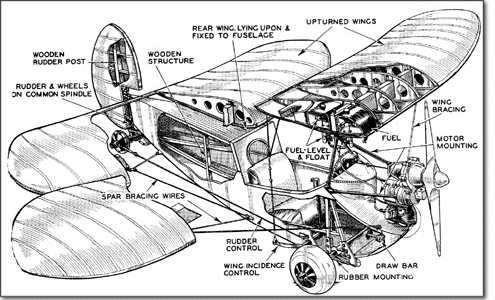
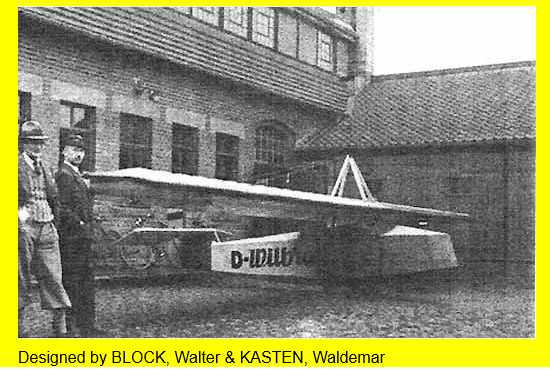
From the Bruno Lange books : Sächsische Flugzeugindustrie GmbH (Dresden) (SFI) Gammelin Ga1 "Kombinations-Flugzeug"

Two seater , the 9,70m wing can be enlarged to 12,95m , and it can get side windows to close the cockpit becoming then sport/school/travel plane .

Vmax 175 km/h . Hirth HM 60 R-1 engine . It was tried at Rechlin in 1934 .

Picture : from Herr Karlheinz Kens :

View attachment 643330

That aircraft is interesting as it was designed by Erich Gammelin. He was a successfull production manager at Dietrich- and Raab-Katzenstein-facility in Cassel and Crefeld during the 20s and he continued to work with Antonius Raab until 1932. When both separated from each other, Gammelin became technical director of S.F.I. in 1934. Initiallx I expected, that the S.F.I. Ga.1 was some kind of further development of the RaKa RK9 Grasmücke, however, Kens picture shows a completely different design.

By the way, Gammelin left S.F.I in Feb. 1935. The company was dissolved in 1937.
 
... not quite, sorry.
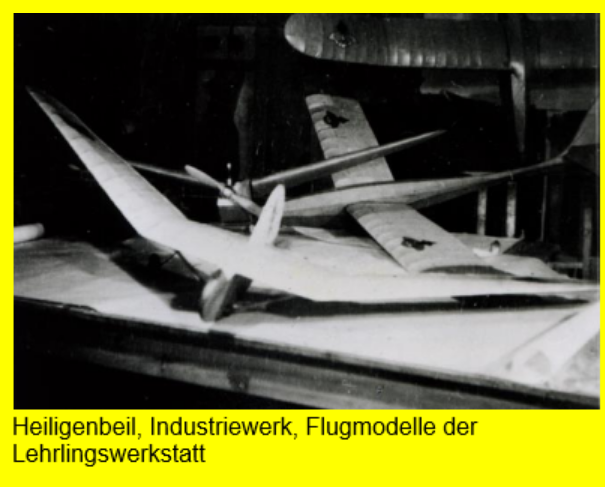
The Industriewerke Heiligenbeil GmbH were a subsidiary of the Schichau-Werke Elbing (mainly known for their shipyrads, but also busy in the field of locomotives, and other "heavy metal"), and worked as a repair shop for aircraft and aviation engines. So, the staff their had to have a profound knowledge of aviation matters, nevertheless, I didn't find any indigenous aircraft design.
This photo is described as "flying models from the apprentices' training workshop", so certainly NOT representing any true aircraft design, though they are decorated with iron crosses. ;)
 
... not quite, sorry.
The Industriewerke Heiligenbeil GmbH were a subsidiary of the Schichau-Werke Elbing (mainly known for their shipyrads, but also busy in the field of locomotives, and other "heavy metal"), and worked as a repair shop for aircraft and aviation engines. So, the staff their had to have a profound knowledge of aviation matters, nevertheless, I didn't find any indigenous aircraft design.
This photo is described as "flying models from the apprentices' training workshop", so certainly NOT representing any true aircraft design, though they are decorated with iron crosses. ;)
Indeed: Building model aeroplanes (and other models) was part of the apprenticeship training. But very interesting nevertheless.
 
Last edited:
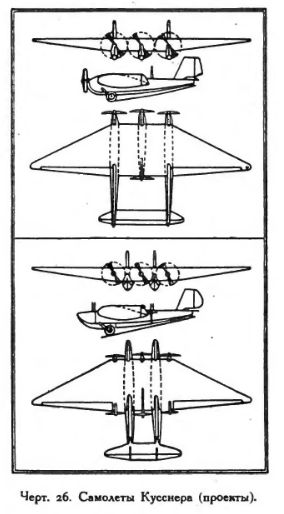
This design was shown in "Der deutsche Sportflieger" 1936 in an article by Adolf Piskorsch (Odrsch bei Troppau) about the "Schwingenflieger"
Troppau was in the "Sudetenland" a country of Czechoslovakia , where the people spoke German .

The sketch shows a proposal of 1934 for a man powered aircraft with "rotating and pulsating" wing ends .

Here two more proposal by PISKORSCH : (source "Flugwesen" 1 and 5 1934) (Flugwesen was published by the "Verbande Deutscher Flieger in der Tschechoslowakischen Republic")

Model-1 and Model-2,

https://wright.libraryhost.com/repositories/2/archival_objects/208026
 

Attachments

  • 5.png
    5.png
    49.2 KB · Views: 55
  • 6.png
    6.png
    50.3 KB · Views: 69
From, Klassiker der Luftfahrt 2018-05,

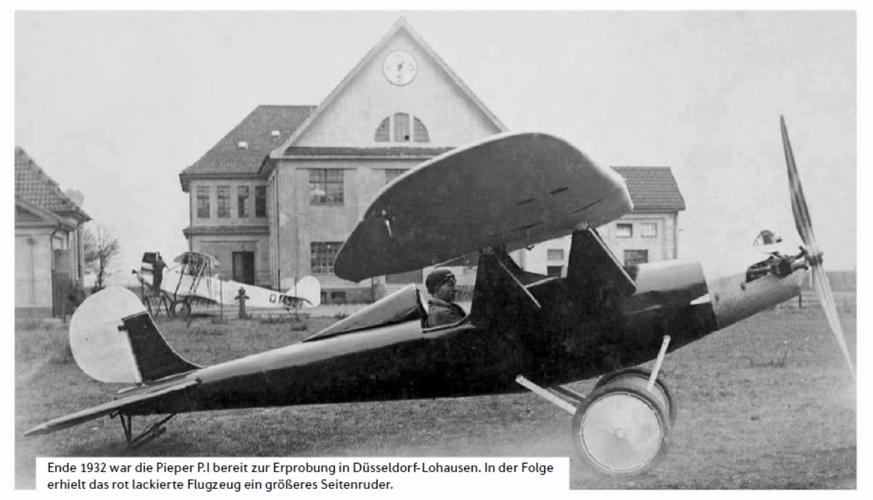
here is the Heinz Pieper P.I monoplane.
 

Attachments

  • 27.png
    27.png
    878.7 KB · Views: 69
The project is there,without any Info,just a hint,I asked about who know anything about it ?.

"There" where? "hint" what?

I was asking for a quote from your source ... because I can't see it there. What else am I missing?
 
Hi,

does anyone hear about German designer called Nebel,and
his activies between 1930 to 1931 ?.
 
Hi,

does anyone hear about German designer called Nebel,and
his activies between 1930 to 1931 ?.
According to Lange in the Typenhandbuch Rudolf Nebel worked with Walter Riedel in 1930 for the Raketenflugplatz Berlin which was an association for space travel.
 

From Flugsport 1/1925 (machine translation):

Ahrens & Schulz Type L 1 high-winged aircraft.

The aircraft is built as a sport or training aircraft, with student and instructor seated in tandem. The controls are of stick-type, but hand-wheel controls can be installed upon request. The forward controls are designed for removal to allow for passenger carrying. The 'parasol' arrangement of the wing above the fuselage provides the best visibility. Two tie rods, one behind the other, run along the outer edge of the fuselage, while an inner canopy connects the wings to the fuselage. The fuselage, with its rectangular cross-section and streamlined shape, is a [... gap in original OCR]

The Ahrens & Schulz Type L.1 high-wing aircraft featured a welded steel tube structure covered with cellulose-coated linen. The split wing is supported by two struts from the fuselage and by two cables from the keel. The elevator, connected by a tube, is mounted on the control surfaces.

The unbalanced control surfaces are made from steel tubing covered with linen and are operated by cables guided over pulleys.

The undercarriage chassis has a normal design and is made of profiled steel tubing, with the front strut braced with cables.

The aircraft's takeoff length is approximately 50-70 m. Manoeuvrability is very good; the aircraft remains stable in turns and has no tendency to skid.

A 50 hp air-cooled engine is normally installed; however, a correspondingly more powerful engine between 50 and 80 hp can also be installed.
 
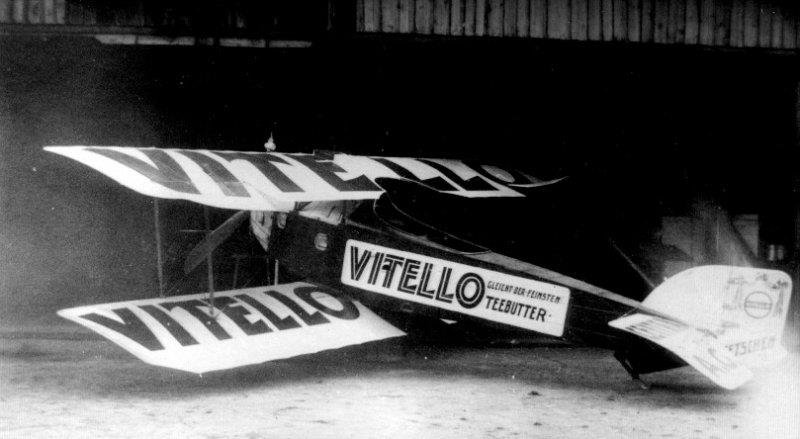
This is not an in-house design! It's more likely a Fokker D.VII from wartime stocks that has been decorated with advertising.
 
Looks like an Aviatik ( Berg ) D.I to me . Note shape of the fin and rudder , and the washed out ailerons . Also the thin wing section .

cheers ,
Robin .
 
Looks like an Aviatik ( Berg ) D.I to me . Note shape of the fin and rudder , and the washed out ailerons . Also the thin wing section .

Agreed that this is a Julius von Berg design ... but, I suspect, that it is a 2-seat C.I rather than a D.I (I say '2-seat C.I' because there was also a wartime single-seat recce C.I variant).

Either way, post #272 is in the wrong thread - all Berg designs being developed and built in the Austro-Hungarian empire, not in Germany
 
OK my dear Apophenia.

From the same site,the FGP FG2,

This reconnaissance glider was a 1944 project that would use a foldable propeller, placed behind the pilots cabin within a tail boom, based on Ing. Hans Wünscher principle.

https://histaviation.com/fgp_fg_2.html
 

Similar threads

Back
Top Bottom