If you had experience as an author, you would know that you should never admit the views of editors.
My experience as an author is modest, mostly in writing the articles and posting them on some forums. In the articles I consider worthy of quoting (but not just in these), I've tried to incorporate very little of me (in the words of the late Paul Harrell) and as much of the sourced material as possible. The material being in multiple languages, German, French, Italian, Russian, and of course in English.
I've never held a grudge against people that opt not to quote me.

In that case we are evenly matched because Wikipedia is not considered a serious source in academic circles. You know what Marx (Groucho) said. I would never belong to a club that decided to admit me.:D

Then I don't know why the beef with Wikipedia.
 
My experience as an author is modest, mostly in writing the articles and posting them on some forums. In the articles I consider worthy of quoting (but not just in these), I've tried to incorporate very little of me (in the words of the late Paul Harrell) and as much of the sourced material as possible. The material being in multiple languages, German, French, Italian, Russian, and of course in English.
I've never held a grudge against people that opt not to quote me.


Then I don't know why the beef with Wikipedia.
The explanation is simple, Korean food does not suit me but if at the entrance of a Korean restaurant someone places a sign saying: "Entry to Spaniards is prohibited", I am within my right to consider this as a case of discrimination.

I also don't like your attitude towards my preferences and my way of working, I have entered this thread to respond to a request for information, not to be involved in a technical discussion about something that does not interest me.
 
Olá Hecked,


Eu gostaria de ver isso também. :) Em dezembro de 1944, a visão geral "Widerstandsdaten von Flugzeugen" da Focke-Wulf ainda listava o Ta 152C-1 com uma asa de 19,5 m² e a potência de decolagem com o DB 603L como 2100 HP, em comparação com os 2050 HP do Jumo 213A. A mesma visão geral lista para o Fw 190D-9.

É claro que o Jumo 213A não é um motor de alta altitude, então, acima de alguma margem acima de sua altura de aceleração máxima, o Ta 152, com o Jumo 213E ou o DB603L, teria tido um desempenho superior em relação à curva sustentada - mas curvas instantâneas seguem aproximadamente a carga alar, assumindo asas semelhantes.

Cumprimentos,

Henning (HoHun)
https://www.gruppofalchi.com/files/...ft-094---Focke-Wulf-Fw-190D-TA-152-Series.pdf It's on the last page, bottom right corner
 
Olá Hecked,


Thanks! I suspect that is a typo, since 19.5 m^2 = 210 sqft, and the listed 216 sqft value only differs by a single digit.

216 sqft = 20.07 m^2, not 20.7 m^2, by the way.

Regards,
Olá Hecked,


Thanks! I suspect that is a typo, since 19.5 m^2 = 210 sqft, and the listed 216 sqft value only differs by a single digit.

216 sqft = 20.07 m^2, not 20.7 m^2, by the way.

Regards,

Henning (HoHun)
oh, I heard a mistake on my part so, anyway it's a gain, I went to the converter and it gave almost 20.1², anyway it's a change, as mentioned by the user
 
Hi Hecked,

oh, I heard a mistake on my part so, anyway it's a gain, I went to the converter and it gave almost 20.1², anyway it's a change, as mentioned by the user

Note that the aircraft profile is also listing the wingspan as 36 ft 1 in, which is equal to 11.00 m - the same wingspan as the Ta 152C with the 19.5 m^2 wing.

If the 216 sqft weren't a typo, how would you get an increased wing area without increasing span? The plan with the Ta 152 was to use the normal Fw 190 wing, mounting it to a redesigned central component. Trying to increase the wing area while keeping wingspan constant would have required redesigning the existing wing ...

Not that an 0.6 m^2 difference in wing area would have made much of a difference for agility, but I still believe we're looking at a typo here.

Regards,

Henning (HoHun)
 
I believe it could have been a typo, but otherwise, the center section might habe been wider (to enlarge the span) and so it could have formed the inner part of the wing. This could have enabled a larger wing span with the normal FW 190 wings attached. This could also explain, why the center section was newly designed.
 
My sources claim span of 10,51 m (34 ft 5 ¾ in) for D-9, and 11,00 m (36 ft 1 in) for Ta 152 C-1. Respective wing area is 18,30 m2 (196.98 sq.ft) and 19,50 m2 (209.9 sq.ft).
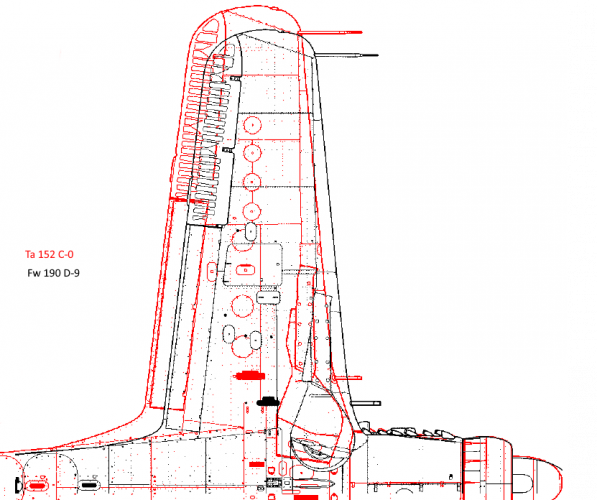
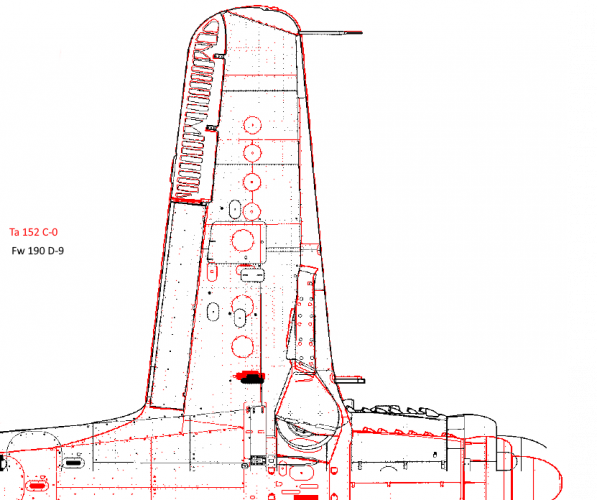
https://www.valka.cz//topic/view/1001https://www.valka.cz/Focke-Wulf-Ta-152-H-t1002 I also went trough the book Special Drawings: Focke Wulf Fw 190, Pt II: Fw 190 C D, Ta 152 by CMK Publications, and put together their wing drawings for Fw 190 D-9 and Ta 152 C-0: I did not do any size corrections, anyway the wings overlap nicely. It's clear the wing roots are quite different. Snímek obrazovky 2025-06-30 125619.png Snímek obrazovky 21.png
Guys, there's a lot of newer sources than Profiles...
 
Hi Aubi,

My sources claim span of 10,51 m (34 ft 5 ¾ in) for D-9, and 11,00 m (36 ft 1 in) for Ta 152 C-1. Respective wing area is 18,30 m2 (196.98 sq.ft) and 19,50 m2 (209.9 sq.ft).

The difference Hecked suggested was actually between the Ta 152C as planned by Focke-Wulf in 1944, with 11.00 m wing span and 19.5 m^2 wing area, and a "big wing" Ta 152C with 20.1 m^2 wing area that he suggests appears in some places, such as the linked Profile.

I mentioned the standard Fw 190 wing because it was kept on the Ta 152C to avoid having to re-tool the factories, and because the linked Profile gives an increased wing area with no change in wing span, which doesn't sound very likely in the light of the planned use of the standard Fw 190 wing.

Guys, there's a lot of newer sources than Profiles...

I agree, but I didn't mention this so far because it looks like a simple typo that has nothing to do with age :)

Regards,

Henning (HoHun)
 
Olá Hecked,


Observe que o perfil da aeronave também lista a envergadura como 36 pés e 1 pol, o que equivale a 11,00 m - a mesma envergadura do Ta 152C com a asa de 19,5 m².

Se os 216 pés quadrados não fossem um erro de digitação, como obter uma área de asa maior sem aumentar a envergadura? O plano com o Ta 152 era usar a asa normal do Fw 190, montando-a em um componente central redesenhado. Tentar aumentar a área da asa mantendo a envergadura constante exigiria o redesenho da asa existente...

Não que uma diferença de 0,6 m² na área da asa faria muita diferença na agilidade, mas ainda acredito que estamos diante de um erro de digitação aqui.

Cumprimentos,

Henning (HoHun)
deixando a asa mais larga, não é necessariamente necessário aumentar a envergadura para aumentar a área da asa, como mencionado pelo usuário, a versão de produção teria mudanças, não teria o tanque de combustível traseiro e o MW-50 na fuselagem, e um dos tanques da asa seria o MW-50 como na versão H, e foi dito que haveria uma mudança na área da asa, e até janeiro e fevereiro, o C estava em testes de protótipo
 
Hi Hecked,

deixando a asa mais larga, não é necessariamente necessário aumentar a envergadura para aumentar a área da asa

Using as much as possible of the exiting tooling for the Fw 190 was the main reason the Ta 152 was designed like it was.

Increasing the wing chord would practically eliminate the advantage of being able to re-use the standard Fw 190 wing, and doing so for a neglible 0.6 m^2 gain in wing area would be economically unwise.

Regards,

Henning (HoHun)
 
Olá Hecked,


Usar o máximo possível das ferramentas existentes no Fw 190 foi o principal motivo pelo qual o Ta 152 foi projetado da forma como foi.

Aumentar a corda da asa praticamente eliminaria a vantagem de poder reutilizar a asa padrão do Fw 190, e fazer isso com um ganho insignificante de 0,6 m² na área da asa não seria economicamente sensato.

Cumprimentos,

Henning (HoHun)
isso mesmo, use o máximo possível, não tudo, a versão de produção teria uma área de asa diferente, não igual aos protótipos, e aposto que não seria menor
 
Hi Hecked,

isso mesmo, use o máximo possível, não tudo, a versão de produção teria uma área de asa diferente, não igual aos protótipos, e aposto que não seria menor

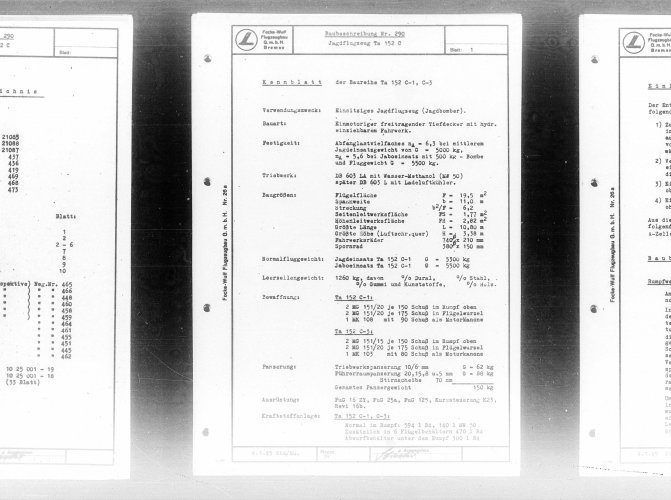
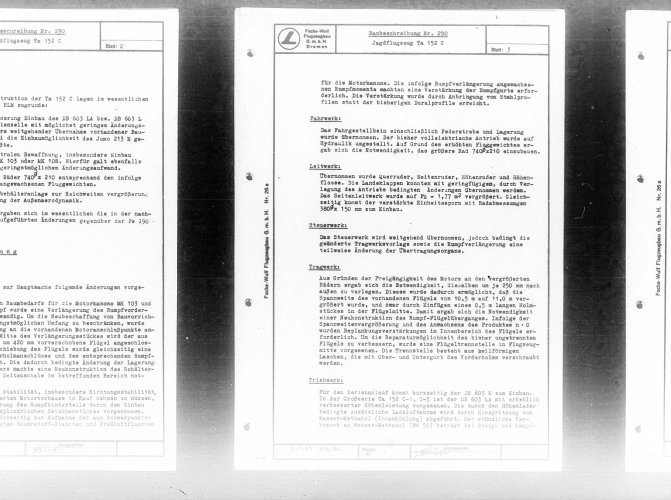
That's the Baubeschreibung (construction description) that details the series production aircraft:


There's not much room for interpretation, in my opinion. Quote a more reliable source than the old Profile, or I won't take the idea serious any more.

Regards,

Henning (HoHun)
 
There was a planned wing with a wider chord and only about 13.6 m span (while still featuring about 23 m^2) for the Ta 152H powered by Jumo 222. The outer portion was to have a laminar flow profile.
Is anything more known about the thoughts to implement this one wrt difference in efficiency and manufacturing compared to the "normal" wings?
 
Last edited:
Hi spicmart,

There was a planned wing with a wider chord and only about 13.6 m span (while still featuring about 23 m^2) for the Ta 152H powered by Jumo 222. The outer portion was to have a laminar flow profile.
Is anything more known about the thoughts to implement this one wrt difference in efficiency and manufacturing compared to the "normal" wings.

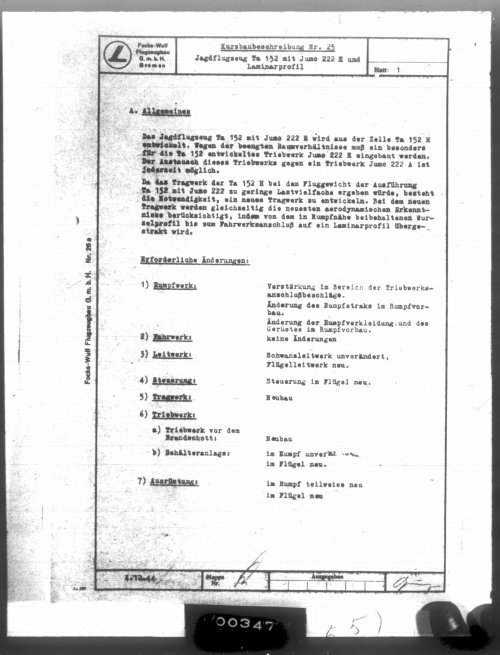
Dietmar Herrmann's "Focke-Wulf Ta 152 - Der Weg zum Höhenjäger" has a section on the Ta 152 with Jumo 222. He considers it a development of the Ta 152 H variant. However, in the bibliography, he lists "Kurzbeschreibung Nr. 25 vom 18.12.1944 - Jagdflugzeug Ta 152 mit Jumo 222 und Laminarprofil", so no variant letter is assigned in the source title at least.

I have seen a reprint of this Kurzbeschreibung, and I seem to remember it states something like, "Since we're going to need a new wing for weight reasons anyway, we're going to introduce a laminar airfoil while we're at it".

Hermann states the normal flying weight as 5815 kg, 515 kg more than the stated normal flying weight of the Ta 152C-1 in fighter configuration.

Regards,

Henning (HoHun)
 
Hi Hecked,


That's the Baubeschreibung (construction description) that details the series production aircraft:


There's not much room for interpretation, in my opinion. Quote a more reliable source than the old Profile, or I won't take the idea serious any more.

Regards,

Henning (HoHun)
I would say it is quite reliable, since he wanted to make the C-3 mod as faithful as possible, and he received documents from Harmann and other members of the now defunct LEMB forum, knowing about the R31 version of the C-1, where the fuselage MW-50 tank was removed, and two wing tanks were selected to receive the MW-50 load, due to the stability problem, and probably its rear fuselage tank should not be filled, as was recommended for the C-0, speaking of which, does anyone have the construction plans for the C-1/R31? The two tanks that receive the MW-50 load would be the ones on the left wing, wouldn't that cause a tendency to stall due to the engine torque being to the left? Since the other tanks would be fuel, and would run dry before the MW-50, since the MW-50 was used in specific situations, wouldn't it be better to have one on each wing?
 
Hi Dan,

Focke-Wulf Kurzbaubeschreibung Nr. 25, page 1.

View attachment 776340

Thanks a lot! Seems my memory wasn't so bad this time around ... here's my translation of the paragraph on the wing:

"Since retaining the wing of the Ta 152 H would result in an excessively low G limit at the flying weight of the variant Ta 152 with Jumo 222, it's necessary to develop a new wing. For the new wing the latest aerodynamic knowledge will be taken into account by transitioning the airfoil from the original root airfoil, which will be retained near the fuselage, to a laminar airfoil at the landing gear attachment point."

Regards,

Henning (HoHun)
 
I would say it is quite reliable, since he wanted to make the C-3 mod as faithful as possible, and he received documents from Harmann and other members of the now defunct LEMB forum, knowing about the R31 version of the C-1, where the fuselage MW-50 tank was removed, and two wing tanks were selected to receive the MW-50 load, due to the stability problem, and probably its rear fuselage tank should not be filled, as was recommended for the C-0, speaking of which, does anyone have the construction plans for the C-1/R31? The two tanks that receive the MW-50 load would be the ones on the left wing, wouldn't that cause a tendency to stall due to the engine torque being to the left? Since the other tanks would be fuel, and would run dry before the MW-50, since the MW-50 was used in specific situations, wouldn't it be better to have one on each wing?

Having trawled through a few hundred pages of documents on Ta 152 C planning, descriptions of variants (C-0 to C-6 and C-11), testing of prototypes, modifications etc. dated between January and the end of March 1945, I can find no mention anywhere of a Ta 152 C-1/R31. There is a lot of information on a lot of obscure potential variations to the design (enlarged fin, steel wings etc.) - but not that one.

I'm inclined to suggest that there is no evidence of an R31 but I'm happy to be proven wrong if there is any contemporary evidence of it.
 
Always wondered if the glider-like wings of the Ta 152H with their lower G-limit did have disadvantages/restrictions when performing stressful combat maneuvers compared to enemy fighter aircraft?
 
And what advantages would the Jumo 222 have offered?
In the end this bigger engine propelled a larger, draggier airframe and I couldn't see much benefit compared to Jumo 213 EB or even J-powered variants in performance potential.
 
Last edited:
Tendo vasculhado algumas centenas de páginas de documentos sobre o planejamento do Ta 152 C, descrições de variantes (C-0 a C-6 e C-11), testes de protótipos, modificações etc., datados entre janeiro e o final de março de 1945, não encontro nenhuma menção a um Ta 152 C-1/R31. Há muitas informações sobre diversas variações potenciais obscuras no projeto (barbatana ampliada, asas de aço etc.) – mas não sobre essa.

Estou inclinado a sugerir que não há evidências de um R31, mas ficarei feliz em ser provado errado se houver alguma evidência contemporânea disso.
há menção de dois C-1/R31 no JG/301, o R31 era o C-1, mas sem o tanque MW-50 na fuselagem para resolver o problema de estabilidade, então dois tanques na asa esquerda receberiam a carga MW-50

(there is mention of two C-1/R31 in the JG/301, the R31 was the C-1, but without the MW-50 tank in the fuselage to solve the stability problem, so two tanks on the left wing would receive the MW-50 load)

Translation added
 
Last edited by a moderator:
there is mention of two C-1/R31s in JG/301, the R31 was the C-1 but without the MW-50 tank in the fuselage to solve the stability problem, so two tanks in the left wing would receive the MW-50 load

That's rather cryptic. I translated your Portuguese and noted that the source you are citing is 'mention of two C-1/R31s in JG/301'.

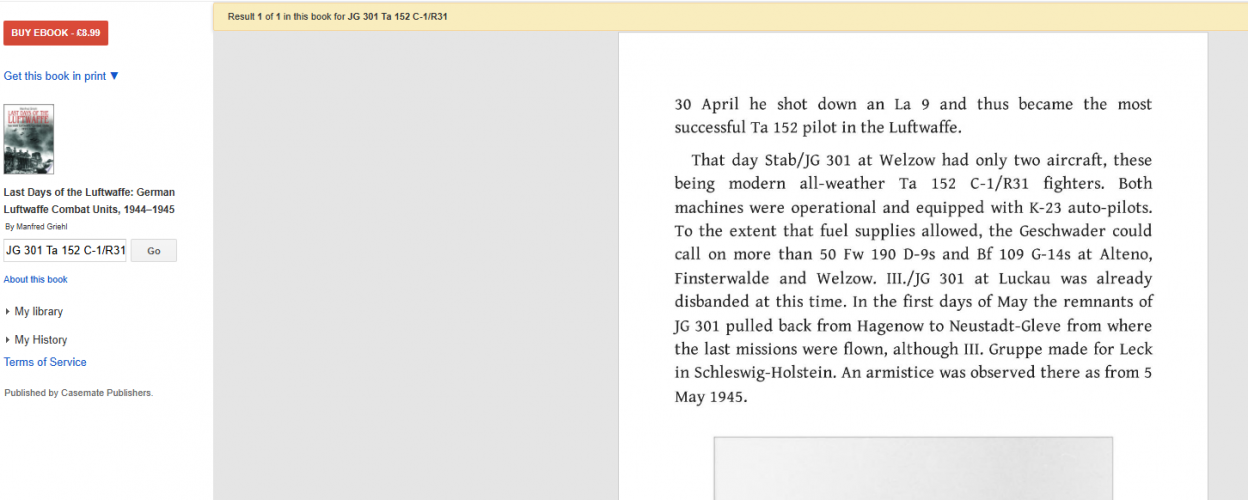
A quick search reveals your likely reference as Manfred Griehl's Last Days of the Luftwaffe: German Luftwaffe Combat Units, 1944-1945. See below.

Screenshot 2025-07-01 202943.png

He mentions Stab/JG 301 having "only two aircraft, these being modern all-weather Ta 152 C-1/R31 fighters. Both machines were operational and equipped with K-23 auto-pilots".

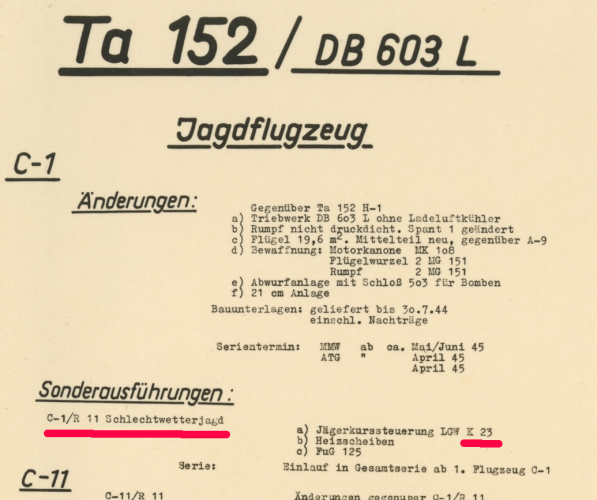
I'm sorry to say that I believe this is a typo. The Focke-Wulf Muster Chart from March 21, 1945, shows the following:

Screenshot 2025-07-01 203449.png

Griehl put 'C-1/R31' but the bad weather variant of the Ta 152 generally was the R11, with the K 23 autopilot. As I say, there is no known contemporary evidence for an 'R31'.
 
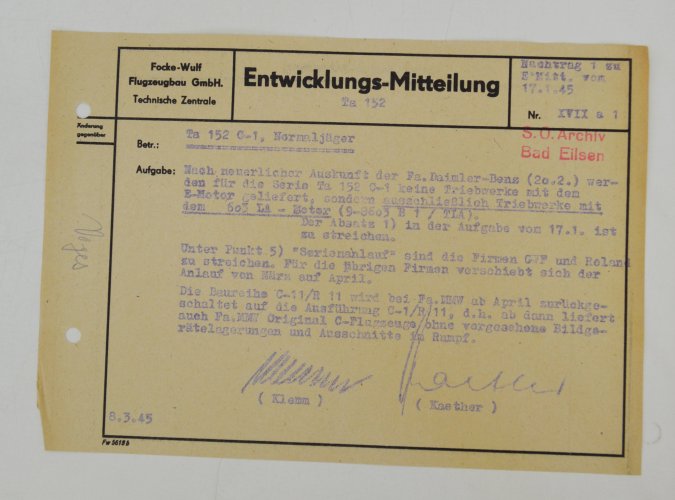
There is also some potential for confusion here because the R11 upgrades were apparently being added by Mitteldeutsche Motorenwerke - which was usually referred to as MMW (maybe they were building the complete aircraft under licence? I'm not sure).
So you have MMW in reference to the R11, rather than the R31 in reference to MW-50.

DSC_0786.JPG
 
Last edited:
That's rather cryptic. I translated your Portuguese and noted that the source you are citing is 'mention of two C-1/R31s in JG/301'.

A quick search reveals your likely reference as Manfred Griehl's Last Days of the Luftwaffe: German Luftwaffe Combat Units, 1944-1945. See below.

View attachment 776452

He mentions Stab/JG 301 having "only two aircraft, these being modern all-weather Ta 152 C-1/R31 fighters. Both machines were operational and equipped with K-23 auto-pilots".

I'm sorry to say that I believe this is a typo. The Focke-Wulf Muster Chart from March 21, 1945, shows the following:

View attachment 776453

Griehl put 'C-1/R31' but the bad weather variant of the Ta 152 generally was the R11, with the K 23 autopilot. As I say, there is no known contemporary evidence for an 'R31'.
I read that on April 20, Luftwaffe quartermaster reported two Ta 152C1/R31
 
There is also some potential for confusion here because the R11 upgrades were apparently being added by Mitteldeutsche Motorenwerke - which was usually referred to as MMW (maybe they were building the complete aircraft under licence? I'm not sure).
So you have MMW in reference to the R11, rather than the R31 in reference to MW-50.

View attachment 776454
Taking advantage of the subject, do you have any documents or testimonies from pilots about the maneuverability of the Ta C version?
 
There is also some potential for confusion here because the R11 upgrades were apparently being added by Mitteldeutsche Motorenwerke - which was usually referred to as MMW (maybe they were building the complete aircraft under licence? I'm not sure).
So you have MMW in reference to the R11, rather than the R31 in reference to MW-50.

View attachment 776454
I read in a Russian book about the Ta 152 that prototypes of the Ta 152C did simulated combat with a Bf 109, is this true?
 
I read that on April 20, Luftwaffe quartermaster reported two Ta 152C1/R31

Griehl may have been quoting someone else's typo, rather than making the typo himself. There is a lot of surviving documentation on plans for the various Ta 152 C variants and the R11 gets quite a lot of mentions. But that is the only Rüstsatz in connection with it. And the description we have of the R31 corresponds to what we know that the R11 was.

Taking advantage of the subject, do you have any documents or testimonies from pilots about the maneuverability of the Ta C version?

No. And I'm not aware of any documentation on Ta 152 C prototype testing against a Bf 109 - but it's entirely possible that this did happen and I just don't have that particular report.
 
I read in a Russian book about the Ta 152 that prototypes of the Ta 152C did simulated combat with a Bf 109, is this true?
Care to tell which Russian book?
The Russians attested "absolute superiority" of their late-war Yak-3 and La-7 over the latest German fighters Fw 190D-9 and Me 109G-10.
 
Hi Hecked,

I read in a Russian book about the Ta 152 that prototypes of the Ta 152C did simulated combat with a Bf 109, is this true?

There are some rare cases of simulated combat (or at least competitive display flying) involving new types recorded, for example for the Arado Ar 234 vs. the Me 262. However, these were rare, usually spur-of-the-moment things without systematical background, as far as I can tell.

However, for the Me 109 vs. Ta 152C case, the results can be predicted fairly reliably from the known qualities of both types, the engine characteristics of the specific subtypes involved, and the speed curves that exist for some projected Ta 152C variants.

An Me 109K was a sports car in comparison to the Ta 152C, and though with a DB 605DC it might have "only" some 1800 HP near sea level, it was so much lighter that it would outclimb and outturn the Ta 152C, which basically was just a heavy Fw 190 with a marginally bigger wing, at all except maybe very high altitudes. With regard to speed, the Ta 152C with DB 603L would be inferior at low and medium altitude too, and only above the DB 605DC's full throttle height, the Ta 152C would have a speed advantage.

The roll rate certainly would favour the Ta 152C, since it basically had the very stiff Fw 190 wing with an only very slightly enlarged wing span, while the Me 109 always suffered from a somewhat flexible wing that reduced aileron effectiveness considerably at higher airspeeds. However, at the higher altitudes where the Ta 152C might be more competitive performance-wise, the fight would more likely take place at generally lower indicated airspeeds, where the Me 109 rolled reasonably well, too.

In the dive, the Ta 152C probably held all the advantages, though diving would bring it down to the lower altitudes where the Me 109 held a (bigger) performance advantage.

Your mileage might vary a bit depending on how much power you think the DB 605LA developed, and which flying weight you assign to each aircraft, but the general comparison really isn't so difficult since it's basically just another case of "Me 109 vs. Fw 190".

Regards,

Henning (HoHun)

 
Hi Hecked,


There are some rare cases of simulated combat (or at least competitive display flying) involving new types recorded, for example for the Arado Ar 234 vs. the Me 262. However, these were rare, usually spur-of-the-moment things without systematical background, as far as I can tell.

However, for the Me 109 vs. Ta 152C case, the results can be predicted fairly reliably from the known qualities of both types, the engine characteristics of the specific subtypes involved, and the speed curves that exist for some projected Ta 152C variants.

An Me 109K was a sports car in comparison to the Ta 152C, and though with a DB 605DC it might have "only" some 1800 HP near sea level, it was so much lighter that it would outclimb and outturn the Ta 152C, which basically was just a heavy Fw 190 with a marginally bigger wing, at all except maybe very high altitudes. With regard to speed, the Ta 152C with DB 603L would be inferior at low and medium altitude too, and only above the DB 605DC's full throttle height, the Ta 152C would have a speed advantage.

The roll rate certainly would favour the Ta 152C, since it basically had the very stiff Fw 190 wing with an only very slightly enlarged wing span, while the Me 109 always suffered from a somewhat flexible wing that reduced aileron effectiveness considerably at higher airspeeds. However, at the higher altitudes where the Ta 152C might be more competitive performance-wise, the fight would more likely take place at generally lower indicated airspeeds, where the Me 109 rolled reasonably well, too.

In the dive, the Ta 152C probably held all the advantages, though diving would bring it down to the lower altitudes where the Me 109 held a (bigger) performance advantage.

Your mileage might vary a bit depending on how much power you think the DB 605LA developed, and which flying weight you assign to each aircraft, but the general comparison really isn't so difficult since it's basically just another case of "Me 109 vs. Fw 190".

Regards,

Henning (HoHun)
Was the Me 109 wing more flexible than others because of its construction?
I mean not-continuous one-wing-spar design, large cut-outs for radiators/flaps, wheel-wells, slat mechanism and a large tip flanged to the wing.
 
Last edited:
Hi Spicmart,

Was the Me 109 wing more flexible than others because of its construction?
I mean no continuous one-wing-spar design, large cut-outs for radiators/flaps, wheel-wells, slat mechanism and a large tip flanged to the wing.

I believe the most relevant factor by far was the use of a single-spar wing with a torsionally-stiff nose box. (It was similar with the Spitfire - one of the reasons to develop the Spiteful wings was that the RAF was unhappy with the Spitfire's roll characteristics.)

Regards,

Henning (HoHun)
 
I believe the most relevant factor by far was the use of a single-spar wing with a torsionally-stiff nose box. (It was similar with the Spitfire - one of the reasons to develop the Spiteful wings was that the RAF was unhappy with the Spitfire's roll characteristics.)

Regards,

Henning (HoHun)

Yet the Spitfire was known as the better rolling plane than the Me 109 at higher speeds despite similar construction and bigger wing.

The redesigned wing of the Spitfire 20 series had a calculated aileron reverse speed of 1366 km/h compared to about 900km/h (or less) of the conventional wing that came before.
 
Last edited:

Similar threads

Back
Top Bottom