I don't have either of these two books, but they are visibly different :

-L'aventure Amiot - CMN, Des hommes, le ciel et la mer, Author Fréderic Patard, Des Champs publishing, 1998

-Félix Amiot, Parcours d'un industriel normand du XXème siècle, Author Justin Lecarpentier, OREP publishing, 2020

http://www.aerostories.org/~aerobiblio/article6250.html
Regarding the "aviation" part (The first two paragraphs, with Google Trad)

The only book so far devoted to this atypical French manufacturer was L’aventure Amiot-CMN by Frédéric Patard, published over twenty years ago and now almost impossible to find. This book by Justin Lecarpentier is based on a history thesis, revised to be more readable by the general public. Typically, the references at the bottom of the page instead of the references at the end of the chapter or of the book, are appreciable for readability. It covers both the career of an aircraft manufacturer and the period that followed in the field of shipbuilding. We will only dwell on the first part, which is about half of the book.
The richness of this work certainly does not lie in its illustrations, which are few in number, and suffer from the quality of the paper which forces the contrasts to be exaggerated and makes the result grainy. On the other hand, the subject focuses on Félix Amiot and his company. The history of his planes appears in this book only to illustrate the point and does not form the basis of the book. A small exception with the interesting details presented by the author regarding the very latest aircraft project, the superb Amiot 530 civilian transport.

The text not only presents the story of Félix Amiot; it also highlights the investigative work carried out by the author. The common thread is based on company archives, consulted in regional archive centers in the Cherbourg region, supplemented by administrative documents and various testimonies provided by the descendants of the Amiot family and those around them.
The study is constructed in a systematic way, starting with the family genealogical tree, then follows the account of the educational journey of young Félix Amiot, highlighting his encounters and friendships that will subsequently support his career. We then move on to the start of its industrial activity, with the creation of the SECM during the First World War, thanks to its patents on stamping and despite its lack of suitable diplomas. After subcontracting, Amiot finally started in aviation, in an unfavorable context, before becoming a major aircraft manufacturer. The author details the opportunities, industrial arrangements, acquisitions, supports, changes, social aspects. Above all, it highlights the tensions with the Air Ministry, the catastrophic impact of nationalizations on the company and the consequences on production. The author quotes excerpts from relevant documents, placing them precisely in context which he skillfully illuminates through his informed study of the context. It details in particular the standoff between Félix Amiot and Pierre Cot, on the subject of nationalizations, then that of the production of Amiot family 350.
 
Last edited:

Attachments

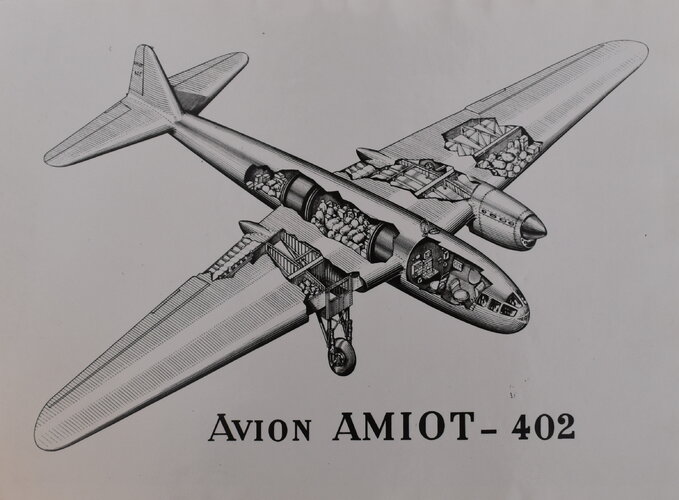
  • 20220413_Amiot-402.jpg
    20220413_Amiot-402.jpg
    1.3 MB · Views: 142
Hi guys, some pics of my Amiot 150 M (or BE)
 

Attachments

  • 1 [].jpg
    1 [].jpg
    64.2 KB · Views: 86
  • Amiot 150 2 [].jpg
    Amiot 150 2 [].jpg
    62.9 KB · Views: 70
  • 3 [].jpg
    3 [].jpg
    62 KB · Views: 59
  • 4 [].jpg
    4 [].jpg
    60.9 KB · Views: 61
  • 5 [].jpg
    5 [].jpg
    60 KB · Views: 66
  • 6 [].jpg
    6 [].jpg
    58 KB · Views: 63
  • 7 [].jpg
    7 [].jpg
    62.9 KB · Views: 59
  • 8 [].jpg
    8 [].jpg
    67.6 KB · Views: 64
  • 9 [].jpg
    9 [].jpg
    64.7 KB · Views: 62
  • 10 [].jpg
    10 [].jpg
    62.8 KB · Views: 97
And some pics of my Amiot 170
 

Attachments

  • 1 [].jpg
    1 [].jpg
    66.3 KB · Views: 87
  • 2 [].jpg
    2 [].jpg
    61.5 KB · Views: 89
  • 3 [].jpg
    3 [].jpg
    57.5 KB · Views: 65
  • 4 [].jpg
    4 [].jpg
    56.2 KB · Views: 70
  • 5 [].jpg
    5 [].jpg
    56.9 KB · Views: 74
  • 6 [].jpg
    6 [].jpg
    60.9 KB · Views: 75
  • 7 [].jpg
    7 [].jpg
    64.6 KB · Views: 66
  • 8 [].jpg
    8 [].jpg
    54.9 KB · Views: 64
  • 9 [].jpg
    9 [].jpg
    62.8 KB · Views: 58
  • 10 [].jpg
    10 [].jpg
    65.6 KB · Views: 103
1940 looks like a bad ripoff of 1870, Sedan disaster included.

Somewhat remarquably on a plateau north of the city... in 1870 one Colonial infantry unit led by General Margueritte made an heroic charge against the invading Prussians - for nothing, and they were wiped out.

Fast forward to 1940, exact same place: a handful of Amiot 143 led by De Laubier charged the panzers from the air only to be slaughtered by the Flak and Me-110s. De Laubier bomber caught fire and he was killed, and the aircraft fell pretty close from the memorial to Margueritte heroic cavalry charge, 70 years earlier to the day.

Rock and a hard place...
 
Last edited:
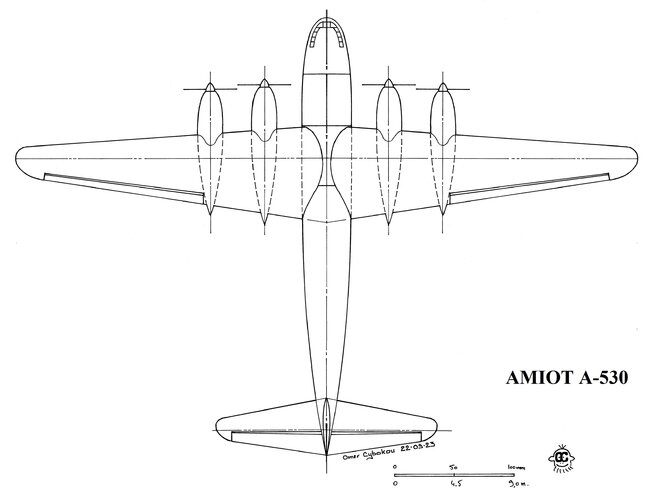
I do not know if Félix Amiot would be satisfied with my job but I propose it anyway. From the elements provided I deduced this view from above (I would do the others later). The fuselage is inspired by the factory plan and I hope there are not too many errors of proportion, while I evaluated with my nose the shape of the engine fairings to contain the Renault 24 H ... Moreover seen the power of 3000 hp I enlarged the diameter of the propellers which seem to me a little rikiki on the plans of time ... I await your criticism, including the most acerbic !
 

Attachments

  • AMIOT 530 DJ DESSUS COMPLET.jpg
    AMIOT 530 DJ DESSUS COMPLET.jpg
    487.7 KB · Views: 104
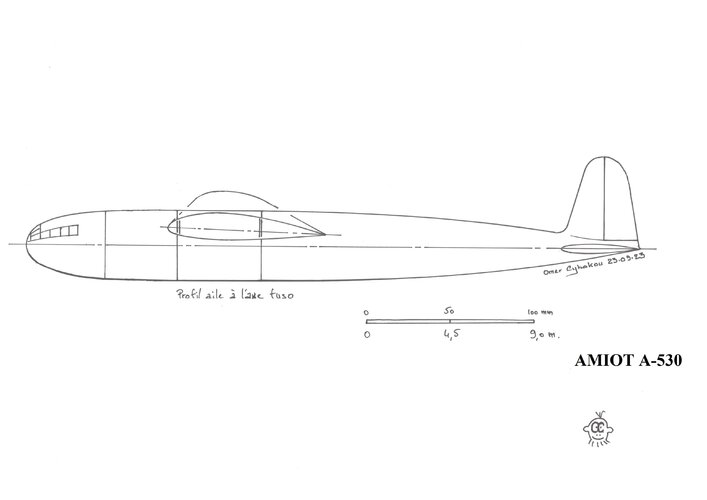
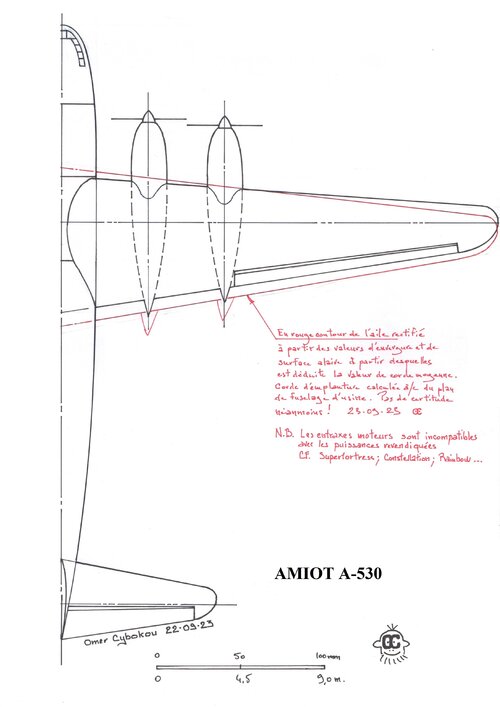
I submit to the amateurs the left view of the fuselage that I built from the elements of this forum and the 1/2 top view rectified in red at the wing. Indeed I realized the inconsistency of the drawing 3 artist views with the values of span and surface that allow to calculate the average value of the chord. After evaluation of the root chord I deduced the end chord, inspired by the sweep of the wing of the Amiot 370 ...

20230922-AMIOT 530 DJ FUSO VUE G.jpg 20230922-AMIOT 530 DJ DESSUS RECTIFIE.jpg
 
I submit to the amateurs the left view of the fuselage that I built from the elements of this forum and the 1/2 top view rectified in red at the wing. Indeed I realized the inconsistency of the drawing 3 artist views with the values of span and surface that allow to calculate the average value of the chord. After evaluation of the root chord I deduced the end chord, inspired by the sweep of the wing of the Amiot 370 ...

View attachment 708377
Note the contour analogy of the flying party with the Superfortress! There is no doubt that this is a phenomenon of convergent evolution due to the application of design rules to the constraints of cabin pressurization ...
 
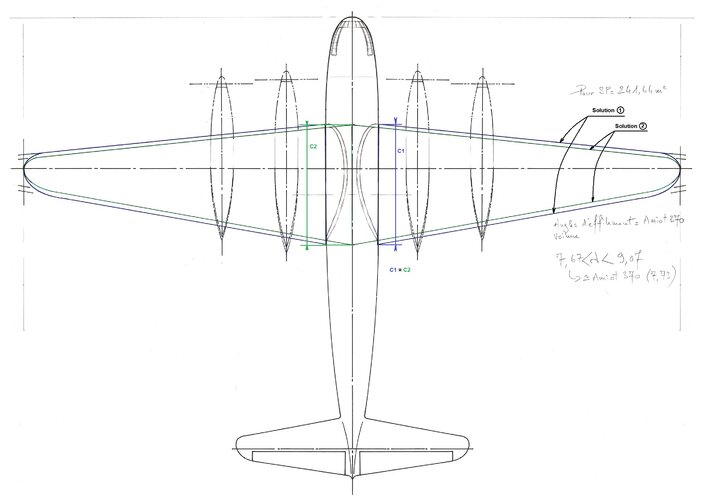
I give you here my last and definitive hypotheses concerning the configuration seen from above of this very beautiful "paper plane" that was the Amiot 530 ... This is the result of a mixture of data from the wing shape of the Amiot 370 for trailing and leading edge angles and the wingspan and wing surface values given for this project, and of course from the factory plots published above. I took the liberty of increasing the outside engine centres compatible with propellers of 4 m (about 13') in diameter, which seems more realistic and a minimum to pass high powers (3000 hp) even with counter-rotating propellers ...

20231023-AMIOT 530 DJ DESSUS RECTIFIE 2.jpg
 
^, agreed. The attention to detail you demonstrate through your projects, is wow, amazing. Always nice to see these.
 
I submit to the amateurs the left view of the fuselage that I built from the elements of this forum and the 1/2 top view rectified in red at the wing. Indeed I realized the inconsistency of the drawing 3 artist views with the values of span and surface that allow to calculate the average value of the chord. After evaluation of the root chord I deduced the end chord, inspired by the sweep of the wing of the Amiot 370 ...

View attachment 708377View attachment 708378
How did it happen that 100 millimeters is 9 meters?
 
From, AAMS-Revue-Prendre-lair-n-1-Janvier-2019,a more Info,

Amiot 400:
The prototype of the "stratospheric" Amiot 400 was not as fortunate as the 355 and was abandoned in early June 1940, just 10 days before its maiden flight. It was scuttled at the Évreux airfield, where the Amiot design office had been temporarily relocated. Its liquid-cooled Hispano-Suiza 12 Y engines, equipped with Planiol-Szydlowski superchargers, allowed for power recovery at 12,000 meters, the altitude at which the aircraft should have reached 600 km/h.
 

Attachments

  • 6.png
    6.png
    35.8 KB · Views: 57
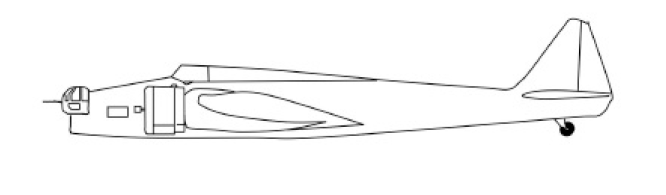
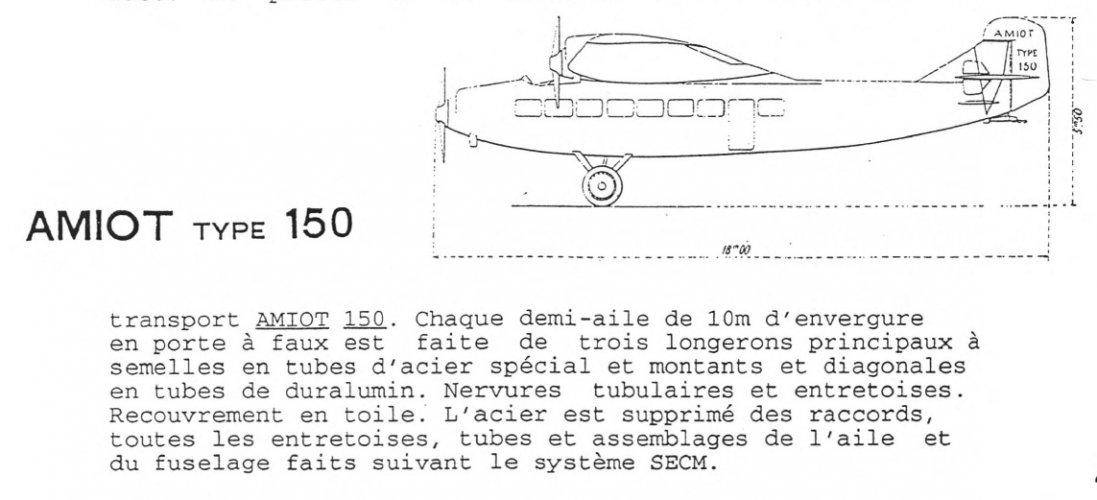
A transport project in profile form, taken from Le Trait d'Union N°154 (March-April 1994) and captioned as the "Amiot 150" (attachment #1).

Looking at the tail designation, I have a feeling it reads more like "Amiot 160"... Besides, the Amiot 150 designation was used for a real aircraft, a seaplane variant of the Amiot 143 (see attachments #2 and #3). Thoughts, anyone?

From TU magazine.
 

Attachments

  • 1.jpg
    1.jpg
    133 KB · Views: 50
From Jean Cuni et Raymond Danel "LeO 45, Amiot 350 et outres B4: L'avion était susceptible de recevoir indifféremment deux types de moteurs: - des Hispano-Suiza 12 Y 28/29 en ligne et à refroidissement par liquide, de 920 ch à 3 300 m (version de base désignée Amiot 350), - des Gnôme-Rhône 14 N-38/39 en étoile et à refroidissement par air, de 1 020 ch à 4 000 m (variante désignée Amiot 351). Les 20 premiers avions commandés au titre du marché nº 741/8 notifié le 27 mai 1938 étaient des 350 B 4.

The aircraft could be fitted with either of two engine types: - Hispano-Suiza 12 Y 28/29 inline, liquid-cooled engines producing 920 hp at 3,300 m (basic version designated Amiot 350), - Gnome-Rhône 14 N-38/39 radial, air-cooled engines producing 1,020 hp at 4,000 m (variant designated Amiot 351). The first 20 aircraft ordered under contract no. 741/8, notified on May 27, 1938, were 350 B 4s.
However, then all mentions of the Amio 350 with 12Y engines vanished like morning fog. Was there an explanation for this?
 
From Jean Cuni et Raymond Danel "LeO 45, Amiot 350 et outres B4: L'avion était susceptible de recevoir indifféremment deux types de moteurs: - des Hispano-Suiza 12 Y 28/29 en ligne et à refroidissement par liquide, de 920 ch à 3 300 m (version de base désignée Amiot 350), - des Gnôme-Rhône 14 N-38/39 en étoile et à refroidissement par air, de 1 020 ch à 4 000 m (variante désignée Amiot 351). Les 20 premiers avions commandés au titre du marché nº 741/8 notifié le 27 mai 1938 étaient des 350 B 4.

The aircraft could be fitted with either of two engine types: - Hispano-Suiza 12 Y 28/29 inline, liquid-cooled engines producing 920 hp at 3,300 m (basic version designated Amiot 350), - Gnome-Rhône 14 N-38/39 radial, air-cooled engines producing 1,020 hp at 4,000 m (variant designated Amiot 351). The first 20 aircraft ordered under contract no. 741/8, notified on May 27, 1938, were 350 B 4s.
However, then all mentions of the Amio 350 with 12Y engines vanished like morning fog. Was there an explanation for this?

The explanation is the Amiot-351 only one was built,and there are two projects carried Type-351.
 
In late 1938, the American representatives of the French firm Amiot-S.E.CM. wrote to the president of Massey-Harris Ltd, the Ontario-based manufacturer of agricultural equipment, and proposed that this company participate in the mass production of the French twin-engine Amiot 350 bomber. The offer was indeed tempting. At that time, or slightly later, a close associate of Félix Amiot, the French businessman Pierre Wertheimer, was looking for a factory near New Orleans. An initial order of one hundred bombers seemed possible.

Before committing fully, the president of Massey-Harris, Thomas Alexander Russell, wanted to know if the Canadian government had any objections to what was being discussed. The response was predictable. The idea seemed excellent and entirely legal. Massey-Harris could proceed without fear; the government did not plan to get involved. In the days that followed, negotiations resumed. Canada Cycle & Motor Company, Canada's bicycle producing giant, was also following this matter very closely. Time passed. In France, enthusiasm waned.

Amiot-S.E.C.M. offered to produce a number of aircraft for the American military. The Roosevelt administration did not wish to get involved and discussions stalled. The French authorities also discovered that the American businessmen they were dealing with were, in fact, nothing more than unscrupulous profiteers with no reputation and no factory. The production scheme project was going nowhere. Finally, having run out of patience, the French decided to call it quits in the late winter or early spring of 1939.
 
As @fortrena will already know, there was an earlier connection between CCM and Massey-Harris - the former being founded in 1899 as a merger of four Canadian bicycle makers ... including Massey-Harris.

Massey-Harris' actual wartime work was the production of military tractors and armoured vehicles ... which seems a better use of the firm's skill set than learning to make aircraft.

From 1942, the CCM plant in Weston, ON, was taken over by the Government of Canada. Run by its peacetime foreman, CCM built militarised Rambler bicycles for the Canadian Army and others as well as various weapon mounts. (A CCM division, Russell Industries Limited, reportedly built light military vehicles. Does anyone know what kind of vehicles?)
 
Last edited:

Similar threads

Back
Top Bottom