https://www.cbc.ca/news/politics/navy-canada-arctic-defence-landing-ship-9.7027777
The commander of the Royal Canadian Navy is floating the idea of an ice-capable amphibious landing ship to move troops and equipment around the country’s Arctic — and perhaps elsewhere.

But Vice-Admiral Angus Topshee is quick not to get his hopes up — and has even, occasionally, taken pains to downplay it.

At various times, Topshee has described the notion as “a conceptual thing" and even told a podcaster last fall that it is “a thought exercise” — part of the imagining that’s going on as the navy and the defence establishment writ large wraps their heads around an era of bigger ambitions and bigger budgets.

However, it is a conceptual thing that’s been the subject of preliminary conversations between naval planners and two of the country’s shipyards: Davie Shipyard in Lévis, Que., and Seaspan in Vancouver. Both are already building the Canadian Coast Guard’s new icebreaker fleet.

Each of the companies have notional ideas — even proposals — that could be modified to create an all-Canadian designed-and-built landing ship for Far North operations.

“We talked to a couple of our shipbuilders, and they've said that theoretically a Polar Class 2 amphibious ship would be possible,” Topshee said in a year-end interview with CBC News. “The key value proposition of an amphibious ship is it can deliver capability from sea to shore without prepared port infrastructure, and that describes our North perfectly."

In theory, that means one big ice-capable ship that carries both smaller landing craft (likely hovercraft) and helicopters. A number of Canada’s allies operate such ships. The difference is almost none of them are built for northern operations.

But it is the notion of an ice-capable landing ship that could prove to be the most ambitious, yet also potentially the most useful as the country tries to demonstrate its sovereignty in the Far North to both friends and foes alike.

“We've done a study of the North, [and] one of the things that becomes clear is that in North America, there's only one year-round ice-free port, and that's in Nuuk, Greenland,” Topshee said.

“As we went through that analysis, we examined what would happen if we had a small [Canadian] community in distress in the High Arctic in February. How could we get capability there?"

Being able to move troops and equipment and sustain them — either in the Arctic or elsewhere — has been a major preoccupation for the military for decades. Canada has often relied on allies or rented the capability it needs.

“To sustain an operation up in the North, we sort of realized that some form of Arctic mobile base probably made a lot of sense, and that is effectively what an amphibious ship is," Topshee said.

Some very interesting points coming from Admiral Topshee regarding the potential for Canada to procure a/multiple ice strengthened amphibious vessels for the RCN.

It is important to recall that both the Liberals and Conservatives directly mentioned purchasing heavy icebreakers for the Navy back on the 2025 campaign trail, and Topshee has addressed this in the past. I would not be surprised if Topshee is trying to get out ahead of a government mandated prestige project of "military heavy icebreakers" by transforming them into something much more useful. If the Feds are going to force the hands of the Navy, it makes much more sense to procure some kind of ice strengthened joint support ship versus procuring militarized heavy icebreakers.

Effectively making the best out of a worst case scenario.

120840963_3358740720845885_8833476672087504522_n.jpg


GsPovFXWoAAWYD0


Davie is already ahead of the game with their G-LAAM concept they've had around for a few years, basically amounting to the same concept as the Dutch Karel Doorman JSS except it is ice strengthened to operate in the Arctic. It would be a vessel that can substitute in for the Protecteur's when required for supplying warships with fuel, supplies and munitions while also able to respond to humanitarian disasters at home/abroad and being able to do some limited sealift. Obviously it is a compromise which will make the vessel worse in theatres outside of the Arctic and North Atlantic however, having even a single Arctic capable joint support ship would be an exceptional capability for both ourselves and our NATO allies.

Polar Class 2 is rather ridiculous however, I think Davie has claimed they can make G-LAAM PC3 if required. That will require further tradeoffs which will lessen its capability/ability to operate elsewhere.

A rating of PC-4 allows you to operate in the populated sections of the Arctic Archipelago for most of, if not all the year in many cases. Even PC-3 is arguable overspecialization, while PC-2 is frankly ridiculous and would make the vessel effectively useless outside of the high Arctic. It would be exceptionally more costly and complex for little gain outside of prestige, while sacrificing the versatility for the vessel to operate abroad.

PC-4 is the same as the highest strength areas of the AOPS, alongside the upcoming Multi-Purpose Icebreakers for the CCG. It would be capable of doing 90% of the work in the Arctic required, that additional 10% is of dubious value and will cost the design quite a lot to get.
 
“As we went through that analysis, we examined what would happen if we had a small [Canadian] community in distress in the High Arctic in February. How could we get capability there?"
LCACs, if you can get them close enough. Or by air.

Both of which are screamingly expensive.
 
Sounds like a job for more gooney birds! I know that there's at ~35 of the old girls registered currently with the Canadian Civil Aviation Authority (for some reason they count BT-67s as DC-3s, R4Ds or C-47s)
Because IIRC the BT67 is an STC, not a type certificate. So they're "DC-3s[etc] with the BT-67 upgrade" legally speaking.
 
...Yes, if they want to take a completely MOTS sub they'll keep the VLS.

This new brief YouTube video sponsored by the South Korean government mentions that their navy's 3300-ton torpedo- and missile-armed submarine Dosan Ahn Chang-ho departed yesterday on a voyage across the Pacific that will wind up in CFB Esquimalt, British Columbia, for planned exercises with Royal Canadian Navy units. The long voyage is part of a strong push from the Koreans to sway Canada to choose them instead of Germany to build the proposed 12-boat Canadian Patrol Submarine Project, replacements for the four aging British-built Victoria-class subs. The video is of course weighted towards Korea, but is interesting. Let's see what the Germans do in response, if they're indeed just as hungry.

View: https://www.youtube.com/watch?v=zoXkfXO0hqU
 
This new brief YouTube video sponsored by the South Korean government mentions that their navy's 3300-ton torpedo- and missile-armed submarine Dosan Ahn Chang-ho departed yesterday on a voyage across the Pacific that will wind up in CFB Esquimalt, British Columbia, for planned exercises with Royal Canadian Navy units. The long voyage is part of a strong push from the Koreans to sway Canada to choose them instead of Germany to build the proposed 12-boat Canadian Patrol Submarine Project, replacements for the four aging British-built Victoria-class subs. The video is of course weighted towards Korea, but is interesting. Let's see what the Germans do in response, if they're indeed just as hungry.

View: https://www.youtube.com/watch?v=zoXkfXO0hqU
It was recently mentioned by PM Carney that the decision around the CPSP would be made by the end of Q2 2026, so we should see a decision by May or June announced. CANSEC 2026 in the end of May might be a natural place to announce such a substantial purchase.
 
It was recently mentioned by PM Carney that the decision around the CPSP would be made by the end of Q2 2026, so we should see a decision by May or June announced. CANSEC 2026 in the end of May might be a natural place to announce such a substantial purchase.

Thanks, Rainbow1910. That would be an aggressive schedule. I see the CANSEC defence tradeshow in Ottawa you mention will be 27-28 May 2026. I've never been a prime minister, but it seems reasonable that if a final decision on this complex submarine program will be announced in only a few weeks, then a preferred winner must be in mind now. If so, could the submitted reports of the Canadian officers that Korean submarine Dosan Ahn Chang-ho picked up in Pearl Harbor, and the results of the sub's pending exercises with RCN units off CFB Esquimalt, truly matter? And no time for whatever the Germans are planning as their riposte to the Korean move.
 
This year the annual Fleet Week in New York City has been pushed back from its usual late-May schedule to instead be part of the United States of America's Semiquincentennial around Independence Day (4 July 2026). The events will include a parade of tall ships, perhaps in the most numbers ever. Humble ketch HMCS Oriole, which I had visited in 2019 and which Rainbow1910 panned in post #19 above as "widely disliked within the RCN as a pathetic little waste of money with very little actual value", will again represent Canada, according to preliminary reports. If so, then she and her crew will be welcome.

(Mexican Navy barque Cuauhtémoc, involved in a fatal collision with the Brooklyn Bridge on 17 May 2025, has been repaired and is also scheduled to return to NY.)
 
...It is important to recall that both the Liberals and Conservatives directly mentioned purchasing heavy icebreakers for the Navy back on the 2025 campaign trail, and Topshee has addressed this in the past. I would not be surprised if Topshee is trying to get out ahead of a government mandated prestige project of "military heavy icebreakers" by transforming them into something much more useful. If the Feds are going to force the hands of the Navy, it makes much more sense to procure some kind of ice strengthened joint support ship versus procuring militarized heavy icebreakers... Polar Class 2 is rather ridiculous however, I think Davie has claimed they can make G-LAAM PC3 if required. That will require further tradeoffs which will lessen its capability/ability to operate elsewhere. A rating of PC-4 allows you to operate in the populated sections of the Arctic Archipelago for most of, if not all the year in many cases. Even PC-3 is arguable overspecialization, while PC-2 is frankly ridiculous and would make the vessel effectively useless outside of the high Arctic. It would be exceptionally more costly and complex for little gain outside of prestige, while sacrificing the versatility for the vessel to operate abroad. PC-4 is the same as the highest strength areas of the AOPS, alongside the upcoming Multi-Purpose Icebreakers for the CCG. It would be capable of doing 90% of the work in the Arctic required, that additional 10% is of dubious value and will cost the design quite a lot to get.


An interesting short article regarding contemporary Arctic Ocean icebreaking in general and a recent Ukrainian hit on new 8400-ton armed icebreaker Ivan Papanin in particular may be found at < https://www.strategypage.com/htmw/htsurf/articles/2026041543115.aspx >.
 
...What little has been released (or even decided yet?) about the Continental Defence Corvettes suggests moves to clarify its requirement. Shedding MCM makes sense in helping to focus the CDC's core roles. But, as you say, what then become the mothership (in the absence of the albeit inadequate MCDVs)...
...The Continental Defence Corvette is in the “examine the options” phase, but it’s pretty much a light frigate, ideally 105m but up to,120m if needs be, with an ice rating he characterizes as “PC6 minus”. CDC to be smaller than a Halifax, but with the same capabilities to hunt subs, sink ships and defend itself from air attack...
I don't think you can pack all that into a smaller package than a Halifax. Not with modern sensors. Look at how big the US Constellation-class is!
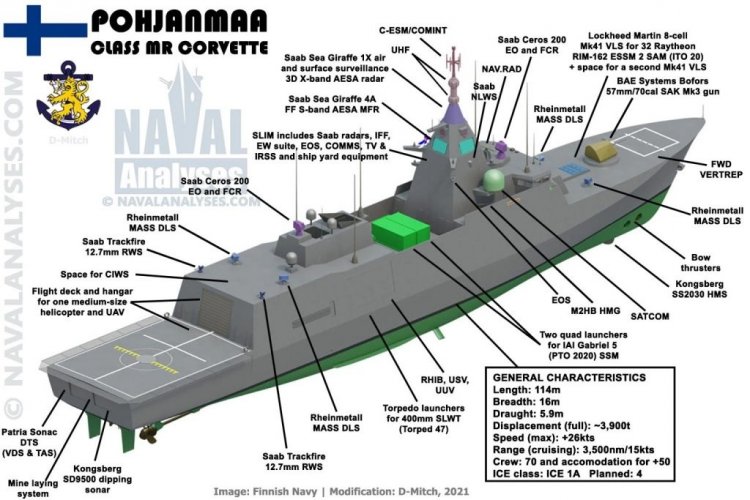
Turns out the Finnish Pohjanmaa class Corvettes (117m, 4,200 tons, 73 crew) are built to Finnish-Swedish Class 1A which according to Wikipedia is approx Polar Class 6 equivalent. So it’s a lightly ice strengthened combatant already exists….

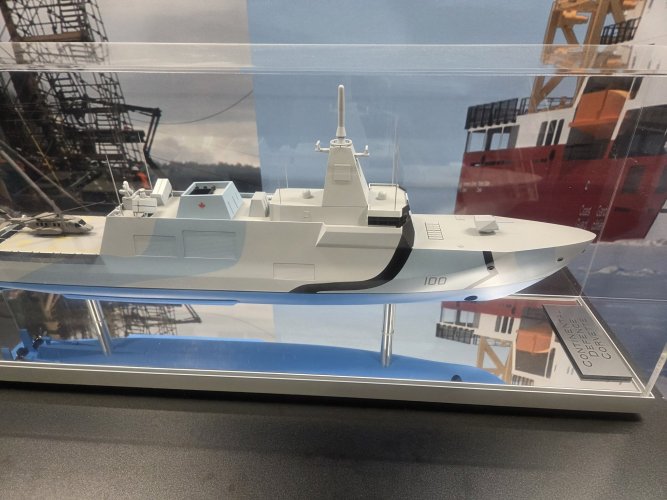
A new video today about the Royal Canadian Navy's 'Continental Defence Corvette' program to build 16 to 20 warships in Canada to replace the retiring Kingston class. Not much new info, but a good overview of where things stand now with the program. The 100m-long notional corvette shown must be substantially heavier than the 1000-ton limit mentioned earlier in this thread. See:
View: https://www.youtube.com/watch?v=k7n6ZogWJcE
 
The 100m-long notional corvette shown must be substantially heavier than the 1000-ton limit mentioned earlier in this thread.
Well the future corvette's displacement is going to be delimited on the low end by ocean going capability and on the high end by the 105m length limit due to port infrastructure.

That basically gives you a displacement range of 1,700t (low end) to 3,500t-4,000t (high end). With the low end being an upgunned OPV somewhat similar to Argentina's Bouchard / Adroit class (built to Polar Class 1C). And the high end being more like a Holland class OPV or shrunk USCG OPC. All with NSM, RAM and 57mm added, optionally a few lightweight VLS.

Oh and all must be bespoke Canadian designs. No one seems concerned about the added risk & cost of reinventing the wheel!
 
A new video today about the Royal Canadian Navy's 'Continental Defence Corvette' program to build 16 to 20 warships in Canada to replace the retiring Kingston class. Not much new info, but a good overview of where things stand now with the program. The 100m-long notional corvette shown must be substantially heavier than the 1000-ton limit mentioned earlier in this thread. See:
View: https://www.youtube.com/watch?v=k7n6ZogWJcE
The previously discussed 1000t limit and even a strict overall length cutoff are basically both out the window at this point, as the rumours are that the CRCN is pushing for the Continental Defence Corvette to effectively be a Halifax class frigate, minus some of the higher end ASW equipment/build/performance standards and squeezed into a smaller, ice rated hull form.

Well the future corvette's displacement is going to be delimited on the low end by ocean going capability and on the high end by the 105m length limit due to port infrastructure.

That basically gives you a displacement range of 1,700t (low end) to 3,500t-4,000t (high end). With the low end being an upgunned OPV somewhat similar to Argentina's Bouchard / Adroit class (built to Polar Class 1C). And the high end being more like a Holland class OPV or shrunk USCG OPC. All with NSM, RAM and 57mm added, optionally a few lightweight VLS.

Oh and all must be bespoke Canadian designs. No one seems concerned about the added risk & cost of reinventing the wheel!
It seems at this point many within the Navy have long moved away from an actual "OPV" like concept and adopted a corvette/light frigate/small combatant mindset for the CDC.

Noah over at True North Strategic Review put together a wikipedia style infobox about CDC related info we currently have which I think is quite eye-opening at this point in time.

Very much seems like we are attached more to the "high end" at this point in time, although this is all subject to change. The value of owning the design, having a far less US dependent class of warships and utilizing the ship design skills our various builders have acquired is currently seen as worth the additional risk/costs of a largely bespoke design.

https://www.truenorthstrategicreview.ca/p/updating-the-continental-defence-79b?r=95jhi

68d66fad-e7f2-4a02-ad54-d71b039aafb5_598x3601.jpg
 
If they now want a <120m hull with the combat capability of a Halifax (MK 41 VLS, SSMs, 57mm gun), some ASW detection capability and optional containers, European sensors and Polar Class PC6 (~Ice Class 1A)... well that sounds a lot like the Finnish Pohjanmaa class.

Perhaps with a slightly downgraded propulsion (CODAD) and radar fit (rotating AESA). Remove the hangar if not needed or convert it to a modular payload space.

Still not seeing anything particularly unique that justifies reinventing the wheel or the need for "design ownership" when none of the systems are going to be Canadian. Buying a proven design and adapting it would allow the first hull to be delivered around 2030 if built abroad (with subsequent hulls built in Canada)... the Canadian timeline looks frankly ridiculous compared to other NATO navies such as Norway, Sweden & Denmark which are all asking yards to deliver hulls by 2030 or 2032 at the latest.
 

Attachments

  • Pohjanmaa class.jpeg
    Pohjanmaa class.jpeg
    210 KB · Views: 44
If they now want a <120m hull with the combat capability of a Halifax (MK 41 VLS, SSMs, 57mm gun), some ASW detection capability and optional containers, European sensors and Polar Class PC6 (~Ice Class 1A)... well that sounds a lot like the Finnish Pohjanmaa class.

Perhaps with a slightly downgraded propulsion (CODAD) and radar fit (rotating AESA). Remove the hangar if not needed or convert it to a modular payload space.

Still not seeing anything particularly unique that justifies reinventing the wheel or the need for "design ownership" when none of the systems are going to be Canadian. Buying a proven design and adapting it would allow the first hull to be delivered around 2030 if built abroad (with subsequent hulls built in Canada)... the Canadian timeline looks frankly ridiculous compared to other NATO navies such as Norway, Sweden & Denmark which are all asking yards to deliver hulls by 2030 or 2032 at the latest.

The primary issue with Pohjanmaa is that the Fins specifically engineered the vessel for ranges/endurance to suit their needs, and ours are substantially expanded in comparison. We're looking at double their days at sea endurance (15 vs 30) and double their range (3,500nmi vs 7,000nmi+) as we have significantly longer range/endurance requirements than Finland. The process of redesigning the vessel to remove the hanger/add multi-mission space alongside whatever other changes are required won't be a simple process. At the end of the day, I think the RCN is better off going for something clean sheet that incorporates everything they are looking for from the beginning versus falling back down the rabbit hole of taking a parent design and making a laundry list of changes to it.

Unless the RCN is beyond desperate to get these vessels as soon as humanly possible, it is entirely impossible that they would be contracted out to a shipyard abroad. This would have been difficult before with the National Shipbuilding Strategy effectively requiring shipbuilding be on shored, but the tremendous upswelling in nationalism as of late alongside a desire for even more domestic investments precludes this option entirely. There is already a number of domestic yards jockeying for these future contracts as we speak. It is important to realize that the CDC isn't explicitly mentioned in any grander government strategic documents or is even officially funded at this point, so the building and commissioning dates are very much a worse case scenario and the Navy wants to move much faster on them if possible.
 
The primary issue with Pohjanmaa is that the Fins specifically engineered the vessel for ranges/endurance to suit their needs, and ours are substantially expanded in comparison. We're looking at double their days at sea endurance (15 vs 30) and double their range (3,500nmi vs 7,000nmi+) as we have significantly longer range/endurance requirements than Finland. The process of redesigning the vessel to remove the hanger/add multi-mission space alongside whatever other changes are required won't be a simple process.

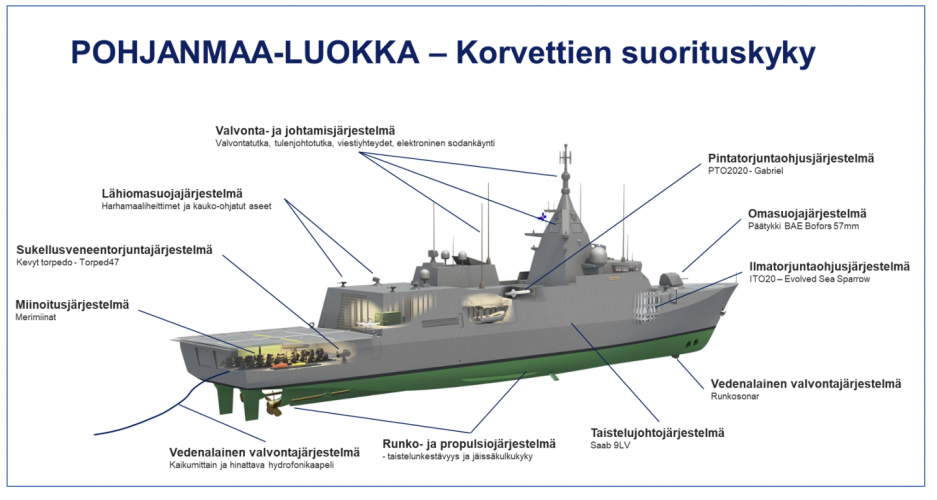
The Pohjanmaas already have 3 multi-mission spaces (a) Stern, (b) Hangar, (c) Midships which can receive a mix of containers and drones. This is similar to most new European designs and isn't particularly complicated to adapt to specific user requirements.

Agree that range & endurance will require some internal changes, but perhaps not as much as one might think, since there's often a substantial amount of unused volume in the hull bottom that can be reallocated to liquids and cruising tanks. Typical fuel volume for a surface combattant of this size is typically 8-12% of displacement, depending on how much of this volume is actually assigned to fuel vs left empty... no reason a similar % couldn't be achieved by converting void spaces on the Pohjanmaa into fuel tanks, without major changes to bulkheads or internal arrangements.

To give an example, if you take a representative patrol frigate like the 3,700t La Fayette class, with 390t of fuel (10.5%) you get a range of 7,000nm @ 15 knots (48kg/nm) including hotel load and 15% margin. This can be extended to ~9,000nm at slower speeds (12 knots). That's probably similar to what the RCN would want, and somewhat conservative as modern designs have the advantage of hybrid electric drive and fuel efficient diesels (e.g. MAN 175Ds). In fact looking at BMT's propulsion studies for 4,000t Venator 110 (similar in size to the Pohjanmaa) you'd need ~2,200kW to cruise at 15 knots in Sea State 4 + 800-1,000kWe hotel load... which adds up to only ~40 kg/nm.

Likewise food storage is usually easy to expand with small changes to internal accommodation spaces. This doesn't impact bulkheads or structural layout. Also minimally crewed ships (70 crew on Pohjanmaa) require very little food storage compared to past designs.

(Pic of modular multi-mission spaces attached)
 

Attachments

  • Pohjanmaa class.png
    Pohjanmaa class.png
    464.6 KB · Views: 37
Last edited:
Agree that range & endurance will require some internal changes, but perhaps not as much as one might think, since there's often a substantial amount of unused volume in the hull bottom that can be reallocated to liquids and cruising tanks. Typical fuel volume for a surface combattant of this size is typically 8-12% of displacement, depending on how much of this volume is actually assigned to fuel vs left empty... no reason a similar % couldn't be achieved by converting void spaces on the Pohjanmaa into fuel tanks, without major changes to bulkheads or internal arrangements.

[...]

Likewise food storage is usually easy to expand with small changes to internal accommodation spaces. This doesn't impact bulkheads or structural layout. Also minimally crewed ships (70 crew on Pohjanmaa) require very little food storage compared to past designs.
Or we just stretch the hull 3m or so through the cold and dry stores lockers, make the rest of the volume as fuel bunkerage.
 

Similar threads

Back
Top Bottom