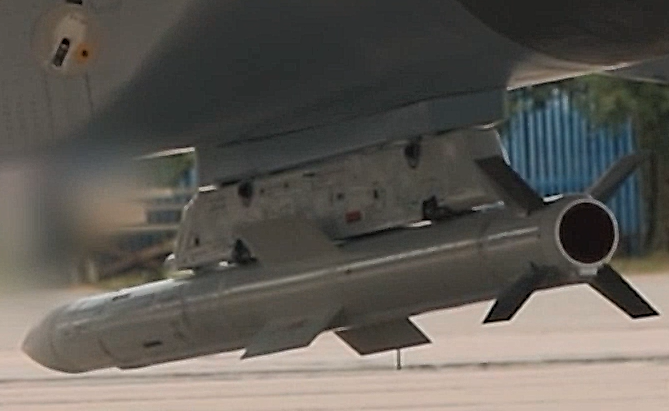
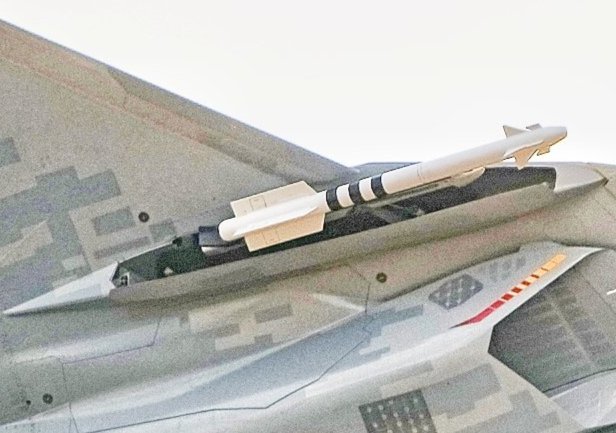
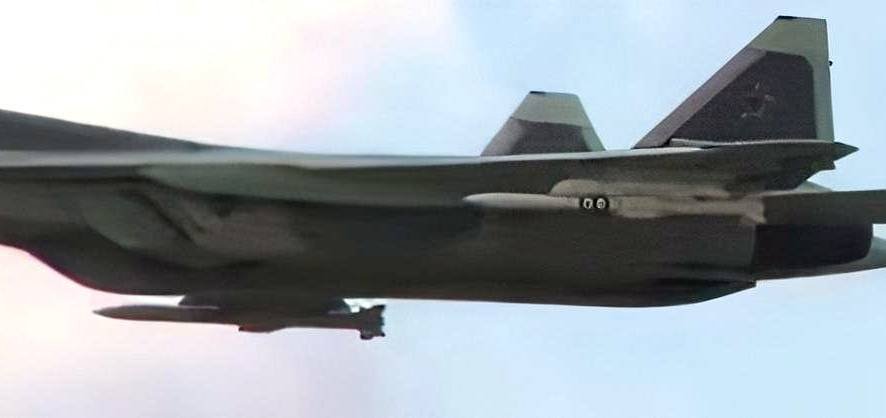
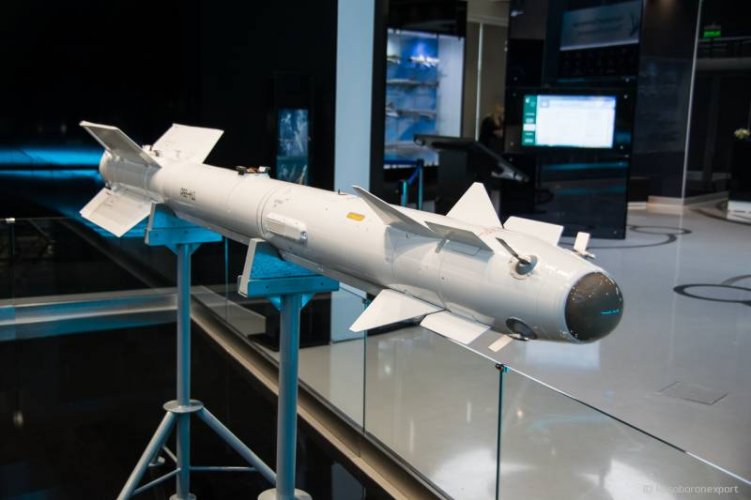
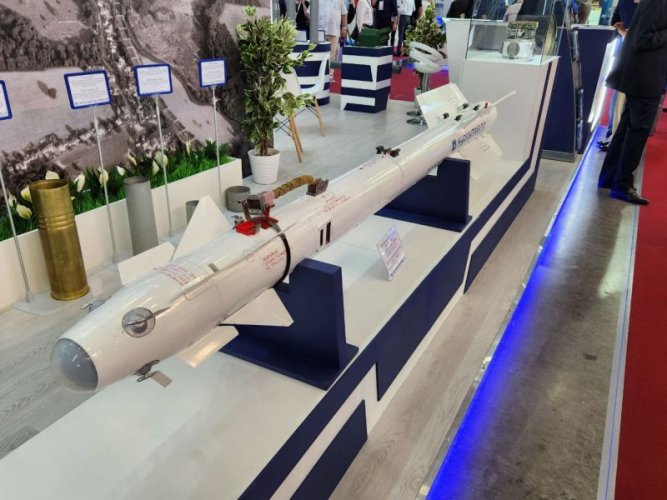
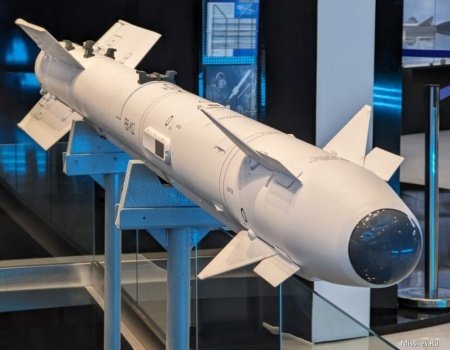
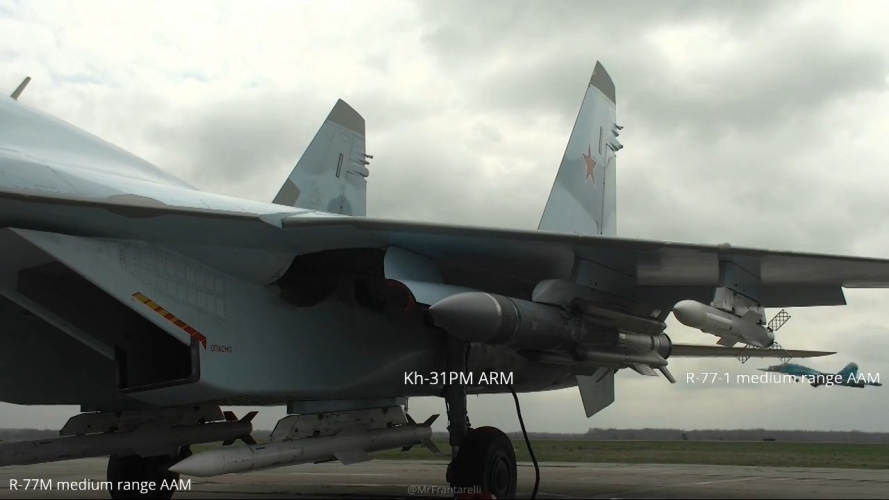
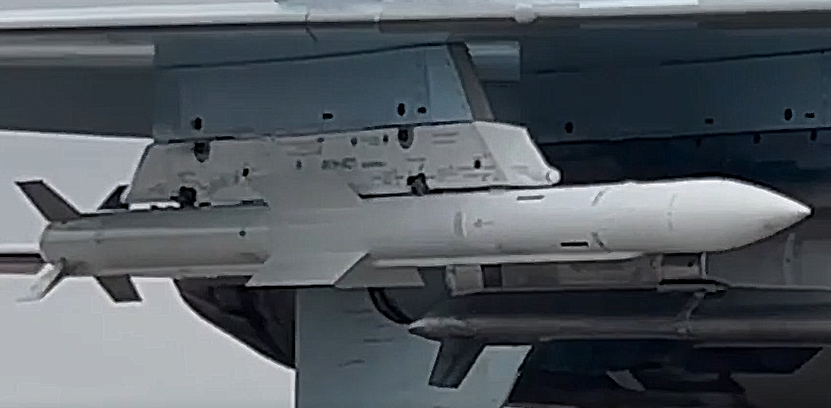
Even if we assume for a moment that is true, there is the elephant in the room: why would Vympel show a half finished missile alongside the then prototype stage R-74M2 and that notched wing R-77 variant (R-77-2?)? They could not have shown it at all or they could have shown something else of their vast portfolio. We need a satisfactory answer to this question between dismissing that missile as just a half-finished/section of an R-77.
This 'new missile' was seen in a video of the Vympel assembly line, not the sales booth at MAKS airshow. Vympel didn't show anything.
The alternative hypothesis is that Vympel created a new and secret small air-to-air missile of uncertain purpose as a "cut-and-shut" made from reused R-77 parts, then accidentally displayed this topic secret missile in a video of their assembly line.
They have then kept silent about it, never displaying it at airshows nor discussing it.
I suggest users bury this discussion until some kind of actual evidence emerges, and stop endlessly rehashing the same speculation, or receive a topic ban.
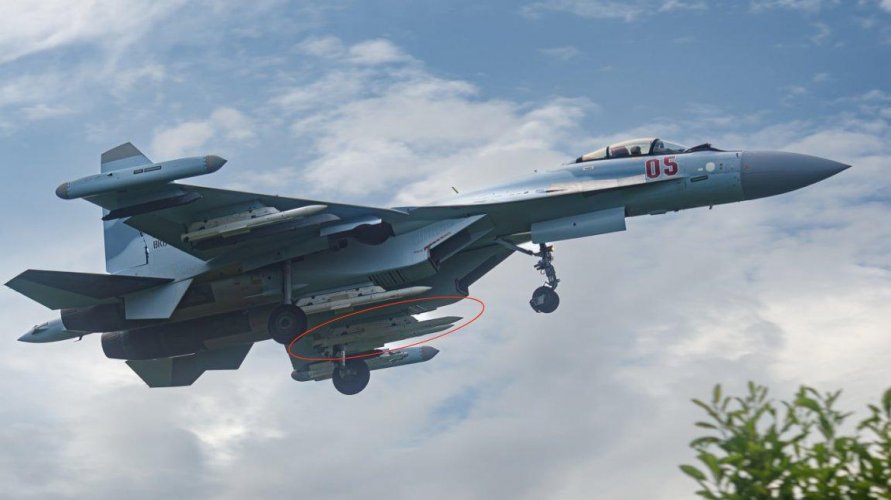
Your photo only shows that it is an inert model related to Izdeliye 171 testing, which doesn't tell anything helpful, while the red model undergoing a drop test in the video is likewise a test item. Neither prove this "hole" is present in the actual missile. We need to see a photo of an actual missile with a hole in its wing actually being carried or fired from an aircraft, or even a representative model displayed at an airshow.
IMM is literally Intertial Mass Model. Not the "new notched wing" missile. It's seen in video that notches being used for cables in drop tests.
You continue to live in your fantasy world where security cleared Vympel anniversary video show dozens of a new "classified Izd 270 missiles" (surprisingly based on old 170, not 180) that just don't have place for fcuking rocket motor section on assembly line. Where all these shorties go after that? To classified storages in Neverland?
And I hardly advise you to find 170/171 nozzle photos on web to understand that it looks totally different even from that 10*10 pixels nozzle area end you trying to use as 'proof'
Your photo only shows that it is an inert model related to Izdeliye 171 testing, which doesn't tell anything helpful, while the red model undergoing a drop test in the video is likewise a test item. Neither prove this "hole" is present in the actual missile. We need to see a photo of an actual missile with a hole in its wing actually being carried or fired from an aircraft, or even a representative model displayed at an airshow.
Yes, those '171-1' inert model photos and tests are now 6 years old. What happened in these 6 years,we don't know 'cause there is no reliable photo or video in the meantime which could tell us what is going on with that and the other new AAM's developed in the near past.
Sorry but for 15 years from the first T-50/Su-57 test flight ,we saw only two missile launches: one test launch of the test version of cruise missile type Kh-69 ( Kh-59MK2) and the test launch of the Izd 760 ( R-74M2).
IMM is literally Intertial Mass Model. Not the "new notched wing" missile. It's seen in video that notches being used for cables in drop tests.
You continue to live in your fantasy world where security cleared Vympel anniversary video show dozens of a new "classified Izd 270 missiles" (surprisingly based on old 170, not 180) that just don't have place for fcuking rocket motor section on assembly line. Where all these shorties go after that? To classified storages in Neverland?
And I hardly advise you to find 170/171 nozzle photos on web to understand that it looks totally different even from that 10*10 pixels nozzle area end you trying to use as 'proof'
IMM or in Serbian 'GTM' (Gabaritno-težinski model) ,it is the same and I know what does it mean . Your answers are always the same. Now check that detail about black connecting block again beacuse it is obvious that there is a big difference between AAM's on that 'double-photo' ( blue and yellow lines).
Izd. 270 has the same wider nozzle as the Izd. 170 and exported Izd 190 ,yes . Newer Izd. 170-1 ( 171-1) have narower nozzles.
My answers always the same because I do know, I don't need to guess or examine blue or yellow lines. KTRV was a starting point of my aerospace career. Stop spreading BS please.
The weapons bay volume looks sufficient (compared to Izdeliye 760, there's still plenty of extra space)... I think just need to replace it with new launch rails
yeah I’m looking for that patent doc as well, I don’t trust random third party websites, they often cite made up data or just unverified stuff in general.
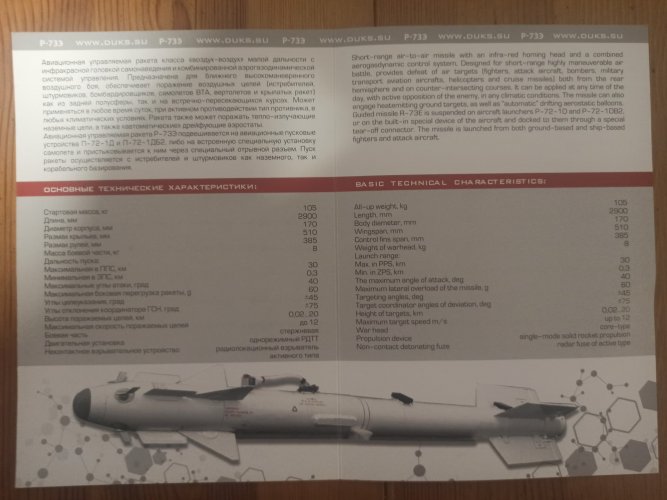
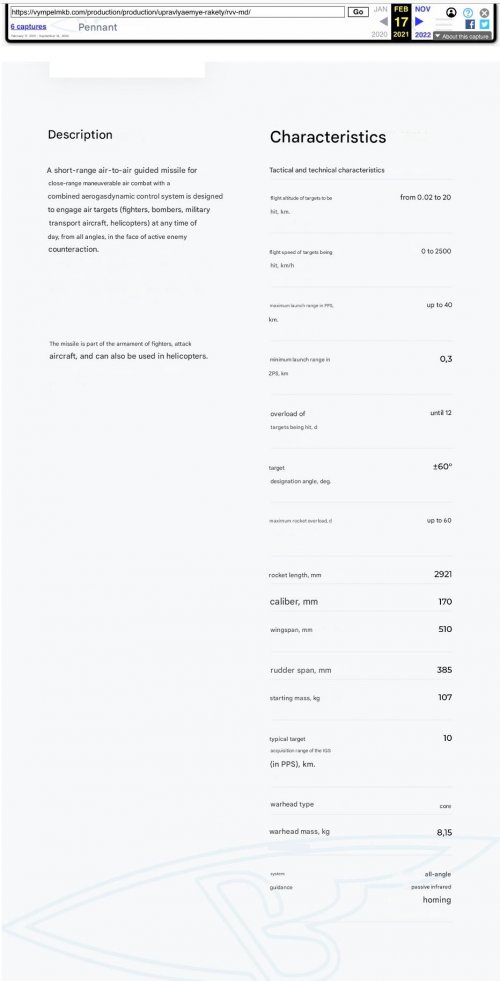
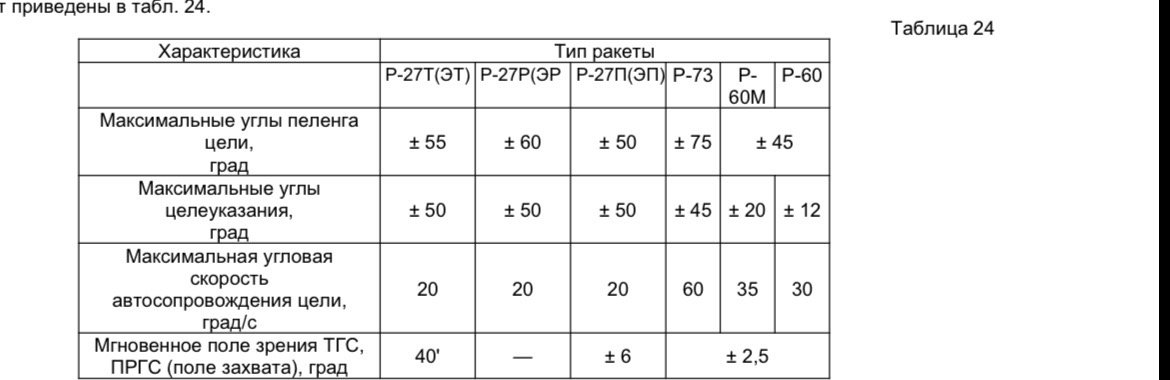
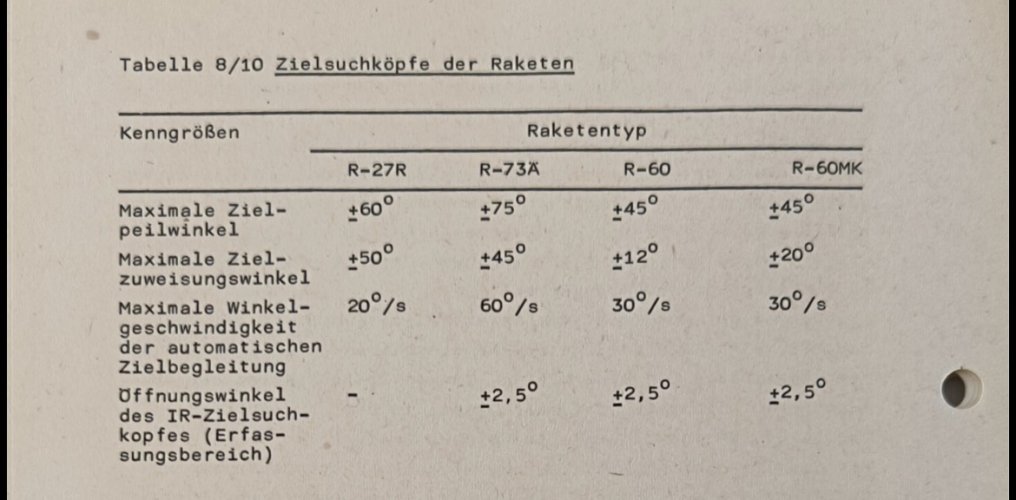
Also does that mean r77 more maneuverable than r73? Max aoa of 45 degrees seem to indicate that compared to the 40 of r73, although r73 has g load max of 60g compared to 50g of r77.
If the 150 degrees is real it means it has higher turning rate than mica which is insane for non thrust vectoring missile.
yeah I’m looking for that patent doc as well, I don’t trust random third party websites, they often cite made up data or just unverified stuff in general.
Also does that mean r77 more maneuverable than r73? Max aoa of 45 degrees seem to indicate that compared to the 40 of r73, although r73 has g load max of 60g compared to 50g of r77.
If the 150 degrees is real it means it has higher turning rate than mica which is insane for non thrust vectoring missile.
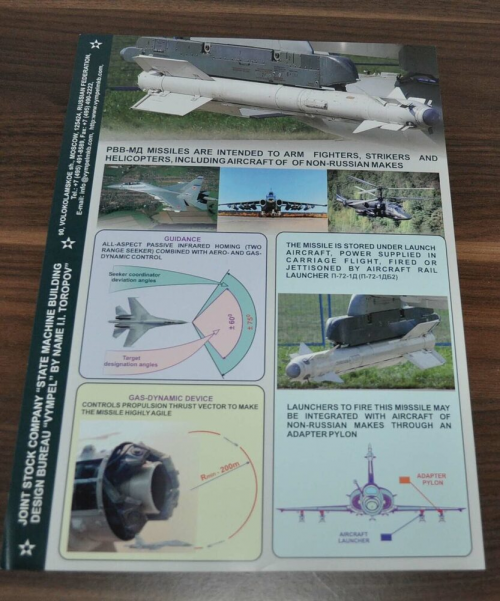
Hm, I have info for 40G but that is from 'Duks' company as I can see.Today, Duks besides Vympel and Kurganpribor produces R-74 ( L/ML ). 60G of lateral G load for the 100+ heavy AAM is excellent.
RVV-AYe in fact was designation for the K-77/R-77. 'RVV-AYe' is not the designation for the export version.Yes ,many sources mentioned that but it si wrong. V.Bogatskiy from ther Vympel company explained that once.
Hm, I have info for 40G but that is from 'Duks' company as I can see.Today, Duks besides Vympel and Kurganpribor produces R-74 ( L/ML ). 60G of lateral G load for the 100+ heavy AAM is excellent.
Author 'DIMMI' modified his page about Izdeliye 810 in Feb this year. He didn't mention designation R-97 and specifically mentioned Izdeliye 'Orlan' ,seems for the radar seeker etc ...He mentioned that Izd 810 does not have wings but it is obvious that there is two pairs of long but narrow wings.
http://militaryrussia.ru/blog/topic-218/topic-684.html
Almost 20 years ago, in 'Take-off ' magazine there was some details about that new very long range AAM for the Su-57 ( PAK FA/T-50), even more details in connection with the Izdeliye 'Orlan' .
''Для самолета пятого поколения на его базе на конкурсной основе ГосМКБ «Вымпел» разрабатывает новое «изделие 810», отвечающее требованиям размещения во внутренних отсеках вооружения носителя. Новая ракета обеспечивает повышенные тактические характеристики по максимальным дальностям пуска (не менеечем в 1,5 раза) и высотам поражаемых целей. В составе вооружения самолета пятого поколения она должна обеспечить его превосходство в дальних воздушных боях с истребителями противника при высокой степени своей выживаемости.К числу новых технических решений,реализуемых при разработке этой ракеты,относится применение РДТТ с двухимпульсной программой тяги и регулируемой паузой, а также энергоблока с увеличенным до 360 с временем работы, что,наряду с оптимизацией аэродинамической компоновки, позволяет обеспечить высокие дальности пуска на всех высотах,включая и малые, а также максимальную высоту поражения скоростной цели до 40 км.
На УР планируется применение многорежимной РГС с активным и пассивным режимами наведения (прорабатываются также перспективы использования полуактивного режима). Режим пассивного наведения на источник помех БРЛС самолета-носителя и на излучение самолетов противника является новым боевым свойством для ракет большой дальности. В состав системы управления включается также высокоточная ИСУ с лазерными ДУС и приемником сигналов спутниковой навигационной системы для ее коррекции на траекториии двухсторонняя линия передачи данных для осуществления радиокоррекциии приема на носитель тактической телеметрии с ракеты о работе ее бортовых систем.Адаптивная боевая часть может формировать, в зависимости от информации о типе цели, три типа поля поражения: узкое, широкое круговое и направленное. Планируемый срок завершения создания новой ракеты определяется примерно 2013 г.''
''For the fifth-generation aircraft based on this aircraft, the Vympel State Design Bureau is developing a new "Product 810" on a competitive basis, which meets the requirements for placement of weapons in the carrier's internal compartments.The new missile offers improved tactical performance in terms of maximum launch ranges (at least 1.5 times) and target altitudes. As part of the fifth-generation aircraft's armament, it should ensure its superiority in long-range air combat against enemy fighters while maintaining a high degree of survivability. New technical solutions implemented in the development of this missile include the use of a solid propellant rocket motor with a two-pulse thrust program and adjustable pause, as well as a power unit with an operating time increased to 360 s ,this, along with the optimization of the aerodynamic configuration, allows for long launch ranges at all altitudes, including low ones, as well as a maximum engagement altitude of up to 40 km against high-speed targets.
The missile is planned to use a multi-mode radar with active and passive guidance modes (the prospects for using a semi-active mode are also being explored).Passive guidance to the jamming source
of the carrier aircraft's radar and to the emissions of enemy aircraft is a new combat capability for long-range missiles.The control system also includes a high-precision INS with laser remote control systems and a satellite navigation system receiver for trajectory correction. A two-way data transmission line is also included for radio correction and the reception of tactical telemetry from the missile on the carrier regarding the operation of its onboard systems.The adaptive warhead can, depending on target type information, generate three types of kill fields: narrow, wide circular, and directional. The planned completion date of the new missile is approximately 2013.''
Some questions and notes ( about bolded details) :
'1.5 times increased launch ranges ' in comparison with R-37M maybe?
Does it seem that this is the first time that one very long range AAM is specifically developed/designed for engaging enemy fighters in BVR combat ?
This is obviously the second AAM with the dual pulse rocket engine after one used in the new R-77M?
If the data about 60sec flight time for the old R-33 is right, this is 6 times more and must keep in mind that old R-33 has dual-stage rocket engine,new Izd 810 has dual-pulse.
Maybe Su-57 can fly/patrol with four Izd 810 inside FWC's above Armstrong Limit ?
Russians obviously never give up from SARH.Even newer R-37M and R-77-1 have combined ARH/SARH in the terminal phase.
It seems that maybe even old R-33 has HOJ mode and of course there was R-27P/EP (questionable if it is operational today.I had info that Vympel produced 200 pcs of them ).
Author mentioned BINS or strapdown INS with lasers and sat-cor possibility something like ''Бесплатформенная инерциальная навигационная система БИНС-СП2'' which has quartz accelerometers and laser gyroscopes: https://vpk.name/images/i122130.html
R-37M also has two-way data link ,older K/R-37 did not have it.
P.S.
Earlier article from 2018 on 'bmpd' about new 'R-97' . Izdeliye 810 or not?
Is there any hard info on izdeliye 180? Given that it appears to be in service, it would be nice to know more about it.
But its just rumors and assumptions so far.
Sure, its likely to have smaller electronics section. Possibly even using advanced seeker. Possibly allowing for a longer propulsion section. Possibly multipulse one, but that's all still just conjecture.
So again, are there any decent info sources on it?
Izdeliyie 810 clearly suggests its a continuation of R-33 (410), R-33S (510), K-37 (610), R-37M(610M) design family.
R-97 designation, if real, would more suggest an R-77 successor design to me. I think it unlikely the two are the same. The evidence for R-97 designation even existing is weak, however. The below translation makes it sound like Boris Obnosov maybe mentioned the R-97 designation but I found no evidence he did, he simply revealed the existence of a new long range AAM project, later known as Izdeliye 810.
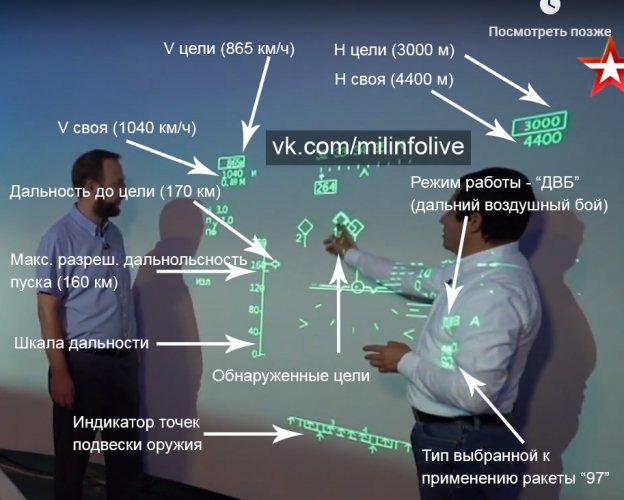
In the ILS, information can be divided into 2 blocks: information about the flight parameters of your aircraft and information about the targets of the tracked radars, as well as the weapons selected for use.
The flight parameters of your aircraft include: speed (1040 km/h), altitude (4400 m), flight course, director index of your aircraft showing the spatial position of the aircraft, the value of the number M — speed of sound (0.89), the values of the current overload and angle of attack.
Information and targets include the following indication elements: symbols of detected targets, speed of the tracked target (865 km/h), altitude of the tracked target (3000 m), range scale on which the range to the captured target (170 km) is displayed, maximum permitted launch range (160 km), operating mode (DVB), weapon hardpoint indicator and the most interesting for us - type of selected missile (97).
And so we have: we are flying at a speed of 1040 km/h at an altitude of 4400 m, the radar (radar station) of our plane accompanies a target that flies slightly lower and slower than us. The sighting system allows you to launch a missile at a distance of 160 km from the target.
The most interesting thing in this frame is the type of missile chosen — «97» Most likely the R-97 — new long-range missile «air-to-air», which was mentioned by the general director of the Tactical Missile Weapons Corporation Boris Obnosov.
Let's compare the R-97 a little with the latest modification of the American AIM-120 AMRAAM (AIM-120D) air-to-air missile. According to open data, its maximum launch range is — 180 km. The maximum missile launch range is indicated if it is fired at air targets flying at high altitude and at high speed. When attacking medium-altitude, medium-speed targets, the range of missiles drops significantly. Those. The launch range against a target with flight parameters H=3000 m and V=865 km/h (as in this frame) will not exceed 70-80 km.
Based on this, the new Russian missile «air-to-air» has a launch range 2 times greater than that of the AIM-120D. When attacking a high-altitude high-speed target, the range can reach 300 km.
Very interesting comment btw. Besides R-97 we could find designation R-87 ( from some sources of course ) but so far ,we don't exactly know for the which new AAM. As you once wrote, we must keep digging and digging...
Some data about the Izdeliye 180 from Genadiy Sokolovsky ( GosMKB Vympel) , from twenty years ago ...
''В новой версии («изделии 180») предусматривается применение ряда новых технических решений. Прежде всего проводится оптимизация аэродинамической компоновки, включающая переход от решетчатых к плоским нескладывающимся рулям, которые обеспечат пониженное аэродинамическое сопротивление ракеты. Отказ от электрических рулевых приводов с решетчатыми рулями – своеобразной «визитной карточки» ракет типа РВВ-АЕ – одно из следствий того, что разработаны и производились они в Киеве. Кроме того, по мнению специалистов,решетчатые рули недостаточно эффективны на больших углах атаки. В России разработкой электрических приводов рулей для ракет «воздух–воздух» занимается МНПК «Авионика».
Другая особенность глубокой модернизации ракет типа РВВ-АЕ – применение многорежимной радиолокационной головки самонаведения (РГС) с комплексированием активного и пассивного режимов наведения. Пассивный режим позволит наводить ракету на источники помехи излучающие РЛС самолетов противника. Разработка активно-пассивной РГС выполняется МНИИ «Агат» на основе опыта работ по созданию модернизированных головок самонаведения для ракет средней дальности, которое это предприятие вело с 1987 г. Сегодня аналогичные активно-пассивные РГС используются на ракетах AMRAAM (начиная с версии AIM-120B), FMRAAM и «Метеор».
На новой ракете предусмотрено применение двухдиапазонной линии радиокоррекции со значительно увеличенным быстродействием, высокоточной инерциальной системы управления разработки московского Государственного НИИ приборостроения (ГНИИП) на основе нового блока датчиков с лазерными ДУС,источника питания с увеличенным временем работы. Новый двухимпульсный РДТТ (как на AIM-120D) с управляемой паузой между импульсами и увеличенной массой топлива сможет работать почти 100 с, обеспечивая ракете повышенную энерговооруженность. Адаптивное боевое снаряжение с управляемым полем поражения позволит повысить эффективность поражения цели при больших возможных значениях промаха.
В результате всех усовершенствований максимальная дальность пуска ракеты во всем диапазоне высот возрастет в 2–3,5 раза, Новыми ее качествами станут пассивные режимы наведения на радиоизлучающие цели, а также возможность обеспечения ПРО и защиты задней полусферы самолета-носителя. Доработанный эскизный проект глубоко модернизированной ракеты планируется выпустить в этом году, а к передаче на вооружение она может быть готова примернов 2010 г. «Это изделие должно быть «оружием гарантированного превосходства» по отношению к зарубежным образцам типа AIМ-120C7», – сообщил Геннадий Соколовский.
Другим направлением развития ракет типа РВВ-АЕ является создание модификации УР с повышенной дальностью пуска, отличающейся применением вместо РДТТ комбинированного твердотопливного ракетно-прямоточного двигателя(КРПД). Полноразмерный макет такой ракеты под названием РВВ-АЕ-ПД неоднократно демонстрировался ГосМКБ«Вымпел» на ряде международных выставок в начале этого десятилетия. «Данная ракета разрабатывается с целью увеличения максимальных дальностей пуска намалых высотах, что позволит обеспечить превосходство отечественного истребителя в воздушном бою над истребителями противника с ракетами «Метеор» и FMRAAM», – сообщил об этой модификации Соколовский. Разработка ее ведется «Вымпелом» на инициативных началах. Аванпроект такой ракеты был защищен в 2002 г., все работы могут быть завершены примерно к 2012 г., однако перспективы принятия на вооружение модификации РВВ-АЕ с КРПД пока не ясны.''
Tranls .....
''The new version ("Product 180") incorporates a number of new technical solutions. First and foremost, the aerodynamic configuration has been optimized, including a transition from latticed to flat, non-folding control surfaces, which will reduce the missile's aerodynamic drag.The abandonment of electric steering actuators with lattice rudders—a distinctive feature of the RVV-AE missiles—is one consequence of their development and production in Kyiv. Furthermore, experts believe that lattice rudders are insufficiently effective at high angles of attack. In Russia, the Scientific and Production Corporation Avionika is developing electric control surface drives for air-to-air missiles.
Another feature of the extensive modernization of the RVV-AE missiles is the use of a multi-mode radar seeker (RSH) with integrated active and passive guidance modes. The passive mode allows the missile to be guided to jamming sources emitted by enemy aircraft radars.
The development of an active-passive radar is being carried out by the Agat Research Institute based on the experience of creating modernized homing heads for medium-range missiles, which this enterprise has been conducting since 1987. Today, similar active-passive radars are used on AMRAAM (starting with the AIM-120B version), FMRAAM, and Meteor missiles.
The new missile is designed to use a dual-band radio correction line with significantly increased response time, a high-precision inertial control system developed by the Moscow State Research Institute of Instrument Engineering (GNIIP) based on a new sensor unit with laser DUS, and a power source with an increased operating time.
The new dual-pulse solid propellant rocket motor (as used in the AIM-120D) with a controlled delay between pulses and increased propellant mass will be able to operate for almost 100 seconds, providing the missile with increased power-to-weight ratio. An adaptive warhead with a controlled kill field will improve target engagement efficiency even with large misses.As a result of all the improvements, the maximum launch range of the missile across the entire altitude range will increase by 2–3.5 times. Its new features will include passive guidance modes for radio-emitting targets, as well as the ability to provide missile defense and protect the rear hemisphere of the carrier aircraft.
A revised preliminary design for a deeply modernized missile is planned for release this year, and it could be ready for deployment around 2010. "This product should be a 'weapon of guaranteed superiority' over foreign models such as the AIM-120C7," said Gennady Sokolovsky.
Another development direction for the RVV-AE missile is the creation of a missile modification with an extended launch range, distinguished by the use of a combined solid-propellant rocket-ramjet motor (SRRM) instead of a solid-propellant rocket motor. A full-scale model of this missile, designated the RVV-AE-PD, was repeatedly demonstrated by the Vympel Design Bureau at a number of international exhibitions earlier this decade.
"This missile is being developed with the goal of increasing the maximum launch range at low altitudes, which will ensure the superiority of the domestic fighter in aerial combat over enemy fighters armed with Meteor and FMRAAM missiles," Sokolovsky said about this modification.
Its development is being carried out by Vympel on a proactive basis. The preliminary design for this missile was approved in 2002, and all work could be completed by approximately 2012. However, the prospects for the adoption of the RVV-AE modification with the ram-jet are still unclear.''
So what we have here ,we have in fact two modifications of the RVV-AE : first with the dual-pulse rocket engine and second with the ram-jet powerplant.
Now, my opinion, this is most propably Izd.180 or R-77M ...
Than this could be the Izd. 180PD ? R-87 or 97 ???
It is said that Izd 180 has rocket engine total operating time 100sec ( for comparison ,new very long range AAM for the Su-57 even 360sec ) but I think it is in fact total controlable flight time or the time of aerodynamic stability and controlability. Max launch range of the Izd 180 is 2-3.5 times greater in comparison with the Izd 170 .
One more detail ,this sentence could be found in some other articles ...
''Furthermore, experts believe that lattice rudders are insufficiently effective at high angles of attack.''
It is strange when it is known that lattice stabilizers of the R-77/-1 allow achieving high AoA ( 40°-50°).
As we could read in the mentioned article, two new Russian AAM's have dual-pulse rocket engine, Izd.180 and Izd.810.
Photo where we can see that R-77M really has shorter and wider wings than R-77-1 .It seems that wings and stabilizers of the R-77M have the same span .
Some details about Izdeliye 750 or R-74M ( ML) /RVV-MD and Izdeliye 760 or R-74M2/ RVV-MD2
R-74M and ML with the radio proximity fuse Yantar and laser proximity fuse Krechet.Does it look that R-74M possess Germanium made dome for the LWIR band seeker?
Authors Douglas Barrie and Piotr Butowski wrote some details,about R-74M and M2 and its Impuls-90/Karfagen-760 IR/ IIR seeker in the article called ''View to a kill'' part two from May 2018 "
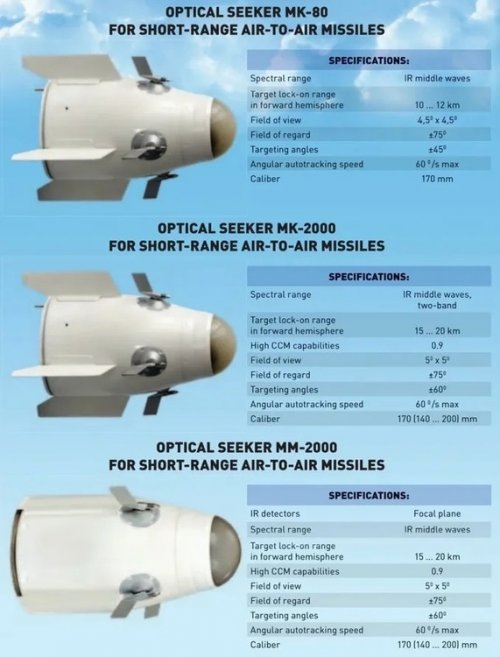
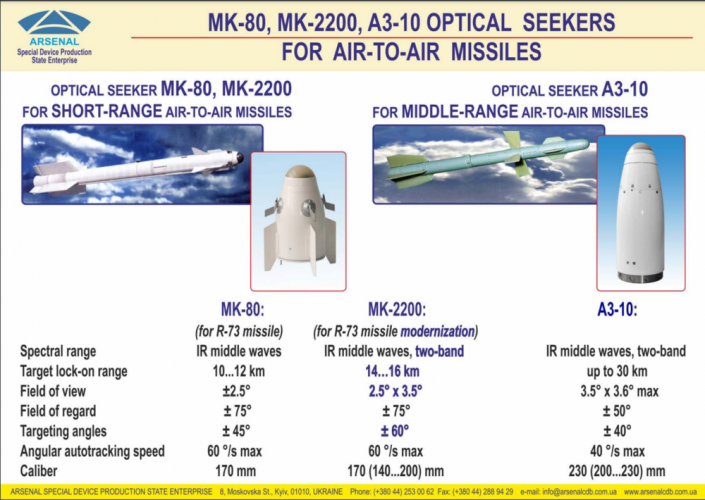
''The K-74M (izdeliye 750) design replaced the previous Mayak (lighthouse) seeker with the two-band infrared Impuls-90 seeker. The Impuls-90 (impulse; IS-90) seeker is more sensitive (maximum range is 9.3- 12.4 miles, 15-20km) and it has an increased offbore- sight angle of +/-60°. The K-74M also introduced digital signal processing. Apart from minor changes in the dimensions of the seeker, the external appearance of the missile is unchanged. The new Impuls seeker, like the previous Mayak, was developed by the Ukrainian Arsenal Company of Kiev.
The programme, however, then disappeared from public view for more than a decade, only for the missile to be displayed again in 2009 with the export designation RVVMD (Raketa Vozdukh-Vozdukh Maloy Dalnosti, short-range air-to-air missile).
The K-74M missile completed state evaluation in October 2012 and was officially commissioned into service with the Russian Air Force with the military designation R-74M (the letter K denotes a missile in the development phase; after entering service it receives the R designation). It is fielded in two sub-variants: the R-74MK (izdeliye 750K) with radar proximity fuse and R-74ML (izdeliye 750L) with laser fuse; the latter is offered for export as the RVV-MDL.
On June 7, 2013, the Duks Company of Moscow secured an order from the Russian defence ministry to produce the first batch of 153 R-74MK and ML missiles by November 2015. Accordingly, in August 2013, Duks signed a follow-on contract with Ukraine’s Arsenal to deliver Impuls-90 seekers. Yuri Klishin, the general manager of Duks, told Russian reporters in June 2016 that since the previous year his company had been delivering a new missile developed from the R-73; undoubtedly, he meant the R-74. However, other Russian media reports suggest production of the R-74M is at a standstill because of the lack of components produced in Ukraine.
The current conflict between Russia and Ukraine has severed military co-operation between the countries, including deliveries of Mayak and Impuls infrared seekers from the Arsenal Company. Despite their efforts, the Russians have not managed to replace the Ukrainian seekers with an indigenous development; the Karfagen seeker from the AOMZ company (see below) is not yet ready for production. In April 2014, the Russian Radiozavod factory in Kyshtym was charged with mastering production of the Impuls-90 seeker for the R-74M (the Ukrainians had handed over the missile documentation to Russia in the early 2000s). The first 12 test seekers were to be completed by October 2014.
However, reports suggest that Duks did not deliver a single R-74M missile by at least October 2016, because of the dearth of Impuls seeker deliveries from Radiozavod. Reportedly, in 2015 the Radiozavod factory mastered production of the older Mayak seekers only.
The Karfagen seeker also doesn’t appear to be a full IIR seeker, which would leave the air force at a disadvantage against any opponent with an IIR-based AAM and would be a drawback for Russian industry in an increasingly competitive export arena. It seems possible the K-74M2 remains a ‘gap filler’ until a yet-to-be-identified next-generation IIR AAM project is completed.''
https://www.key.aero/article/view-kill
There is so many mistakes in this article. Even old Mayak-80/E was two-band IR seeker.To repeat, old Soviet R-73 (L) from 1983 had lock-on limitation of angle aspect of 120°,+/-60°. IR seeker coordinator had angle limitation +/-75°. From 1987 there was export version R-73E ( only with radio proximity fuse). Lock-on limitation of the R-73E for the MiG-29A/B was reduced to the angle aspect of 90° so +/-45° but with two optical blocks called SCAB-A/B besides the ILS-31/HUD.Than in 1991 was tested and from 1992 was in operational use R-73M where IR seeker had lock-on limitation of 150° ,+/-75° and where seeker coordinator had angle limits +/-90°.This new short range AAM had almost the same destiny as then famous RVV-AE or R-77.Only several hundreds of serial produced missiles were transferred to Akhtubinsk air base during 1991 and on 23 April 1994 both AAM's type R-74M(ML) and R-77 were officially entered VVS on the fighter MiG-29S/9.13S.
As far as I know, from 2015 company Kurganpribor in Kurgan serially produced both Izdeliye 740/R-74 and Izdeliye 750/R-74M with all Russian components.
https://bmpd.livejournal.com/3700881.html
In fact, during 2015 ( one year after Crimea crises), four companies : GosMKB Vympel and AO Duks in Moscow , PO Strela in Korolev and Kurganpribor in Kurgan started to mass produce : R-37M,R-74/M and R-77-1/L.
On the many photos we can see that R-74M/ML and R-74M2 have that black colored dome.Old R-73/R-74 have yellowish colored dome.There must be some difference than?
IR seeker coordinator had angle limitation +/-75°. From 1987 there was export version R-73E ( only with radio proximity fuse). Lock-on limitation of the R-73E for the MiG-29A/B was reduced to the angle aspect of 90° so +/-45°
This is limitation of R-73/73L/73E on all models not just MiG-29. The max the seeker can be slewed is 45 degrees despite having a maximum 75 degree angle to target after launch. Only later variants increased this to 60 degrees. There are already pictures on this page that affirm this.
Read Su-27SK it will say same thing https://www.secretprojects.co.uk/threads/current-russian-ukrainian-aam-projects.283/post-852545
This is limitation of R-73/73L/73E on all models not just MiG-29. The max the seeker can be slewed is 45 degrees despite having a maximum 75 degree angle to target after launch. Only later variants increased this to 60 degrees. There are already pictures on this page that affirm this.
Read Su-27SK it will say same thing
That is not right, as I wrote, R-73/L with the original MWIR/ IR seeker 'Mayak 80' had angle limitation for lock-on in mode SHLEM or other of +/-60°. What you posted is only material for the export versions ,nothing else.
So +/-60° from 1983 for MiG-29 in VVS ( from 1985 for Su-27S/P ) and +/-45° for MiG-29A/B from 1987. From 1992 there was R-73M with +/-75° but that version like R-77 wasn't mass produced.
Su-27SK is the export version like MiG-29A/B, that is the point. Don't mix some material for export versions for the variants of VVS.
That is not right, as I wrote, R-73/L with the original MWIR/ IR seeker 'Mayak 80' had angle limitation for lock-on in mode SHLEM or other of +/-60°. What you posted is only material for the export versi
Then post some evidence. What I post are Ukrainian brochures both for Ukrainian and export service. Su-27SK manual also gives 45 degree limit. Domestic MiG-29 manual shows 45 degree limit. Idk what to say. Either you must’ve heard it from someone else falsely and believed it or made it up yourself.
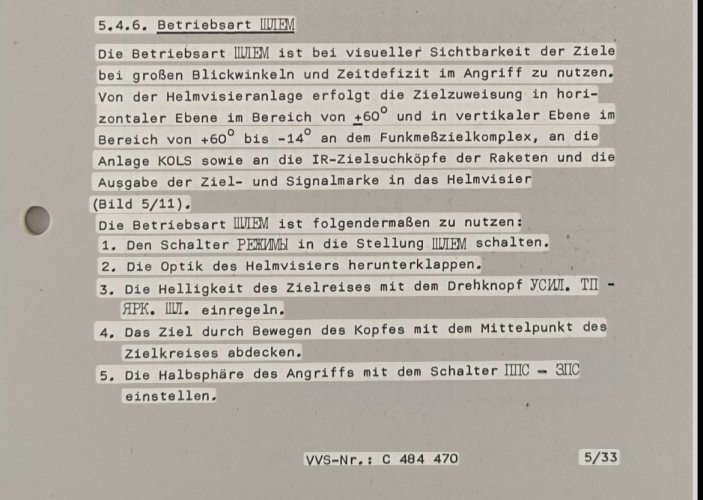
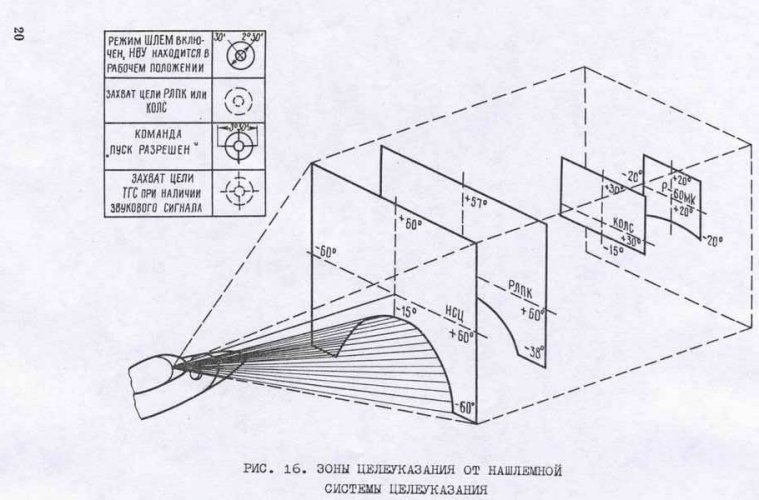
If you are confused why missiles would have lower boresight angles then HMS, the whole range of the HMS is used once the pilot activates COOP mode to activate radar locking with HMS.
You already did it.Take a look on your own attachment where we can see lock-on zone with the HMS ( Schel-3UM with the optical colimator in front of the right eye type NVU-2M) . It is limited by the angles +/-60°.
You already did it.Take a look on your own attachment where we can see lock-on zone with the HMS ( Schel-3UM with the optical colimator in front of the right eye type NVU-2M) . It is limited by the angles +/-60°.
Yes becuase it is only about what Schel-3UM can do and says 0.00% about what R-73 can do. Just because HMS looks 60 degrees in one direction doesn’t mean R-73 can lock that far.
This site uses cookies to help personalise content, tailor your experience and to keep you logged in if you register.
By continuing to use this site, you are consenting to our use of cookies.