I can't help but note that your position is always "they do things different, then THEY MUST BE MISTAKEN".
The confidence in Kat's statements is probably calibrated a little too high, but there are vulnerabilities that the PLAAF and PLARF and their political superiors must consider in the event of a long war.
Ultimately, the bleeding edge of military technology is probably in advanced submarines and very long-range stealth aircraft and advanced satellite mega constellations, and commensurate investments in those must be necessary.
China is still a developing nation, a lot of these advanced technologies will take time to mature and deploy at scale. It makes no sense to deploy these technologies at scale if they are not competitive with Western equivalents, unless you want to pull a Soviet Union and pump out mountains of crappy diesel submarines and go bankrupt in the process like an idiot. In the interim, it is extraordinarily reasonable to focus on capabilities that match up to their Western equivalents while investing heavily in development rather than production. Furthermore, there is probably no set timetable for war, but rather the CCP wishes to have the most economical and favorable correlation of forces for war at every point in time should a crisis arise, as judged by balancing cost, benefit, capability, and national requirements - if there were, they would be pulling a Soviet Union and pumping out crap en masse! You can say that they're gambling with the future of the nation by economizing, but that's just responsible spending of limited tax dollars (or RMB, as the case may be). If a crisis does arise and war does come, then yes, they will look foolish to the nationalist crowd for not arming the country to the teeth.
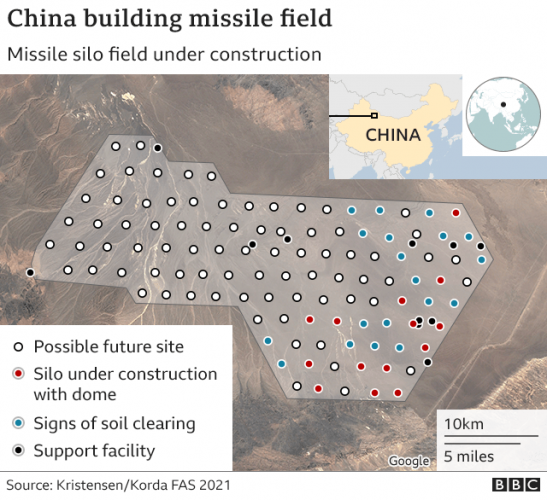
ICBMs are probably not a survivable second strike, but provide a reasonably low cost way of storing missiles while complicating the task of the United States Air Force. Sorties directed against the silo fields are sorties that cannot hit the tunnel networks, and vice versa. As China builds out the nuclear weapons complex, it makes sense to build the most mature systems first, as above. Chinese construction methods are advanced, they know how to pour good concrete. You're building out the vestigal, minimum-deterrence nuclear weapons complex anyway so your plutonium and bombs and interim missiles need to go somewhere, might as well plop them in silos. Can you imagine how expensive it would have been to house 1,000x DF-41 in
more tunnels in Sichuan? With a silo buildout, warhead production capacity will be there when they go with the SinoTrident or SinoMidgetman or whatever comes next, and you have an investment in the future (Minuteman has lasted half a century!). This is a developmental process, different stuff is coming online at different times, and rushing the R&D is inordinately costly (look at the hundred-gigadollar chip effort) - and you can lean on the civilian sector to lift all boats. Again, China is a developing nation, and these are the implications of phased development (at least, that's how the CCP is going to justify it).
Modern weapons probably allow for significant degradation of capabilities in a single sortie, which is why the Chinese have invested in deep tunnel
and silo to provide a larger strategic force. Even with a five to ten percent sortie loss rate, which would be a disaster for the USAF stealth bomber force in any protracted campaign and completely unsustainable, in this sort of Silver Bullet capability mission, use-once-only (or a nuclear mission), it's potentially workable. A la WW2, the bomber will always get through; the question is the sortie loss rate.
As the Israelis have attested, a bolt-from-the-blue conducted with the acme of operational and tactical methods can be quite devastating, to the extent of allowing ABM defenses to soak up missiles - but not completely decapitating.
And that's forgetting combined arms - the USN can provide significant cover for any such silver-bullet mission, including jamming, fighter support, suppression of air defenses etc (the recent Israeli war being the prototype). Yes, there will be attrition, yes you will lose one flattop, but if you KO a big chunk of the PLARF strategic nuclear force and change the nuclear correlation of forces Maritime Strategy style you're in business! The US has probably no qualms about suddenly massively vertically escalating to conventional counterforce, as recently demonstrated by the Israeli surprise attacks.