Lascaris

ACCESS: Secret
Joined
14 November 2008
Messages
349
Reaction score
443
So say that in 1942 Auphan is a bit more pro-active/decisive and the Marine Nationale or a sizable part of it anyway sails away to join the Allies. Fast forward to 1945 and France ends up the war in possession of several more cruisers, destroyers and submarines. To put it in more concrete terms lets say that the Marine Nationale ends up with the following list of ships besides Richelieu, Jean Bart, Strasbourg and Bearn.
  • Heavy Cruisers: 6
    • Algerie class: 1 (Algerie)
    • Duquesne class: 2 (Duquesne, Tourville)
    • Suffren class: 3 (Suffren, Colbert, Foch)
  • Light Cruisers: 7
    • Duguay Trouin class: 2 (Duguay Trouin, Primauguet)
    • Emile Bertin class: 1 (Emile Bertin)
    • La Galisonierre class: 3 (Georges Leygues, Montcalm, Gloire)
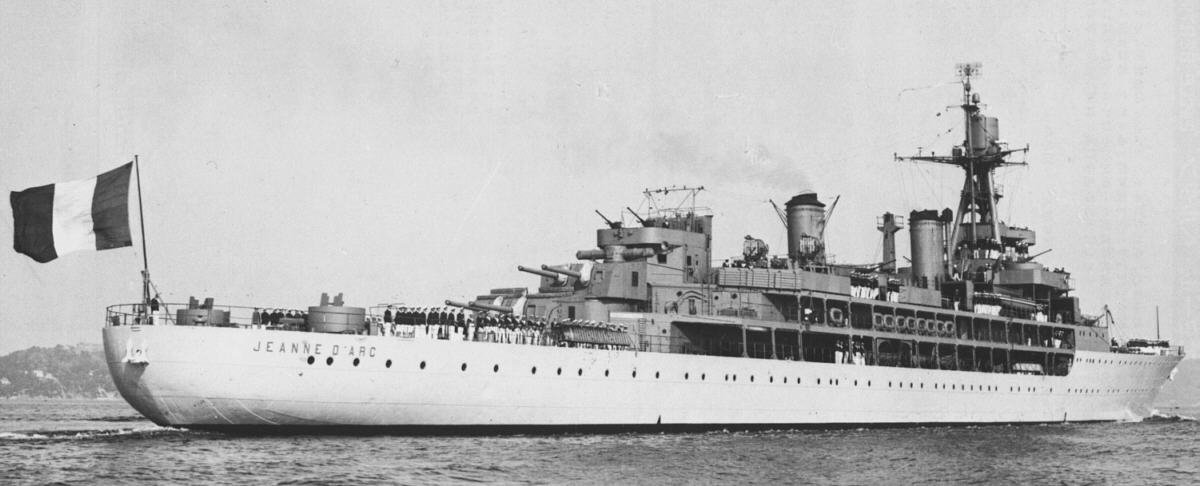
    • Jeanne d'Arc class: 1 (Jeanne d'Arc)
  • Destroyers: 32
    • Mogador class: 2 (Mogador, Volta)
    • Fantasque class: 4 (Le Fantasque, Le Terrible, Le Triomphant, Le Malin)
    • Vauquelin class: 2 (Kersaint, Cassard)
    • Aigle class: 4 (Albatros, Milan, Vautur, Gerfaut)
    • Guepard class: 1 (Verdun)
    • Chakal class: 3 (Lynx, Tigre, Leopard)
    • L' Adroit class: 9 (Basque, Forbin, Le Fortune, L' Alcyon, Bulonnais, Brestois, Fougoueux, Frondeur, L' Adroit)
    • Bourrasque class: 4 (Simoun, Tempete, Tornade, Tramontane)
    • Le Hardi class: 3 (Le Hardi, Mameluk, Casque)
  • Torpedo boats: 2
    • La Melpomene class: 2 (La Pomone, L' Iphigenie)
  • Submarines: 26
    • Surcouf class: 1 (Surcouf)
    • Redoutable class: 10 (Protee, Acheron, Acteon, Beveziers, Archimede, Argo, Glorieux, Centaure, Casablanca, Redoutable)
    • Requin class: 5 (Espadon, Phoque, Dauphin, Narval, Marsouin)
    • Saphir class: 1 (Rubis)
    • Minerve class: 3 (Minerve, Junon, Iris)
    • Argonaute class: 4
    • Minerve class: 2
  • Escorts: 10
    • Bougainville class: 4
    • Flower class: 6
So fast forward to the 1950s. Obviously the surviving fleet is a dwindling resource. But in OTL many of the ships that actually survived made it to the late 1950s and a bit later. Do we see the French navy maintaining higher force levels in the late 1940s early 1950s till the surviving ships start leaving service? And can actually France afford the manpower and maintainance costs involved?
 
So say that in 1942 Auphan is a bit more pro-active/decisive and the Marine Nationale or a sizable part of it anyway sails away to join the Allies. Fast forward to 1945 and France ends up the war in possession of several more cruisers, destroyers and submarines. To put it in more concrete terms lets say that the Marine Nationale ends up with the following list of ships besides Richelieu, Jean Bart, Strasbourg and Bearn.
  • Heavy Cruisers: 6
    • Algerie class: 1 (Algerie)
    • Duquesne class: 2 (Duquesne, Tourville)
    • Suffren class: 3 (Suffren, Colbert, Foch)
  • Light Cruisers: 7
    • Duguay Trouin class: 2 (Duguay Trouin, Primauguet)
    • Emile Bertin class: 1 (Emile Bertin)
    • La Galisonierre class: 3 (Georges Leygues, Montcalm, Gloire)
    • Jeanne d'Arc class: 1 (Jeanne d'Arc)
  • Destroyers: 32
    • Mogador class: 2 (Mogador, Volta)
    • Fantasque class: 4 (Le Fantasque, Le Terrible, Le Triomphant, Le Malin)
    • Vauquelin class: 2 (Kersaint, Cassard)
    • Aigle class: 4 (Albatros, Milan, Vautur, Gerfaut)
    • Guepard class: 1 (Verdun)
    • Chakal class: 3 (Lynx, Tigre, Leopard)
    • L' Adroit class: 9 (Basque, Forbin, Le Fortune, L' Alcyon, Bulonnais, Brestois, Fougoueux, Frondeur, L' Adroit)
    • Bourrasque class: 4 (Simoun, Tempete, Tornade, Tramontane)
    • Le Hardi class: 3 (Le Hardi, Mameluk, Casque)
  • Torpedo boats: 2
    • La Melpomene class: 2 (La Pomone, L' Iphigenie)
  • Submarines: 26
    • Surcouf class: 1 (Surcouf)
    • Redoutable class: 10 (Protee, Acheron, Acteon, Beveziers, Archimede, Argo, Glorieux, Centaure, Casablanca, Redoutable)
    • Requin class: 5 (Espadon, Phoque, Dauphin, Narval, Marsouin)
    • Saphir class: 1 (Rubis)
    • Minerve class: 3 (Minerve, Junon, Iris)
    • Argonaute class: 4
    • Minerve class: 2
  • Escorts: 10
    • Bougainville class: 4
    • Flower class: 6
So fast forward to the 1950s. Obviously the surviving fleet is a dwindling resource. But in OTL many of the ships that actually survived made it to the late 1950s and a bit later. Do we see the French navy maintaining higher force levels in the late 1940s early 1950s till the surviving ships start leaving service? And can actually France afford the manpower and maintainance costs involved?
Interesting concept!
 
Auphan was the good guy - unfortunately his superiors de Laborde and Darlan were vichyst dickheads. De Laborde in particularly was a first class moron (and this is unfair to morons, really).

...

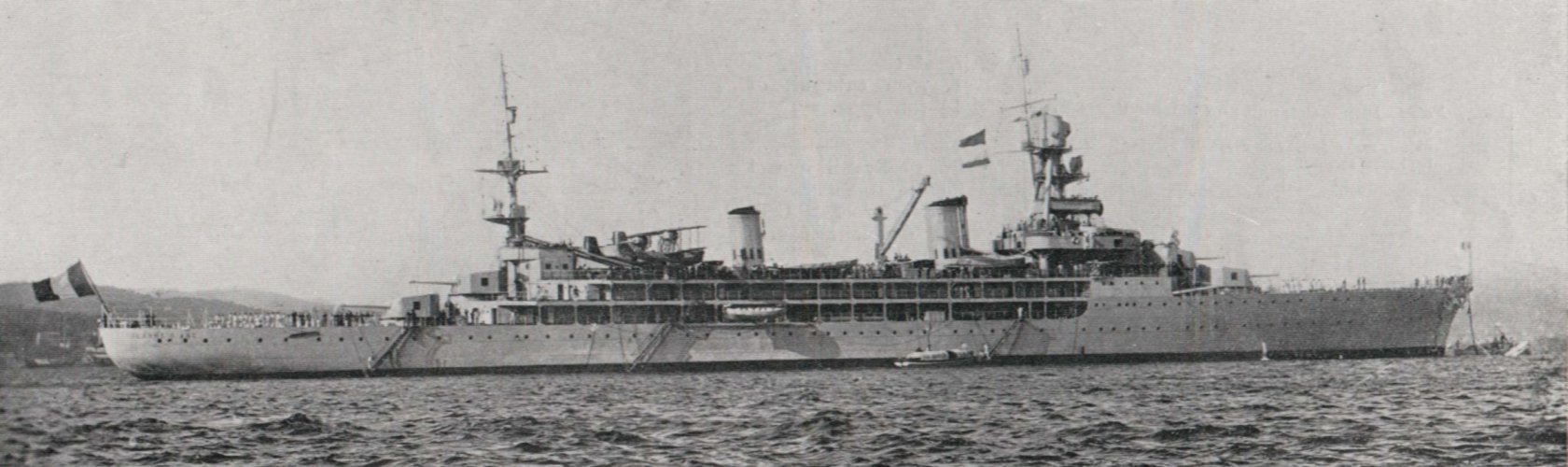
CRUISERS -- I have a soft spot for Algerie - France best heavy cruiser, ever. France however was severely limited in manpower after 1945. We got three light cruisers, broadly sharing a similar hull shape: De Grasse, Colbert, Jeanne d'Arc. Each landed a specialized role in the end: flagship of nuclear testing (De Grasse) missile cruiser (Colbert) helicopter cruiser (Jeanne d'Arc).
The 8-inch cruisers older than Algerie would not survive for a very long time.

-What happens to Dunkerque and Strasbourg battlecruisers ? OTL, battleships Jean Bart and Richelieu survived until 1960 but were severely under-manned even at Suez.

- Might be interesting to see the impact of all the surviving destroyers on the T47 / T53 family.

-Submarine cruiser Surcouf went down with all hands in February 1942 so was already gone by Toulon scuttling.

Overall, I think France had no choice other than investing in destroyers and aircraft carriers - CL, CA, BC and BB were luxuries. This duly noted, I want to see Algerie as a missile cruiser with MASURCA.
 
Last edited:
So say that in 1942 Auphan is a bit more pro-active/decisive and the Marine Nationale or a sizable part of it anyway sails away to join the Allies. Fast forward to 1945 and France ends up the war in possession of several more cruisers, destroyers and submarines. To put it in more concrete terms lets say that the Marine Nationale ends up with the following list of ships besides Richelieu, Jean Bart, Strasbourg and Bearn.
  • Heavy Cruisers: 6
    • Algerie class: 1 (Algerie)
    • Duquesne class: 2 (Duquesne, Tourville)
    • Suffren class: 3 (Suffren, Colbert, Foch)
  • Light Cruisers: 7
    • Duguay Trouin class: 2 (Duguay Trouin, Primauguet)
    • Emile Bertin class: 1 (Emile Bertin)
    • La Galisonierre class: 3 (Georges Leygues, Montcalm, Gloire)
    • Jeanne d'Arc class: 1 (Jeanne d'Arc)
  • Destroyers: 32
    • Mogador class: 2 (Mogador, Volta)
    • Fantasque class: 4 (Le Fantasque, Le Terrible, Le Triomphant, Le Malin)
    • Vauquelin class: 2 (Kersaint, Cassard)
    • Aigle class: 4 (Albatros, Milan, Vautur, Gerfaut)
    • Guepard class: 1 (Verdun)
    • Chakal class: 3 (Lynx, Tigre, Leopard)
    • L' Adroit class: 9 (Basque, Forbin, Le Fortune, L' Alcyon, Bulonnais, Brestois, Fougoueux, Frondeur, L' Adroit)
    • Bourrasque class: 4 (Simoun, Tempete, Tornade, Tramontane)
    • Le Hardi class: 3 (Le Hardi, Mameluk, Casque)
  • Torpedo boats: 2
    • La Melpomene class: 2 (La Pomone, L' Iphigenie)
  • Submarines: 26
    • Surcouf class: 1 (Surcouf)
    • Redoutable class: 10 (Protee, Acheron, Acteon, Beveziers, Archimede, Argo, Glorieux, Centaure, Casablanca, Redoutable)
    • Requin class: 5 (Espadon, Phoque, Dauphin, Narval, Marsouin)
    • Saphir class: 1 (Rubis)
    • Minerve class: 3 (Minerve, Junon, Iris)
    • Argonaute class: 4
    • Minerve class: 2
  • Escorts: 10
    • Bougainville class: 4
    • Flower class: 6
So fast forward to the 1950s. Obviously the surviving fleet is a dwindling resource. But in OTL many of the ships that actually survived made it to the late 1950s and a bit later. Do we see the French navy maintaining higher force levels in the late 1940s early 1950s till the surviving ships start leaving service? And can actually France afford the manpower and maintainance costs involved?
Considering that IRL postwar France didn't have the money to enroll all the personnel they wanted, it would be very challenging to operate all of these ships indeed.

It is possible that having a more powerful Navy would give Free France more leverage to receive more support during the war, as it could notably help the Allied war effort. Possibly when the Korean war starts as well.
 
Well, without "Catapult" he would likely join the allies side voluntary somewhere in late 1941-early 1942 (after USSR and USA joined the war).

Not sure at all. With or without Catapult, he remained a political opportunist determined to make a career in Vichy. More generally : as an Admiral he was good and built a superb French Navy fleet. But once he dabbled into politics, he was a total disaster: he had an ego the size of Richelieu battleship.
Vichy was a major surprise and a disruptive political event that persuaded a lot of opportunists, not career politicians, to try and get a chance. Particularly across the french military - or what was left of it. Petain evidently showed the way... see Huntziger as another example.
 
Not sure at all. With or without Catapult, he remained a political opportunist determined to make a career in Vichy
But the absolute impotence and lack of future for Vichy government became obvious by 1941; and by 1942 it was obvious that Vichy France would not survive for long anyway. For opportunits, it would be a clear indication that it's time to switch sides; especially considering that Darlan wasn't exactly much affilliated with Vichy, and was more like independent warlord in Africa.
 
Auphan?

Or do you meal Admiral Darlan?
Rear admiral Gabriel Auphan minister of the navy at the time of Toulon.
CRUISERS -- I have a soft spot for Algerie - France best heavy cruiser, ever. France however was severely limited in manpower after 1945. We got three light cruisers, broadly sharing a similar hull shape: De Grasse, Colbert, Jeanne d'Arc. Each landed a specialized role in the end: flagship of nuclear testing (De Grasse) missile cruiser (Colbert) helicopter cruiser (Jeanne d'Arc).
The 8-inch cruisers older than Algerie would not survive for a very long time.
Suffren made it to 1962 IMS. I think replacing it with Algerie is an obvious one without affecting in any way crew requirements.
-What happens to Dunkerque and Strasbourg battlecruisers ? OTL, battleships Jean Bart and Richelieu survived until 1960 but were severely under-manned even at Suez.
Denkerque IMO could not escape Toulon given its damage so gets scuttled. Strasbourg after 1945... does it potentially affect the fate of Jean Bart, with it being completed as a carrier? It wouldn't make the most satisfactory carrier but a 50,000 ton ship is going to be by default far more useful than the light carriers France got OTL.
- Might be interesting to see the impact of all the surviving destroyers on the T47 / T53 family.
The useful ones in addition to OTL are likely the pair of Mogadors and the 3 Hardis. Which can easily take the place of the German and Italian destroyers pressed into service OTL.
-Submarine cruiser Surcouf went down with all hands in February 1942 so was already gone by Toulon scuttling.
Ah yes. I'll admit copying the list from my timeline in AH.com where she was luckier.
Overall, I think France had no choice other than investing in destroyers and aircraft carriers - CL, CA, BC and BB were luxuries. This duly noted, I want to see Algerie as a missile cruiser with MASURCA.
If the Italians could do that...
 
Jean Bart carrier is my pet peeve. Whatever the battleship hull limitations, it is still superior to OTL two Independance class (Lafayette & Bois belleau) and Arromanches. Which made it to 1974 OTL so why not Jean Bart being similar.
Strasbourg and Richelieu fates are tricky.
Strasbourg take place of OTL Jean Bart, turned carrier ITTL. Except they are dissimilar. I think Strasbourg will be retired early.
 
ITTL there are two major changes to a) the carrier fleet and b) the cruiser fleet

Carrier fleet: Jean Bart is quite better than Arromanches or the Independance twins. He may replace one of them, but which one(s) ?
To simplify matters, I'd say
-Jean Bart
-Arromanches
This, until 1961 when the Clem, Foch and Jeanne d'Arc enter the chat. I'd say that Jeanne d'Arc would replace Arromanches, leaving four "aviation ships" in an homogenous 30 kt top speed (Arromanches was 24 kt in a good day).

The BB / BC / CA / CL post war fleet
-Richelieu
-Strasbourg
-Algerie
-De Grasse
-Colbert
(nota bene: Jean Bart and Jeanne d'Arc have switched to the carrier side, so see above)

- Sticky point: having no Independance carriers across the 1950's can free crew for the Algerie cruiser.

- But it doesn't solves the problem of BC Strasbourg: unlike Jean Bart OTL, being different and inferior from Richelieu.
- So why bother with Strasbourg, knowing how undermanned and underused, even at Suez, were Richelieu and Jean Bart twins ?

This leaves
-Clem + Foch + Jean Bart + Jeanne d'Arc four "carrier" fleet (OTL: Clem, Foch, Jeane d'Arc, Arromanches until 1974)
-Algerie, De Grasse and Colbert as ITTL "three cruiser fleet". (OTL: Colbert, Jeanne d'Arc, De Grasse until 1972)

Sounds pretty close from OTL.

For the three cruisers, the 1960's will bring two interesting questions
- which one gets MASURCA ? probably Colbert, the only new build since MASURCA was a monster system;
-which one goes to Moruroa in 1966 as a floating command post for nuclear testing ?
OTL, Richelieu was considered but De Grasse got the job instead. Can Algerie sneaks between them ?
 
Last edited:
Historically none of the surviving heavy cruisers saw front line service beyound the end of 1947.

Suffren was decommissioned and placed in Reserve on 1 Oct 1947, having completed her final tour off Indochina in March that year. She was then moored at Angle Robert, Toulon and served as a hulk for the gunnery school and from 1961 the sonar school. Renamed Ocean on 1 Jan 1963 to free up her original name. Became surplus to requirements in 1971, striken in 1972 and renamed Q 494. For sale in 1975 and broken up in 1976.

Duquesne in Reserve at Toulon from 1 Sept 1947 after completing her final Indochina tour in May that year. Attached to the Amphibious Operations Training Centre at Arzew being modified at Oran to fit her role as command post and barracks Feb-Aug 1948 then moored at Arzew. Stricken July 1955, and towed to Mers el-Kebir and put up for sale a year later.

Tourville completed her final Indochina deployment in Dec 1947 and was placed in special reserve at Brest on 1 Jan 1948. She then served as a floating barracks for various schools until being placed in Reserve B on 28 April 1961. Stricken 8 March 1962 becoming Q 312 and towed to Toulon Jan/Feb 1963 to be broken up.

From Jordan & Moulin " French Cruisers 1922-1956"
 
ITTL there are two major changes to a) the carrier fleet and b) the cruiser fleet

Carrier fleet: Jean Bart is quite better than Arromanches or the Independance twins. He may replace one of them, but which one(s) ?
To simplify matters, I'd say
-Jean Bart
-Arromanches
Langley. Bois Belleau makes too good propaganda to go to waste.
This, until 1961 when the Clem, Foch and Jeanne d'Arc enter the chat. I'd say that Jeanne d'Arc would replace Arromanches, leaving four "aviation ships" in an homogenous 30 kt top speed (Arromanches was 24 kt in a good day).
I'm not all that certain... they do enter the chat. Jean Bart is in the 45-50,000t range. It provides France with experience operating a large carrier, comparisons with the smaller carriers is inevitable. And it likely can serve into the 1970s if not 1980s. When the time comes in the late 1950s why build Clem and Foch and not... a single Verdun? A second maybe by the early 1970s as Jean Bart replacement?
The BB / BC / CA / CL post war fleet
-Richelieu
-Strasbourg
-Algerie
-De Grasse
-Colbert
(nota bene: Jean Bart and Jeanne d'Arc have switched to the carrier side, so see above)

- Sticky point: having no Independance carriers across the 1950's can free crew for the Algerie cruiser.
If Algerie is supposed to be taking the place of Jeane d'Arc, a 40 year service life brings it to 1974 or so....
 
I suppose it would depend on what level of upgrading they received during the war. Doubtless a lot of Anglo-American kit like 20mm Orkileons and 40mm Bofors would be added and radar. Some might get reconstructions in US yards. So it might be a fairly rag-tag fleets in terms of commonality.
 
Langley. Bois Belleau makes too good propaganda to go to waste.

I'm not all that certain... they do enter the chat. Jean Bart is in the 45-50,000t range. It provides France with experience operating a large carrier, comparisons with the smaller carriers is inevitable. And it likely can serve into the 1970s if not 1980s. When the time comes in the late 1950s why build Clem and Foch and not... a single Verdun? A second maybe by the early 1970s as Jean Bart replacement?

If Algerie is supposed to be taking the place of Jeane d'Arc, a 40 year service life brings it to 1974 or so....

Now that's an interesting idea. You're right, Jean Bart tonnage at 45 000 tons is closer from PA58 Verdun (and PA75 Charles de Gaulle !) than PA54 Clem & PA55 Foch. https://en.wikipedia.org/wiki/Clemenceau-class_aircraft_carrier

"Jean Bart is 45 000 tons. Why should the new carriers be around 30 000 tons ? make no sense."

Put otherwise: Jeant Bart drags PA54 / PA55 upwards in tonnage.

It remains to be seen however whether the French Navy can fund two Verduns. The 1954-1960 era budget-wise is squeezed between colonial wars (end of Indochina, Algeria), NATO committments, Suez, and the coming 800 pound gorilla: the Force de Frappe nuclear deterrent.
 
I don't think Algerie would replace Jeanne d'Arc, it is not an helicopter cruiser nor to last into the 2010's. I think Colbert or De Grasse might be in competition with Algerie. De Grasse was a pre- WWII hull, Colbert was brand new, in 1959.
I want to see Algerie in Suez, and later with a MASURCA missile system.
 
I don't think Algerie would replace Jeanne d'Arc, it is not an helicopter cruiser nor to last into the 2010's. I think Colbert or De Grasse might be in competition with Algerie. De Grasse was a pre- WWII hull, Colbert was brand new, in 1959.
I want to see Algerie in Suez, and later with a MASURCA missile system.
I think he meant the previous Jeanne d'Arc, which the Jeanne d'Arc you mean replaced.
 
The useful ones in addition to OTL are likely the pair of Mogadors and the 3 Hardis. Which can easily take the place of the German and Italian destroyers pressed into service OTL.
Having more French ships would help operationally and helped with maintenance via standardisation. Would it save money that could be used to pay more sailors 1945-60 or build more ships 1945-60 too?
 
  • Heavy Cruisers: 6
    • Algerie class: 1 (Algerie)
    • Duquesne class: 2 (Duquesne, Tourville)
    • Suffren class: 3 (Suffren, Colbert, Foch)
  • Light Cruisers: 7
    • Duguay Trouin class: 2 (Duguay Trouin, Primauguet)
    • Emile Bertin class: 1 (Emile Bertin)
    • La Galisonierre class: 3 (Georges Leygues, Montcalm, Gloire)
France had 19 cruisers (7 heavy & 12 light) at the start of the war and 9 ships (3 heavy & 6 light) survived the war.

The 3 heavy cruisers that survived the war were Duquense, Tourville & Suffren. The 6 light cruisers were Duguay Trouin, Emile Bertin, Glorie, Georges Leygues, Jeanne d' Arc & Montcalm

7 cruisers (4 heavy & 3 light) were scuttled at Toulon. The 4 heavy cruisers were Algérie, Colbert, Foch and Dupleix. The 3 light cruisers were La Galissonnière, Jean de Vienne and Marseillaise.

Them surviving the war would produce a total of 16 cruisers (7 heavy & 9 light). However, your list has 13 cruisers (6 heavy & 7 light).

Your list doesn't include Dupleix, Jean de Vienne, La Galissonnière and Marseillaise. However, you have included the light cruiser Primaguet which IOTL was sunk on 08.11.42 in the Battle of Casablanca. For completeness the other losses were the light cruiser Pluton which blew up on 13.09.39 and the light cruiser Lamotte-Piquet which was sunk on 12.01.45 by Task Force 38 during the South China Sea Raid.
 
Must confess, that I thought about this a lot) In my main AH timeline (frankly, it's pretty fragmentary - more a set of separate articles about ships, missiles, ect., than a proper timeline) the "Catapult" was avoided - there was SOME fighting between French and British forces in 1940-1941, but nothing like Mers-el-Kebir massacre - and thus North Africa remained much more favorable to Allied case. And in early 1942, after Germans stuck in USSR and America entered the war, Darlan decided "screw the Vichy, the whole world is against Germans now, they are doomed for sure!" and openly joined Free France. With the majority of French fleet on his side)

The sutiation about individual ships looked like that:

* BB "Richelieu" - used initially in the Med, then (after Italy switched sides in 1943) participated in major French-Italian naval offensive toward Singapore. Served post-war as part of French Navy battleline (mainly as a counter to Italian battleships of "Littorio"-class). In late 1950s refitted into missile-carrying battleship, with MASURCA SAM and SE-4500 cruise missiles.
* BB "Jean Bart" - since there were no "Torch", she suffered no damage, and was fully completed shortly after war. Served post-war as part of French Navy battleline (mainly as a counter to Italian battleships of "Littorio"-class). In late 1950s refitted into missile-carrying battleship, with MASURCA SAM and SE-4500 cruise missiles.

* BBL "Strasbourg" - used in Mediterranean, then send to Indian ocean. After war used as part of French battleline till 1956, then reduced to reserve. Plans for a major overhaul & missile re-arming were cancelled due to cost. Considered for sale to South America, but deal fell through.
* BBL "Dunkerque" - stayed in Mediterranean the whole war. After war used as training ship. Decommissioned in late 1950s.

* BB "Provence" - stayed in Mediterranean, used mainly as artillery support ship for coastal bombardment. Reduced to reserve post-war, decommissioned 1948.
* BB "Bretagne" - stayed in Mediterranean, used mainly as artillery support ship for coastal bombardment. Reduced to reserve post-war, decommissioned 1948.
* BB "Lorraine" - basically as OTL.

* CV "Bearn" - her crew have allegance problems (as well as other ships on Antilles), and were unwilling to serve under either Darlan or De Gaulle. So the solution was found in late 1942; the ship was "temporarely reassigned" to Soviet Navy & served as escort carrier in North Atlantic till the end of the war (basically a floating analogue of "Normandie-Neman" squadron). Post-war basically OTL.

* AVC "Commandant Teste" - used as seaplane carrier & floating base till the end of the war. Post-war converted into experimental landing helicopter dock ship; served in Indochina till mid-1960s. Later converted into weapon test ship.

* CA "Algerie" - transferred on Indian Ocean, participated in offensive toward Singapore in 1944-1945. Post-war flagship of French cruiser squadron in Indochina till mid-1950s, then training ship. Planned reconstruction into missile-carrying cruiser (with MASURCA SAM) cancelled.

* CA "Suffren" - served in Atlantic, after war close to OTL
* CA "Colbert" - served in Atlantic, in 1945 sent on Indian Ocean to replace the lost "Dupleix". After war part of French Indochina cruiser squadron (alongside Algerie and Fosh) till early 1950s. Training ship till 1960s.
* CA "Fosh" - send on Indian Ocean, after war part of French Indochina cruiser squadron (alongside Algerie and Colbert) till early 1950s. Training ship till 1960s.
* CA "Dupleix" - lost in action on Indian Ocean in late 1944; the last major French warship lost during the war.

* CA "Duquesne" - basically OTL.
* CA "Tourville" - basically OTL.

* CL "La Gallisonierre" - the only large French warship, captured by Germans in Toulon, 1942. Captured intact (since nobody bothered much to prepare for the few ships that remained in French harbors to be scuttled), commissioned into Kriegsmarine as "Magdeburg". Sunk in 1944 by Franco-Italian light cruiser squadron.
* CL "Jean de Vienne" - send on Indian Ocean, after war part of French Indochina cruiser squadron till mid-1950s.
* CL "Marseillaise" - send on Indian Ocean, after war part of French Indochina cruiser squadron till mid-1950s. In early 1960s refitted as test ship for missile armament.
* CL "Gloire" - basically OTL.
* CL "Montcalm" - basically OTL.
* CL "Georges Legyues" - basically OTL.

* CL "Jeanne d'Arc" - "temporarely reassigned" to Soviet Navy in 1942 & served as escort carrier in North Atlantic till the end of the war. After war basically OTL.

* CL "Duguay Trouin" - basically OTL.
* CL "Primauguet" - basically same career as OTL "Duguay Trouin".

* SSB "Surcouf" - served on Indian Ocean, mainly as special operation unit and commando support. After war refitted into experimental submarine; used for cruise missile & ballistic missile launching experimens till late 1950s.

I didn't bother to write a backstory for most of light units, sorry)
 
There is a fascinating POD where, sometimes between June 22 (armistice) and before MEK (July 3) the bulk of the french fleet accepts to surrender to the british - and gets stored in Guadeloupe and Martinique; that is in the Caribbean. After the USA enter the war the ships are put to good use - one way or another.
 
* CL "Jeanne d'Arc" - "temporarely reassigned" to Soviet Navy in 1942 & served as escort carrier in North Atlantic till the end of the war. After war basically OTL.

Ummm escort CRUISER, not carrier.

FS JEANNE D`ARC-1946.jpg

Jeanne_d'Arc_1934.jpg

Or were you having it converted to a carrier during or after its stint with the Soviet Navy.
 
Denkerque IMO could not escape Toulon given its damage so gets scuttled. Strasbourg after 1945... does it potentially affect the fate of Jean Bart, with it being completed as a carrier? It wouldn't make the most satisfactory carrier but a 50,000 ton ship is going to be by default far more useful than the light carriers France got OTL.
Converting a battleship into a carrier usually doesn't work very well.

IMO the primary important thing it would do is drag the size of the later French carriers upward to ~Midway sized.
 
-What happens to Dunkerque and Strasbourg battlecruisers ? OTL, battleships Jean Bart and Richelieu survived until 1960 but were severely under-manned even at Suez.
Dunkerque and Strasbourg would have made excellent Sverdlov class cruiser killers. (Which is not surprising as they were designed to be surface raider killers.) Maybe, the USA would have provided some money to help the MN keep them fully operational through MDAP.
 
Part of the Opening Message.
  • Torpedo boats: 2
    • La Melpomene class: 2 (La Pomone, L' Iphigenie)
My information is that 3 ships were scuttled at Toulon (La Bayonnaise, La Poursuivante & Baliste), 3 were scuttled at Bizerta in Tunisia (La Pomone, L'Iphigénie & Bombarde) and 6 were captured by the British in Operation Catapult (Bouclier, Branlebas, La Cordelière, La Flore, La Melpomène & L'Incomprise). Bralebas was lost on 14.12.40 but the other 5 were returned to France.

Therefore, 11 would have survived the war ITTL (if there were no losses between November 1942 and VE-Day) instead of 2. But it's unlikely that the 6 ships that were scuttled on 27.11.42 IOTL would have seen much service post-war ITTL as the 5 that survived the war IOTL were sold for breaking up in 1950.
 
  • Destroyers: 32
    • Mogador class: 2 (Mogador, Volta)
    • Fantasque class: 4 (Le Fantasque, Le Terrible, Le Triomphant, Le Malin)
    • Vauquelin class: 2 (Kersaint, Cassard)
    • Aigle class: 4 (Albatros, Milan, Vautur, Gerfaut)
    • Guepard class: 1 (Verdun)
    • Chakal class: 3 (Lynx, Tigre, Leopard)
    • L' Adroit class: 9 (Basque, Forbin, Le Fortune, L' Alcyon, Bulonnais, Brestois, Fougoueux, Frondeur, L' Adroit)
    • Bourrasque class: 4 (Simoun, Tempete, Tornade, Tramontane)
    • Le Hardi class: 3 (Le Hardi, Mameluk, Casque)
I counted 16 were contre-torpilleurs and 16 smaller destroyers.

Of the 32 contre-torpilleurs that France had in September 1939.
  • 4 (Bison, Chacal, Jaguar, Maillé Brézé) were lost before France surrendered.
  • 1 (Chevalier Paul) sunk when the British invades Syria.
  • 2 (Epervier & Milan) sunk in the battles of Cassablanca and Oran.
  • 1 (L'Audacieux) which was in dry dock at Bizerta and the short story is she was damaged beyond repair and cannibalised for spares.
  • 18 (Aigle, Cassard, Gerfaut, Guépard ("Cheetah"),Kersaint, L'Indomptable, Lion, Lynx, Mogador, Panthère, Tartu, Tigre, Valmy, Vauban, Vauquelin, Vautour, Verdun & Volta) which were scuttled at Toulon.
  • 1 (Léopard) which was taken by the British in Operation Catapult and commissioned into the Free French Navy. Unfortunately, she ran aground in the Mediterranean in 1943 and was declared a constructive total loss. However, that was sort of due to her being damaged during the liberation of Réunion.
  • 5 (Albatros, Le Fantasque, Le Malin, Le Terrible & Le Triomphant) survived the war. Le Triomphant was captured by the British in Operation Catapult and commissioned in the French Navy. The other 4 were at Casablanca on 27.11.42.
Except, Tigre was captured almost intact by the Germans. They transferred her to Italy which commissioned her as FR23, who in turn transferred her to Free France after Italy changed sides. Therefore, 6 survived the war, including 4 Le Fantasque class, which were reclassified as cruisers.

Therefore, if L'Audacieux and Léopard had been luckier a total of 27 contre-torpilleurs could have survived the war ITTL instead of the 16 listed in the Opening Message.

The survivors ITTL included all 6 Le Fantasque and both Mogador class on account of being the largest and youngest. The latter may have been modernised along the lines of the 2 Captiani Romani class destroyers (which the French called cruisers) that France received in 1948. Having 6 Le Fantasque class instead of 4 might make it worthwhile to modernise them to a greater extent than IOTL and keep them in service longer than IOTL.

Having 19 older contre-torpilleurs survive the war instead of 2 might result in some being kept in service for a reasonable length of time and being modernised. Although they were old, their size made it easier to modernise than smaller destroyers and as there were more of them economies of scale might come into play with the costs of refitting and modernising them.
 
Last edited:
  • Destroyers: 32
    • Mogador class: 2 (Mogador, Volta)
    • Fantasque class: 4 (Le Fantasque, Le Terrible, Le Triomphant, Le Malin)
    • Vauquelin class: 2 (Kersaint, Cassard)
    • Aigle class: 4 (Albatros, Milan, Vautur, Gerfaut)
    • Guepard class: 1 (Verdun)
    • Chakal class: 3 (Lynx, Tigre, Leopard)
    • L' Adroit class: 9 (Basque, Forbin, Le Fortune, L' Alcyon, Bulonnais, Brestois, Fougoueux, Frondeur, L' Adroit)
    • Bourrasque class: 4 (Simoun, Tempete, Tornade, Tramontane)
    • Le Hardi class: 3 (Le Hardi, Mameluk, Casque)
I counted 16 were contre-torpilleurs and 16 smaller destroyers.

Of the 26 smaller destroyers that France had in September 1939.
  • 7 (Bourrasque Cyclone, Foudroyant, La Railleuse, L'Adroit, Orage & Sirocco) were sunk before France surrendered.
  • 7 (Boulonnais, Brestois, Fougueux, Frondeur, Tornade, Tramontane & Typhon) were sunk in the Battles of Casablanca and Oran.
  • 4 (Bordelais, La Palme, Le Mars & Trombe) were scuttled at Toulon.
    • Except Trombe was commissioned into the RM as FR31 on 19.01.43 and was returned to France on 28.10.43.
    • Which reduces the number of smaller destroyers lost at Toulon from 4 to 3.
  • 8 (Basque, Forbin, L'Alcyon, Le Fortuné, Mistral, Ouragan, Simoun & Tempête survived the war.
Furthermore 8 Le Hardi class had been launched by the end of 1939. They were scuttled at Toulon too. Their names were Casque, Épée (renamed L'Adroit), Fleuret (later renamed Foudroyant) , Lansequenet, Le Corsaire (renamed Sirocco), Le Flibustier (renamed Bison) ,Le Hardi & Mameluk.

Therefore, I think as many as 28 smaller destroyers could have survived the war instead of the 16 in the Opening Message. They would consist of 20 older destroyers instead of 13 and 8 Le Hardi class instead of 3.

However, the 9 smaller destroyers that survived the war were discarded 1949-52 IOTL. Therefore, I think any extra destroyers of this type that survived the war would have been scrapped 1949-52 ITTL too. That is on account of their age (they were completed 1927-31), their small size making them difficult to modernise, the availability of larger numbers of more modern ships and not enough money, which would be better spent on more new ships.

It's a different story with the Le Hardi class, which on account of being larger and newer aught to survive until the late 1950s and may survive into the 1960s.
 
Last edited:
This is what Norman Friedman said about French postwar plans in "The Postwar Naval Revolution" published in 1986.
The French Navy of 1945 was still quite powerful, but most of its ships were obsolescent, and many of them badly worn by wartime service far from bases and spare parts. The only carrier, Bearn, was obsolete. Of two modern battleships, one was incomplete, and some proposed converting her to a carrier. Three light cruisers and three large destroyers remained in good condition, out of an enormous prewar fleet. Even though France had suffered badly during the war, the new French government was determined not merely to reconstruct but, like the British, to pursue simultaneously all of the important elements of military technology – including new warship construction.
The postwar fleet would consist of three carrier task forces (Atlantic, Mediterranean, colonial) plus four ASW escort groups, an amphibious flotilla (60,000 tons), coastal forces (motor torpedo boats), pocket submarines, and minesweepers, 60 long-range submarines, and 12 colonial avisos (sloops). Each carrier group would consist of two carriers, a battleship, four cruisers, and 12 fast escorts. Each escort group would consist of a small carrier and abou 12 escorts (for a total of 50). The fleet would return to about its pre-1940 size (750,000 tons compared to 700,000 in 1940, or 400,000 in 1945).
This ambitious plan was soon cut by about half. By using existing ships the Navy could avoid any requirements to build battleships or cruisers, although clearly it needed carriers. It would operate two task groups, each built around one of the two modern battleships, with one heavy and one light carrier (to be built) and a dozen escorts (half of them ex-German or ex-Italian at this stage). Two escort groups would be organized around the escort carrier Dixmude and the aircraft transport Commandant Teste (which would be converted into an escort carrier), plus ex-Allied frigates. Coastal defence would be the responsibility of 24 small craft (vedettes), 12 ex-German midget submarines, and a hundred aircraft. There were 30 submarines and 30,000 tons of amphibious shipping. Even this program would have required 222,500 tons of new construction, over a dozen years. The construction program was finally fixed in 1949. It added 72,000 tons of ships to replace those reaching retirement age, and another 28,000 tons under construction, for a total of 322,500 tons.
By this time, France had joined NATO. She was also deeply involved in Vietnam, and so could not afford the planned program. As early as 1946, the war in Indo-China required six cruisers, two aircraft transports, six frigates, and major amphibious and support units. US MDAP aid could pay for ships, but only for those required to fight the kind of war NATO envisaged. A planned 28,000-ton carrier had to be abandoned, and even a 14,000-tonner seemed too difficult. Instead, France obtained a former British light fleet carrier (Colossus) and then, under MDAP, two US light fleet carriers. Of the high seas forces envisaged in 1945, France was able to build two anti-aircraft cruisers (one a redesigned ship laid down before the war) and 18 large destroyers (Scourf class). She planned a total of 73 ocean escorts: 13 ocean-going E50/E52 class (Le Corse and le Normand classes; 18 were actually built, and two more cancelled), 40 austere mass-produced units (E54, a French equivalent of the British Type 14), and possibly 20 larger dual-purpose units (colonial avisos and frigates).
There was always a tension between French national concerns (including colonial security) and her NATO obligations. NATO could not formally support the wars either in Indo-China or in Algeria, although it certainly did provide considerable informal assistance. Funds were tight, and even though MDAP paid for much of the purely NATO construction, operating those ships cost scarce men and money. From about 1955 onwards, with the draining war in Indo-China over, France could increasingly favour what some called her national fleet over the NATO ASW/anti-mine fleet. She built two fleet carriers and planned another, and she abandoned the austere E54 entirely, in favour of the Commandante Rivière class “aviso-escorteur”, one ships she built 9. The national program on turn was scaled down as money was drained by the Algerian War and by the French nuclear program, the latter increasingly important as General de Gaulle turned his country away from reliance on NATO for her defence. Almost 30 years later, it seems symbolic that the replacements for the NATO frigates of the early fifties are avisos (A69 class) designed primarily to protect the seaward approaches to the French ballistic missile submarine bases, i.e., to protect what the French consider the guarantee of their national independence.
Edit 07.06.25

The last sentence of the last paragraph said that the A69 class were replacements for the NATO frigates. That isn't true. The first 14 were one-for-one replacements of the 14 vedettes built in the 1950s and the last 3 were built instead of the first 3 of a planned class of 12 avisos designated A70.

This makes Plan Bleu look somewhat less ambitious as the the increase is from 61 to 65 by 1985 instead of 47 to 65 by 1985. That is from 2 FLE60, 18 T47/53/56, 1 C65, 18 E50/52, 9 E59 and 14 vedettes in the early 1970s to 2 FLE60, 3 F67, 24 C70, 1 C65, 9 E59, 14 A69 and 12 A70 by 1985.
 
Last edited:
The 1945-46 governments knew the country was ruined, but there was also a lot of exuberance - only the sky was the limit. This was particularly true with the military. One example is Charles Tillon plans for military aviation : completely blue sky.
 
Both French battleships and battlecruisers make very convenient candidates for missile conversions because the main artillery is concentrated forward and it would be much easier structurally to replace the secondary guns with missile launchers and magazines. No problems with heavy barbettes, hull integrity, etc. With proper budget and care could make it into 90's and still be very potent platforms.
 
Last edited:
Never thought about that interesting detail @Martes. Applies to Richelieu and Jean Bart, but also to the survivors from the Dunkerque class battlecruisers.
 
The 1945-46 governments knew the country was ruined, but there was also a lot of exuberance - only the sky was the limit. This was particularly true with the military. One example is Charles Tillon plans for military aviation : completely blue sky.
FWIW if the ships lost during Operation Torch IOTL survived the war ITTL the French Navy would have had a great many of the ships wanted in the post-war plan. The biggest deficiency being 2 aircraft carriers against a requirement for 10. Furthermore, many of the destroyers were large enough to warrant being rearmed with modern weapons. E.g. it looks to me like all the CTs and the Le Hardi class were big enough to take four-to-eight US 5in guns (in single or twin mountings) and a Mk 37 fire control. Unfortunately, these ships were a wasting asset on account of their age.
 
Both French battleships and battlecruisers make very convenient candidates for missile conversions because the main artillery is concentrated forward and it would be much easier structurally to replace the secondary guns with missile launchers and magazines. No problems with heavy barbettes, hull integrity, etc. With proper budget and care could make it into 90's and still be very potent platforms.
Never thought about that interesting detail @Martes. Applies to Richelieu and Jean Bart, but also to the survivors from the Dunkerque class battlecruisers.
FWIW one of the Richelieu class was used as the trials ship for early versions of the Masurca missile. (Which, I misspelt as "mascara" for many years.)
 
Last edited:

Similar threads

Back
Top Bottom