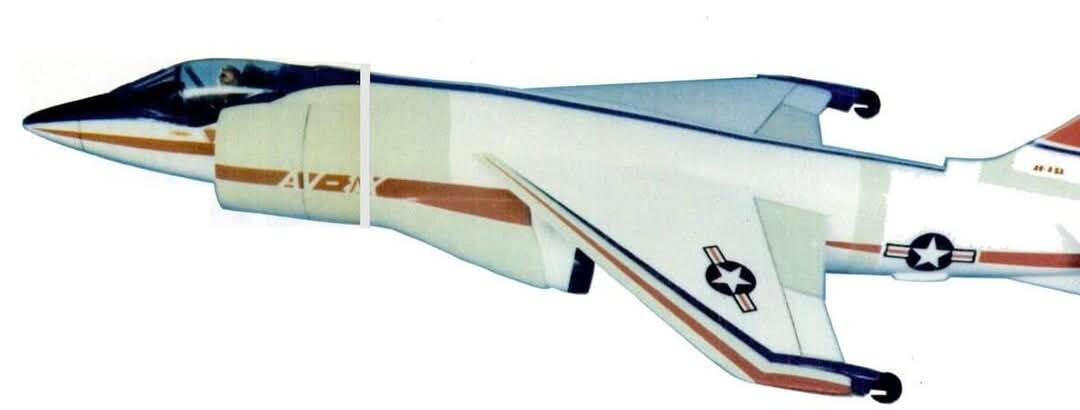
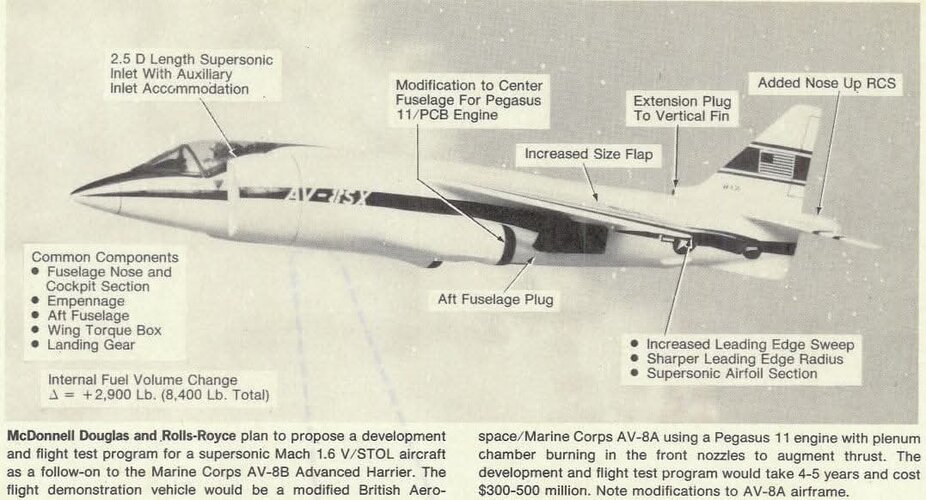
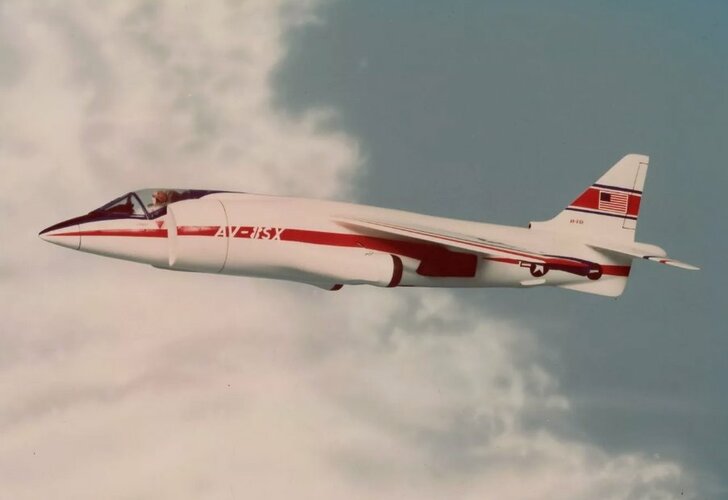
HIDEN rings a bell. Rolls Royce did the engine work on Harrier 21 and I've seen at least one of the 2 variants included in their product history lists. RB-578 was the version using the Pegasus core for our hoped-for prototype that never happened, and RB-571 was the same layout but with the more powerful Eurofighter engine core. I can't say much about the aircraft itself because of that whole ITAR thing but since 2/3 of the work was done by Brits, you might touch base with RR or BAE and see if they've retained anything in their files that they could share. If you're able to track down RB-578 or -571 you'll see a family resemblance with what MDC's ASTOVL Model 4629 had, with some significant differences of course. NASA Contractor Report 195358 "STOVL Control Integration Program" has no restrictive distribution markings and so if you find RB-578/571 material elsewhere you'll be able to see pretty clearly what MDC/BAe/RR thinking was in the early 1990s. Here's one illustration of Model 4629 from the NASA report:

View attachment 736144
Hrm. You lose a lot of thrust turning the cold nozzles 180deg like that, but it does get the engine moved aft and off the CG.
 
Hrm. You lose a lot of thrust turning the cold nozzles 180deg like that, but it does get the engine moved aft and off the CG.
Yep, V/STOL is all about weighing up the pros and cons of each solution. Would moving the engine and centre of gravity aft reduce the amount of thrust required from the front nozzles?
 
Yep, V/STOL is all about weighing up the pros and cons of each solution. Would moving the engine and centre of gravity aft reduce the amount of thrust required from the front nozzles?
Not really, but it would give you more space on or around the CG for other things. Like a weapons bay.
 
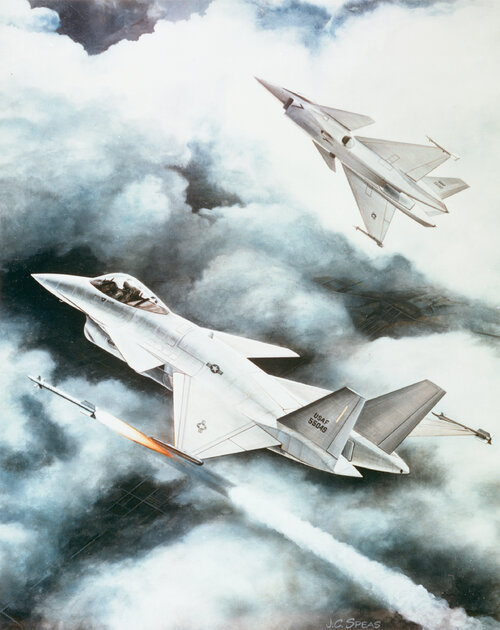
More Harrier 21 speculating - like or laugh :)
Right in some places, not so right in others. Somebody really needs to talk to RR and BAe. I suppose the people who actually did the work are long gone (or worse) but the fact that RR still shows RB.578 and RB.571 in their historic lists might indicate that they have other things in their archives. Peter Calder, Peter Moore, Suresh Gupta, Ben Ward, Adam Strachan-Stephens, and Barry New were the RR people on Harrier 21 whose cards I got at the time. Wish I'd gotten some from the BAe folks but our designers coordinated with them separately and I don't recall ever meeting with any of them myself.
 
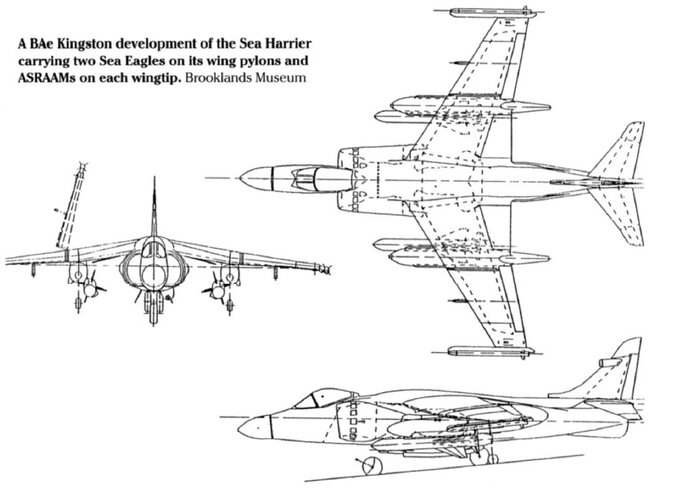
AVPRO speculation or
Very close! The design groups at MDC and BAe worked independently on an airframe to contain the RB.578/571 engine, meeting a set of fixed requirements for speed, range, duration etc. The British design featured a favorite of theirs, a single vertical tail with fold-over section to fit below decks in the L-ships and Harrier Carriers, while the American design went with the familiar twin tail that's been on just about everything in the past 50+ years. One had round inlets, the other had rectangular ones, and so on with the details. Our designers and theirs merged the best features of each one and I honestly don't remember which choices went into the final configuration. I don't know exactly what that artwork represents but it's similar to what was in the mix at the time.
 
stever_sl, can you let us know if the Harrier 21 proposals had the standard tandem + outriggers or a new tricycle undercarriage?

No worries if not, it’s just great to know there is another Harrier development out there to be revealed :)
If I tell you that, it starts to reveal things about the locations of certain "things" and I fear the wrath of ITAR if I go any further! :)
 
I've opened a case with DDTC to get a ruling on whether the Harrier 21 material really qualifies for protection under ITAR, since 1/2 of the airframe design work and 100% of the propulsion design was done in the UK, and also since we deliberately avoided incorporating any advanced technologies or materials beyond what was already in use in 1990 because we knew from long experience that the Marines, our primary customer, couldn't afford and didn't really need that level of technology. I'll be interested to see what their ruling is, and if it's favorable, I'll share what I have on Harrier 21.
 
Did you come across any mention of work done by prior team --The 'Supersonic Harrier'-- including a Rob Rowe ??

I met him serendipitously, as his wife bred/judged Siamese cats. This was ~1990.
Beyond utterly deprecating 'Plenum Chamber Burning', he still felt sufficiently bound by NDA., OSA etc etc to not even hint at the very elegant solution his team belatedly found. Which, sadly, proved too late to prevent political cancellation of project...
 
I've opened a case with DDTC to get a ruling on whether the Harrier 21 material really qualifies for protection under ITAR, since 1/2 of the airframe design work and 100% of the propulsion design was done in the UK, and also since we deliberately avoided incorporating any advanced technologies or materials beyond what was already in use in 1990 because we knew from long experience that the Marines, our primary customer, couldn't afford and didn't really need that level of technology. I'll be interested to see what their ruling is, and if it's favorable, I'll share what I have on Harrier 21.
Even if only 1% of the design work was US based it would still arguably fall under ITAR
 
Even if only 1% of the design work was US based it would still arguably fall under ITAR
That's why I asked for a formal review. Typically companies do this on their own, and nobody questions the marking once it's on. If the answer for Harrier 21 comes back from DDTC that ITAR is appropriate, then we'll know for sure that the info package can't be shared. But if it goes the other way, then the door is open at last, without worrying about whether it might cause damage to US defense posture in any way.
 
Did you come across any mention of work done by prior team --The 'Supersonic Harrier'-- including a Rob Rowe ??

I met him serendipitously, as his wife bred/judged Siamese cats. This was ~1990.
Beyond utterly deprecating 'Plenum Chamber Burning', he still felt sufficiently bound by NDA., OSA etc etc to not even hint at the very elegant solution his team belatedly found. Which, sadly, proved too late to prevent political cancellation of project...
The name doesn't ring a bell for our Harrier 21 team, but I know BAe and MDC were both working on other potential advanced STOVL solutions. Was he with BAe or RR? I know the names of several of the RR people but I never had direct contact with BAe myself.
 
I'm sorry, it's been a long, lonnng time.
All I remember is Rob Rowe was part of a small 'Tiger Team' brought in to solve the PCB problems, contrive supersonic use.

He said they'd solved it without that deprecated, 'dead end' PCB, but declined to say further.
After he invoked NDA/OSA, I could not enquire further, but he was evidently still very bitter their 'elegant' solution was abandoned.

Sadly, within a year or two of the project's cancellation, his colleagues' health failed. leaving him the last of them.

A possible tracing link was that, mid-90s, both very clever sons were doing Engineering at Uni.
 
For those still interested in Harrier 21, I got in touch with the Rolls Royce Heritage Trust to see if they had anything that they could share on the aircraft or at least the RB.578 and RB.571 engines. Sadly, their Honorable General Secretary since 1990 wasn't aware of anything. That just leaves the BAe connection, and I have no contacts there at all. Might someone here know someone there to start the ball rolling?
 
Found on @PaleoAero Twitter , no source given. Ferry tips provided a 9% L/D improvement.

And for reference, an actual ferry tip that was for sale online.
"DANGER POWER CONTROL AND JET BLAST".
Late to the party, but the source was:

Fozard JW. The Harrier — an engineering commentary. The Aeronautical Journal . 1969;73(705):769-788. doi:10.1017/S0001924000051642
 
@stever_sl I'm not sure whether this was off-topic. but was PCB ever brought up in discussions regarding Advanced Harriers/Harrier Replacements in the US. I am aware that the UK kept a lot of its knowledge regarding PCB secret during the 80's as they were working on the P.1216, but having read a little about the beginnings of the F-35 in Dan Raymer's book, I was kind of surprised that he never mentioned it. I'm not sure whether the UK was being consulted at that stage however, this was the early 90's. Was there ever an American equivalent to PCB or were other solutions preferred?
 
@stever_sl I'm not sure whether this was off-topic. but was PCB ever brought up in discussions regarding Advanced Harriers/Harrier Replacements in the US. I am aware that the UK kept a lot of its knowledge regarding PCB secret during the 80's as they were working on the P.1216, but having read a little about the beginnings of the F-35 in Dan Raymer's book, I was kind of surprised that he never mentioned it. I'm not sure whether the UK was being consulted at that stage however, this was the early 90's. Was there ever an American equivalent to PCB or were other solutions preferred?
I know there was an AV-8C that was fitted with a PCB Pegasus, so there definitely was an American interest there.
 
@stever_sl I'm not sure whether this was off-topic. but was PCB ever brought up in discussions regarding Advanced Harriers/Harrier Replacements in the US. I am aware that the UK kept a lot of its knowledge regarding PCB secret during the 80's as they were working on the P.1216, but having read a little about the beginnings of the F-35 in Dan Raymer's book, I was kind of surprised that he never mentioned it. I'm not sure whether the UK was being consulted at that stage however, this was the early 90's. Was there ever an American equivalent to PCB or were other solutions preferred?
PCB was well known to our team but it hadn't traded out well in the UK and we were happy when RR came up with something much better for Harrier 21.
 
I was with the MDC Harrier and Advanced STOVL teams for years but I've never heard of this. Any sources for the info?
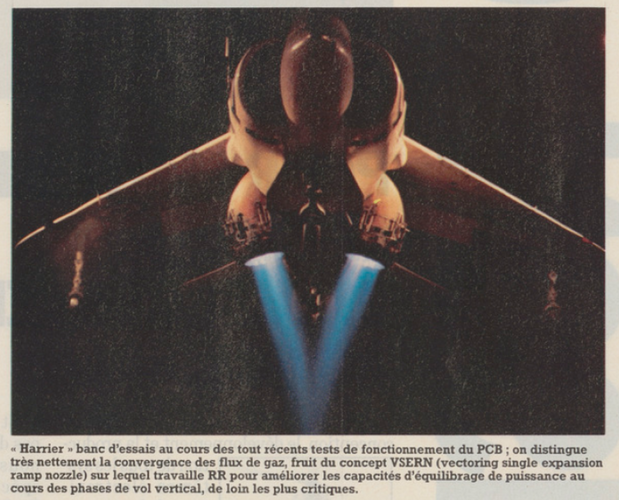
Not finding one in a quick search, what I am remembering was a harrier with "saggy tits" for the PCB nozzles with US markings on it. I'm assuming it was a singular test or demonstration type.

PCB nozzles on this were located much lower on the airframe than the cold nozzles. Where the standard Harrier cold nozzles are up in the "wingpits", the PCB nozzles were rotated down to about 30-45deg below horizontal axis of the engine/airframe, well clear of the wings and fuselage sides.
 
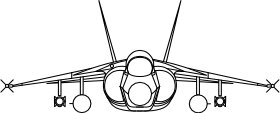
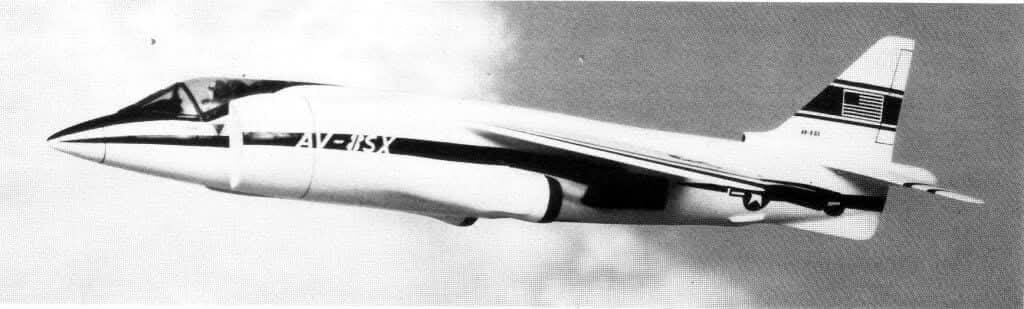
MDD. AV-8SX (ref. SP. forum postings)

Looks like a brute-force way of puhing a first generation Harrier through the sound barrier. Basic issue was the Pegasus big fan needed big round intakes not exactly adapted to supersonic flight. This project desperately tries to go around this major issue. Was it realistic ? no idea. There are good reasons the P.1154 and P.1216 no longer looked like Harriers...
 
I am going to ask the imporbvable, can someone write the book please?

At least a bookazine, you folks have the bous between you and all I get from the bits and pieces is confused. Sorry if this sounds like a rant, it's not.

I learn much from you as a padawan, i indeedy do.
 
Was this an actual demonstrator or a proposed demonstrator?
I'm not sure. But, for whatever it may be worth, I do remember reading about this at the time, probably in Aviation Week. I remember that there was a ground test rig or mock up, but no actual aircraft. The PCB was supposed to be used with a later Pegasus version to power an advanced Marine Corps AV-8C variant that was never built.
 
Not finding one in a quick search, what I am remembering was a harrier with "saggy tits" for the PCB nozzles with US markings on it. I'm assuming it was a singular test or demonstration type.

PCB nozzles on this were located much lower on the airframe than the cold nozzles. Where the standard Harrier cold nozzles are up in the "wingpits", the PCB nozzles were rotated down to about 30-45deg below horizontal axis of the engine/airframe, well clear of the wings and fuselage sides.
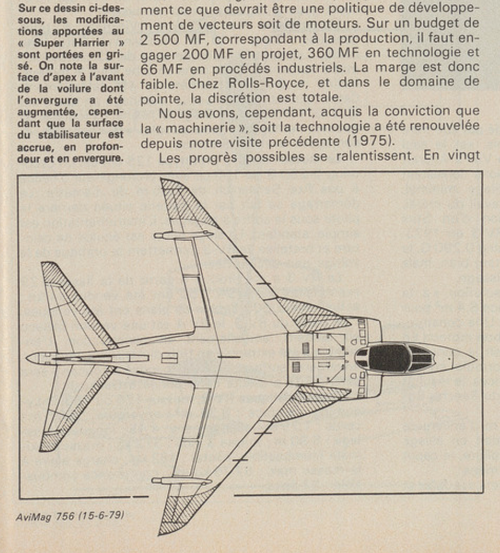
I'm very familiar with the P.1154 design with PCB, and that's why we needed an alternative for Harrier 21, just too much cross-sectional area in the middle of the aircraft causing unmanageable transonic drag rise, and no way to reduce the area there. About that AV-8C, I do know of an AV-8B that was modified with wingtip AIM-9s and zero-scarf rear (hot) nozzles, but that was a bit after I'd moved on from the group. I think the one you're referencing was a Harrier GR.1, XV798, that did some PCB work and is in the museum at Kemble now, with those nozzles still installed as far as I know.
 
I'm very familiar with the P.1154 design with PCB, and that's why we needed an alternative for Harrier 21, just too much cross-sectional area in the middle of the aircraft causing unmanageable transonic drag rise, and no way to reduce the area there. About that AV-8C, I do know of an AV-8B that was modified with wingtip AIM-9s and zero-scarf rear (hot) nozzles, but that was a bit after I'd moved on from the group. I think the one you're referencing was a Harrier GR.1, XV798, that did some PCB work and is in the museum at Kemble now, with those nozzles still installed as far as I know.
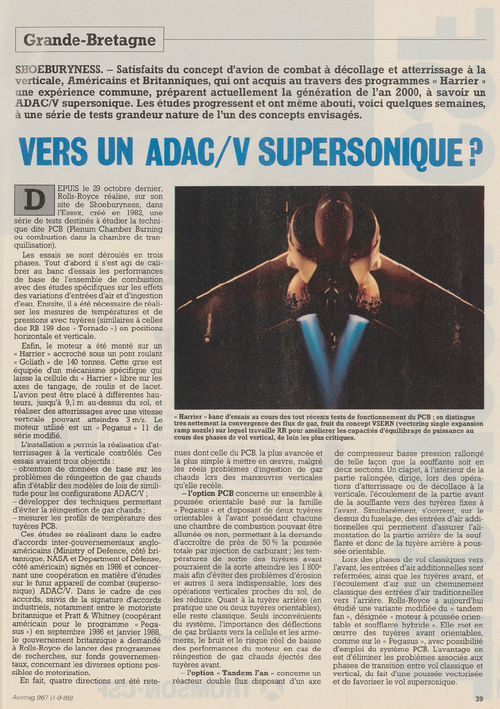
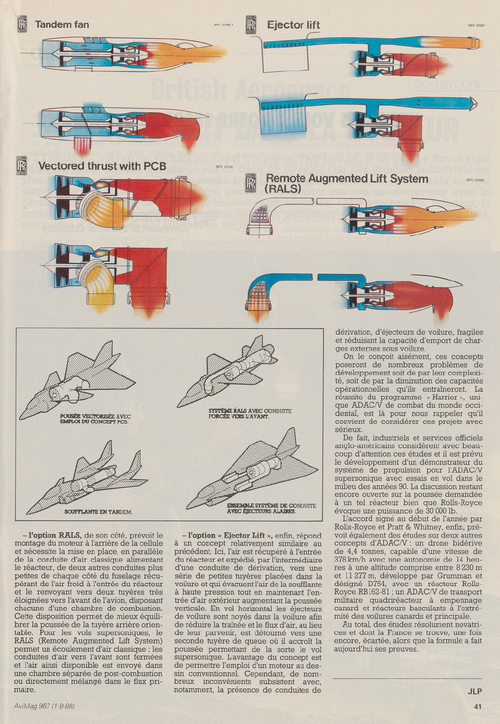
About Oct 1987 I was a member the Tandem fan team at RR Patchway. There were three other teams working simultaneously on;- PCB, Remote Augmented Lift (RALS), and ejector lift. I remember there were quite open concept comparative reviews every few months. At one of these, PCB got absolutely hammered on safety grounds, principally the critical need to maintain stable combustion in multiple places within the engine. Statistics were presented on existing engine afterburner light up reliability with the inference that given a failure for just one zone to light, would be loss of aircraft (Catastrophic). This was so bad it implied an unsustainable fleet. Although it was presented as requirement for improvement, many said anything up to a couple of years later, that it was a factor in the PCB rejection. I certainly concur that it was also said that it was not well suited to a supersonic aircraft architecture, ground erosion and hot gas recirculation.

During my time at RR , RALS was bleed air driven. Tandem fan expired in about 1990, ejector lift a bit earlier. The step change occurred quite quickly when RALS (shaft) was studied which killed off PCB once and for all.
 

Similar threads

Back
Top Bottom