Messerschmitt P 1107 and P 1108 long range jet bombers

Stargazer

ACCESS: USAP
Top Contributor
Senior Member
Joined
25 June 2009
Messages
15,515
Reaction score
9,447
In the autumn of 1944, Reichsmarschall Göring requested that Junkers, Arado and Messerschmitt design and produce very long range high speed bombers capable of carrying 4-ton bomb payloads. The goal was to be able to attack distant maritime convoys and strategic targets in both the U.S. and the Soviet Union.

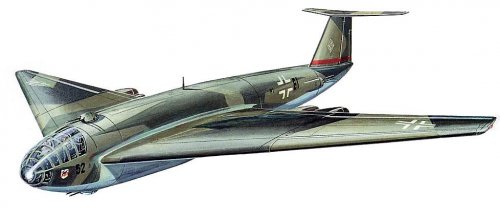
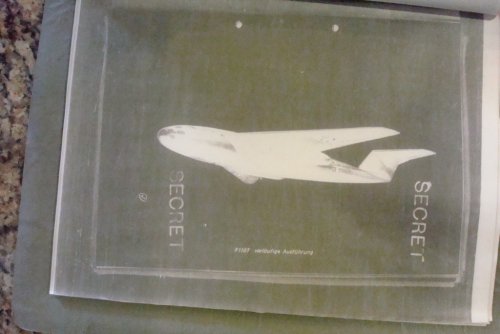
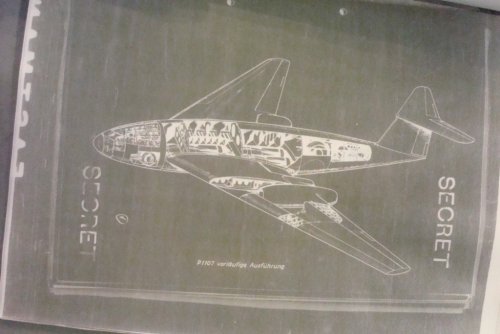
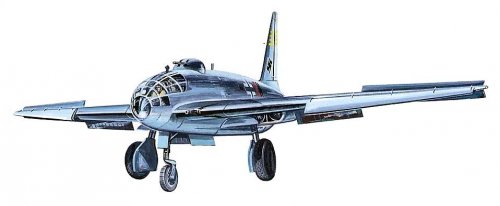
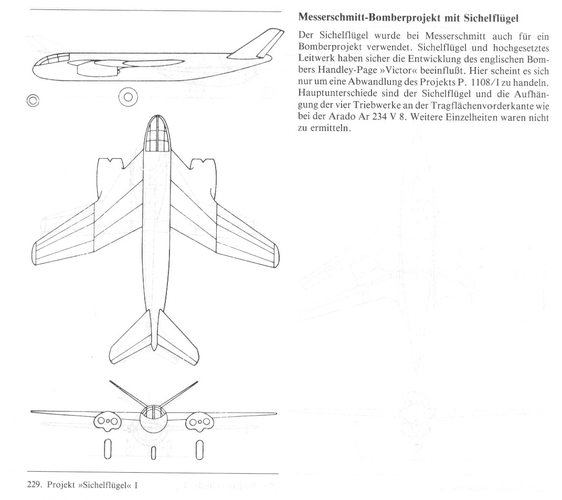
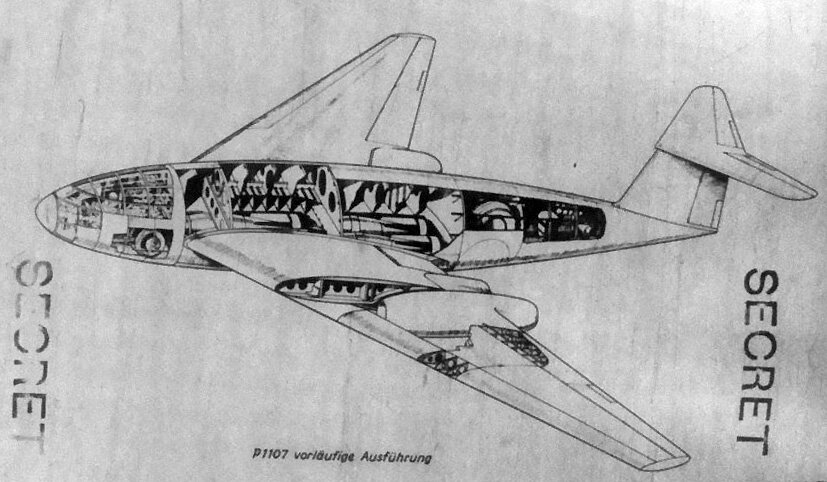
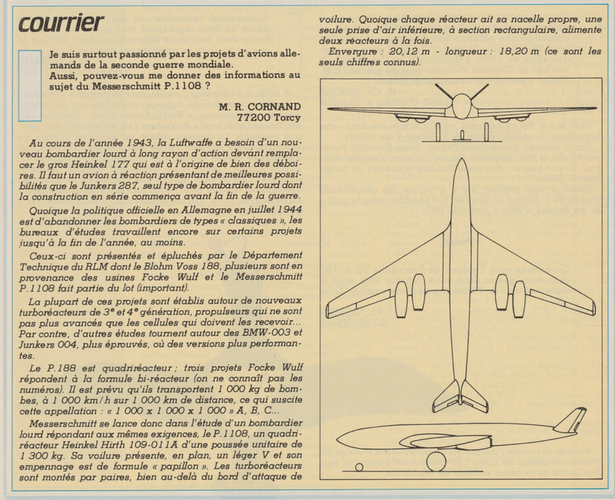
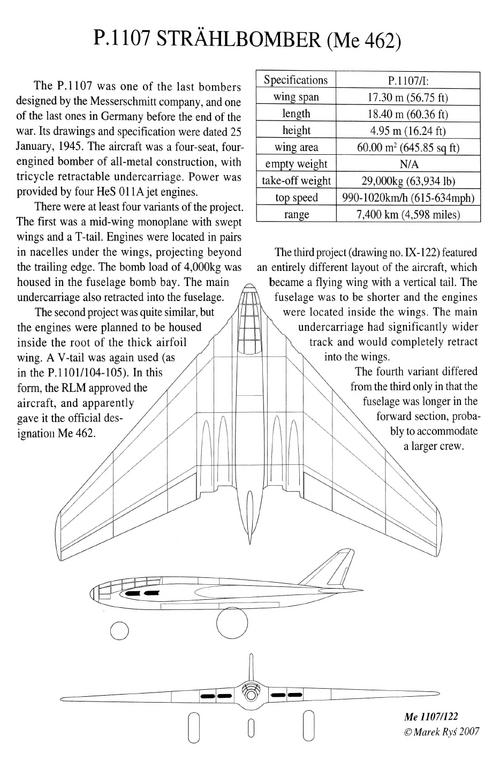
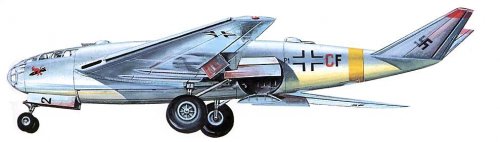
In November 1944, Messerschmitt submitted a swept-wing four-jet bomber project designated P 1107. The four engines were mounted in nacelles by pairs under the wings. Though one of the variants considered had a V-tail, the other proposal was equipped with one of the earliest T-tail designs, so as to clear the tail surfaces from the exhaust of the turbojets. As for Junkers, they elected to work at improving their Ju 287 forward-swept wing design, which didn't go without some technical challenges despite the improvements it represented in both aerodynamics and construction.

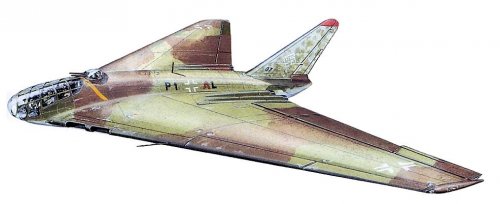
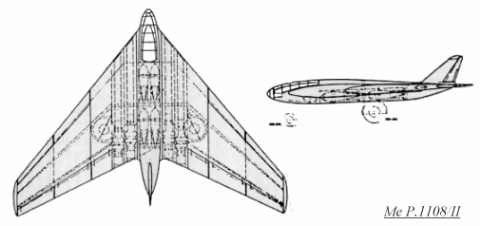
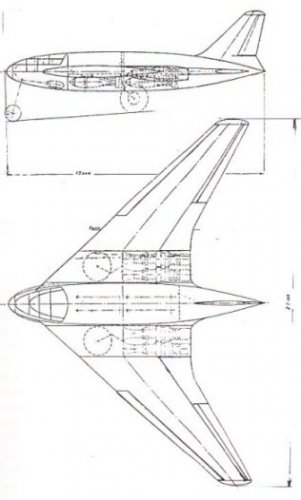
Simultaneously, the Messerschmitt engineers worked on flying wing bomber designs designated P.1108/1 et P.1108/2. According to their calculations, these various bombers could carry the required payload over a distance of 7,800 kilometers at a speed of about 900 km/h. The range could even be extended to 9,600 kilometers for strategic reconnaissance versions. Junkers also worked — jointly with the DFS sailwing institute — on their own four-jet flying wing proposal, the EF 130.

In January 1945, the RLM examined the proposals made by all three manufacturers. Its experts notified in their report that the Messerschmitt P.1107/1 and /2 offered the highest speeds, but in terms of operational range, Horten's proposals were greatly superior to those of both Messerschmitt and Junkers. Not only was their construction easier, but the use of steel tubing and wood in the fabrication of Horten's wings was a decisive factor that led to that company being selected for that bomber program.

Despite the increasing damage caused by Allied bombings, the Messerschmitt design bureau continued to submit variants of their P.1108 flying wing proposal, but at the end of March 1945, Junkers and Messerschmitt were both ordered by the RLM to cease all development on long range bomber designs. Only the Horten brothers continued work on their Ho XVIII B-2 by personal request of Göring. Some unconfirmed RLM reports suggest that the production of the Ho XVIII B-2 had started on April 1st, 1945 at the Kahia underground factory in Thuringe, but no trace of that prototype — if ever it existed — has survived.

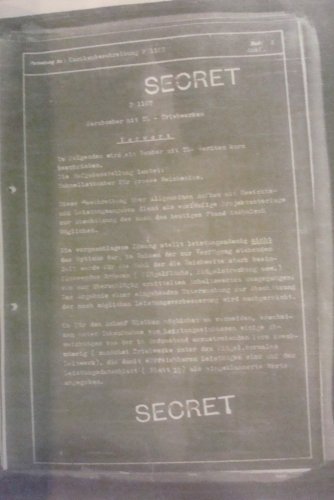
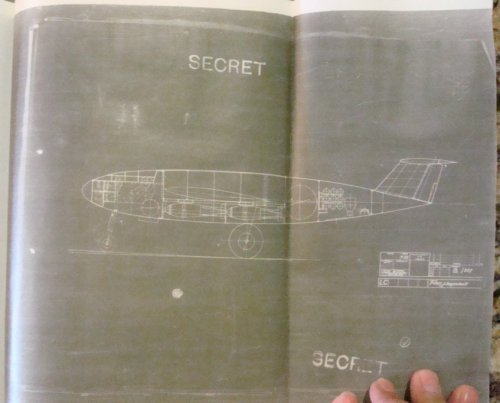
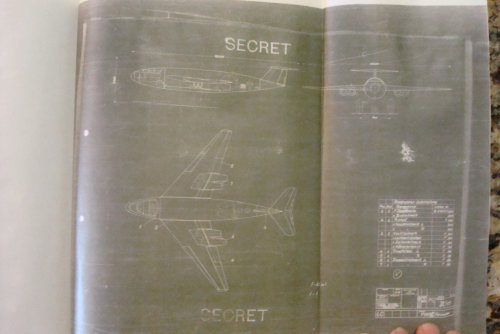
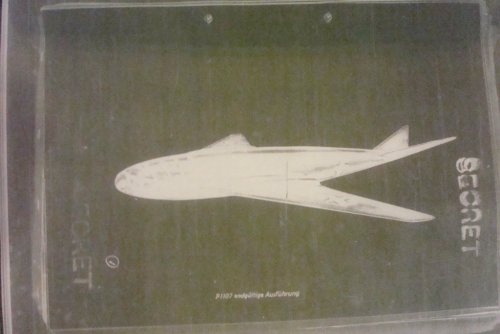
The beautiful and rare Messerschmitt P 1107 company document posted below was reproduced by the Air Documents Division of the the USAF's T-2 AMC Technical Intelligence service at Wright Field, Ohio. It was finally declassified in 1961 and appeared some time ago on eBay.
 

Attachments

  • 05.JPG
    05.JPG
    136.5 KB · Views: 1,472
  • messerschmitt_p.1107-2_01.jpg
    messerschmitt_p.1107-2_01.jpg
    43.9 KB · Views: 737
  • messerschmitt_p.1107-1_01.jpg
    messerschmitt_p.1107-1_01.jpg
    50.5 KB · Views: 745
  • 06.JPG
    06.JPG
    128.7 KB · Views: 721
  • 11.JPG
    11.JPG
    102.8 KB · Views: 1,140
  • 10.JPG
    10.JPG
    118.6 KB · Views: 1,143
  • 09.JPG
    09.JPG
    130.5 KB · Views: 1,181
  • 08.JPG
    08.JPG
    133.9 KB · Views: 1,293
The Messerschmitt P 1108 flying wing:
 

Attachments

  • messerschmitt_p.1108-2_01.jpg
    messerschmitt_p.1108-2_01.jpg
    35.5 KB · Views: 756
  • messerschmitt_p.1107(IX-122)_01.jpg
    messerschmitt_p.1107(IX-122)_01.jpg
    51.4 KB · Views: 713
  • messerschmitt_p.1108-2_02.jpg
    messerschmitt_p.1108-2_02.jpg
    8.8 KB · Views: 695
  • P 1108.jpg
    P 1108.jpg
    25.3 KB · Views: 731
The P.1107 and P.1108 have the size of medium bombers. They are pretty close to EE Canberra or Ilyushin Il-28 in size, even B-45 Tornado is much larger. HOW could they be long-range strategic bombers, with 7800 km range?? This look nonsence, isn't it?

As for me, the data from http://www.luft46.com/mess/mess.html (http://www.luft46.com/mess/mep1108i.html for example) look much more plausible...
 
At the risk of getting off topic - are the ranges quoted for the Ar E.555-11 (14) and Ho XVIII B plausible?
 
The advantage of the flying wing is that drag has been reduced to a minimun.
As a result , the performance of the flying wing is unequalled in speed , range
and operating economy.

You can in fact ,not compare a flying wing concept with conventional designs as the Il-28 , Canberra and the B-45...
 
7,000 Km with four thirsty first generation jet engines?...simply unrealistic. As many of Luft 46 German projects. A serious examination of most III Reich long range / heavy bombers will show you how deceptive are. The Me 264 Amerika Bomber seems a toy plane compared with its American counterpart, the XB-36 "Germania Bomber". The Me 264 was even smaller than the B-29. So describing P 1107 and P 1108 is, in my opinion, a fantasy.
 
The flying wing layout may have bettered the possible range, although with hindsight,
we could speculate about flight control and handling problems in those pre-computer
era. But a range of about 7,000 km was predicted for the conventional layouts, too.
Here a number of facts may have played a part:
- Over optimistic predictions for fuel consumption of the still untested BMW 018 jet
- Over optimistic predictions for the aerodynamic efficiency of those new designs,
especially maybe the flying wing types
- And, above all to my opinion, the general demand then to exxagerate performances
of new designs, just to prevent them from being cancelled !
 
lark said:
The advantage of the flying wing is that drag has been reduced to a minimun.
As a result , the performance of the flying wing is unequalled in speed , range
and operating economy.

You can in fact ,not compare a flying wing concept with conventional designs as the Il-28 , Canberra and the B-45...

But there were also conventional designs among P.1107 and 1108 concepts. And such a range was proclaimed for them, too.

OK, maybe they weren't fully conventional - but nothing more peculiar than, for example, British V-bombers. And the V-bombers actually had similar range characteristics of about 7000 km... but were more than 1.5x larger than these Messerschmitt projects. Also, the Avro Vulcan flying wing didn't have any significal advantage in range againts its conventional rivals and wasn't much smaller in size.

And tne Northrop YB-49, which was a true flying wing and a much larger and heavier aircraft than Messerschmitt designs (52.4 m span, 88 tons maximum takeoff weight!), had only 4000 miles (6436 km) range with 4500 kg bomb load.
 
From, Die Deutsche Luftruestung 1933-1945 - Vol.3 - Henschel-Messerschmitt (Bernard&Graefe),

was that a real Project ?,
Yes, the aircraft shown in its drawing was a real project, bearing the drawing numbers P.1101/XVIII-104 and P.1101/XVIII-105.
 
I'd speculate that these very late-war German bomber and such jet designs were predicated on little more than wishful thinking. They often were to use powerplants that were either on a drawing board or in the earliest stages of testing. Range and speed were, as with the Allies, often little more than guesses.

Flying wings in particular were highly suspect as to not only range and speed based on the engines to be used, but on stability and flight control as the Northrop designs that actually were tested at higher speeds proved. It is extremely unlikely that the Germans could have gotten their flying wing designs to work any better.

This isn't to dis the German designs, but rather point out that any high speed, near sonic, or transonic, flying wing was going to face serious stability issues in a period where fly-by-wire and computer control didn't exist. These were simply beyond the extant technology.
 
The entire reason so many late-war german designs were flying wings was to avoid stability and control problems. Without an all moving tail there really isn't any clear way to go trans/supersonic besides a flying wing.
 
In the autumn of 1944, Reichsmarschall Göring requested that Junkers, Arado and Messerschmitt design and produce very long range high speed bombers capable of carrying 4-ton bomb payloads. The goal was to be able to attack distant maritime convoys and strategic targets in both the U.S. and the Soviet Union.

In November 1944, Messerschmitt submitted a swept-wing four-jet bomber project designated P 1107. The four engines were mounted in nacelles by pairs under the wings. Though one of the variants considered had a V-tail, the other proposal was equipped with one of the earliest T-tail designs, so as to clear the tail surfaces from the exhaust of the turbojets. As for Junkers, they elected to work at improving their Ju 287 forward-swept wing design, which didn't go without some technical challenges despite the improvements it represented in both aerodynamics and construction.

Simultaneously, the Messerschmitt engineers worked on flying wing bomber designs designated P.1108/1 et P.1108/2. According to their calculations, these various bombers could carry the required payload over a distance of 7,800 kilometers at a speed of about 900 km/h. The range could even be extended to 9,600 kilometers for strategic reconnaissance versions. Junkers also worked — jointly with the DFS sailwing institute — on their own four-jet flying wing proposal, the EF 130.

In January 1945, the RLM examined the proposals made by all three manufacturers. Its experts notified in their report that the Messerschmitt P.1107/1 and /2 offered the highest speeds, but in terms of operational range, Horten's proposals were greatly superior to those of both Messerschmitt and Junkers. Not only was their construction easier, but the use of steel tubing and wood in the fabrication of Horten's wings was a decisive factor that led to that company being selected for that bomber program.

Despite the increasing damage caused by Allied bombings, the Messerschmitt design bureau continued to submit variants of their P.1108 flying wing proposal, but at the end of March 1945, Junkers and Messerschmitt were both ordered by the RLM to cease all development on long range bomber designs. Only the Horten brothers continued work on their Ho XVIII B-2 by personal request of Göring. Some unconfirmed RLM reports suggest that the production of the Ho XVIII B-2 had started on April 1st, 1945 at the Kahia underground factory in Thuringe, but no trace of that prototype — if ever it existed — has survived.

The beautiful and rare Messerschmitt P 1107 company document posted below was reproduced by the Air Documents Division of the the USAF's T-2 AMC Technical Intelligence service at Wright Field, Ohio. It was finally declassified in 1961 and appeared some time ago on eBay.
 

Attachments

  • p.1107.jpg
    p.1107.jpg
    149.7 KB · Views: 603
The flying wing layout may have bettered the possible range, although with hindsight,
we could speculate about flight control and handling problems in those pre-computer
era. But a range of about 7,000 km was predicted for the conventional layouts, too.
Here a number of facts may have played a part:
- Over optimistic predictions for fuel consumption of the still untested BMW 018 jet
- Over optimistic predictions for the aerodynamic efficiency of those new designs,
especially maybe the flying wing types
- And, above all to my opinion, the general demand then to exxagerate performances
of new designs, just to prevent them from being cancelled !
( And in my opinion) To prevent any designer or technician to be send to the front...
Milch in his biography suspected that the was the case with many of the designs that were made during the war.
Just to keep people busy and to give the High Command the idea that all those people were doing something valuable to the war-cause.
 
I'd speculate that these very late-war German bomber and such jet designs were predicated on little more than wishful thinking. They often were to use powerplants that were either on a drawing board or in the earliest stages of testing. Range and speed were, as with the Allies, often little more than guesses.

Flying wings in particular were highly suspect as to not only range and speed based on the engines to be used, but on stability and flight control as the Northrop designs that actually were tested at higher speeds proved. It is extremely unlikely that the Germans could have gotten their flying wing designs to work any better.

This isn't to dis the German designs, but rather point out that any high speed, near sonic, or transonic, flying wing was going to face serious stability issues in a period where fly-by-wire and computer control didn't exist. These were simply beyond the extant technology.
Horton was well ahead of Northrop (i know there is somewhere an other link to this guy in this form, but I couldnt find it):

View: https://www.youtube.com/watch?v=q6oVXPkTnss&ab_channel=ScienceAcceleratorOUTOFTHEBOX


Still, I also don t believe in the feasablility of 7000 km range of this planes....
 
I'd speculate that these very late-war German bomber and such jet designs were predicated on little more than wishful thinking. They often were to use powerplants that were either on a drawing board or in the earliest stages of testing. Range and speed were, as with the Allies, often little more than guesses.

Flying wings in particular were highly suspect as to not only range and speed based on the engines to be used, but on stability and flight control as the Northrop designs that actually were tested at higher speeds proved. It is extremely unlikely that the Germans could have gotten their flying wing designs to work any better.

This isn't to dis the German designs, but rather point out that any high speed, near sonic, or transonic, flying wing was going to face serious stability issues in a period where fly-by-wire and computer control didn't exist. These were simply beyond the extant technology.
Horton was well ahead of Northrop (i know there is somewhere an other link to this guy in this form, but I couldnt find it):

View: https://www.youtube.com/watch?v=q6oVXPkTnss&ab_channel=ScienceAcceleratorOUTOFTHEBOX


Still, I also don t believe in the feasablility of 7000 km range of this planes....
The quote of Saint-Ex at the end of the video is totally apocriphe !
The exact form in Citadelle, a posthumous and unfinished work by Saint-Exupéry, published in 1948 by Gallimard is :
“To create the ship is not to weave the webs, to forge the nails, to read the stars, but to give the taste of the sea which is one, and in the light of which there is no longer anything that is contradictory but community in love.”

Tonton
 
I prefer this another of our great Saint-Ex :

" It is good that I compel you to build, a sailboat that will go on the sea, the hull, the decks and the mast, then that in a beautiful day, like a wedding day, I will make you dress it with sails and offer it to the sea. Then the sound of your hammers will be song, your sweat and ahans will be fervor. And your launch from the ship will be a miraculous gesture because you will have blossomed the waters" ;)
 
The flying wing layout may have bettered the possible range, although with hindsight,
we could speculate about flight control and handling problems in those pre-computer
era. But a range of about 7,000 km was predicted for the conventional layouts, too.
Here a number of facts may have played a part:
- Over optimistic predictions for fuel consumption of the still untested BMW 018 jet
- Over optimistic predictions for the aerodynamic efficiency of those new designs,
especially maybe the flying wing types
- And, above all to my opinion, the general demand then to exxagerate performances
of new designs, just to prevent them from being cancelled !
( And in my opinion) To prevent any designer or technician to be send to the front...
Milch in his biography suspected that the was the case with many of the designs that were made during the war.
Just to keep people busy and to give the High Command the idea that all those people were doing something valuable to the war-cause.
Very much true! The LFA for example created a proposal for a surface-to-air missile that became Feuerlille. The missile was given specifications that included a warhead and guidance system on paper. But the scientists and engineers wanted to develop it as a sounding rocket for research on supersonic flight and high altitude research. It was never fitted with any sort of warhead or guidance, and likely would have never made it as a SAM, but it kept the funding coming and the people involved doing "important" stuff rather than being drafted.

But, then again, all countries did this sort of thing either officially or unofficially. The US, for example, often inducted skilled technicians, engineers, and scientists to keep them from being drafted and then gave them automatic promotions to ranks that were commensurate with their civilian pay and authority. For example, at MIT, the Rad Lab (doing radar, electronics, and computer research) had numerous people inducted into the service that way. It wasn't uncommon to see say, a technician wearing a First Sargant's uniform with no ribbons, medals, time in service stripes, that would normally be the case.
The US railway engineer battalions were done that way too. They were made up of men that worked for a particular railway corporation and most of the battalion would be given instant rank equivalent to their civilian positions. Shop foremen became senior NCO's. Shop supervisors, warrant officers. The managers would be officers of various ranks with the commanding officer being a major or Lt. colonel.

This had to be done to protect these valuable people from ending up being drafted and then misused in the military compared to their value as civilians.
 
In Wikipedia,they talked about Me.462 as a Me P.1107 ?!.

https://en.wikipedia.org/wiki/List_of_RLM_aircraft_designations
The cited source in the Wikipedia articles is just another website that does not itself cite a specific source--it just lists some general references, most of which are familiar titles and one of which refers back to Wikipdeia itself. So I wouldn't rely on the the information alone

If interested, you could take the Wikipedia information as a starting point (which is the purpose of encyclopedias). You might try to follow up by checking the one primary source supplied: USAAF Air Materiel Command: "List of German Air Ministry Aircraft Numbers" (Foreign Equipment Descriptive Brief 46-6B,21 August 1946). That might give you a lead to finding further information.
 
In Wikipedia,they talked about Me.462 as a Me P.1107 ?!.

They did ... but it is worth mentioning that Wikipedia's source was our own Andreas Parsch and his Designation Systems website: https://www.designation-systems.net/non-us/germany.html

Wikipedia, without qualification, states "Me 462 | Proposed RLM designation for the P.1107." But Wikipedia fails to mention that Andreas listed 'Me 462' in light brown type.

On the same page, Andreas makes clear "There are also a few numbers which do not appear in the RLM-GL/C lists (and which may or may not have been allocated by the RLM), but which are found in one or more other sources. These are presented in light brown." In other words, this 8-462 number is to found in secondary sources but not in the lists which were actually created by the Generalluftzeugmeister Entwicklungsabteilung C.

Wikipedia also ignored Andreas' footnote ...

Me 462 (note 34) | Messerschmitt | Four-engine jet bomber (1945); project only ...

34. The number 8-462 was proposed by Messerschmitt for their P-1107 project, but the RLM did most probably never officially allocate the number.

So, as statements, "Proposed RLM designation ..." and "... RLM did most probably never officially allocate the number" pretty much contradict each other.
 
I have been told that in Luftfahrt or maybe Luftfahrt Profile circa 1978 (or thereabouts), there was an article stating that Messerschmitt actually constructed some components for the P.1107, which were recovered after the war and taken to the Karmann Institute in the USA.

This seems very unlikely to me but has anybody ever seen such an article ?
My interest is in relation to understanding what was going on with the bomber competition between the Ju287. Me.P.1107 and - specifically, the Horten H.XVIII.

As regards the Horten design, te designation H.XVIII B-2, is as far as I know a post-war invention.
The story that Horten were forced by Junkers to add a large fin, is supported by a drawing of the mythical B-2.
However the 'bomber with a fin' was a postwar Horten project and another example of the Hortens spin-doctoring. It is often noted that Goering ordered construction of the H.XVII to start - the minutes of those meeting show no such thing !
I am currently working on a Horten book in which many aspects of the Hortens version of events, previously accepted at face value, can be shown to be factually inaccurate.
Any and all input most welcomed
Paul
 
I have been told that in Luftfahrt or maybe Luftfahrt Profile circa 1978 (or thereabouts), there was an article stating that Messerschmitt actually constructed some components for the P.1107, which were recovered after the war and taken to the Karmann Institute in the USA.

This seems very unlikely to me but has anybody ever seen such an article ?
My interest is in relation to understanding what was going on with the bomber competition between the Ju287. Me.P.1107 and - specifically, the Horten H.XVIII.

As regards the Horten design, te designation H.XVIII B-2, is as far as I know a post-war invention.
The story that Horten were forced by Junkers to add a large fin, is supported by a drawing of the mythical B-2.
However the 'bomber with a fin' was a postwar Horten project and another example of the Hortens spin-doctoring. It is often noted that Goering ordered construction of the H.XVII to start - the minutes of those meeting show no such thing !
I am currently working on a Horten book in which many aspects of the Hortens version of events, previously accepted at face value, can be shown to be factually inaccurate.
Any and all input most welcomed
Paul
Another book that is going to put an end to all the myths once and for all, good luck.

German Flying Wings Bibliography

​

‘Gegenüberstellung 8-229 Go P-60’ by Nauber. Translation of captured enemy document, F-TS525-RE 21, February 1946, by Intelligence T-2, Air Document Division, Headquarters Air Technical Service Command, Wright Field.

‘Vorlaufige Baubeschreibung der Nurflügel 229’ by Schmid. Translation of captured enemy document, F-TS526-RE, 24 February 1946, by Intelligence T-2, Air Document Division, Headquarters Air Technical Service Command, Wright Field.

‘Towards the Ideal Aircraft’ by Alain Pelletier, Air Enthusiast Nº 64, July/August 1996.

‘Horten 229’ by David Myhra, Monogram Close-up 12, 1983.

‘Ho 229’ by Arthur L. Bentley, Scale Aviation Modeller International, August 2005.

‘Die Gebrüden Horten und ihre Nurflügelflugzeuge’ by E. Uden, Modell Fan, Juli 2001.

‘Horten Exotica’, Air Enthusiast/Thirty-One.

‘German Secret Weapons: Blueprint for Mars’ by Brian J. Ford, Ballantine Books, 1972.

‘Secret Weapons: Technology, Science and the Race to Win World War II’ by Brian J. Ford, Bloomsbury Publishing, 2011.

‘Electronic Combat over the Third Reich’ by Major Stephen R. Fraley, Air Command and Staff College. AD-A215-411.

‘Augen durch Nach und Nebel’ by Cajus Bekker, Gerhard Stalling Verlag, Oldemburg 1958.

‘The radar eye blinded: the USAF and electronic warfare 1945-1955’ by Lt.Col. Daniel T. Kuehl, AFIT/CI, Wright Patterson AFB. AD-A265-494.

‘Nurflügel, Die Geschichte der Horten Flugzeuge 1933-1960’ by Reimar Horten and Peter F. Selinger, Weishaupt Verlag, Graz, 1985.

‘The Horten Brothers and their all-wing aircraft’ by David Myhra, Schiffer, 1998.

‘Jet Planes of the Third Reich’ by J. Richard Smith and Eddie J. Creek, Monogram 1982.

‘The Warplanes of the Third Reich’ by William Green, Galahad Books, 1970.

‘Luftwaffe Secret Projects, Fighters, 1939-1945’ by Walter Schick and Ingolf Meyer, Midland 1997.

‘Luftwaffe Secret Projects, Bombers, 1935-1945’ by Dieter Herwig and Heinz Rode, Midland 2000.

‘Luftwaffe Secret Projects, Ground Attack and Special Purpose Aircraft’ by Dieter Herwig and Heinz Rode, Midland 2003.

‘Geheimprojekte der Luftwaffe, Band II, Strategische Bomber 1935-1945’ by Dieter Herwig and Heinz Rode, Motorbuch Verlag, 1988.

‘Jet Planes of the Third Reich, The Secret Projects, Volume one’ by Manfred Griehl, Monogram 1998.

‘Jet Planes of the Third Reich, The Secret Projects, Volume two’ by Manfred Griehl, Monogram 2004.

‘Schlachtflugzeuge und Kampfzerstörer 1935-1945’ by Dieter Herwig and Heinz Rode, Motorbuch Verlag, 2002.

‘Deutsche Nurflügel bis 1945’ by Hans-Peter Dabrowski, Podzun-Pallas Verlag.

‘Horten Ho 229 Spirit of Thuringia’ by Huib Ottens, Classic, 2006.

‘Les Ailes Volantes’ by Alain Pelletier, E-T-A-I, 1999.

‘German Jet Genesis’ by David Masters, Jane’s, 1982.

‘Paper Planes of the Third Reich’ by F/Lt. J.L. newton, Toros Publications, 1988.

‘German aircraft, new and projected types’ by Sqn. Leader H.F. King, Air Intelligence Report Nº 2383, January 1946.

‘German Aircraft Paints’ by G. Palmer at al. BIOS Final Report 365.c.1945.

‘Ein Dreieck Fliegt’ by Alexander Lippisch, Motorbuch Verlag, 1976.

‘Last Talons of the Eagle’ by Gary Hyland and Anton Gill, Headline, 1998.

‘Luftwaffe over America’ by Manfred Griehl, Pen & Sword, 2016.

‘Die deutschen Funkmessersfahren bis 1945’ by Fritz Trenkle, Motorbuch Verlag, 1986.

‘Die deutsche luftrüstung 1933-1945, Band 1 to 4’ by Heinz J. Nowarra, Bernard & Graefe Verlag, 1986.

‘Nurfügel, Die Ho 229-Vorläufen der heutingen B2’ by Hans-Peter Dabrowski, Waffen-Arsenal S-17, 1990.

‘The Horten tailless aircraft, British Intelligence Objectives Sub-Committee, Item Nº25, File Nº XXIII-6, May 1945.

‘The Horten Tailless Aircraft’ by K.G. Wilkinson, B.Sc. D.I.C. Farnborough Hants.

‘Horten Tailless Aircraft’, by M.A. Biot, Lieut.Comdr, USNR. Technical Report No.76-45. Central Air Documents Office. Intelligence Department. Air Material Command. Wright-Patterson AFB.

‘Horten Tailless Aircraft’, by M.A. Biot, Combined Intelligence Objectives Sub-Committee (CIOS) Reports. File Nº XXIII (6). 1945.

‘The Horten Tailless Aircraft’, by K.G. Wilkinson, B.Sc.D.I.C. R.A.E. Report No. F.A. 259/1. Tech Note No. Aero. 1703, October 1945.

‘Investigation of German Aircraft Protective Coatings’, US Naval Technical Mission in Europe. BIOS Miscelaneous Report 54. 1945.

‘Stealth Bomber’ by Bill Sweetman, Airlife, 1989.

‘The Vanishing Paperclips’, by Hans H. Amtmann, Monogram, 1988.

‘Hitler’s Secret Weapons 1933-1945: The Essential Facts and Figures for Germany’s Secret Weapons Program’, by David Porter, Amber, 2010.

‘Research Activities at Göttingen on Aerodynamics of Projectiles, Missiles and Ramjets’, by R.H. Norris. CIOS Report. File Nº XXVII (86). c. 1945.

http://www.twitt.org/Farnborough_02.html

Electronic Warfare Against the Axis

https://vc.airvectors.net/ttwiz_08.html

German WW2 ECM (Electronic countermeasures)

https://www.qsl.net/ab4oj/nsprog/german_ecm.pdf

Electronic Countermeasures - The Art of Jamming

https://www.rfcafe.com/references/e...rmeasures-electronics-world-december-1959.htm
 
Justo - thank you for the doubtful encouragement.
I have been researching the Hortens since 1974, contributed in a small way to Horten/Selinger-Nurflugel, did a damage limitation job on one of Myras dubious books, contributed to Ho.229 Spirit of Thuringia, a lot of my material was passed without my permission to Russ Lee and appeared in Only the Wing (he was unaware of that and there is no acrimony). I even corrected your own false assumption that the H.II was prone piloted !

Any list of references is always welcome but but you quote many books which simply repeat the Hortens own verbal history, which original documentation demonstrates is sometimes distorted, contradictory, time-shifted and occassionally, downright lies. Despite that, these guys are my heros and my motive is to simply discover the truth, whatever it may be.

If you are sceptical about the Hortens words, Reimar Hortens claim of the maiden flight of the H.IX/Ho229 being on 18 December 1944 is simply untrue. The Hortens were being very closely monitored and the events at Oranienburg documented in the Rechin weekly report - I rather think they would have noticed.

The Hortens state that the maiden flight of the H.VII ocurred in 1942, 1943 and May 1944 - quite an achievement - as it was still in a torque test rig on 8 August 1944, all those statements are untrue.

Nurflugel lists 44 airframes (Reimars account remember). Wnr 44 is the H.XIV glider. Jan Scott who translated the book and spent many hours with Reimar, was told face to face that TWO H.XIV were constructed - confirmed by intelligence reports that BOTH were captured. Indeed there are a surprising number of documented airframes missing from that list.

I could go on but feel thats enough to justify a claim that I do know what I am doing and I am not trying to produce a sensational new work of fiction - just solid research and writing what happened based on the facts.

Working with Arthur Bentley, that will include a forensic account of the structural evolution of the H.IX/Ho229 from V1 through to V6, seeting out the development timeline and the many orders to place it in series production, that were in turn cancelled.

Of course it will not be the definitve book on the Hortens but hopefully it will be the most accurate so far, based rather boringly on primary documents.
Paul
 
I became interested in the Hortens because of an article in Flaps magazine in 1969, I'm tired of arguing about the tails of the Hortens (I mean the planes).

Is there evidence?

What did the Americans take?

What did the Russians take?

What did the Germans destroy?

What did Northrop's technicians find out?

What was in Khala?

If there is no evidence... does that mean that it is a myth?

I will wait for the publication of his book, to which I wish much success, I will find out everything that is wrong with mine and I will continue with my work.

There are still many questions that no one bothers to answer, for lack of evidence.
 
Was there not a mockup of the P.1107 or did it enter construction? Does anyone have photographs?
 
Justo - as I am driven purely by the evidence and - exactly like you - have spent 50 years asking the questions that no one has ever bothered to ask, I am rather puzzled by your antipathy.

I completely agree that lack of evidence doesn't mean something is a myth.
However, the Hortens words MUST be regarded as myth, when documentary evidence shows events happened differently or at different times.

What did the Americans take ? at least four more airframes than has been previously noted.
Russians - may have aquired two airframes at Eilenburg, although one of the most intensive artilliary barrages of the war probably destroyed them. One original source states they may have aquired what sounds like an Ho229 but that conflicts with the known airframes. My approach will be to flag up such discepancies.

Kahla - where the construction of the H.XVIII was supposedly starting.
Interesting place which I have been intensively researching. Did you know that a number of Ar96 flights landed on the mountain top runway, in addition to the new build Me.262 take-offs ?
The only primary evidence for any Horten construction at Kahla that I have found was not for the H.XVIII !!
I would welcome anything that you may wish to share that shows otherwise.
Literally every high level report on the H.XVIII makes it explicitly clear, even in mid March 1945 that the bomber was no more than a theoretical study - despite Gorings strong support.

On 25 February 1945 the Ju287 was selected for series production and the H.XVIII rejected.
There is no evidence that the Hortens had started ANY construction drawings by that point. They were then to collaborate with Junkers and allegedly visit Dessau perhaps a week later.
There are allegations that Goring verbally authorised construction of the H.XVIII, although its difficult to see how manpower and materials could be provided without any written authorisation. None-the-less, in the insanity of the last weeks of the war, anything is possible.

But what COULD have been built ?
The Hortens thought the drawings would require 12,000 hours to produce but officials considered 120,000 hours to be more realistic. Asking the questions that no one asks..... what could have been accomplished in the six weeks between the Dessau meeting and the capture of Kahla ?
A ten man design team, working 10 hours a day, would have needed 40 weeks to have completed the drawings. Of course construction could start on small components as soon as the first drawings are completed.

However, where is the evidence - other than the Hortens words and remember, their claims for the H.XVIII originate at the time they were trying to impress the Allies with their abilities, in the hope of securing post-war work.

Once again, I would like to forget any antipathy, as it sounds like we take the same approach, in search of the same evidence and to record history on the basis of fact.
Paul
 
Justo - as I am driven purely by the evidence and - exactly like you - have spent 50 years asking the questions that no one has ever bothered to ask, I am rather puzzled by your antipathy.

I completely agree that lack of evidence doesn't mean something is a myth.
However, the Hortens words MUST be regarded as myth, when documentary evidence shows events happened differently or at different times.

What did the Americans take ? at least four more airframes than has been previously noted.
Russians - may have aquired two airframes at Eilenburg, although one of the most intensive artilliary barrages of the war probably destroyed them. One original source states they may have aquired what sounds like an Ho229 but that conflicts with the known airframes. My approach will be to flag up such discepancies.

Kahla - where the construction of the H.XVIII was supposedly starting.
Interesting place which I have been intensively researching. Did you know that a number of Ar96 flights landed on the mountain top runway, in addition to the new build Me.262 take-offs ?
The only primary evidence for any Horten construction at Kahla that I have found was not for the H.XVIII !!
I would welcome anything that you may wish to share that shows otherwise.
Literally every high level report on the H.XVIII makes it explicitly clear, even in mid March 1945 that the bomber was no more than a theoretical study - despite Gorings strong support.

On 25 February 1945 the Ju287 was selected for series production and the H.XVIII rejected.
There is no evidence that the Hortens had started ANY construction drawings by that point. They were then to collaborate with Junkers and allegedly visit Dessau perhaps a week later.
There are allegations that Goring verbally authorised construction of the H.XVIII, although its difficult to see how manpower and materials could be provided without any written authorisation. None-the-less, in the insanity of the last weeks of the war, anything is possible.

But what COULD have been built ?
The Hortens thought the drawings would require 12,000 hours to produce but officials considered 120,000 hours to be more realistic. Asking the questions that no one asks..... what could have been accomplished in the six weeks between the Dessau meeting and the capture of Kahla ?
A ten man design team, working 10 hours a day, would have needed 40 weeks to have completed the drawings. Of course construction could start on small components as soon as the first drawings are completed.

However, where is the evidence - other than the Hortens words and remember, their claims for the H.XVIII originate at the time they were trying to impress the Allies with their abilities, in the hope of securing post-war work.

Once again, I would like to forget any antipathy, as it sounds like we take the same approach, in search of the same evidence and to record history on the basis of fact.
Paul
There is no antipathy, it is simply impossible for me to immerse myself in the Horten universe at this time when I have problems with the structure of another book about technology transfers between the USA and Japan during the thirties.

All my documentation is scanned on disks with a reduced format and difficult to access since I did not expect to have to use it in the medium term.

I'm sorry I can't actively collaborate on your research, but if you need to use some of my drawings I can send them to you without problems because they are in active files.
 
Justo, that is a very kind and generous offer. I have already sourced drawings for most types but I will bear you in mind.
Your phrase - 'impossible to immerse myself in the Horten universe at this time' does indeed capture the the uniquely difficult nature of Horten research. I completely understand that you are busy with an impressive array of publications.
Best regards
Paul
 
That brief drawing of P.1107 was originally published like this; it was only enlarged. Also, you'll notice that the infographic here wasn't in English. That can be fixed, but there are also those here who want the original version, lacking identification, so I had to investigate to find out what project it was about. AI helps, but it makes many mistakes, either by not understanding or by receiving incorrect instructions; therefore, its results must be reviewed.
I'm sorry, but none of this makes sense to me. I was asking why you posted such an obviously AI-generated image. "AI slop" refers to these images which contain total nonsense because AIs hallucinate. I don't think such images are appropriate for this forum.
 

Similar threads

Back
Top Bottom