Mr. Delaunay which we spoke about him before,he designed avionette or ultra-light airplane after WWI ...

You have conflated different people.

Your 'Delaunay' attachment may refer to pilot Henry Delaunay.

The people associated with SIA (and thus Coanda) were Pierre and Robert Delaunay-Belleville who ran SA des Etablissements Delaunay-Belleville. That firm - primarily a well-known luxury auto-maker (but originally boiler-makers) - was named named for their father, Louis Delaunay-Belleville (who was dead by 1912).
 
From L'Air Revue 1942,

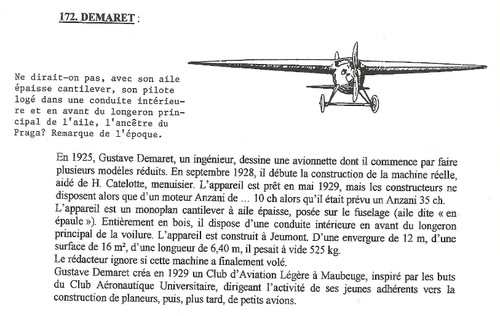
here is a two light airplane drawings,designed by Mr. Jean Boucarnot and Mr. Demaret.

A more Info about Demaret airplane,from TU 187.
 

Attachments

  • 1.png
    1.png
    226.3 KB · Views: 128
Last edited:
From TU 187,

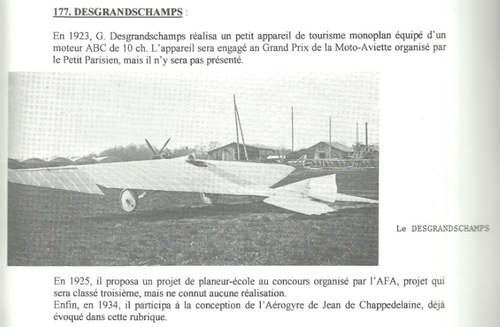
About G. Desgrandschamps;

177. DESGRANDSCHAMEPS:
In 1923, G. Desgrandschamps produced a small monoplane tourism device equipped with a
10 hp ABC engine. The aircraft will be entered in the Moto-Aviette (motor-glider) Grand Prix
organized by the Little Parisian, but he won't be shown there.

In 1925, he proposed a school glider project to the competition organized by the AFA, a project
which will be classified third, but knew no achievement.Finally. in 1934, he participated in the
design of the Aerogyre by Jean de Chappedelaine, already mentioned in this section.
 

Attachments

  • 1.png
    1.png
    404.4 KB · Views: 116
This "Little Parisian" is the Petit Parisian newspaper we've encountered before. And the AFA was l'Association Française Aérienne.

The connection with Jean de Chappedelaine's Aérogyre low-speed testbed (based on a Caudron Luciole) make me wonder if this M Desgrandschamps was actually the aerodynamicist R.-G. Desgrandschamps?
 
Hi,

Mr. Maurice Drouhin was a well known pilot,but he designed also
airplane,who heard about it ?.
 

Attachments

  • 1.png
    1.png
    5.1 KB · Views: 89
Last edited:
The Joubert J 3, which bears more than a passing resemblance to the Mignet HM.8 but, equally, differs in significant respects. Maybe its design was influenced by the HM.8. Maybe it was constructed using HM.8 components. Maybe it was converted from an HM.8. So far I've found next to no information about it. Does anyone have any?
Hi may I point you to the aviafrance website, as mentioned in a previous posting, https://www.aviafrance.com/joubert-j-3-aviation-france-10226.htm
 
In TU magazine,

there was unknown airplane from 1920,designed by Dubois-Piquet,any idea ?.
 

Attachments

  • 1.png
    1.png
    3.3 KB · Views: 62
In TU magazine,

they spoke about Mr. Ducceschi who designed an airplane in 1934,but when I search on it in Ailes,
I can't understand what was it ?.
 

Attachments

  • 0.png
    0.png
    4.3 KB · Views: 65
  • 1.png
    1.png
    180.7 KB · Views: 78
From TU magazine,does anyone hear about Mr. Dumay and his airplane of 1939 ?.
 

Attachments

  • 1.png
    1.png
    4.3 KB · Views: 68
Last edited by a moderator:
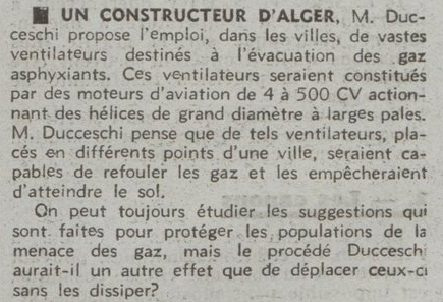
In TU magazine, they spoke about Mr. Ducceschi who designed an airplane in 1934, but when I search on it in Ailes, I can't understand what was it ?.

Nothing to do with aircraft. M. Ducceschi was proposing the use of large-diameter fans to drive 'asphyxiating gases' (smog, pollution, natural gas fumes?) away from Algiers. These large-bladed fans would be powered by aero-engines of 400-to-500 hp. That seems to be the only aviation connection. (The article ends voicing a concern that Ducceschi's concept may serve to displace the noxious gases without actually dissipating these pollutants.)

Obviously, any avion developed by Ducceschi in 1934 was utterly unrelated to his Algiers proposal (assuming this is the same Ducceschi). Alternatively, Trait d'Union was equally misled by Ducceschi's mention of aero-engines for his pollution project.
 
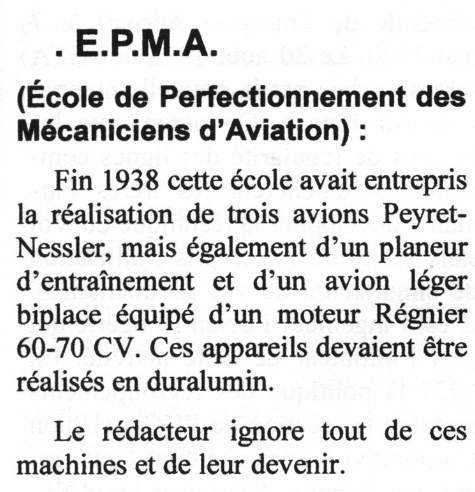
From TU 198,

the E.P.M.A. (Ecole de Perfectionnement des Mécaniciens d’Aviation) designed a Glider and light
Airplane;

At the end of 1938 this school had undertaken the realization of three Peyret aircraft- Nessler,
but also a glider and a light aircraft two-seater fitted with a Régnier engine 60-70 hp.These
airplanes were to be made of duralumin.

The editor ignores all of thesemachines and their future.
 

Attachments

  • 1.png
    1.png
    175.7 KB · Views: 58
From TU 224,

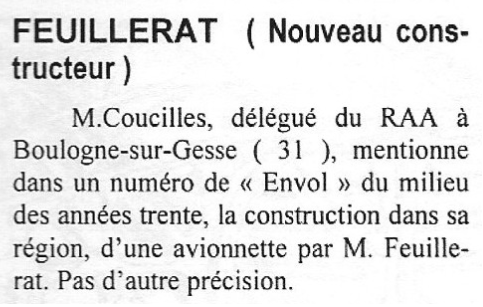
Mr. Feuillerat designed a ultra-light airplane;

M.Coucilles, delegate of the RAA at Boulogne-sur-Gesse (31}), mentions in an issue of "Envol" in the middle
construction in its thirties region, of a ultra-light airplane by Mr. Feuillerat. No further details.
 

Attachments

  • 1.png
    1.png
    126 KB · Views: 96
From TU 198,and Aviation Francaise 1947,

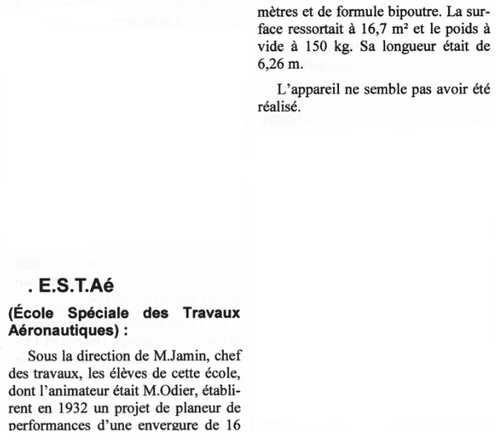
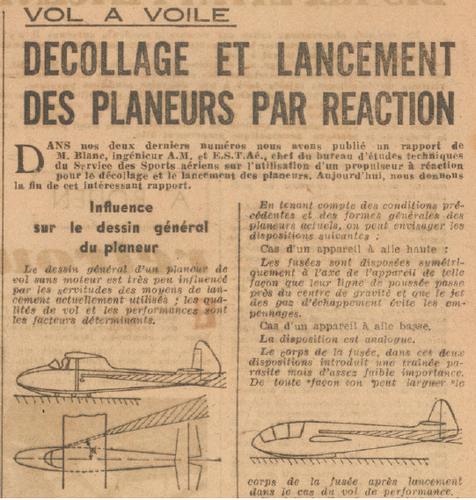
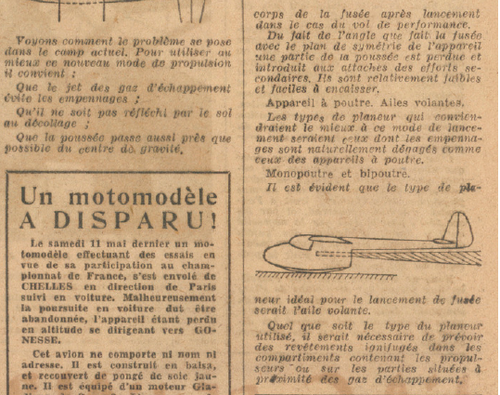
here is most activities of E.S.T.Aé. (Ecole Spéciale des Travaux Aéronautiques),one of them
was a twin-boom glider.
 

Attachments

  • 1.png
    1.png
    115.3 KB · Views: 103
  • g-1.png
    g-1.png
    635.3 KB · Views: 83
  • g-2.png
    g-2.png
    485.3 KB · Views: 75
  • g-3.png
    g-3.png
    752.4 KB · Views: 69
  • g-4.png
    g-4.png
    352.1 KB · Views: 66
  • g-5.png
    g-5.png
    650.1 KB · Views: 67
From TU magazine,

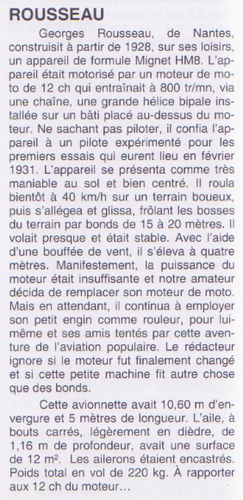
I spoke before about Georges Rousseau in Postwar section,and here is early activities;

Georges Rousseau, from Nantes. built from 1928. on his leisure,a device of formula Mignet HM8.
The device was powered by a 12 hp motorcycle engine which drove at 800 rpm, via a chain, a large
two-bladed propeller installed on a frame placed above the engine. Not knowing how to fly, he
entrusted the aircraft to an experienced pilot for the first tests which took place in February
1931. The device presented itself as very handy on the ground and well centered. He rolled
soon at 40 km/h on muddy ground, then lightened and slipped, brushing against the bumps
from 15 to 20 meters of land. he almost flew and was stable. With help with a whiff of wind, it
rose to four meters. Clearly, the power of engine was insufficient and our amateur decided to
replace his motorcycle engine.But in the meantime, he continued to use his little machine as a
wheeler, for himself and his friends tempted by this adventure of popular aviation. The writer
don't know if the engine was finally changed and if this little machine did something else
that leaps.

This mini-plane was 10.60 m wide and 5 m long. The wing, at square tips, slightly dihedral, of
1.16 m deep, had a surface of 12 m2. The fins were recessed. Total flight weight of 220 kg.
To report at 12 hp of the engine.


Attachments

  • Rousseau.png
    Rousseau.png
    354.2 KB · Views: 75
From TU 236,

here is a Monoplane designed by Fourrier-Bourdinaud-Beau,for Fournier,maby the name is wrong;

We had signed the device built in Haute-Marne by MM. Fournier, Bourdinaud and Beau. In the
book by Huben Déchanet "Lux Centuries in the sky of the country of Langres ", we speaks of
this device as having been built by Lucien Fourrier. After verification, the editor of this section
realized that he had misprinted the name of Fourier and had written, by mistake, Fournier.

Therefore. this device, the first amateur device built in the country of Langres, was born in Hortes,
from the hands of Lucien Fourrier, working in the village, assisted by two "airplane specialists cn" (!).
The local newspaper, "La Haute-Marnc-Nouvelle ”, echoed it in actobre 1927 on the occasion of the
first taxiing tests which took place in a field, the Jong on the road from Chalindrey to Hortes, on
Sunday October 2, around 10 a.m. The device is said looked like the Nieupor monoplane. He is
all in plywood and fitted with a 39 hp Anzani engine. After a few engine tests, the pilot rolled
the machine, but without leaving the ground. the land apparently not suitable for takeoff in
conditions of satisfactory security.

numerous modifications and takeoff attempts were postponed later. It was not until August 1928 that
he first flights took place and they gave “Enjoy all satisfaction The future above this device is always
unknown.
 
That makes sense, Lucien Fourrier was a carpenter in Hortes. No clue about MM Bourdinaud and Beau :(
 
Hi,

here is a biplane designed by Fourquard,maybe remained a Project only ?.
 

Attachments

  • 1.png
    1.png
    260.4 KB · Views: 72
  • Les_Ailes___journal_hebdomadaire_[...]_bpt6k6553867n_5.jpeg
    Les_Ailes___journal_hebdomadaire_[...]_bpt6k6553867n_5.jpeg
    1.6 MB · Views: 77
Last edited:
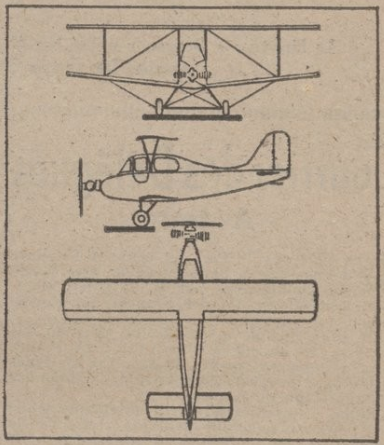
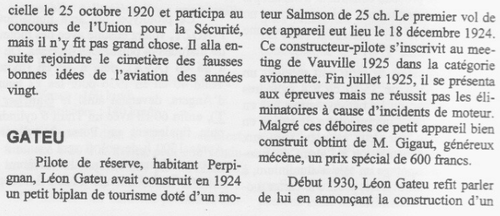
From TU 207,

Mr. Leon Gateu designed a tourist Biplane in 1924,powered by one 25 hp Salmson engine,and also
created a two-seat Monoplane in 1930,powered by one 45 hp engine,the later maybe remained a
Project only ?.
 

Attachments

  • 1.png
    1.png
    195.8 KB · Views: 67
  • 2.png
    2.png
    76.7 KB · Views: 61
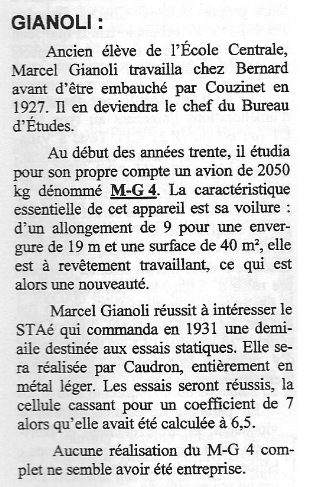
From TU 208,

here is a strange light airplane,designed by Mr. Marcel Gianoli;

Former student of the Central School, Marcel Gianoli worked at Bernard before being hired by Couzinet in
1927. He will become the head of the Bureau Studies.

In the early 1930s he studied for his own account a plane from 2050 kg called M-G 4. The characteristic
essential of this device is its wing: an extension of 9 for a span of 19 m and a surface of 40 m2, it is coated
with working, which is then a novelty.

Marcel Gianoli manages to interest the STAé which ordered in 1931 a half wing intended for the static tests.
It will be produced by Caudron, entirely in light metal. The tests will be successful, the brittle cell for a
coefficient of 7 when it had been calculated at 6.5.

No realization of the complete M-G 4 seems to have been undertaken.
 

Attachments

  • 1.png
    1.png
    151.4 KB · Views: 59
A slightly better (if somewhat loose) translation might be:

A former student of the École centrale Paris, Marcel Gianoli worked at Bernard before being hired by Couzinet in 1927. Gianoli would become head of Couzinet's design office.

On his own in the early thirties, Gianoli studied a projected 2,050 kg aircraft designated M-G 4. The key feature of this aircraft was its wing: which had an aspect ratio of 9.0, a 19 metre wingspan, and a wing area of 40 m2. This wing was of stressed-skin construction, then a novelty.

Marcel Gianoli managed to interest the STAé in his concept. In 1931, the STAé ordered the construction of a half-wing intended for static testing. This test wing will be made by Caudron, entirely in light alloy metal. The tests are successful - the wing having a coefficient of 7 when only 6.5 had been calculated.

No work on the complete M-G 4 airframe seems to have been undertaken.

hesham's cutting clears up another bit of online confusion. A number of sources claim that Gianoli was working at Société Letord when René Couzinet moved his Arc-en-ciel work there for completion. Obviously not. Marcel Gianoli had been working with Couzinet all along. I suspect the fact that both hangars were located in Meudon is the root of the confusion.

Marcel Gianoli acted as both flight engineer and navigator on Arc-en-ciel tests. He was onboard for the fatal Arc-en-ciel crash of 08 August 1928, shattering his pelvis. By 1936, Marcel Gianoli would form ECA (Études et constructions aéronautiques) with Paul Rozycki.

 
From TU 208,

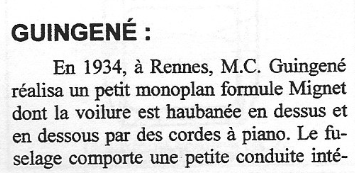
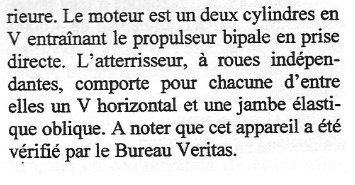
here is an Info about Mr. Guingene and his formula Mignet;

In 1934, in Rennes, M.C. Guingené produced a small Mignet formula monoplane whose wing is
guyed above and below by piano strings. The fuselage has a small interior pipe. The engine is a
two cylinder in V driving the two-bladed propellant direct. The undercarriage, with independent
wheels, comprises for each of they have a horizontal V and an oblique elastic leg. Note that this
airplane has been verified by Bureau Veritas.
 

Attachments

  • g-1.png
    g-1.png
    56.3 KB · Views: 54
  • g-2.png
    g-2.png
    61.1 KB · Views: 75
From TU 215,

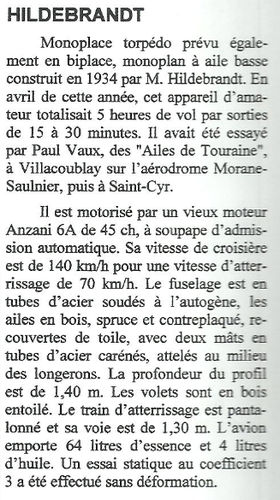
Mr. Hildebrandt and his design;

Single-seater torpedo also planned as a two-seater, low-wing monoplane built in 1934 by Mr. Hildebrandt. In
April of this year, this amateur aircraft totaled 5 flight hours per 15 to 30 minute outings. He had been tried
by Paul Vaux, from "Aïles de Touraine",in Villacoublay on the Morane-Saulnier aerodrome, then in Saint-Cyr.

It is powered by an old engine Anzani 6A 45 hp, with automatic intake valve. Its cruising speed is 140 km / h
for a landing speed of 70 km / h. The fuselage is in autogenously welded steel tubes,wooden wings, spruce
and plywood, covered with canvas, with two masts in streamlined steel tubes, coupled in the middle stringers.
Profile depth is 1.40 m. The shutters are made of wood Canvas. The landing gear is pantalized and its path is
1.30 m. The plane takes 64 liters of petrol and 4 liters oil. A static coefficient test 3 was carried out without
deformation.
 

Attachments

  • 1.png
    1.png
    207.3 KB · Views: 71
Last edited:
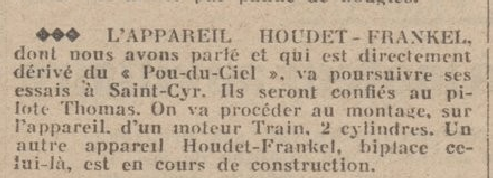
From Les Ailes and TU 215,

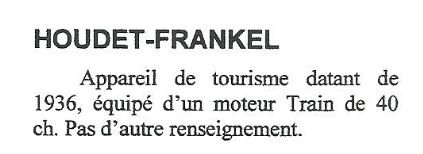
Houdet-Frankel designed a two-seat light tourist airplane in 1936,powered by 40 hp Train 2 engine,it
was derivative of Pou-du-Ciel.
 

Attachments

  • 1.png
    1.png
    120.5 KB · Views: 57
  • 2.png
    2.png
    38.5 KB · Views: 50
From Ailes and TU 236,

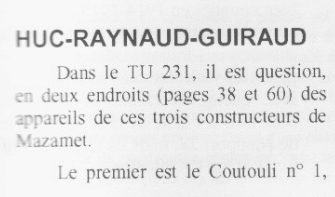
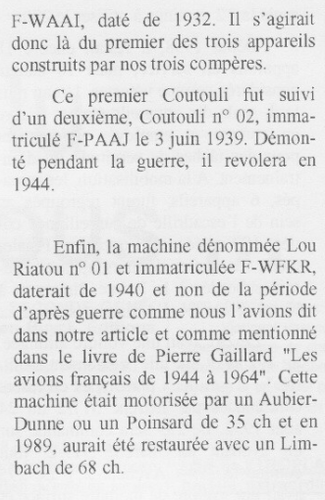
here is a two variants of parasol wing Monoplane,designed by trio Huc-Raynaud-Guiraud.
 

Attachments

  • 1.png
    1.png
    51.6 KB · Views: 48
  • 2.png
    2.png
    149.1 KB · Views: 72
  • Les_Ailes___journal_hebdomadaire_[...]_bpt6k6554700f_12.jpeg
    Les_Ailes___journal_hebdomadaire_[...]_bpt6k6554700f_12.jpeg
    1.8 MB · Views: 80
I think Beyer is a typical German name and I am very sure that Weimar is a city in Germany, exactly in Thuringia. So this project doesn't seem to be a French one, but rather a German one.
 
Hi Maveric,I deleted the post,and transferred it to German topic.

From TU 236,

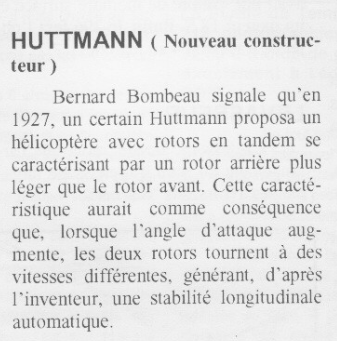
From Mr. Huttmann,who designed a helicopter in 1927;

Bernard Bombeau points out that 1927, a certain Huttmann proposed a helicopter with tandem rotors characterized by a rear rotor more lighter than the front rotor. This characteristic would result in that,when the angle of attack increases, the two rotors rotate at different speeds. generating, according to
the inventor, longitudinal stability automatic.
 

Attachments

  • 1.png
    1.png
    98.2 KB · Views: 105
Last edited:
From TU 215,

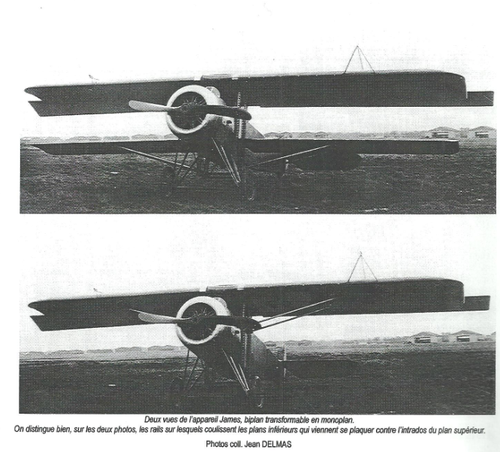
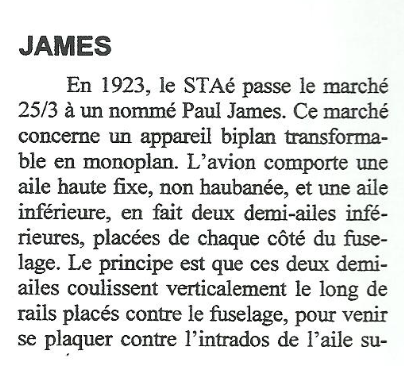
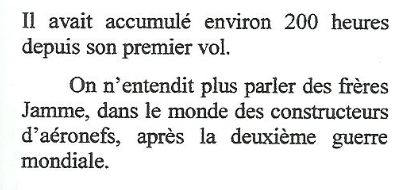
here is a Paul James biplane with could be converted into a monoplane;

In 1923, the STAe passes the market 25/3 to a man named Paul James. This market concerns a biplane
device convertible into a monoplane. The aircraft has a fixed high wing, not guyed, and one wing lower,
in fact two lower half-wings, placed on each side of the fuselage. The principle is that these two half-
wings slide vertically along rails placed against the fuselage, to come to press against the underside
of the wing su-He had accumulated about 200 hours since his first trip.
 

Attachments

  • 0.png
    0.png
    498 KB · Views: 110
  • 1.png
    1.png
    130 KB · Views: 87
  • 2.png
    2.png
    50.8 KB · Views: 63
From TU 216,

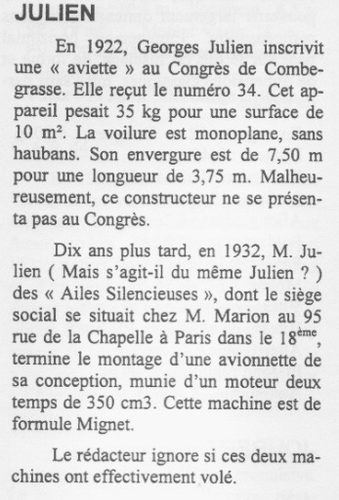
here is a two airplanes.designed by Georges Julien;

In 1922, Georges Julien registered an “aviette” at the Combegrasse Congress. She received number 34.
This device weighed 35 kg for an area of 10 m °. The wing is monoplane, without wire. Its wingspan is
7.50 m for a length of 3.75 m. Unfortunately, this builder did not attend Congress.

Ten years later, in 1932, Mr. Julien (But is it the same Julien?) "Silent Wings", whose headquarters social
was located at Mr. Marion's 95 rue de la Chapelle in Paris in 18 °,completes the assembly of a light aircraft
its design, equipped with a two engine time of 350 cm3. This machine is Mignet formula.

The editor does not know if these two machines actually flew.
 

Attachments

  • 1.png
    1.png
    166 KB · Views: 92
From TU 244,

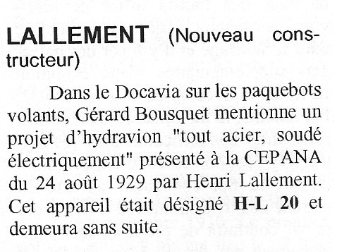
Mr. Henri Lallement designed a seaplane Project of 1929,called HL-20;

In the Docavia on the liners steering wheels, Gérard Bousquet mentions an all-steel, welded seaplane Project
electrically "presented to CEPANA August 24, 1929 by Henri Lallement.This device was designated HL-20 and
remained without oil.
 

Attachments

  • 1.png
    1.png
    72.9 KB · Views: 81
Or ...

LALLEMENT (New manufacturer)

In the Docavia book on transoceanic flying boats, Gérard Bousquet mentions a seaplane project "of all electrically-welded steel construction," present to CEPANA on 24 August 1929 by Henri Lallement. This aircraft was designated H-L 20 but the project was not pursued.

Note: The designation is H-L 20 not HL-20 (sic). That "paquebots volants" actually translates as 'flying oceanliners' so, obviously, we are talking about a very large passenger-carrying flying boat.

The Docavia publication in question is Bousquet's 2006 Les Paquebots Volants: Les hydravions français transocéaniques. Do any members have access to this book? Amazon.ca is offering me a new copy for $ 1,420.99! ;P

CEPANA, of course, refers to the Commission d'examen des Prototypes et Appareils Nouveaux de l'Aeronautique.
 
My dear Apophenia,

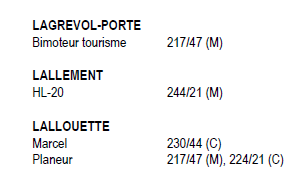
I have the book,and no drawing for it,and for the designation,in TU index,they mentioned it
as HL-20 ?.
 

Attachments

  • 1.png
    1.png
    7.2 KB · Views: 69
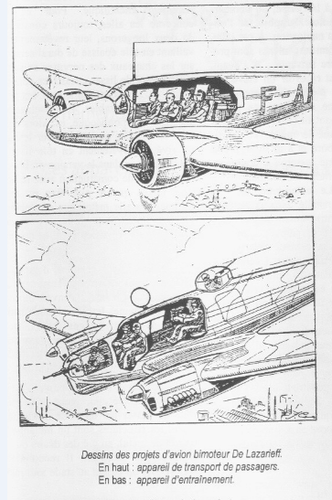
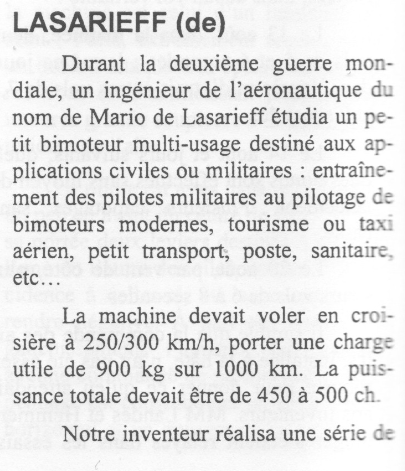
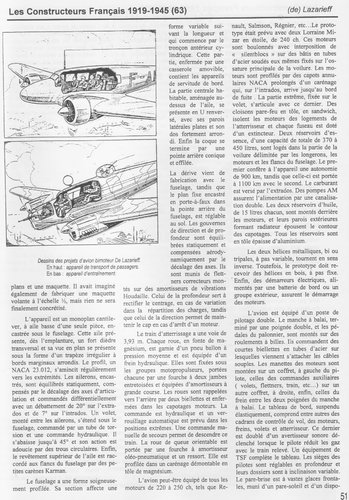
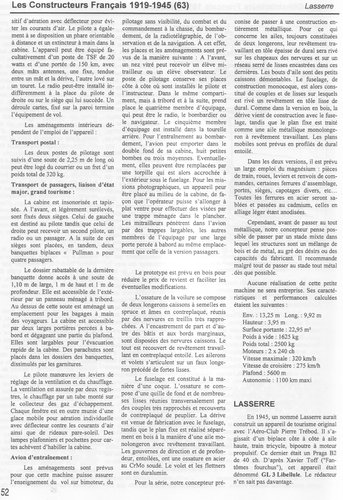
From TU 217,

Mr. Mario de Lasarieff designed a low-wing twin engined light transport,crew trainer,liaison,tourist and
postal monoplane Project,powered by either two 220 to 250 hp engines.

I remember we spoke about this airplane before ?.
 

Attachments

  • 0.png
    0.png
    177.6 KB · Views: 96
  • 1.png
    1.png
    169.6 KB · Views: 95
  • 2.jpg
    2.jpg
    759.3 KB · Views: 67
  • 3.jpg
    3.jpg
    2 MB · Views: 68
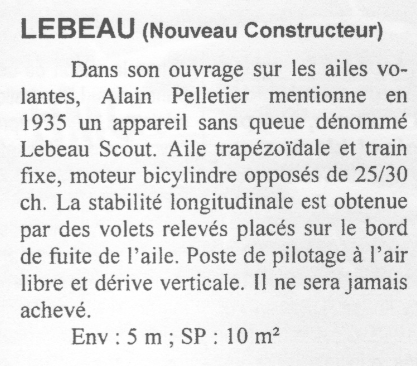
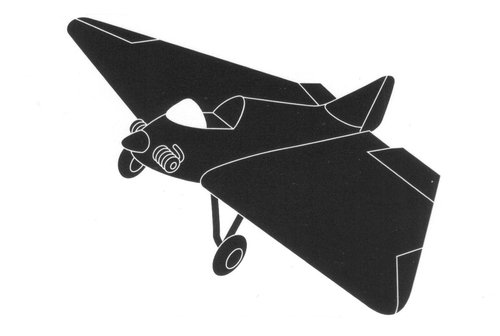
From TU 230,

Mr. Lebeau designed a flying wing tailless light airplane,called Scout;

In his work on flying wings, Alain Pelletier mentions in 1935 a tailless airplane called Lebeau Scout,trapezoidal
wing and train fixed, 25/30 hp opposing twin-cylinder engine,longitudinal stability is obtained by raised flaps
placed on the edge wing leak,cockpit in the air free and vertical drift,it was never completed.

Length 5 m ; SP: 10 m °
 

Attachments

  • 1.png
    1.png
    136.5 KB · Views: 70
From TU 226,

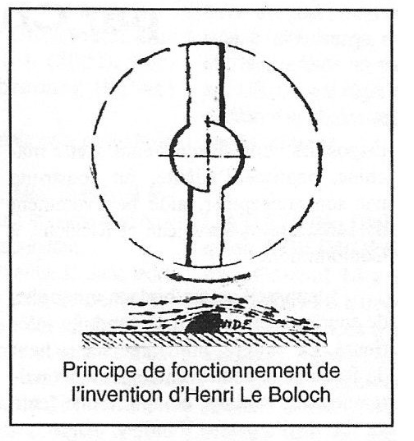
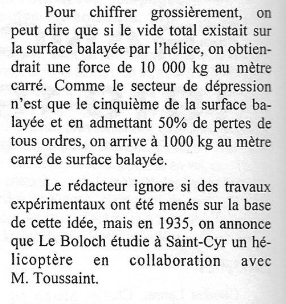
Mr. Henri Le Boloch designed a system for Brake Flaps in 1920,followed by Lift Machine with a propellers,and
a Helicopter in 1934/35,we spoke about him before here;


The first is the subject of the patent 526,166 filed February 20, 1920 and which relates to lower shutters, in fact
brake flaps.

In 1934, he proposed a system lift based on an original principle. A small diameter propeller special shape, the
profile not including than an attack spout with no back surface,rotates horizontally at very high speed flush with
a flat surface. To the very high rotational speeds, the air streams, violently spread by the edge of the propeller
as by a projectile, cannot close immediately behind her. The result is the formation of an intense and remarkably extensive depression. Air nets,by folding back, draw in some so the profile of least resistance determined by the
leading edge.

Such a propeller, even in rotation very fast in the open air, would not lead to no practical results; but, and there it
is the crux of this invention, if this rotation takes place flush with a horizontal plane surface, this surface harvest all
the benefit of the area intense pressure, in the form of a vertical thrust. Of course, the contact must be intimate to compel all the air streams to pass through the upper surface.,it suffices to coat the surface plane with a simple film
of oil very viscous,this device therefore consists of get a pressure difference between the upper part of the plane on which turns the propeller which lifts the column of air at each pass, and the lower part on which is exerted without
constrains atmospheric pressure. The result must be a lifting force.

To roughly quantify, we can say that if the total vacuum existed on the surface swept by the propeller, we would
obtain a force of 10,000 kg per meter square. Like the depression area is only one fifth of the swept area and
admitting 50% of all orders, we arrive at 1000 kg per meter square of swept area.

Editor does not know if work were conducted on the basis of this idea, but in 1935, it was announced that Le Boloch
is studying a helicopter at Saint-Cyr in collaboration with Mr. Toussaint.

 

Attachments

  • 0.png
    0.png
    131.2 KB · Views: 74
  • 1.png
    1.png
    201.4 KB · Views: 63
  • 2.png
    2.png
    85.4 KB · Views: 57
  • 3.png
    3.png
    146.6 KB · Views: 58
  • 4.png
    4.png
    89.1 KB · Views: 59
Hi,

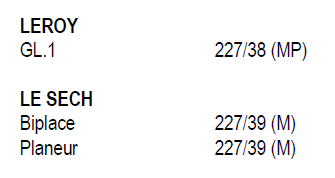
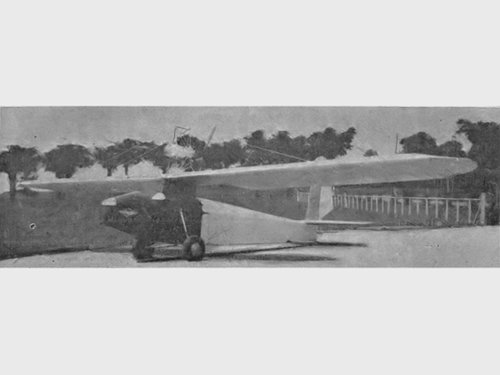
does anyone know those two designers and their airplanes,Leroy GL.1 and Le Sech two-seat ?,and
was this person which they meant or not ?.


Attachments

  • 1.png
    1.png
    5.9 KB · Views: 75
  • Leroy-1934.jpg
    Leroy-1934.jpg
    54.8 KB · Views: 83
Last edited:
From TU 229,

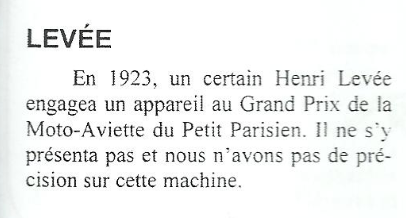
Mr. Henri Levee designed a ultra-light airplane in 1923,no more details are known ?.
 

Attachments

  • 1.png
    1.png
    60.1 KB · Views: 70
The little quote says he never showed up at the contest, so nothing more is known about the plane, and I didn't turn up anything either. Not what you asked for, but here is a contemporary article from LES AILES describing the contest and some of the planes that did show up. There is also a contemporary article in English if anyone has an AVIATION WEEK online subscription: https://archive.aviationweek.com/issue/19230820

Mr. Henri Levee designed a ultra-light airplane in 1923,no more details are known ?.
 

Attachments

  • Les Ailes 12 juillet 1923 le Grand Prix de la Moto-Aviette du Petit Parisien.pdf
    7.4 MB · Views: 20
From TU 229,and Ailes 1929 & 1932,

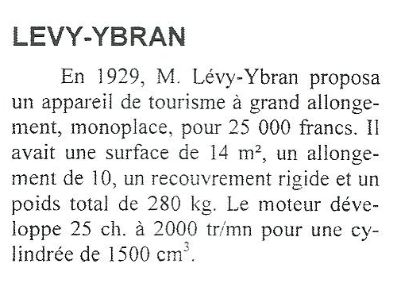
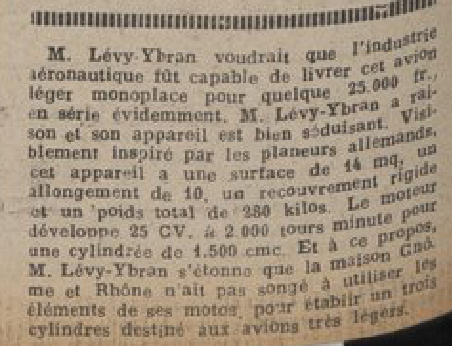
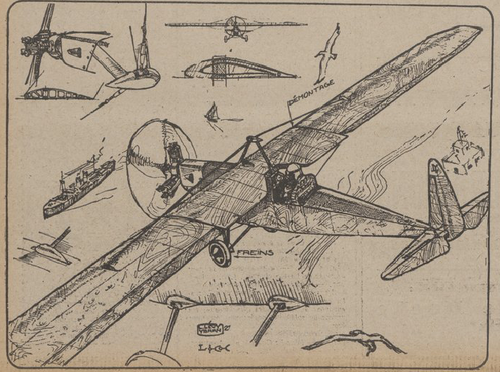
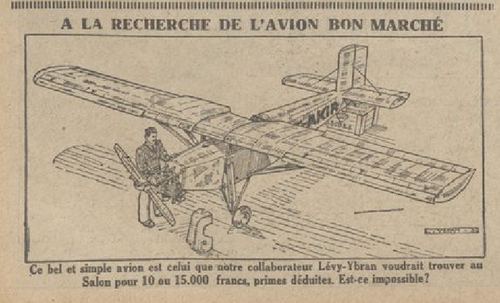
Mr. Lévy-Ybran designed a single seat light Monoplane;

In 1929, Mr. Lévy-Ybran proposed a long-elongated, single-seat tourism unit for 25,000 francs,it
had a surface of 14 m2, an elongation of 10, a rigid covering and a total weight of 280 kg,the engine
develops 25 hp. at 2000 revs for a displacement of 1500 cm °.

I don't know if he was the same Georges Levy or not ?.
 

Attachments

  • 1.png
    1.png
    71.7 KB · Views: 55
  • 2.png
    2.png
    111.7 KB · Views: 82
  • 3.png
    3.png
    607.3 KB · Views: 83
  • 4.png
    4.png
    260 KB · Views: 89
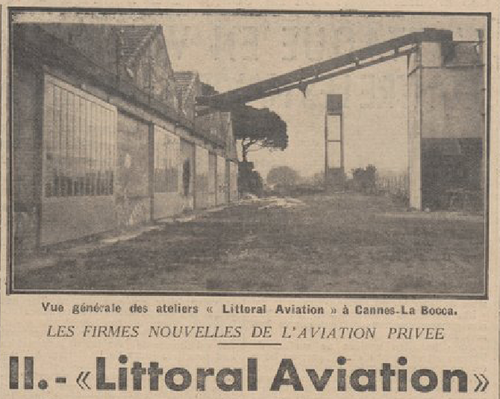
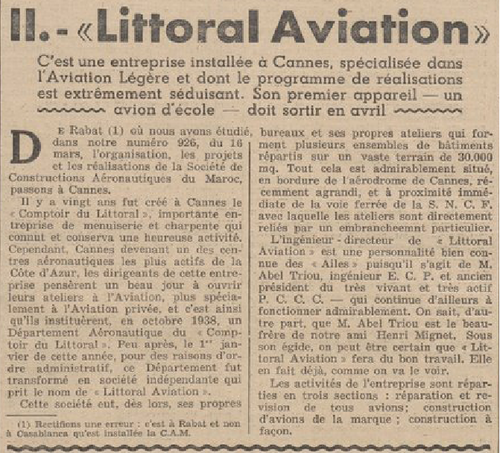
From Ailes 1939,

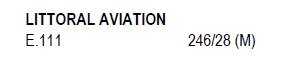
what was this; Littoral Aviation E.111 ?.
 

Attachments

  • 0.png
    0.png
    2.4 KB · Views: 91
  • 1.png
    1.png
    324.5 KB · Views: 82
  • 2.png
    2.png
    398.9 KB · Views: 78

Similar threads

Back
Top Bottom