Defense Updates has put out a video about why reloading the Mk-41 VLS underway at sea is critical:


The US Navy has carried out an unglamorous but key test.The service recently showcased new methods and technologies for resupplying vertical launch systems (VLS) at sea during a Pentagon-led command and control exercise—part of ongoing efforts to develop dedicated at-sea VLS reloading capabilities. This comes amid growing concerns over missile capacity in the surface fleet, particularly in the Indo-Pacific regions.​
As part of Large Scale Exercise 2025, the Arleigh Burke-class destroyer USS Farragut (DDG 99) conducted a missile reload operation off Norfolk Naval Base, receiving munitions for its forward and aft Mark 41 VLS from the ready reserve crane ship SS Gopher State (T-ACS 4).​
In this video, Defense Updates analyzes why At-Sea VLS Reloading is crucial for the US Navy?
Chapters:
0:00 TITLE
00:11 INTRODUCTION
01:10 SPONSORSHIP - NordVPN
01:44 NEED
03:00 THE RELOAD
05:52 ANALYSIS

Recent events in the Red Sea and off the Israeli coast have shown why this ability is critical to have.
 
Defense Updates has put out a video concerning how helping to defend Israel against Iranian missile attacks has put a big dent in the USN's ABM inventory:


According to reports, U.S. forces fired over 150 THAAD and 80 SM-3 interceptors in support of Israel—nearly 25% of the total THAAD inventory. This unprecedented use has raised red flags in the Pentagon, revealing serious gaps in America’s ability to sustain high-intensity missile defense operations.​
In this video, Defense Updates analyzes how Israel’s defense has put US in risky position by denting missile interceptor inventory?
#defenseupdates #usvsiran #israeliranwar
Chapters:
0:00 TITLE
00:11 INTRODUCTION
01:10 SPONSORSHIP - NordVPN
01:44 THAAD
04:04 SM-3
06:05 ANALYSIS
 
I believe it would elevate SM2s to being usable for self-protection versus AShBMs, but not particularly able to engage ballistic missiles attacking a separate target.

Which gets back to my wanting a small rack of Mk41s installed on Ford-class, for anti-hypersonic and anti-AShBM work. ~24 cells, unless there's volume to stick a block of 32 cells in the aft port quarter that isn't flight deck.
 
Which gets back to my wanting a small rack of Mk41s installed on Ford-class, for anti-hypersonic and anti-AShBM work. ~24 cells, unless there's volume to stick a block of 32 cells in the aft port quarter that isn't flight deck.
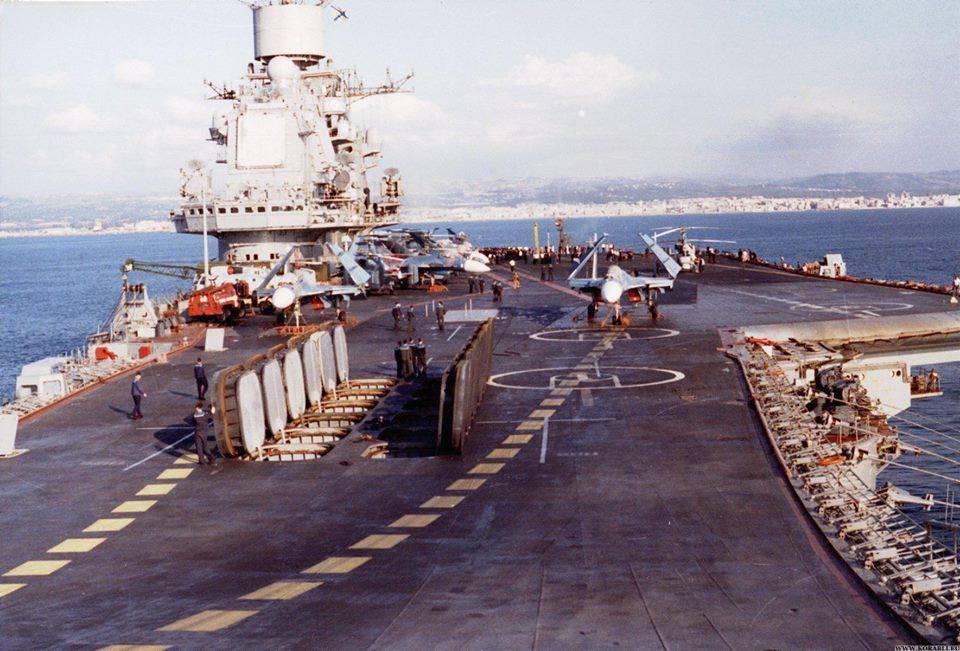
The mk29s are rather dated by this point. But hey, maybe they could do it Kuznetsov style! :p
P-700-Granit-onboard-Kuznetsov.jpg
 
The mk29s are rather dated by this point. But hey, maybe they could do it Kuznetsov style! :p
P-700-Granit-onboard-Kuznetsov.jpg
Other option would be racking 8-16x Mk41 cells in each place there's currently an ESSM unit, placed at a slight angle to horizontal. Fill 2 cells in that rack with ESSM quadpacks and the rest with SM2 Actives (or SM6s if necessary). That would keep any boosters from falling back on the flight deck.
 
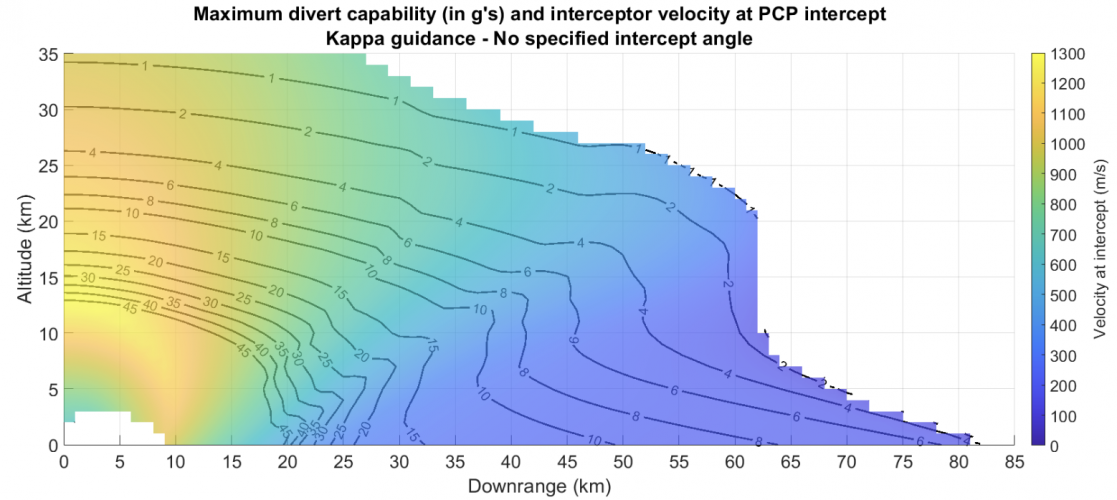
In terms of the SM-2's kinematics, this report's table seems somewhat applicable, although I don't know the specific requirements for ballistic intercepts and the guidance method might be different in that case.
View attachment 782585
That is about what I expected.

45gees divert capability at 10km altitude and 10km range. (I'm assuming a roughly 45deg dive angle for most AShBMs.)
 
That's it? I thought SM-2 had more range than that. Most sources give 80-90 NM.
Two notes.

First, the thesis is unclassified, and therefore makes a number of assumptions which may or may not be correct.

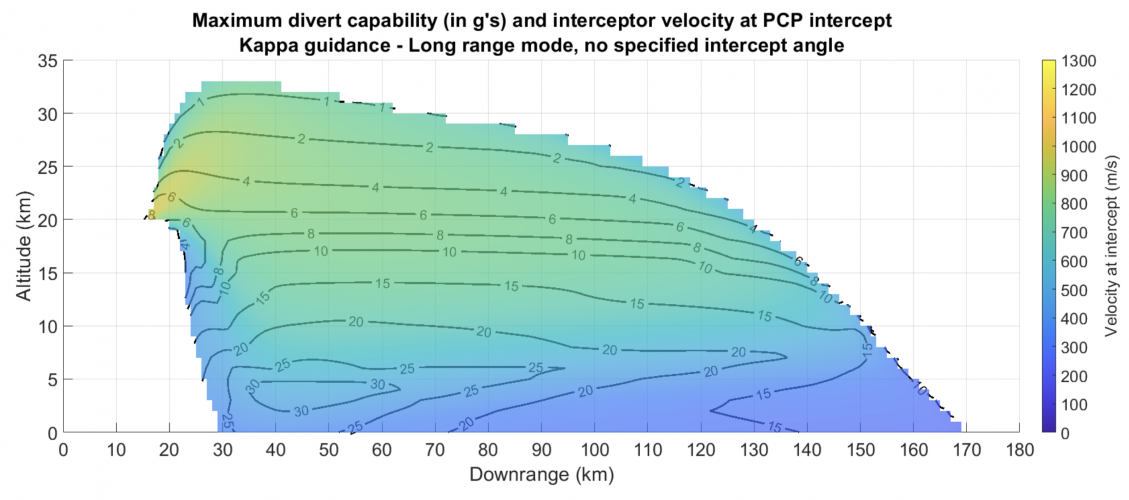
Second, the author proposes a 'normal' and a 'long range' guidance mode, with the latter restricting manoeuvres early in flight to extend flight time at high altitude, explicitly to address that issue. Based on the author's assumptions, that gives a kinematic maximum range of 173km.
 
Real SM-2 guidance certainly includes lofting, as is evidenced by videos. Here's the paper's best guess.
sm2LR.png
The constant 3g pitch-over manoeuvre during the initial 25 seconds of flight positions the interceptor at an altitude of 18.1 km and a downrange position of 12.9 km, displayed as the left-most point of the flyout table. During this pitch-over manoeuvre, the burnout Mach number at 16 seconds is Mach 4.3, translated to a ground Mach number of 3.7. Comparing the time-to-intercept contour lines of [long range mode] to [normal mode] results in a shorter time-to-intercept from a downrange distance of 40 km onward at all altitudes. [Long range mode] greatly increases the Mach number at intercept at all altitudes for downrange distances greater than 30 km
 
Last edited:

Contracts For Aug. 12, 2025​

Raytheon Co., Tucson, Arizona, was awarded a $258,742,330 cost-plus-incentive-fee contract for the engineering, manufacturing, and development of the Standard Missile 2 (SM-2) Block IIICU All Up Round. This contract includes options which, if exercised, would bring the cumulative value of this contract to $263,137,090. Work will be performed in... and is expected to be completed by September 2031. Fiscal 2025 research, development, test and evaluation (Navy) funds in the amount of $52,054,849 (65%); Foreign Military Sales (Canada) funds in the amount of $18,473,766 (23%); and fiscal 2024 research, development, test and evaluation (Navy) funds in the amount of $9,071,456 (11%), were obligated at time of award, of which $9,071,456 will expire at the end of the current fiscal year. Naval Sea Systems Command, Washington, D.C., is the contracting activity (N00024-25-C-5413). (Awarded on July 31, 2025)

Separately, SM-6 IB:
 
Last edited:
The SM-2 Block IIIC and Block IIICU are medium-range, surfaceto-air missiles with active radio frequency seekers. Both missiles are modifications to legacy SM-2 Block III/IIIA/IIIB missiles. The most significant modification is replacement of the legacy semiactive missile seeker with a dualmode semi-active and active missile seeker based on SM-6 Block I technology. The SM-2 Block IIIC and Block IIICU have a new dorsal fin design and a thrust vectoring jet tab assembly that control trajectory as the missile egresses the launcher.

These SM-2 IIIC missiles are conversions of older stockpiled SM-2 missiles? These missiles are not new production?
And if so, this implies that the only new-production Standards are the 150-ish SM-6 and SM-3s produced each year?
 
These SM-2 IIIC missiles are conversions of older stockpiled SM-2 missiles? These missiles are not new production?
And if so, this implies that the only new-production Standards are the 150-ish SM-6 and SM-3s produced each year?
There's probably a small number of SM-2s being produced to account for expenditures.

But remember that the priority is to replace SM2ERs with SM6s.
 
Real SM-2 guidance certainly includes lofting, as is evidenced by videos. Here's the paper's best guess.
View attachment 782678
"During this pitch-over manoeuvre, the burnout Mach number at 16 seconds"

Except the motor burns for more like 30-ish seconds.

You can see the booster drop off here at 2:34 and the motor is still burning at 3:04 and even 3:07 when seen through the clouds.

 
Last edited:
You can see the booster drop off here at 2:34
Good eye! IFRC the SM-2ER IV's upper stage is essentially a SM-2MR, so the burn time should be the same. Interestingly, the mk104 motor appears to be largely unchanged since the 80s.

May I ask how you got the video? I assume the large amount of publicly available SM shot footage is mostly to justify BMD spending.
 
Good eye! IFRC the SM-2ER IV's upper stage is essentially a SM-2MR, so the burn time should be the same. Interestingly, the mk104 motor appears to be largely unchanged since the 80s.

May I ask how you got the video? I assume the large amount of publicly available SM shot footage is mostly to justify BMD spending.
Downloaded it from somewhere years ago. Was a .wmv file I downloaded in 2008.
 
Defense Updates has just put out a video concerning the SM-2:


The Standard Missile-2, officially designated RIM-66 for medium-range and RIM-67 for extended-range versions, has been the core of naval air defense for decades. Developed by Raytheon, the SM-2 evolved from the earlier Standard Missile-1 and replaced older systems that could no longer meet the demands of modern warfare. Its design philosophy was simple yet forward-looking — to create a reliable, flexible, and fast-reacting interceptor that could defend fleets against enemy aircraft and anti-ship missiles at long range.​
The SM-2 has served as the U.S. Navy’s workhorse in layered air defense since the 1970s. It became the foundation for the entire Standard Missile family, which later produced the SM-3 for ballistic missile defense and the SM-6 for extended-range, multi-mission use. Even today, the SM-2 remains widely deployed across U.S. and allied fleets, proving the durability and adaptability of its design.​
In this video, Defense Updates analyzes why SM-2 remains one of the most potent interceptor missile in the world?
#defenseupdates #sm2 #usmilitary
Chapters:
0:00 TITLE
00:11 INTRODUCTION
01:22 SPONSORSHIP - NordVPN
01:56 ORIGINS AND DEVELOPMENT
03:24 DESIGN AND CONSTRUCTION
04:38 OPERATIONAL CAPABLITIES
07:20 ANALYSIS
 
No further development of the Compact Agile Interceptor? Zero dollars requested for FY26, and I can't find evidence of this program elsewhere. From the FY26 Navy RDT&E BA 1-3:

FY 2025 to FY 2026 Increase/Decrease Statement:
The decrease in funding from FY 2025 to FY 2026 is due to this INP completing Applied Reserarch development in FY 2025
Background:
Title: Compact Agile Interceptors
Description: The US Navy lacks both in capability and capacity interceptors that have the ability to defeat complex raids of hypersonic missiles, cruise missiles and surface vessels. The Compact Agile Interceptor INP will use small diameter missiles to achieve a higher packing efficiency. Disruptive seeker technology, which weighs mere ounces will replace wasted pounds of payload weight and allow for higher speed missile interceptors. The seedling will evaluate multiple propulsion technologies including solid fuel ramjets, highly loaded grain propellants, and active throttling of solid rockets. The missiles airframe may be staged to enable the interceptor(s) the greatest agility to overmatch the threat. Multiple warhead technologies will be evaluated including reactive materials, kinetic warheads, and tailorable fragment warheads. The Activity identified in Project Unit 3506 specifically addresses Applied Research in support of the Compact Agile Interceptors INP effort.
FY 2025 Plans:
Initiate
- Independent Cost Estimate for the proposed INP program
- Procurement of 2-3 flight test units with selected propulsion concept
- Live fire proof of concept flight demonstration of propulsion concept
Complete
- Mission Analysis to establish Capability & Limitations of Engagement Envelope
- Propulsion/Payload Study to establish Missile Architecture and Technology Design Objectives
 
No further development of the Compact Agile Interceptor? Zero dollars requested for FY26, and I can't find evidence of this program elsewhere. From the FY26 Navy RDT&E BA 1-3:

FY 2025 to FY 2026 Increase/Decrease Statement:
The decrease in funding from FY 2025 to FY 2026 is due to this INP completing Applied Reserarch development in FY 2025
Background:
Title: Compact Agile Interceptors
Description: The US Navy lacks both in capability and capacity interceptors that have the ability to defeat complex raids of hypersonic missiles, cruise missiles and surface vessels. The Compact Agile Interceptor INP will use small diameter missiles to achieve a higher packing efficiency. Disruptive seeker technology, which weighs mere ounces will replace wasted pounds of payload weight and allow for higher speed missile interceptors. The seedling will evaluate multiple propulsion technologies including solid fuel ramjets, highly loaded grain propellants, and active throttling of solid rockets. The missiles airframe may be staged to enable the interceptor(s) the greatest agility to overmatch the threat. Multiple warhead technologies will be evaluated including reactive materials, kinetic warheads, and tailorable fragment warheads. The Activity identified in Project Unit 3506 specifically addresses Applied Research in support of the Compact Agile Interceptors INP effort.
FY 2025 Plans:
Initiate
- Independent Cost Estimate for the proposed INP program
- Procurement of 2-3 flight test units with selected propulsion concept
- Live fire proof of concept flight demonstration of propulsion concept
Complete
- Mission Analysis to establish Capability & Limitations of Engagement Envelope
- Propulsion/Payload Study to establish Missile Architecture and Technology Design Objectives
The text says it's because research development was completed in 2025.
 
Applied Research, yes. But I cannot find evidence that the CAI lives on in Advanced Technology Development or elsewhere.
From what a quick bit of reading tells me, this project was about folding fin modifications to the PAC-3 MSE to allow it to dual-pack into Mk41 cells. So it probably wasn't a huge development task and on that basis it's likely being fielded as we speak.

 
From what a quick bit of reading tells me, this project was about folding fin modifications to the PAC-3 MSE to allow it to dual-pack into Mk41 cells. So it probably wasn't a huge development task and on that basis it's likely being fielded as we speak.


I think it more likely it was canned because there is no available PAC3 production capacity.
 
Is there any chance CAI was related to the ESSM replacement program and that all of the development has moved there?
 
I think it more likely it was canned because there is no available PAC3 production capacity.
This just in: ;)

Lockheed Martin, Pentagon strike deal to triple PAC-3 missile production​

 
Since this is a SM thread, it would be interesting to see if a combined joint demand (Navy, Army and perhaps Air Force) pushes SM-6 numbers up. So far, the production ramp has been anemic and coupled with performance improvements (guidance etc) has actually led to higher unit cost despite increases on the production side. Somewhere between 500-1,000 units a year should begin pushing unit cost down on the newer SM-6 variants and if the USAF jumps on the AIM-174 to arm its legacy platforms then this might create enough demand for such a production quantity.
 
I do not see USAF adopting SM-6, and I suspect the Army buy is minuscule compared to the USN numbers. What is the current production rate? I was led to believe it was quite small.
 
Since this is a SM thread, it would be interesting to see if a combined joint demand (Navy, Army and perhaps Air Force) pushes SM-6 numbers up. So far, the production ramp has been anemic and coupled with performance improvements (guidance etc) has actually led to higher unit cost despite increases on the production side. Somewhere between 500-1,000 units a year should begin pushing unit cost down on the newer SM-6 variants and if the USAF jumps on the AIM-174 to arm its legacy platforms then this might create enough demand for such a production quantity.
Did SM-6 Block IB (21" dia missile) get cancelled or just put on hold?
 
The Navy is not pursuing the missile right now and paused the program until it reviewed the path forward. It did however continue to fund the Aerojet rocket motor to preserve its options. I think the problem was that it was leading them towards a very expensive multi-mission missile (I think 2-3 x the cost of the current variant) making it quite unaffordable.
 
I do not see USAF adopting SM-6, and I suspect the Army buy is minuscule compared to the USN numbers. What is the current production rate? I was led to believe it was quite small.
The USAF could probably make good use of the AIM-174 especially if it expands the current F-15EX fleet which is a strong possibility. But then again, it could well have other more optimized missiles in the works. Current SM-6 production numbers are in the 200-300 range I believe.
 

Similar threads

Back
Top Bottom