- Joined
- 3 June 2011
- Messages
- 20,895
- Reaction score
- 19,083

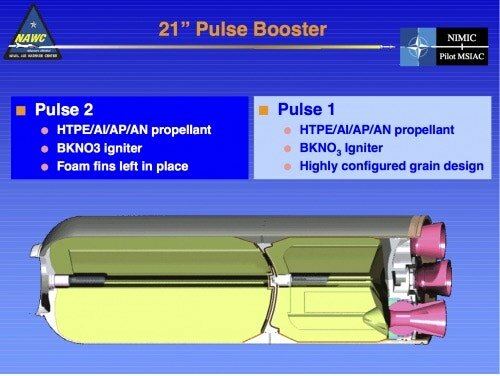
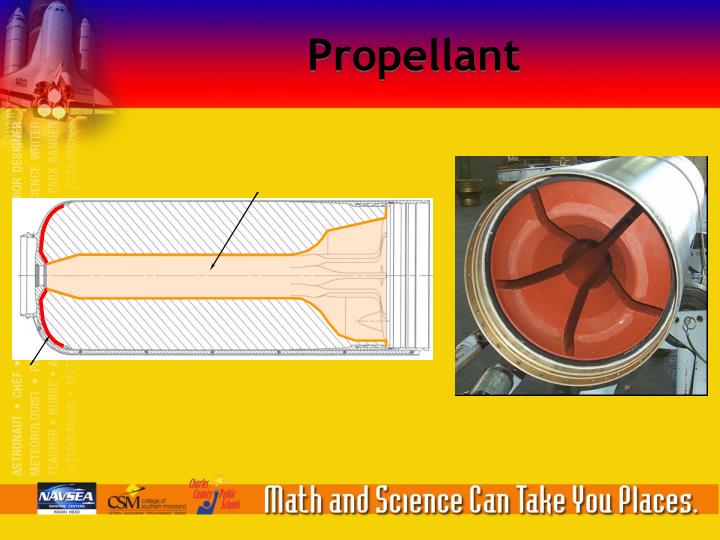
What is this booster? The mk72 has a single pulse design.
What is this booster? The mk72 has a single pulse design.
That's what I thought too. In fact I saw this picture years before the one above. Was told it was incorrect. Not sure which is true, or if one design replaced the other.What is this booster? The mk72 has a single pulse design.
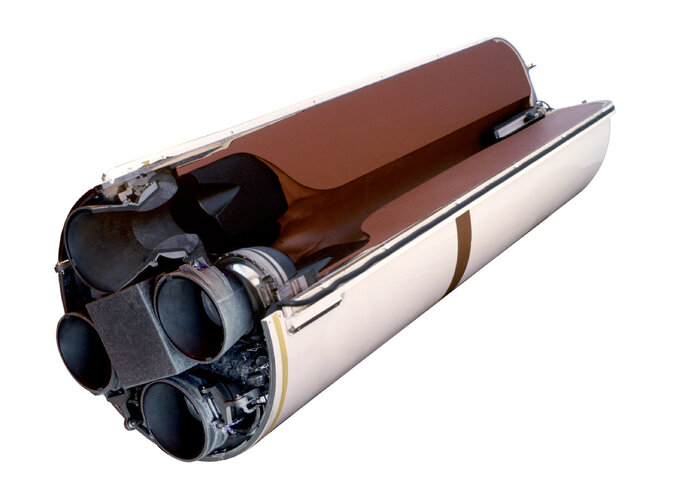
Well, there's also this supposedly official photo from https://www.secretprojects.co.uk/threads/us-navy-standard-missile-family.7671/post-745429That's what I thought too. In fact I saw this picture years before the one above. Was told it was incorrect. Not sure which is true, or if one design replaced the other.
Also, could I ask where and when you found the dual-pulse photo?
Thanks. Looks like this conversation has happened before. It does seem strange that they would optimize the booster this much. I've seen some DTIC report claiming that single stage all-boost is the "best" thrust profile, at least for ABM missions.
That is how the THAAD works, not that THAAD is a high end ABM...Thanks. Looks like this conversation has happened before. It does seem strange that they would optimize the booster this much. I've seen some DTIC report claiming that single stage all-boost is the "best" thrust profile, at least for ABM missions.
That is how the THAAD works, not that THAAD is a high end ABM...
Found the report. It's not really applicable to the mk72, but it might be of interest to this thread.
I've wondered why they would complicate things further by adding a DTRM to the already boosted ER (SM2IV/SM3/SM6) model. SM-3 has 5 or 6 separate rocket pulses! The report called for "all boost" for the second stage, figure 5 is a single pulse motor.I wouldn't surprised at all if figure five in the report is representative of the 21" version of the Mk-104 DTRM used in the SM-3 Block-II interceptor missile.
I've wondered why they would complicate things further by adding a DTRM to the already boosted ER (SM2IV/SM3/SM6) model.
SM-3 has 5 or 6 separate rocket pulses!
Sorry, I mixed up the terminology. By pulses, I was referring to distinct burn profiles. The main thing that I'm wondering is why the original 13.5" SM2IV/SM3/SM6 has a booster (mk72) and then a boost-sustain motor (mk104, designed for MR) on top of that, giving it a boost-boost-sustain profile instead of the usual simple boost-sustain. It might make sense to use an off-the-shelf mk104 as an interim, but you said the new 21" 2nd stage is also dual-thrust? Perhaps the mk72 doesn't provide enough boost?They aren't adding an extra DTRM, the standard Mk-104 DTRM is 13.5" in diameter while the 21" diameter Mk-104 DTRM has the same diameter as the 21" diameter Mk-72 launch-booster, this 21" diameter DTRM has a longer burn-time and more thrust.
The SM-3 has three stages - the Mk-72 with a high-thrust, short burn boost only burn-profile, the Mk-104 DTRM has a single-pulse dual thrust burn-profile (A high thrust thrust short burn boost phase followed by a long lower thrust sustain burn-profile) and the Mk-136 TSRM which has two pulses boost only that can be fired once or twice. This makes a total three or four burn pulses.
Perhaps the mk72 doesn't provide enough boost?

The Mk72 is a short burn to get the entire stack up past Mach 1 and pointed in more or less the right direction.Sorry, I mixed up the terminology. By pulses, I was referring to distinct burn profiles. The main thing that I'm wondering is why the original 13.5" SM2IV/SM3/SM6 has a booster (mk72) and then a boost-sustain motor (mk104, designed for MR) on top of that, giving it a boost-boost-sustain profile instead of the usual simple boost-sustain. It might make sense to use an off-the-shelf mk104 as an interim, but you said the new 21" 2nd stage is also dual-thrust? Perhaps the mk72 doesn't provide enough boost?

And it was cheaper to just reuse the normal rocket motor instead of building a new one with different profilThe Mk72 is a short burn to get the entire stack up past Mach 1 and pointed in more or less the right direction.
And it was cheaper to just reuse the normal rocket motor instead of building a new one with different profil
He asked why the DTRM also has boost and sustain and in the end its a cost question. Do any possible enhancements from reducing of removing that boost phase outweight the cost of having a seperate line for the different pulse profile. That cost more then using you're run of the mill MK 104 from SM-2What exactly do you mean?
Let's try explaining it this way: the Mk72 "simulates" an aircraft launching the missile, by getting the whole stack up, pointed in the right direction, and supersonic. When the Mk72 cuts out, that's equivalent to the point that the aircraft fires the missile. The missile then boosts up to its cruising speed, sustains for a while at high altitude for max range, and then tips over and comes screaming down from 100,000ft to ruin the day of some incoming aircraft/missile.Sorry, I mixed up the terminology. By pulses, I was referring to distinct burn profiles. The main thing that I'm wondering is why the original 13.5" SM2IV/SM3/SM6 has a booster (mk72) and then a boost-sustain motor (mk104, designed for MR) on top of that, giving it a boost-boost-sustain profile instead of the usual simple boost-sustain. It might make sense to use an off-the-shelf mk104 as an interim, but you said the new 21" 2nd stage is also dual-thrust? Perhaps the mk72 doesn't provide enough boost?


Let me answer for you, after all, this should be written more clearly in Chinese, Tatar, this word originally meant a very wide range of nomads in ancient northern China, similar to the "Khitan" in your Russians. In essence, "Khitan" and "Tatar" are the same as the names of ancient Chinese nomads. The Americans did use some names that Chinese could understand to name missiles or weapon systems.Just thought about one thing: why RIM-24 was named "Tartar"?
I mean, all other "T-series" have more or less logical names. "Talos" - the artificial bronze giant, capable of flying and burning enemies in his flames. "Typhon" - multi-head serpent, capable of catching numerous preys at once. "Terrier" - a fast, nimble dog, a rat-catcher.
But "Tartar" looks... odd. What exactly this name was supposed to means? A place? Odd. A Tatary region in Asia? Even odder. A sauce? A mythological Greek underworld? Neither seems to make sence.
Erm... this make no sence, sorry. Why should Americans in late-1950s be bothered about Chinese understanding of the name of American military system?Let me answer for you, after all, this should be written more clearly in Chinese, Tatar, this word originally meant a very wide range of nomads in ancient northern China, similar to the "Khitan" in your Russians. In essence, "Khitan" and "Tatar" are the same as the names of ancient Chinese nomads. The Americans did use some names that Chinese could understand to name missiles or weapon systems.

I think they were simply shooting for anything that began with T and was two syllables. Tatar, Talos, Terrier.
Fagot
It means "a bundle of sticks."

If I recall correctly, the Terrier was named Terrier because during one of early test shots one observer commented that "it chasing the targret like my terrier chasing rats". Everybody liked the allegory, so the name stuck and was later made official.I have never seen an actual explanation for either Terrier or Tartar, but I suspect it's something like this:
Kinda hard to believe that was the intent in the 50s
In addition to this missile, they also have the AGM-158B, which the U.S. Air Force named the "Polar Dragon" after a weapon in ancient China,
Why would you think it doesn't? If the only difference is the lack of a Mk72 booster, presumably it has similar capability just in a smaller envelope.Hey, could someone explain why the SM-6 has BMD capability, but the SM-2 BIIIC, that shares the same airframe and seeker isn't? What makes the difference?
I've never seen it advertised as being able to do BMD in any capacity, that's all.Why would you think it doesn't? If the only difference is the lack of a Mk72 booster, presumably it has similar capability just in a smaller envelope.
Is the thing even in service yet?I've never seen it advertised as being able to do BMD in any capacity, that's all.
Quick glance on Google suggests that it should be in service now, though not very widespread. I just found it strange that BMD capability was never mentioned for the SM-2 BIIIC.Is the thing even in service yet?