Ok since I'm allowed, I'll try it to summarize the general history of the carrier.
The source is The italian aircraft carrier Falco/Sparviero 1942–43: the real story by Enrico Cernuschi. (In warship 2026)
Four preliminary studies had been drawn up by General (GN) Bozzoni during the winter of 1941/1942 for what was then termed ‘the second carrier’.
The first study was a copy of Aquila except that the flight deck extended the full breadth of the ship; the island, like that of the French Béarn, did not encroach on the flight deck, but was on a sponson, with two twin 135/45 (5.3in) mountings of the new dual-purpose type under development for the never-completed cruisers of the Etna class: one forward of the island, the other abaft the funnel. Moving the weight of the island outboard of the flight deck had to be compensated for by increasing the depth of the port bulge.
The second design was dictated by the fact discovered at a fairly late stage that only three sets of machinery, each comprising two boilers and a single set of turbines, were available from the original reserve courtesy of the cancelled light cruisers of the ‘Capitani Romani’ class; only three shafts were therefore possible, and the machinery would generate only three quarters the horse-power of the Roma conversion. However, the reduction in volume required by the machinery would permit a
second hangar, while the reduction in weight would allow light splinter-proof plating under the wooden flight
deck. The main armament was now eight 135mm low-angle guns installed on sponsons, four on either side,
while the twelve 90/50 (3.5in) stabilised HA guns of the first study were replaced by twelve 65/64 (2.6in) auto-matic guns of a new, advanced model.
The third variant was an improvement of the second design which, thanks to the lengthening of the bow and the hull, allowed a modest increase in maximum speed to 29–30 knots on three shafts. The fourth was similar to the second and third variants, but with only a single
hangar and an armoured deck two metres (ie one deck height) lower than the earlier designs.
The formal decision to convert Augustus into a fleet carrier on the basis of the third design by General Bozzoni was announced by Mussolini on 3 July 1942. Three days later the liner was requisitioned but, with the resources of the Ansaldo yard fully occupied in fitting out Aquila, this was simply an
administrative act that anticipated the 1943–1944 naval war programme.
The situation had changed dramatically by mid-September 1942.
In the absence of catapults and a modern arrester system, the air groups were to be formed with the IMAM Ro.63, an Italian STOL aircraft
A rapid, simple conversion was
envisaged: the ship would have a flush through-deck, with no superstructure above the flight deck. There would be a single hangar served by a new hydraulic lift of Italian design modelled on the one fitted in the Zara- class heavy cruisers; alternatively, a dozen Ro. 63 would
be kept on deck in a permanent deck park.
The original passenger-ship hull form and the original diesel engines were to be retained. The hull would therefore be unmodified up to the flight deck, which would be supported on pillars and lattice supports.
There would be no protection beyond anti-torpedo bulges abreast the
machinery, and these would inevitably have reduced cruising speed to a maximum of 18 knots. In the absence
of an island, the exhausts were to be discharged via trunking on both sides, extending for almost half length of the ship and turning outboard towards the stern.
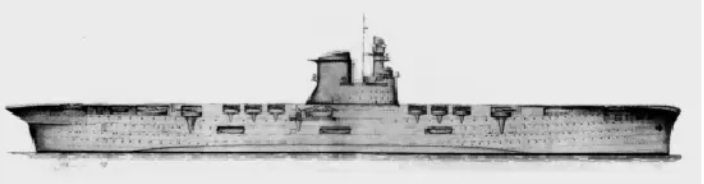
By the end of 1942, Falco had become Sparviero and the Regia Marina now decided to convert the liner Augustus into a fleet carrier named Sparviero, incorporating the best features of the various designs by General Bozzoni. The island was still on a sponson, but the funnel was now canted out to starboard. The bulge was offset to port to compensate for the island/funnel structure on the starboard side.
The design adopted had an enclosed bow plated up to the flight deck on the British pattern, with a prominent bulb at its foot. There were two superimposed hangars:the dimensions of the upper hangar, which had a 25mm roof, were 185m x 16m x 5.70m; the lower hangar was identical except in length, which was reduced by three metres to 182m. The hangars and the flight deck were served by two lifts each 14m x 16m, and the designed air group, which included a deck park, was now 92 aircraft with (manually) folding wings. The flight deck was squared off at its forward end to accommodate two catapults.
The new design was feasible because FIAT had (unexpectedly) succeeded, after six years of development, in resolving the problems with their diesel engine. By the end of 1942 the first four diesels manufactured in 1939 (now rated at 12,500bhp) were available; maximum output was 50,000bhp.
A further innovation was a steam catapult proposed in 1941 by Admiral Eugenio Minisini, a famous inventor in the ranks of the Italian Navy since the Great War, and tested the following year at Baia; the steam for the catapult was generated by hydrogen peroxide.
The main armament, as in Aquila, was eight 135mm low-angle guns in single mountings, and for anti-aircraft fire there were to be twelve 65/64 (2.6in) fully-automatic guns in single mountings and 22 of a new sextuple 20mm mounting. However, during the spring of 1943, both the 65/54 and the over-complex 20mm mounting experienced developmental problems, and it was proposed to fit in their place 104 37/54 guns (34 in twin mountings with 36 in deck-edge single collapsible mountings).
Pegna moved fast to secure the future air complement.
In January 1943 he requested a folding-wing navalised variant of the new FIAT G.55 fighter and, at the same, a similar solution for the Reggiane Re.2005,
The Caproni-Reggiane aircraft appeared to be the better option, as in the spring of 1942 that company had begun work on a folding wing for the Re.2001 fighter-bomber then under development, which was powered by a DB 601 engine; the latter aircraft was to be embarked on Aquila in 1943.
However, the superior STOL capabilities of the FIAT G.55 ensured its success, and from the 101st aircraft production of the navalised ‘N’ variant of the G.55 was to be given precedence over the land-based variant, with manufacture scheduled from October 1943.
For the dive-bombing and torpedo attack missions, in April 1943 engineer Giuseppe Gabrielli of FIAT, a pupil of Pegna during the 1920s, would begin studies for the FIAT G.57, a variant of the G.55 which reverted to a radial engine, the 1,250hp Fiat A.83 R.C.24-52, introduced successfully during the spring of 1943.6
This whirl of activity was, however, abruptly halted on its tracks on the afternoon of 17 January 1943, and on 20 January Supermarina, the Italian Navy’s Navy’s central command, decided that the resources of the Genoese Ansaldo yard were to be concentrated on commissioning in the shortest possible timeframe the corvettes, torpedo boats and MM/SB on its slipways, a decision confirmed by Mussolini on 23 January.
The source is The italian aircraft carrier Falco/Sparviero 1942–43: the real story by Enrico Cernuschi. (In warship 2026)
Four preliminary studies had been drawn up by General (GN) Bozzoni during the winter of 1941/1942 for what was then termed ‘the second carrier’.
The first study was a copy of Aquila except that the flight deck extended the full breadth of the ship; the island, like that of the French Béarn, did not encroach on the flight deck, but was on a sponson, with two twin 135/45 (5.3in) mountings of the new dual-purpose type under development for the never-completed cruisers of the Etna class: one forward of the island, the other abaft the funnel. Moving the weight of the island outboard of the flight deck had to be compensated for by increasing the depth of the port bulge.
The second design was dictated by the fact discovered at a fairly late stage that only three sets of machinery, each comprising two boilers and a single set of turbines, were available from the original reserve courtesy of the cancelled light cruisers of the ‘Capitani Romani’ class; only three shafts were therefore possible, and the machinery would generate only three quarters the horse-power of the Roma conversion. However, the reduction in volume required by the machinery would permit a
second hangar, while the reduction in weight would allow light splinter-proof plating under the wooden flight
deck. The main armament was now eight 135mm low-angle guns installed on sponsons, four on either side,
while the twelve 90/50 (3.5in) stabilised HA guns of the first study were replaced by twelve 65/64 (2.6in) auto-matic guns of a new, advanced model.
The third variant was an improvement of the second design which, thanks to the lengthening of the bow and the hull, allowed a modest increase in maximum speed to 29–30 knots on three shafts. The fourth was similar to the second and third variants, but with only a single
hangar and an armoured deck two metres (ie one deck height) lower than the earlier designs.
The formal decision to convert Augustus into a fleet carrier on the basis of the third design by General Bozzoni was announced by Mussolini on 3 July 1942. Three days later the liner was requisitioned but, with the resources of the Ansaldo yard fully occupied in fitting out Aquila, this was simply an
administrative act that anticipated the 1943–1944 naval war programme.
The situation had changed dramatically by mid-September 1942.
In the absence of catapults and a modern arrester system, the air groups were to be formed with the IMAM Ro.63, an Italian STOL aircraft
A rapid, simple conversion was
envisaged: the ship would have a flush through-deck, with no superstructure above the flight deck. There would be a single hangar served by a new hydraulic lift of Italian design modelled on the one fitted in the Zara- class heavy cruisers; alternatively, a dozen Ro. 63 would
be kept on deck in a permanent deck park.
The original passenger-ship hull form and the original diesel engines were to be retained. The hull would therefore be unmodified up to the flight deck, which would be supported on pillars and lattice supports.
There would be no protection beyond anti-torpedo bulges abreast the
machinery, and these would inevitably have reduced cruising speed to a maximum of 18 knots. In the absence
of an island, the exhausts were to be discharged via trunking on both sides, extending for almost half length of the ship and turning outboard towards the stern.
By the end of 1942, Falco had become Sparviero and the Regia Marina now decided to convert the liner Augustus into a fleet carrier named Sparviero, incorporating the best features of the various designs by General Bozzoni. The island was still on a sponson, but the funnel was now canted out to starboard. The bulge was offset to port to compensate for the island/funnel structure on the starboard side.
The design adopted had an enclosed bow plated up to the flight deck on the British pattern, with a prominent bulb at its foot. There were two superimposed hangars:the dimensions of the upper hangar, which had a 25mm roof, were 185m x 16m x 5.70m; the lower hangar was identical except in length, which was reduced by three metres to 182m. The hangars and the flight deck were served by two lifts each 14m x 16m, and the designed air group, which included a deck park, was now 92 aircraft with (manually) folding wings. The flight deck was squared off at its forward end to accommodate two catapults.
The new design was feasible because FIAT had (unexpectedly) succeeded, after six years of development, in resolving the problems with their diesel engine. By the end of 1942 the first four diesels manufactured in 1939 (now rated at 12,500bhp) were available; maximum output was 50,000bhp.
A further innovation was a steam catapult proposed in 1941 by Admiral Eugenio Minisini, a famous inventor in the ranks of the Italian Navy since the Great War, and tested the following year at Baia; the steam for the catapult was generated by hydrogen peroxide.
The main armament, as in Aquila, was eight 135mm low-angle guns in single mountings, and for anti-aircraft fire there were to be twelve 65/64 (2.6in) fully-automatic guns in single mountings and 22 of a new sextuple 20mm mounting. However, during the spring of 1943, both the 65/54 and the over-complex 20mm mounting experienced developmental problems, and it was proposed to fit in their place 104 37/54 guns (34 in twin mountings with 36 in deck-edge single collapsible mountings).
Pegna moved fast to secure the future air complement.
In January 1943 he requested a folding-wing navalised variant of the new FIAT G.55 fighter and, at the same, a similar solution for the Reggiane Re.2005,
The Caproni-Reggiane aircraft appeared to be the better option, as in the spring of 1942 that company had begun work on a folding wing for the Re.2001 fighter-bomber then under development, which was powered by a DB 601 engine; the latter aircraft was to be embarked on Aquila in 1943.
However, the superior STOL capabilities of the FIAT G.55 ensured its success, and from the 101st aircraft production of the navalised ‘N’ variant of the G.55 was to be given precedence over the land-based variant, with manufacture scheduled from October 1943.
For the dive-bombing and torpedo attack missions, in April 1943 engineer Giuseppe Gabrielli of FIAT, a pupil of Pegna during the 1920s, would begin studies for the FIAT G.57, a variant of the G.55 which reverted to a radial engine, the 1,250hp Fiat A.83 R.C.24-52, introduced successfully during the spring of 1943.6
This whirl of activity was, however, abruptly halted on its tracks on the afternoon of 17 January 1943, and on 20 January Supermarina, the Italian Navy’s Navy’s central command, decided that the resources of the Genoese Ansaldo yard were to be concentrated on commissioning in the shortest possible timeframe the corvettes, torpedo boats and MM/SB on its slipways, a decision confirmed by Mussolini on 23 January.
Pretty much yeah, they generally use the Roma 1936 conversion plan data.So the data shown here and in many now older naval books are for the 1936 project?
https://navypedia.org/ships/italy/it_cv_sparviero.htm