Now is the question if PLAAF and AlgAF will buy R-37ME ( max launch distance=400km) and R-77ME ( max launch distance =200km) for their Su-35. This is very sensitive especially after what happens during Indo-Pak air battles during May 2025.
 
Now is the question if PLAAF and AlgAF will buy R-37ME ( max launch distance=400km) and R-77ME ( max launch distance =200km) for their Su-35. This is very sensitive especially after what happens during Indo-Pak air battles during May 2025.

Forget this nonsense ... why should the PLAAF buy any Russian stuff anymore? That's ridiculous ...
 
Now is the question if PLAAF and AlgAF will buy R-37ME ( max launch distance=400km) and R-77ME ( max launch distance =200km) for their Su-35. This is very sensitive especially after what happens during Indo-Pak air battles during May 2025.

China doesn't use their Su-35s all that much, IIRC rumor has it they mostly bought them due to their engines.

Either way, China has no need to arm their handful of Su-35S with R-37MEs or R-77MEs when their indigenous J-16, of which they have far more, can use the indigenous PL-17 and PL-15. It's simply a matter of having no need to buy foreign when they have domestic counterparts in much wider use.

Algeria is an interesting point however. It would be quite wasteful to not get the adequate munitions and missiles to maximize the effectiveness of their kitted out Su-34s and Su-35s. R-77ME would make further sense if the rumors of their Su-57SE purchase are true, because then there would be commonality in armaments between their 35s and 57s.
 
Now is the question if PLAAF and AlgAF will buy R-37ME ( max launch distance=400km) and R-77ME ( max launch distance =200km) for their Su-35. This is very sensitive especially after what happens during Indo-Pak air battles during May 2025.
Not the PLAAF for sure
 
Forget this nonsense ... why should the PLAAF buy any Russian stuff anymore? That's ridiculous ...

You are kidding, right?

China doesn't use their Su-35s all that much, IIRC rumor has it they mostly bought them due to their engines.

Either way, China has no need to arm their handful of Su-35S with R-37MEs or R-77MEs when their indigenous J-16, of which they have far more, can use the indigenous PL-17 and PL-15. It's simply a matter of having no need to buy foreign when they have domestic counterparts in much wider use.

Algeria is an interesting point however. It would be quite wasteful to not get the adequate munitions and missiles to maximize the effectiveness of their kitted out Su-34s and Su-35s. R-77ME would make further sense if the rumors of their Su-57SE purchase are true, because then there would be commonality in armaments between their 35s and 57s.

Rumors ? PLAAF Su-35's are part of the elite 6th aviation brigade ( former 6th aviation regiment of the 2nd aviation division) in the Suitzy air base ( Guangdong province) ,very close to Taiwan.

 
Last edited:
Rumors ? PLAAF Su-35's are part of the elite 6th aviation brigade ( former 6th aviation regiment of the 2nd aviation division) in the Suitzy air base ( Guangdong province) ,very close to Taiwan.

And? 24 aircraft in total, that's a rounding error in terms of numbers for the PLAAF, for comparison there are ~300 J-16s, even more J-20s, on top come several hundred J-10s. Among other combat jets like the J-11 and J-35.

What they all have in common? They use domestic missiles. There is no need to procure new and most importantly foreign ordnance for 24 jets, when the other >1000 use domestic missiles.
 
China doesn't use their Su-35s all that much, IIRC rumor has it they mostly bought them due to their engines.

Either way, China has no need to arm their handful of Su-35S with R-37MEs or R-77MEs when their indigenous J-16, of which they have far more, can use the indigenous PL-17 and PL-15. It's simply a matter of having no need to buy foreign when they have domestic counterparts in much wider use.

Algeria is an interesting point however. It would be quite wasteful to not get the adequate munitions and missiles to maximize the effectiveness of their kitted out Su-34s and Su-35s. R-77ME would make further sense if the rumors of their Su-57SE purchase are true, because then there would be commonality in armaments between their 35s and 57s.
Iirc there were rumors they came with R-37M(and rest of the kit) in the first place.
 
And? 24 aircraft in total, that's a rounding error in terms of numbers for the PLAAF, for comparison there are ~300 J-16s, even more J-20s, on top come several hundred J-10s. Among other combat jets like the J-11 and J-35.

What they all have in common? They use domestic missiles. There is no need to procure new and most importantly foreign ordnance for 24 jets, when the other >1000 use domestic missiles.

Numbers are not important as full combat potential of one fighter. With R-37 ME and R-77ME ,Su-35's with N035E Irbis-E would have excellent combat capabilities.
 
Numbers are not important as full combat potential of one fighter. With R-37 ME and R-77ME ,Su-35's with N035E Irbis-E would have excellent combat capabilities.
Please stop spreading this…
There is no “R-37ME”, export version is called “RVV-BD”, limited to 200 km. Wtf is “R-77ME”…?

China will not buy Su-35/Irbis/RVV-SD/RVV-BD. They have their own better stuff, both fighters(J-15/16) and missiles.
 
Not in comparison to the J-16 carrying PL-17, but we should stop this here
Kinda interesting to compare approaches:

2010s:
USAF, USN
Universal compact/extended range MRAAM;
PLAAF:
Universal superior range MRAAM;
Europe:
Compact/superior range ramjet MRAAM, affordable/compact MRAAM;
France:
Compact/Superior range ramjet MRAAM; small, multiseeker MRAAM/SRAAM.
VKS:
Universal LRAAM, maneuverable, moderate range MRAAM.

2020s:
USN:
Heavy LRAAM(external only), affordable/compact MRAAM;
USF:
compact/extended range MRAAM, affordable/compact MRAAM;
PLAAF:
Heavy LRAAM(external only), extended range MRAAM;
VKS:
Universal LRAAM(internal), extended range MRAAM.

Overall:
PLAAF maxes out; USAF (unwillingly) were forced to split, but still maintain universal character of their best weapon. USN does 50/50 (maxing out LRAAM only). Finally, VKS normalizes use of a more moderate LRAAM.
 
Last edited:
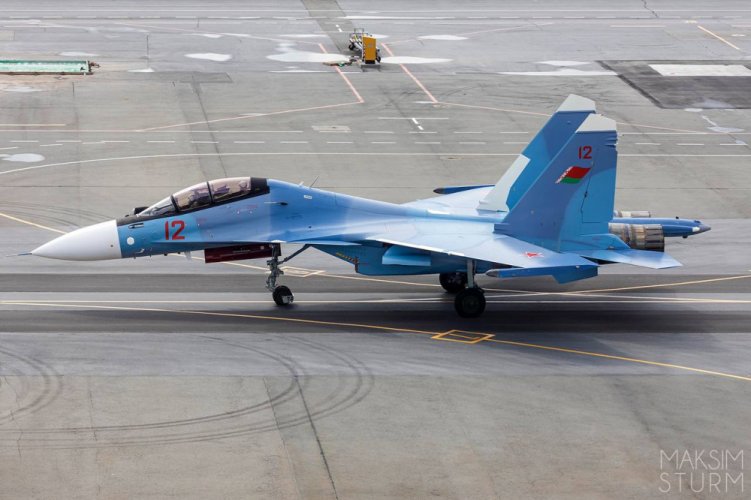
Bmpd's take on Belarus Su-30SM2 delivery, including a gorgeous pic of SM2 bort 12.
1755280249936.jpeg
 
Same source on the recent Su-34 delivery.
 
Please stop spreading this…
There is no “R-37ME”, export version is called “RVV-BD”, limited to 200 km. Wtf is “R-77ME”…?

China will not buy Su-35/Irbis/RVV-SD/RVV-BD. They have their own better stuff, both fighters(J-15/16) and missiles.

Hm, R-37ME is Izdeliye 620 and has own catapult launcher known as AKU-620E .There is no RVV-BD ( as some official military designation ) 'cause it is only the commercial name for the long range ( very long range) AAM's.

China already bought Su-35 with N035E Irbis-E and R-77-1EL,that's the fact.

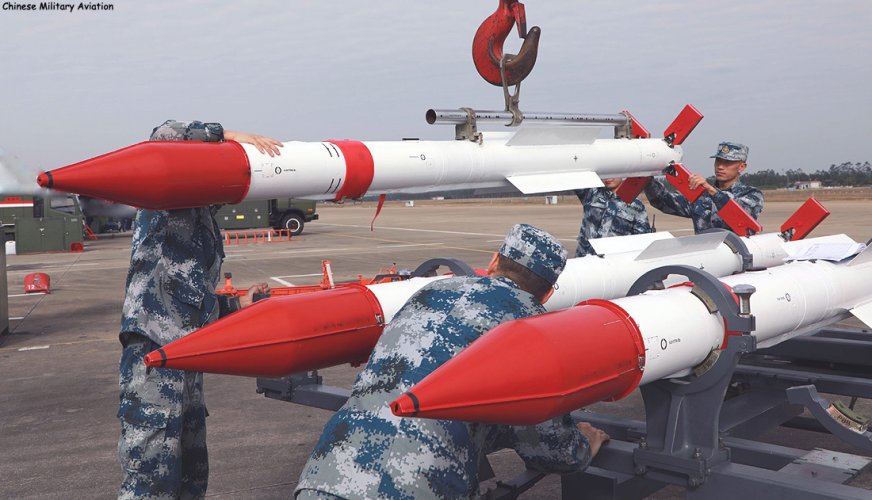
On this photo we can see export version known as R-77-1EL ( E for export ,L for Laser proximity fuse). Commercial name for the R-77-1 is RVV-SD. R-77ME should be export version of the newer R-77M.

About max launch distance,it is the same as of R-37M, so 400km for the launch parameter Dr max 1 in the supersonic -stratospheric launch scenario. Do you know what does so called launch parameter ''Dr max 1''mean at all ? Btw ,I've never heard /read that any export version of some AAM has smaller launch distances than its 'domestic version'.

PLAAF R-77-1EL.jpg
 
Last edited:
China will not buy Su-35/Irbis/RVV-SD/RVV-BD. They have their own better stuff, both fighters(J-15/16) and missiles.

While I agree that China will not buy export versions of the R-77-1 and R-37M, other part of your comment is very controversial if I may say so!

Airframe/flight performance wise Su-35S is superior to both J-15/16. It has superior take off and landing performance, acceleration, climb rate, turning performance, high AoA/nose pointing capability, service ceiling, range etc. All that combined provides tactical advantage in WVR and BVR fight.
Regarding avionics and sensors no side holds any cardinal advantage, other than a fact that Su-35S has significantly wider radar field of view which can prove to be deciding factor in certain BVR situations.

Missile wise where do you see Chinese superiority?!

There is no country on Earth that has such extensive experience in using BVR air to air missiles like Russia.

Russians have multiple access, and for example just in 2023 Su-35S pilot Alan Datiyev had 12 air to air kills!


We have seen R-77-1 shots going from 60 to 90 km (the longest AIM-120C7 kill was around 45 km, the rest was at the WVR border to around 25 km if I remember correctly), and R-37M kills at over 200 km against the ground clutter and low flying fighters jets, not against a big and slow targets.

R-77M is around 200 km range missile with AESA active homing head, and Russians are known to combine active-semi active and active-passive homing heads in addition to excellent maneuverability at the end stage of the missile flight.
R-77M version of the missile intended for the Su-57 probably differs from the version we have seen on the Su-35S, and the same is valid for the ultra long range, hypersonic izd. 810 in comparison to the R-37M.
 
Missile wise where do you see Chinese superiority?!

While I agree that Russia has some incredible and outstanding experience in BVR, the Chinese missiles have been used. The PL-15E used by PAD J-10CEs was an example. Despite the lack of data we have in PLAAF, we perfectly know they can be equal or maybe even more superior to their American and Russian counterparts.
 
It has superior take off and landing performance, acceleration, climb rate, turning performance, high AoA/nose pointing capability, service ceiling, range etc
J16 has more than enough of these.

The extra advantage, i would say minor advantage su35 will have in wvr.
Though lots of other factors will come into play too.


No significant advantage in bvr.


Will have significant advantage in dog fight, i guess.


Though those air to air kill, lot of them are shooting down drones and cruise missiles.
And ones against fighter jets, are old ukranian migs and flanker whose situational awareness are not the best.


The only worth it advantage su35's airframe will have is maintinence and availability, but j16 already has probably the highest availibility rate of all flankers.
 
While I agree that China will not buy export versions of the R-77-1 and R-37M, other part of your comment is very controversial if I may say so!
R-37M(RVV-BD) is at least under question mark, but we outright saw Su-35sk armed with RVV-SD.

No significant advantage in bvr.
Airframe ones are in fact likely significant (as much as it can even be significant within one general type).
It's just not the most important aspect for BVR overall.
 
While I agree that China will not buy export versions of the R-77-1 and R-37M, other part of your comment is very controversial if I may say so!

Airframe/flight performance wise Su-35S is superior to both J-15/16. It has superior take off and landing performance, acceleration, climb rate, turning performance, high AoA/nose pointing capability, service ceiling, range etc. All that combined provides tactical advantage in WVR and BVR fight.
Regarding avionics and sensors no side holds any cardinal advantage, other than a fact that Su-35S has significantly wider radar field of view which can prove to be deciding factor in certain BVR situations.

Missile wise where do you see Chinese superiority?!

There is no country on Earth that has such extensive experience in using BVR air to air missiles like Russia.

Russians have multiple access, and for example just in 2023 Su-35S pilot Alan Datiyev had 12 air to air kills!


We have seen R-77-1 shots going from 60 to 90 km (the longest AIM-120C7 kill was around 45 km, the rest was at the WVR border to around 25 km if I remember correctly), and R-37M kills at over 200 km against the ground clutter and low flying fighters jets, not against a big and slow targets.

R-77M is around 200 km range missile with AESA active homing head, and Russians are known to combine active-semi active and active-passive homing heads in addition to excellent maneuverability at the end stage of the missile flight.
R-77M version of the missile intended for the Su-57 probably differs from the version we have seen on the Su-35S, and the same is valid for the ultra long range, hypersonic izd. 810 in comparison to the R-37M.

PLAAF already possess R-77-1EL friend.

There is also Lt.Col. Ilya Sizov with 11 shootings down flying on Su-35S.


On July 2024 ,Su-35S shot down low flying MiG-29 with R-37M and launch distance was record-breaking 213km ( in case of engaging enemy fighters).


While I agree that Russia has some incredible and outstanding experience in BVR, the Chinese missiles have been used. The PL-15E used by PAD J-10CEs was an example. Despite the lack of data we have in PLAAF, we perfectly know they can be equal or maybe even more superior to their American and Russian counterparts.

What was the main problem with IAF fighters during Indo-Pak conflict on May 2025.
Their fighters ( of course armed) ,especially Su-30MKI had very big frontal/lateral RCS. That is first,second,although PESA N011M Bars-M has max detection/tracking range of 400 km in HPRF mode,they didn't possess any modern and useful long/very long range AAM at all. With 350kg heavy R-27ER1 ( inertial guidance with use of RC channel + SARH), they can achieve max launch distance against big incoming target of 150km, that's it. With R-77-1EL ( IAF received it several years ago) ,max launch distance is about 100km.On the other side ,PAF fighters J-10C had that very useful Chinese about 230kg heavy PL-15E with dual-pulse engine and inertial guidance +ARH.They could achieve max launch distance about 200km.As material evidence of so-called aerial victories , we could see one Rafale and one Su-30MKI wreckages.

The main disadvantage for the IAF fighters (Su-30MKI) was that they didn't have any real and useful long-range AAM like new Russian R-37ME or R-77ME (if exists).We could see that MiG-31BM ,Su-30SM2 and Su-35S were capable of shooting down UkrAF 4th gen 9G capable fighters from 100 to more than 200km away.
 
the Chinese missiles have been used. The PL-15E used by PAD J-10CEs was an example. Despite the lack of data we have in PLAAF, we perfectly know they can be equal or maybe even more superior to their American and Russian counterparts.

Eh...Russian long range AAMs were definitely used significantly more often. R-37M is used pretty much regularly since 2022 in active combat to hold suicidal pilots UAF at arms length, or neutralize them.
 
And ones against fighter jets, are old ukranian migs and flanker whose situational awareness are not the best.

Indian Rafales didn't really demonstrate better situational awareness, the aircraft are perhaps newer, but a turkey shoot remains a turkey shoot. No matter how limp or not the turkey is.
 
Indian Rafales didn't really demonstrate better situational awareness, the aircraft are perhaps newer, but a turkey shoot remains a turkey shoot. No matter how limp or not the turkey is.
Shooting down Indian rafales would be more "impressive" than shooting down old ukranian flankers and migs would be.
 
Last edited:
Eh...Russian long range AAMs were definitely used significantly more often. R-37M is used pretty much regularly since 2022 in active combat to hold suicidal pilots UAF at arms length, or neutralize them.
I mean yeah, combat usage of Russians AAMs was definitely larger compared to their Chinese counterpart, I just wanted to point out that PLAAF AAMs were used too. Little action yes, but it was still deployed in real world combat.
 
Same source on the recent Su-34 delivery.

Third serie with 2 new Su-34M,it seems like that ,so 6 new Su-34M so far. There were six series last year but some of them had 3 new Su-34M.
 
J16 has more than enough of these.

The extra advantage, i would say minor advantage su35 will have in wvr.
Though lots of other factors will come into play too.


No significant advantage in bvr.


Will have significant advantage in dog fight, i guess.

Not enough compared to the Su-35S.

J-16 has inherited "flaws" of the two seater Flanker because the Russians wanted their Su-27UB trainer to have an elevated seating position so that trainee/operator would have superior field of view, and they also wanted to keep the same amount of fuel as the single seater, which would not be possible if they have opted for the F-15E type of layout.
Obvious downside is significant increase of the planes midsection, increased weight (on average the two seater is 1,2 tones heavier), and added weight in front of the CG.
All that has significantly reduced the overall flight performance of the plane where we have around Mach 0,35 reduction of the top speed, around 600 km reduction in range, reduction of acceleration, climb rate, service ceiling, turn performance etc. and I'm pretty sure that increase of the midsection wasn't that "kind" towards the RCS of the plane.

Add to that the fact that Su-35S has more powerful engines with TVC and the J-16 will lose in a dog fight every single time under the condition that both planes are flown with the equally capable pilots.
The same thing happens when you pit the Su-30SM against the Su-35S. Su-30SM is losing badly even if it has TVC engines.

Just to put it into perspective, here is the video of the Su-35S and Su-30SM taking off one after another (here the videos are merged) where we can see Su-35S not using the AB, while Su-30SM's are using AB.

View: https://www.youtube.com/watch?v=FmrJQEtjO34


Now, all that disadvantages are also hampering the J-16 in BVR engagement where the acceleration, speed, height, supersonic persistence and maneuvering are having significant impact on the missile kinematic and on capability to engage and disengage.
Su-35S can accelerate faster up to the supersonic speed, it can also fly higher and can stay significantly longer in supersonic area because not only does it have superior lift to drag ratio, where you don't need as much engine RPM for the same speed (you also spend less fuel), but the Su-35S can carry about 2,1 tons of fuel more!
Su-35S also has significantly superior supersonic maneuverability because it can use the TVC for the trim drag reduction (according to the Sergey Bogdan, the test pilot), and when you add the fact that the Su-35S radar has two times wider field of view, it is easy to understand how it can provide the missile midcourse guidance, while at the same time going away from the incoming missile (we have seen that from the HUD videos from the SMO engagements), and on the contrary, the J-16 needs to fly towards the incoming missile if it wants to provide the missile with the target update.
It is clear that the Su-35S has more potential for the BVR "cat and mouse" game, and among other things that is the main reason F-22 is capable of dominating the F-35 in BVR fight (according to the F-22 pilots), simply by superior kinematics!

Though those air to air kill, lot of them are shooting down drones and cruise missiles.
And ones against fighter jets, are old ukranian migs and flanker whose situational awareness are not the best.

You obviously haven't read the article I have posted?
Out of 12 air to air kills Alan Datiyev scored 11 kills of manned aircraft (9 jets and two helicopters) and just one Bayraktar drone kill.
Now, you are hugely oversimplifying Russian accomplishments since the Ukraine pilots are tactically well versed and on international exercises they were able to score kills against the US F-15C in both BVR and WVR, and they are flying under the cover of some of the best SAM systems and ground jamming systems, both of Soviet and Western origin. Add to that the fact that the West is providing the ISR (Intelligence, Surveillance, and Reconnaissance) 24/7, and you can see that the Russians are facing the opponent US/NATO never did, and China basically doesn't have any experience of the sort!
Almost all 200+ km kills are done under very difficult conditions where the targeting planes were trying to disengage or escape flying extremely low, which means that the jet/missile radars had to work against the ground clutter and hit the small, fighter sized targets, and at the same time the Russian plane was in a danger of being shot by the SAM's.
Up to date, no one has achieved such a long range kills in high intensity conflict!
Ukraines have the F-16 with the AIM-120, but they make absolutely no difference, and they know it. Russians planes are far superior in BVR realm for such types of jets.

 
PLAAF already possess R-77-1EL friend.

There is also Lt.Col. Ilya Sizov with 11 shootings down flying on Su-35S.


On July 2024 ,Su-35S shot down low flying MiG-29 with R-37M and launch distance was record-breaking 213km ( in case of engaging enemy fighters).

Correct!

What was the main problem with IAF fighters during Indo-Pak conflict on May 2025.
Their fighters ( of course armed) ,especially Su-30MKI had very big frontal/lateral RCS. That is first,second,although PESA N011M Bars-M has max detection/tracking range of 400 km in HPRF mode,they didn't possess any modern and useful long/very long range AAM at all. With 350kg heavy R-27ER1 ( inertial guidance with use of RC channel + SARH), they can achieve max launch distance against big incoming target of 150km, that's it. With R-77-1EL ( IAF received it several years ago) ,max launch distance is about 100km.On the other side ,PAF fighters J-10C had that very useful Chinese about 230kg heavy PL-15E with dual-pulse engine and inertial guidance +ARH.They could achieve max launch distance about 200km.As material evidence of so-called aerial victories , we could see one Rafale and one Su-30MKI wreckages.

The main disadvantage for the IAF fighters (Su-30MKI) was that they didn't have any real and useful long-range AAM like new Russian R-37ME or R-77ME (if exists).We could see that MiG-31BM ,Su-30SM2 and Su-35S were capable of shooting down UkrAF 4th gen 9G capable fighters from 100 to more than 200km away.

As far as I know, further investigation of the alleged Su-30MKI wreckage has shown that it was in fact the indian Mig-29 that was shot down, not the Su-30MKI
 
Last edited:
While I agree that Russia has some incredible and outstanding experience in BVR, the Chinese missiles have been used. The PL-15E used by PAD J-10CEs was an example. Despite the lack of data we have in PLAAF, we perfectly know they can be equal or maybe even more superior to their American and Russian counterparts.

I'm pretty sure that the PL-15 has advantages compared to the AIM-120D, or R-77-1 because it is slightly bigger missile with dual pulsed solid fuel rocket motor and active AESA seeker, so it should have more range and better target tracking properties due to the electronic radar scanning, resistance to jamming etc. I doubt that it will have the maneuverability of the R-77-1, but that it about it for the Russian missile.
R-77M on the other hand is also the bigger missile with similar propulsion and active AESA seeker with claimed range of about 200 km.
So my question is, how exactly the PL-15 is superior missile as others have claimed?
As far as I can tell, R-77M should also be more maneuverable missile since it has bigger lifting and control surfaces, and it should have better end game when the speed drops down at longer ranges.

Advantage I see with the R-37M or Izd. 810 compared to the PL-17 is the fact that such a missile can fit in the internal weapons bay of the Su-57, or potentially Su-75 if it becomes operational. PL-17 can't fit inside the J-20.
Second, the diameter of the R-37M or Izd. 810 is bigger which means that it can always store bigger homing head and it is clear what types of advantages that brings to the table.
So, if the two missiles have similar range, the missile with bigger and more powerful homing head will have advantage, especially if it is fired from the stealth plane.

I also don't know if the PL-17 is actually operational and if it is hypersonic missile like the R-37M?
In any case the R-37M is the only operational ultra long range missile that is combat tested with excellent results against the fighter sized targets flying against the ground clutter.

It would be interesting to see how the PL-17 would fare against similar targets, giving that it doesn't have any lifting surfaces, just the stabs at the rear end?
 
I'm pretty sure that the PL-15 has advantages compared to the AIM-120D, or R-77-1 because it is slightly bigger missile with dual pulsed solid fuel rocket motor and active AESA seeker, so it should have more range and better target tracking properties due to the electronic radar scanning, resistance to jamming etc. I doubt that it will have the maneuverability of the R-77-1, but that it about it for the Russian missile.
R-77M on the other hand is also the bigger missile with similar propulsion and active AESA seeker with claimed range of about 200 km.
So my question is, how exactly the PL-15 is superior missile as others have claimed?
As far as I can tell, R-77M should also be more maneuverable missile since it has bigger lifting and control surfaces, and it should have better end game when the speed drops down at longer ranges.

Advantage I see with the R-37M or Izd. 810 compared to the PL-17 is the fact that such a missile can fit in the internal weapons bay of the Su-57, or potentially Su-75 if it becomes operational. PL-17 can't fit inside the J-20.
Second, the diameter of the R-37M or Izd. 810 is bigger which means that it can always store bigger homing head and it is clear what types of advantages that brings to the table.
So, if the two missiles have similar range, the missile with bigger and more powerful homing head will have advantage, especially if it is fired from the stealth plane.

I also don't know if the PL-17 is actually operational and if it is hypersonic missile like the R-37M?
In any case the R-37M is the only operational ultra long range missile that is combat tested with excellent results against the fighter sized targets flying against the ground clutter.

It would be interesting to see how the PL-17 would fare against similar targets, giving that it doesn't have any lifting surfaces, just the stabs at the rear end?
R-77M is barely in service and the Chinese already have PL-15's sucessor in service of some capacity. PL-17 has been spotted multiple times and has been confirmed to be in service. I also doubt Russian seeker heads being as advanced as Chinese ones, the recovered seeker head for PL-15 had 192 TRMs and it isn't even considered to be advanced anymore since they are exporting it and the missile being 10 years old by now.
 
R-77M is barely in service and the Chinese already have PL-15's sucessor in service of some capacity. PL-17 has been spotted multiple times and has been confirmed to be in service. I also doubt Russian seeker heads being as advanced as Chinese ones, the recovered seeker head for PL-15 had 192 TRMs and it isn't even considered to be advanced anymore since they are exporting it and the missile being 10 years old by now.

As far as I know serial production of the R-77M started in 2019 with the contract signed by the Ministry of Defense during the Army-2019 forum.
What PL-15 successor, you have the performance data on that missile and precise performance data for the R-77M so you can claim the superiority of the PL-15 successor?
PL-17 was spotted multiple times, nice!
So you can claim that the PL-15 is superior missile just based on the number of the TRM's?
Interesting!
 
R-77M is barely in service

It's appearance on a second rate fighter of the VKS without much fanfare would imply that it's already in use for quite a while on first rate aircraft (Su-57S).

Assuming it's "barely in service" is quite a stretch, when the nature of it's appearance would suggest the opposite. As it implies that they have enough of these laying around to throw them on Su-35S on deployment.
 
There is so many new Russian inertial-radar guided AAM's and we know very little about them. From Izd. 171-1 via 180, 270 and there is that 810. About new active (active -passive) AESA radar seekers ,there is one with more than 200 TRM's,so called MAFAR.

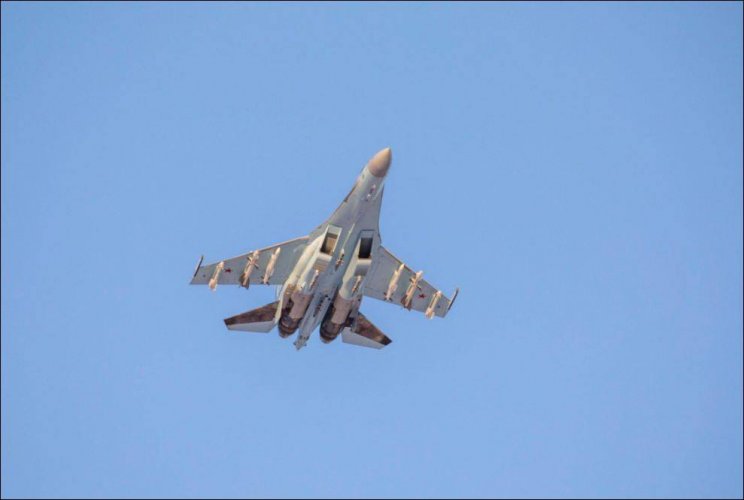
Su-35S with R-77-1,R-27T and R-74 over Syria.

Su-35S in SAR.jpg
 
As far as I know serial production of the R-77M started in 2019 with the contract signed by the Ministry of Defense during the Army-2019 forum.
What PL-15 successor, you have the performance data on that missile and precise performance data for the R-77M so you can claim the superiority of the PL-15 successor?
PL-17 was spotted multiple times, nice!
So you can claim that the PL-15 is superior missile just based on the number of the TRM's?
Interesting!
Go check out the Chinese AAM page, and yes how good the seeker head of the missile is a very important aspect of a missile. Sure good on you that R-77M was ordered in 2019. R-77M also from specs seems to be at best a comparable missile to the PL-15.
 
Go check out the Chinese AAM page, and yes how good the seeker head of the missile is a very important aspect of a missile. Sure good on you that R-77M was ordered in 2019. R-77M also from specs seems to be at best a comparable missile to the PL-15.

When we talk about R-37M and R-77-1 on the Su-35S ,both have inertial + ARH/SARH in the terminal phase where is very hard to jamm both mode in the same time.About new R-77M,open sources tell us that there is monopulse pelengator with AESA active/passive radar seeker.


'PeregrineFalcon' posted this Su-35S video in the merged one :

''Just to put it into perspective, here is the video of the Su-35S and Su-30SM taking off one after another (here the videos are merged) where we can see Su-35S not using the AB, while Su-30SM's are using AB.''

Sukhoi Su-35 "Flanker" supermaneuverable aircraft takeoff and aerobatics.​


View: https://www.youtube.com/watch?v=mHMxh0_mTec


Is there full video which can be find ?
 

Similar threads

Back
Top Bottom