Wondering if anyone knows or could find the name of the Director of Truss Structures for McDonnell Douglas in the final days of Freedom's design.
I can't remember or find it. I'm writing a memoir about my non-linear design to replace the platform's equilateral triangle truss structures that we were R&D'ing before congress pulled the plug!
Have you checked to see if there is an alumni group for people who worked on their space systems? If it exists, you can ask there. Explain up front why you are looking.
Now, would this feel some of the same forces a falling chimney encounters? https://probingphysics.com/the-falling-chimney-paradox/
I would think a torus might also be better able to generate a mini-magnetosphere---and house--perhaps--a tokamak due to how it is built.
Space Station Freedom
Space Station Freedom was a NASA-led multi-national project proposed in the 1980s to construct a permanently crewed space station in low Earth orbit. Despite initial approval by President Ronald Reagan and a public announcement in the 1984 State of the Union Address, the ambitious project faced significant budget cuts and delays. Ultimately, a scaled-down version of Freedom evolved into the US Orbital Segment (USOS) of the International Space Station (ISS). [...]
I remember some art from a TA Heppenheimer book where a box kite spacecraft was a solar electric tug---with the claim (if memory serves) that it could slowly spiral out a 100 ton payload.
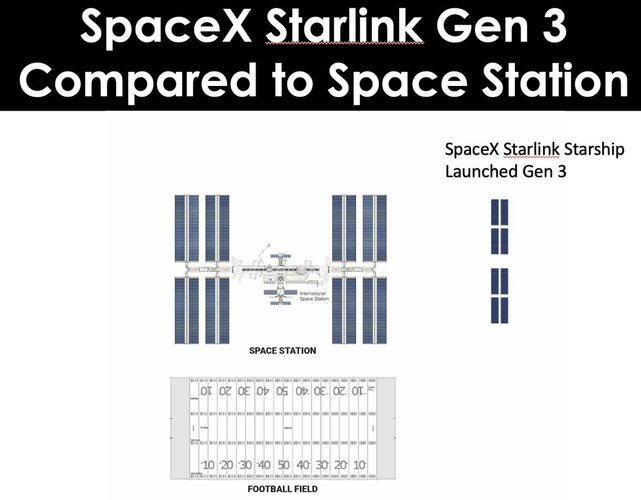
I figure Starship could put trusselators up to add to the ISS truss, rather like what Dennis Wingo proposed.
That might allow reduced Starship refueling---unmanned Starship spirals out with a faster capsule meeting up with it.
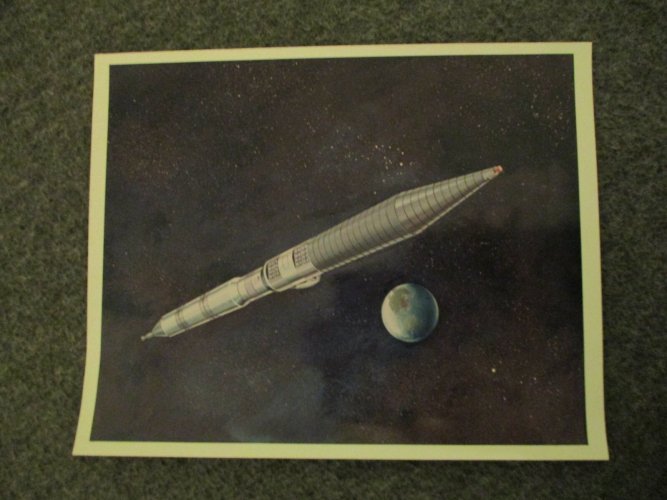
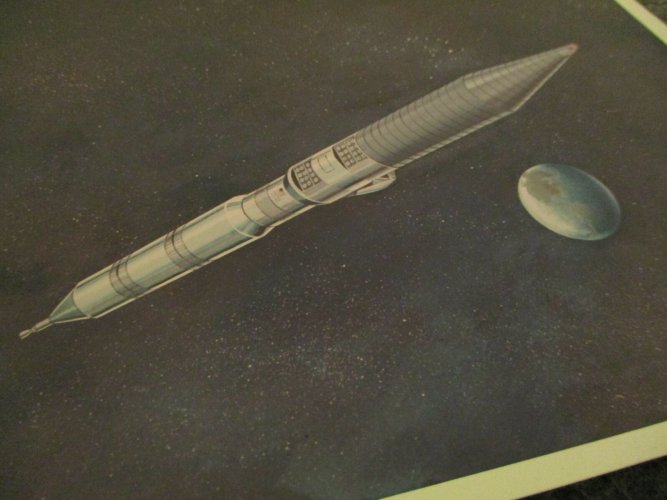
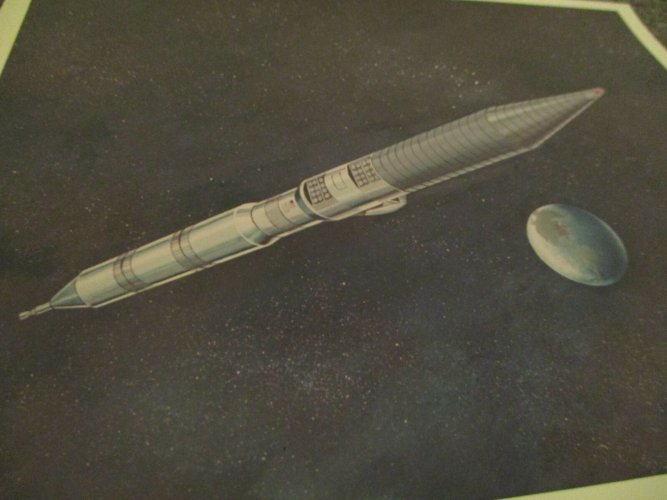
I found a 1969 concept of this space station. This is 'Manned Earth Orbital Space Station'
1970 NASA authorization. Hearings before the subcommittee on manned space flight of the committee on science and astronautics U.S. House of representatives. Ninety-first congress. First session. On H.R. 4046, H.R. 10251 (Superseded by H.R. 11271). February 28, March 6, 7, 8, 11, 12, 14, and 25, 1969. [No. 3] Part 2. – Washington: U.S. Government printing office, 1969.
Last year I indicated that we were going through the necessary in-housepreliminaries to utilize the requested FY 1969 funds on definition of a Saturn-V Workshop in the Apollo Applications Program and on a Space Station to follow the Apollo Applications Program. Within the funding levels that finally emerged for Fiscal Year 1969, it was apparent that the pace of our program was being slowed to the point that maintenance of this sequence would be inefficient and only marginally effective in advancing space flight technology and the national interest. If pre-eminence in space is to be a continuing national goal, if space technology is to be the cutting edge of progress, if space is to continue as the frontier-we must step out with programs that demand advancement along a broad front. That means increased capability, greater program flexibility, increased responsiveness; and the realities of today make it clear that operating costs must be substantially lowered. We, therefore, believe that the next step in earth- orbiting manned space flight must be a new, semi-permanent space station which includes, as part of the system, a new low cost transportation capability. A discussion of the role and objectives of this space station system is presented in my next section. Accordingly, we intend to bypass the intermediary steps of more advanced Apollo Applications Program workshops, intermediate launch vehicles and logistics craft, in favor of going directly to the design of a space station and a logistic system for lowering transportation costs by an order of magnitude or more. We believe such a space station system should be in being in the mid-1970's. Beginning with FY 1970, we are identifying the space station as a line item in the budget.
I should like to turn next to a discussion of the role and objectives of the space station. I will then follow with a description of the space station program and system as we now see them. Since the antecedents of the space station and its related transportation system lie in the Advanced Manned Missions studies, I will defer discussing the study background of the station system until I take up the subject of these studies a little later.
ROLE OF THE SPACE STATION
The Space Station Program will introduce a new, more mature and routine mode of space operations. Man will live and work in space for long periods of time. A large scale of operations will develop, perhaps with a single large orbital facility or perhaps with several smaller facilities in the orbits required to meet specific uses. Men will be ferried between these stations and ground in reusable land landing spacecraft. The station will be used by multiple agencies of the government or industry to satisfy a broad spectrum of space uses. The orbital stations will become more autonomous, both in terms of command and control and in terms of life support commodities. All of these factors will lead to lower cost of space operations and a resultant increase in use of this major resource. The precise nature of the mature program is dependent upon the uses which evolve from the pilot phases of the Space Station operation. Hence. two sets of requirements exists. The first firm set of requirements are determined by uses we are now defining for the initial phases of the Space Station Program. The second, more tenuous set of requirements will become definitive as the pilot program of space station activities is conducted.
Objectives
First, one may ask "What is a space station?" Perhaps the simplest answer would be "A space station is a central point for many activities in space, and located in the most advantageous position in space."
The objectives of the space station program are:
(1) To conduct beneficial space applications programs, scientific investigations, and technological and engineering experiments.
(2) To demonstrate the practicality of establishing, operating, and maintaining long duration manned orbital stations.
(3) To utilize earth orbital manned flights for test and development of equipment and operational techniques applicable to lunar and planetary exploration.
(4) To extend technology and develop space systems and subsystems required to increase useful life by at least several orders of magnitude.
(5) To develop new operational techniques and equipment which can demonstrate substantial reductions in unit operating costs.
(6) To extend the present knowledge of the long term biomedical and behavioral characteristics of man in space.
DEVELOPMENT PLAN
Since the space station is the first manned spaceflight project to move through the Agency's Phased Project Planning System, allow me to digress briefly to familiarize you with this procedure while using the space station as an illustration.
It is NASA policy to undertake the implementation of major research and development projects only on the basis of plans and analyses that clearly define the work to be done. its programmatic, managerial, resources and schedule implications, and an assurance that the required technology can be made available. Phased Project Planning is a phased approach to the planning and conduct of such activity. NASA identifies four phases as follows: Phase A-Preliminary Analysis, Phase B-Definition, Phase C-Design, and Phase D-Development/Operations. The work content of each of the first three phases is directed toward developing information needed to support the major decision to go into the next phase. Initiation of a phase, or its completion, does not, however, imply commitment to the next phase. I should emphasize that Phased Project Planning progresses on a total project basis (technical, resources, timing, contracting, management consideration, etc.).
Phase A is primarily an in-house effort which involves the analysis of alternate overall project approaches or concepts for accomplishing a proposed agency technical objective or mission. In this phase the more promising space station concepts which have been examined in the Advanced Manned Missions study effort were identified and analyzed. Those project approaches were selected which are worthy of further refinement. In addition, an across-the-board assessment of ourstatus in all pertinent areas has been documented. This Phase A process culminated in a decision by the Administrator to initiate Phase B.
The Definition Phase of the Space Station Program was initiated in FY 1969 with series of Phase B Program Definition and Supporting Studies performed under contract with industry. An experiment/payload program has been formulated by NASA to be used in the contractural studies as a basis for design of the station and supporting systems. In parallel with these studies, a contracted experiment definition effort and a supporting development effort will be conducted to provide the advanced systems required to assure smooth transition into the design and development phases of the program. The major purpose of the Phase B effort will be anin-depth evaluation of the preferred concepts for the Space Station Program including the logistic system, facilities, and the development of technical and management data from which NASA can make a selection of a recommended single program concept. Substantial utilization of NASA in-house test, checkout and launch facilities and contractor fabrication facilities will be requred for the Space Station Program. The impact of the program on these facilities and the interrelationship of this program with other NASA flight programs will also be a part of Phase B.
The Phase C Design effort, which will be initiated in FY 1970, will define in-depth the programmatic elements selected in Phase B for the conduct of the update dexperiment/payload program, and will provide preliminary designs for those program elements requiring significant hardware development in Phase D. The Phase C effort will generate realistic costs and schedules for the selected systems and will provide management with the basis for a decision to proceed into the Phase D Development. Specifically, the Phase C effort will provide competitive preliminary designs for the Space Station, its subsystems and any separable modules, the logistic system including the logistic spacecraft and launch vehicles, and any special safety or escape devices needed. The Phase C effort will also examine in-depth the ground-based facilities and operations required to support the Space Station. The program elements will be separated into manageable packages for development by industrial concerns. It is anticipated that competitive contracts will be let for most program elements and parallel designcompetitions will be considered for critical program elements such as the station itself, the logistic spacecraft, etc. The experiment/payload program developed in Phase B will be updated prior to commencement of Phase C, incorporating the results of the planning effort performed during Phase B in parallel with the Phase B contracted studies.
The primary Phase C design effort will be supported by a continuing experiment definition program and by development of experiments which are in the updated experiment/payload program. Advanced development effort will be continued on critical subsystems identified in Phase B.
At the end of the Phase C contracts, the contractor will submit a report of pertinent results and a proposal for implementing Phase D. Following management approval of Phase C results and selection of preferred designs for any program elements designed competitively, the Phase C contractor efforts will be extended into Phase D. Phase D will complete the design and engineering of all program elements and will include fabrication, development, testing and mission operations.
SPACE STATION DESCRIPTION
The Space Station envisaged in this program is a significantly more advanced concept than the Saturn I Workshop in the Apollo Applications Program. The goal is the establishment of a multi-purpose, general usage station, suitable for achieving operational goals in a variety of disciplines. Even though we are now only entering the Definition phase, the general features of the system can be discerned and I should like to turn next to a description of the system. It should be understood, however, that our position on these matters is not so inflexible that we could not change should subsequent study results or operational and technological experience indicate that to be either necessary or highly desirable.
Configurations
Demands for adaptability and multiple usage will be met in large measure by modular design techniques, both with respect to the basic configuration and payload packages. MT69-4101 shows one such concept which includes a new, advanced logistics vehicle about which more will be said later. MT69-4100 illustrates a possible interior arrangement for this station
Modular Arrangement
The initial plan is to develop a set of modules to make up the space station andits payload packages. The initial space station of the mid-1970 period might consist ofan assembly of a few of these basic modules.
Types of Modules
Thetypes ofmoduleswhich are now under consideration include:
1. Crew Quarters One or more modules which would provide for crew sleeping, cleanliness, personal hygiene and human waste disposal.
2.WardRoom-Amodule which includes facilities for crew dining and food preparationplus facilities for crew off-duty activities.
3. Systems-A module which would house the power distribution, environmentalcontrol and life support systems for the crew.
4. Docking and Cargo Handling-A module which would permit docking of the resupply vehicle; crew interchange; unloading of food, materials, supplies, and expendables; and loading of equipment, materials, film and other data for earth return.
5. Laboratory Modules - One or more modules with a set of equipment in stalled on the ground for conducting specific laboratory experiments in such fields as astronomy, space physics, manufacturing or other scientific and engineering disciplines.
6. Maintenance - A module consisting of machine shops and other facilities for the calibration, adjustment, and updating of equipment.
7. Storage - A module which consists of a warehouse for food, spare parts, and expendables.
Growth Potential
Through careful selection, design and arrangement of the various types of modules, the initial space station could be augmented if requirements exist. In this manner, we would have flexibility for crew size, additional laboratory facilities, or other special purpose equipment as new engineering, scientific and Operational needs arise.
The space station system could provide, for example, a utilization of either zero "g" or artificial "g" modes dependent on the nature of the actual environment desired.
The space complex will thus be a functionally flexible assembly of modules, capable of expansion or modification to meet changing requirements in a manner similar to the modifications of ground research facilities.
The space station is planned for 10 years of continuous operation. This will be achieved by fundamentally high reliability subsystems designs plus provisions for maintenance and repair, refurbishment and replacement and expendables replenishment. The use of wider design margins in the design of space station equipment will also be a means of reducing costly test programs to assure reliability and safety. Crew productivity over this period of time will be assured by rotation at three to six-month intervals and by bringing up new experiment packages and modules as they become available and can be accommodated by the station workload. Productivity will be further enhanced by the use of a comprehensive onboard data system for checkout, experiments system monitoring, communications, and other functions thereby freeing the crew as far as possible to capitalize on the human capabilities for research and experimentation.
Present design concepts
At present we plan to study a station initially sized for a crew of 12 with an internal payload support volume of at least 10,000 cubic feet. For this size station, total electrical power will vary up to 30 kilowatts and perhaps more to accommodate peak loads. Power can be supplied by solar panel arrays but incorporation of a nuclear electrical power supply will be desirable for some applications. Growth in volume and crew size accommodation will be accomplished by use of modular techniques, the same as for accommodating changing mission requirements
The long lifetime requirement assures that technology in all the foregoing areas, and others such as environmental control, is pushed forcefully but not at the cost of unacceptable technological and investment risk.
A relatively high accuracy attitude stabilization system will be incorporated for both earth centered and celestial inertial orientations according to the nature of the experiment program requirements. Systems of horizon scanners, star trackers, and rate gyros can provide an adequate sensing capability. Control moment gyros and conventional thrusters can furnish activation forces adequate for most station and experiment requirements. Experiment stability requirements beyond the basic station capability will be provided by the particular experiment package.
The nominal design orbit of the station will be inclined 50° to 55° to the equator at an altitude of 200 to 300 nautical miles. This altitude represents a compromise between the requirement of earth viewing experiments for low altitudes and the penalties associated with atmospheric drag. The Space Station system design will be compatible with polar orbits and would be adaptable in some form to 24 hour synchronous orbit.
Harold Carr. Next stop: Mars // Boeing Magazine. - Sept. 1964, pp. 3-5.
Boeing study looks ahead to
NEXT STOP: MARS
By HAROLD CARR
THE magnitude, complexity and problems of manned interplanetary flight are formidable, but a small group of advanced space planners at Boeing believe the chances of man reaching Mars will be as certain as tomorrow morning's daylight or this month's full moon.
Such space missions have been under study for two years in the advanced concepts group of Boeing's advanced space systems organization. Personnel in the group say emphatically: "We should be able to lick all the technical problems of a manned interplanetary trip by the late 1970s. We think it's a safe bet we can put a man on Mars in the 1980s."
Manned interplanetary trips are the ultimate in present-day thinking. Boeing's advanced concepts group also is studying a variety of advanced orbital operations. The ideas developed in these areas also should apply to future manned and unmanned planetary missions.
The concept of an orbital way station from which men could assemble and service space vehicles headed for the moon or the planets is one idea being examined.
A NASA Saturn 5 rocket (Boeing is helping to build it) is looked upon as the type of booster which could lift the way station into orbit around the earth. Orbiting stations of various sizes are under consideration. A station small enough to be sent up with one booster shot is a possibility.
A larger way station could be sent up in sections to meet and be joined while in orbit. Once it is assembled and circling the earth in a regular pattern, the way station would serve as a residence for personnel and as an assembly and launching facility for vehicles going on into space.
A Mars vehicle (fuel tanks, crew cabin, engine, Mars landing craft and other items ) could be boosted to the way station in sections, using a number of Saturn 5 rockets. The Mars vehicle would be assembled, fueled and checked out for launching Astronauts would go aboard. Then the vehicle would be edged away from the way station and its engine started.
Way station personnel probably would be transported to and from earth by a hypersonic- speed reentry spacecraft. Boeing and NASA designs for such vehicles were discussed in the June, 1964, Boeing Magazine.
Steve Ragar, program manager on the orbital way station study, says: "We believe the way station concept is significant because it would make possible the assembly and firing of very large spacecraft beyond the influence of most of the earth's gravity. Far less energy would be needed to send such a vehicle on a space trip from the way station than from earth. "
THE ADVANCED concepts group was awarded a 10-month study contract by NASA to investigate the orbital launch facility idea. Last month, the group was awarded a nine-month, $ 100,000 contract from NASA for the study of manned interplanetary support mission requirements.
Space flight studies under way at Boeing are based on three types of missions: fly-bys to Mars and Venus, or possibly to both during one flight; flights ending in orbits around Mars or Venus, and manned landings on Mars.
A crew of from three to eight is being studied for these flights, with the exact number dependent on the type of mission. More information on equipment necessary to support man on extended space trips is needed before crew size can be accurately predicted.
Some of the questions to be answered are: What effect will prolonged trips under low gravity conditions have on man? What control of space radiation hazards will be needed ? How will astronauts respond physically and psychologically to the long-term, cramped conditions in a spacecraft?
It is estimated that a complete manned interplanetary spacecraft, which would be much larger than any now in existence, could weigh from 500,000 pounds to more than six million pounds, depending on mission and propulsion system.
A major problem is the development of an adequate powerplant for the Mars vehicle. Boeing is examining various types of propulsion systems, including chemical, nuclear, and nuclear- electric rockets.
Why go to Mars first? Because scientists believe there is some life there. Seasonal color variations indicate the possibility of a low form of plant life on Mars; polar masses, thought by some to be ice, are clearly visible.
The possibility of life on Mars in some form we know lends romanticism to the first manned deepspace project. The minimum distance to Mars is 35 million miles; the maximum is 250 million miles. Astronauts can look forward to a round-trip ride of from 300 to 1,000 days, again depending on the type of mission and the spacecraft's flight path. The time spent at the planet will vary from a brief fly-by mission to perhaps a year-long exploration.
Scientists believe there is very little oxygen on Mars in comparison to earth, so it appears that the first human Mars explorers will have to carry their own atmosphere with them. Also, there is a fluctuation of surface temperature from 200 degrees below zero to approximately 85 degrees F, according to the best information now available.
In order to keep the crew size realistic, each astronaut will probably have to be a jack-of-all-trades.
ALTHOUGH they will be rocketing through space at thousands of miles an hour for long periods of time, crew members will be kept busy conducting various space experiments, maintaining the spacecraft, making minor trajectory adjustments, and continually checking the spacecraft equipment which keeps them alive.
One idea about rendezvous and landing on Mars is that approximately 40 million miles from earth the spacecraft will go into orbit around the planet. The astronauts would transfer into their landing craft, which then would be detached from the spacecraft. Retro rockets could be used to land, and later to launch the craft from Mars. The spacecraft would make the return trip to the orbiting way station.
The first step in obtaining information about Mars is scheduled for November, 1964, when a Mariner spacecraft should be launched for an unmanned picture-taking fly-by mission. More sophisticated Mariner fly- bys are planned for 1966 and early 1969. The fact that Mars orbits closest to earth approximately every two years determines the most favorable times for launching space probes.
The Voyager, a possible followon project of Mariner, may make interplanetary probes to Mars in the next decade. Voyager would land on Mars with instruments designed to detect biological life form.
Before man first steps on Mars, deep -space probes to Jupiter, largest of the planets and 390 million miles from earth, probably will be under way.
It is in this context that Boeing's planners are studying manned interplanetary flight. The challenges of developing technology to make these flights possible are great, but not insurmountable.
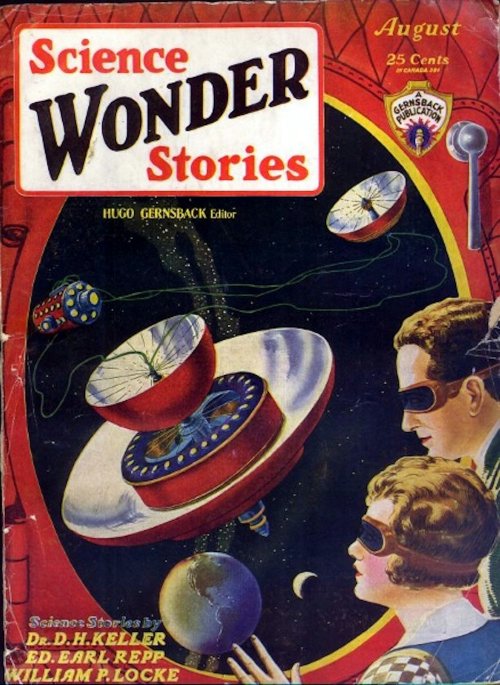
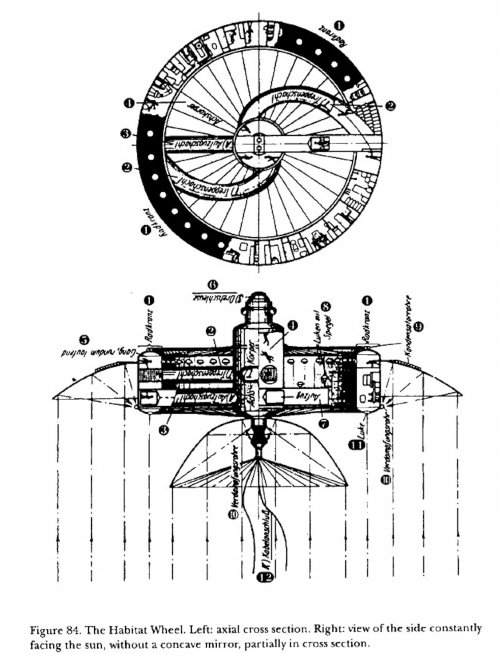
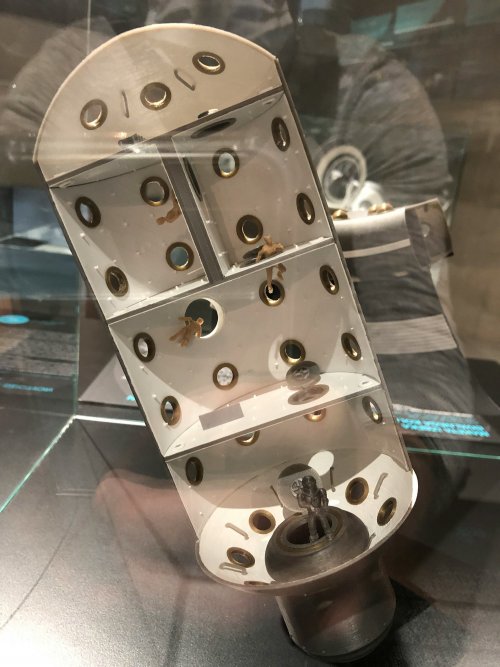
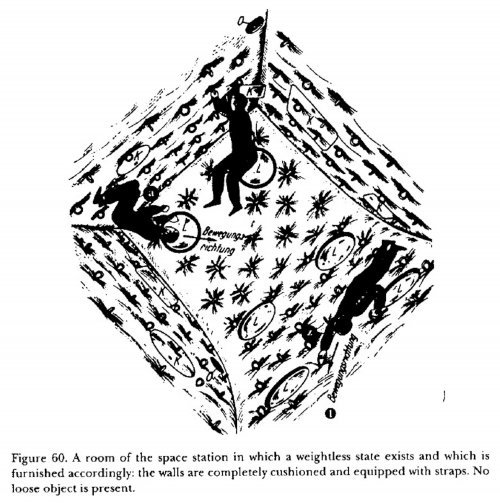
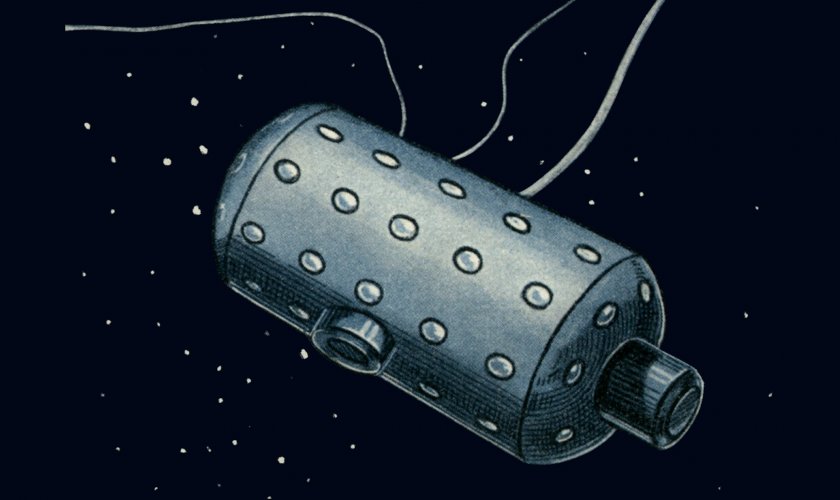
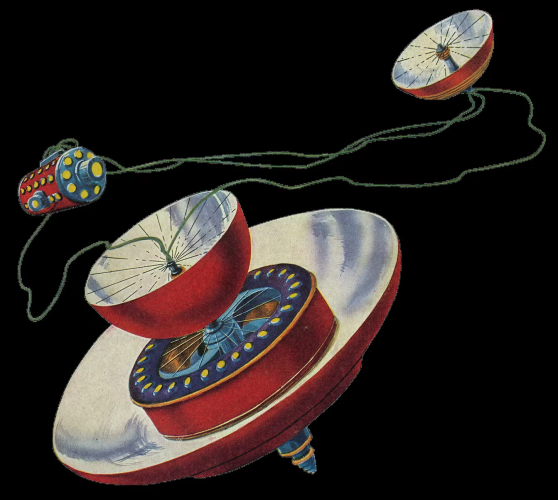
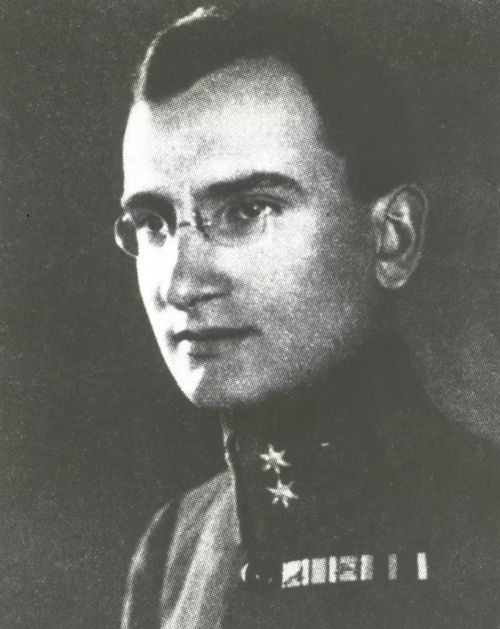
A bit of history. In 1929 Hermann Potocnik published the first detailed description of a space station that creates artificial gravity by rotation. Recently it's been given a technical analysis making use of what we've learned since.
Look at some recent articles in The Space Review about MTSS, which stood for Manned Test Space Station or Military Test Space Station (the contractors were pitching their studies to both NASA and Air Force, and there was about 95% overlap at that time).
https://www.thespacereview.com/article/5176/1
The quick version is that even while working on Mercury in the very early 1960s, contractors were looking at how to extend a space mission. That involved using Mercury and a pressurized compartment behind it that an astronaut would crawl into. These were some of the first contractor studies of space stations (there had been other studies of space stations in the 1950s, but not applying actual flight knowledge).
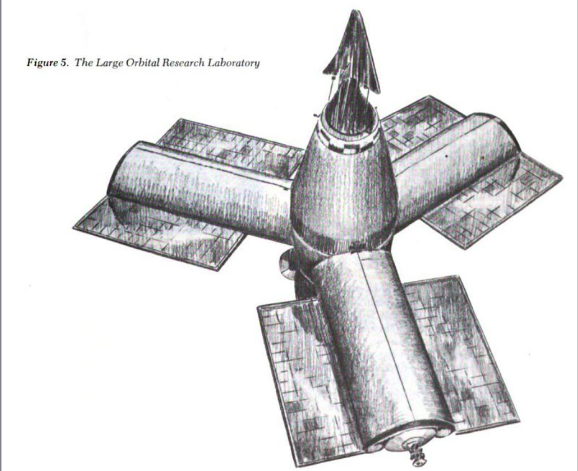
Those MTSS concepts were soon overtaken by Gemini, and then by MOL and MORL by the mid-1960s. The spacecraft were getting bigger, and the space station concepts got bigger with them, eventually leading to Skylab.
If you are interested in the MTSS and early space station concepts, keep watching The Space Review. Hans has managed to find a lot of interesting documents on the 1958-1963 era and continues digging for them. He's actually plugging holes that I did not know existed.
This site uses cookies to help personalise content, tailor your experience and to keep you logged in if you register.
By continuing to use this site, you are consenting to our use of cookies.