Russian "I" & "DI" Aircraft Series

For DI series
Several omissions there:
  1. The DI-3 and DI-4 designations were reallocated to Polikarpov but they had been used first for other aircraft:
    • DI-3 (1) = Tupolev ANT-15 two-seat fighter (1930, project only)
    • DI-3 (2) = Polikarpov-Grigorovich TsKB N° 9 (1930, 1 built)
    • DI-4 (1) = Laville (Richard) project
    • DI-4 (2) = Polikarpov two-seat monoplane fighter (1933)
      You mention the latter as being designed by Laville, but isn't it just a confusion of the two allocations?
  2. The DI-5 (or TsKB N° 2) was probably a Kocherigyn project (other sources cite Yatsenko, possibly a joint design).
  3. You forgot to mention the fact that DI-6 (TsKB-11 and -41) was a Kocherigyn-Yatsenko model.
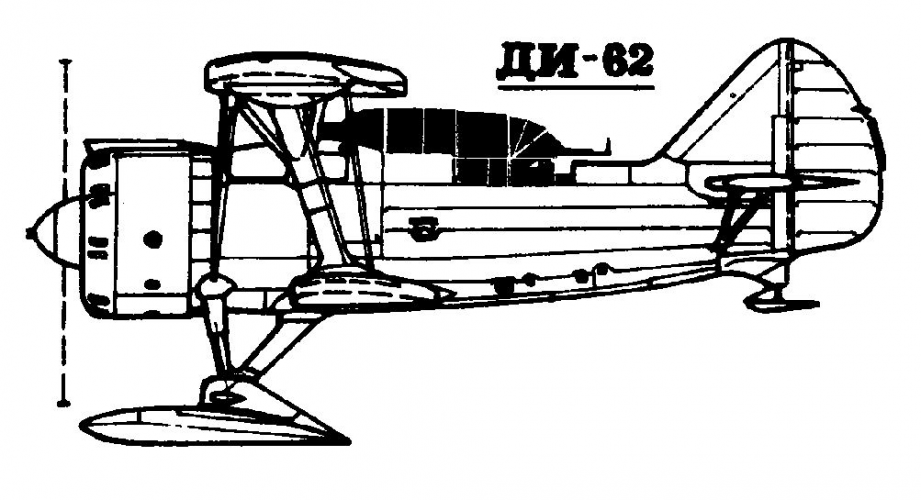
    Also, you missed out the DI-62 variant.
  4. The DI-7 was also a Kocherigyn design (despite being based on a Polikarpov).
For reference, Le Fana de l'Aviation N° 12 covered all DI- types.

Finally, I find the choice of covering only the DI- series in this topic very arbitrary.
Either cover all official fighter designations together, or separate I- from all the rest!

The other fighter designators were:
  • DIP (two-seat cannon fighter)
    Only one aircraft, the DIP (or DIP.1), which was the Tupolev ANT-45.
  • DIS & IDS (long-range escort fighter)
    Only one aircraft of each, the Myasishchev DIS (also known as VM-14 or DIS-2 VK-107A) and the Grushin IDS (or GP-1).
  • TIS (heavy escort fighter)
    Only one aircraft, the Polikarpov TIS.
  • UTI (fighter trainer)
    The UTI series ran from UTI-1 to UTI-6:
    • UTI-1 was the Polikarpov-Grigorovich I-5;
    • UTI-2 was a Polikarpov.
    • UTI-3 is unknown to me.
    • UTI-4 was the Polikarpov I-16UTI.
    • UTI-5 was the Shevchenko-Nikitin NV-2.
    • UTI-6 was the Shevchenko-Nikitin NV-6.
    • One can also add to this list the non-standard Mikhelson UTI-M49.
 

Attachments

  • 1744896750145.png
    1744896750145.png
    150 KB · Views: 18
Several omissions there:
  1. The DI-3 and DI-4 designations were reallocated to Polikarpov but they had been used first for other aircraft:
    • DI-3 (1) = Tupolev ANT-15 two-seat fighter (1930, project only)
    • DI-3 (2) = Polikarpov-Grigorovich TsKB N° 9 (1930, 1 built)
    • DI-4 (1) = Laville (Richard) project
    • DI-4 (2) = Polikarpov two-seat monoplane fighter (1933)
      You mention the latter as being designed by Laville, but isn't it just a confusion of the two allocations?
  2. The DI-5 (or TsKB N° 2) was probably a Kocherigyn project (other sources cite Yatsenko, possibly a joint design).
  3. You forgot to mention the fact that DI-6 (TsKB-11 and -41) was a Kocherigyn-Yatsenko model.
    Also, you missed out the DI-62 variant.
  4. The DI-7 was also a Kocherigyn design (despite being based on a Polikarpov).
For reference, Le Fana de l'Aviation N° 12 covered all DI- types.

Finally, I find the choice of covering only the DI- series in this topic very arbitrary.
Either cover all official fighter designations together, or separate I- from all the rest!

The other fighter designators were:
  • DIP (two-seat cannon fighter)
    Only one aircraft, the DIP (or DIP.1), which was the Tupolev ANT-45.
  • DIS & IDS (long-range escort fighter)
    Only one aircraft of each, the Myasishchev DIS (also known as VM-14 or DIS-2 VK-107A) and the Grushin IDS (or GP-1).
  • TIS (heavy escort fighter)
    Only one aircraft, the Polikarpov TIS.
  • UTI (fighter trainer)
    The UTI series ran from UTI-1 to UTI-6:
    • UTI-1 was the Polikarpov-Grigorovich I-5;
    • UTI-2 was a Polikarpov.
    • UTI-3 is unknown to me.
    • UTI-4 was the Polikarpov I-16UTI.
    • UTI-5 was the Shevchenko-Nikitin NV-2.
    • UTI-6 was the Shevchenko-Nikitin NV-6.
    • One can also add to this list the non-standard Mikhelson UTI-M49.

hi all!
UTI-2 = I-16 type 14 (f/f 1935, 45 built, 1935-36, GAZ #21)
UTI-3 = I-16 type 11 (f/f 1935, 1 built, 1935, GAZ #21, I-16 version fith fixed LG)
UTI-4 = I-16 type 15 (f/f 1935, 3395 built, 1937-42, GAZ ##21, 153, 458)
UTI-4B = I-16 type 15B (f/f ?, ? built, GAZ #458, single-seat cambat version)

For DI series,

DI-1 was also known as 2I-N1,a two-seat sesquiplane biplane fighter,built
in a prototype,powered by one 450 hp Napier Lion W-12 water-cooled piston
engine,Polikarpov
DI-2 was also known as D-2,it was a two-seat biplane fighter,enlarge version
of Polikarpov I-3,powered by one 730 hp BMW VI engine
DI-3 was the same as ANT-15 two-seat fighter,project
DI-3 was a two-seat sesquiplane biplane fighter,replaced DI-2,which the later
crashed,powered by one 730 hp BMW VI V-12 engine,Grigorovich
DI-4 was a two-seat parasol gull-wing monoplane fighter,powered by one
600 hp Curtiss Conqueror engine,designed by Andre Laville
DI-4 was a two-seat fighter monoplane project,Polikarpov 1933
DI-5 was a two-seat biplane fighter project,powered by one M-32 inline
engine,maybe by Yatsyenko
DI-6 was a two-seat single bay biplane fighter,powered by one 700 hp
Shvetsov M-25 9-cylinder air-cooled radial piston engine,Kocherigyn-Yatsenko
DI-6bis was a trainer version with fixed landing gear
DI-6Sh (TsKB-11Sh, TsKB-38) was a ground attack variant with armored pilot's seat and four forward-firing PV-1 machine guns under the bottom wing
DI-6MMSH was one prototype with M-300 engine
DI-62 was a version of DI-6,powered by M-62 engine
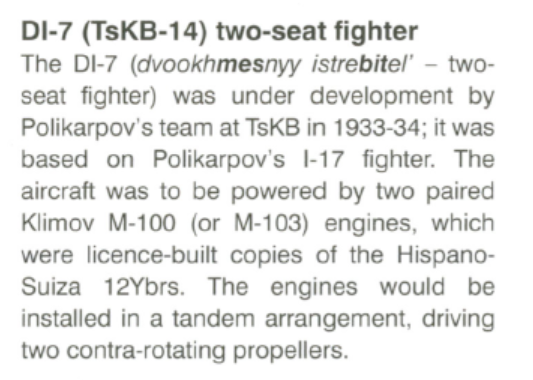
DI-7 was a two-seat twin engined version of I-17,powered by two M-100
engines,project
DI-8 was a two-seat heavy fighter,similar to ANT-40,powered by two 800 hp
Gnome-Rhone 14K engines

DI-6Sh also LSh-2
DI-6UT trainer
DI-8 = Arckangelsky ANT-46
 
Interesting. I don't know where I got the info about the DI-7 being Kocherigin... But yes, you're right TsKB-14 is indeed listed in my files as a Polikarpov, so I must have made a mistake somewhere.

Confirmation here (although it doesn't say specifically that the two-seat version was also by Polikarpov):
By mid-1933, Design Team No. 2 of the Polikarpov Central Design Bureau began work on a monoplane fighter with liquid-cooled engines TsKB-15. (...) In addition to the TsKB-15 (I-17), a two-seat version of it, the DI-7, was developed in the second half of 1933, but it was not developed.
Source: History of aircraft designs in the USSR, 1938-1950, by V.B. Shavrov.

And here:
At that time we did not have a powerful thousand-horsepower engine, success could have been achieved by placing a pair of engines in tandem, one after the other in series, to reduce aerodynamic drag, as A. Moskalov and N. Polikarpov did with their projects - SAM-4 "Sigma" and SI (TsKB-21), DI-7 (one of the proposed options), respectively.
from Borovik at https://propjet.ucoz.ru/forum/12-16-1

However, as the blog of Kirill Shishkin states:
Most of the aircraft in this list are more or less known, except for DI-5 and DI-7. It is difficult to say anything about DI-7, since it apparently remained in the form of a concept, in any case, its images on paper were not found.
Source: http://nwtele.ru/content/neizvestnye-migi-yaki-ily-i-prochie
 
Last edited:
DI-4 was a two-seat parasol gull-wing monoplane fighter,powered by one 600 hp Curtiss Conqueror engine,designed by Andre Laville
DI-4 was a two-seat fighter monoplane project,Polikarpov 1933
After comparing different sources, it seems we both were wrong.

I can find no justification of there being two separate projects, nor can I find any conclusive proof that Polikarpov was ever involved in the DI-4. There was only ONE aircraft designated DI-4, designed by Henri Laville (with a little help from assistant Lavochkin), and interpolated from a two-seat fighter design by Paul Aimé Richard (of Richard-Penhoët fame). Some articles fail to specify the designer for the DI-4 and make it sound like it was a derivative of the Polikarpov DI-1 and DI-2, which it was not. That's probably the source of the confusion.
 
After comparing different sources, it seems we both were wrong.

I can find no justification of there being two separate projects, nor can I find any conclusive proof that Polikarpov was ever involved in the DI-4. There was only ONE aircraft designated DI-4, designed by Henri Laville (with a little help from assistant Lavochkin), and interpolated from a two-seat fighter design by Paul Aimé Richard (of Richard-Penhoët fame). Some articles fail to specify the designer for the DI-4 and make it sound like it was a derivative of the Polikarpov DI-1 and DI-2, which it was not. That's probably the source of the confusion.

OK,I edit it.
 
I-153 (I-15ter) was development of the I-15 with retractable landing gear
I-153DM (Dopolnityelnyi Motor - supplementary engine) - on an experimental basis, the I-153DM was flown with gasoline-burning ramjet engines under the wings. DM-2 engines increased the top speed by 30 km/h (19 mph) while more powerful DM-4 engines added as much as 51 km/h (32 mph)
I-153P (Pushechnyy – cannon armed) - two synchronized 20 mm (0.79 in) ShVAK cannons, added firepower was offset by the increase in weight and tendency of gunpowder to foul the windscreen
I-153Sh and USh - ground attack versions with underwing containers with four ShKAS machine guns (Sh) or twenty 2.5 kg (5.5 lb) bombs (USh)
I-153TK - Four prototypes fitted with M-25V or M-62 engines boosted by twin TK-1 superchargers
I-153V (Vysotnoi - height) (also known as I-190GK (Germetichyeskoi Kabine – hermetic (pressure) cabin) - A single aircraft fitted with the definitive Schyerbakov "minimum leak" pressure cabin
I-153V-TKGK (Vysotnoi-TK Germetichyeskoi Cabine - height turbo-charged hermetic (pressure) cabin) - high-altitude version with a turbocharged M-63 engine and a pressurized cockpit
I-153UD - rear fuselage completed as a wooden monocoque rather than fabric-covered steel and wooden frame to save metal, did not enter production. [19]
I-153-50 a fifty were equipped with larger oil tanks and plumbed to accept external fuel tanks under the wings which doubled the combat range. These were primarily used by the Soviet Navy

Also for this aircraft,

I-153M-25,I-153M-62,I-153M-63,I-153GK & I-153PBRD.
 
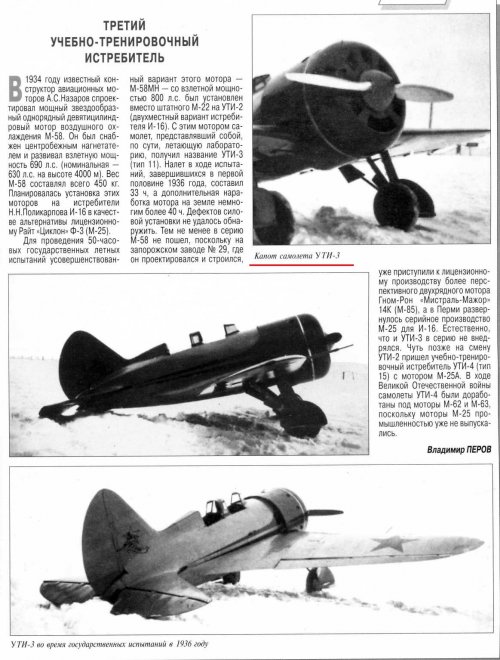
UTI-3 No. 11211A training aircraft equipped with an experimental M-58 engine. It was tested in 1935. Externally, the aircraft stands out with a modified hood with holes of a non-standard shape and a visor shape different from the UTI-4. Chkalov flew it. He liked the plane, especially after comparing it with UT-2 No. 8211. The difficulties of mastering the production of another new engine, despite its advantages, did not give the UTI-3 a go.
At the end of 1935, another two-seat version was tested, the UTI-3 No. 11211, equipped with a Soviet M-58 engine. During the tests in which V. P. Chkalov took part, the aircraft flew for 33 hours until the spring of 1936. The prototype engine worked on the ground for an additional 40 hours. Although the UTI-3 was rated higher than the UT-2 No.8211, due to the lack of the required number of M-58 engines, the aircraft remained in a single copy.
 
I-165 or I-16bis – an improved version with so-called "high-speed" wing (with stressed skin instead of fabric), refined aerodynamics of fuselage and engine cowling, with "oil-pneumatic undercarriage legs" (I don't t know if this term means retraction system or just a shock absorber). Like I-164, I-165 also had additional fuel tanks. Two prototypes were built, both with M-62 engines

The Polikarpov I-165 was also evaluated with M-88 engine.
 

Similar threads

Back
Top Bottom