Not quite true since you don't need a positive net energy return, only propulsive force, for space propulsion use.
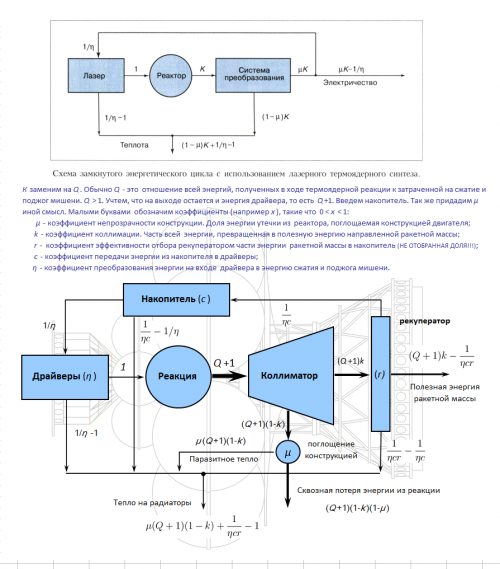
I've heard this idea about thermonuclear propulsion in space many times. I could even try to find the original source, somewhere in British magazines from 1962. But I think the idea is widely misunderstood. It made sense when it came to interplanetary spacecraft (and was apparently first expressed in that context). But for starships, it's not. Reaching the nearest stars faster than the most modern nuclear ion drive requires a very high factor (Q) (the ratio of the energy produced by the thermonuclear reaction to the energy of the drive unit igniting the target). Roughly speaking, achieving a flight time twice that of a nuclear-ion rocket requires a Q of 100, and achieving a speed four times that requires a Q of 1000. That's just over a hundred years.It's all about specific power. Daedalus was a completely unrealistic project, not because thermonuclear fusion hadn't yet been achieved (it was achievable with the target size), but because the design (of the first stage) assumed an unrealistically high specific power of 40 MW/kg. This was achievable for Orion (and even more), but not for Daedalus. Alain Bond and his team made a major conceptual error here (riding the wave of laser fusion enthusiasm of the early 1970s).Generally, Daedalus is considered a continuation of Orion. But conceptually, this is not the case (Bond was mistaken here). Orion even had an excessively high specific power, but the question of its maximum possible specific impulse remained (this is its main mystery). For Daedalus, and similar projects, the primary question is different. Expecting a specific impulse of 10,000 km/s is no problem. But that's not enough. The critical question is: what maximum specific power can you get from this? All fusion engines (whether magnetic or inertial) suffer from the same specific power deficit as a "conventional" ion rocket, albeit to a lesser degree. But in any case, that same Q parameter is the only thing that can give you a speed advantage. The higher it is, the more sense such an engine makes for interstellar propulsion.Sorry, the attached explanatory diagram is in Russian.
 

Attachments

  • Баланс в двигателе на инерционном УТС.png
    Баланс в двигателе на инерционном УТС.png
    192.1 KB · Views: 33
My AI tells me:

Top Diagram: Closed Energy Cycle Using Laser Thermonuclear Fusion​

Title: Diagram of a closed energy cycle using laser thermonuclear fusion
Components and Energy Flows:
  • Laser → Reactor: 1η\frac{1}{\eta}
  • Reactor → Conversion System: KK
  • Conversion System → Electricity Output: μK\mu K
  • Conversion System → Reactor: (1−μ)K(1 - \mu)K
  • Reactor → Laser: (1−μ)K+1η−1(1 - \mu)K + \frac{1}{\eta} - 1
  • Net Electricity Output: μK−1η\mu K - \frac{1}{\eta}
Variable Definitions:
  • K — Ratio of total energy from thermonuclear reaction to energy spent on compression and ignition of the target
  • μ — Coefficient of energy leakage to reactor and engine construction
  • k — Collimation coefficient
  • r — Efficiency of recuperating part of the rocket mass energy into the accumulator
  • c — Coefficient of energy transfer from accumulator to drivers
  • η — Energy conversion efficiency at the driver input for compression and target ignition

Bottom Diagram: Energy Flow in Rocket-Based Fusion System​

Components and Energy Flows:
  • Drivers → Reaction: 1η\frac{1}{\eta}
  • Accumulator → Drivers: 1ηc−1η\frac{1}{\eta c} - \frac{1}{\eta}
  • Reaction → Accumulator: Q+1Q + 1
  • Reaction → Collimator: Q+1Q + 1
  • Collimator → Recuperator: (Q+1)(1−k)(Q + 1)(1 - k)
  • Recuperator → Output: (Q+1)k=1ηc(Q + 1)k = \frac{1}{\eta c}
Heat Losses:
  • Parasitic Heat: μ(Q+1)(1−k)\mu(Q + 1)(1 - k)
  • Heat to Radiators: μ(Q+1)(1−k)−1ηc+1\mu(Q + 1)(1 - k) - \frac{1}{\eta c} + 1
  • Energy Loss from Reaction: (Q+1)(1−k)(1−μ)(Q + 1)(1 - k)(1 - \mu)
I hope it is helpful ( I don't understand much of it)
 
:)
I hope it is helpful ( I don't understand much of it)
If you didn't understand the simple gist right away, this will only confuse you further. :) I once drew this diagram to explain it to Russian-speaking opponents (and, of course, to myself first). But those who didn't want to understand it never understood a thing, even though it was written in their native language. :)
 
I started off on the wrong foot here.
Since the Orion topic is combined with the Daedalus topic here, I should first address a long-troubling mystery related to Daedalus and Orion.

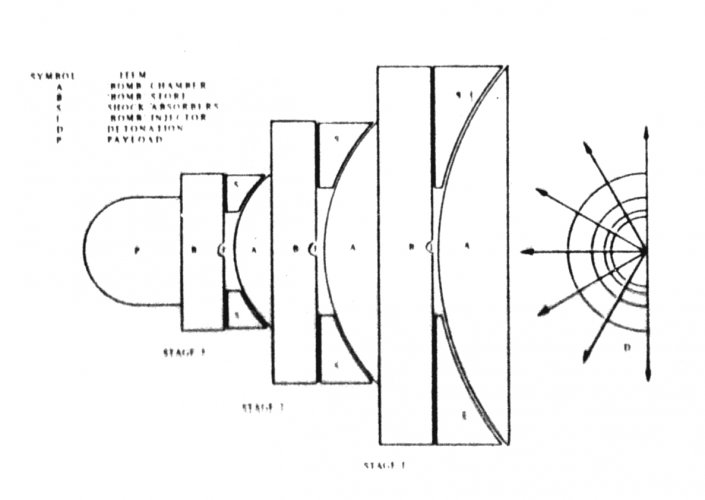
A reliable and surprising fact. Alain Bond conceived of the Daedalus project as a development of the Orion concept. This has been repeatedly stated (see the attached three-stage Orion design from Alain Bond's 1971 article, before Nuckolls published his sensational article on laser fusion in September 1972). The entire genealogy of the Daedalus idea as an upgrade to Orion can be traced. It's undeniable that the starting point was Freeman Dyson's 1968 article "Interstellar Transport." But what's surprising? When, ten years later, detailed British reports on the Daedalus project appeared (from Dyson's fellow countrymen! He was already a US citizen, but the homeland of childhood is the homeland of childhood!) in the late 1970s, Dyson himself, as far as I know (correct me if I'm wrong), NOT A WORD ABOUT IT!
Not a word of praise.
Not a word of criticism.
No mention at all!
He (perhaps the only one) seemed to have failed to notice the emergence of the Daedalus project!
How can this be understood?
And further, all the materials I've come across, all the comments Dyson made over the subsequent long life, astonishingly avoid the topic of Daedalus altogether, not to mention the relationship between Daedalus and Orion. For Dyson, it was as if Daedalus didn't exist!
How can this be understood?
 

Attachments

  • Бомболет Алена Бонда 1971.jpg
    Бомболет Алена Бонда 1971.jpg
    148.6 KB · Views: 27
You mean thrust?
No.
Thrust is a force. Newtons (in SI).
Specific power is [Watts/kg]. The power of the drive per vehicle mass.

w = W/M

However, when we're dealing with a rocket (rocket acceleration), we need to clarify that by W we mean the USEFUL power of the jet stream, that is, W = F*u/2. Here, F is the thrust [Newtons], u is the exhaust velocity [m/s] (you can also use I*g - the specific impulse multiplied by the acceleration of gravity at Earth). Also, W = dm*u^2/2. Here, dm is the rocket mass consumption per second. That is, not [kg], but [kg/s].
Second nuance.
A rocket is a body of variable mass. Therefore, it is MORE CONVENIENT to agree (and take into account in all calculations) on the specific power of an EMPTY rocket. Without the rocket mass. Specific power is a very conservative engineering characteristic of any machine or even subsystem through which energy flows. And, in essence, all the characteristics of real transport systems, including space travel, must be calculated based on it.

In fact, the most serious barrier to reaching the stars is not the speed of light or the interstellar medium (dust), but the "force" of inertia. If you want to get somewhere quickly, you need a very high specific power. Without it, you won't get where you want in the required time. For interstellar distances and the desired time, you need an insanely high specific power of a starship. And essentially, all starship design comes down to this problem: how to achieve a specific power orders of magnitude greater than what we can already achieve.
Orion was a unique example of how to achieve this.
You're essentially right about the thrust. Yes, high specific power ultimately results in both high thrust and high exhaust velocity. W = Fu/2. But thrust is a consequence. Specific power is the cause.
 
And yet! Why did Dyson never say anything about the British "Daedalus" project?
Personally, I've been searching for some time now for any word from him about "Daedalus," which is supposed to be a further development of "Orion." But there's not a hint!
Until his old age, he repeatedly recalled "Orion" as his insanely wonderful past. But "Daedalus" seemed nonexistent for him!
Or am I mistaken?
 
And yet! Why did Dyson never say anything about the British "Daedalus" project?
Personally, I've been searching for some time now for any word from him about "Daedalus," which is supposed to be a further development of "Orion." But there's not a hint!
Until his old age, he repeatedly recalled "Orion" as his insanely wonderful past. But "Daedalus" seemed nonexistent for him!
Or am I mistaken?
I mean, it's possible that "Not Invented Here" or "those idiots have completely misunderstood my designs" was talking.
 
I mean, it's possible that "Not Invented Here" or "those idiots have completely misunderstood my designs" was talking.
That's the intrigue! It feels like Dyson took a BAD attitude toward the idea of his compatriots at BIS.
There's no direct evidence. But there is a number of indirect ones.
Dyson has written many gripping books in which even I (who don't speak or think in English) sense a deep, subtle, British irony and self-irony. Very restrained and very appealing to me.
At times, Dyson can be very frank. For example, his reflections on how he's a coward and wouldn't be able to rush to help in a critical situation, which he once describes. But at other times, he's very closed and impenetrable. Especially when it comes to nuclear secrets. He clearly resents the need to "filter the conversation" due to his Q-status. He is the central figure in the story of the student who "invented" the atomic bomb, John Aristotle Phillips, in the mid-1970s. And here we see a very "closed" Dyson.
Dyson has been a member of the JASON group since the early 1960s. That is, he is a scientific consultant to the US government on the most "sensitive" issues (for example, the use of tactical nuclear weapons in Vietnam). He has to be a politician. But he clearly feels burdened by this burden his entire life.
What do we know for sure?
First of all, Dyson, through General Atomic, Ted Taylor, and Edward Tellor, was literally drawn into atomic projects in the 1950s, such as TRIGA and the tritium reactor, as a result of which he received Q-clearance. This paved the way for his participation in the Orion project, where he essentially became the chief theorist. Oppenheimer understandingly lets him leave Princeton for a year-long academic "vacation" to "frisk" on the West Coast. All of this is well described by Dyson himself, other participants in the events, and Dyson's son, George, in a 2002 book (his son tried to outdo his father in the subtlety of humor, but it came out a little differently, more American, though still quite good).
However, Dyson is the first of the Orion team to understand that the project will never be realized in the real world, that all the funds will go to the newly founded NASA, to von Braun's chemical rockets. Therefore, after his academic leave from Princeton ends, he does not extend it (although he could have), but returns to Princeton. It should be noted here that he seems to be the only one who is excited about the idea of expanding Orion into an interstellar spacecraft. Everyone else (including Ted Taylor) looks no further than Saturn. For them, even Saturn is unrealistically bold. But in 1958, Dyson created a (still) secret, short report describing five starship designs (this appears in George's book).
Just around 1960, a wave of public concern about nuclear fallout arose, and Dyson, having already left the Project in an attempt to "save" Orion, delved into the topic of "clean" thermonuclear weapons. He traveled to Livermore for several months to visit Edward Teller, where (we can only guess) he learned, among other things, about the idea of the neutron bomb.
An interesting collision occurs here. Dyson befriends Edward Teller when the latter is being obstructed by colleagues due to the Oppenheimer affair. Meanwhile, Teller's main "enemy," Oppenheimer, is Dyson's boss and, in fact, also a friend of Dyson's. This is a piquant situation, which Dyson recounts very cautiously in the late 1970s in "Disturbing the Universe." In 1960, he wrote an article, "The Future of Nuclear Weapons," which he now (in 1979) regrets having written, discussing hidden underground nuclear tests and the possibility of creating pure thermonuclear bombs. Beforehand, he sent the article to Oppenheimer, clearly asking for advice on whether he should put forward such ideas. Oppenheimer responded vaguely, as was his custom, almost in Sanskrit, and the article (inspired by his friendship with Edward Teller) was published. As a result, Dyson, for the first time, seems to have found himself an outcast among scientists. Dyson's article was very poorly received by his fellow scientists, who were "fighting for peace and disarmament." Unexpectedly for himself (always accustomed to "neutrality"), he found himself among the "hawks" advocating for continued nuclear testing (and therefore, ultimately, among the consultants of the 1963 Moscow Treaty). Still a "modest British youth," he apparently didn't like this situation at the time. And over time, this peculiar position (neither for nor against) became his life credo (Dyson – always against everyone!). Dyson realized then that Oppenheimer had "set him up" a bit. "He taught him a lesson."
What happens next? In 1965, Dyson comes out with another scandalous article (but this time he's already prepared for the obstruction of his colleagues, who are treading a well-worn political rut, which, in turn, is not long in coming) titled "Death of a Project." With undisguised, bitter sarcasm, Dyson delivers a brilliant, systematic analysis (precisely as a scientific and political analyst) of the reasons for the closure of the Orion project. And, in fact, no one since then (2025-1965 = 60 years) has written anything more profound or intelligent about the reasons for the closure of Orion.
The project is closed for POLITICAL reasons. For the first time, perhaps, in history. It would seem time to close the subject, right? Even Ted Taylor left the project and moved on to other topics (non-proliferation of nuclear weapons). Case closed. But in 1968, 10 years later (after the still-classified 1958 paper on starships), Dyson wrote that very same article, "Interstellar Transport," which blew many minds. The article clearly sent ripples through the air, one of the results of which was the British Project Daedalus.
The article demands a separate analysis in the form of... a book. Yes, yes! I'm not kidding. Almost every line in it is a puzzle. The first time I read it, I was simultaneously fascinated and disappointed. I had more questions after reading it than I had before! For me, this article is the "Dyson Enigma," which must be solved like a rebus, almost letter by letter. One thing is immediately clear. Dyson was trying to intrigue the reader with the idea of a starship powered by bombs, but at the same time he was absolutely careful not to reveal anything that would be under Q-status. And under Q-status was almost everything. How did he get out of it? That's not important now. What's important is something else.
What prompted this new publication?
That's immediately clear. The prompt was the successful launch of the Saturn V rocket. It finally took off! And in the very first paragraph of the article, we see Dyson's condescending attitude toward this event. Envy and poorly concealed regret. It's certainly great that the Saturn V took off and we'll now land on the Moon. But if the government had made the right decision back then, ten years ago, and chosen Orion, we'd now be preparing to fly to the real Saturn for the same money! Chemical rockets are a dead end, like airships in aviation! We took the wrong turn!
And then he explains the technology's potential. With Orion technology, we could reach the stars within a century!
In short. This article was a slap in the face for NASA's reputation. Dyson disliked NASA from the very beginning and subsequently criticized it constantly as a stagnant, bureaucratic organization that stifled new ideas. It was a competitor that had killed his youthful dream of Orion, and then abandoned the development of solar sails. When NASA became interested in Orion in 1963 and began attempting to connect Orion to the first stage of the Saturn V, Dyson openly scoffed at what he considered a stupid undertaking. You want to avoid precipitation? What a hassle! A waste of money! The precipitation will still return to the atmosphere via the magnetic field. Every last gram! This is an indisputable fact. By stacking Orion on top of the Saturn V, all you might achieve is fewer broken windows in neighboring houses during launch. That's all! But the radioactive fallout will be the same as if Orion launched directly from Earth! This is pure deception!
Basically, Dyson had a bad relationship with NASA from the start, and with this new article, he's clearly pissed NASA off!
What was the response? I suspect it's this one (yes, it's a bit late, but revenge is a dish best eaten cold):

https://ntrs.nasa.gov/api/citations/19720025114/downloads/19720025114.pdf
FFECTIVE SPECIFIC IMPULSE OF EXTERNAL NUCLEAR ULSE PROPULSION SYSTEMS
by Tbaine We Reynolds Lewis Research Cmtm cleueland, Ohio 44135

September 1972 (the article was later published in an abridged form in SPACECRAFT magazine, issue 10, October 1973). The article essentially demolishes the idea of an interstellar Orion. Scientifically delicate in style, but utterly devastating in substance. The authors claim to have adopted a very "gentle" model of what's happening. They burn pure deuterium in front of a slab into a plasma cloud (not a bomb!), converting all the energy of the explosion into the expansion of a Maxwellian plasma cloud (although there will be considerable radiation leakage, but they ignore this for now). They examine only how the slab will interact with the plasma cloud (considering both an isotropic cloud and introducing an anisotropy coefficient, i.e., introducing the "directivity of the explosion") and calculate the resulting specific impulse, even in this maximally lenient model. They arrived at 15,000 seconds at best. That's 150,000 m/s or 150 km/s. An exhaust velocity of 15,000-10,000 km/s is completely out of the question with such a primitive "nozzle" as a pusher plate! The most terrifying thing is plate ablation. According to their calculations, it turned out to be simply monstrous! In fact, it turned out that the thrust from ablation could even be greater than that from the plasma cloud reflected from the plate. It was after this article, I suspect, in the 1970s, that the USSR developed designs for "ablative" impulse spacecraft (in the USSR, the smartest people read all this stuff in the Western open press with awe!). And to this day, the prevailing opinion in Russian-speaking expert and academic circles is that Dyson is a "theoretician" out of touch with reality, who failed to delve into the fine details of Orion and was imagining things based on primitive assumptions (yes, the article "Interstellar Transport" is based on much simpler calculations and assumptions about certain boundaries!). They say he was thinking superficially! They say the Dyson Sphere is unstable (like Niven's Ring—it will fall!), and interstellar Orion is an unrealistic fantasy.
Conclusion?
A reflective plate is no good! For the plasma of a miniature thermonuclear explosion of deuterium or helium-3 with deuterium, a magnetic nozzle is needed! And this is where Daedalus-like engine concepts from a wide variety of authors appear. Like mushrooms after a rain. One project, ahead of the other! The era of Daedalus begins! It's still ongoing.
How did Dyson respond to this?
Nothing.
Absolutely nothing.
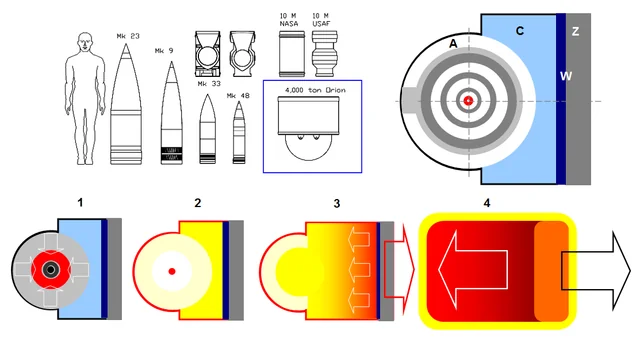
He simply couldn't answer. He couldn't go public with another article and say that the model in the NASA paper is beautiful, correct in itself, but... fundamentally wrong! Orion doesn't work that way! There's no Maxwellian expansion of the plasma cloud! Or rather, it's there too, but it's a secondary effect (which he, Dyson, described as oscillation of the "disk in and out"). But the main acceleration of the plasma occurs during the bomb's explosion due to radiation hydrodynamics, which operates in any hydrogen bomb and which is essentially the greatest Q-secret, which anyone with Q status must remain silent about. All he could say or hint at publicly on this matter was already in that very article, "Interstellar Transport." This refers to the shock wave dynamics of some supernovae (in 1966 and 1967, Zeldovich published a pair of textbooks in the USSR, where this time the Russians again laid out a mass of military secrets in the form of a jumble of formulas, but claimed priority for themselves)!
Dyson was "gagged" by his Q-status.
He remained silent, just as he had remained silent in 1974 when confronted with the tricky questions of a student named John Aristotle Phillips, who (as Dyson later recalled with hostility when questioned) simply knew how to extract secrets from him! Dyson himself was apparently quite frightened by the experience with Phillips (military secrets leak through a casual gesture)!
But Dyson's silence seemed to confirm the correctness of his critics. But he couldn't answer! The only way he could "get even" was to ignore ANY Daedalus-like projects, constructed as if to confirm this criticism. He would continue to remain silent about any such ideas. Forget about explosion-driven drive systems once and for all. Which is essentially what he did in the 1970s. He continued to popularize space expansion. He admired O'Neill's projects. He scolded NASA for not developing advanced, unusual propulsion systems (referring to solar sails or laser-propelled rockets, which was already in the 1990s). He himself became fascinated with the new interstellar propulsion—energy beam sails. He met Robert Forward in 1980 and helped him analyze the fine details of a radio sail. He eventually joined the jury of the Hawking-Milner project. He also talked about Orion. But he talked about it as a pleasant "youthful mistake."
Surprisingly, no one who interviewed Dyson about Orion, as far as I know (correct me if I'm wrong), ever bothered to ask him what he thought of the Daedalus project. Was it really an improved version of their Orion idea? Although, perhaps they did ask? But the answer wasn't publicly published?

All of this is just my guesswork. An attempt to piece together a puzzle from the available factual fragments. And I don't have even half the pieces.
But how else can one explain such a strange disregard for all the pulsating concepts proposed after Orion?

I'll be happy to retract my hypothesis if I'm provided with refuting material (a strong generalization is easily destroyed by a single counterexample). Of course, I've read a lot about Dyson and Dyson himself. But I haven't read everything. Perhaps I really have missed something? Well then, give me a link to the original source where Dyson mentions anything about Project Daedalus or anything similar to Daedalus! I'd be very grateful! Because my attempts to find something like that have yielded nothing.

 
Ever the bane of everyone, classification paperwork. [3.2TB of profanity-laced rant deleted]
But then again, what would you be doing now if secrecy didn't exist at all? All you'd be left with would be the secrets of dark energy or matter! But people like you and me wouldn't even bother lining up for them. Right? :)
I grew up in a country where secrecy was downright paranoid. In the army, I learned that secrecy is a fool's delight. A person entrusted with a secret considers themselves far superior to one who wasn't.
Great people like Dyson, for whom the need to keep secrets became a terrible burden, are few and far between. The entire history of humanity is a history of secrets, intrigues, and revelations. And our language was probably born primarily as a mechanism for transmitting gossip (useful, open information can be conveyed through gestures, sounds, and posture). Without secrets and intrigues, we wouldn't be on this planet! :)
 
Damn interesting posts you are writting. I've red the 2002 book by Dyson son. And made my own research for my hard sci-fi story I hope to finish and publish... someday.

You're right that Dyson and Taylor ran into a brickwall when pitching Orion to NASA, after the US military became a political impossibility (the Air Force fought DARPA in 1959 and NASA until 1961, with proposals like the LUNEX moonbase and many others manned spaceflights megalomaniac plans. And of course: Orion !)

What did they exactly ran into ? Milton Klein and Harold Finger, who had their own nuclear drive (albeit pathetic compared to Orion) : NERVA, of course. That organization, exactly. https://en.wikipedia.org/wiki/Space_Nuclear_Propulsion_Office

Interesting factoid: much like Apollo and the 880-tons "shrunk" Orion, NERVA was to ride a Saturn V to orbit, a mission called RIFT: Reactor In-Flight Test. Later the full system was called RNS: Reusable Nuclear Shuttle, part of the 1969 IPP and STG of Paine, Mueller and Agnew shame... fame.

And thus, circa 1965 all three propulsion systems - let's call them Apollo, NERVA and Orion - kinda started from the space place: a Boeing S-IC. Which in turns allows for interesting comparison between the three. Surprise surprise: even shrunk to 880 tons and 33 ft diameter, Orion completely buried the other two.

It is easy to forget Dyson was british, and indeed his lack of connection, even very loose, to "team Daedalus" is intriguing.

As for non-fission-trigger H-bombs : Friedwart Winterberg has all kind of proposals about it.
https://en.wikipedia.org/wiki/Friedwardt_Winterberg

The said Winterberg was also part of the "Daedalus pre-history" you mention. He also published a paper circa 1971 which seems to have inspired "team Daedalus" as much as Nuckolls you mentionned.
 
I mean, the various proposals for pulsed fusion power generation on earth pretty much prove that it's possible to have laser-ignited fusion without a fission blast to set it off. Or particle-beam ignited, or half a dozen other non-fission ignition sources.
 
And yet! Why did Dyson never say anything about the British "Daedalus" project?
Personally, I've been searching for some time now for any word from him about "Daedalus," which is supposed to be a further development of "Orion." But there's not a hint!
Until his old age, he repeatedly recalled "Orion" as his insanely wonderful past. But "Daedalus" seemed nonexistent for him!
Or am I mistaken?

Daedalus was an "amature" proposal that wasn't very well detailed, (mostly because most of the technology suggested was at the time very 'cutting edge' stuff and not generally understood) and required a huge in-space infrastructure that was at the time laughable to suggest and has not gotten more applicable with age.
Likely Dyson wasn't going to weigh in so as not to bias the scales for or against such a project. Keep in mind that Orion was supposed to be a "super-heavy-lift" launcher of payload from Earth with utility assumed once it was in space. Daedalus was a proposed one-way Starship that needed a huge in-space presence and infrastructure which was very far in the "future" if it every happened at all.

"Daedalus" wasn't a "future development" but used an laser ignition pulse system that again was so far different from the use let alone the operation of "Orion" that it was more a 'side' mission and technology to "Orion".
By the time "Orion" had moved from surface launch to being launched on a Saturn V Dyson had dropped out of the whole idea because it was no longer the "Orion" he supported or helped with. It pretty much avoided both the problems but also the advantages of the original concept so would have been of marginal use if it had worked at all at such a small scale.

Randy
 
I mean, the various proposals for pulsed fusion power generation on earth pretty much prove that it's possible to have laser-ignited fusion without a fission blast to set it off. Or particle-beam ignited, or half a dozen other non-fission ignition sources.
My opinion is this. It's no problem to ignite a DT target if you have a suitable 100 MJ driver. 4.2 MJ is a kilogram of TNT. So 100 MJ is only 24 kg of TNT. The only problem is that this energy must be concentrated into a volume of mm^3 and in a time of 10^(-8) s. That's the whole difficulty.What they're doing at NIF is an attempt to achieve the same thing but with a much smaller target and an energy of only 2 MJ. In other words, they're just playing around with trifles and are in no hurry. It's pure science, which has nothing to do with real energy. It's Nuckolls's whim. Ignite a 1 MJ target (he originally planned to ignite 100 kJ)! But they almost achieved their goal with 2x. In other words, they found the MINIMUM. The limit of what's physically possible. But that doesn't mean you'll be able to obtain an energy source with such a weak driver. That's a purely laboratory result. Experiments during the Centurion and Halite experiments in the 1980s, at the Nevada Test Site, showed that a 100 MJ driver is actually needed to achieve an almost guaranteed (80%) ignition of a "regular" target, not a brilliantly crafted object.
 
IIRC, the Orion pusher plate would get a protective / ablative silicone spray between 'shots'.
Kinda like oil-misting a grill-pan...

FWIW, the recent development of a table-top muon source might, perhaps, lead to a power/weight efficient aneutronic pulsed-fusion device.

Else, barring 'New Science', utterly massive craft built around 'Evolved Tokomaks' ??

{ Antimatter ? NIMBY !!! }
 
My opinion is this. It's no problem to ignite a DT target if you have a suitable 100 MJ driver. 4.2 MJ is a kilogram of TNT. So 100 MJ is only 24 kg of TNT. The only problem is that this energy must be concentrated into a volume of mm^3 and in a time of 10^(-8) s. That's the whole difficulty.What they're doing at NIF is an attempt to achieve the same thing but with a much smaller target and an energy of only 2 MJ. In other words, they're just playing around with trifles and are in no hurry. It's pure science, which has nothing to do with real energy. It's Nuckolls's whim. Ignite a 1 MJ target (he originally planned to ignite 100 kJ)! But they almost achieved their goal with 2x. In other words, they found the MINIMUM. The limit of what's physically possible. But that doesn't mean you'll be able to obtain an energy source with such a weak driver. That's a purely laboratory result. Experiments during the Centurion and Halite experiments in the 1980s, at the Nevada Test Site, showed that a 100 MJ driver is actually needed to achieve an almost guaranteed (80%) ignition of a "regular" target, not a brilliantly crafted object.
Agree 100%.

You need a 100MJ zap. But then you have a fusion pulse. Use D+3He (with more 3He than the math says you need) as fuel and you have a highly aneutronic reaction that emits charged particles and ions. Magnetic exhaust nozzle to use some of the electromagnetic force to generate power and channel the fusion products.
 
The neutron problem is somehow mythologized. Yes, almost all neutrons escape from the milligram targets burned at NIF. But if you increase the target mass even to 1-5 grams, the mean free path of a neutron in a compressed target is already four times smaller than the diameter of the compressed target. This means that a significant portion of the neutrons have time to thermalize. This means that a larger target (for example, the Daedalus target was designed to be exactly this large) wouldn't have to worry about neutrons. It would have been entirely possible to burn deuterium alone, rather than deuterium and the rare helium-3.
But there's another problem that everyone somehow ignores: radiation. The fact is that almost all of the target's energy (if it hasn't escaped with the neutrons) is converted into X-rays (if thermalization has occurred). About 10% will remain for the plasma (which is the rocket mass for us). 90% of the energy is converted into parasitic radiation, or X-rays. In the case of a power reactor, this is unimportant. In the case of a spacecraft, it's fatal.
 
The neutron problem is somehow mythologized. Yes, almost all neutrons escape from the milligram targets burned at NIF. But if you increase the target mass even to 1-5 grams, the mean free path of a neutron in a compressed target is already four times smaller than the diameter of the compressed target. This means that a significant portion of the neutrons have time to thermalize. This means that a larger target (for example, the Daedalus target was designed to be exactly this large) wouldn't have to worry about neutrons. It would have been entirely possible to burn deuterium alone, rather than deuterium and the rare helium-3.
But there's another problem that everyone somehow ignores: radiation. The fact is that almost all of the target's energy (if it hasn't escaped with the neutrons) is converted into X-rays (if thermalization has occurred). About 10% will remain for the plasma (which is the rocket mass for us). 90% of the energy is converted into parasitic radiation, or X-rays. In the case of a power reactor, this is unimportant. In the case of a spacecraft, it's fatal.
Again, if you use D+3He targets with an excess of 3He, your fusion products are primarily charged particles (Helium-4 ions and random protons). About 75% of the total, in fact. 5% neutrons, which you can get down to around 1% courtesy of that excess of 3He and increasing the charged particle production accordingly, plus in the neighborhood of 20% photons. The charge particles mean you can use a magnetic nozzle at a distance from your ship, which reduces the % of the sky your ship covers and therefore how much of that very energetic reaction's heat you are absorbing.

https://www.projectrho.com/public_html/rocket/enginelist3.php#id--Fusion--(_Epstein_Drive_) has the details, I'm running off of Matter Beam's analysis for this summary.

Obligatory time-sucking website warning! Atomic Rockets will consume days if you're not careful!
 
Obligatory time-sucking website warning! Atomic Rockets will consume days if you're not careful!
Readily agree. That website is amazing. The only place where every single nuclear rocket design is briefly analyzed and summarized.

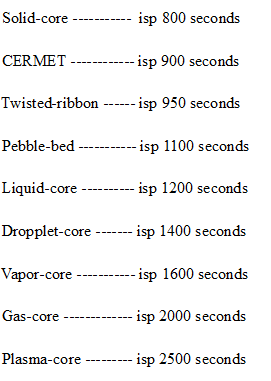
For example, all the nuclear-thermal concepts: from solid-core to plasma-core with all the in-betweens. Only with that website it is possible to list the different nuclear-thermal rocket types, according to their theoretical specific impulse.

Basically this:
Capture d’écran 2025-11-28 111345.png
 
Last edited:
It's undeniable that the starting point was Freeman Dyson's 1968 article "Interstellar Transport."
Actually although Dyson gets the credit, he didn't come up with the original concept; that came from Ted Taylor, an atomic bomb designer and visionary. McPhee's "The Curve of Binding Energy" goes into a lot of detail about that. McPhee conducted extensive interviews with both Dyson and Taylor. Each was very complimentary toward the other. Based on his work designing fission bombs, Taylor had the idea of using their huge energy output to push a plate with a cargo compartment on top of it. He worked out the basics of the concept, then brought Dyson into the loop. The details:

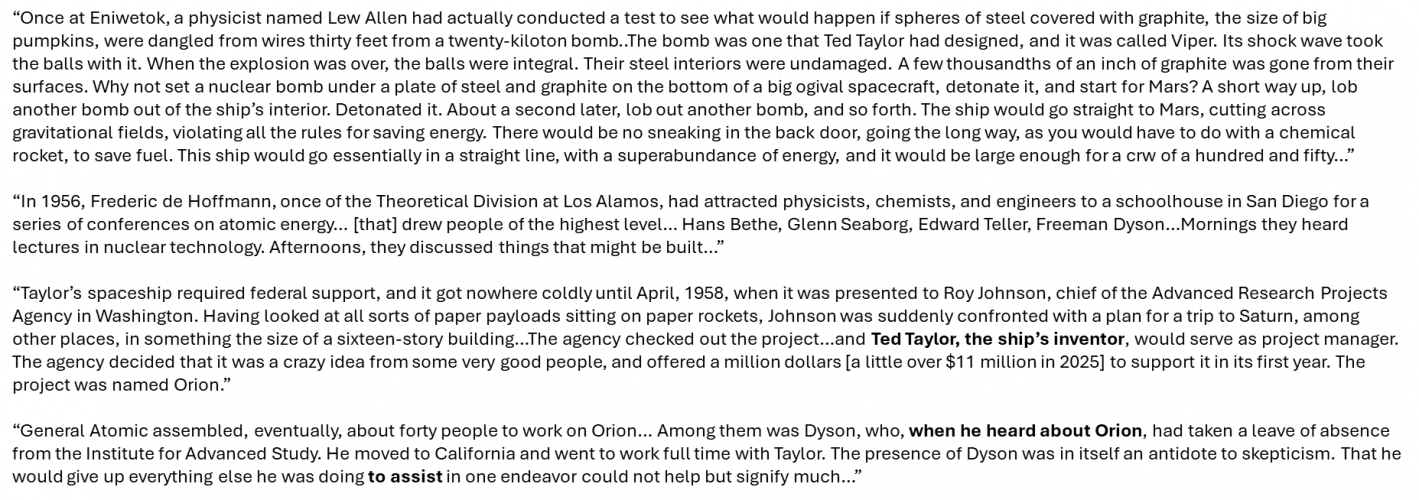
“Once at Eniwetok, a physicist named Lew Allen had actually conducted a test to see what would happen if spheres of steel covered with graphite, the size of big pumpkins, were dangled from wires thirty feet from a twenty-kiloton bomb... The bomb was one that Ted Taylor had designed, and it was called Viper. Its shock wave took the balls with it. When the explosion was over, the balls were integral. Their steel interiors were undamaged. A few thousandths of an inch of graphite was gone from their surfaces. Why not set a nuclear bomb under a plate of steel and graphite on the bottom of a big ogival spacecraft, detonate it, and start for Mars? A short way up, lob another bomb out of the ship’s interior. Detonated it. About a second later, lob out another bomb, and so forth. The ship would go straight to Mars, cutting across gravitational fields, violating all the rules for saving energy. There would be no sneaking in the back door, going the long way, as you would have to do with a chemical rocket, to save fuel. This ship would go essentially in a straight line, with a superabundance of energy, and it would be large enough for a crew of a hundred and fifty…”
“In 1956, Frederic de Hoffmann, once of the Theoretical Division at Los Alamos, had attracted physicists, chemists, and engineers to a schoolhouse in San Diego for a series of conferences on atomic energy… [that] drew people of the highest level… Hans Bethe, Glenn Seaborg, Edward Teller, Freeman Dyson…Mornings they heard lectures in nuclear technology. Afternoons, they discussed things that might be built…”
“Taylor’s spaceship required federal support, and it got nowhere coldly until April, 1958, when it was presented to Roy Johnson, chief of the Advanced Research Projects Agency in Washington. Having looked at all sorts of paper payloads sitting on paper rockets, Johnson was suddenly confronted with a plan for a trip to Saturn, among other places, in something the size of a sixteen-story building…The agency checked out the project…and Ted Taylor, the ship’s inventor, would serve as project manager. The agency decided that it was a crazy idea from some very good people, and offered a million dollars [a little over $11 million in 2025] to support it in its first year. The project was named Orion.”
“General Atomic assembled, eventually, about forty people to work on Orion… Among them was Dyson, who, when he heard about Orion, had taken a leave of absence from the Institute for Advanced Study. He moved to California and went to work full time with Taylor. The presence of Dyson was in itself an antidote to skepticism. That he would give up everything else he was doing to assist in one endeavor could not help but signify much…”

About those times, Dyson had this to say: “Ted taught me everything I know about bombs. He was the man who had made [fission] bombs small and cheap. For Orion, having them small and cheap was the point…Very few people have Ted’s imagination. Very few people have his courage. He was ten or twenty years ahead of the rest of us…I felt that he – much more than von Braun or anyone else – was the real Columbus of our days. I think he is perhaps the greatest man that I ever knew well. And he is completely unknown... Ted, incidentally, was extremely good as a boss.”
 

Attachments

  • 1764354026779.png
    1764354026779.png
    71.2 KB · Views: 17
Ted Taylor is much more obscure than Dyson, plus he had a different trajectory from 1965 onwards - disarmement.
https://en.wikipedia.org/wiki/Ted_Taylor_(physicist)
True, he saw the light that others like Teller never did see. Taylor's later research into energy conservation and also snowflakes (believe it or not) make fascinating reading. He had a machine that pumped water out of a nozzle at high pressure to create perfect snowflakes, and he said that once they came out as perfect little solid pyramidal (or something - I don't have the book in front of me) shapes that they were never able to replicate. A very interesting man.
 
True, he saw the light that others like Teller never did see. Taylor's later research into energy conservation and also snowflakes (believe it or not) make fascinating reading. He had a machine that pumped water out of a nozzle at high pressure to create perfect snowflakes, and he said that once they came out as perfect little solid pyramidal (or something - I don't have the book in front of me) shapes that they were never able to replicate. A very interesting man.
Sounds like Unilever's problem
https://www.campbellacademy.co.uk/blog/blog/unilever-test-fix-problem
Might ablatives help with nuclear salt water rockets?
 
Sounds like Unilever's problem
https://www.campbellacademy.co.uk/blog/blog/unilever-test-fix-problem
Might ablatives help with nuclear salt water rockets?
That's 3 things that I never thought I'd see relating to one another: Rockets, salt water, and nuclear stuff. I love engineering! As far as the Unilever nozzle thing goes, I hadn't heard about that but reading the article just makes me tremendously sad. "They failed and failed and failed and failed until they got it right, but they failed and measured and this is how we learn from things. They weren’t scared to get things wrong because they knew that the consequences of that was the opportunity to try again to get it right." It reminds me of the company management for some of the projects I worked on, especially Canard Rotor Wing, whose management was violently risk-phobic. It's how we lost DARPA's support and funding. The skies could have been filled with stoppable-rotor aircraft by now if they'd just done what the customer said instead of the exact opposite. But I think I've told that story elsewhere, so I'll go watch some funny videos to get over my current melancholy. :)
 
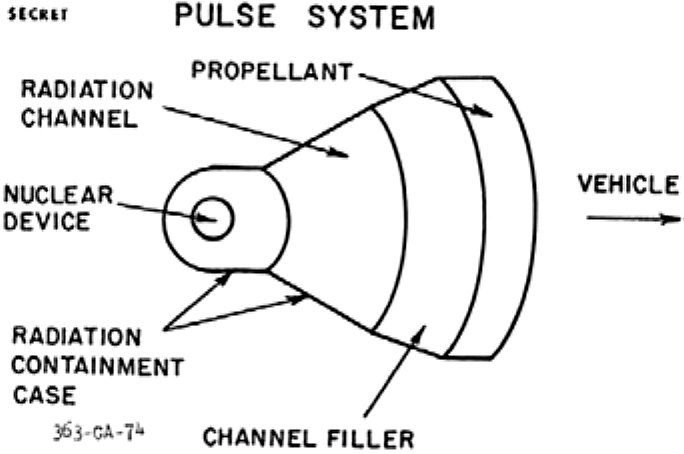
Does anyone know where this diagram of the Orion nuclear module comes from? What document is it from? Is this document online anywhere?

orionpunit2.jpg

I got the image from here. And the original source for this diagram isn't listed there.
The image says (apparently) 363-GA-74.
It might not be GA, but CA, but most likely the former, GA, because it's General Atomic. I think I've seen this image somewhere in some declassified document before. But perhaps that's a false memory. I can't find anything like it right now (even though I think I downloaded a lot of declassified documents on Orion).
I really want to see the ORIGINAL description of the operating principle of this device, which should accompany this diagram in that document, if it exists in that document.
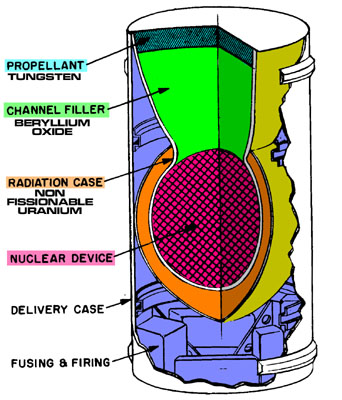
This, as far as I understand, is the second diagram that somehow reveals the design of the Orion nuclear pulse module. The first diagram is more well-known.

1779890035123.png
This diagram is included in a previously classified but now declassified report:

NUCLEAR PULSE SPACE VEHICLE STUDY Vol. III -- CONCEPTUAL VEHICLE DESIGNS AND OPERATIONAL SYSTEMS (U) Contract NASA-I1053 Issued September 19, 1964 George C. Marshall Space Flight Center Future Projects Office National Aeronautics and Space Administration Huntsville, Alabam.

Declassified in 1976. Section 2. 1. 4. "The Pulse Unit" contains this more familiar diagram and a brief description of the operating principle, from which, apparently, all known descriptions of the operating principle of the Orion "Pulse Unit" in other documents and books derive. But I'd like to receive a second, most likely similar, declassified description, which likely accompanied the other diagram I provided first, to see what differences there are. Are there any differences at all? The second diagram has slightly more "design details." How is their meaning explained?

I recently created a post on Reddit attempting to explain the TRUE mechanism of the module's operation, and I'm faced with the need to know exactly what's been declassified and where people got the explanations for the module's operation that my explanation "conflicts with".

1779891105819.png

I have very little doubt that all these well-known official, "declassified" descriptions of the operating principle are worthless. This is obvious when reading them. They explain nothing. They don't distort the essence of the device, but they also don't reveal the physical essence of how such a module works. In other words, General Atomic, an organization with Q status (possession of nuclear weapons secrets), while communicating with NASA as an unclassified organization, simply didn't share the true essence of the Orion impulse module's operation with civilian scientists. Instead, a more or less plausible, crude diagram was presented, which didn't distort anything, but also didn't explain how the directed plasma jet onto the ship's plate was formed.

But to confirm my hunch, I need to collect all the known examples of the module's operating descriptions that have since been declassified. I have one, and I want another. But where can I get one?
 
Last edited:
try
Aerospace Project Review Issue V1N4 by Scott Lowther
to get here:
https://www.aerospaceprojectsreview.com/
Michelle, I know Scott's website and read it from time to time.
Unfortunately, I'm a "poor relative from Ukraine" and don't have PayPal. :) No, if I were sure this would help me, I'd tense up and stop pretending to be a poor relative who doesn't want to pay even a penny... :) Scott has more than one magazine dedicated to Orion, as I understand it! You're offering me these magnificent works. And I'm looking for a historical document. What are you trying to say with THAT? That this diagram isn't from a historical document? Did Scott draw it? Then I'm not very interested in it yet, in terms of investigating history (precisely as history), which means this diagram is a "replica" and simply a false trail that I followed. I was sure I'd seen this diagram somewhere in some declassified document. But false memories are common. :(
 
I recently created a post on Reddit attempting to explain the TRUE mechanism of the module's operation, and I'm faced with the need to know exactly what's been declassified and where people got the explanations for the module's operation that my explanation "conflicts with".
I've been using the information on Atomic Rockets. I'd assume you've seen that stuff.
 

Similar threads

Back
Top Bottom