I mean, it's possible that "Not Invented Here" or "those idiots have completely misunderstood my designs" was talking.
That's the intrigue! It feels like Dyson took a BAD attitude toward the idea of his compatriots at BIS.
There's no direct evidence. But there is a number of indirect ones.
Dyson has written many gripping books in which even I (who don't speak or think in English) sense a deep, subtle, British irony and self-irony. Very restrained and very appealing to me.
At times, Dyson can be very frank. For example, his reflections on how he's a coward and wouldn't be able to rush to help in a critical situation, which he once describes. But at other times, he's very closed and impenetrable. Especially when it comes to nuclear secrets. He clearly resents the need to "filter the conversation" due to his Q-status. He is the central figure in the story of the student who "invented" the atomic bomb, John Aristotle Phillips, in the mid-1970s. And here we see a very "closed" Dyson.
Dyson has been a member of the JASON group since the early 1960s. That is, he is a scientific consultant to the US government on the most "sensitive" issues (for example, the use of tactical nuclear weapons in Vietnam). He has to be a politician. But he clearly feels burdened by this burden his entire life.
What do we know for sure?
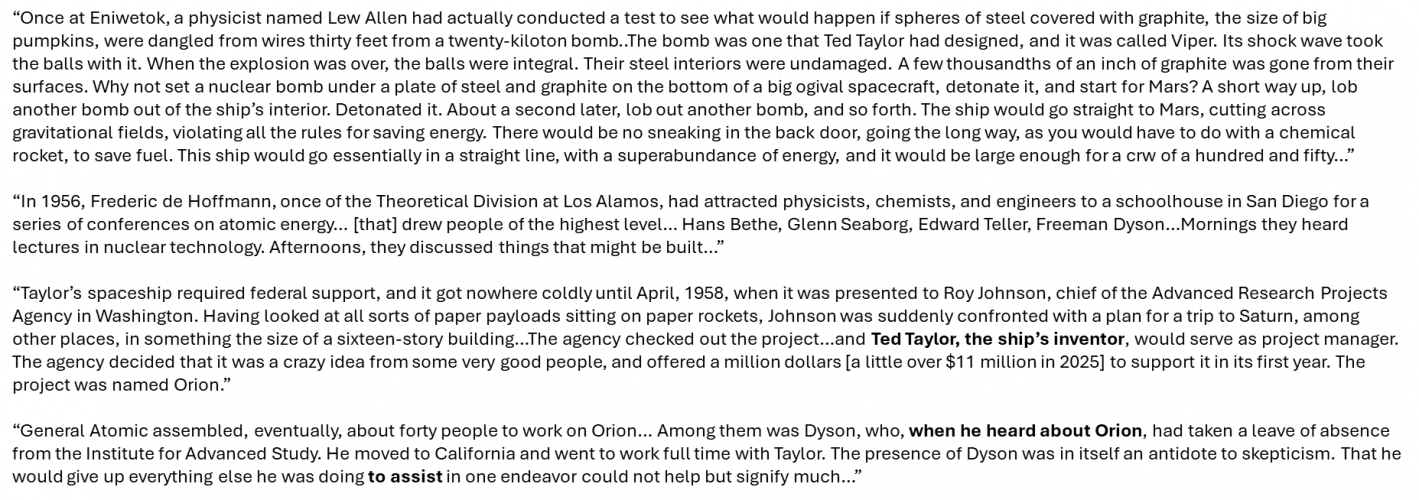
First of all, Dyson, through General Atomic, Ted Taylor, and Edward Tellor, was literally drawn into atomic projects in the 1950s, such as TRIGA and the tritium reactor, as a result of which he received Q-clearance. This paved the way for his participation in the Orion project, where he essentially became the chief theorist. Oppenheimer understandingly lets him leave Princeton for a year-long academic "vacation" to "frisk" on the West Coast. All of this is well described by Dyson himself, other participants in the events, and Dyson's son, George, in a 2002 book (his son tried to outdo his father in the subtlety of humor, but it came out a little differently, more American, though still quite good).
However, Dyson is the first of the Orion team to understand that the project will never be realized in the real world, that all the funds will go to the newly founded NASA, to von Braun's chemical rockets. Therefore, after his academic leave from Princeton ends, he does not extend it (although he could have), but returns to Princeton. It should be noted here that he seems to be the only one who is excited about the idea of expanding Orion into an interstellar spacecraft. Everyone else (including Ted Taylor) looks no further than Saturn. For them, even Saturn is unrealistically bold. But in 1958, Dyson created a (still) secret, short report describing five starship designs (this appears in George's book).
Just around 1960, a wave of public concern about nuclear fallout arose, and Dyson, having already left the Project in an attempt to "save" Orion, delved into the topic of "clean" thermonuclear weapons. He traveled to Livermore for several months to visit Edward Teller, where (we can only guess) he learned, among other things, about the idea of the neutron bomb.
An interesting collision occurs here. Dyson befriends Edward Teller when the latter is being obstructed by colleagues due to the Oppenheimer affair. Meanwhile, Teller's main "enemy," Oppenheimer, is Dyson's boss and, in fact, also a friend of Dyson's. This is a piquant situation, which Dyson recounts very cautiously in the late 1970s in "Disturbing the Universe." In 1960, he wrote an article, "The Future of Nuclear Weapons," which he now (in 1979) regrets having written, discussing hidden underground nuclear tests and the possibility of creating pure thermonuclear bombs. Beforehand, he sent the article to Oppenheimer, clearly asking for advice on whether he should put forward such ideas. Oppenheimer responded vaguely, as was his custom, almost in Sanskrit, and the article (inspired by his friendship with Edward Teller) was published. As a result, Dyson, for the first time, seems to have found himself an outcast among scientists. Dyson's article was very poorly received by his fellow scientists, who were "fighting for peace and disarmament." Unexpectedly for himself (always accustomed to "neutrality"), he found himself among the "hawks" advocating for continued nuclear testing (and therefore, ultimately, among the consultants of the 1963 Moscow Treaty). Still a "modest British youth," he apparently didn't like this situation at the time. And over time, this peculiar position (neither for nor against) became his life credo (Dyson – always against everyone!). Dyson realized then that Oppenheimer had "set him up" a bit. "He taught him a lesson."
What happens next? In 1965, Dyson comes out with another scandalous article (but this time he's already prepared for the obstruction of his colleagues, who are treading a well-worn political rut, which, in turn, is not long in coming) titled "Death of a Project." With undisguised, bitter sarcasm, Dyson delivers a brilliant, systematic analysis (precisely as a scientific and political analyst) of the reasons for the closure of the Orion project. And, in fact, no one since then (2025-1965 = 60 years) has written anything more profound or intelligent about the reasons for the closure of Orion.
The project is closed for POLITICAL reasons. For the first time, perhaps, in history. It would seem time to close the subject, right? Even Ted Taylor left the project and moved on to other topics (non-proliferation of nuclear weapons). Case closed. But in 1968, 10 years later (after the still-classified 1958 paper on starships), Dyson wrote that very same article, "Interstellar Transport," which blew many minds. The article clearly sent ripples through the air, one of the results of which was the British Project Daedalus.
The article demands a separate analysis in the form of... a book. Yes, yes! I'm not kidding. Almost every line in it is a puzzle. The first time I read it, I was simultaneously fascinated and disappointed. I had more questions after reading it than I had before! For me, this article is the "Dyson Enigma," which must be solved like a rebus, almost letter by letter. One thing is immediately clear. Dyson was trying to intrigue the reader with the idea of a starship powered by bombs, but at the same time he was absolutely careful not to reveal anything that would be under Q-status. And under Q-status was almost everything. How did he get out of it? That's not important now. What's important is something else.
What prompted this new publication?
That's immediately clear. The prompt was the successful launch of the Saturn V rocket. It finally took off! And in the very first paragraph of the article, we see Dyson's condescending attitude toward this event. Envy and poorly concealed regret. It's certainly great that the Saturn V took off and we'll now land on the Moon. But if the government had made the right decision back then, ten years ago, and chosen Orion, we'd now be preparing to fly to the real Saturn for the same money! Chemical rockets are a dead end, like airships in aviation! We took the wrong turn!
And then he explains the technology's potential. With Orion technology, we could reach the stars within a century!
In short. This article was a slap in the face for NASA's reputation. Dyson disliked NASA from the very beginning and subsequently criticized it constantly as a stagnant, bureaucratic organization that stifled new ideas. It was a competitor that had killed his youthful dream of Orion, and then abandoned the development of solar sails. When NASA became interested in Orion in 1963 and began attempting to connect Orion to the first stage of the Saturn V, Dyson openly scoffed at what he considered a stupid undertaking. You want to avoid precipitation? What a hassle! A waste of money! The precipitation will still return to the atmosphere via the magnetic field. Every last gram! This is an indisputable fact. By stacking Orion on top of the Saturn V, all you might achieve is fewer broken windows in neighboring houses during launch. That's all! But the radioactive fallout will be the same as if Orion launched directly from Earth! This is pure deception!
Basically, Dyson had a bad relationship with NASA from the start, and with this new article, he's clearly pissed NASA off!
What was the response? I suspect it's this one (yes, it's a bit late, but revenge is a dish best eaten cold):
https://ntrs.nasa.gov/api/citations/19720025114/downloads/19720025114.pdf
FFECTIVE SPECIFIC IMPULSE OF EXTERNAL NUCLEAR ULSE PROPULSION SYSTEMS
by Tbaine We Reynolds Lewis Research Cmtm cleueland, Ohio 44135
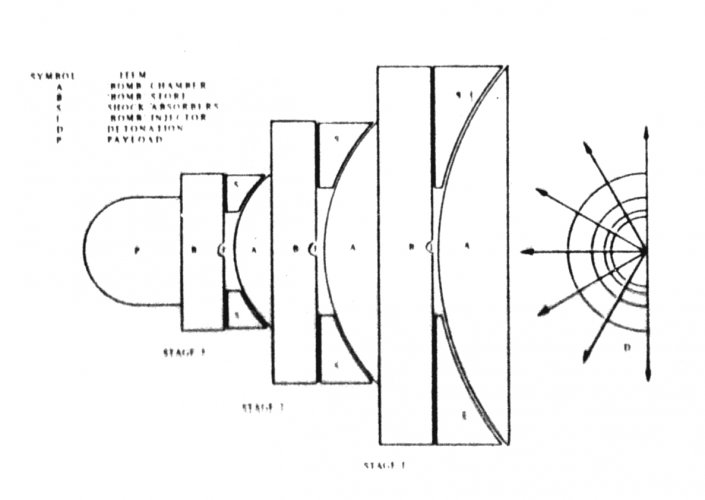
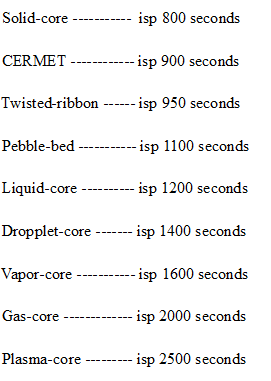
September 1972 (the article was later published in an abridged form in SPACECRAFT magazine, issue 10, October 1973). The article essentially demolishes the idea of an interstellar Orion. Scientifically delicate in style, but utterly devastating in substance. The authors claim to have adopted a very "gentle" model of what's happening. They burn pure deuterium in front of a slab into a plasma cloud (not a bomb!), converting all the energy of the explosion into the expansion of a Maxwellian plasma cloud (although there will be considerable radiation leakage, but they ignore this for now). They examine only how the slab will interact with the plasma cloud (considering both an isotropic cloud and introducing an anisotropy coefficient, i.e., introducing the "directivity of the explosion") and calculate the resulting specific impulse, even in this maximally lenient model. They arrived at 15,000 seconds at best. That's 150,000 m/s or 150 km/s. An exhaust velocity of 15,000-10,000 km/s is completely out of the question with such a primitive "nozzle" as a pusher plate! The most terrifying thing is plate ablation. According to their calculations, it turned out to be simply monstrous! In fact, it turned out that the thrust from ablation could even be greater than that from the plasma cloud reflected from the plate. It was after this article, I suspect, in the 1970s, that the USSR developed designs for "ablative" impulse spacecraft (in the USSR, the smartest people read all this stuff in the Western open press with awe!). And to this day, the prevailing opinion in Russian-speaking expert and academic circles is that Dyson is a "theoretician" out of touch with reality, who failed to delve into the fine details of Orion and was imagining things based on primitive assumptions (yes, the article "Interstellar Transport" is based on much simpler calculations and assumptions about certain boundaries!). They say he was thinking superficially! They say the Dyson Sphere is unstable (like Niven's Ring—it will fall!), and interstellar Orion is an unrealistic fantasy.
Conclusion?
A reflective plate is no good! For the plasma of a miniature thermonuclear explosion of deuterium or helium-3 with deuterium, a magnetic nozzle is needed! And this is where Daedalus-like engine concepts from a wide variety of authors appear. Like mushrooms after a rain. One project, ahead of the other! The era of Daedalus begins! It's still ongoing.
How did Dyson respond to this?
Nothing.
Absolutely nothing.
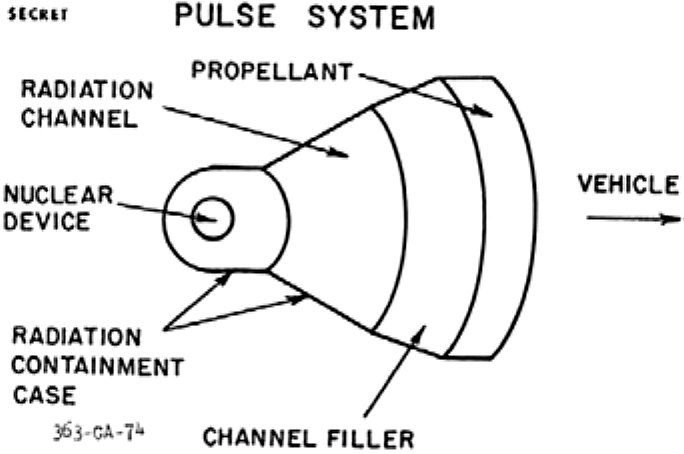
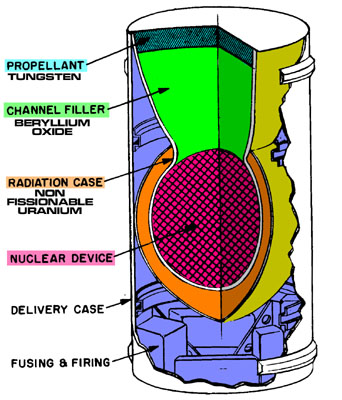
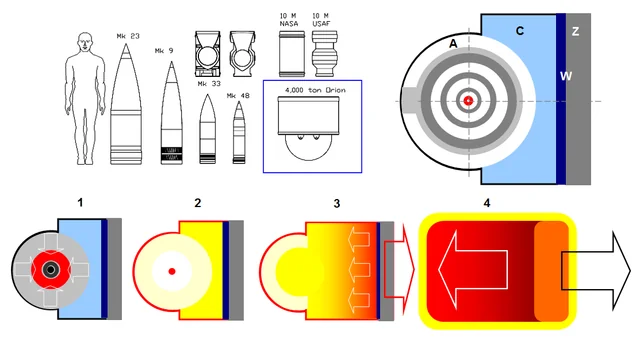
He simply couldn't answer. He couldn't go public with another article and say that the model in the NASA paper is beautiful, correct in itself, but... fundamentally wrong! Orion doesn't work that way! There's no Maxwellian expansion of the plasma cloud! Or rather, it's there too, but it's a secondary effect (which he, Dyson, described as oscillation of the "disk in and out"). But the main acceleration of the plasma occurs during the bomb's explosion due to radiation hydrodynamics, which operates in any hydrogen bomb and which is essentially the greatest Q-secret, which anyone with Q status must remain silent about. All he could say or hint at publicly on this matter was already in that very article, "Interstellar Transport." This refers to the shock wave dynamics of some supernovae (in 1966 and 1967, Zeldovich published a pair of textbooks in the USSR, where this time the Russians again laid out a mass of military secrets in the form of a jumble of formulas, but claimed priority for themselves)!
Dyson was "gagged" by his Q-status.
He remained silent, just as he had remained silent in 1974 when confronted with the tricky questions of a student named John Aristotle Phillips, who (as Dyson later recalled with hostility when questioned) simply knew how to extract secrets from him! Dyson himself was apparently quite frightened by the experience with Phillips (military secrets leak through a casual gesture)!
But Dyson's silence seemed to confirm the correctness of his critics. But he couldn't answer! The only way he could "get even" was to ignore ANY Daedalus-like projects, constructed as if to confirm this criticism. He would continue to remain silent about any such ideas. Forget about explosion-driven drive systems once and for all. Which is essentially what he did in the 1970s. He continued to popularize space expansion. He admired O'Neill's projects. He scolded NASA for not developing advanced, unusual propulsion systems (referring to solar sails or laser-propelled rockets, which was already in the 1990s). He himself became fascinated with the new interstellar propulsion—energy beam sails. He met Robert Forward in 1980 and helped him analyze the fine details of a radio sail. He eventually joined the jury of the Hawking-Milner project. He also talked about Orion. But he talked about it as a pleasant "youthful mistake."
Surprisingly, no one who interviewed Dyson about Orion, as far as I know (correct me if I'm wrong), ever bothered to ask him what he thought of the Daedalus project. Was it really an improved version of their Orion idea? Although, perhaps they did ask? But the answer wasn't publicly published?
All of this is just my guesswork. An attempt to piece together a puzzle from the available factual fragments. And I don't have even half the pieces.
But how else can one explain such a strange disregard for all the pulsating concepts proposed after Orion?
I'll be happy to retract my hypothesis if I'm provided with refuting material (a strong generalization is easily destroyed by a single counterexample). Of course, I've read a lot about Dyson and Dyson himself. But I haven't read everything. Perhaps I really have missed something? Well then, give me a link to the original source where Dyson mentions anything about Project Daedalus or anything similar to Daedalus! I'd be very grateful! Because my attempts to find something like that have yielded nothing.