I have a small update regarding the mention of the Vickers cruiser.
I read the second part of the article about the second submarine tender, and I'm using that article to write this post.
Starting with a brief introduction, in short - it's 1935, and the tender involves mainly three shipyards: Vickers-Armstrong, Cammell Laird, which ultimately withdrew, and the Dutch consortium NVSB, which ultimately won the tender for submarines for Poland.
The Poles wanted submarines with a displacement of around 1,000 tons, but the British offered us a submarine with a displacement of 1,450 tons - as a reminder, this was the Vickers-Armstrong Design 1077, the information drawing was sent to KMW on April 27, 1935.
I think it's important to say a few words about this project.
In terms of design, this design bears similarities to the Delfim submarine built in 1931 for Portugal – ours was to be larger, better armed, and faster, as the Design 1077 had a speed of up to 20 knots.
Perhaps the design of the submarine for us was at least partially based on it – I don't know, but yes, it is at least somewhat similar.
On July 22, 1935, the NVSB submitted a proposal for the Project 2005 submarine, with a displacement of 1,096 tons, which won the tender – in short: this was the design from which the later ORP Orzeł plan evolved. Comparing this design to the final ORP Orzeł plans, both designs are similar, but they have differences.

Returning to the matter at hand:
In his report, Sir Howard William Kennard, the British ambassador to Warsaw, feared that, due to increasing pressure on the Poles to change the design and the ship's requirements from Vickers-Armstrong, the British might lose the submarine tender.
He also added that the chances of winning the tender were slim anyway, after the Vickers-Armstrong shipyard withdrew during the destroyer tender because the shipyard was insisting on domestically produced guns.

He also lamented that, if not for its shortsighted approach, the shipyard could have secured the order not only for destroyers but also for submarines, and a large cruiser planned in the near future, for 2 million pounds sterling.

And he was right, because in the submarine tender, Vickers-Armstrong once again played its cards right and ultimately lost.

Source: Morze Statki i Okręty 9-10 2025, article drugi przetarg na polskie łodzie podwodne... wszystko, co chcielibyście o nim wiedzieć, ale baliście się zapytać. Część 2. Author: Andrzej.S.Bartelski.
 
I have two new informations about the destroyers Wicher and Burza (which I apparently didn't notice at first).
1. During the design of the destroyers for Poland, there was an idea to arm both destroyers (the future Wicher and Burza) with 138.6 mm Model 1923 guns.
However, this would have required modifications to the design, and KMW chief Jerzy Świrski refused to change the guns. In a letter dated April 28, 1927, he stated that the destroyers should be equipped with 130 mm guns.
2. When selecting the anti-aircraft armament for the destroyers built in France, semi-automatic 37 mm Hotchkiss Model 1925 guns, based on the naval Model 1925, were considered.
However, ultimately, the decision was made to use 40 mm Vickers guns.

Source: Wielki Leksykon Uzbrojenia Wrzesień 1939 - Tom 143 Artyleria Okrętowa. Author - Waldemar Nadolny.
 
Below is a link to a film about Stefan Drzewiecki – a Polish engineer who built submarines. The voice-over is Polish (though I suspect it's AI-assisted), with English subtitles.
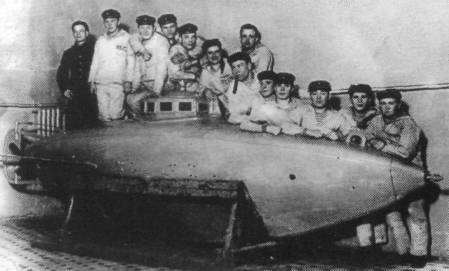
He designed a series of about 50 (!) early submarines for Russian Imperial Fortress Service (not Navy), but they were rather primitive. They were pedal-driven (thus very slow), have only ballast depth control (the movable ballast inside the hull was moved forward to dive, or backward to rise), and were armed with basically floating mines, connected by rope (the mines were supposed to be released when the submarine was behind enemy ship, so they would float up at ship's sides and then would be exploded by electric cable). Their only advantage was, that they were very cheap, so the type was adopted for harbor defense. But after series on unsucsessful trials - when it was demonstrated that submarines can't hold the bearing and have little chance to even find the enemy (despite being equipped with periscopes) - most of them were relegated for harbor utility duties, like inspecting the underwater parts of the ships and piers. A few boats still retained by Russo-Japanese War were equipped with ICE engines and used as semi-submersible torpedo boats for defense of Vladivostok. They were used in patrol operations, and one of them - "Keta" - even scared away some Japanese destroyers (Japanese were very afraid of submarine attacks after losing two battleships on mines near Port Arthur in one day; they thought it was Russian submarine work).

Drzewiecki recognized the limitations of his boats, and tried to improve their design. One of the boats was experimentally equipped with electric drive, and external tubes for Whitehead torpedoes were tested. But the results were still unsatisfactory due to his boats very small size:

1767855158861.png

Yep, it was the real boat.


Later, he suggested a project of semi-submersible "water-armored torpedo boat", which was supposed to have most of the hull underwater, and only a small upper structure (filled with cork) over surface for better seakeeping. It was supposed to have steam-electric drive, with steam engine powering the dynamo, that provided current for three electric motors; a series of accumulator batteries were also included in case the boat need to make a dive. The project was viewed as interesting, but not proceeded with (by late 1880s Russian Navy grew stronger in terms of battleships and armored cruisers, and interest toward unorthodox solutions decreased).
 
I'll just add that Stefan Drzewiecki wasn't the only Pole to design a submarine.

At this point, I know of several such individuals:

- Krzysztof Arciszewski, in June 1636, presented the Dutch authorities with a design for underwater firecrackers to combat galleons, which he developed during his second stay in Brazil.
Jerzy Pertek wrote about this design in his book "Polscy Pionierzy Podwodnej Żeglugi," on page 4.
Unfortunately, I don't know any further information about this project.

- Jakub Fryderyk Hoffmann - a military doctor in the Dąbrowski Legions.
Around 1795, he developed a design for an underwater vehicle intended for use in the mission to rescue Tadeusz Kościuszko, who was held captive in the Schlissenburg Fortress.
He sent his idea to the Directory in Paris.
I don't have any details about his vehicle, including any graphics.

- Kazimierz Czarnowski (1791-1847) - in 1825, he developed a submarine design, which is why he sent a letter to Tsar Nicholas I in 1829, but his design was ultimately rejected.
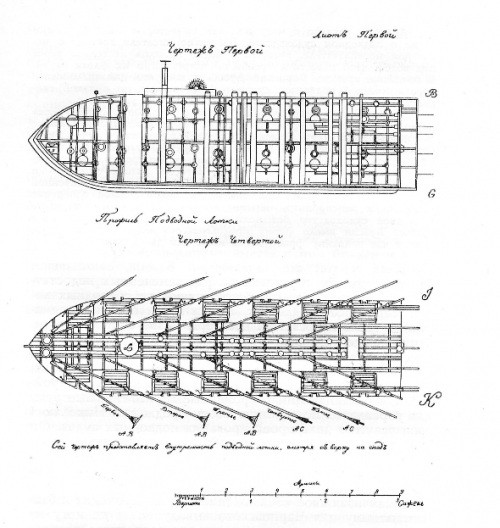
His design for the submarine was 10 meters long, and the vessel was to be propelled underwater by 28 rowers and afloat by sails.
The armament was to consist of a mine and machine guns.
Unfortunately, I have no further information about his design.

- In 1876, Stefan Baranowski, together with his son Włodzimierz, constructed a submarine, which is known only to have been a successful design.
Jerzy Pertek mentioned it in the book mentioned earlier, on page 25.
 
- Kazimierz Czarnowski (1791-1847) - in 1825, he developed a submarine design, which is why he sent a letter to Tsar Nicholas I in 1829, but his design was ultimately rejected.
His design for the submarine was 10 meters long, and the vessel was to be propelled underwater by 28 rowers and afloat by sails.
The armament was to consist of a mine and machine guns.
Unfortunately, I have no further information about his design.

The Czarnovsky project was taken pretty seriously (despite Czarnowski being at that moment in prison, under suspicion of belonging to revolutionary society), and directed to the Major General of Communication Engineers Corps, Pyotr Bazen (renowed mathematician with several works about differential calculus and well-known engineer, who designed many objects of infrastructure and buildings). Bazen considered project to be interesting in concept, but noted numerous flaws in calculations, which made it unworkable.

Czarnovsky revorked his project (apparently hoping to get a pardon) and presented a new version by 1832. The same Bazen again reviewed project, but deduced that Czarnovsky didn't have any engineering education, and all his calculations are still wrong. Bazen concluded his review with note that "sadly, a bright imagination not supported by knowledge could not produce a really useful invention"
Czarnovsky was released in 1834, but in 1839 was arrested again in Arkhangelsk for organization of revolutionary society (this time for sure), which planned to capture several warships and use them as raiders. For that he was exiled to small town of Sarapul, where he died in 1847.
1767889064141.png
Czarnovsky submarine. It was supposed to be large, twin-deck vessel (10 meters long, 3 meters in diameter), in shape of artillery shell. It was planned to be made from riveted metal (made watertight by the layer of thick leather inside), and moved by seven pair of oars, portruging through special watertight sleeves. On the rear, several rudder-like oars were supposed to be installed. The submarine was planned to dive by flooding 28 leather watertight bags inside, and rise by squeezing water out of them with the help of levers. A special retractable pilothouse was also used as part of ballast system.

The initial Czarnovsky plans for the submarine were apparently peaceful - it was suggested to use it to search for underwater wrecks and pearls on sea bottom. But later, apparently hoping to impress Bazen, Czarnovsky reworked his plans into proper warship - equipped with small cannons in pilothouse, boarding equipment for troops, and special mines, provided with chemical time fuze (a chunk of water-soluble material, like shugar, was holding the spring till it dissolved completely, after which released spring fired the mine)

The major weak point of project (noted by Bazen) was insufficient air supply for such a large crew - several dozens of rowers, not counting the planned boarding teams! Czarnovsky tried to remedy the situation by suggesting to store compressed air in leather bags, but he badly miscalculated the required volume of almost everything. So while the project was deemed as interesting, it was also too flawed to be even remotely workable.
 
There was a rumor in Poland:
Apparently, at the turn of the 1970s and 1980s, preparations were being made to build a submarine, and the technical design was even reportedly transferred to Poland for possible technological development.

The whole thing was supposed to fall apart after 1980, for political reasons.

I read about it in Nautologia (a quarterly) Nr.4/1993, page 82.

And from what I understand, it was supposed to be a license-built submarine/export version, or an unrealized project – of course, from the USSR, or possibly Yugoslavia (because those are the only options).
 
And from what I understand, it was supposed to be a license-built submarine/export version, or an unrealized project – of course, from the USSR, or possibly Yugoslavia (because those are the only options).
Pretty possible. I dare say, Yugoslavia seems to be most likely - they produced several series of rather efficient coastal submarines, which Poland might want to have. Big submarines could be brought from USSR, but coastal units were another matter.
 
In my opinion, the situation could have been similar to that with Project 956 for Poland:
Perhaps it was intended to be a successor to the Whiskey V class, which, as we know, Poland had.
For this reason, there could have been some discussion on the matter. The submarine market was dominated by the USSR, which sold licenses to other countries, so perhaps they agreed to sell licenses for one of the submarines – the Romeo, Foxtrot, or Tango classes – because those were the only options.
Regardless, the Polish Navy had larger submarines.
Later, we had two Foxtrot-class submarines and one Kilo-class submarine (Project 877E).

Yugoslavia seems to be a possible destination, but I'm sticking with the option of large submarines.
However, I don't think the talks are advanced.
 
I have a question for @Tzoli
Do you happen to have the Geneva naval programs C, D, E, and F—along with details, i.e., how many individual ships there were supposed to be?
I think you mentioned them once—I think on the Paradox forum.
 
I have a question for @Tzoli
Do you happen to have the Geneva naval programs C, D, E, and F—along with details, i.e., how many individual ships there were supposed to be?
I think you mentioned them once—I think on the Paradox forum.

You are lucky I found it quickly:
https://forum.paradoxplaza.com/foru...rlds-naval-powers.529044/page-6#post-12779909
After 123 years of foreign occupation, Poland once again became an independent nation as a result of the Treaty of Versailles. Immediately, Poland, Lithuania, Ukraine (during its short-lived pre-Soviet independence), and the USSR fought a series of wars starting in 1918 and ending in 1922 that determined Poland's eastern borders. Tensions between Poland and Germany, and Poland and Czechoslovakia were also high, as Poland had claims on Czechoslovakian Silesia, and Germany resented the loss of territory. As a result, Poland was an aggressive state seeking to reclaim its historic borders while being surrounded by hostile forces attempting to do the same to Poland.

Due to its small coastline, Poland felt it didn't require a large navy to protect its sealanes, and due to the global depression Poland couldn't afford to build a massive navy and had no experience building warships. As such, Poland looked abroad to bolster its navy. Prior to 1939, Poland felt its primary enemy was the USSR, not Germany. Initially, Poland looked to France and bought 2 destroyers and 3 submarines, but due to their exceptionally poor quality, Poland later purchased destroyers from the UK and submarines from the Dutch. Poland's ultimate goal was to build its own ships larger than minesweepers and expand its arms industry. In 1935, after Germany's rearmament started, a "central industrial center" was proposed and some work started with the goal of it being completed by 1941. The idea was to create a massive industrial area between the Vistula and San rivers, away from both the German and Soviet borders, in order to fuel the growing Polish military and overall economy. This industrial area didn't reach its intended size.


Ships in service in 1936
1 D`Entrecasteaux-class Light Cruiser (renamed the Baltyk, this ship was built in 1899 in France and sold to Poland as a hulk in 1927; it had little to no combat value)
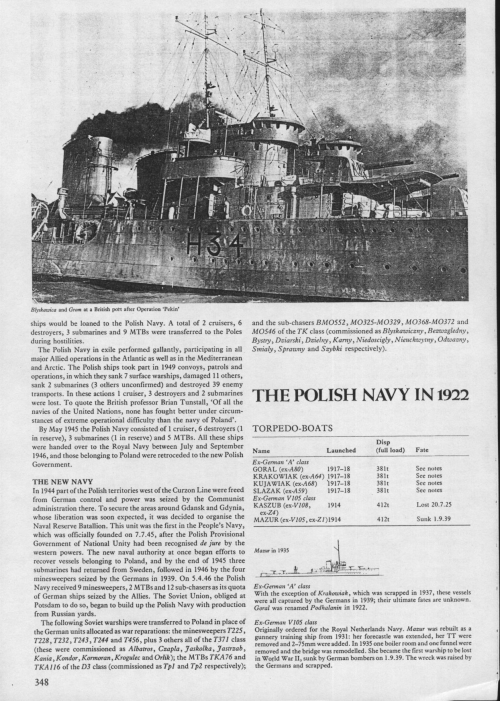
2 Wicher-class Destroyers (French-built destroyers)
3 Wilk-class Submarines (French-built subs)

Additional ships commissioned by 1939
2 Grom-class Destroyers (UK-built destroyers)
2 Orzel-class Submarines (Dutch-built subs, the Orzel had a very interesting career)

Ships launched in 1939
2 Huragan-class Destroyers (construction started in July '37, scrapped by Germany; these were built in Gdynia by Poland itself)
2 unknown-class Submarines (laid down in France, never named, scrapped by Germany)

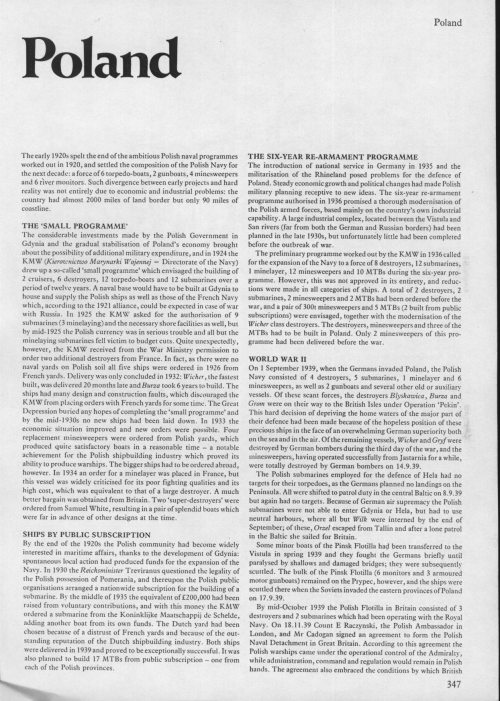
Poland also had many naval expansion plans, none of which were feasible due to economic reasons (notice the differences between the two 1920 build plans :)). The lists below are for the total fleet size. At the time the 1936 plan was made, Poland's navy consisted of only 2 destroyers and 3 submarines plus smaller vessels from the 1924 Plan, and only 2 additional destroyers and 2 additional submarines were delivered by the time the war started. The 1936 build plan was to be completed by 1942, with the bulk of the ships being built in Poland itself starting in 1940. The following are official expansion plans that were approved by Poland's government.
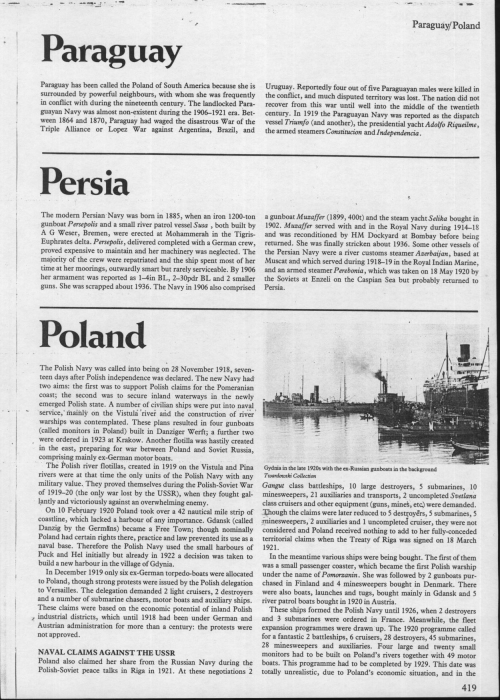
Russian Empire ships claimed by Poland*
2 Gangut-class Battleships
2 Svetlana-class cruisers (both unfinished)
10 destroyers
5 submarines

1st 1920 Plan
2 Battleships (these are NOT the Ganguts from above)
6 Light Cruisers
28 Destroyers
45 Submarines

2nd 1920 Plan (revision of the 1st 1920 Plan)
1 Light Cruiser
4 Destroyers
2 Submarines

1924 Plan (revision of the 2nd 1920 Plan)
2 Light Cruisers
6 Destroyers (2 delivered)
12 Submarines (3 delivered)

1936 expansion plan (revision of the 1924 Plan)
8 Destroyers (2 delivered, 2 already existing from '24 plan, 2 under construction when the war started)
12 Submarines (2 delivered, 3 already from '24 plan, 2 under construction in France when war started)

* Due to the chaos of the disintegration of the Russian Empire and the Russian Civil War, not all post-Russian states were given "their share" of the Russian navy. During the 1921 Riga peace talks, Poland demanded its share of the Russian navy, but dropped the claims for territorial gains instead to end the Polish-Soviet War.

My source was the official Polish Navy website: http://www.polishnavy.pl/PMW/history/index.html

TZoli has provided some more info about Poland's unofficial expansion plans, none of which were approved:

TZoli said:
1936/37 naval programme (what the polish admirals wanted)
2 Battleships similar to the 1938/39 one probably meant to counter the German Scharnhorsts
2 Heavy cruiser of 10.000tons 3x3 203mm Guns 9x 120mm AA guns 4x2 Torpedoes 10.000shp engine 200mm Armour
9 Destroyers
18 Submarines

1937/38 naval programme (what the polish admirals wanted)
3 Battleships of 25.000 tons 350mm Belt armour 120-140.000shp engine 3x3 305mm Cannons 4x3 or 6x2 150mm Guns 2x3 Torpedoes
1 Aircraft Cruiser probably similar to the Swedish Gotland crusier
12 Destroyers
21 Submarines
Proposed Naval Plan of 1942: (to be start at)
1 Battleship
1 Heavy Cruiser of 15.000tons 3x3 203mm and 9x 120mm Guns
Numerous Destroyers

constructive post from that forum:

" This 150 000 tons fleet is not the coincident. It has roots in Geneva Conference where Poland stated programme for such a large navy. It was purely of political reasons and everybody was aware that this was just propaganda and had nothing to do with real programme. In fact before Geneva Conference Polish Navy prepared 6 versions of the programme ranging from the most realistic ones to the totally s-f. The so called A programme stands for 18 500 t fleet, B for 25 000 t, C for 70 500 t (1 BB, 2 CA), D for 100 000 t (2 BB, 2 CA), E for 150 000 t (3 BB, 6 CA) and F for fantastic 210 000 t (4 BB, 8 CA). It was proposed to present in Geneva one of the versions D, E, F as 'official plans' and to show Polish ambitions for big navy. Later it was decided to show E as official plan. In fact the real plan was B which was later executed as 6-year programme (1936/42: 6 DD, 12 SS, 1 CM, 12 PM, 12 MTB). "
 
I was just asking if you had the complete C, D, and F programs.
I know a lot of naval programs, including unofficial ones, but I don't know the details of versions C, D, and F, because version E was the one presented in Geneva.
I'll compare it to what I have.

And as for the naval programs, maybe I'll write a post with all the official naval programs soon.
 
Sorry, this is all I have, I think from Conway's all the world fighting ships and other forums.
You might need to get into touch with Polish Naval enthusiasts who might know more or have access to the documents.
 
Returning to the plans to acquire battleships and ships in general from the partitioning powers, I found another mention of such plans in Jerzy Pertek's book "Mała Flota Wielkim Duchem" on pages 192-193, where I will quote his words on the subject:
"The first such idea arose at the end of World War I, when, as part of the initiative to establish Polish armed forces alongside Russian forces, a project was developed to man several warships with Polish crews. One of these warships was to be a battleship, and there is no doubt that a crew could easily be assembled from among the officers, non-commissioned officers, and sailors serving in the Russian fleet. Senior Polish officers often commanded Russian battleships, the last of whom was Kazimierz Porębski, who commanded the large battleship "Imperatrica Marija" from 1913 to 1916.
However, the aforementioned project was never implemented, because the outbreak of the February Revolution and then the October Revolution caused the course of events to take completely different paths than expected."

As a brief comment, I'll say that at that time, i.e., from 1917 to 1919, the Ukrainian Navy formally existed until 1921.
One such warship that flew the Ukrainian flag was the Pamiat Merkuria.

The idea I mentioned above dates back to 1917 and can be compared to the seizure of Black Sea Fleet warships under the Ukrainian flag, except that in Poland's case, it was intended to be on a smaller scale, as they wanted to man several warships, as I mentioned above. However, these did not have to be warships from the Black Sea Fleet, as in the case of Ukraine.

This is just to provide an analogy.
 
Last edited:
"The first such idea arose at the end of World War I, when, as part of the initiative to establish Polish armed forces alongside Russian forces, a project was developed to man several warships with Polish crews. One of these warships was to be a battleship, and there is no doubt that a crew could easily be assembled from among the officers, non-commissioned officers, and sailors serving in the Russian fleet. Senior Polish officers often commanded Russian battleships, the last of whom was Kazimierz Porębski, who commanded the large battleship "Imperatrica Marija" from 1913 to 1916.
Would be an interesting idea. Wonder, what battleship would be given? Since Baltic Fleet would likely be reluctant to give away (even formally) one of the precious new dreadnoughts, I think, one of "Imperator Pavel I"-class semi-dreadnoughts would be most likely.
 
Would be an interesting idea. Wonder, what battleship would be given? Since Baltic Fleet would likely be reluctant to give away (even formally) one of the precious new dreadnoughts, I think, one of "Imperator Pavel I"-class semi-dreadnoughts would be most likely.
The Polish wanted the newest Battleships as their rationale that many polish workers built them.
 
The Polish wanted the newest Battleships as their rationale that many polish workers built them.
Yeah, but I rather doubt that Navy would agree on that. There weren't that much battleships in Russian Navy, after all, so giving the newest units would be... well, more complicated.
 
I'm not sure by 1918/19:
4 Borodino class BC under construction
3+1 Sevastopol/Gangut class
3 Imperatritsa Mariya class
1 Imperator Nikolai I

That is 8 battleships, 2-3 need repair and I don't know the state of Nikolai I, and 4 battlecruisers need completion
Of course all are outclassed by every navy's new construction
 
and I don't know the state of Nikolai I,
Hull was about 75% complete, armor 65% produced (but installed only about 30%), machinery was in low state of completion due to more urgent war needs.

and 4 battlecruisers need completion
Izmail's hull was about 65% complete, armor 36% installed, boilers and machinery 66% installed. Her turrets were planned to be ready by 1919.

"Borodino" hull was about 57% complete, armor 13% installed, boilers and machinery 40% installed. Her turrets were planned to be ready by 1920.

"Kinburn" and "Navarin" hulls was about 50% complete, armor 5/2% installed, boilers and machinery less than 20% installed. Their turrets were planned to be ready by 1920.

Of course all are outclassed by every navy's new construction
Well, "Izmail"'s were basically as good as HMS Hood or Kongo-class; less seakeeping capability, but better armor and artillery.

Maria's and Nikolay's were roughly comparable to early superdreadnoughts due to their excellent guns.

So basically, after completion of all naval programs, Russian Empire were planned to have fleet generally comparable to Japanese one.
 
Would be an interesting idea. Wonder, what battleship would be given?
That's a good question, because the book didn't specify what kind of warships they were supposed to be — if, of course, any specific ones were in mind. After all, this idea dates back to 1917.
 
I have a question, @Tzoli .
In one of the threads on this forum, you wrote:
Ages ago I've posted somewhere (apart from the now gone warship projects forum) the Polish intended naval programme of what the admirals wanted between the two world wars and what Poland demanded from the Russians after ww1. It included Ganguts, Svetlana cruisers new build battleships and heavy cruisers.
Therefore, my question is: do you still have the proposals for what was demanded from Russia after World War I, including the latest battleships and heavy cruisers? (If I understood correctly).
And where did you get this information?
Because honestly, I don't know of any proposals for demanding the latest battleships from Russia.

To be precise: what is mentioned at the beginning of this thread - what was demanded from the partitioning powers after the end of WW1, i.e. variants from Austria-Hungary, Russia and Germany - is true, I originally found it on the Polish forum dws.org in one of the threads, but these plans are mentioned in the book Marynarka Wojenna Polski Odrodzonej, volume 1.
 
I have a question, @Tzoli .
In one of the threads on this forum, you wrote:

Therefore, my question is: do you still have the proposals for what was demanded from Russia after World War I, including the latest battleships and heavy cruisers? (If I understood correctly).
And where did you get this information?
Because honestly, I don't know of any proposals for demanding the latest battleships from Russia.

To be precise: what is mentioned at the beginning of this thread - what was demanded from the partitioning powers after the end of WW1, i.e. variants from Austria-Hungary, Russia and Germany - is true, I originally found it on the Polish forum dws.org in one of the threads, but these plans are mentioned in the book Marynarka Wojenna Polski Odrodzonej, volume 1.
I've already postad that here:
https://www.secretprojects.co.uk/threads/polish-projects.38305/page-9#post-882617
As for source, I think it was from Conway's All the World Fighting Ships. But this was like 15-16 years ago, I do not remember the source. Will check the books. But it could had been another person's post from the old and defunct warship projects forum.
 
Therefore, my question is: do you still have the proposals for what was demanded from Russia after World War I, including the latest battleships and heavy cruisers? (If I understood correctly).
And where did you get this information?
Because honestly, I don't know of any proposals for demanding the latest battleships from Russia.
The problem with such kind of data is, that in political turmoil of the era it's pretty hard to discriminate between serious plans and someone's wild proposals.
 
In this post, I will discuss the naval programs described in Siegfried Breyer’s book *Battleships and Battlecruisers 1905–1970* (Poland’s naval programs were detailed on page 483, if I recall correctly).
Two naval programs are described in the aforementioned book:
1 . The first is the Plan 1936/1937, which included two battleships of 25,000 tons (standard displacement) and two heavy cruisers of 10,000 tons (armament: 3x3 203 mm guns, 9x120 mm guns, 2x4 torpedo launchers; armor up to 200 mm; four turbines with a total output of 100,000 hp; estimated construction cost per cruiser: 70 million zlotys).
At that time, there were only two naval programs similar to the one mentioned above:
the first was the semi-official plan by Aleksander Potyrała from 1936, which included:
2 battleships of 25,000 tons (standard displacement),
2 heavy cruisers of 10,000 tons (3x3 203 mm guns, 9x120 mm guns, 2x4 533 mm torpedo launchers, 200 mm belt armor, 120,000 hp engine output, speed of 30+ knots—if I recall correctly, the estimated construction cost per cruiser was 70 million zlotys),
9 destroyers,
9 torpedo boats,
18 submarines.
A second program from 1937, similar to the 1936 plan, was also authored by Aleksander Potyrała; it comprised:
2 battlecruisers with a displacement of 25,000 tons,
2 heavy cruisers (Józef Dyskant in his book "Krążowniki Dragon and Conrad: Nawodne Bliźniaki", describes this as a design project and provides the following specifications: standard displacement—i.e., excluding ammunition, water, and food reserves; armament: 3x3 203 mm guns, 9 dual-purpose 120 mm guns, over a dozen 40 mm and 20 mm anti-aircraft guns, plus several heavy machine guns - in Polish Nkm(likely the 13.2 mm Hotchkiss) and medium machine guns - in Polish ckm (presumably 7.6 mm caliber, though this is my conjecture) and 2x4 533 mm torpedo launchers; armor protection for the waterline, main artillery, and conning tower reaching up to 200 mm; and 4 turbine propulsion units with a total output of 100,000–120,000 hp, enabling speeds exceeding 30 knots.
The estimated construction cost per cruiser was 70 million zlotys.)
9 destroyers,
9 torpedo boats,
18 submarines,
21 minesweepers,
24 motor torpedo boats and at least a dozen smaller vessels.
The total fleet tonnage was 145,776 tons, and the cost of the entire program amounted to 1.061 billion zlotys.
It appears that what is described as the Plan 1936/1937 is actually Potyrała’s 1936 program; the differences in the data are minimal.

2 . The second program described in the book is the Plan 1938/1939, which comprises:
3 battleships of 25,000 tons (3x3 305 mm guns, 12 152 mm guns, 2x3 torpedo tubes, 350 mm belt armor, total turbine power of 120,000–140,000 hp, speed of 30 knots; construction cost per battleship estimated at 162.5 million zlotys)
1 air cruiser with a displacement of 6,000 tons
12 escort vessels
12 destroyers with a displacement of 2,000 tons
21 submarines
18 torpedo boats
1 minelayer
16 minesweepers.
And here lies the problem:
I do not recall Poland working on such a program between 1938 and 1939; although I have not found the source where such a program was published, in my opinion, this is also an unofficial naval program created by someone associated with the Polish Navy —reflecting private views on the expansion of the Polish fleet.
However, the leads point to Julian Ginsbert, who wrote articles for the Polish press and magazines.
He was essentially constantly working on fleet modernization.
I am aware of at least three naval programs authored by him:
a) One from 1932, based on the novel *Panna Wodna* (the story's titular character is a "crusader" — a vessel type somewhere between a light cruiser and a destroyer):
3 battleships
1 aircraft carrier
4 crusaders
1 training cruiser
13 destroyers
18 submarines
6 motor torpedo boats.
The total fleet tonnage is about 150,000 tons.
b) Another naval program, created after World War II while Ginsbert was living in exile in Great Britain; I found this in *Przegląd Morski* nr. 2/2012, in the article "Programy rozwoju floty polskiej. Część 2."
This program included:
3 battleships (20,000 tons each)
2 cruisers (6,000 tons each)
4 large destroyers (2,000 tons each)
16 destroyers (1,000 tons each)
2 minelayers (2,000 tons displacement each)
6 large submarines (1,200 tons displacement each; designated as "submarine cruisers")
3 submarine minelayers (1,000 tons each)
And 15 small submarines (500 tons surface displacement each).
Additionally, there were 12 escort vessels (600 tons displacement), 16 minesweepers, and 24 motor torpedo boats.
The total fleet tonnage is 150,000 tons.
c) Another naval program authored by Ginsbert dates back to 1936; this ten-year program included:
3 battleships of 25,000 tons each,
1 aircraft cruiser of 6,000 tons, modeled on the Swedish cruiser *Gotland* (8 × 152 mm guns, 8 × 102 mm guns, 12 fighter-bombers launched from catapults located at the stern and amidships, speed of 35 knots)
1 minelaying cruiser with a displacement of 4,500 tons, carrying 600 mines and 2 seaplanes— capable of serving as a flotilla leader,
12 destroyers of 2,000 tons each,
12 escort vessels of 600 tons each,
1 minelayer,
21 submarines,
12 motor torpedo boats,
16 minesweepers.
Initially, the cost of this program was estimated at 1.5 billion zlotys, though this figure was later revised to 2.5 billion zlotys.
I conclude that the aforementioned Plan 1938/1939 was a modification of Ginsbert’s mid-1936 program — omitting the minelaying cruiser and increasing the number of motor torpedo boats (18 versus the 12 proposed in 1936), while the rest remained the same.
However, these were merely the private views of individuals associated with the Polish Navy, rather than actual official intentions.
 

Similar threads

Back
Top Bottom