Interesting. But there seems to have been the idea to use the Alizé's radar and the Jaguar to only carry the missile... or this was all about AS-30 and Martel.

You're talking about that quote about the next strike aircraft needing radar because of the retirement of Alizé, right? I don't think that's necessarily tied to Exocet; it's probably referring to the difficulty of simply finding targets at sea without a radar-equipped aircraft. Without radar, you'd use something like Alizé to help lead a flight of strike aircraft to the general vicinity of the target. (Argentina did this with Skyhawks and S-2 Trackers in the Falklands., for example.)
 
Mirage G with Spey would have been a pretty outstanding aircraft. Touchdowns were achieved at a speed as low as 108 kt. Not bad for a 15 mt plane. And two seater, with that. It would have been the ideal "in between" Phantom and Tomcat. In another forum long ago, we found a name for it: the Tomkitten.

It could have certainly hauled a pair of AIM-54s (from ESSEX carriers !) or, alternatively, 530 / Skyflash. On mobile underwing pylons, Tornado / F-111 style.

After the F-111B and before Tomcat / Hornet, the USN was very interested. So was Vought, which had a special relationship with France (since 1939 and the V-156F) and Dassault (in the 60's). Vought entry in the Tomcat race had a MoU with Dassault, and strong Mirage G DNA, including the air intakes.
 
It could have certainly hauled a pair of AIM-54s (from ESSEX carriers !) or, alternatively, 530 / Skyflash. On mobile underwing pylons, Tornado / F-111 style.

But could it have carried AWG-9? Without that, those Phoenix are expensive ballast. I suspect it could not, as AWG-9 was huge.
 
You probably have a point... just like Cyrano de Bergerac, it would need a very large nose.
:p

Cutaway

avions-marcel-dassault-mirage-g-prototype-cutaway-drawing-aviation-magazine-international-no-jpg.131185
 
The Phantom/Buccaneer combination was probably as good as any of these unbuilt designs. Ark or Eagle take you to 1978.
CVA01 if it had been built in the late 60s might have joined in 1974 or so.
F18s would probably have been bought at around the same time the USN replaced its Phantoms on Midway and Coral Sea.
Sorry no paper planes.
CVA01 might have been a nightmare to operate in real life. But I think it would have survived Nott in 1981. NATO would have argued strongly for her retention.
Whether CVA02 would have followed in the 70s is hard to say. With NATO backing and no East of Suez baggage as in our timeline she might have done.
Seakings, a couple of Hawkeyes and maybe even a Greyhound would have been part of the air group.
The quid pro would have been disposal of the 8 Countys and Blake and Tiger in the 70s as the T42s arrive. Probably the SSN programme would also have been more drawn out and the earlier boats phased out sooner.
 
Mirage G with Spey would have been a pretty outstanding aircraft.

The Aeronavale had a strangely ambitious requirement for the Crusader replacement and would not accept anything less:

"... monter à Mach 2/50 000 pieds en 7 minutes, avec deux engins, et avoir un temps d’attente de 1h 40 à 100 miles nautiques. Il est précisé qu’un appareil ne satisfaisant pas à ces minima ne présenterait plus d’intérêt militaire pour la Marine dans la période considérée"

Maybe they wanted to push through the Mirage G as per the demonstrator, but they also have something on the Spey:

"Ainsi, le seul avion répondant aux demandes de l’état-major de la Marine est un avion à géométrie variable avec réacteur américain TF 306 E ; avec un réacteur britannique Spey, l’avion à réservoir ventral supersonique se rapprocherait des performances demandées"

Again from http://www.eurosae.com/wp-content/uploads/2017/09/Bonnet_Avions_militaires_I.pdf
 
Those COMAERO / Bonnet documents are very good and useful.

That was one of the reasons the F1-M53 while considered by the Aéronavale, never had a "true" chance. The M53 lacked thrust (that's an understatement, and remained true until M53-P2 in the mid-80's) and the wing was too small.

The real missed oportunity, even more than the F1-M53, was the Mirage F3. In fact a F3-M53-P2 would have been near perfect. Alas, these two missed by two decades (1967-1987). Shame.

Had the F3 and (nascent) M53 been combined circa 1968-69, they could have erased three aircraft from history
-Mirage F1-Atar
-Mirage F1-M53
-Mirage 2000
It also would have saved the Armée de l'air a rather expensive duplication (F1+2000) and the best part of a decade.
 
The trouble with these Ark Royal at the Battle of the Falklands scenarios is that they often miss the vital detail.

<SNIP>

I don't really buy the argument one carrier would have prevented an invasion, the Argentines had carrier airpower, were operating with shore-based fast jet support, they had diesel subs. An Exocet hitting Ark could well have caused serious damage, she was not invulnerable and if there were no Gannets, just as vulnerable to air attack as the newer RN ships. If anything they should have been more worried about the SSN fleet.
Nice post, but shouldn't this be in the Ark Royal in the Falklands thread?
 
Yes this has randomly popped up here! Hopefully a Mod can move it.

Done, sorry for the delay.
 
Last edited by a moderator:
To be honest I don’t see how you improve on the historic Hermes air group of 12 Sea Vixen, 7 Buccaneers, 5 Gannets and 5 Wessex...
The RN apparently did a study on an all A-4 Skyhawk group, I believe the number was 28 or 30 but will need to find and check the reference (if I can ever remember where I read it).

I have wondered how a Jaguar M air group would have done. More to the point how a Sea Jaguar FRS1 then F/A2 using Sea Harrier avionics, would have done flying into the 80s or potentially 90s on Hermes, Vic and Eagle.
So had the Jaguar M worked out better it might have delivered such a capability.
But this does remind me of a curious question I still have. Why is there no supersonic version of the Skyhawk?
As this would solve this conundrum, and sell quite well.
If you don't mind me saying zen, to have the A-4 Skyhawk supersonic would undoubtedly require an afterburning engine to replace the reasonable fuel-efficient J52/J65 engine. A thinner wing (which might cause issue with main landing gear storage), an air-to-air centric radar (and it's associated black boxes)....all equating to a very short legged and limited fighter, with limited offensive/defence armament because external fuel would most likely be required.
Saying this I have read that Douglas (or it could have been McDD by that stage) studied a proposed fighter/Interceptor derivative of the Skyhawk, which seems to have remained subsonic, but carried it's air-to-air radar in a modified droptank and was to be armed with Aim-7 Sparrow AAM's...... [I'll attempt to find the quote/literature!].

Such configuration would seemingly give the Skyhawk the best of both worlds - attack and fighter/interceptor options (alas subsonic).

Regards
Pioneer

 
Last edited:
To be honest I don’t see how you improve on the historic Hermes air group of 12 Sea Vixen, 7 Buccaneers, 5 Gannets and 5 Wessex...
The RN apparently did a study on an all A-4 Skyhawk group, I believe the number was 28 or 30 but will need to find and check the reference (if I can ever remember where I read it).

I have wondered how a Jaguar M air group would have done. More to the point how a Sea Jaguar FRS1 then F/A2 using Sea Harrier avionics, would have done flying into the 80s or potentially 90s on Hermes, Vic and Eagle.
So had the Jaguar M worked out better it might have delivered such a capability.
But this does remind me of a curious question I still have. Why is there no supersonic version of the Skyhawk?
As this would solve this conundrum, and sell quite well.
If you don't mind me saying zen, to have the A-4 Skyhawk supersonic would undoubtedly require an afterburning engine to replace the resalable fuel-efficient J52/J65 engine. A thinner wing (which might cause issue with main landing gear storage), an air-to-air centric radar (and it's associated black boxes)....all equating to a very short legged and limited fighter, with limited offensive/defence armament because external fuel would most likely be required.
Saying this I have read that Douglas (or it could have been McDD by that stage) studied a proposed fighter/Interceptor derivative of the Skyhawk, which seems to have remained subsonic, but carried it's air-to-air radar in a modified droptank and was to be armed with Aim-7 Sparrow AAM's...... [I'll attempt to find the quote/literature!].

Such configuration would seemingly give the Skyhawk the best of both worlds - attack and fighter/interceptor options (alas subsonic).

Regards
Pioneer
Going from memory here, but I'm pretty sure that the Skyhawk was not area ruled either, so getting it to go supersonic may also require a redesign of the fuselage. Which would definitely make the project more trouble than it's worth given the absolute embarrassment of riches the United States had when it came to supersonic naval fighters.
 
To be honest I don’t see how you improve on the historic Hermes air group of 12 Sea Vixen, 7 Buccaneers, 5 Gannets and 5 Wessex...
The RN apparently did a study on an all A-4 Skyhawk group, I believe the number was 28 or 30 but will need to find and check the reference (if I can ever remember where I read it).

I have wondered how a Jaguar M air group would have done. More to the point how a Sea Jaguar FRS1 then F/A2 using Sea Harrier avionics, would have done flying into the 80s or potentially 90s on Hermes, Vic and Eagle.
So had the Jaguar M worked out better it might have delivered such a capability.
But this does remind me of a curious question I still have. Why is there no supersonic version of the Skyhawk?
As this would solve this conundrum, and sell quite well.
If you don't mind me saying zen, to have the A-4 Skyhawk supersonic would undoubtedly require an afterburning engine to replace the resalable fuel-efficient J52/J65 engine. A thinner wing (which might cause issue with main landing gear storage), an air-to-air centric radar (and it's associated black boxes)....all equating to a very short legged and limited fighter, with limited offensive/defence armament because external fuel would most likely be required.
Saying this I have read that Douglas (or it could have been McDD by that stage) studied a proposed fighter/Interceptor derivative of the Skyhawk, which seems to have remained subsonic, but carried it's air-to-air radar in a modified droptank and was to be armed with Aim-7 Sparrow AAM's...... [I'll attempt to find the quote/literature!].

Such configuration would seemingly give the Skyhawk the best of both worlds - attack and fighter/interceptor options (alas subsonic).

Regards
Pioneer
Going from memory here, but I'm pretty sure that the Skyhawk was not area ruled either, so getting it to go supersonic may also require a redesign of the fuselage. Which would definitely make the project more trouble than it's worth given the absolute embarrassment of riches the United States had when it came to supersonic naval fighters.
Yes, good and valid point about the Area Ruling issue SsgtC, something I completely overlooked.

Regards
Pioneer
 
An Etendard IV would make a better starting point than a Skyhawk for a supersonic fighter, as it already is transonic (and therefore area ruled).

However the stumbling block in both cases is the lack of a suitable afterburning engine in the early 60s. The Atar & J79 being too big and the Jaguar’s Adour being too small. The F404 or RB199 would have been perfect but came one generation later so would only have been an option for the Super Etendard.

In fact an RB199 Super Etendard would seem like the perfect basis for a late 70s small naval multirole fighter, as the RB199 is very similar in size to the Atar 8K50 but with the benefit of reheat and much lower fuel consumption… would have been a nice what if.
 
An Etendard IV would make a better starting point than a Skyhawk for a supersonic fighter, as it already is transonic (and therefore area ruled).

However the stumbling block in both cases is the lack of a suitable afterburning engine in the early 60s. The Atar & J79 being too big and the Jaguar’s Adour being too small. The F404 or RB199 would have been perfect but came one generation later so would only have been an option for the Super Etendard.

In fact an RB199 Super Etendard would seem like the perfect basis for a late 70s small naval multirole fighter, as the RB199 is very similar in size to the Atar 8K50 but with the benefit of reheat and much lower fuel consumption… would have been a nice what if.
There was the RB.153, which worked.
There was the M.45 which also worked.

While both don't produce as much thrust as a late model Avon or Atar in dry thrust. Their reheated thrust does match them.
But they both weight a lot less, through the use of convergent divergent nozzles produce higher velocity thrust than dry Avon or Atar and consequently do allow for supersonic flight.
Especially so with variable inlet(s).

In fact this is why a twin RB.153 offering on the Lightning made sense. Despite what seems like lower static sea level thrust levels.
Again this is because of much lower engine weight, lower fuel burn, modern exhaust nozzles. Such that performance was very similar to the older Avon version.
 
Like all defence issues, hindsight is a wonderful thing.
The Falklands was an avoidable war. Rather like the current Covid crisis, Whitehall let the politicians take the hit for the failure of the institutions to see it coming and urge action sooner.
Without the Falklands in 1981 Nott's emphasis on our NATO commitments,especially the Central Front,would have been entirely uncontroversial.
The RN had never grasped that taking the nuclear deterrent from the RAF had been a poisoned chalice. Whereas Vulcans and Victors had many roles short of nuclear war and were visible at annual Battle of Britain shows, the nuclear submarine force was out of sight and out of mind.
The RAF had never forgotten or forgiven Mountbatten's role in trashing TSR2. Revenge came quickly in 1966 and CVA01.
But, the RN was still seen by the RAF as an archaic and overblown force.
Air Power was crucial to all the key UK defence roles. Nott was briefed accordingly.
Three carriers or even 4 meant that often only one could be guaranteed to be available.
Reducing the force to the two later ships and letting the RAN have Invincible was thus quite reasonable.
The amphibious warfare force (2 LSDs and 5 LSTs) was a legacy of the 1960s build up East of Suez. Its remaining NATO role to reinforce Denmark and Norway was to move largely lightly equipped infantry units. These could just as easily be flown in.
The escort ship force in 1980 was largely obsolete. Only the newT22 and T42 ships were of some use in the North Atlantic. The T21 and T12 plus even older units had no defence against Soviet missile attacks from surface,sub surface or air units.
Putting resources into the vital nuclear deterrent and the highly effective SSN force, which the US respected and the Sovs feared was the right call.
Sorry to resurrect this but while going through a variety of postings on Carrier Air and the Falklands.
I came across you posting either I didn't see it then or missed it completely.
You're working on the interesting premise that the British government were the only one the participants in the war.
Anya was not only the main planner of the invasion but had been I believe the senior military attache to their embassy . He based the decision to go after the Falklands as opposed to seizing the Beagle channel.
Based on his beliefs that an effete UK would be unable rouse the their manly desire for glorious battle .
Anya is is an interesting case study in the Peter Principle if nothing else .
But the point I'm trying to make is that short of posting either a CTOL carrier task group or a couple of SSN s based in the the Falklands. The Argentine Junta was going to have it's little war.
The other guy always gets a vote in these things
Anya was as thick as a Charlie Sheen pre- nup. And the other Junta members weren't all that far behind either.
British capability barely came into their decision. They were in the midst of crisis if they didn't do something . They'd most likely end up in Prison if they were lucky ..if not dangling from a light pole Ahla Mussolini.
In this case They chose..... poorly.
 
I know this is a well covered subject but I was wondering if there is anywhere an RN document from 1965 or 1966 showing what its planned 1975 or so carrier fleet was supposed to look like.

Based on what has been posted here already here is a stab at what I think was intended

Fleet Carriers

1 CVA 01 type (Queen Elizabeth)

1 Audacious type (Eagle)

The air groups for the above would have resembled that actually deployed in Ark Royal in 1975
(1sqn Phantom 1 Sqn Buccaneer, Gannet AEW/COD , Sea King ASW Wessex SAR)

Hermes as also planned to continue in service. As far as I can find it was only planned to operate 1 or 2 squadrons of Bucaneers from this ship, with supporting helos. I suppose the squadrons would come from the Eagle/QE who would then operate 2 Phantom squadrons. Presumably Hermes was not expected to operate on its own.

Had AFVG or an equivalent been developed for service from 1980 or so, Hermes could have operated into the 80s as a mixed carrier again, with QE. Eagle would leave service as soon as CVA02 (Duke of Edinburgh) entered service in 1980-2

The Commando Ship and Helicopter cruiser force was presumably planned to be Bulwark/Albion and the three Tiger class. Replacement ships were being developed to be ordered once CVA 01 was out of the way and before CVA 02 main costs.

I assume this is what the 1965 plans envisaged. It is not hard to see why it was too much for a strapped British budget.
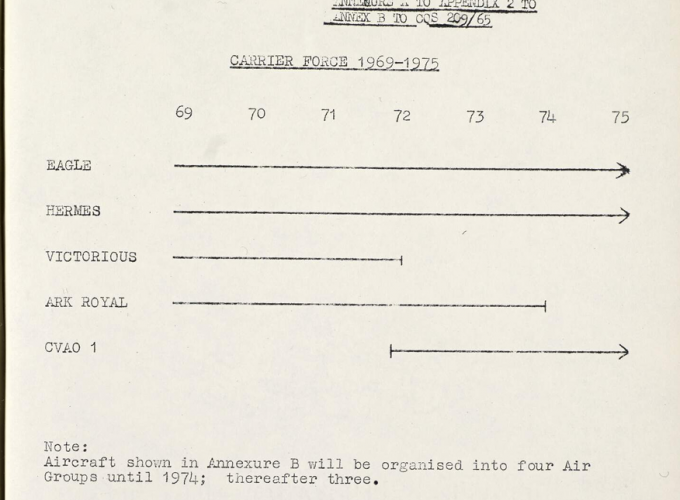
Believe it or not I have actually got a answer for what was planned in 1965 for 1975 carrier wise.

1752013709614.png
 
Believe it or not I have actually got a answer for what was planned in 1965 for 1975 carrier wise.

View attachment 777442
Do you have a date for the origin of this document?
Bearing in mind Ark Royal was identified reasonably early in the Carrier Replacement Programme as not being 100% reliable, I could see her, despite the fact that she is the larger of the two ships, being taken out of service before Victorious…in fact, if I recall correctly as opposed to CVA-01 and 02 replacing Victorious and Ark Royal respectively in the original long range plan, CVA-01 was ultimately to replace both ships…
…Yes, I know the Vic would not be able to (safely?) operate Phantoms, but, she was better electrically etc, etc…
 
Last edited:

Similar threads

Back
Top Bottom