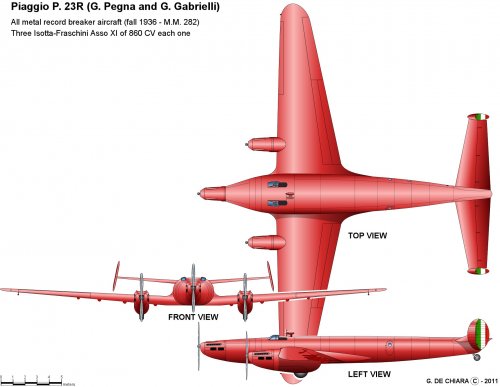
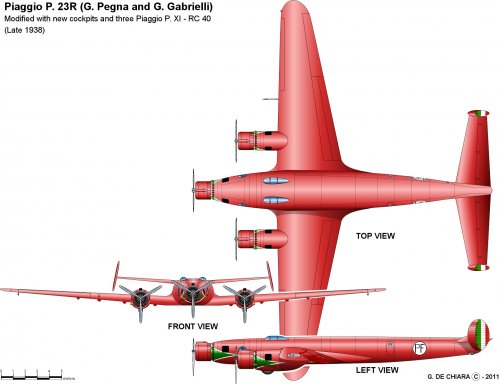
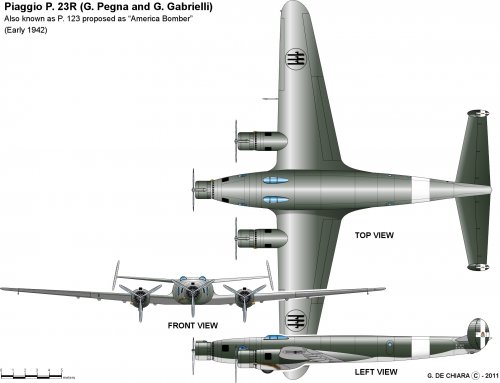
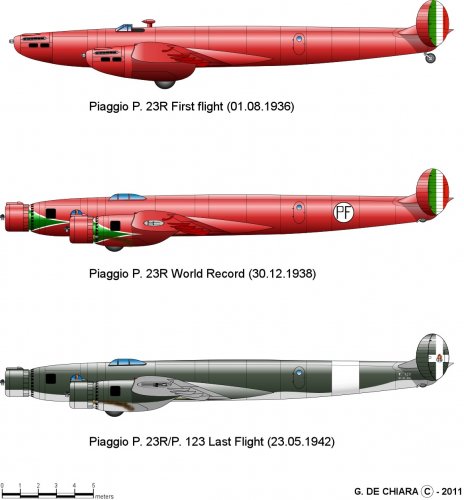
Here it is my personal contribution about the matter.
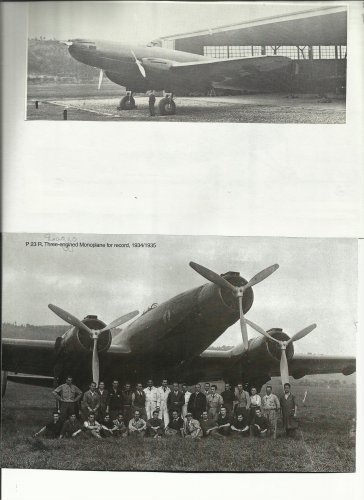
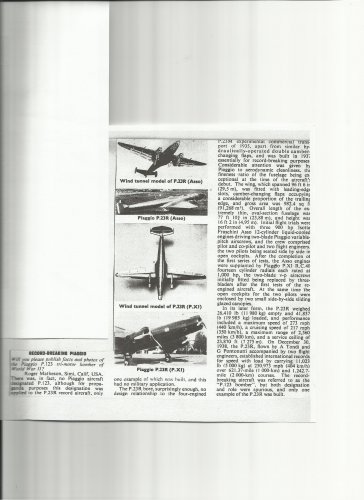
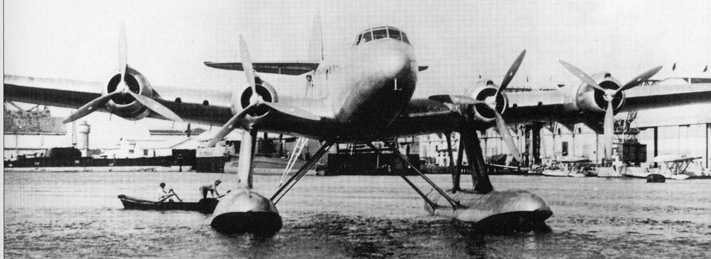
Less known Italian prototype of mid-30's, born as record breaker (and eventually succeded in it) was also utilized as fake bomber during WWII in order to mislead Allies. During 1942 it was seriously considered as potential "America Bomber" for a single hit run over New York with no return possibility (the crew should be rescued in open sea by Italian ocean going submarine).
Anyway the only prototype crashed during 1942 and it was scrapped.
Thanks Peppe for your continuous work about the lesser known Italian multi-engine planes.
In fact we had seen the P.23 only in wooden-color models or black and white photos and is really a pleasure to see it in its true red colors
Was it engine problems or powerplant/material shortages that precluded development of a production version? Even in limited numbers it would seem like a Military version could have been useful, IMHO.
Was it engine problems or powerplant/material shortages that precluded development of a production version? Even in limited numbers it would seem like a Military version could have been useful, IMHO.
It is dificult to answer it, probably Nico or Skybolt would do it better.
My guess is that P 23R was meant only for record purposes (like many other Italian aircraft of that times) and a military version could produce the same disastrous results of Breda Ba 88....
This made me do a little research. Per Wikipedia, the aircraft was designed to set commercial transport records, which explains the wide, unique fuselage cross-section.
Your first version with the abrupt canopies drew my attention. I would think the vertical back of the canopy would have created substantial drag.
In any case, that long wide nose must have made landings fun and challenging.
I second the others here. Thank you very much for documenting another aircraft that I was not familiar with. Makes me dig into some fun research.
This made me do a little research. Per Wikipedia, the aircraft was designed to set commercial transport records, which explains the wide, unique fuselage cross-section.
Your first version with the abrupt canopies drew my attention. I would think the vertical back of the canopy would have created substantial drag.
In any case, that long wide nose must have made landings fun and challenging.
I second the others here. Thank you very much for documenting another aircraft that I was not familiar with. Makes me dig into some fun research.
Thanks for your kind words Steve, I fully agree with you about the first canopy design, it is clear that the designer tried to reduce drag effect through the new canopies.
I also agree with you about take off and landing challenges, with this very long nose only skilled pilots could make airborne this beast even if I wonder about a periscope could help pilots during landing, but I've any clue about a periscope or other helping device....
Unfortunately not, the declared payload was 4.500 Kg but (obviously) for New York bomb run should be less (much less).
The latest word from Mussolini about the New York raid was to not drop bomb over the town but propaganda papers (like the Vienna raid of D'Annunzio during WWI) or a load of Sicilian Oranges (seriously!!) with tri-colour parachutes....
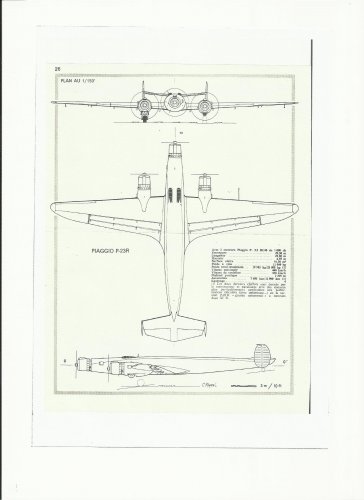
According to "Prototipi della Regia Aeronautica" by Nico Sgarlato (Delta Editrice):
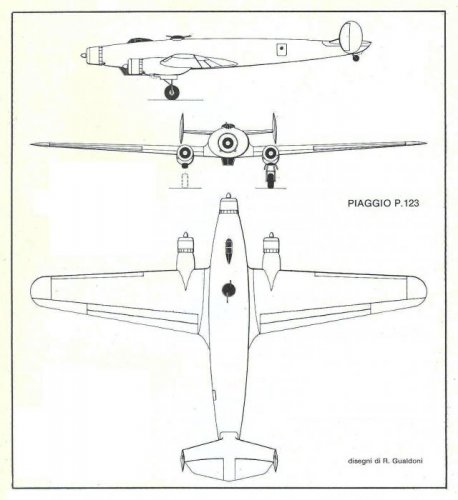
wingspan: 29 meters
lenght: 23,5 meters
height: 4,93 meters
wing surface: 91,5 sqm
empty mass: 8.900 kg
total mass: 23.900 kg
Hi fellows,
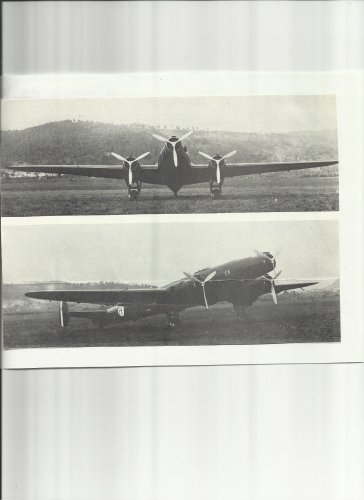
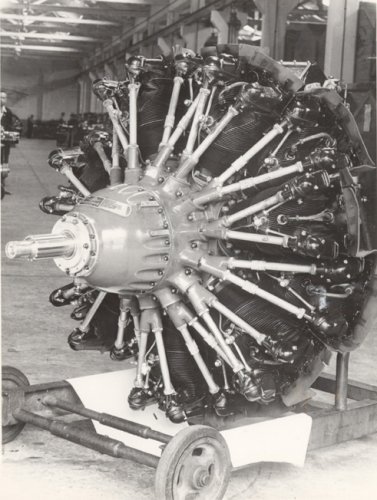
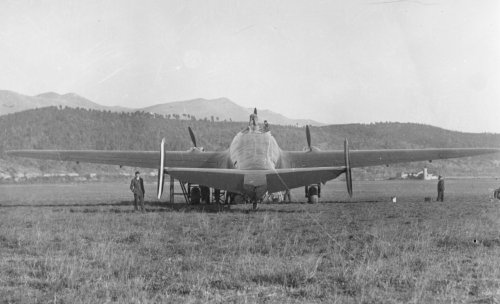
I enclose an interesting rear view of the P.23R and one of its Piaggio P.XI RC.40 engine, developed copy of the French Gnome-et-RH^one GR.14K Mistral Major.
In Mr. Piaggio and Eng. Casiraghi intention the P.23R was only a record plane. Notwithstanding, Casiraghi had the idea of developing it in something like the SIAI-Marchetti SM.82 Marsupiale. In 1938-1939 the technical bureau of Piaggio spent 18.680 hours of engineering work, proposing a BGR (Bombardiere a Grande Raggio, long range bomber), perhaps P.123B, but I failed to find proof of that designation) as an interim solution waiting for the definitive P.1008B re-engined with P.XII RC.35 Tornado. Piaggio offered a prototype after Ministero dell'Aeronautica interest for three aircraft. Work started on a wing structure, but the program was soon cancelled to avoid waste of resources during the P.108/P.133 development.
In the meantime there was the study of a transport version (P.123T) but the requirement was already fulfilled by SM.82 and P.108T and any development work was suspended.
Nico
I don't know if the planning reached the stage of devising the exact type of weapon. I know that some high brasses proposed a psy-war mission with the launch of a ton of leaflets and, according to Giancarlo Garello, one of the first author on that matter, was considered also a 'warload' of 1,000 kg of Sicily oranges...
Thanks to the all contributors! Do you have data or suggestions on the such wide fuselage?
I think that most fule in long-range aircraft has been stored mainly in wings, and for bomber there is no need for such capacious fuslage.
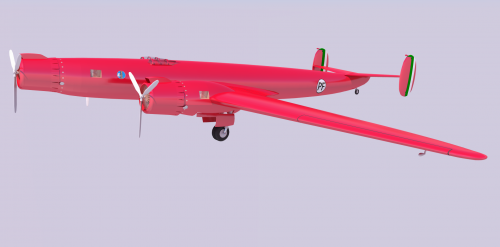
Amazing artwork, Archipeppe,
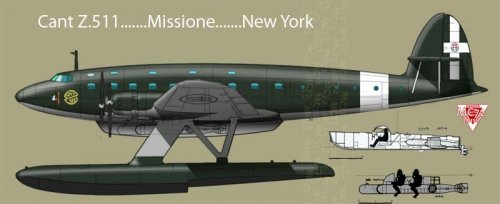
I was surprised by the wide fuselage, that is clear in your graphic, now i undestend because ... somebady think maybe was possibile a mission over New York; It was also felt in another plane for this purpose, this was the Cant Z.511, armed with a human torpedo or assault boat, which would be carried in a gondola between the floats.
Again wonderful Job!
Amazing artwork, Archipeppe,
I was surprised by the wide fuselage, that is clear in your graphic, now i undestend because ... somebady think maybe was possibile a mission over New York; It was also felt in another plane for this purpose, this was the Cant Z.511, armed with a human torpedo or assault boat, which would be carried in a gondola between the floats.
Again wonderful Job!
Many thanks MC-72, I also always liked your outstanding graphic jobs ;D.
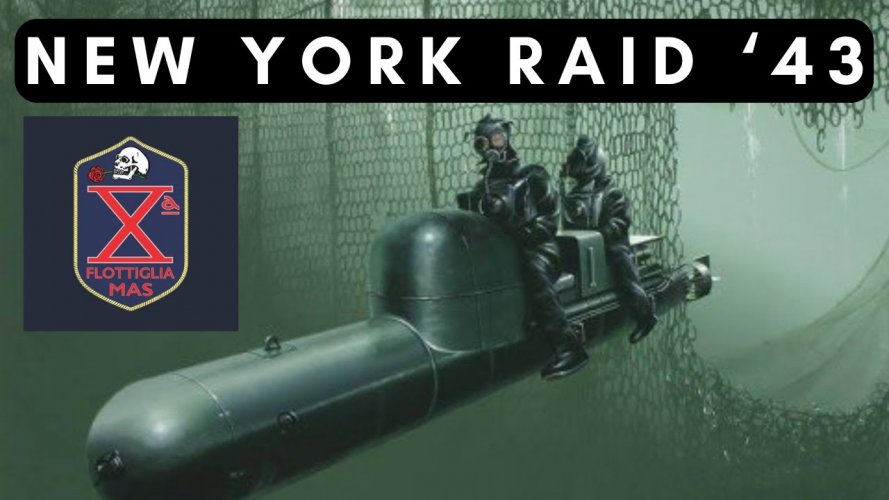
Actually there were a bunch of aircrafts that was seriously considered for the "Operazione S" (New York Raid), according to the old Aerei's article I've mentioned before, and they was for sure P. 23R, Z. 511 and SM- 95B.
Thanks for the info of the SM95 was also considered, I didn't know that extra candidate.
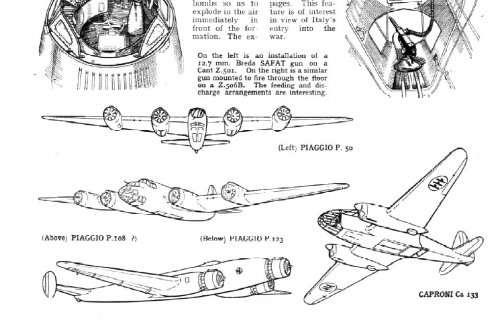
Also i found in Flight http://www.flightglobal.com/pdfarchive/view/1940/1940%20-%201708.html this report of article short after Italy declare War in WW2, a impression of P.23 as bomber Belived to be a P.123 trimotor bomber
Saludos
MC72
Thanks for the info of the SM95 was also considered, I didn't know that extra candidate.
Also i found in Flight http://www.flightglobal.com/pdfarchive/view/1940/1940%20-%201708.html this report of article short after Italy declare War in WW2, a impression of P.23 as bomber Belived to be a P.123 trimotor bomber
Saludos
MC72
Problem with the Link!!
well i send the image in cuestion os the Flight Magazine page 528 (13june 1940)same date of Today but 71 Years Ago!!!
Saludos
MC72
I can see that the modification were minor, an upper Breda Lanciani-L turret, a bottom windowed position for bomber (like SM-81) and (probably) a bomb bay.....
Hello everyone.
Here I am with a little contribution.
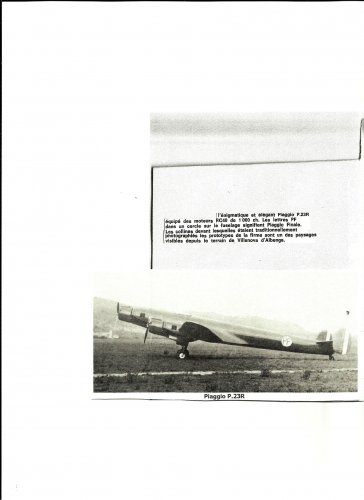
Paint scheme was the very first one, as shown in a post above, no titles (I-ABOC), no "PF" roundels on the wings, no (green?) decorations on the nacelles.
Cheers,
Marco
Some considerations about the Amerikabomber program and Operazione S.
How did the US and canadian bombers operate? They took off from Britain to bomb Germany.
There wasn't a bomber capable of reaching Germany from America and return in a single flight, in fact even today there isn't such a bomber, the B52 could theoretically but with a small payload, without air refueling...
For a mission like that with a full payload you expect to do 1 or 2 air refuelings.
There were air refueling tests during WW2 so it wouldn't be entirely impossible, but still, Axis bombers would have had to land somewhere in the Americas, and they had nowhere to land. And what was the Axis expecting to bomb in America anyway? They couldn't have destroyed American industry... Even the germans simply relocated their industry underground and kept fighting, a land victory was still necessary to defeat a country or complete encirclement and economic crippling at least.
That's why the V weapons stood for Vengeance, they were a retaliation for the british bombing of german cities. The V weapons were not intended to change the course of the war, even if London was completely destroyed it wouldn't have mattered. It was a propaganda show and a retaliatory measure. Also developing advanced technology was useful to trade with the Allies, it saved a lot of german scientists lives.
To this day things haven't changed, despite having ICBMs and other missiles and remotely operated weapons we still need boots on the ground, and bombers that take off from nearby countries, as the recent wars in the middle east have shown.
So we hear all the time that the Axis should have invested more in heavy bombing campaigns and it's true, I always said this too. Germany had foreseen the need for long range bombers when planning the invasion of the Soviet Union (Uralbomber) but didn't pursue the idea, focusing on air support and short range bombing. Combined arms was the more immediate necessity and it was what made them win in the early phases of the war, after all. And then the Luftwaffe was winning the battle of Britain when it was bombing air bases and infrastructure, but then Hitler changed the target to cities in retaliation for the first british bombings of german cities, so the British were able to get their air force back up again and win air superiority. Germany wasted their initial success, this is considered one of their greatest blunders.
Heavy bombers are useful if they disrupt the enemy economy, if they destroy infrastructure and production, not just cities.
Italy did this in a small scale with the P.108 and SM.82, for example bombing British oil in Palestine and Bahrain, dealing some damage. Refineries in Palestine were stopped for 1 month, a heavier bombing campain over more targets could have severely hurt the British economy, even without conquering their colonies it could have effectively been like losing oil and other resources coming from the colonies for Britain, temporarily, allowing for victories elsewhere. But italy had too few bombers, and was losing on other sides.
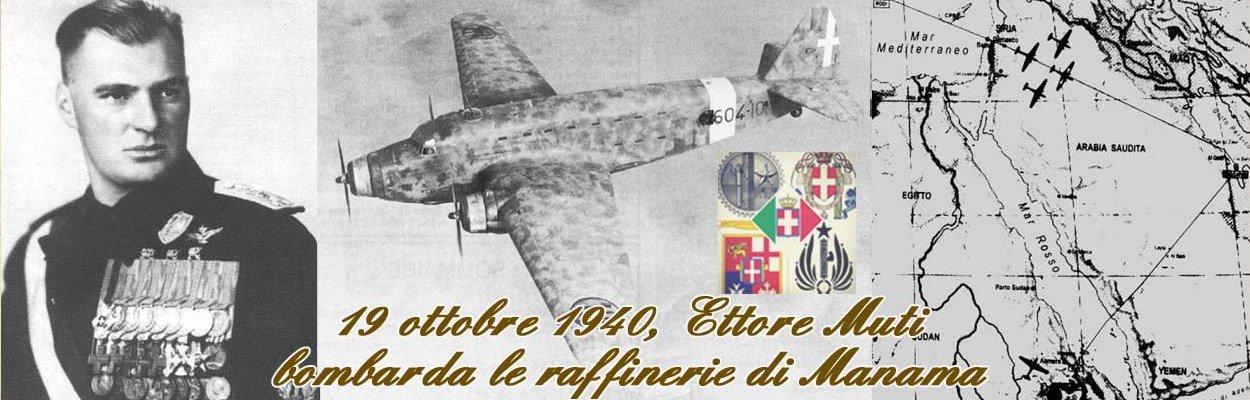
This was the Ettore Muti raid, it started from the Dodecanese, bombed Manama, and landed in Italian East Africa. It was a bold and heroic feat, effectively an intercontinental bombing spanning 3 continents.
Germany and Japan may have made amazing conquests over land, but never did something like this. Italy was the only one, and this would have been something that could have hurt Britain, not launching V weapons over London...
As for Operazione S, again Italy showed the best thinking: the CANT Z.511 was a huge transatlantic seaplane that was meant to carry midget submarines armed with torpedos to New York, these would have damaged ships or the port. Fast and stealthy, a proven concept entirely within Italy's capabilities. Instead using bombers to damage factories would have been almost impossible and wouldn't have done enough damage as we already said, and using V style weapons was even more absurd.
Even the initial idea of simply dropping oranges and leaflets on New York may sound ridiculous and make you laugh, but it's just a proof that Italy KNEW that bombing would have done almost NO significant damage, a mission to New York would mostly serve as propaganda, morale boost, as demonstration that the Axis could reach America etc...
It would have been still better than the Doolittle raid at least....
See even in Japan the US only managed to do serious bombing campaigns with B29s especially designed for the pacific once they conquered the Mariana Islands etc. but the raids were much fewer than in Europe.
And don't forget that Italy made long range flights to Japan before the Germans, over the USSR and the Arctic.
This site uses cookies to help personalise content, tailor your experience and to keep you logged in if you register.
By continuing to use this site, you are consenting to our use of cookies.