Mirages I - III/5, Prototypes & Projects

This was the original facebook post.
My post earlier contained a typo..it was 14 sets, not 16.

"Pakistan Mirage IIIO (ex Australian) with replacement wings from a ex-SAAF Mirage III EZ. Pakistan bought 14 sets of zero timed EZ wings to replace the wings on the IIIO’s they bought for the ROSE upgrade program. Later these Mirage III/V ROSE aircraft were also fitted with in flight refueling probes made in South Africa similar to those fitted to Cheetah Es."
 
Last edited:
There were 16 Mirage IIIEZ's converted to Cheetah E configuration.
After retirement, a number were sold to Chile as spares, and one was kept and is at the SAAF museum.
As far as I remember, South Africa originally ordered 17 EZ's, with an additional later airframe bought as an attrition replacement.

Further than that, and the description of zero timed wings, I'm not sure.
 
Last edited:
Correct. 16 EZs became Cheetah Es. The original order was for 16 EZs with the 17th an attrition replacement acquired some years later.
Three CZs were fitted with EZ wings in the late 80s so there were 13 EZ sets availble. That said, the wing sets of the DZ and D2Z fleets that were converted, plus one R2Z set, were also availble so putting together 14 sets with okay fatigue life left from ex-SAAF stock is totally plausible. The sets were mixed at times too. The R2Z at the SAAF museum Ysterplaat has one D2Z wing for example.
 
Long time ago I began doing side views of Mirages variants, from pictures and available known dimensions, so are very far from definitive and perfectly accurate. In the sense, reference on the MIIIS posted here by Overscan has the best MIII scale plan I've seen so far.

But here was my takes on these funny noses Mirages, and advanced Kfirs & Cheetahs. Funny how all Atar powered and canarded Israeli/South African kitted variants had their noses further extended.

Also how Kfir CE/C10 nose is even longer than on Cheetah C. I suppose the volume needed at the back of cockpit on the Cheetah C was transferred to the nose on the C10, as these were rebuild C2 & C7 as far as I know, so standard Kfir fuselages. the Nammer profile is obviously very speculative, but one can see it's basically an Cheetah C airframe with F404. So to me, the Cheetah C was the Nammer, but they couldn't get F404s...

FunnyNosesMirages.jpg

AdvancedKfirs-CheetahC.jpg
 
Last edited:
Really nice, Galgot.
I too had noticed the small plug forward of the cockpit in the Kfir C10.
A giveaway is the position of the front undercarriage positional difference between the Cheetah C and Kfir C10.
This plug on the C10 is not as big (voluminous) as the lengthening plug aft of the cockpit in Cheetah C, but clearly was needed for avionics.
The Cheetah C is the longest of the Mirage III derived single seat fighters.
Interestingly, with the SMR95 turbofan project, South Africa would have ended up with a Nammer analogue, but with a different turbofan.
Here is an interesting snippet from Flight International dated late 1989, which fits right in timewise regarding the Nammer and engines.
We can ignore some of the inaccuracies (original engine supply to Israel regarding J79/09K50, as well as the Carver design not being a twin engined Cheetah but a new design) but the gist of the article regarding the Nammer and Cheetah C is accurate I think.
 

Attachments

  • FB_IMG_1754835906137.jpg
    FB_IMG_1754835906137.jpg
    104.5 KB · Views: 114
Last edited:
I don't know if this would be the right topic for this.

This 424-page monograph on the IAI Dagger & Finger is being published in Argentina this month. It includes information on the Nesher program, its service in the Israeli Air Force, the Nesher's service and combat history in Israel, and later in Argentina as the Dagger, including improvements and modernizations (Finger Program) until the decommissioning of the last examples in 2015.

Regards

GwIkSd1W4AAFnmA
 
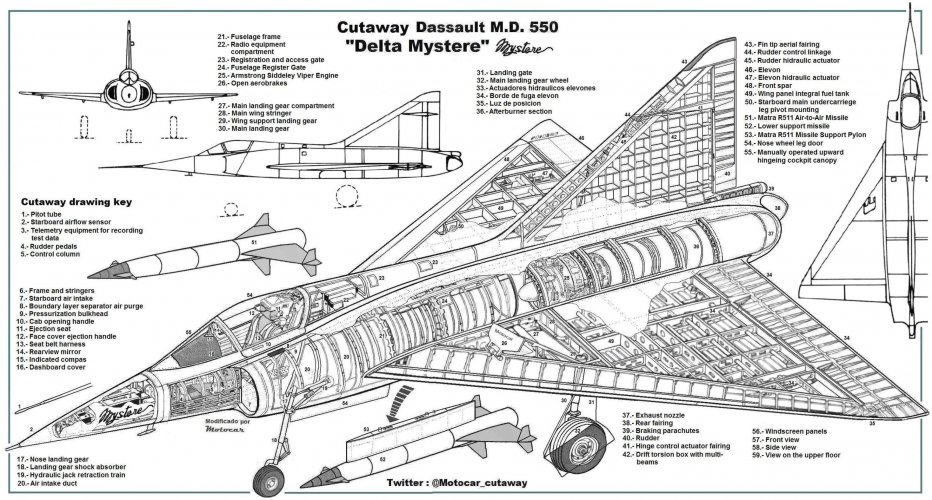
Schematic Cutaway Dassault M.D. 550 Delta Mystere As it was initially announced, Dassault's project was initially unveiled in response to the requirement for a fast-climbing interceptor, capable of reaching the flight level of Soviet bombers in a few minutes in the early 50's, it was a small light and very attractive fighter powered by two light Armstrong Siddeley Viper engines with afterburner, even so, it lacked the necessary thrust and that is where the 2nd part of the propulsion system was proposed, a liquid fuel rocket engine that would allow to achieve the performance requested in the specifications of the demanding requirement. Its enormous drift used the same construction technique as the Delta wings, Its armament was a Matra R511 Air-to-Air missile, which initially would be attached directly to the lower fuselage but then a launch pylon was added, my greatest surprise was to discover that despite being guided by radar the fighter itself did not have that system installed and depended on the ground control radar (something similar happened with the Leduc 022) the proposal soon It evolved to receive changes in different parts, the drift, thinner wings with different dihedral, more powerful engines, revised nose landing gear, more bulbous cockpit cover and slightly elongated fuselage. Anyway, changes that showed that a larger aircraft was necessary, which would lead to the single-engine Mirage II, the IIIA and its final version with Cyrano radar, the Mirage IIIC. It is worth concluding by saying that the Delta Mystere did not win that tender and preferences pointed to another proposal from the SNCASE firm. Motocar

Cutaway Drawing Key, modified by Motocar
 

Attachments

  • Cutaway MD Delta Mystere con infografia en ingles grande.jpg
    Cutaway MD Delta Mystere con infografia en ingles grande.jpg
    784.8 KB · Views: 88
As I said before, some people think that designing an airplane, changing its wings, and adding a canard is like putting a spoiler on your car or motorcycle project. Good grief... that's the level of expertise we've reached.

The phrase refers to Chile's purchase of Dassault Mirage 5 fighter jets, a case made famous by a corruption scandal involving bribes in the 1990s.

The Chilean Air Force (FACh) bought 25 Mirage 5 aircraft that had been decommissioned by Belgium. Despite the reference to "Fake IAF" (Israeli Air Force), the aircraft purchased by Chile were not related to Israel, although the Dassault Mirage 5 itself did have an Israeli origin.

Purchase: Chile acquired 25 Dassault Mirage 5 aircraft that had been decommissioned by Belgium, at a cost of $109 million.

Scandal: The deal was marred by a corruption case, in which it is suspected that $15 million was used for bribes and kickbacks.

Aircraft Origin: The Dassault Mirage 5 is a French supersonic attack aircraft, originally designed for the Israeli Air Force, which later became a popular export model.

"Fake IAF": The reference to the "IAF" (Israeli Air Force) refers to the origin of the Mirage 5's original design, but it has nothing to do with the Chilean purchase, which was made from Belgium.

This information can, of course, be found in Spanish.

Part of it is in Chile and the other part in Argentina. And the Spanish planes were also resold to Pakistan like from other countries ( not only Australia ).

It doesn't matter that information has even been provided about the name of the American engineer. Nor does it matter that someone even provided a photograph of the Dassault canard design in their wind tunnel.

This is what happens when some people concoct theories and reinforce each other. Their theories are based only on what they know. And when the story involves other countries outside their sphere or language, their story falls apart.

Those with in-depth knowledge of the history have already explained it. It doesn't matter. On Facebook, there are even those who have posted fake photos of Israeli Mirages supposedly attacking something (for advertising purposes, I suppose), and someone on Mirage forums has even been publishing a fabricated story about the Israeli origin of these models in installments.

When something is so repetitive and uses time to resurface in successive attempts, it's not a coincidence. But oh well. Some of us are interested in aviation history. Let's leave the rest to the fanatics and demagogues.

Good night.
 
Last edited:
Someday we should do a research or survey with illustrations, angles data, installation type, graphics and blueprints of all the canard wings of all the Mirages, Kfirs and Cheetahs; because they are all different.
 
Little changes can be made to the nose, as was done in Argentina to adapt an Israeli radar. The Argentinians say they did it themselves.

I understand that if they chose that radar, it is because the Israelis were already using it in their aircraft and would therefore have already adapted a radome to it.

Many little details can be discussed. I have heard that here in Spain, slots were also made in the wings.

But to propose structural changes ( wings, fuselage, landing gear, engine ... ) without many years of experience in wind tunnels at supersonic speeds, with the essential help of top-level engineers, including those who built the aircraft to be modified, is to misunderstand the complexity of aeronautics. And even more so in those years.

To think that a anyone other than the manufacturer's can make all that is, in my opinion, to take others for fools. I include marketing stories.

Or...to have no idea what they're talking about.
 
Nice.
These are Mirage IIIE, so they use SEPR 844 rocket engines which had the advantage of burning regular jet engine fuel.

The earlier SEPR 841 used on Mirage IIIC was using TX2 oxidizer (a mixture of triethylamine and xylidine). Its use was relatively dangerous, both because of the risk of explosion or fire and because of the hypergolic nature of the propellants and oxidizers used (particularly nitric acid), which ignited spontaneously upon contact.

It also necessitated two specific tanks, thus the MIIIC couldn't carry guns if equipped with the SEPR 841, the TX oxidizer tank being mounted in place of the "chassis canons" on the underside, after the main air intakes. The nitric acid being integrated to the SEPR 841 pack, in a stainless steel tank on the under fuselage rear part.
Thus equipped, the Mirage IIIC could only be armed with the R511, then R530 missile (later with AIM9B too). R530 was really only good for intercepting big straight moving targets, ie high flying soviet bombers.

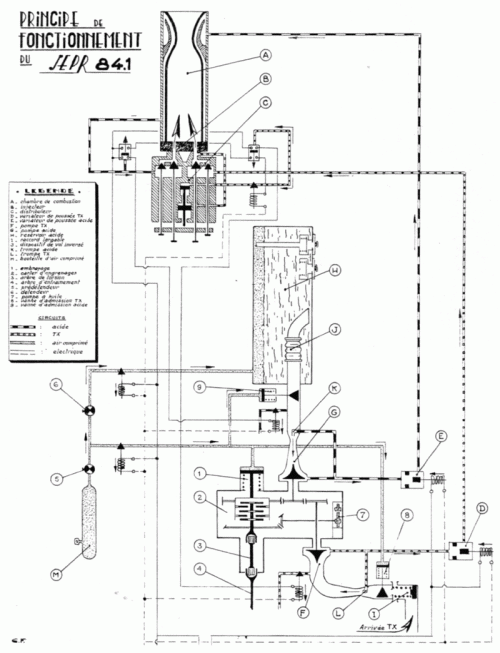
This is the SEPR 841 principle of operation image :
image810.gif

The SEPR 844 only used some TX2 oxidizer as a starting fuel to initiate combustion with the nitric acid, taken a small tank located on the lower part of the rocket part. Once started, it burned regular jet fuel.

The maintenance operations are very easy. By way of proof, the Defense NATO "Air Defence" concourse won by the Colmar Squadron in April 1970, and including turn around operations of four identical aircrafts after each mission. The Colmar’s Mirage 111 E equiped with SEPR844 made turn around times beetween 12mn9seeondes and 14 mn 55 secondes.

Taken from this interesting pdf attached :
 

Attachments

  • AIAA-90-1835.pdf
    944.8 KB · Views: 14
Last edited:
Nice.
These are Mirage IIIE, so they use SEPR 844 rocket engines which had the advantage of burning regular jet engine fuel.

The earlier SEPR 841 used on Mirage IIIC was using TX2 oxidizer (a mixture of triethylamine and xylidine). Its use was relatively dangerous, both because of the risk of explosion or fire and because of the hypergolic nature of the propellants and oxidizers used (particularly nitric acid), which ignited spontaneously upon contact.

It also necessitated two specific tanks, thus the MIIIC couldn't carry guns if equipped with the SEPR 841, the TX oxidizer tank being mounted in place of the "chassis canons" on the underside, after the main air intakes. The nitric acid being integrated to the SEPR 841 pack, in a stainless steel tank on the under fuselage rear part.
Thus equipped, the Mirage IIIC could only be armed with the R511, then R530 missile (later with AIM9B too). R530 was really only good for intercepting big straight moving targets, ie high flying soviet bombers.

This is the SEPR 841 principle of operation image :
View attachment 819967

The SEPR 844 only used some TX2 oxidizer as a starting fuel to initiate combustion with the nitric acid, taken a small tank located on the lower part of the rocket part. Once started, it burned regular jet fuel.


Taken from this interesting pdf attached :
Cool! It is basically the old BMW rocket engine P 3395.
 
Cool! It is basically the old BMW rocket engine P 3395.
Not sure it derived from that P 3395 specifically, but it certainly had some WWII German research roots.

SEPR, for Société d'étude de la Propulsion par Réaction (Jet Propulsion Research Company) was a French Gov owned company founded in 1944, taking advantages of the Germans researches and captured equipments in WWII.

The SEPR (Société d’Études de la Propulsion par Réaction) was founded on May 30, 1944, under the name SCEPR (Société Civile d’Études de la Propulsion par Réaction). While the early years were devoted to the study and reconstruction of recovered German equipment, by 1950 the society had the personnel and equipment necessary to undertake the study of new rocket engines.
from here.

Kind of the same thing as ATAR for Atelier Technique et Aéronautique Rickenbach .

Lots of the jet/rocket propulsion materials and technicians the French managed to grab were from BMW, because some were based in the French occupation zone at the war's end.
 
Last edited:

Similar threads

Back
Top Bottom