- Joined
- 25 July 2007
- Messages
- 4,918
- Reaction score
- 5,538
Gabardini/CANSA Aircraft Designations
After designing a radical catamaran flying boat in France in 1910, Giuseppe Gabardini returned to Italy in 1912 and set up Aeroplani Gabardini at Taliedo. In Dec 1913, Gabardini took over the Cameri facilities of AVIS (Ateliers Voisin Italie Septentrionale) and opened a flying school (Aeroplani Gabardini-Officine e scuola di volo-Aerodromo Cameri). To provide that school with training machines, Gabardini began the Società Anonima Gabardini per l'Incremento dell' Aviazione (or simply the 'Società Incremento Aviazione') in 1916.
Early Gabardini designs don't seem to have proper designations, receiving generic descriptive names like Monoplano, Idrovolante, Alpi, etc. The 1914 Gabardini Biplano was later designated as the G.3 (likely applied retroactively). According to Federico Filippi (WWI Aero, #153, Aug 1996), Gabardini first applied designation numbers in 1917. So, it seems plausible that Gabardini began his numbering system with his 1910 flying boat and the Monoplano variants (as 'G.1' and 'G.2') even if such designations were never actually used publicly.
The known 'G' series runs from G.3 to G.9 but then seems to be abandoned for the Gabardini Lictor cabin monoplane. The aircraft has numbers assigned to indicate horsepower (a common practice with earlier Gabardini designs) but no 'G' number ever seems to have been applied. (As an aircraft name, Lictor was an odd choice, being a Roman magistrate's guard in classical times.)
Gabardini designations are listed below. I've included links to images for some types.
After Giuseppe Gabardini died in 1936, the Cameri works were absorbed by Fiat and became CANSA (Costruzioni Aeronautiche Novaresi Società Anonima or the Aeronautical Construction Company of Novaresi). CANSA designations are listed after the Gabardi types.
________________________________
Gabardini/CANSA Aircraft Designations
Società Anonima Gabardini Designation Anomolies
The first two 'designations' are common references for aircraft types rebuilt or modified by Gabardini. A puzzle is Golden Years' 'Gabardini Standard' (c/n 36, I-AYGB).
Gabardini HD - Hanriot HD.1 used at the Scuola Aviazione di Cameri
- HD: As with A.300s, probably mod. aircraft; not built by Gabardini
- HD: Civil reg. I-AVEG, I-AVEI, I-AVEU, I-AVEV, I-AWAC, I-AWAE, I-AYHA, I-AYZD
- HD 4D: Civil registration I-AYGS
-- http://1000aircraftphotos.com/Contributions/Soliani/1696.htm
Gabardini A.300/6 - 3-seat recce biplane, mod. Ansaldo A.300/4*
-- * Gabardini modified 50 x existing 3-seat A.300/4 airframes
Società Anonima Gabardini Aircraft Designations
Gabardini Hydravion - 1910 monoplane flying boat
- Hydravion: 1 x 50 hp Anzani 3-cyl.; span (??) M; aka 'Monaco-monoplano'
- Hydravion: Catamaran hull; variable-incidence wing; tractor propeller
-- View: http://www.flickr.com/photos/amphalon/8389186785/in/set-72157603137921947
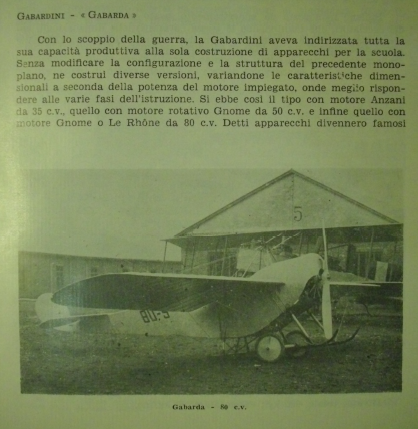
Gabardini Monoplano - 1913 'Gabarda' 1-/2-seat monoplane trainer
- Monoplano 'Checca' ('Gay'): Trainer (ground & flying); span 9.00 m
- 'Checca': Single- or dual-control ('DC' prefix); various engine types*
-- http://www.asso4stormo.it/arc_02/arc_02_01/Costigliolo_cos/cos009.jpg
-- * Codes = hp: 35 hp Anzani, 45 hp Anzani, 80 hp Gnome (DC-80)
-- * 'Checca' 35 HP: 35 hp Anzani 3-cylinder; fuselage codes 35-xx
-- http://flyingmachines.ru/Images7/04-Others/Janes/Gabardini-3.jpg
-- http://www.circolodel53.it/Immagini/Storiche/Una-Checca-della-Scuola-di-.jpg
-- * 'Checca' 45 HP: 45 hp Anzani 3-cylinder; fuselage codes 45-xx
-- http://i275.photobucket.com/albums/jj311/aquilius-files/Rumpelkiste/Cameri1916.jpg
-- *DC-80 'Checca': Doppio Comando, 80 hp Gnome, fuse. codes 80-xx
-- DC-80 'Checca': Civil registrations I-AYLM, I-AYNO, I-AYTO, I-AYVR
- Monoplano ground trainer: Gimballed, unpowered captive simulator
-- http://flyingmachines.ru/Images7/04-Others/Janes/Gabardini-1.jpg
- Monoplano Scuola (School): 2-seat 11.3 m span, 50 hp Gnome
-- http://flyingmachines.ru/Images7/04-Others/Janes/Gabardini-2.jpg
- Monoplano Vuolo (Flight): 1-/2-seat, 10.5 m span, 80 hp Gnome
-- http://www.asso4stormo.it/arc_02/arc_02_01/Costigliolo_cos/Cos008.jpg
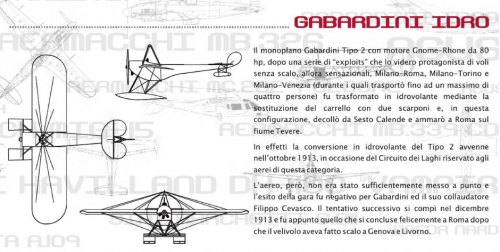
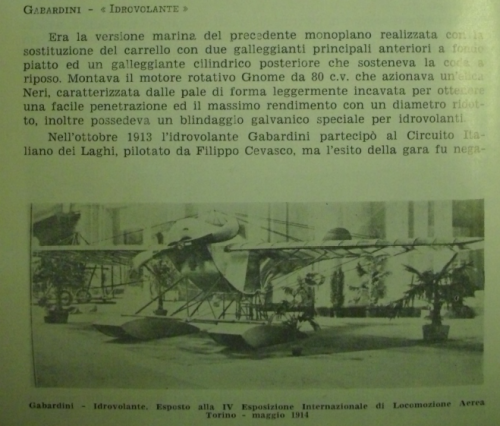
- Idrovolante: 1913 'Gabarda' on twin, wooden float gear, x 2
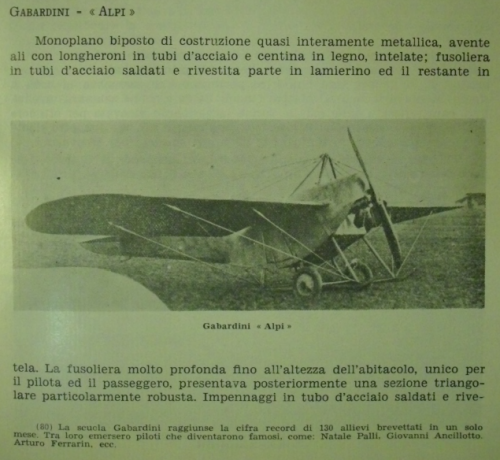
- Tipo Alpi: (Alpine Type) 1922 'Gabarda' 2-seat trainer; 110 hp Le Rhone
-- Alpi: I-AVEH, I-AVEK, I-AVEW, I-AYBE, I-AYBH (converted into G.4?)
-- Alpi: I-AYDB, I-AYGR, I-AYGT, I-AYOF, I-AYRS, I-AYTU, I-AYVR, I-AYZP
-- Alpi dc: I-AAMP, I-AAMQ
-- Alpi-Fiat: I-ABEW
Gabardini G.2 - 1913, possibly same as Monoplano/Idrovolante
-- see Reply #9, below
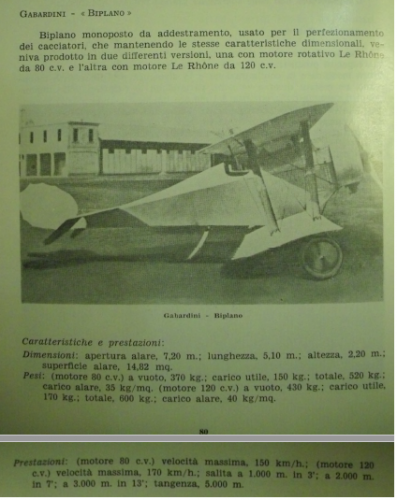
Gabardini G.3 - 1914 'Biplano' 1-/2-seat biplane trainer
- G.3 : 50 hp Gnome 7 Omega 7-cyl. rotary; span 7.20 m
- G.3 : 80 hp Le Rhône 9C 9-cylinder rotary; span 7.20 m
- G.3 : 110 hp Le Rhône 9C 9-cyl. rotary; span 7.20 m
-- Name 'Gabar-de' listed online (confusion with 'Gabarda'?)
Gabardini G.4 - 1924 single-seat biplane trainer; various engines
- Gabardini G.4: Single-seat version; 1 x 80 hp Gnome 9-cyl. rotary
-- http://www.asso4stormo.it/arc_02/arc_02_03/Bersani_ber/ber112.jpg
-- G.4: Civil reg. I-AYDA, I-AYGL, I-AYLV, I-AYRT, I-AYVC, I-AYZA, I-AYZD
- Gabardini G-4 bis: Single-seat version; 1 x 120 hp Le Rhône 9-cyl.
-- G.4 bis: Civil reg. I-AYBL, I-AYBH (Alpi conversion), I-AYEX, I-AYGL,
-- G.4 bis: Civil reg.I-AYLV, I-AYRT, I-AYTR, I-AYVC, I-AYZA
- Gabardini G-4 bis dc: 'Doppio Comando' dual-control 2-seater
-- G.4 bis dc: I-AYOM, I-AYPC, I-AYBP, I-AYFA, I-AYLA, I-AYRO, I-AYSO
-- http://www.asso4stormo.it/arc_02/arc_02_03/Bersani_ber/Ber119.jpg
Gabardini G.5 series - G.50 and G.51 biplane advanced trainer; x 15
- G.5 : (eg I-AWAW)
- G.50: Single-seat biplane; aka G.50 mc (monocomando); span 7.20 m
-- http://1000aircraftphotos.com/Contributions/Soliani/1726.htm
- G.50: Civil reg. I-AVES, I-AYCZ, I-AYDI, I-AYLT, I-AYTA, I-AYTB, I-AYTC
- G.51: Single-seat biplane; 1 x 80 hp Le Rhône 9C 9-cylinder rotary
- G.51: Civil reg. I-AVEM, I-AVEZ, I-AWAD, I-AYCD, I-AYCV
- G.51 bis: Single-seat biplane; 1 x 110 hp Le Rhône 9J 9-cyl. rotary
- G-51 bis: Civil registration I-AAMN (unconfirmed?)
-- http://www.asso4stormo.it/arc_02/arc_02_01/Costigliolo_cos/Cos014.jpg
- G.51 dc: 'Doppio Comando' scuola type; 1 x 50 hp Gnome 7 Omega
- G.51 dc: Civil registration I-AAMX 23.07.32
-- http://flyingmachines.ru/Images7/04-Others/Janes/Gabardini_B-3.jpg
Gabardini G.6: 2-seat biplane advanced trainer; 1 x 120 hp Le Rhône
Gabardini G.7 - 2-seat biplane trainer for 1928 trainer competition*
- Gabardini G.7 dc (or/and G.7 mc): Civil registration I-AYLZ
-- * With Breda Ba.15, Bonomi B-2, CAB C.4, CRDA Cant 26, Fiat AS.1,
-- Macchi M.70, Piaggio P.9, Romeo Ro.5, and winning Caproni Ca.100
Gabardini G.8 - 1923 1-seat biplane trainer/fighter; span 8.34 m
- G.8 : Unarmed trainer; 1 x 140 hp Hispano-Suiza 8A V8 engine
-- NB: Some G.8 obviously dual-control (eg: c/n DC.2, DC.11, etc.)
- G.8 : Fighter; 2 x 7.7mm Vickers mgs; 1 x 200 hp HS 8A V-8
- G.8bis: 1 x 180 hp HS 34, revised rad., long-span lower wing
-- http://www.asso4stormo.it/arc_02/arc_02_03/Bersani_ber/ber114.jpg
- G.8 : Civil registration I-AYBF, I-AYBI, I-AYBK, I-AYCI,* I-AYCS, I-AYCV,
- G.8 : Civil reg. I-AYDI, I-AYGF, I-AYPI, I-AYRL, I-AYSI, I-AYVI, I-AYZI
-- * I-AYCI had c/n I-HS (suggesting Hispano Suiza testbed a/c?)
Gabardini G.9 - 1923 single-seat biplane fighter; span 7.00 m
- G.9: 1 x 200 hp SPA 6a 6-cyl. inline; equal span; low cabanes
-- http://www.circolodel53.it/Immagini/Storiche/Pubblicazione-del-1925.jpg
- G.9bis: 1 x 300 hp HS.42 V8; long cabanes; tall u/c legs
-- G.9bis was a later aerodynamic revision by ing. F. Zappata
Gabardini Lictor - 1935 low-wing monoplane cabin tourer, span 11.43 m
-- Lictor series designed by ing. Mario Bottini (later of SAIMAN)
- Lictor 90 : 1 x 90 hp Fiat A.50S 7-cyl. radial; x 1; MM.345/I-ABDN
-- http://1000aircraftphotos.com/Contributions/Soliani/1750.htm
- Lictor 130: 130 hp Alfa Romeo 110 4-cylinder; x 1 MM.304/I-ABND
-- http://1000aircraftphotos.com/Contributions/Soliani/1752.htm
______________________________
After designing a radical catamaran flying boat in France in 1910, Giuseppe Gabardini returned to Italy in 1912 and set up Aeroplani Gabardini at Taliedo. In Dec 1913, Gabardini took over the Cameri facilities of AVIS (Ateliers Voisin Italie Septentrionale) and opened a flying school (Aeroplani Gabardini-Officine e scuola di volo-Aerodromo Cameri). To provide that school with training machines, Gabardini began the Società Anonima Gabardini per l'Incremento dell' Aviazione (or simply the 'Società Incremento Aviazione') in 1916.
Early Gabardini designs don't seem to have proper designations, receiving generic descriptive names like Monoplano, Idrovolante, Alpi, etc. The 1914 Gabardini Biplano was later designated as the G.3 (likely applied retroactively). According to Federico Filippi (WWI Aero, #153, Aug 1996), Gabardini first applied designation numbers in 1917. So, it seems plausible that Gabardini began his numbering system with his 1910 flying boat and the Monoplano variants (as 'G.1' and 'G.2') even if such designations were never actually used publicly.
The known 'G' series runs from G.3 to G.9 but then seems to be abandoned for the Gabardini Lictor cabin monoplane. The aircraft has numbers assigned to indicate horsepower (a common practice with earlier Gabardini designs) but no 'G' number ever seems to have been applied. (As an aircraft name, Lictor was an odd choice, being a Roman magistrate's guard in classical times.)
Gabardini designations are listed below. I've included links to images for some types.
After Giuseppe Gabardini died in 1936, the Cameri works were absorbed by Fiat and became CANSA (Costruzioni Aeronautiche Novaresi Società Anonima or the Aeronautical Construction Company of Novaresi). CANSA designations are listed after the Gabardi types.
________________________________
Gabardini/CANSA Aircraft Designations
Società Anonima Gabardini Designation Anomolies
The first two 'designations' are common references for aircraft types rebuilt or modified by Gabardini. A puzzle is Golden Years' 'Gabardini Standard' (c/n 36, I-AYGB).
Gabardini HD - Hanriot HD.1 used at the Scuola Aviazione di Cameri
- HD: As with A.300s, probably mod. aircraft; not built by Gabardini
- HD: Civil reg. I-AVEG, I-AVEI, I-AVEU, I-AVEV, I-AWAC, I-AWAE, I-AYHA, I-AYZD
- HD 4D: Civil registration I-AYGS
-- http://1000aircraftphotos.com/Contributions/Soliani/1696.htm
Gabardini A.300/6 - 3-seat recce biplane, mod. Ansaldo A.300/4*
-- * Gabardini modified 50 x existing 3-seat A.300/4 airframes
Società Anonima Gabardini Aircraft Designations
Gabardini Hydravion - 1910 monoplane flying boat
- Hydravion: 1 x 50 hp Anzani 3-cyl.; span (??) M; aka 'Monaco-monoplano'
- Hydravion: Catamaran hull; variable-incidence wing; tractor propeller
-- View: http://www.flickr.com/photos/amphalon/8389186785/in/set-72157603137921947
Gabardini Monoplano - 1913 'Gabarda' 1-/2-seat monoplane trainer
- Monoplano 'Checca' ('Gay'): Trainer (ground & flying); span 9.00 m
- 'Checca': Single- or dual-control ('DC' prefix); various engine types*
-- http://www.asso4stormo.it/arc_02/arc_02_01/Costigliolo_cos/cos009.jpg
-- * Codes = hp: 35 hp Anzani, 45 hp Anzani, 80 hp Gnome (DC-80)
-- * 'Checca' 35 HP: 35 hp Anzani 3-cylinder; fuselage codes 35-xx
-- http://flyingmachines.ru/Images7/04-Others/Janes/Gabardini-3.jpg
-- http://www.circolodel53.it/Immagini/Storiche/Una-Checca-della-Scuola-di-.jpg
-- * 'Checca' 45 HP: 45 hp Anzani 3-cylinder; fuselage codes 45-xx
-- http://i275.photobucket.com/albums/jj311/aquilius-files/Rumpelkiste/Cameri1916.jpg
-- *DC-80 'Checca': Doppio Comando, 80 hp Gnome, fuse. codes 80-xx
-- DC-80 'Checca': Civil registrations I-AYLM, I-AYNO, I-AYTO, I-AYVR
- Monoplano ground trainer: Gimballed, unpowered captive simulator
-- http://flyingmachines.ru/Images7/04-Others/Janes/Gabardini-1.jpg
- Monoplano Scuola (School): 2-seat 11.3 m span, 50 hp Gnome
-- http://flyingmachines.ru/Images7/04-Others/Janes/Gabardini-2.jpg
- Monoplano Vuolo (Flight): 1-/2-seat, 10.5 m span, 80 hp Gnome
-- http://www.asso4stormo.it/arc_02/arc_02_01/Costigliolo_cos/Cos008.jpg
- Idrovolante: 1913 'Gabarda' on twin, wooden float gear, x 2
- Tipo Alpi: (Alpine Type) 1922 'Gabarda' 2-seat trainer; 110 hp Le Rhone
-- Alpi: I-AVEH, I-AVEK, I-AVEW, I-AYBE, I-AYBH (converted into G.4?)
-- Alpi: I-AYDB, I-AYGR, I-AYGT, I-AYOF, I-AYRS, I-AYTU, I-AYVR, I-AYZP
-- Alpi dc: I-AAMP, I-AAMQ
-- Alpi-Fiat: I-ABEW
Gabardini G.2 - 1913, possibly same as Monoplano/Idrovolante
-- see Reply #9, below
Gabardini G.3 - 1914 'Biplano' 1-/2-seat biplane trainer
- G.3 : 50 hp Gnome 7 Omega 7-cyl. rotary; span 7.20 m
- G.3 : 80 hp Le Rhône 9C 9-cylinder rotary; span 7.20 m
- G.3 : 110 hp Le Rhône 9C 9-cyl. rotary; span 7.20 m
-- Name 'Gabar-de' listed online (confusion with 'Gabarda'?)
Gabardini G.4 - 1924 single-seat biplane trainer; various engines
- Gabardini G.4: Single-seat version; 1 x 80 hp Gnome 9-cyl. rotary
-- http://www.asso4stormo.it/arc_02/arc_02_03/Bersani_ber/ber112.jpg
-- G.4: Civil reg. I-AYDA, I-AYGL, I-AYLV, I-AYRT, I-AYVC, I-AYZA, I-AYZD
- Gabardini G-4 bis: Single-seat version; 1 x 120 hp Le Rhône 9-cyl.
-- G.4 bis: Civil reg. I-AYBL, I-AYBH (Alpi conversion), I-AYEX, I-AYGL,
-- G.4 bis: Civil reg.I-AYLV, I-AYRT, I-AYTR, I-AYVC, I-AYZA
- Gabardini G-4 bis dc: 'Doppio Comando' dual-control 2-seater
-- G.4 bis dc: I-AYOM, I-AYPC, I-AYBP, I-AYFA, I-AYLA, I-AYRO, I-AYSO
-- http://www.asso4stormo.it/arc_02/arc_02_03/Bersani_ber/Ber119.jpg
Gabardini G.5 series - G.50 and G.51 biplane advanced trainer; x 15
- G.5 : (eg I-AWAW)
- G.50: Single-seat biplane; aka G.50 mc (monocomando); span 7.20 m
-- http://1000aircraftphotos.com/Contributions/Soliani/1726.htm
- G.50: Civil reg. I-AVES, I-AYCZ, I-AYDI, I-AYLT, I-AYTA, I-AYTB, I-AYTC
- G.51: Single-seat biplane; 1 x 80 hp Le Rhône 9C 9-cylinder rotary
- G.51: Civil reg. I-AVEM, I-AVEZ, I-AWAD, I-AYCD, I-AYCV
- G.51 bis: Single-seat biplane; 1 x 110 hp Le Rhône 9J 9-cyl. rotary
- G-51 bis: Civil registration I-AAMN (unconfirmed?)
-- http://www.asso4stormo.it/arc_02/arc_02_01/Costigliolo_cos/Cos014.jpg
- G.51 dc: 'Doppio Comando' scuola type; 1 x 50 hp Gnome 7 Omega
- G.51 dc: Civil registration I-AAMX 23.07.32
-- http://flyingmachines.ru/Images7/04-Others/Janes/Gabardini_B-3.jpg
Gabardini G.6: 2-seat biplane advanced trainer; 1 x 120 hp Le Rhône
Gabardini G.7 - 2-seat biplane trainer for 1928 trainer competition*
- Gabardini G.7 dc (or/and G.7 mc): Civil registration I-AYLZ
-- * With Breda Ba.15, Bonomi B-2, CAB C.4, CRDA Cant 26, Fiat AS.1,
-- Macchi M.70, Piaggio P.9, Romeo Ro.5, and winning Caproni Ca.100
Gabardini G.8 - 1923 1-seat biplane trainer/fighter; span 8.34 m
- G.8 : Unarmed trainer; 1 x 140 hp Hispano-Suiza 8A V8 engine
-- NB: Some G.8 obviously dual-control (eg: c/n DC.2, DC.11, etc.)
- G.8 : Fighter; 2 x 7.7mm Vickers mgs; 1 x 200 hp HS 8A V-8
- G.8bis: 1 x 180 hp HS 34, revised rad., long-span lower wing
-- http://www.asso4stormo.it/arc_02/arc_02_03/Bersani_ber/ber114.jpg
- G.8 : Civil registration I-AYBF, I-AYBI, I-AYBK, I-AYCI,* I-AYCS, I-AYCV,
- G.8 : Civil reg. I-AYDI, I-AYGF, I-AYPI, I-AYRL, I-AYSI, I-AYVI, I-AYZI
-- * I-AYCI had c/n I-HS (suggesting Hispano Suiza testbed a/c?)
Gabardini G.9 - 1923 single-seat biplane fighter; span 7.00 m
- G.9: 1 x 200 hp SPA 6a 6-cyl. inline; equal span; low cabanes
-- http://www.circolodel53.it/Immagini/Storiche/Pubblicazione-del-1925.jpg
- G.9bis: 1 x 300 hp HS.42 V8; long cabanes; tall u/c legs
-- G.9bis was a later aerodynamic revision by ing. F. Zappata
Gabardini Lictor - 1935 low-wing monoplane cabin tourer, span 11.43 m
-- Lictor series designed by ing. Mario Bottini (later of SAIMAN)
- Lictor 90 : 1 x 90 hp Fiat A.50S 7-cyl. radial; x 1; MM.345/I-ABDN
-- http://1000aircraftphotos.com/Contributions/Soliani/1750.htm
- Lictor 130: 130 hp Alfa Romeo 110 4-cylinder; x 1 MM.304/I-ABND
-- http://1000aircraftphotos.com/Contributions/Soliani/1752.htm
______________________________
Last edited: