Charioteer71

HAVE FUN
Joined
31 October 2017
Messages
65
Reaction score
164
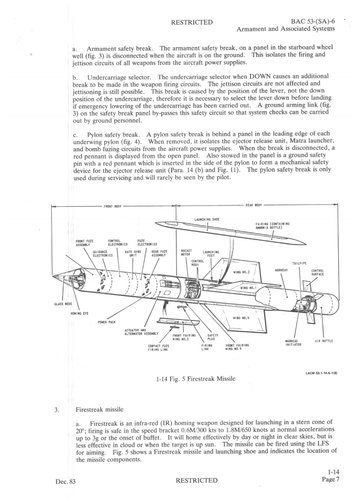
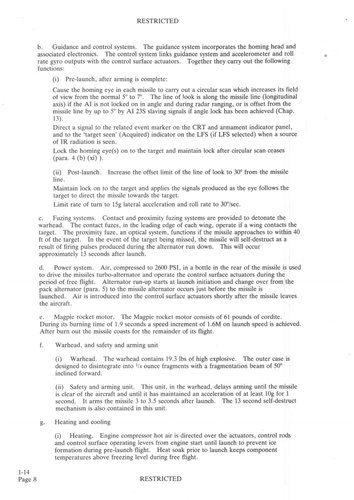
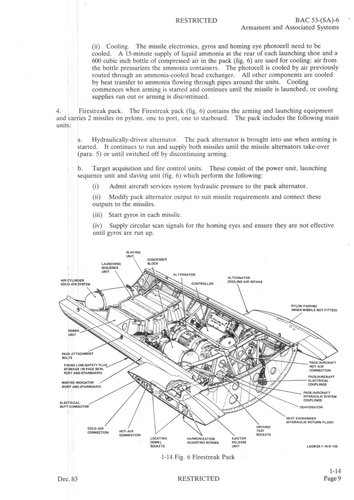
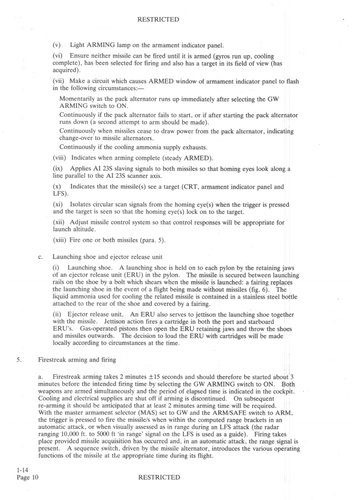
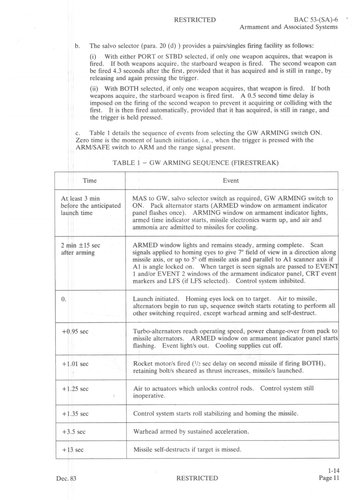
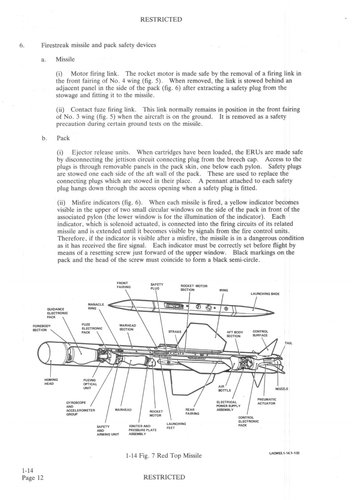
All from Lightning F.53 Pilots Notes.

Maximum overload: 15G lateral acceleration and rate of roll 30°/sec

Motor Burn time: 1.9 sec

Max flight time: 13 sec

Seeker FOV: 7°

Seeker gimbal limit pre-launch: 0° unslaved; 5° slaved by AI23S (export version of AI23B), seeker "looking axis" parallel to A1 scanner axis

Seeker gimbal limit (post-launch): 30°

Warhead explosive mass: 19.3lbs/8.75kg

Not only High Explosive, there're also 0.25 ounce fragments with a fragmentaion beam of 50° inclined forward.

Proximity fuse range: 40ft/12m
 

Attachments

  • 012001205090_0Firestreak_1.Jpeg
    012001205090_0Firestreak_1.Jpeg
    2 MB · Views: 301
  • 012001205090_0Firestreak_2.Jpeg
    012001205090_0Firestreak_2.Jpeg
    2.2 MB · Views: 240
  • 012001205090_0Firestreak_3.Jpeg
    012001205090_0Firestreak_3.Jpeg
    2.2 MB · Views: 201
  • 012001205090_0Firestreak_4.Jpeg
    012001205090_0Firestreak_4.Jpeg
    2.2 MB · Views: 187
  • 012001205090_0Firestreak_5.Jpeg
    012001205090_0Firestreak_5.Jpeg
    2.1 MB · Views: 176
  • 012001205090_0Firestreak_6.Jpeg
    012001205090_0Firestreak_6.Jpeg
    1.9 MB · Views: 220
Last edited:
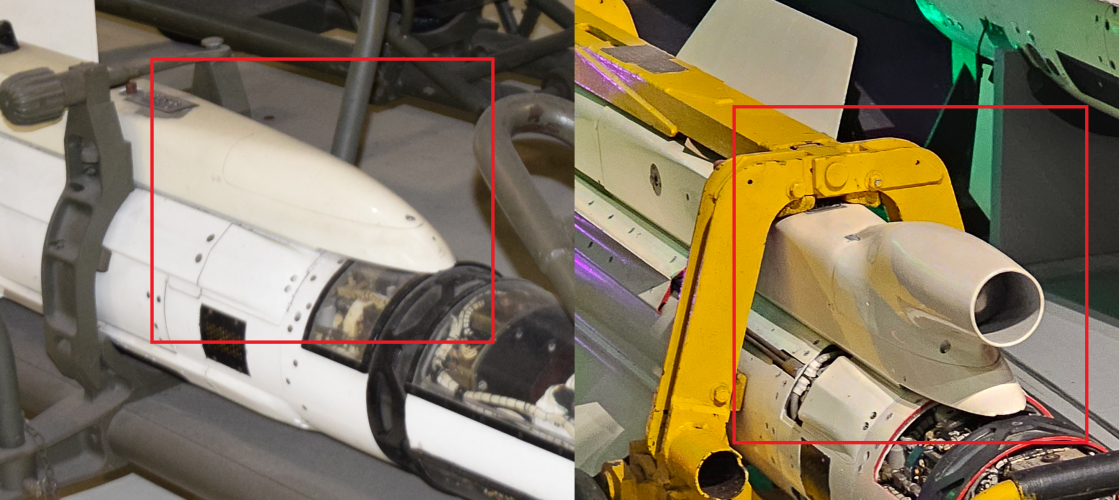
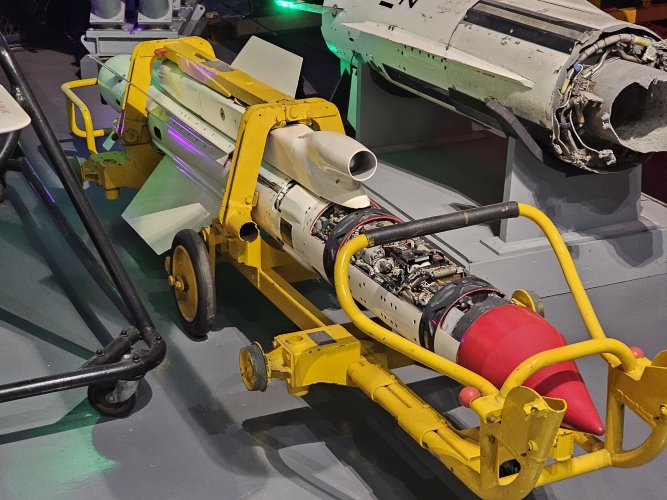
This Firestreak is on display at the Explosion Museum at Priddy's Hard in Gosport. Anyone know what the intake on the launch shoe is for and for whi aircraft this was intended. 20250408_151537.jpg I can't find any photos of this on an aircraft.

Ta

Chris
 
This Firestreak is on display at the Explosion Museum at Priddy's Hard in Gosport. Anyone know what the intake on the launch shoe is for and for whi aircraft this was intended.
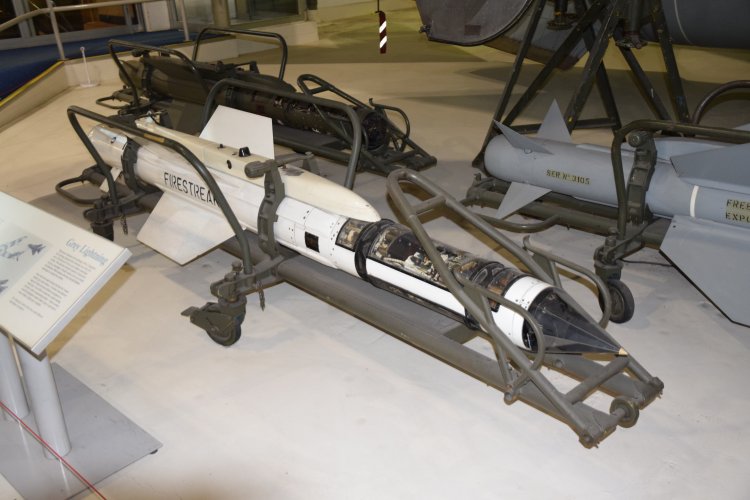
Compressed air connector for ground testing, maybe? The usual Firestreak launcher have a simple plug in this place:

De_Havilland_Firestreak_(40081274790).jpg

If I recall correctly, the Firestreak seeker was cooled in flight by air, running through the ammonia coolant system. For ground testing the air must be pumped by external means, then. So presumably, on your photo launcher is fitted for compressor connection.
 
Hmm that's different, iv looked at various Blue Jay/Firestreak launch shoes but so far none seem to have the fairing as fitted to the display example.
Any thoughts if it is a ram air intake or a mounting for a camera / sensor ?
Hmm, Venom/Sea Venom, Sabre, SR.53, Canberra, Hunter, Javelin, Sea Vixen, Lightning, so far nope
 
I had no idea when Chris showed this to me but I've since had a rummage.

This could be a launch shoe for the Sea Vixen FAW.2. It could carry a mixed load out with the starboard pylons being modified for Firestreak with their separate cooling and heating system from the pure air system carried for the Red Tops (which in this case just fed the port-side pylons).
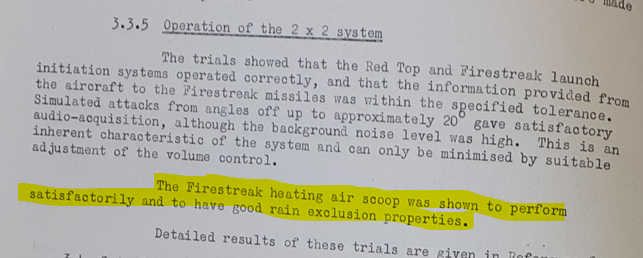
I think this might be a heater air intake - I've found this snippet in an A&AEE report:
1744362390542.png
 
IIRC a few Sea Venom FAW.22's also got fitted for it.

I can't remember which book I read that in, but Wikipedia seems to corroborate my dim memory.

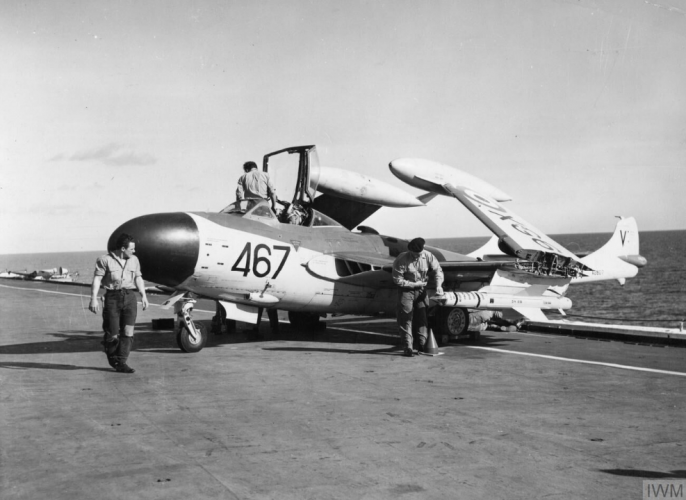
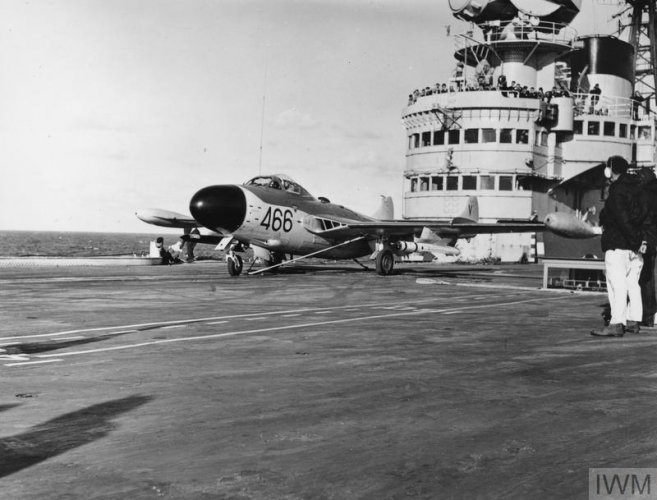
FAW.21s XG607, XG612, and XG662. They were modified at Christchurch, and the modification involved removing the cannon, rocket gear and associated wiring. The book De Havilland Venom and Sea Venom: the Complete History by David Watkins has more detail. Attached are two photos from the IWM, each showing a different airframe, of Sea Venoms with Firestreak onboard Victorious for trials.
 

Attachments

  • Sea Venom Firestreak.png
    Sea Venom Firestreak.png
    563 KB · Views: 94
  • Venom-Victorious-Firestreak.jpg
    Venom-Victorious-Firestreak.jpg
    70.4 KB · Views: 79
Last edited:
FAW.21s XG607, XG612, and XG662. They were modified at Christchurch, and the mod involved removing the cannon, rocket gear and associated wiring. The book De Havilland Venom and Sea Venom: the Complete History by David Watkins has more detail. Attached is a photo from the IWM of one of the aircraft, complete with Firestreak, onboard Victorious for trials.
Thank you JFC Fuller

Would be interesting to know what was ascertained from the trials.

Regards
Pioneer
 
FAW.21s XG607, XG612, and XG662. They were modified at Christchurch, and the modification involved removing the cannon, rocket gear and associated wiring. The book De Havilland Venom and Sea Venom: the Complete History by David Watkins has more detail. Attached are two photos from the IWM, each showing a different airframe, of Sea Venoms with Firestreak onboard Victorious for trials.
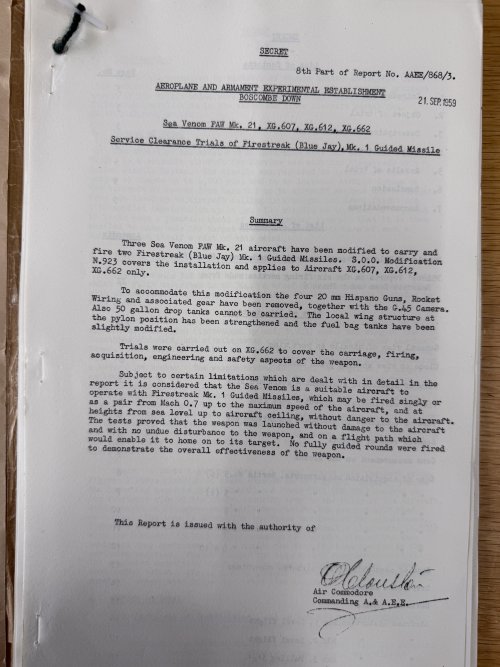
The AAEE Boscombe Down report of trials to clear the Sea Venom to carry and fire Firestreak is in The National Archives file AVIA 18-4068. The trials had been requested by the Ministry of Supply in a letter dated 11 October 1957. A copy of the AAEE report's summary page is attached, which concluded that "the Sea Venom is a suitable aircraft to operate with the Firestreak Mk. 1 Guided Missiles". These land based trials were carried out in two parts, "Target Acquisition Trials" and "Dispersion Firing Trials". The report gives the dates of the dispersion firing trials, which were completed on 17 February 1958.
The subsequent deployment of 3 modified FAW.21s with 893 squadron on HMS Victorious in December 1958 enabled the Fleet Air Arm to test the whole process of operating a fighter aircraft embarked on a carrier with air-to-air guided weapons. The Sea Venom's Observer, Patrick Mountain, for the first Firestreak firing by the squadron gives a very interesting personal anecdote about it in the book "Fleet Air Arm Boys, Volume 1: Air Defence Fighter Aircraft Since 1945". The firing took place in the Mediterranean, and he notes that their target was a Firefly launched from Hal Far in Malta. Patrick comments: "Satisfyingly the Firestreak homed in on the heat source, exploding with a depressingly small puff of smoke. This caused the Firefly to to turn steeply to starboard and head for the sea. Duty carried out." With respect to "the puff of smoke", it is likely that the operational warhead had been replaced with a less-lethal trials version to try to limit the number of targets destroyed.
 

Attachments

  • IMG_2413.JPG
    IMG_2413.JPG
    3 MB · Views: 36
The Firestreak is a fascinating early air-to-air missile because it represents the transition from gun-based combat to guided missile warfare. Its infrared seeker and large warhead were impressive for the late 1950s, but compared with later missiles it had significant limitations in seeker sensitivity, target acquisition, and engagement envelope. It was generally most effective against non-maneuvering or rear-aspect targets and required fairly favorable launch conditions. Any discussion of its performance also has to consider the aircraft carrying it, since radar guidance cues and launch parameters had a major impact on real-world effectiveness.
 
Sophisticated, complicated and expensive. But it was one of the first AAM and there was a lot to learn how to make things easy and affordable.
 
The Firestreak was designed from the outset to be cued by the aircraft's radar, which enabled it's day and night capability, whereas the AIM-9B was essentially a day-fighter weapon using the fighter's gunsight to visually point the aircraft and weapon in the target direction in order to achieve target acquisition. My understanding is that the USN did not introduce radar cueing of the Sidewinder until the AIM-9G version; please correct me if I'm wrong.
Another significant difference was that the IR detector cell in Firestreak was upgraded from its initial design standard of an uncooled Lead Sulphide (PbS) detector to a cooled PbS detector (at around 77 degrees Kelvin), giving much better discrimination against sunlit clouds as well as improved sensitivity. I don't know the date when this modification was implemented, and it would be greatly appreciated if anyone could shed light on the timescale. The AIM-9B had an uncooled PbS detector which made it susceptible to interference from sunlit clouds and other spurious reflections. The AIM-9D introduced the major upgrade for Sidewinder of a cooled PbS detector, giving improved target discrimination and sensitivity. The AIM-9D and -9G introduced other changes which improved their performance significantly, but as noted here, some of their enhancements were already available on Firestreak. The fact that Firestreak remained in Service on the Lightning until 1988 indicates that it continued to be a useful missile for a very long time, particularly in scenarios where tail engagements were necessary, such as when visual identification of the target was essential before taking a shot.
The much improved Red Top and the highly effective AIM-9L introduced a much wider engagement aspect capability. Note that Red Top introduced a cooled Indium Antimonide (InSb) IR detector many years before the AIM-9L. The initial plan was for Red Top to have a cooled Lead Telluride (PbTe) IR detector, but problems with manufacturing the PbTe cells and rapid progress with InSb at the Royal Radar Establishment (RRE) led to the early adoption of InSb in Red Top's development programme. The MOD never corrected a "security leak" that Red Top would have a PbTe IR detector, and the myth has been promulgated for many years in secondary sources.
 
My understanding is that the USN did not introduce radar cueing of the Sidewinder until the AIM-9G version; please correct me if I'm wrong.

You are correct, this was the SEAM (Sidewinder Expanded Acquisition Mode) upgrade, basically an extra avionics box that connected the F-4's fire-control system to a modified AIM-9D seeker allowing external cueing of the Sidewinder's seeker.
 
Have just spotted how to change my AVATAR picture from "J". The photo of a 23 Squadron Lightning F6 intercepting a Bear was taken during my first tour in the RAF, as the Junior Engineer Officer (JEngO) on 23 Squadron.
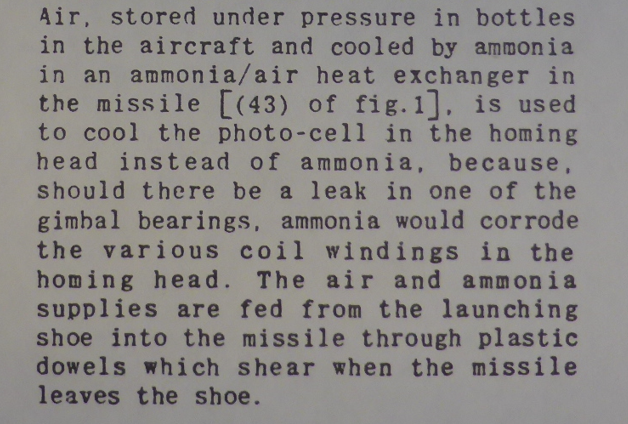
Further to my earlier query about when the Firestreak seeker was modified from uncooled to cooled lead sulphide (PbS), it would have been after Blue Jay Mk 2 and Mk 3 were cancelled in 1957. De Havilland Propellers had by then designed the method of feeding the cooling air through the seeker gimbals as part of the design for the cooled PbTe seekers planned for Blue Jay Mk 2 and Mk3. However they were cancelled owing to funding constraints in order to focus future development funding on Blue Jay Mk 4, which became Red Top. The key meeting that decided to cancel the Mk 2 and Mk3 was held on 28 May 1957, and the minutes are included in the UK National Archives file AVIA 13-1252. The cooled seeker modification had been incorporated in Firestreak by April 1960; the RAF publication on the Firestreak Weapon System, CD 1144, AL 3, dated April 1960, includes the text below. Does anyone have any information on the decision process and precise timescale when the Firestreak modification was approved and incorporated in the missile some time between May 1957 and April 1960?

1785598715832.png ​
 

Similar threads

Back
Top Bottom